Oracle: Data Warehouse Design
Characteristics of a Data Warehouse

  A data warehouse is a database designed for
   querying, reporting, and analysis.
  A data warehouse contains historical data
   derived from transaction data.
  Data warehouses separate analysis workload
   from transaction workload.
  A data warehouse is primarily
   an analytical tool.
Comparing OLTP and Data Warehouses
          OLTP                        Data Warehouse


   Many              Joins            Some


   Comparatively   Data accessed by   Large
   lower           queries            amount


   Normalized       Duplicated data   Denormalized
   DBMS                               DBMS

                   Derived data
   Rare            and                Common
                   aggregates
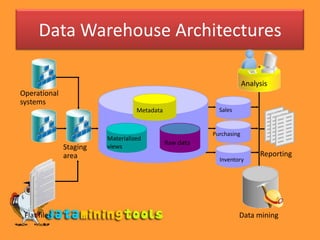
Data Warehouse Architectures

                                                                     Analysis
Operational
systems
                                  Metadata                Sales


                                                        Purchasing
                        Materialized
                                             Raw data
              Staging   views
              area                                                        Reporting
                                                          Inventory


 Flat files                                                       Data mining
Data Warehouse Design
• Key data warehouse design considerations:
  – Identify the specific data content.
  – Recognize the critical relationships within and
    between groups of data.
  – Define the system environment
    supporting your data warehouse.
  – Identify the required data
    transformations.
  – Calculate the frequency at which
    the data must be refreshed.
Logical Design
– A logical design is conceptual and
  abstract.
– Entity-relationship (ER) modeling
  is useful in identifying logical
  information requirements.
   • An entity represents a chunk of data.
   • The properties of entities are known as attributes.
   • The links between entities and attributes are known
     as relationships.
– Dimensional modeling is a specialized
  type of ER modeling useful in data warehouse
  design.
Oracle Warehouse Builder
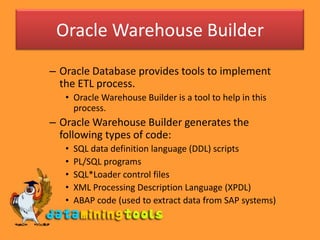
– Oracle Database provides tools to implement
  the ETL process.
   • Oracle Warehouse Builder is a tool to help in this
     process.
– Oracle Warehouse Builder generates the
  following types of code:
   •   SQL data definition language (DDL) scripts
   •   PL/SQL programs
   •   SQL*Loader control files
   •   XML Processing Description Language (XPDL)
   •   ABAP code (used to extract data from SAP systems)
Data Warehousing Schemas
– Objects can be arranged in data warehousing
  schema models in a variety of ways:
   •   Star schema
   •   Snowflake schema
   •   Third normal form (3NF) schema
   •   Hybrid schemas
– The source data model and user
  requirements should steer the data
  warehouse schema.
– Implementation of the logical model may
  require changes to enable you to adapt it to
  your physical system.
Schema Characteristics
– Star schema
   • Characterized by one or more large fact tables and a
     number of much smaller dimension tables
   • Each dimension table joined to the fact table using a
     primary key to foreign key join
– Snowflake schema
   • Dimension data grouped into multiple tables instead
     of one large table
   • Increased number of dimension tables, requiring
     more foreign key joins
– Third normal form (3NF) schema
   • A classical relational-database model that minimizes
     data redundancy through normalization
Data Warehousing Objects
– Fact tables
   • Fact tables are the large tables that store business
     measurements.
– Dimension tables
   • A dimension is a structure composed of one or more
     hierarchies that categorizes data.
   • Unique identifiers are specified for one distinct
     record in a dimension table.
– Relationships
   • Relationships guarantee
     integrity of business
     information.
Fact Tables
– A fact table must be defined for each star schema.
– Fact tables are the large tables that store business
  measurements.
– A fact table contains either detail-level or
  aggregated facts.
– A fact table usually contains facts with the same
  level of aggregation.
– The primary key of the fact table is
  usually a composite key made up
  of all its foreign keys.
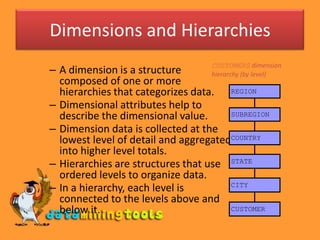
Dimensions and Hierarchies
                                   CUSTOMERS dimension
– A dimension is a structure       hierarchy (by level)
  composed of one or more
  hierarchies that categorizes data. REGION
– Dimensional attributes help to
  describe the dimensional value.         SUBREGION

– Dimension data is collected at the
  lowest level of detail and aggregatedCOUNTRY
  into higher level totals.
– Hierarchies are structures that use STATE
  ordered levels to organize data.
– In a hierarchy, each level is           CITY

  connected to the levels above and
  below it.                               CUSTOMER
Dimensions and Hierarchies

 PRODUCTS                             CUSTOMERS
 #prod_id         Unique identifier   #cust_id
                    Fact table        cust_last_name
                                       cust_city
                                       cust_state_province
   Relationship    SALES
                   cust_id
                   prod_id                     Hierarchy


 TIMES                                  CHANNELS
                  PROMOTIONS

Dimension table                        Dimension table
                  Dimension table
Physical Design
  Logical             Physical (Tablespaces)


Entities           Tables                      Indexes


                                               Materialized
Relationships          Integrity
                                               views
                       constraints
                     - Primary key
                     - Foreign key
Attributes           - Not null                Dimensions


Unique
identifiers        Columns
Data Warehouse Physical Structures

• Tables and partitioned tables
  – Partitioned tables enable you to split
    large data volumes into smaller,
    more manageable pieces.
  – Expect performance benefits from:
     • Partition pruning
     • Intelligent parallel processing
  – Compressed tables offer scaleup opportunities
    for read-only operations.
  – Table compression saves disk space.
Data Warehouse Physical Structures

  – Views:
     • Are tailored presentations of data contained in one
       or more tables or views
     • Do not require any space in the database
  – Materialized views:
     • Are query results that have been stored in advance
     • (Like indexes) are used transparently and improve
       performance
  – Integrity constraints:
     • Are used in data warehouses for query rewrite
  – Dimensions:
     • Are containers of logical relationships and do not
       require any space in the database
Managing Large Volumes of Data
• Work smarter in your data warehouse:
  –   Partitioning
  –   Bitmap indexes/Star transformation
  –   Data compression
  –   Query rewrite
• Work harder in your data warehouse:
  – Parallelism for all operations
       • DBA tasks, such as loading, index creation, table
         creation, data modification, backup and recovery
       • End-user operations, such as queries
       • Unbounded scalability: Real Application Clusters
I/O Performance in Data Warehouses

  – I/O is typically the primary determinant of data
    warehouse performance.
  – Data warehouse storage configurations should be
    chosen by I/O bandwidth, not storage capacity.
  – Every component of the I/O
    subsystem should provide
    enough bandwidth:
     • Disks
     • I/O channels
     • I/O adapters
  – In data warehouses, maximizing
    sequential I/O throughput is critical.
I/O Scalability
Parallel execution:
     – Reduces response time for data-intensive operations on large
       databases
     – Benefits systems with the following characteristics:
          • Multiprocessors, clusters, or massively parallel systems
          • Sufficient I/O bandwidth
          • Sufficient memory to support memory-intensive processes such
            as sorts, hashing, and I/O buffers

                                Query servers
                                                               Coordinator
 Data on disk          Scan                     Sort Q1

                       Scan                     Sort Q2
                                                               Dispatch
                                                               work
                       Scan                     Sort Q3

                       Scan                     Sort Q4
                     Scanners          Sorters (Aggregators)
I/O Scalability

• Automatic Storage Management (ASM)
  – Configuring storage for a DB depends on many
    variables:
     •   Which data to put on which disk
     •   Logical unit number (LUN) configurations
     •   DB types and workloads; data warehouse, OLTP, DSS
     •   Trade-offs between available options
  – ASM provides solutions to storage issues
    encountered in data warehouses.
I/O Scalability

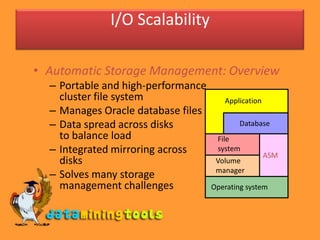
• Automatic Storage Management: Overview
  – Portable and high-performance
    cluster file system                Application
  – Manages Oracle database files
  – Data spread across disks                Database
    to balance load                  File
  – Integrated mirroring across      system
                                                     ASM
    disks                            Volume
                                     manager
  – Solves many storage
    management challenges           Operating system
Visit more self help tutorials

• Pick a tutorial of your choice and browse
  through it at your own pace.
• The tutorials section is free, self-guiding and
  will not involve any additional support.
• Visit us at www.dataminingtools.net

Oracle: DW Design

  • 1.
  • 2.
    Characteristics of aData Warehouse A data warehouse is a database designed for querying, reporting, and analysis. A data warehouse contains historical data derived from transaction data. Data warehouses separate analysis workload from transaction workload. A data warehouse is primarily an analytical tool.
  • 3.
    Comparing OLTP andData Warehouses OLTP Data Warehouse Many Joins Some Comparatively Data accessed by Large lower queries amount Normalized Duplicated data Denormalized DBMS DBMS Derived data Rare and Common aggregates
  • 4.
    Data Warehouse Architectures Analysis Operational systems Metadata Sales Purchasing Materialized Raw data Staging views area Reporting Inventory Flat files Data mining
  • 5.
    Data Warehouse Design •Key data warehouse design considerations: – Identify the specific data content. – Recognize the critical relationships within and between groups of data. – Define the system environment supporting your data warehouse. – Identify the required data transformations. – Calculate the frequency at which the data must be refreshed.
  • 6.
    Logical Design – Alogical design is conceptual and abstract. – Entity-relationship (ER) modeling is useful in identifying logical information requirements. • An entity represents a chunk of data. • The properties of entities are known as attributes. • The links between entities and attributes are known as relationships. – Dimensional modeling is a specialized type of ER modeling useful in data warehouse design.
  • 7.
    Oracle Warehouse Builder –Oracle Database provides tools to implement the ETL process. • Oracle Warehouse Builder is a tool to help in this process. – Oracle Warehouse Builder generates the following types of code: • SQL data definition language (DDL) scripts • PL/SQL programs • SQL*Loader control files • XML Processing Description Language (XPDL) • ABAP code (used to extract data from SAP systems)
  • 8.
    Data Warehousing Schemas –Objects can be arranged in data warehousing schema models in a variety of ways: • Star schema • Snowflake schema • Third normal form (3NF) schema • Hybrid schemas – The source data model and user requirements should steer the data warehouse schema. – Implementation of the logical model may require changes to enable you to adapt it to your physical system.
  • 9.
    Schema Characteristics – Starschema • Characterized by one or more large fact tables and a number of much smaller dimension tables • Each dimension table joined to the fact table using a primary key to foreign key join – Snowflake schema • Dimension data grouped into multiple tables instead of one large table • Increased number of dimension tables, requiring more foreign key joins – Third normal form (3NF) schema • A classical relational-database model that minimizes data redundancy through normalization
  • 10.
    Data Warehousing Objects –Fact tables • Fact tables are the large tables that store business measurements. – Dimension tables • A dimension is a structure composed of one or more hierarchies that categorizes data. • Unique identifiers are specified for one distinct record in a dimension table. – Relationships • Relationships guarantee integrity of business information.
  • 11.
    Fact Tables – Afact table must be defined for each star schema. – Fact tables are the large tables that store business measurements. – A fact table contains either detail-level or aggregated facts. – A fact table usually contains facts with the same level of aggregation. – The primary key of the fact table is usually a composite key made up of all its foreign keys.
  • 12.
    Dimensions and Hierarchies CUSTOMERS dimension – A dimension is a structure hierarchy (by level) composed of one or more hierarchies that categorizes data. REGION – Dimensional attributes help to describe the dimensional value. SUBREGION – Dimension data is collected at the lowest level of detail and aggregatedCOUNTRY into higher level totals. – Hierarchies are structures that use STATE ordered levels to organize data. – In a hierarchy, each level is CITY connected to the levels above and below it. CUSTOMER
  • 13.
    Dimensions and Hierarchies PRODUCTS CUSTOMERS #prod_id Unique identifier #cust_id Fact table cust_last_name cust_city cust_state_province Relationship SALES cust_id prod_id Hierarchy TIMES CHANNELS PROMOTIONS Dimension table Dimension table Dimension table
  • 14.
    Physical Design Logical Physical (Tablespaces) Entities Tables Indexes Materialized Relationships Integrity views constraints - Primary key - Foreign key Attributes - Not null Dimensions Unique identifiers Columns
  • 15.
    Data Warehouse PhysicalStructures • Tables and partitioned tables – Partitioned tables enable you to split large data volumes into smaller, more manageable pieces. – Expect performance benefits from: • Partition pruning • Intelligent parallel processing – Compressed tables offer scaleup opportunities for read-only operations. – Table compression saves disk space.
  • 16.
    Data Warehouse PhysicalStructures – Views: • Are tailored presentations of data contained in one or more tables or views • Do not require any space in the database – Materialized views: • Are query results that have been stored in advance • (Like indexes) are used transparently and improve performance – Integrity constraints: • Are used in data warehouses for query rewrite – Dimensions: • Are containers of logical relationships and do not require any space in the database
  • 17.
    Managing Large Volumesof Data • Work smarter in your data warehouse: – Partitioning – Bitmap indexes/Star transformation – Data compression – Query rewrite • Work harder in your data warehouse: – Parallelism for all operations • DBA tasks, such as loading, index creation, table creation, data modification, backup and recovery • End-user operations, such as queries • Unbounded scalability: Real Application Clusters
  • 18.
    I/O Performance inData Warehouses – I/O is typically the primary determinant of data warehouse performance. – Data warehouse storage configurations should be chosen by I/O bandwidth, not storage capacity. – Every component of the I/O subsystem should provide enough bandwidth: • Disks • I/O channels • I/O adapters – In data warehouses, maximizing sequential I/O throughput is critical.
  • 19.
    I/O Scalability Parallel execution: – Reduces response time for data-intensive operations on large databases – Benefits systems with the following characteristics: • Multiprocessors, clusters, or massively parallel systems • Sufficient I/O bandwidth • Sufficient memory to support memory-intensive processes such as sorts, hashing, and I/O buffers Query servers Coordinator Data on disk Scan Sort Q1 Scan Sort Q2 Dispatch work Scan Sort Q3 Scan Sort Q4 Scanners Sorters (Aggregators)
  • 20.
    I/O Scalability • AutomaticStorage Management (ASM) – Configuring storage for a DB depends on many variables: • Which data to put on which disk • Logical unit number (LUN) configurations • DB types and workloads; data warehouse, OLTP, DSS • Trade-offs between available options – ASM provides solutions to storage issues encountered in data warehouses.
  • 21.
    I/O Scalability • AutomaticStorage Management: Overview – Portable and high-performance cluster file system Application – Manages Oracle database files – Data spread across disks Database to balance load File – Integrated mirroring across system ASM disks Volume manager – Solves many storage management challenges Operating system
  • 22.
    Visit more selfhelp tutorials • Pick a tutorial of your choice and browse through it at your own pace. • The tutorials section is free, self-guiding and will not involve any additional support. • Visit us at www.dataminingtools.net