•
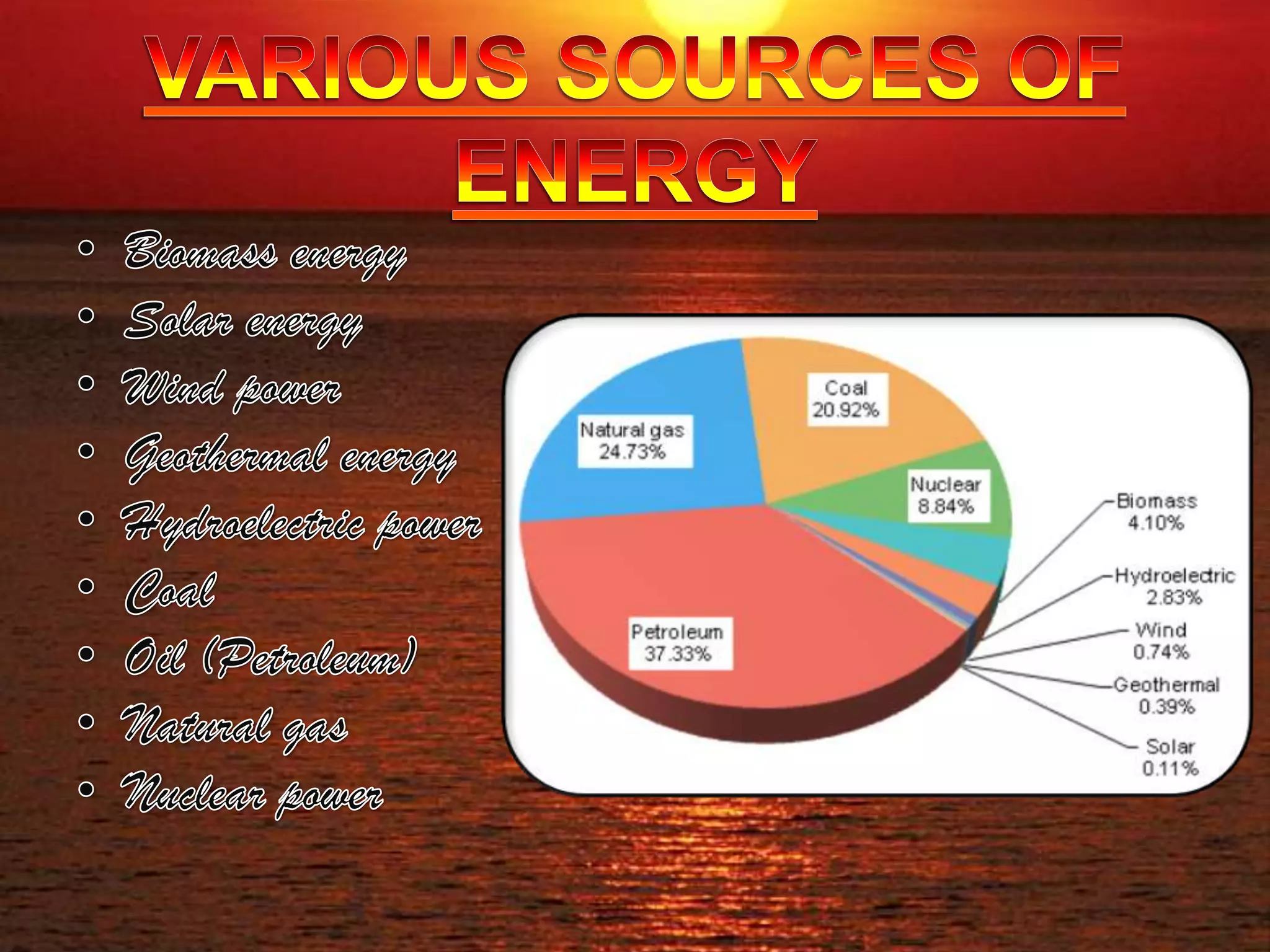
•
•
•
•
•

•
•

•
•

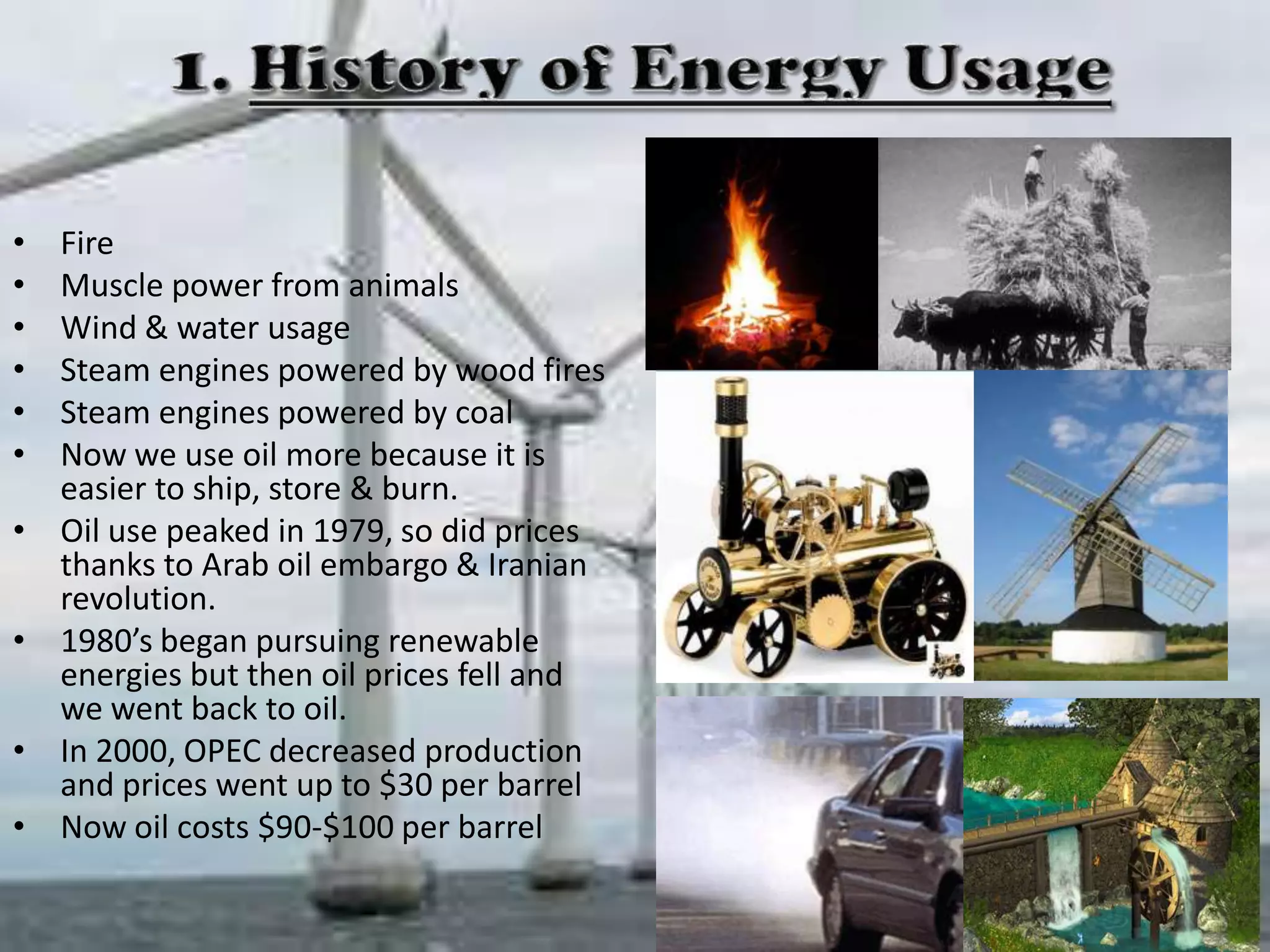
Fire
Muscle power from animals
Wind & water usage
Steam engines powered by wood fires
Steam engines powered by coal
Now we use oil more because it is
easier to ship, store & burn.
Oil use peaked in 1979, so did prices
thanks to Arab oil embargo & Iranian
revolution.
1980’s began pursuing renewable
energies but then oil prices fell and
we went back to oil.
In 2000, OPEC decreased production
and prices went up to $30 per barrel
Now oil costs $90-$100 per barrel
• Biomass energy- It comes from plants and is a rich source of carbon and
hydrogen. Fast-growing plants, such as switch grass and willow and
poplar trees, can be harvested as "power crops." Biomass wastes,
including forest residues, lumber and paper mill waste etc can be used to
produce heat, transportation fuels, and electricity.
• Solar energy- It is the power from the sun. It is free and inexhaustible.
Converting sunlight into useful forms is not free, but the fuel is. Sunlight
has been used by humans for drying crops and heating water and buildings
for millennia. A twentieth-century technology is photovoltaic, which turns
sunlight directly into electricity.
• Wind power- It is another ancient energy source that has moved into the
modern era. Advanced aerodynamics research has developed wind turbines
that can produce electricity at a lower cost than power from polluting coal
plants.
• Geothermal energy- It taps into the heat under the earth's crust to boil
water. The hot water is then used to drive electric turbines and heat
buildings.
• Hydroelectric power- It uses the force of moving water to produce
electricity. Hydropower is one of the main suppliers of electricity in the
world.
• Coal- It is the largest source of fuel for electricity production, and also
the largest source of environmental harm.
• Oil- It is used primarily for transportation fuels, but also for power
production, heat and as a feedstock for chemicals.
• Natural gas- It is a relatively clean burning fossil fuel, used mostly for
space and water heating in buildings and running industrial
processes. Increasingly, natural gas is used in turbines to produce
electricity.
• Nuclear power- It harnesses the heat of radioactive materials to produce
steam for power generation.
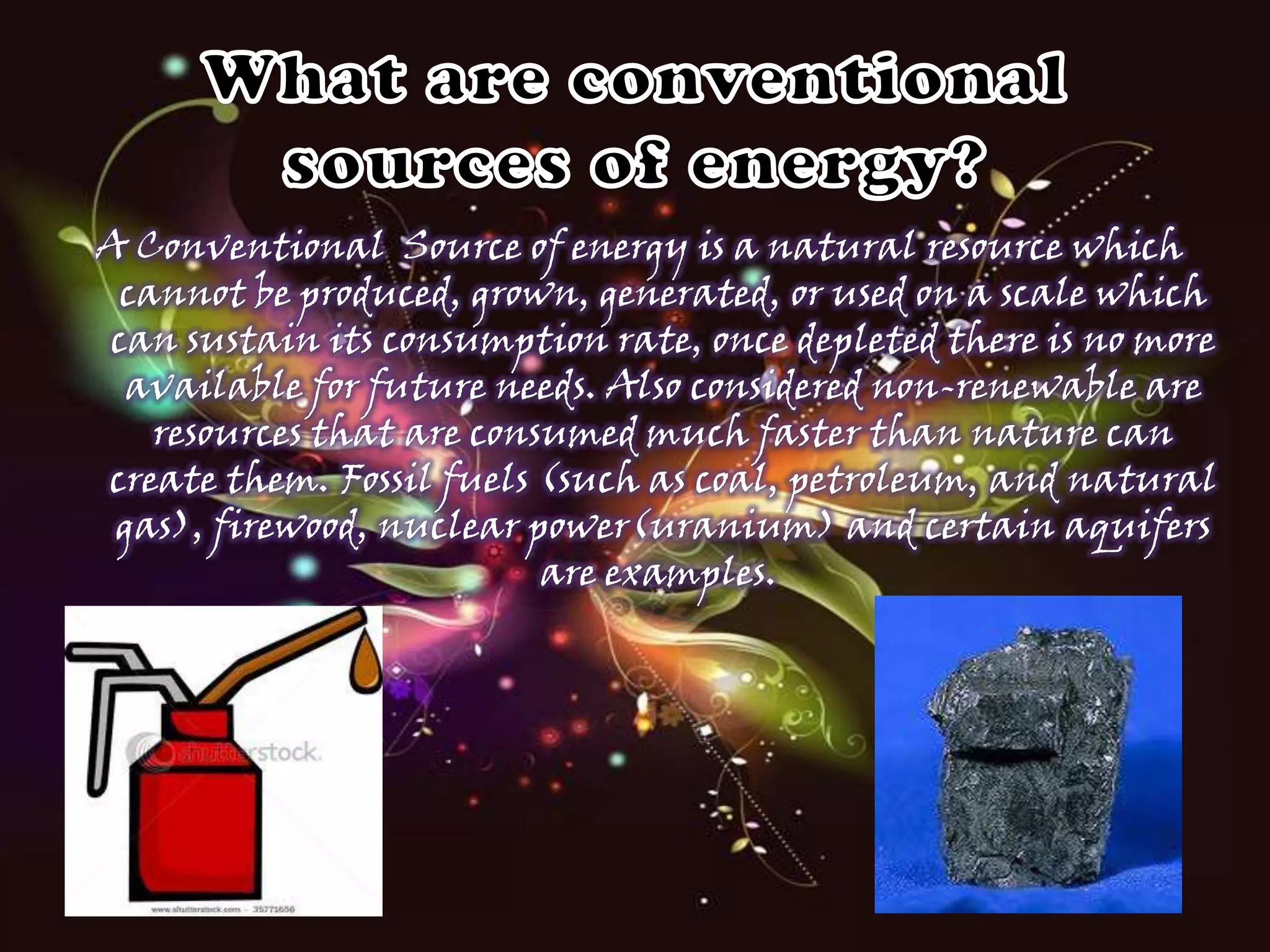
A Conventional Source of energy is a natural resource which
cannot be produced, grown, generated, or used on a scale which
can sustain its consumption rate, once depleted there is no more
available for future needs. Also considered non-renewable are
resources that are consumed much faster than nature can
create them. Fossil fuels (such as coal, petroleum, and natural
gas), firewood, nuclear power(uranium) and certain aquifers
are examples.
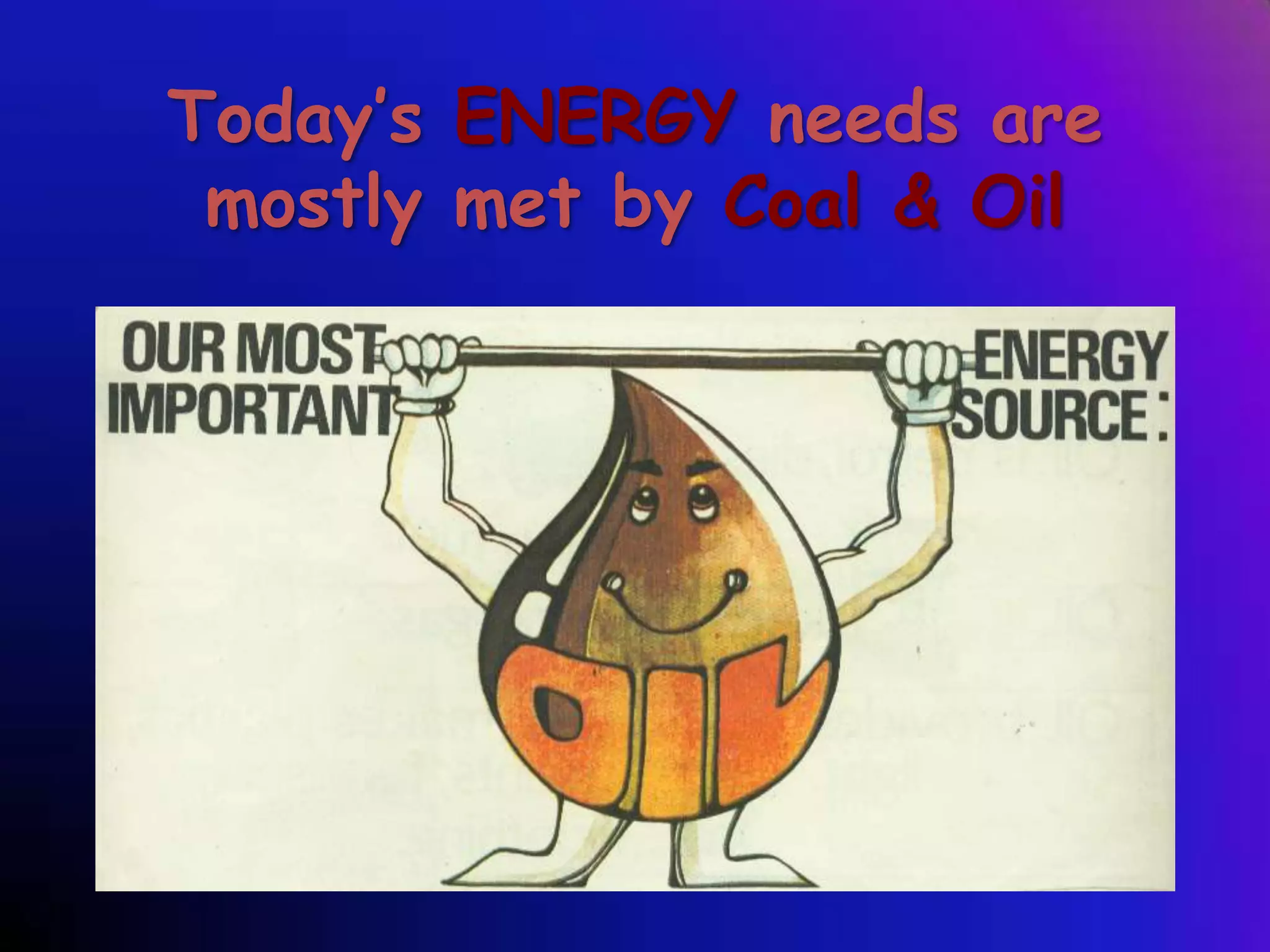
Today’s ENERGY needs are
mostly met by Coal & Oil
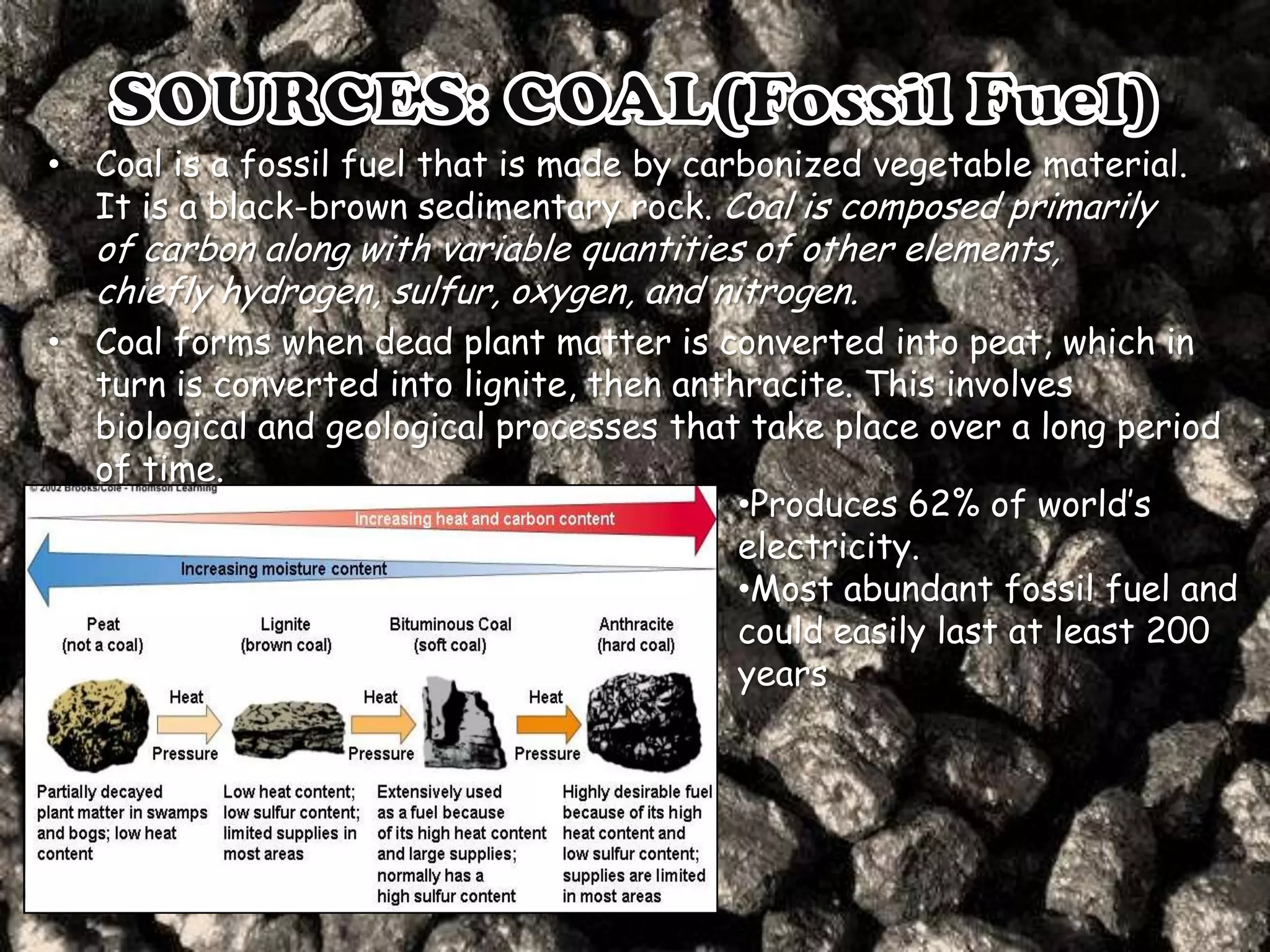
• Coal is a fossil fuel that is made by carbonized vegetable material.
It is a black-brown sedimentary rock. Coal is composed primarily

of carbon along with variable quantities of other elements,
chiefly hydrogen, sulfur, oxygen, and nitrogen.

• Coal forms when dead plant matter is converted into peat, which in
turn is converted into lignite, then anthracite. This involves
biological and geological processes that take place over a long period
of time.
•Produces 62% of world’s
electricity.
•Most abundant fossil fuel and
could easily last at least 200
years
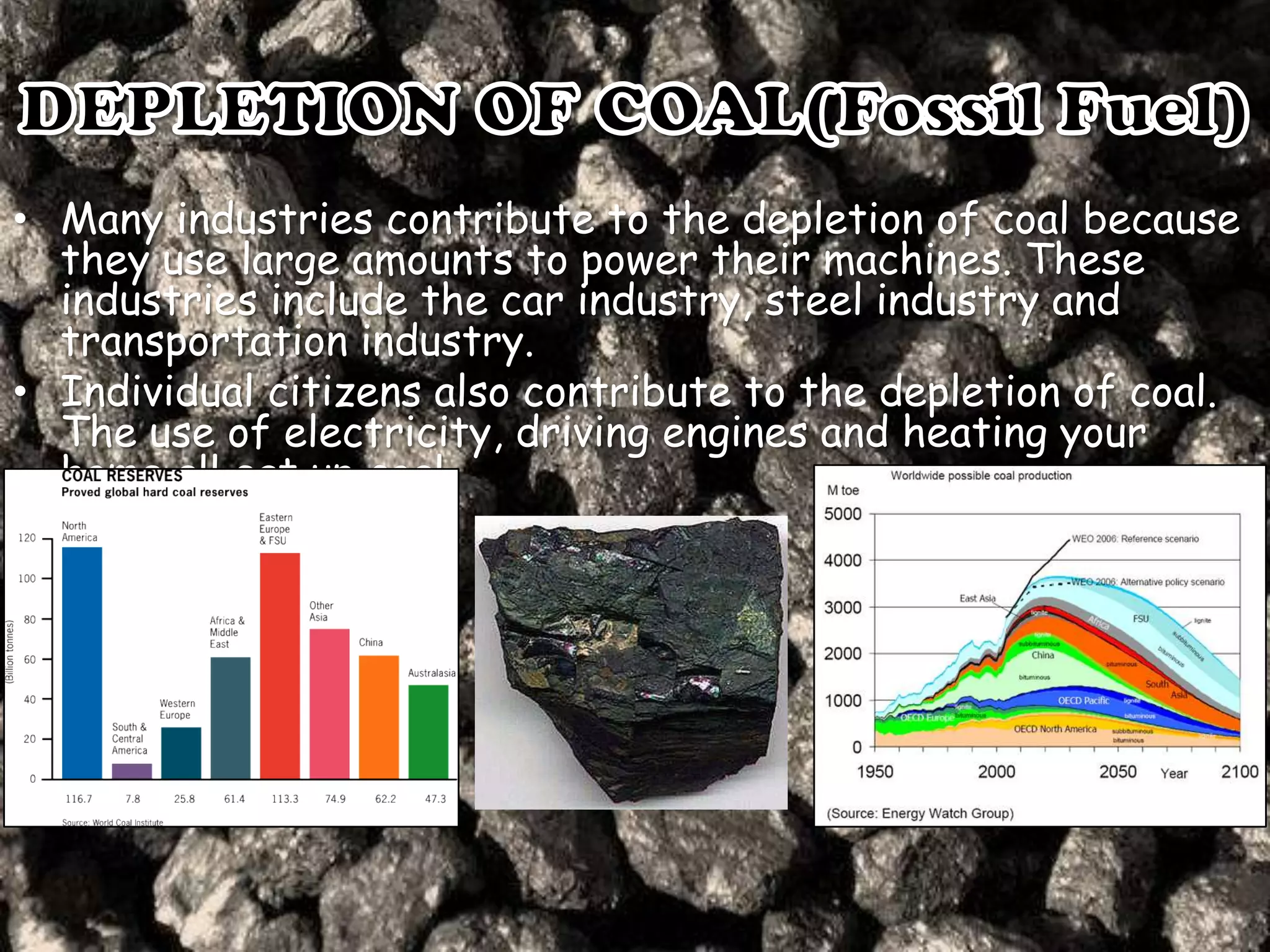
• Many industries contribute to the depletion of coal because
they use large amounts to power their machines. These
industries include the car industry, steel industry and
transportation industry.
• Individual citizens also contribute to the depletion of coal.
The use of electricity, driving engines and heating your
home all eat up coal.
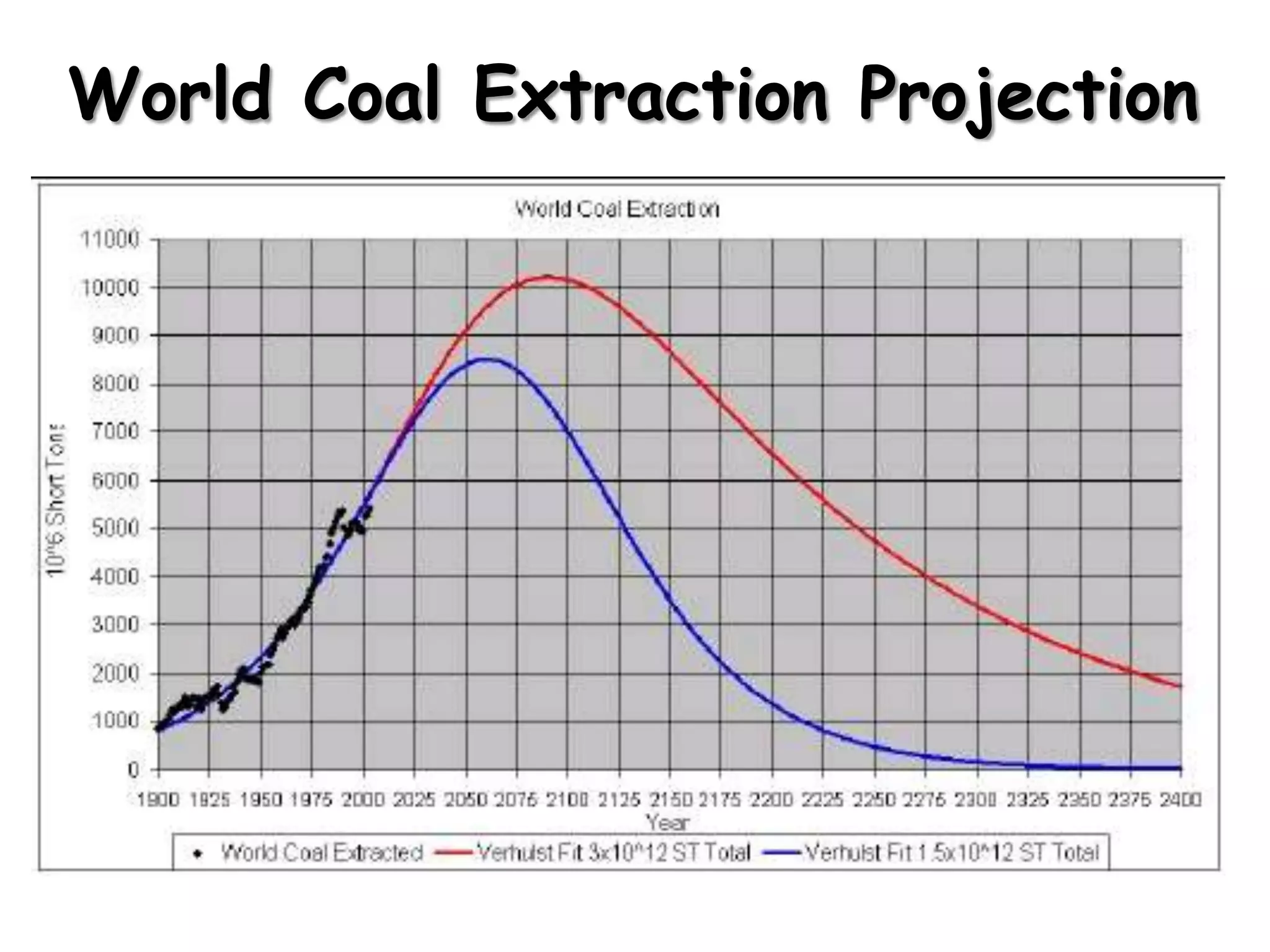
World Coal Extraction Projection
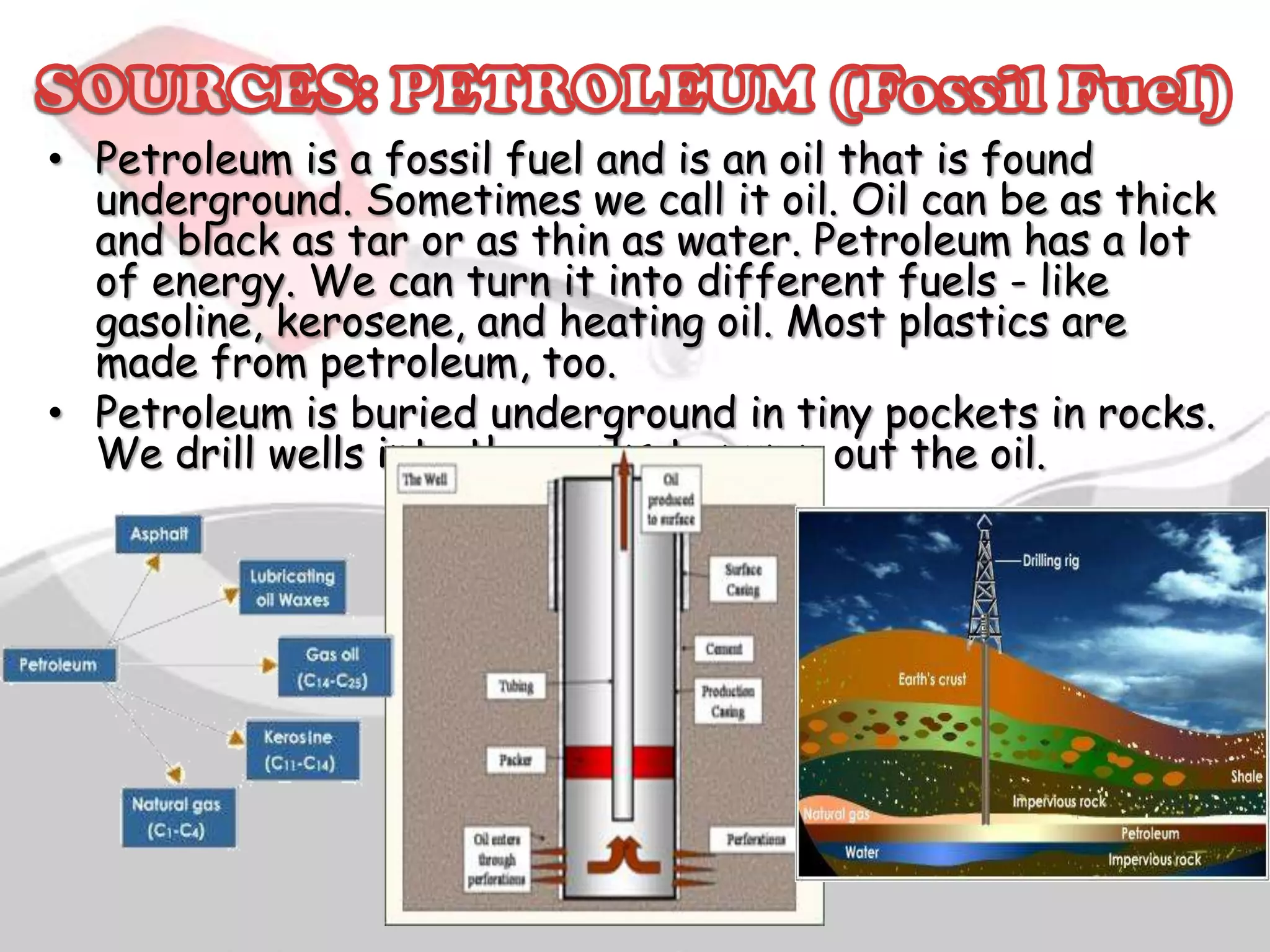
• Petroleum is a fossil fuel and is an oil that is found
underground. Sometimes we call it oil. Oil can be as thick
and black as tar or as thin as water. Petroleum has a lot
of energy. We can turn it into different fuels - like
gasoline, kerosene, and heating oil. Most plastics are
made from petroleum, too.
• Petroleum is buried underground in tiny pockets in rocks.
We drill wells into the rocks to pump out the oil.
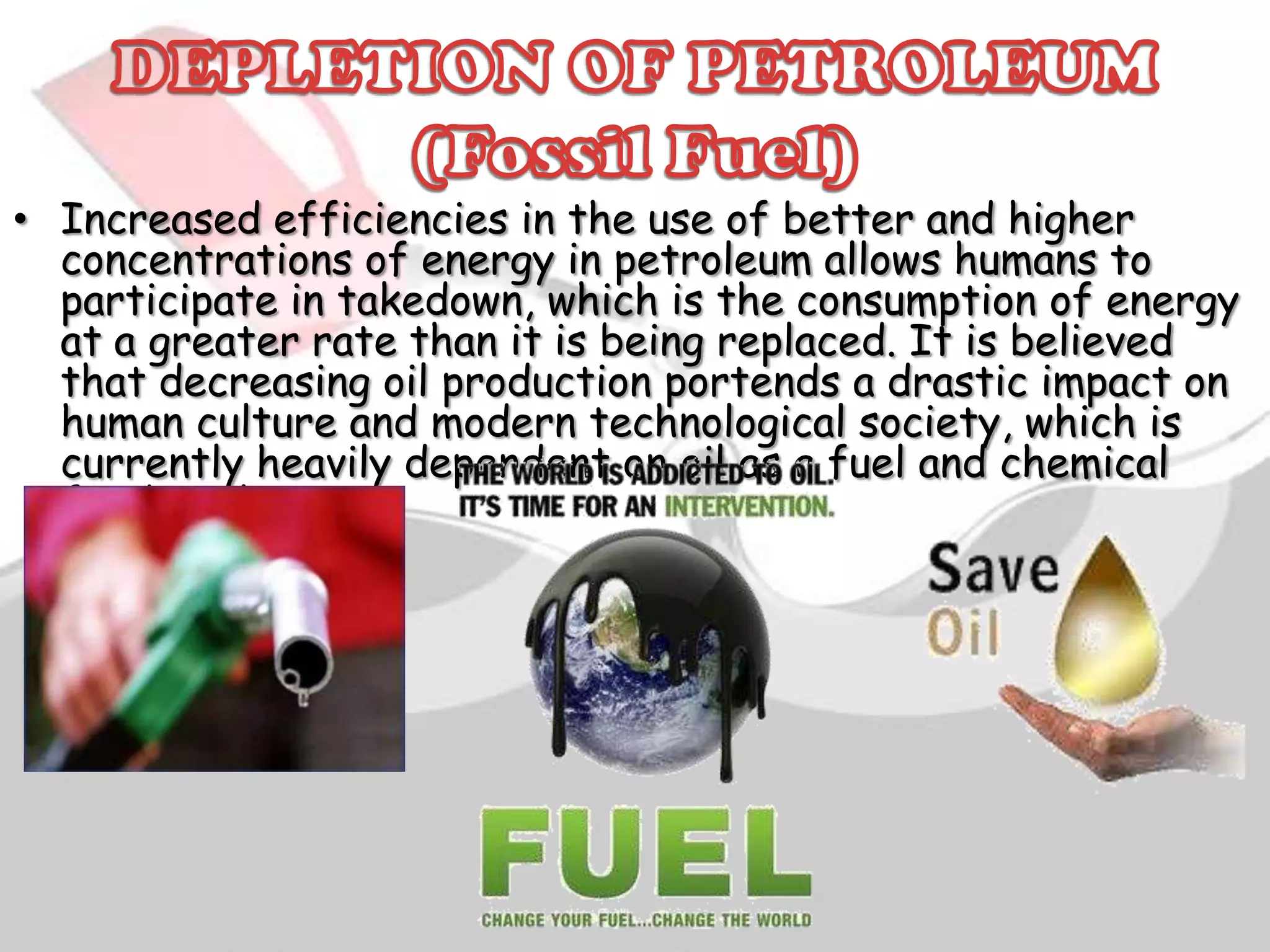
• Increased efficiencies in the use of better and higher
concentrations of energy in petroleum allows humans to
participate in takedown, which is the consumption of energy
at a greater rate than it is being replaced. It is believed
that decreasing oil production portends a drastic impact on
human culture and modern technological society, which is
currently heavily dependent on oil as a fuel and chemical
feedstock.
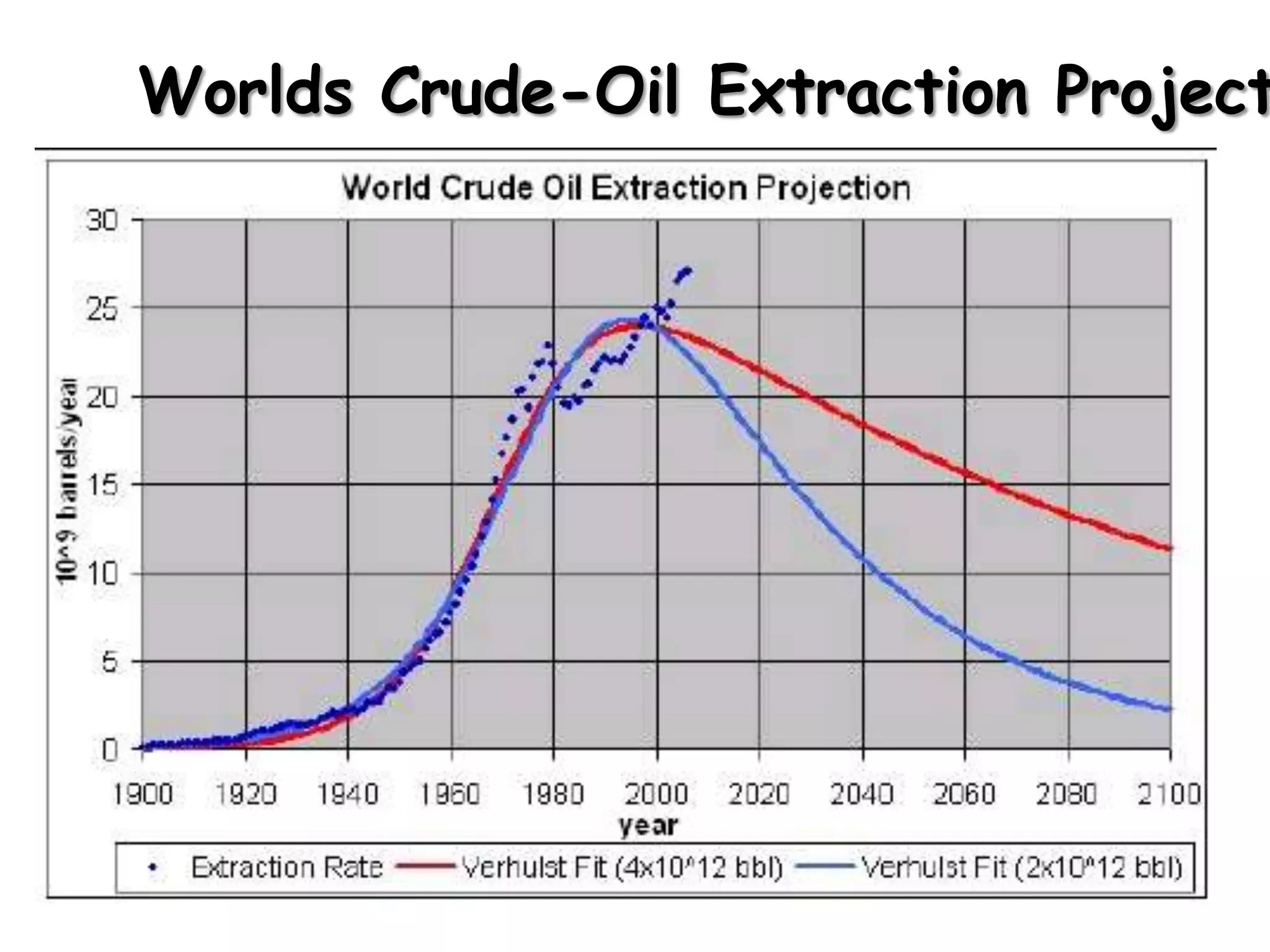
Worlds Crude-Oil Extraction Project
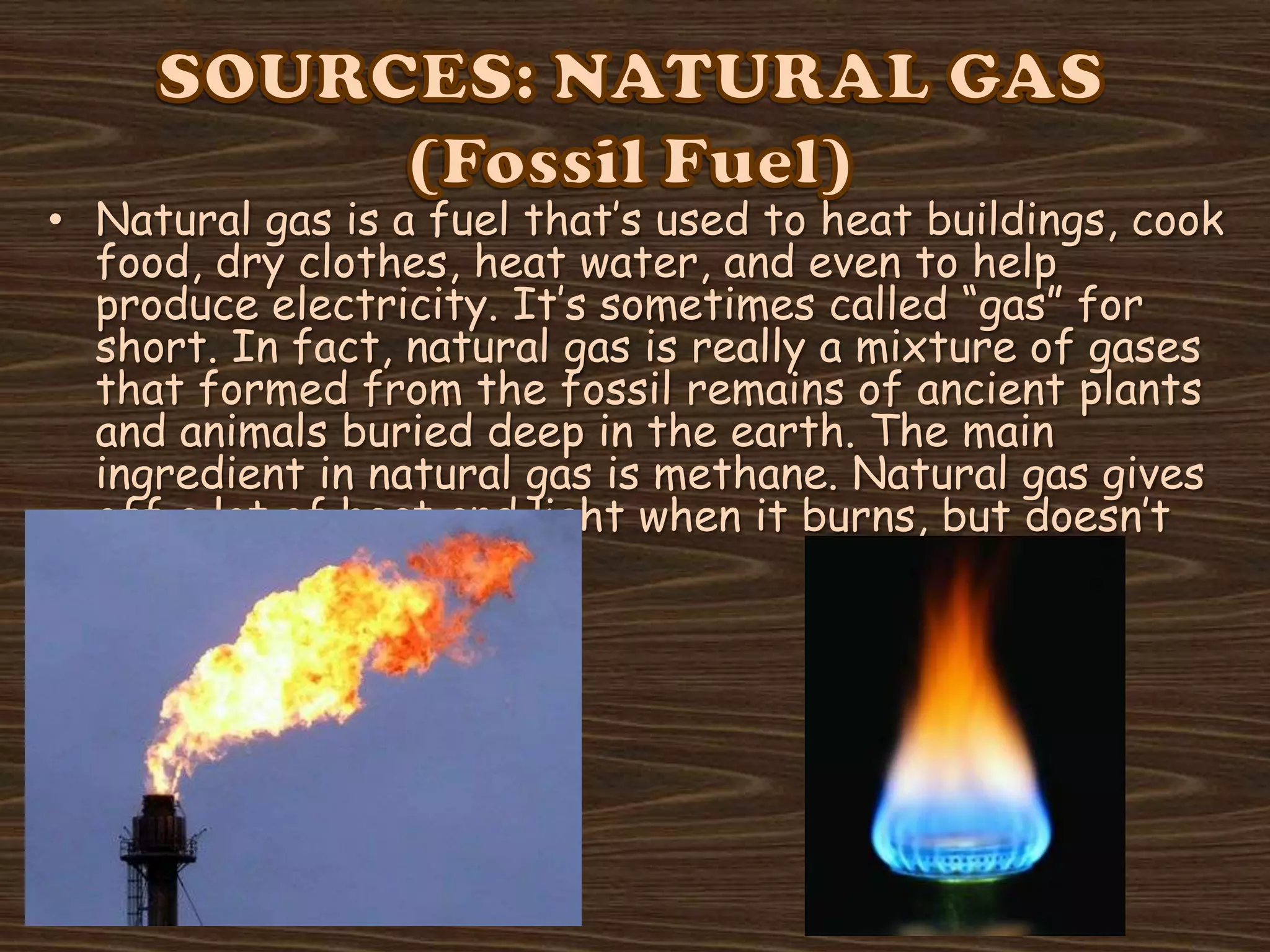
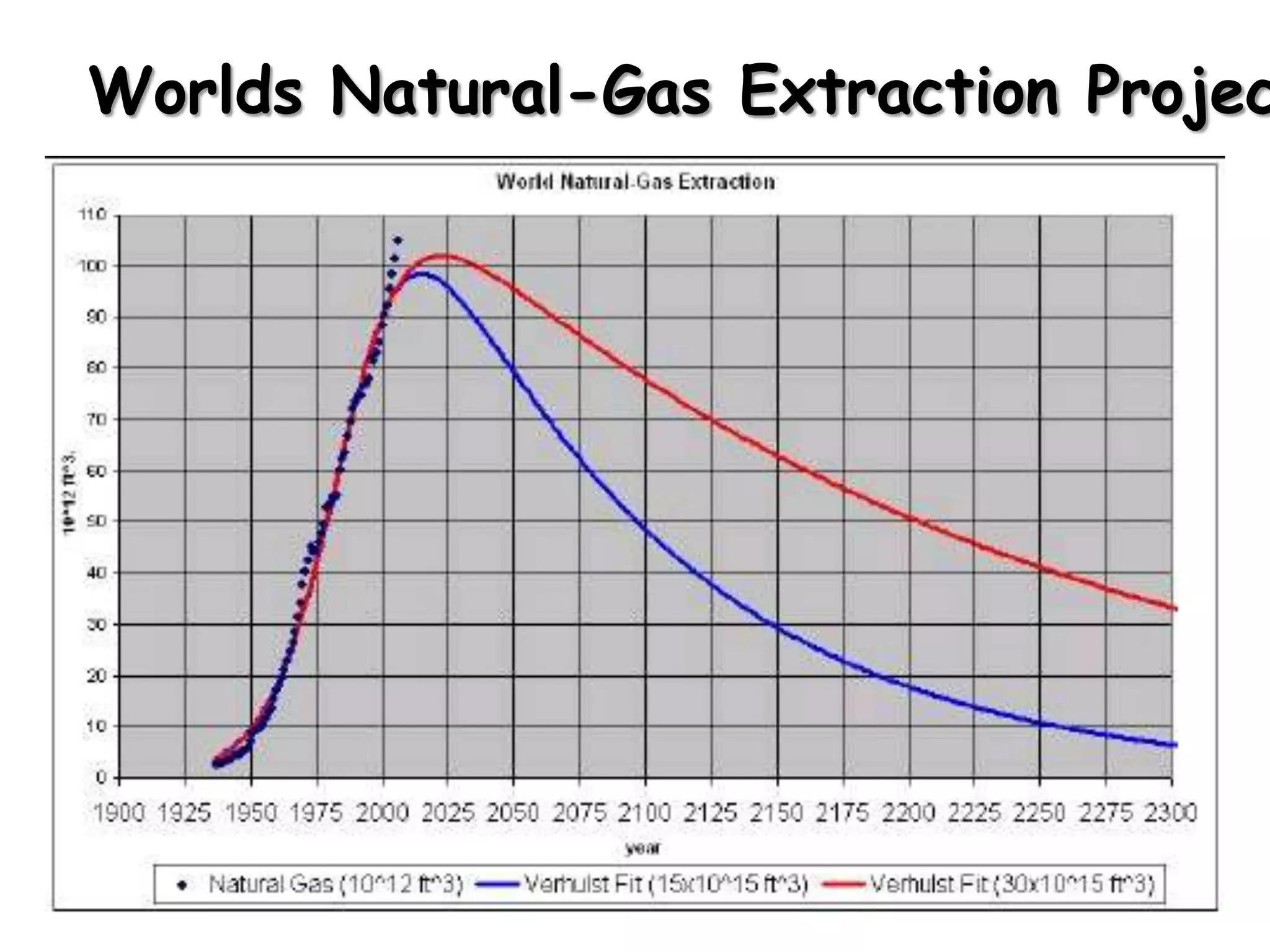
• Natural gas is a fuel that’s used to heat buildings, cook
food, dry clothes, heat water, and even to help
produce electricity. It’s sometimes called “gas” for

short. In fact, natural gas is really a mixture of gases
that formed from the fossil remains of ancient plants
and animals buried deep in the earth. The main
ingredient in natural gas is methane. Natural gas gives
off a lot of heat and light when it burns, but doesn’t
produce smoke.
• This is seen as depletion because gas is burned much more
quickly than it is formed. There are limited natural gas reserves.
• The gas equivalent of almost 60 billion tonnes of oil is used up.
• The territories that use most of the gas are the United States,
the Russian Federation, the Ukraine and Canada.
• Until about 1965 natural gas from oilfields was often considered
useless, so was disposed of by flaring. It has since been used
extensively, as a fuel.

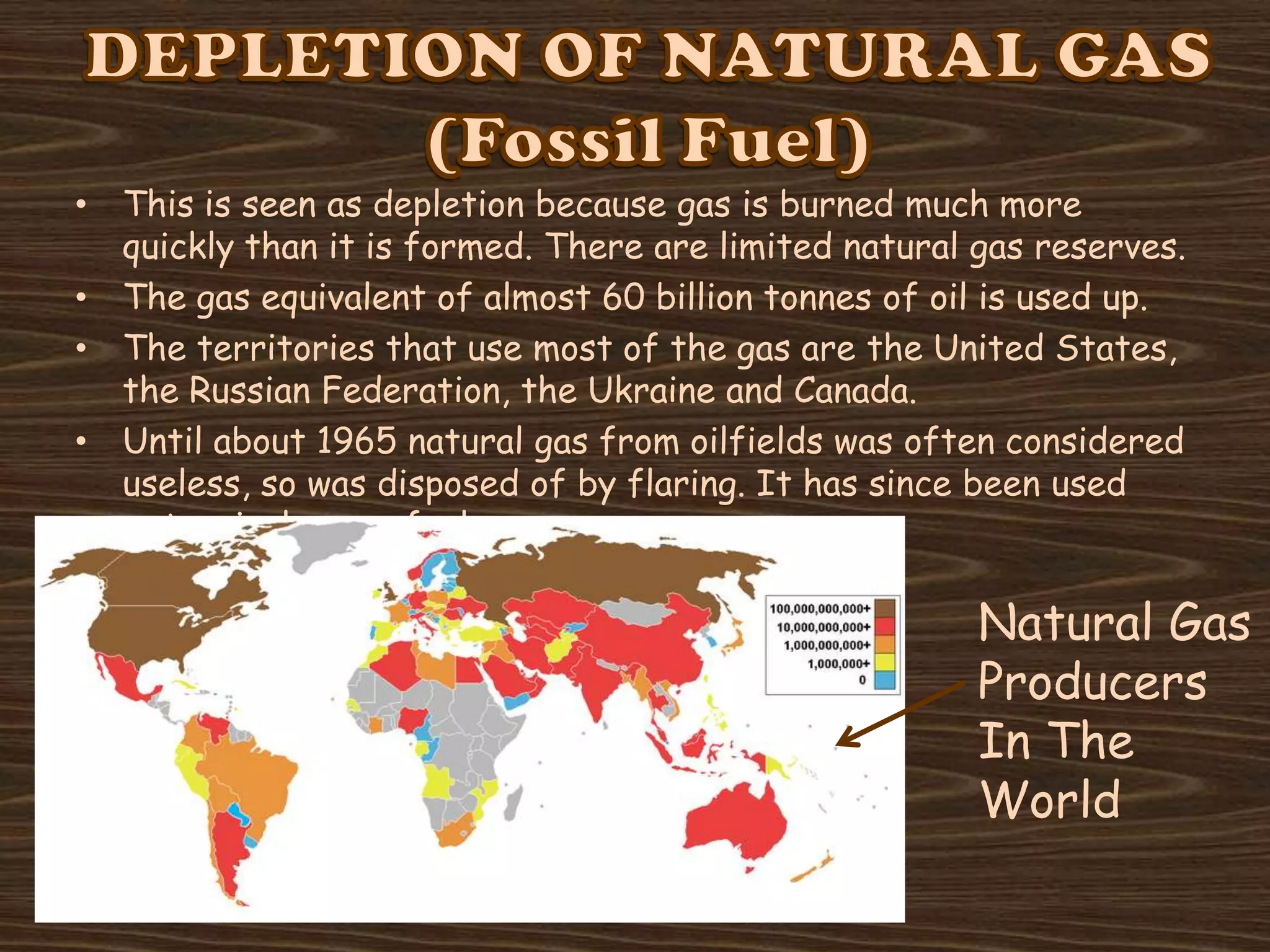
Natural Gas
Producers
In The
World
Worlds Natural-Gas Extraction Projec
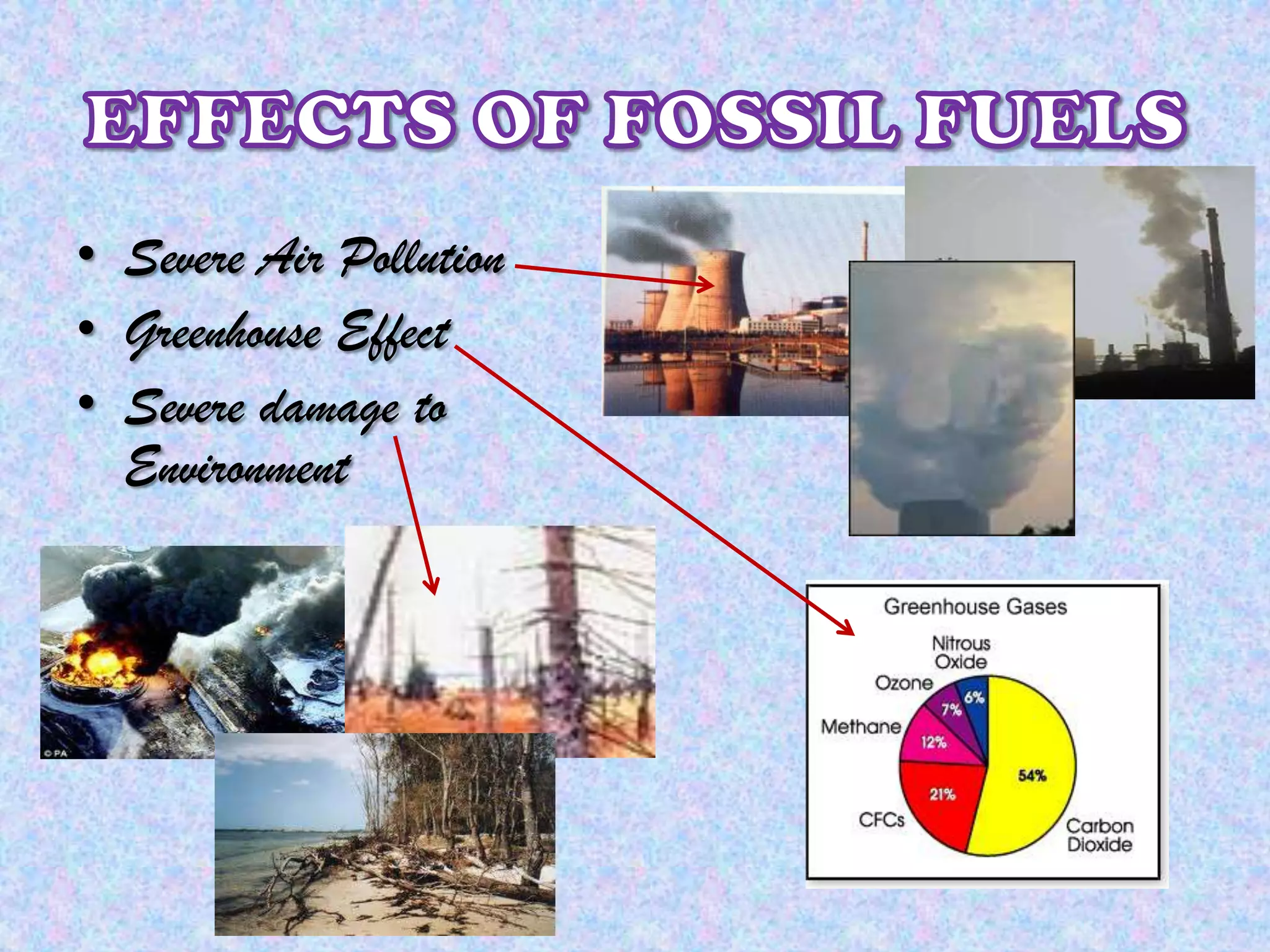
• Severe Air Pollution
• Greenhouse Effect
• Severe damage to
Environment
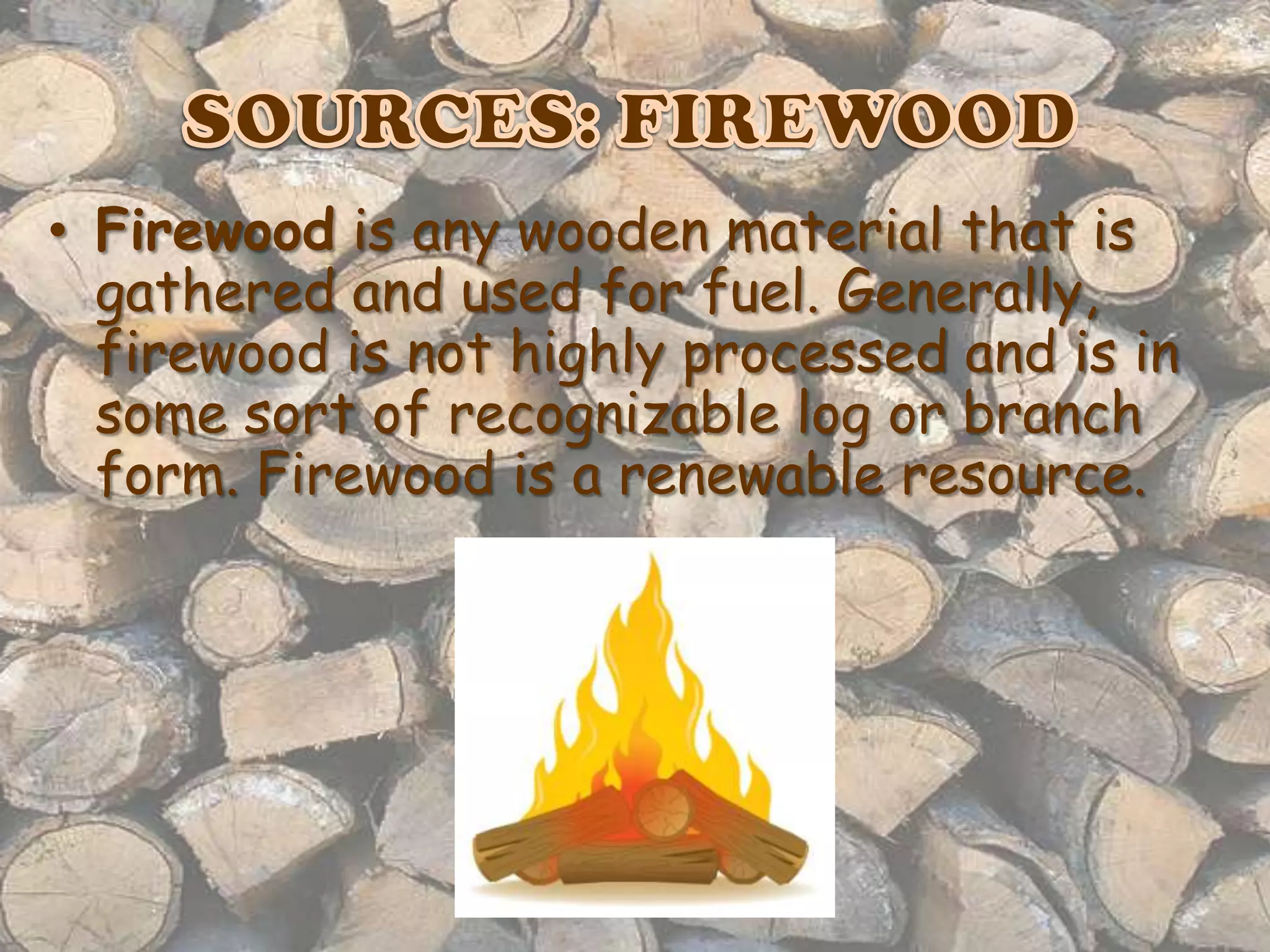
• Firewood is any wooden material that is
gathered and used for fuel. Generally,
firewood is not highly processed and is in
some sort of recognizable log or branch
form. Firewood is a renewable resource.
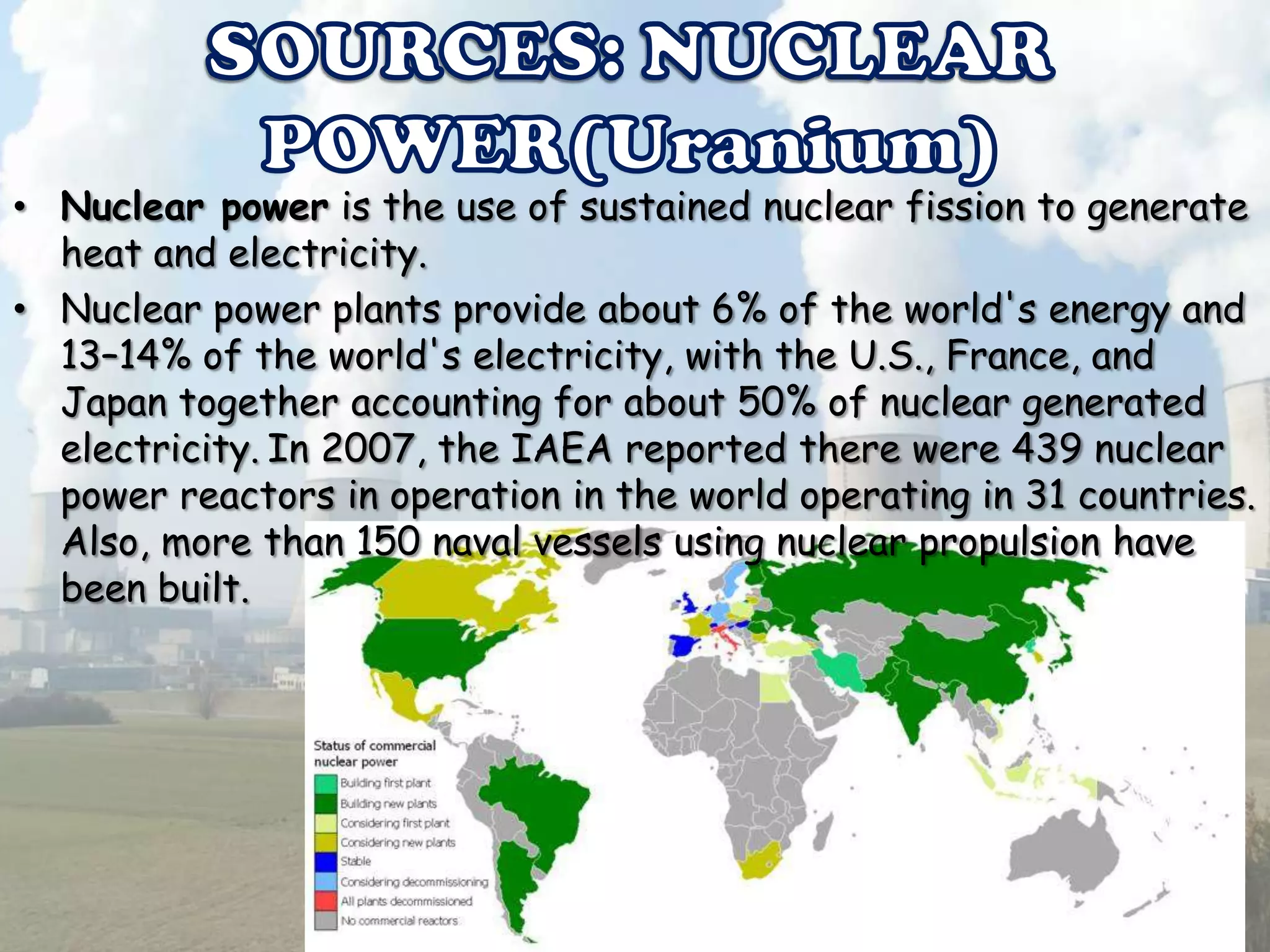
• Nuclear power is the use of sustained nuclear fission to generate
heat and electricity.
• Nuclear power plants provide about 6% of the world's energy and
13–14% of the world's electricity, with the U.S., France, and
Japan together accounting for about 50% of nuclear generated
electricity. In 2007, the IAEA reported there were 439 nuclear
power reactors in operation in the world operating in 31 countries.
Also, more than 150 naval vessels using nuclear propulsion have
been built.
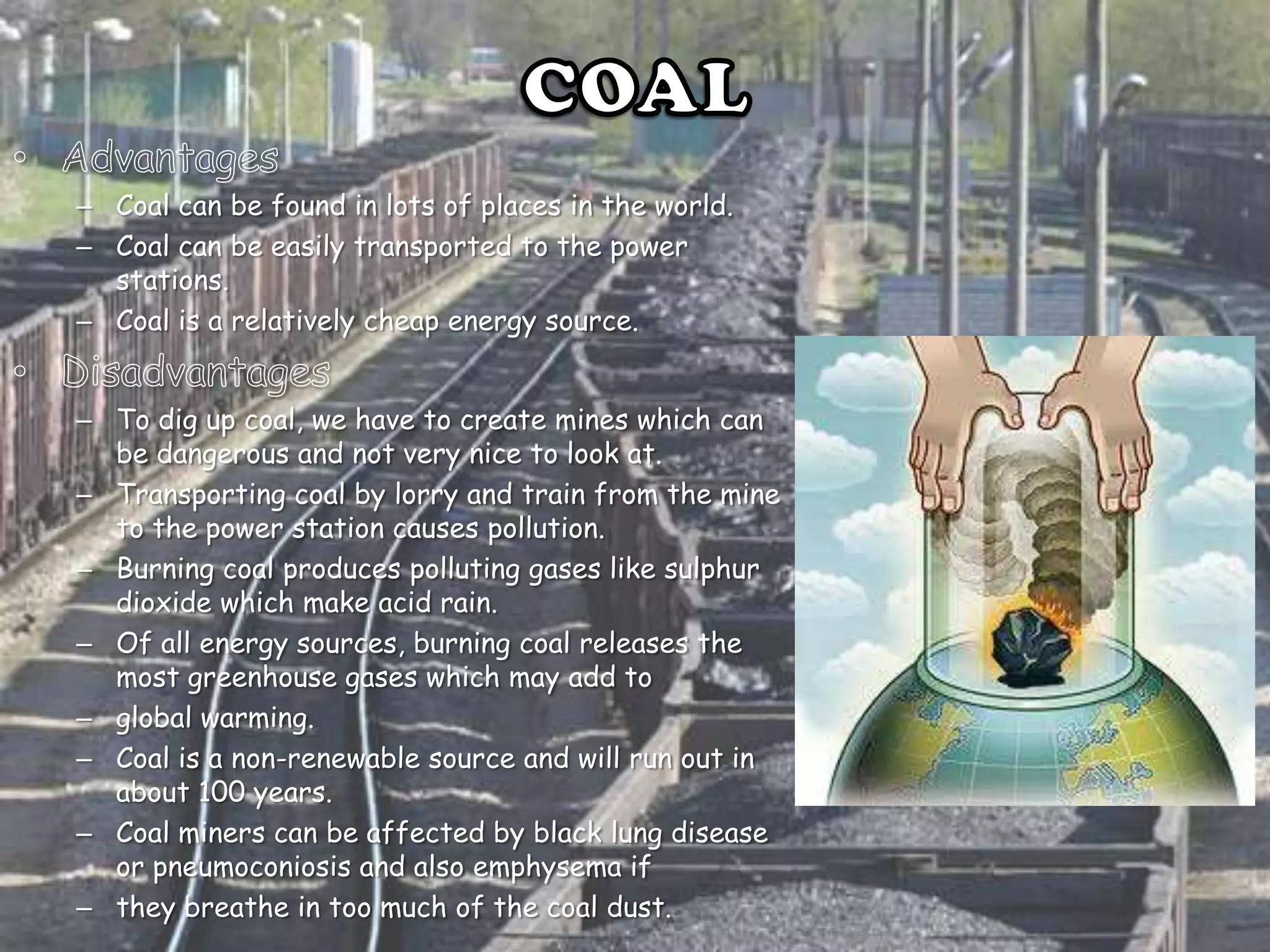
– Coal can be found in lots of places in the world.
– Coal can be easily transported to the power
stations.
– Coal is a relatively cheap energy source.
– To dig up coal, we have to create mines which can
be dangerous and not very nice to look at.
– Transporting coal by lorry and train from the mine
to the power station causes pollution.
– Burning coal produces polluting gases like sulphur
dioxide which make acid rain.
– Of all energy sources, burning coal releases the
most greenhouse gases which may add to
– global warming.
– Coal is a non-renewable source and will run out in
about 100 years.
– Coal miners can be affected by black lung disease
or pneumoconiosis and also emphysema if
– they breathe in too much of the coal dust.
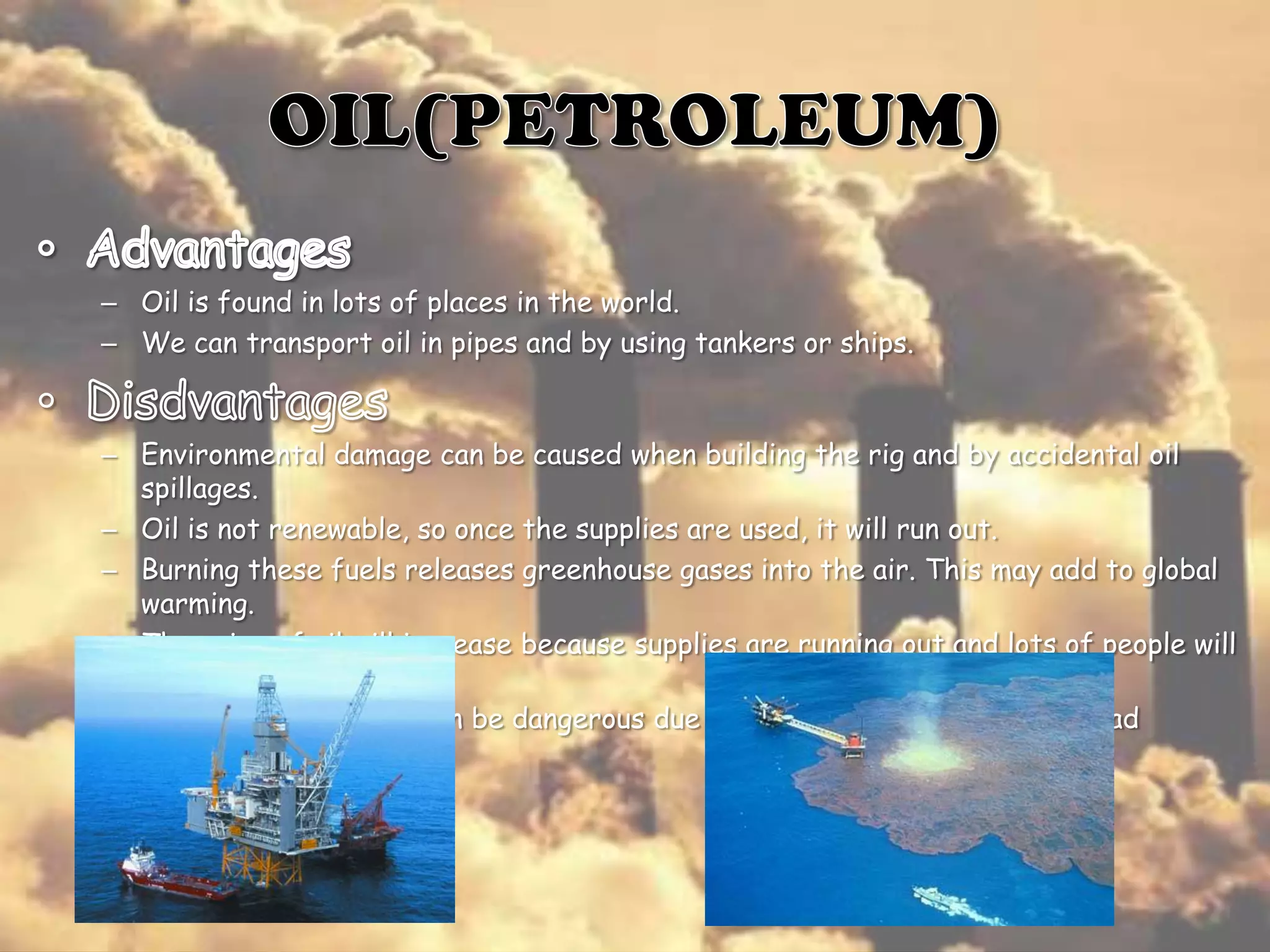
– Oil is found in lots of places in the world.
– We can transport oil in pipes and by using tankers or ships.

– Environmental damage can be caused when building the rig and by accidental oil
spillages.
– Oil is not renewable, so once the supplies are used, it will run out.
– Burning these fuels releases greenhouse gases into the air. This may add to global
warming.
– The price of oil will increase because supplies are running out and lots of people will
want it
– Working on an oil rig can be dangerous due to the risk of explosions and bad
weather.
–

–

–

–

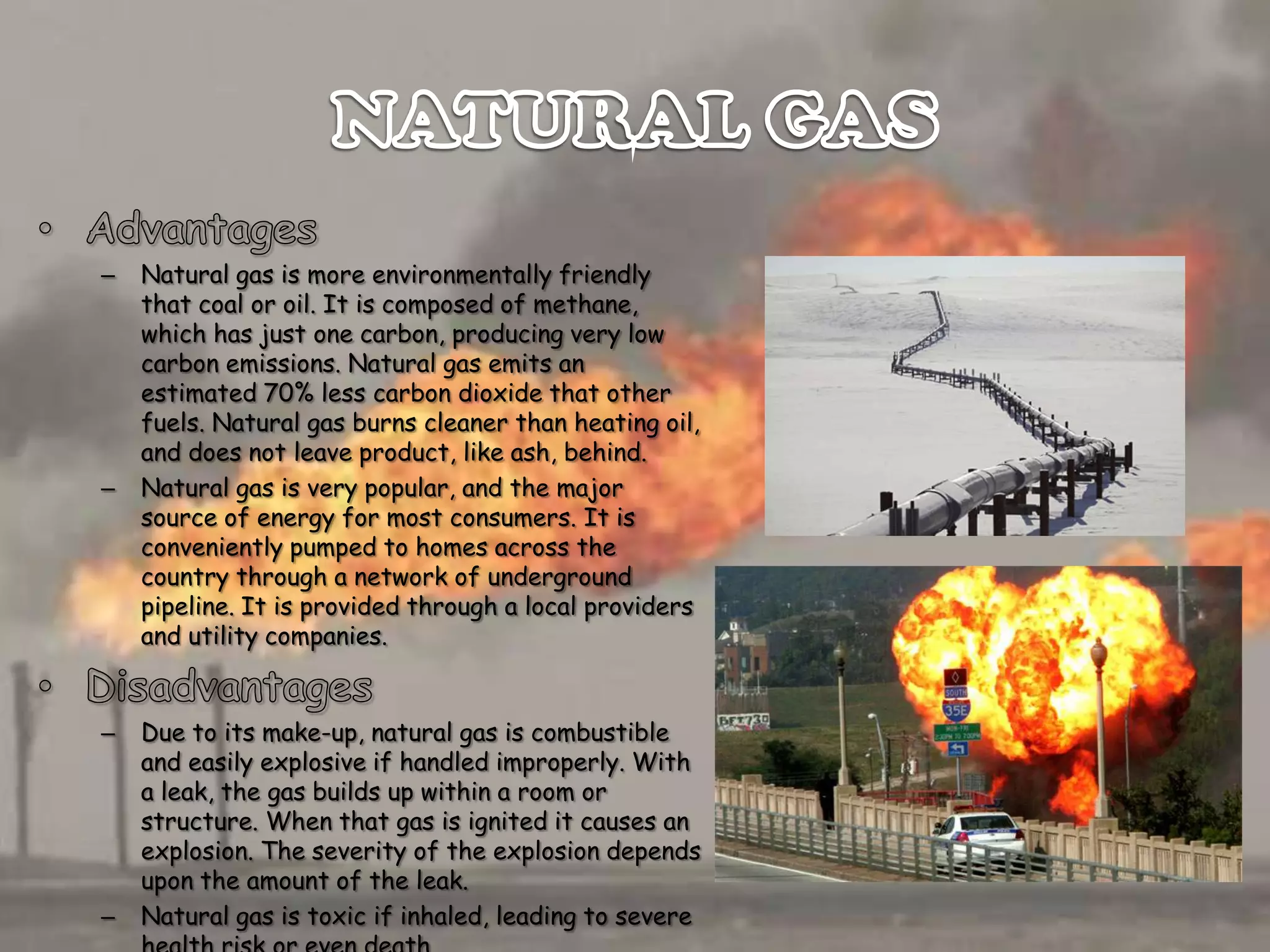
Natural gas is more environmentally friendly
that coal or oil. It is composed of methane,
which has just one carbon, producing very low
carbon emissions. Natural gas emits an
estimated 70% less carbon dioxide that other
fuels. Natural gas burns cleaner than heating oil,
and does not leave product, like ash, behind.
Natural gas is very popular, and the major
source of energy for most consumers. It is
conveniently pumped to homes across the
country through a network of underground
pipeline. It is provided through a local providers
and utility companies.

Due to its make-up, natural gas is combustible
and easily explosive if handled improperly. With
a leak, the gas builds up within a room or
structure. When that gas is ignited it causes an
explosion. The severity of the explosion depends
upon the amount of the leak.
Natural gas is toxic if inhaled, leading to severe
– Nuclear fuel does not make
harmful greenhouse gases.
– You only need a very small
amount of nuclear fuel to make a
lot of energy

– The waste that is produced when
using nuclear fuel is radioactive
and very harmful. It needs
– to be disposed of carefully
– Nuclear power stations are at
risk from terrorist attack and
sabotage.
– World uranium supplies may run
out in about 50 years.

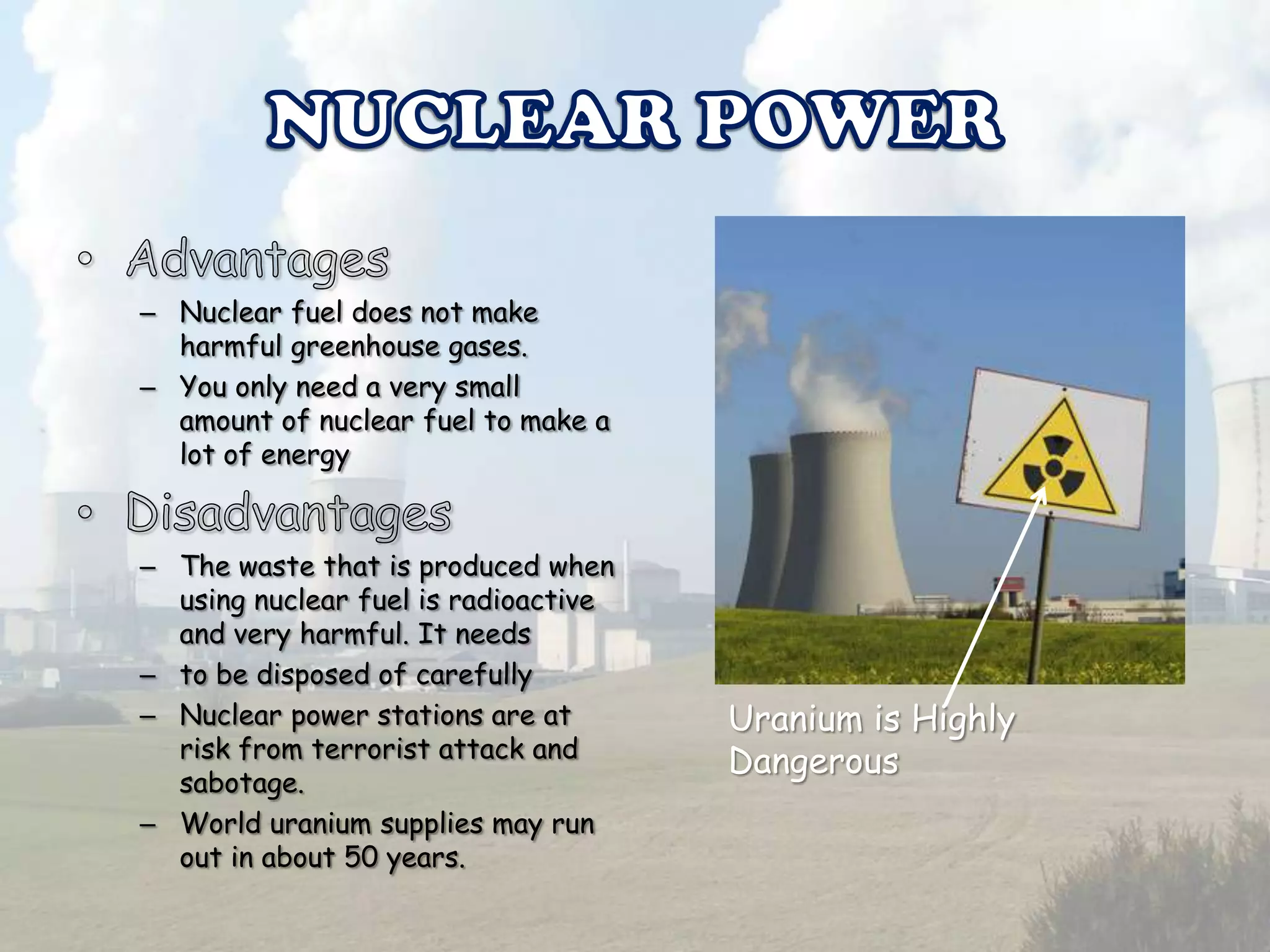
Uranium is Highly
Dangerous
– The wood is a renewable resource,
offering a sustainable, dependable
supply.
– The amount of carbon dioxide (CO2)
emitted during the burning process is
typically 90% less than when burning
fossil fuel.
– Wood fuel contains minimal amounts of
sulphur and heavy metals.
– It provides less heat energy per unit
than materials like coal.
– Burning firewood is a very inefficient
method of heating a house.
– Firewood produces carbon dioxide and
carbon monoxide and other pollutants
as well.
– Most of the heat produced goes
Never Forget Ancient Wisdom
“MATA BHUMIH PUTROHAM
PRITHVIYAH”
MEANS
“THE EARTH IS OUR MOTHER, WE ARE
HER CHILDREN”
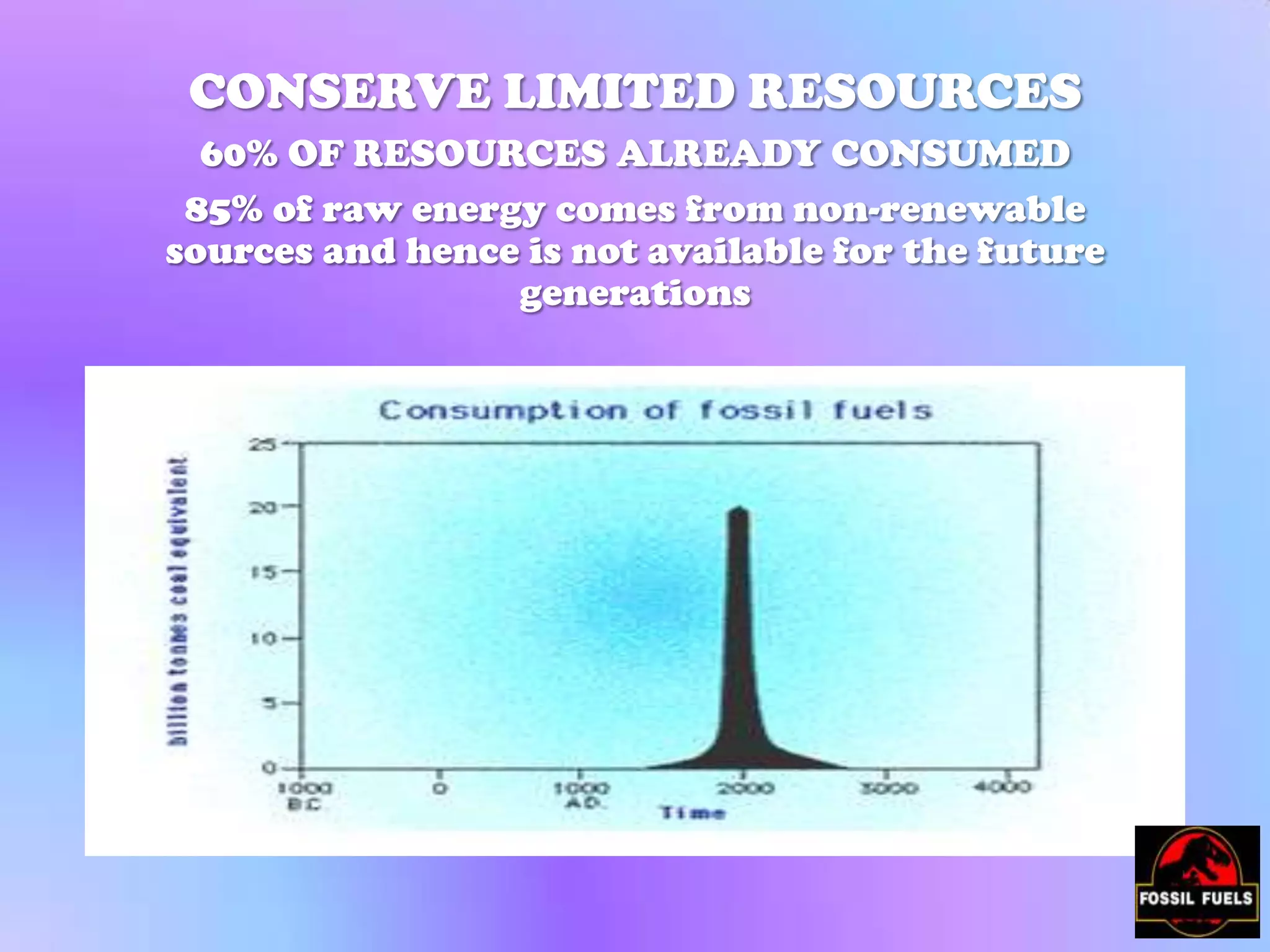
CONSERVE LIMITED RESOURCES
60% OF RESOURCES ALREADY CONSUMED
85% of raw energy comes from non-renewable
sources and hence is not available for the future
generations
•
•
•
•
•
•

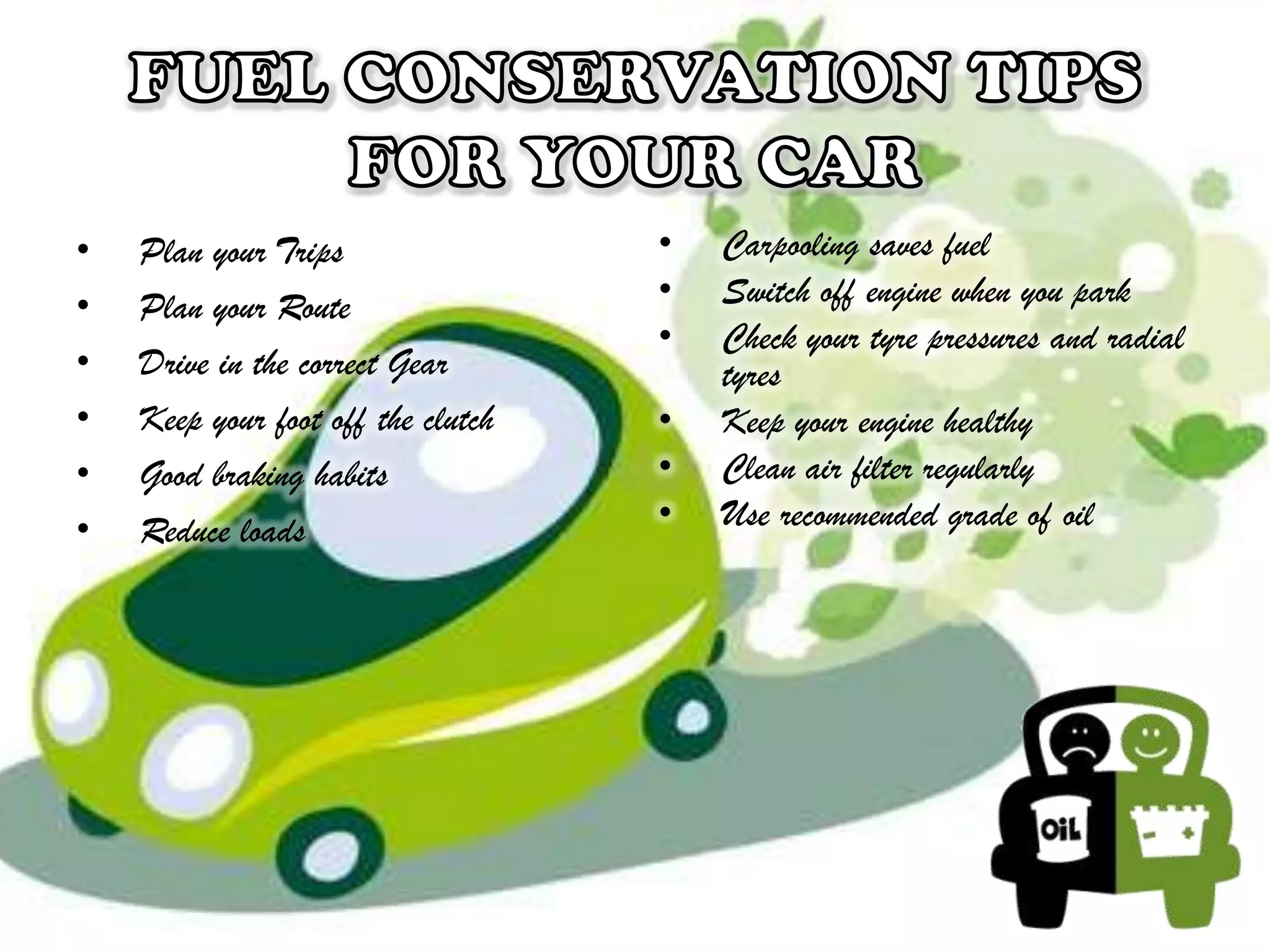
Plan your Trips
Plan your Route
Drive in the correct Gear
Keep your foot off the clutch
Good braking habits
Reduce loads

•
•
•
•
•
•

Carpooling saves fuel
Switch off engine when you park
Check your tyre pressures and radial
tyres
Keep your engine healthy
Clean air filter regularly
Use recommended grade of oil
• Insulation
• Eliminate air leaks
• Air to air heat
exchangers
• Efficient appliances
• Efficient electric
motors
• High-efficiency
lightning
• Increasing fuel
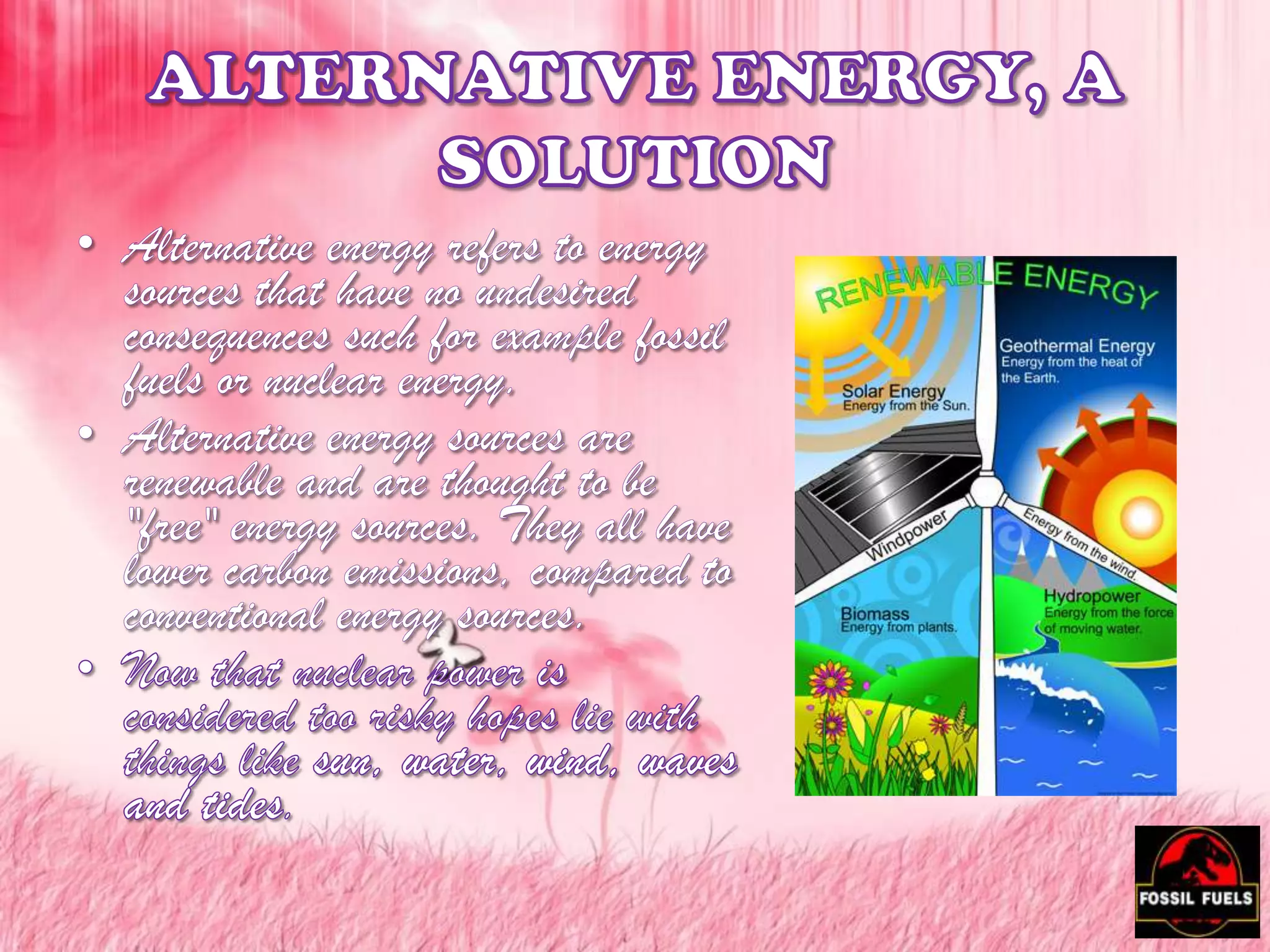
SOLAR ENERGY - Solar energy is the
technology used to harness the sun's energy
and make it useable. Today, the technology
produces less than one tenth of one percent
of global energy demand. The most common
way to harness solar energy is to use solar
panels.
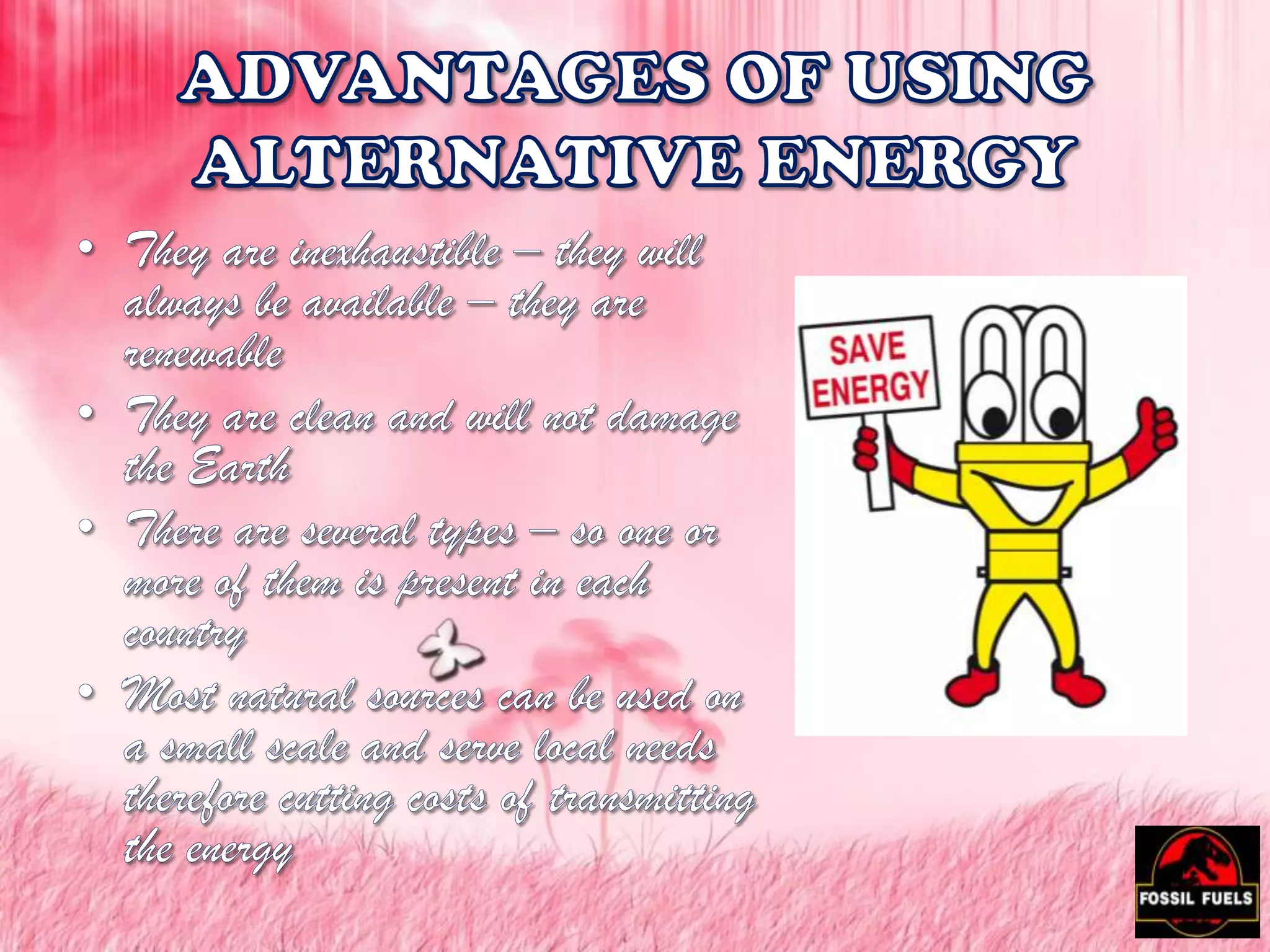
HYDRO ENERGY - The production of
energy through the use of the
gravitational force of falling or flowing
water is called hydro energy. It is the
most widely used form of renewable
energy.
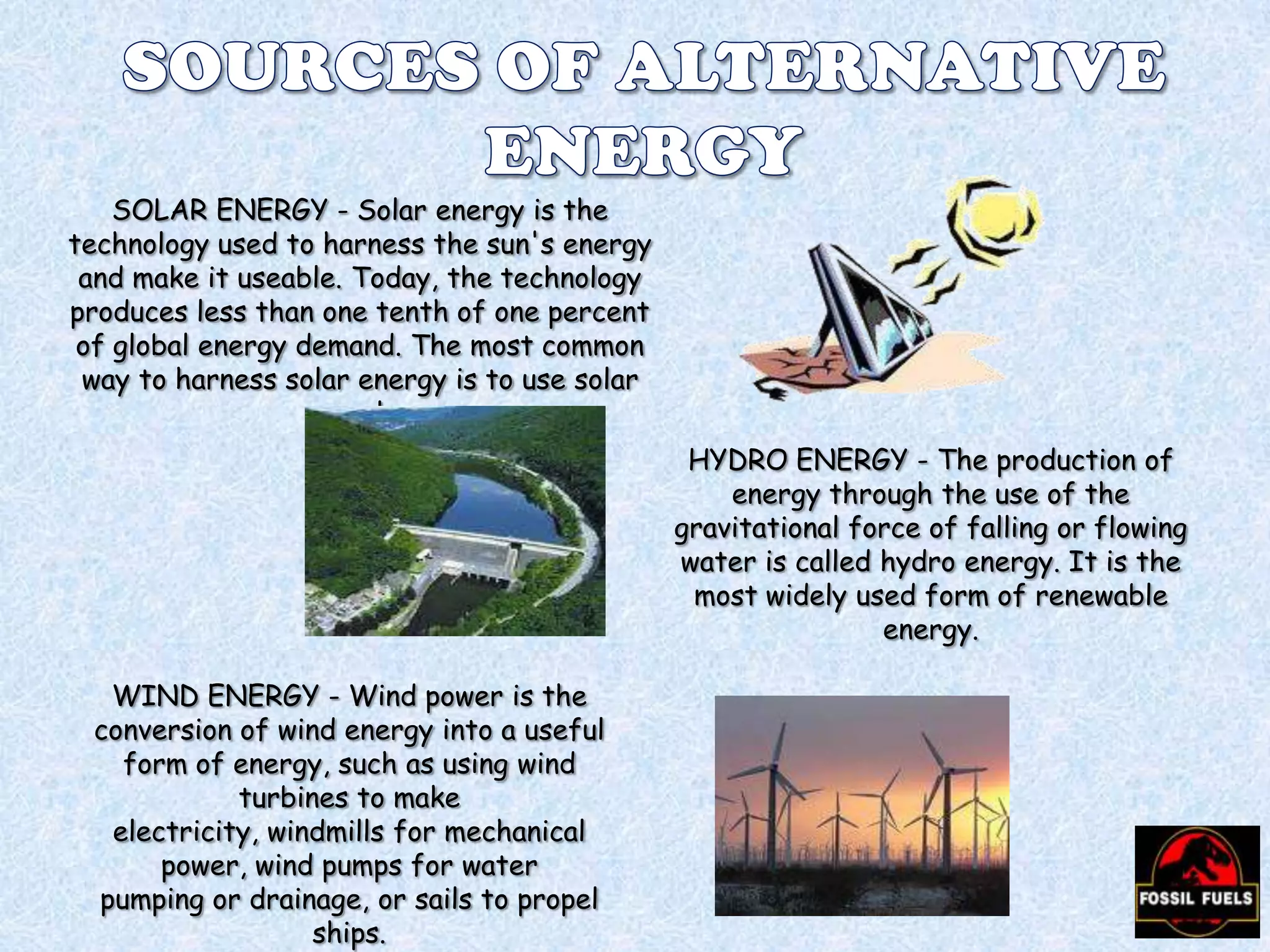
WIND ENERGY - Wind power is the
conversion of wind energy into a useful
form of energy, such as using wind
turbines to make
electricity, windmills for mechanical
power, wind pumps for water
pumping or drainage, or sails to propel
ships.
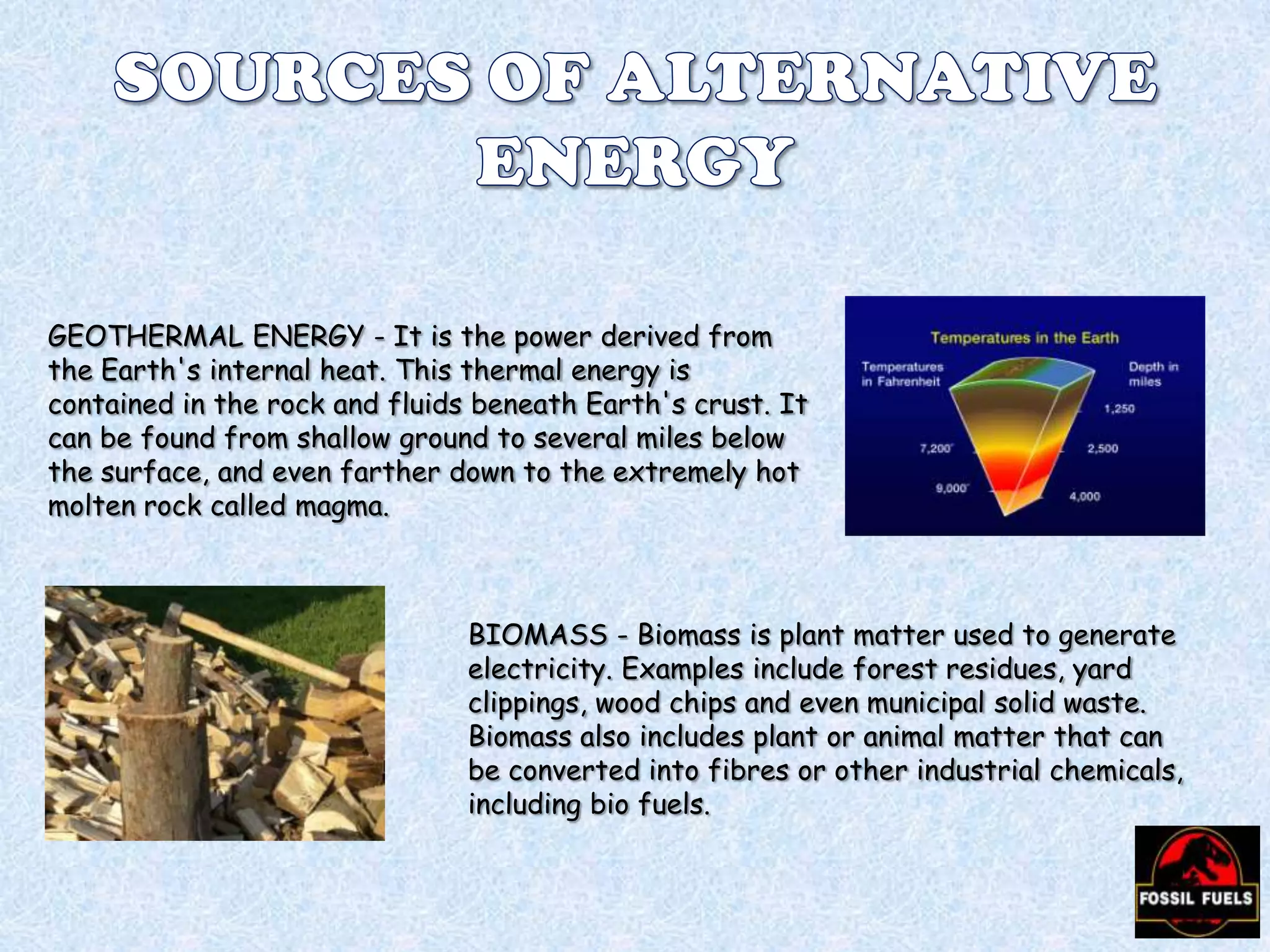
GEOTHERMAL ENERGY - It is the power derived from
the Earth's internal heat. This thermal energy is
contained in the rock and fluids beneath Earth's crust. It
can be found from shallow ground to several miles below
the surface, and even farther down to the extremely hot
molten rock called magma.

BIOMASS - Biomass is plant matter used to generate
electricity. Examples include forest residues, yard
clippings, wood chips and even municipal solid waste.
Biomass also includes plant or animal matter that can
be converted into fibres or other industrial chemicals,
including bio fuels.
• Increase fuel efficiency standards for vehicle, appliances,
buildings
• Tax and other financial incentives for energy efficiency
• Subsidize renewable energy use, research and development
• By 2050:
– renewable energy=50%
– cut coal use by 50%
– phase out nuclear altogether
Conventional sources of energy

Conventional sources of energy

  • 3.
    • • • • • • • • • • Fire Muscle power fromanimals Wind & water usage Steam engines powered by wood fires Steam engines powered by coal Now we use oil more because it is easier to ship, store & burn. Oil use peaked in 1979, so did prices thanks to Arab oil embargo & Iranian revolution. 1980’s began pursuing renewable energies but then oil prices fell and we went back to oil. In 2000, OPEC decreased production and prices went up to $30 per barrel Now oil costs $90-$100 per barrel
  • 6.
    • Biomass energy-It comes from plants and is a rich source of carbon and hydrogen. Fast-growing plants, such as switch grass and willow and poplar trees, can be harvested as "power crops." Biomass wastes, including forest residues, lumber and paper mill waste etc can be used to produce heat, transportation fuels, and electricity. • Solar energy- It is the power from the sun. It is free and inexhaustible. Converting sunlight into useful forms is not free, but the fuel is. Sunlight has been used by humans for drying crops and heating water and buildings for millennia. A twentieth-century technology is photovoltaic, which turns sunlight directly into electricity.
  • 7.
    • Wind power-It is another ancient energy source that has moved into the modern era. Advanced aerodynamics research has developed wind turbines that can produce electricity at a lower cost than power from polluting coal plants. • Geothermal energy- It taps into the heat under the earth's crust to boil water. The hot water is then used to drive electric turbines and heat buildings. • Hydroelectric power- It uses the force of moving water to produce electricity. Hydropower is one of the main suppliers of electricity in the world.
  • 8.
    • Coal- Itis the largest source of fuel for electricity production, and also the largest source of environmental harm. • Oil- It is used primarily for transportation fuels, but also for power production, heat and as a feedstock for chemicals. • Natural gas- It is a relatively clean burning fossil fuel, used mostly for space and water heating in buildings and running industrial processes. Increasingly, natural gas is used in turbines to produce electricity. • Nuclear power- It harnesses the heat of radioactive materials to produce steam for power generation.
  • 10.
    A Conventional Sourceof energy is a natural resource which cannot be produced, grown, generated, or used on a scale which can sustain its consumption rate, once depleted there is no more available for future needs. Also considered non-renewable are resources that are consumed much faster than nature can create them. Fossil fuels (such as coal, petroleum, and natural gas), firewood, nuclear power(uranium) and certain aquifers are examples.
  • 12.
    Today’s ENERGY needsare mostly met by Coal & Oil
  • 13.
    • Coal isa fossil fuel that is made by carbonized vegetable material. It is a black-brown sedimentary rock. Coal is composed primarily of carbon along with variable quantities of other elements, chiefly hydrogen, sulfur, oxygen, and nitrogen. • Coal forms when dead plant matter is converted into peat, which in turn is converted into lignite, then anthracite. This involves biological and geological processes that take place over a long period of time. •Produces 62% of world’s electricity. •Most abundant fossil fuel and could easily last at least 200 years
  • 14.
    • Many industriescontribute to the depletion of coal because they use large amounts to power their machines. These industries include the car industry, steel industry and transportation industry. • Individual citizens also contribute to the depletion of coal. The use of electricity, driving engines and heating your home all eat up coal.
  • 15.
  • 16.
    • Petroleum isa fossil fuel and is an oil that is found underground. Sometimes we call it oil. Oil can be as thick and black as tar or as thin as water. Petroleum has a lot of energy. We can turn it into different fuels - like gasoline, kerosene, and heating oil. Most plastics are made from petroleum, too. • Petroleum is buried underground in tiny pockets in rocks. We drill wells into the rocks to pump out the oil.
  • 17.
    • Increased efficienciesin the use of better and higher concentrations of energy in petroleum allows humans to participate in takedown, which is the consumption of energy at a greater rate than it is being replaced. It is believed that decreasing oil production portends a drastic impact on human culture and modern technological society, which is currently heavily dependent on oil as a fuel and chemical feedstock.
  • 18.
  • 19.
    • Natural gasis a fuel that’s used to heat buildings, cook food, dry clothes, heat water, and even to help produce electricity. It’s sometimes called “gas” for short. In fact, natural gas is really a mixture of gases that formed from the fossil remains of ancient plants and animals buried deep in the earth. The main ingredient in natural gas is methane. Natural gas gives off a lot of heat and light when it burns, but doesn’t produce smoke.
  • 20.
    • This isseen as depletion because gas is burned much more quickly than it is formed. There are limited natural gas reserves. • The gas equivalent of almost 60 billion tonnes of oil is used up. • The territories that use most of the gas are the United States, the Russian Federation, the Ukraine and Canada. • Until about 1965 natural gas from oilfields was often considered useless, so was disposed of by flaring. It has since been used extensively, as a fuel. Natural Gas Producers In The World
  • 21.
  • 22.
    • Severe AirPollution • Greenhouse Effect • Severe damage to Environment
  • 23.
    • Firewood isany wooden material that is gathered and used for fuel. Generally, firewood is not highly processed and is in some sort of recognizable log or branch form. Firewood is a renewable resource.
  • 24.
    • Nuclear poweris the use of sustained nuclear fission to generate heat and electricity. • Nuclear power plants provide about 6% of the world's energy and 13–14% of the world's electricity, with the U.S., France, and Japan together accounting for about 50% of nuclear generated electricity. In 2007, the IAEA reported there were 439 nuclear power reactors in operation in the world operating in 31 countries. Also, more than 150 naval vessels using nuclear propulsion have been built.
  • 26.
    – Coal canbe found in lots of places in the world. – Coal can be easily transported to the power stations. – Coal is a relatively cheap energy source. – To dig up coal, we have to create mines which can be dangerous and not very nice to look at. – Transporting coal by lorry and train from the mine to the power station causes pollution. – Burning coal produces polluting gases like sulphur dioxide which make acid rain. – Of all energy sources, burning coal releases the most greenhouse gases which may add to – global warming. – Coal is a non-renewable source and will run out in about 100 years. – Coal miners can be affected by black lung disease or pneumoconiosis and also emphysema if – they breathe in too much of the coal dust.
  • 27.
    – Oil isfound in lots of places in the world. – We can transport oil in pipes and by using tankers or ships. – Environmental damage can be caused when building the rig and by accidental oil spillages. – Oil is not renewable, so once the supplies are used, it will run out. – Burning these fuels releases greenhouse gases into the air. This may add to global warming. – The price of oil will increase because supplies are running out and lots of people will want it – Working on an oil rig can be dangerous due to the risk of explosions and bad weather.
  • 28.
    – – – – Natural gas ismore environmentally friendly that coal or oil. It is composed of methane, which has just one carbon, producing very low carbon emissions. Natural gas emits an estimated 70% less carbon dioxide that other fuels. Natural gas burns cleaner than heating oil, and does not leave product, like ash, behind. Natural gas is very popular, and the major source of energy for most consumers. It is conveniently pumped to homes across the country through a network of underground pipeline. It is provided through a local providers and utility companies. Due to its make-up, natural gas is combustible and easily explosive if handled improperly. With a leak, the gas builds up within a room or structure. When that gas is ignited it causes an explosion. The severity of the explosion depends upon the amount of the leak. Natural gas is toxic if inhaled, leading to severe
  • 29.
    – Nuclear fueldoes not make harmful greenhouse gases. – You only need a very small amount of nuclear fuel to make a lot of energy – The waste that is produced when using nuclear fuel is radioactive and very harmful. It needs – to be disposed of carefully – Nuclear power stations are at risk from terrorist attack and sabotage. – World uranium supplies may run out in about 50 years. Uranium is Highly Dangerous
  • 30.
    – The woodis a renewable resource, offering a sustainable, dependable supply. – The amount of carbon dioxide (CO2) emitted during the burning process is typically 90% less than when burning fossil fuel. – Wood fuel contains minimal amounts of sulphur and heavy metals. – It provides less heat energy per unit than materials like coal. – Burning firewood is a very inefficient method of heating a house. – Firewood produces carbon dioxide and carbon monoxide and other pollutants as well. – Most of the heat produced goes
  • 32.
    Never Forget AncientWisdom “MATA BHUMIH PUTROHAM PRITHVIYAH” MEANS “THE EARTH IS OUR MOTHER, WE ARE HER CHILDREN”
  • 34.
    CONSERVE LIMITED RESOURCES 60%OF RESOURCES ALREADY CONSUMED 85% of raw energy comes from non-renewable sources and hence is not available for the future generations
  • 35.
    • • • • • • Plan your Trips Planyour Route Drive in the correct Gear Keep your foot off the clutch Good braking habits Reduce loads • • • • • • Carpooling saves fuel Switch off engine when you park Check your tyre pressures and radial tyres Keep your engine healthy Clean air filter regularly Use recommended grade of oil
  • 36.
    • Insulation • Eliminateair leaks • Air to air heat exchangers • Efficient appliances • Efficient electric motors • High-efficiency lightning • Increasing fuel
  • 39.
    SOLAR ENERGY -Solar energy is the technology used to harness the sun's energy and make it useable. Today, the technology produces less than one tenth of one percent of global energy demand. The most common way to harness solar energy is to use solar panels. HYDRO ENERGY - The production of energy through the use of the gravitational force of falling or flowing water is called hydro energy. It is the most widely used form of renewable energy. WIND ENERGY - Wind power is the conversion of wind energy into a useful form of energy, such as using wind turbines to make electricity, windmills for mechanical power, wind pumps for water pumping or drainage, or sails to propel ships.
  • 40.
    GEOTHERMAL ENERGY -It is the power derived from the Earth's internal heat. This thermal energy is contained in the rock and fluids beneath Earth's crust. It can be found from shallow ground to several miles below the surface, and even farther down to the extremely hot molten rock called magma. BIOMASS - Biomass is plant matter used to generate electricity. Examples include forest residues, yard clippings, wood chips and even municipal solid waste. Biomass also includes plant or animal matter that can be converted into fibres or other industrial chemicals, including bio fuels.
  • 41.
    • Increase fuelefficiency standards for vehicle, appliances, buildings • Tax and other financial incentives for energy efficiency • Subsidize renewable energy use, research and development • By 2050: – renewable energy=50% – cut coal use by 50% – phase out nuclear altogether