Chapter 25 Section 1
The Cold War Begins
Section 1
The Drive for Reform
• Identify the causes of Progressivism and
compare it to Populism.
• Analyze the role that journalists played in the
Progressive Movement.
• Evaluate some of the social reforms that
Progressives tackled.
• Explain what Progressives hoped to achieve
through political reforms.
Objectives
Chapter 25 Section 1
The Cold War Begins
Section 1
The Drive for Reform
Terms and People
• Progressivism – movement that believed honest
and efficient government could bring about social
justice
• muckrakers – socially conscious journalists and
writers who dramatized the need for reform
• Lincoln Steffens – muckraking author of Shame of
the Cities, exposed corruption in urban government
• Jacob Riis – muckraking photographer and author
of How The Other Half Lives, exposed the condition
of the urban poor
Chapter 25 Section 1
The Cold War Begins
Section 1
The Drive for Reform
Terms and People (continued)
• Social Gospel – belief that following Christian
principles could bring about social justice
• settlement house – community center that
provided services for the urban poor
• Jane Addams – leader in the settlement house
movement
• direct primary – allowed voters to select
candidates rather than having them selected by
party leaders
Chapter 25 Section 1
The Cold War Begins
Section 1
The Drive for Reform
Terms and People (continued)
• initiative – gave citizens the power to propose
laws
• referendum – allowed citizens to reject or accept
laws passed by their legislature
• recall – gave voters the power to remove
legislators before their term is up
Chapter 25 Section 1
The Cold War Begins
Section 1
The Drive for Reform
What areas did Progressives think were in
need of the greatest reform?
Progressivism was a movement that believed
the social challenges caused by industrialization,
urbanization, and immigration in the 1890s and
1900s could be addressed.
Progressives believed that honest and efficient
government could bring about social justice.
Chapter 25 Section 1
The Cold War Begins
Section 1
The Drive for Reform
• believed industrialization
and urbanization had
created social and
political problems.
• were mainly from the
emerging middle class.
• wanted to reform by
using logic and reason.
Progressives
were
reformers
who:
Chapter 25 Section 1
The Cold War Begins
Section 1
The Drive for Reform
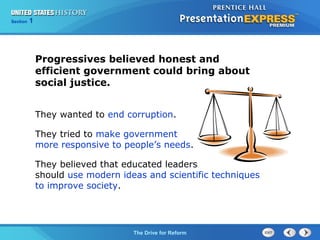
Progressives believed honest and
efficient government could bring about
social justice.
They wanted to end corruption.
They tried to make government
more responsive to people’s needs.
They believed that educated leaders
should use modern ideas and scientific techniques
to improve society.
Chapter 25 Section 1
The Cold War Begins
Section 1
The Drive for Reform
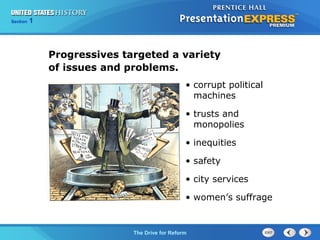
Progressives targeted a variety
of issues and problems.
• corrupt political
machines
• trusts and
monopolies
• inequities
• safety
• city services
• women’s suffrage
Chapter 25 Section 1
The Cold War Begins
Section 1
The Drive for Reform
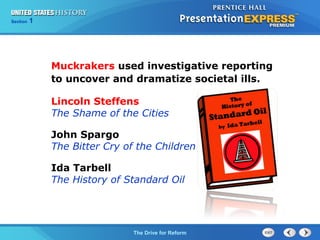
Muckrakers used investigative reporting
to uncover and dramatize societal ills.
Lincoln Steffens
The Shame of the Cities
John Spargo
The Bitter Cry of the Children
Ida Tarbell
The History of Standard Oil
Chapter 25 Section 1
The Cold War Begins
Section 1
The Drive for Reform
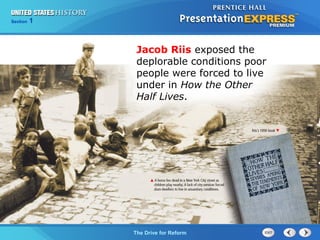
Jacob Riis exposed the
deplorable conditions poor
people were forced to live
under in How the Other
Half Lives.
Chapter 25 Section 1
The Cold War Begins
Section 1
The Drive for Reform
Upton Sinclair’s novel, The Jungle,
provided a shocking look at
meatpacking in Chicago’s
stockyards.
The naturalist novel portrayed the
struggle of common people.
Chapter 25 Section 1
The Cold War Begins
Section 1
The Drive for Reform
Progressive
novelists
covered a
wide range
of topics.
• Theodore Dreiser’s,
Sister Carrie, discussed
factory conditions for
working women.
• Francis Ellen Watkins’s,
Iola Leroy, focused on
racial issues.
• Frank Norris’s, The
Octopus, centered on
the tensions between
farmers and the
railroads.
Chapter 25 Section 1
The Cold War Begins
Section 1
The Drive for Reform
Christian reformers’
Social Gospel
demanded a shorter
work day and the
end of child labor.
Jane Addams led the settlement house movement.
Her urban community centers provided
social services for immigrants and the poor.
Chapter 25 Section 1
The Cold War Begins
Section 1
The Drive for Reform
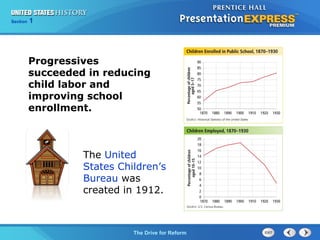
Progressives
succeeded in reducing
child labor and
improving school
enrollment.
The United
States Children’s
Bureau was
created in 1912.
Chapter 25 Section 1
The Cold War Begins
Section 1
The Drive for Reform
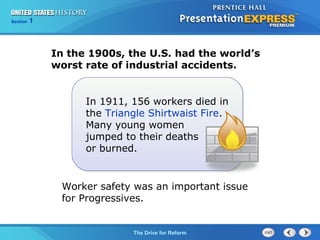
In 1911, 156 workers died in
the Triangle Shirtwaist Fire.
Many young women
jumped to their deaths
or burned.
In the 1900s, the U.S. had the world’s
worst rate of industrial accidents.
Worker safety was an important issue
for Progressives.
Chapter 25 Section 1
The Cold War Begins
Section 1
The Drive for Reform
To reform
society,
Progressives
realized they
must also
reform
government.
• Government could
not be controlled by
political bosses and
business interests.
• Government needed
to be more efficient
and more accountable
to the people.
Chapter 25 Section 1
The Cold War Begins
Section 1
The Drive for Reform
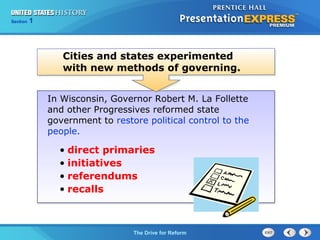
Cities and states experimented
with new methods of governing.
In Wisconsin, Governor Robert M. La Follette
and other Progressives reformed state
government to restore political control to the
people.
• direct primaries
• initiatives
• referendums
• recalls
Chapter 25 Section 1
The Cold War Begins
Section 1
The Drive for Reform
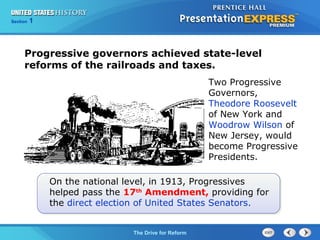
Progressive governors achieved state-level
reforms of the railroads and taxes.
On the national level, in 1913, Progressives
helped pass the 17th
Amendment, providing for
the direct election of United States Senators.
Two Progressive
Governors,
Theodore Roosevelt
of New York and
Woodrow Wilson of
New Jersey, would
become Progressive
Presidents.
Chapter 25 Section 1
The Cold War Begins
Section 1
The Drive for Reform
Section 2
Women Gain Rights
Chapter 25 Section 1
The Cold War Begins
Section 1
The Drive for Reform
• Analyze the impact of changes in women’s
education on women’s roles in society.
• Explain what women did to win workers’
rights and to improve family life.
• Evaluate the tactics women used to win
passage of the Nineteenth Amendment.
Objectives
Chapter 25 Section 1
The Cold War Begins
Section 1
The Drive for Reform
Terms and People
• Florence Kelley – founded the National
Consumer’s League known as the NCL
• National Consumer’s League (NCL) – labeled
and publicized “goods produced under fair, safe,
and healthy working conditions”
• temperance movement – campaign to end the
production, sale, and use of alcohol
• Margaret Sanger – opened the first birth control
clinic
• Ida B. Wells – helped to found the National
Association of Colored Women
Chapter 25 Section 1
The Cold War Begins
Section 1
The Drive for Reform
Terms and People (continued)
• suffrage – the right to vote
• Carrie Chapman Catt – president of the NAWSA,
campaigned to pass women’s suffrage at both the
state and national levels
• NAWSA – National American Woman Suffrage
Association
• Alice Paul – social activist, led women to picket
at the White House
• Nineteenth Amendment – 1919, granted
women the right to vote
Chapter 25 Section 1
The Cold War Begins
Section 1
The Drive for Reform
In the early 1900s, many women were no
longer content playing a limited role in
society. Activists helped bring about
Progressive reforms including women’s
suffrage.
Women would continue the struggle to expand
their roles and rights in the future.
How did women of the Progressive
Era make progress and win the right
to vote?
Chapter 25 Section 1
The Cold War Begins
Section 1
The Drive for Reform
However, most poor women
continued to labor long
hours, often under dangerous
or dirty conditions.
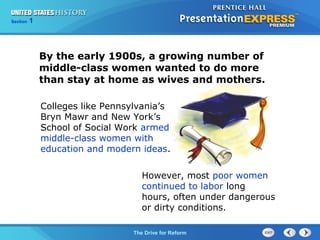
By the early 1900s, a growing number of
middle-class women wanted to do more
than stay at home as wives and mothers.
Colleges like Pennsylvania’s
Bryn Mawr and New York’s
School of Social Work armed
middle-class women with
education and modern ideas.
Chapter 25 Section 1
The Cold War Begins
Section 1
The Drive for Reform
Progressive
reforms
addressed
working
women’s
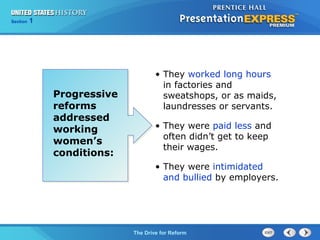
conditions:
• They worked long hours
in factories and
sweatshops, or as maids,
laundresses or servants.
• They were paid less and
often didn’t get to keep
their wages.
• They were intimidated
and bullied by employers.
Chapter 25 Section 1
The Cold War Begins
Section 1
The Drive for Reform
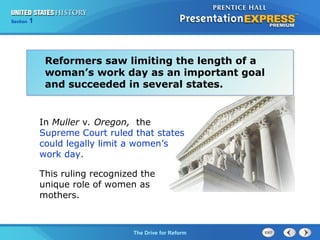
In Muller v. Oregon, the
Supreme Court ruled that states
could legally limit a women’s
work day.
This ruling recognized the
unique role of women as
mothers.
Reformers saw limiting the length of a
woman’s work day as an important goal
and succeeded in several states.
Chapter 25 Section 1
The Cold War Begins
Section 1
The Drive for Reform
In 1899, Florence Kelley founded the Women’s
Trade Union League which worked for a federal
minimum wage and a national eight-hour workday.
The WTUL also created the
first workers’ strike fund,
which helped support families
who refused to work in
unsafe or unfair conditions.
Chapter 25 Section 1
The Cold War Begins
Section 1
The Drive for Reform
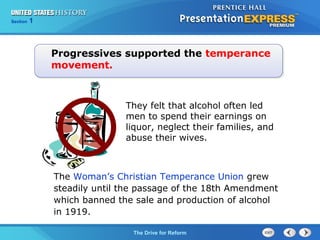
The Woman’s Christian Temperance Union grew
steadily until the passage of the 18th Amendment
which banned the sale and production of alcohol
in 1919.
Progressives supported the temperance
movement.
They felt that alcohol often led
men to spend their earnings on
liquor, neglect their families, and
abuse their wives.
Chapter 25 Section 1
The Cold War Begins
Section 1
The Drive for Reform
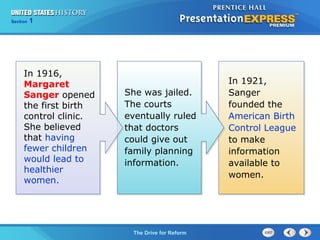
In 1921,
Sanger
founded the
American Birth
Control League
to make
information
available to
women.
In 1916,
Margaret
Sanger opened
the first birth
control clinic.
She believed
that having
fewer children
would lead to
healthier
women.
She was jailed.
The courts
eventually ruled
that doctors
could give out
family planning
information.
Chapter 25 Section 1
The Cold War Begins
Section 1
The Drive for Reform
• Ida B. Wells founded the National Association of
Colored Women or NACW in 1896.
• The NACW supported day care centers for the
children of working parents.
• Wells also worked for suffrage, to end lynchings,
and to stop segregation in the Chicago schools.
African Americans also worked
for women’s rights.
Chapter 25 Section 1
The Cold War Begins
Section 1
The Drive for Reform
Ultimately suffrage was seen as the only way
to ensure that government protected children,
fostered education, and supported family life.
Since the 1860s, Susan B. Anthony
and Elizabeth Cady Stanton
worked relentlessly for
women’s suffrage.
Still, by the 1890s, only Wyoming
and Colorado allowed women to vote.
Susan B. Anthony
Chapter 25 Section 1
The Cold War Begins
Section 1
The Drive for Reform
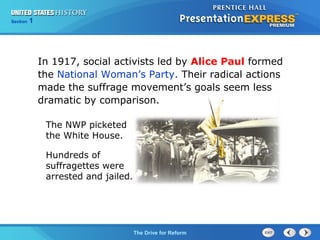
In 1917, social activists led by Alice Paul formed
the National Woman’s Party. Their radical actions
made the suffrage movement’s goals seem less
dramatic by comparison.
The NWP picketed
the White House.
Hundreds of
suffragettes were
arrested and jailed.
Chapter 25 Section 1
The Cold War Begins
Section 1
The Drive for Reform
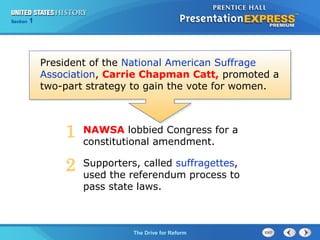
President of the National American Suffrage
Association, Carrie Chapman Catt, promoted a
two-part strategy to gain the vote for women.
NAWSA lobbied Congress for a
constitutional amendment.
Supporters, called suffragettes,
used the referendum process to
pass state laws.
1
2
Chapter 25 Section 1
The Cold War Begins
Section 1
The Drive for Reform
The National Association
Opposed to Woman’s Suffrage
feared voting would distract
women from their family roles.
Many men and women were
offended by Paul’s protests in
front of the White House. A mob
shredded her signs and pickets.
Not all
women
supported
suffrage.
Chapter 25 Section 1
The Cold War Begins
Section 1
The Drive for Reform
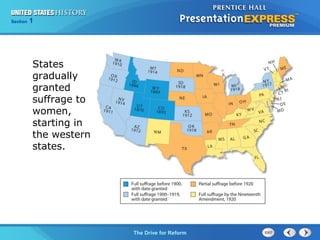
States
gradually
granted
suffrage to
women,
starting in
the western
states.
Chapter 25 Section 1
The Cold War Begins
Section 1
The Drive for Reform
In June 1919, the Nineteenth Amendment was
passed by Congress. The amendment stated
that the vote “shall not be denied or abridged
on account of sex.”
In November
1920, women
nationwide voted
in a presidential
election for the
first time.
Chapter 25 Section 1
The Cold War Begins
Section 1
The Drive for Reform
Section 3
Striving for Equality
Chapter 25 Section 1
The Cold War Begins
Section 1
The Drive for Reform
Objectives
• Analyze Progressives’ attitudes toward
minority rights.
• Explain why African Americans organized.
• Examine the strategies used by members of
other minority groups to defend their rights.
Chapter 25 Section 1
The Cold War Begins
Section 1
The Drive for Reform
Terms and People
• Americanization – effort to replace immigrant
customs with white, Protestant, middle-class
practices and values
• Booker T. Washington – favored a gradualist
approach for blacks to earn rights through
economic progress and employment in the
skilled trades
• W.E.B. Du Bois – demanded immediate and full
rights for blacks as guaranteed by the Constitution
Chapter 25 Section 1
The Cold War Begins
Section 1
The Drive for Reform
Terms and People (continued)
• Niagara Movement – opposed Washington’s
approach; favored education in history,
literature, and philosophy, not just in the trades
• NAACP – National Association for the
Advancement of Colored People, viewed full
legal rights as the only solution to racial
discrimination
• Urban League – organization to assist
working class African Americans with relief, jobs,
clothing, and schools
Chapter 25 Section 1
The Cold War Begins
Section 1
The Drive for Reform
• Anti-Defamation League – organization to
defend Jews and others from false statements,
and verbal or physical attacks
• mutualistas – Mexican American groups that
provided loans, legal assistance, and disability
insurance for members
Terms and People (continued)
Chapter 25 Section 1
The Cold War Begins
Section 1
The Drive for Reform
Prejudice and discrimination continued
even during the Progressive era. Minorities,
including African Americans, Latinos,
Catholics, Jews, and Native Americans,
worked to help themselves.
Their efforts paved the way for the era of
civil rights several decades later.
What steps did minorities take to combat
social problems and discrimination?
Chapter 25 Section 1
The Cold War Begins
Section 1
The Drive for Reform
Most Progressives were white,
middle-class Protestants who
held the racial and ethnic
prejudices common in that era.
They envisioned a
model America based
on Protestant ethics
and a white middle-
class lifestyle.
As a result, they
were often hostile
to minority or
immigrant
cultures.
Chapter 25 Section 1
The Cold War Begins
Section 1
The Drive for Reform
Progressives believed assimilation
would turn immigrants into loyal
and moral citizens.
• The results were well-intentioned, but often
insensitive or racist efforts to change the immigrants.
• While teaching English they also advised immigrants
to replace their customs with middle-class practices
and Protestant values.
• Settlement houses and other civic groups played a
prominent role in Americanization efforts.
Chapter 25 Section 1
The Cold War Begins
Section 1
The Drive for Reform
This prejudice
against immigrant
customs and
culture gave
strength to the
temperance
movement.
Progressives saw many immigrant
customs as moral failures.
Immigrant use of
alcohol, such as
the serving of
wine with meals,
alarmed some
people.
Chapter 25 Section 1
The Cold War Begins
Section 1
The Drive for Reform
• The Plessy v. Ferguson decision furthered
discrimination in the North as well as the South.
• By 1910, segregation was the norm nationwide.
• In 1914, even federal offices were segregated by
Progressive President Woodrow Wilson.
Racial theories were also used to justify
laws that kept blacks from voting. Many
Progressives supported racial prejudices.
Chapter 25 Section 1
The Cold War Begins
Section 1
The Drive for Reform
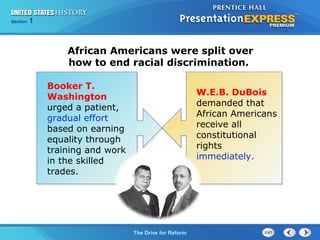
African Americans were split over
how to end racial discrimination.
Booker T.
Washington
urged a patient,
gradual effort
based on earning
equality through
training and work
in the skilled
trades.
W.E.B. DuBois
demanded that
African Americans
receive all
constitutional
rights
immediately.
Chapter 25 Section 1
The Cold War Begins
Section 1
The Drive for Reform
• Their Niagara Movement rejected the
gradualist approach stating that trade skills
“create workers, but cannot make men.”
• They also believed African Americans should
learn how to think for themselves through the
study of history, literature, and philosophy.
In 1905, DuBois and William Monroe Trotter
were concerned that all across the South,
black men could not vote.
Chapter 25 Section 1
The Cold War Begins
Section 1
The Drive for Reform
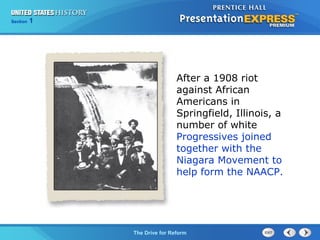
After a 1908 riot
against African
Americans in
Springfield, Illinois, a
number of white
Progressives joined
together with the
Niagara Movement to
help form the NAACP.
Chapter 25 Section 1
The Cold War Begins
Section 1
The Drive for Reform
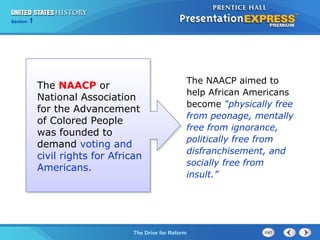
The NAACP aimed to
help African Americans
become “physically free
from peonage, mentally
free from ignorance,
politically free from
disfranchisement, and
socially free from
insult.”
The NAACP or
National Association
for the Advancement
of Colored People
was founded to
demand voting and
civil rights for African
Americans.
Chapter 25 Section 1
The Cold War Begins
Section 1
The Drive for Reform
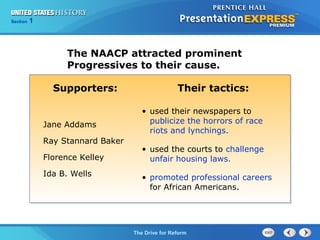
The NAACP attracted prominent
Progressives to their cause.
Supporters: Their tactics:
Jane Addams
Ray Stannard Baker
Florence Kelley
Ida B. Wells
• used their newspapers to
publicize the horrors of race
riots and lynchings.
• used the courts to challenge
unfair housing laws.
• promoted professional careers
for African Americans.
Chapter 25 Section 1
The Cold War Begins
Section 1
The Drive for Reform
In 1911, the Urban League was formed
to create a network of local clubs and
churches to assist African Americans
migrating to northern cities.
While the NAACP focused
on political justice, the
Urban League helped the
poor find jobs, housing,
clothing, and schools for
their children.
Chapter 25 Section 1
The Cold War Begins
Section 1
The Drive for Reform
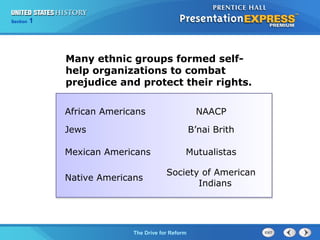
Many ethnic groups formed self-
help organizations to combat
prejudice and protect their rights.
African Americans NAACP
Jews B’nai Brith
Mexican Americans Mutualistas
Native Americans
Society of American
Indians
Chapter 25 Section 1
The Cold War Begins
Section 1
The Drive for Reform
In 1843, Jewish families formed the
B’nai B’rith to provide religious
education and self-help.
In 1913, the Anti-Defamation
League was formed to defend against
physical and verbal attacks, false
statements, and to “secure justice
and fair treatment for all citizens alike.”
Chapter 25 Section 1
The Cold War Begins
Section 1
The Drive for Reform
Mexican Americans formed mutualistas,
groups that provided legal assistance
and disability insurance.
The Partido Liberal
Mexicano in Arizona
served a role similar to
the Urban League for
Mexican Americans.
Many Latinos were
subject to unfair labor
contracts, which the
mutualistas helped to
defeat.
Chapter 25 Section 1
The Cold War Begins
Section 1
The Drive for Reform
In 1911, Carlos
Montezuma helped form
the Society of American
Indians to protest
federal policy.
Nevertheless, by 1932,
two-thirds of all tribal
lands had been sold off.
Despite organized protests, Native Americans
and Japanese lost their ownership of land.
In 1913, California
restricted land
ownership to American
citizens only, which
excluded the Japanese,
who were not allowed
to become citizens.
In a 1922 decision, the
Supreme Court allowed
the limitation.
Chapter 25 Section 1
The Cold War Begins
Section 1
The Drive for Reform
Section 4
Reformers in the White House
Chapter 25 Section 1
The Cold War Begins
Section 1
The Drive for Reform
Objectives
• Discuss Theodore Roosevelt’s ideas on the role of
government.
• Analyze how Roosevelt changed the government’s
role in the economy.
• Explain the impact of Roosevelt’s actions on
natural resources.
• Compare and contrast Taft’s policies with
Roosevelt’s.
Chapter 25 Section 1
The Cold War Begins
Section 1
The Drive for Reform
Objectives
• Evaluate what Wilson hoped to do with his
“New Freedom” program.
• Describe Wilson’s efforts to regulate the
economy.
• Assess the legacy of the Progressive Era.
Chapter 25 Section 1
The Cold War Begins
Section 1
The Drive for Reform
Terms and People
• Theodore Roosevelt – energetic Progressive who
became the youngest president in 1901
• Square Deal – Roosevelt’s program to keep the
wealthy and powerful from taking advantage of
small business owners and the poor
• Hepburn Act – gave the Interstate Commerce
Committee power to limit railroad company prices
• Meat Inspection Act – gave federal agents
power to inspect and monitor the meatpacking
industry
Chapter 25 Section 1
The Cold War Begins
Section 1
The Drive for Reform
Terms and People (continued)
• Pure Food and Drug Act – gave the federal
government responsibility for insuring food and
medicine are safe
• John Muir – California naturalist who advocated
for the creation of Yosemite National Park
• Gifford Pinchot – forestry official who proposed
managing the forests for later public use
Chapter 25 Section 1
The Cold War Begins
Section 1
The Drive for Reform
• National Reclamation Act – gave the federal
government power to decide where and how water
would be distributed in arid western states
• New Nationalism – Roosevelt’s 1912 plan to
restore the government’s trustbusting power
• Progressive Party – Roosevelt’s party in the
1912 election
Terms and People (continued)
Chapter 25 Section 1
The Cold War Begins
Section 1
The Drive for Reform
Terms and People
• Woodrow Wilson – Progressive Democrat
elected President in 1912
• New Freedom – Wilson’s program to place strict
government controls on corporations
• Sixteenth Amendment – gave Congress the
power to impose an income tax
• Federal Reserve Act – placed the national banks
under the control of a Federal Reserve Board
Chapter 25 Section 1
The Cold War Begins
Section 1
The Drive for Reform
Terms and People (continued)
• Federal Trade Commission – group appointed
by the President to monitor business practices
that might lead to a monopoly
• Clayton Antitrust Act – strengthened anti-
trust laws by spelling out specific practices in
which businesses could not engage
Chapter 25 Section 1
The Cold War Begins
Section 1
The Drive for Reform
What did Roosevelt think government
should do for citizens?
After a number of weak and ineffective
Presidents, Theodore Roosevelt was a
charismatic figure who ushered in a new era.
Roosevelt passed Progressive reforms,
expanded the powers of the presidency, and
changed how Americans viewed the roles of
the President and the government.
Chapter 25 Section 1
The Cold War Begins
Section 1
The Drive for Reform
Woodrow Wilson used the expanded power of the
presidency to promote a far-reaching reform
agenda.
Some of Wilson’s economic and antitrust measures
are still important in American life today.
What steps did Wilson take to increase
the government’s role in the economy?
Chapter 25 Section 1
The Cold War Begins
Section 1
The Drive for Reform
• Shortly after graduation from Harvard in 1880,
he was elected to the New York State Assembly.
• Following the death of his wife three years later,
he headed west to become a rancher.
• He had a reputation for being smart,
opinionated, and extremely energetic.
In 1901, 43-year-old Theodore Roosevelt
became the United States’ youngest president,
rising quickly as a Progressive idealist.
Chapter 25 Section 1
The Cold War Begins
Section 1
The Drive for Reform
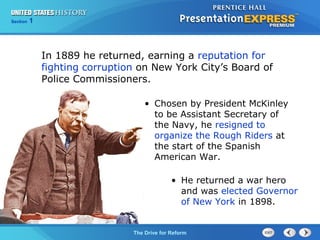
• Chosen by President McKinley
to be Assistant Secretary of
the Navy, he resigned to
organize the Rough Riders at
the start of the Spanish
American War.
• He returned a war hero
and was elected Governor
of New York in 1898.
In 1889 he returned, earning a reputation for
fighting corruption on New York City’s Board of
Police Commissioners.
Chapter 25 Section 1
The Cold War Begins
Section 1
The Drive for Reform
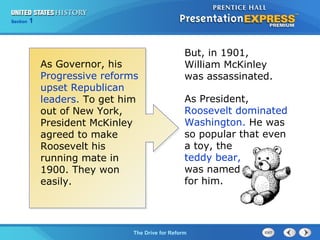
But, in 1901,
William McKinley
was assassinated.
As Governor, his
Progressive reforms
upset Republican
leaders. To get him
out of New York,
President McKinley
agreed to make
Roosevelt his
running mate in
1900. They won
easily.
As President,
Roosevelt dominated
Washington. He was
so popular that even
a toy, the
teddy bear,
was named
for him.
Chapter 25 Section 1
The Cold War Begins
Section 1
The Drive for Reform
Roosevelt greatly expanded the power of
the presidency and the role of government
beyond that of helping big business.
• He used the power
of the federal
government on
behalf of workers
and the people.
• His Square Deal
program promised
fairness and
honesty from
government.
Chapter 25 Section 1
The Cold War Begins
Section 1
The Drive for Reform
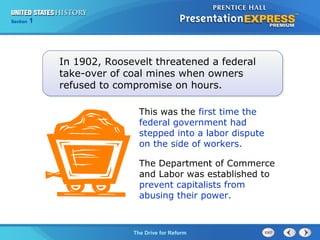
In 1902, Roosevelt threatened a federal
take-over of coal mines when owners
refused to compromise on hours.
This was the first time the
federal government had
stepped into a labor dispute
on the side of workers.
The Department of Commerce
and Labor was established to
prevent capitalists from
abusing their power.
Chapter 25 Section 1
The Cold War Begins
Section 1
The Drive for Reform
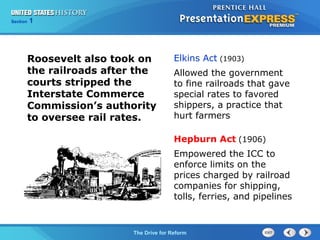
Roosevelt also took on
the railroads after the
courts stripped the
Interstate Commerce
Commission’s authority
to oversee rail rates.
Elkins Act (1903)
Allowed the government
to fine railroads that gave
special rates to favored
shippers, a practice that
hurt farmers
Hepburn Act (1906)
Empowered the ICC to
enforce limits on the
prices charged by railroad
companies for shipping,
tolls, ferries, and pipelines
Chapter 25 Section 1
The Cold War Begins
Section 1
The Drive for Reform
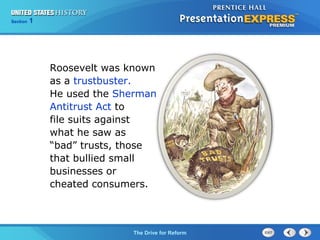
Roosevelt was known
as a trustbuster.
He used the Sherman
Antitrust Act to
file suits against
what he saw as
“bad” trusts, those
that bullied small
businesses or
cheated consumers.
Chapter 25 Section 1
The Cold War Begins
Section 1
The Drive for Reform
Roosevelt backed
Progressive goals to
protect consumers
by making the
federal government
responsible for food
safety.
Today, the Food and Drug Administration (FDA) tests
and monitors the safety of food and medicine.
• The Meat Inspection
Act provided for federal
inspections and
monitoring of meat
plants.
• The Pure Food and
Drug Act banned the
interstate shipments of
impure or mislabeled
food or medicine.
Chapter 25 Section 1
The Cold War Begins
Section 1
The Drive for Reform
Roosevelt had a deep reverence for nature,
which shaped his policies.
As a Progressive,
Roosevelt supported
Gifford Pinchot’s
philosophy on the
preservation of
resources.
Pinchot felt that resources
should be managed and
preserved for public use.
Roosevelt also admired
John Muir, who helped
establish Yosemite National
Park, and who advised him
to set aside millions of
acres of forestland.
Chapter 25 Section 1
The Cold War Begins
Section 1
The Drive for Reform
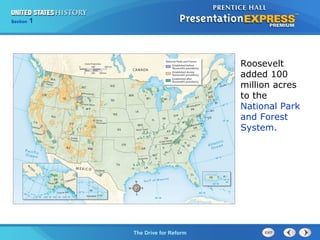
Roosevelt
added 100
million acres
to the
National Park
and Forest
System.
Chapter 25 Section 1
The Cold War Begins
Section 1
The Drive for Reform
This Act gave the
federal government
power to distribute
water in the arid
west, effectively
giving government
the power to decide
where and how
water would be
dispensed.
In another
example of the
government’s
authority,
Congress passed
the National
Reclamation
Act of 1902.
Chapter 25 Section 1
The Cold War Begins
Section 1
The Drive for Reform
1909 Taft approved the Aldrich Act which didn’t
lower tariffs as much as Roosevelt wanted.
1910 Taft signed the Mann-Elkins Act providing
for federal control over telephone and
telegraph rates.
1911 Taft relaxed the hard line set by the
Sherman Antitrust Act.
In 1908, Roosevelt retired. But he soon disagreed
with his successor William Howard Taft on several
issues.
Chapter 25 Section 1
The Cold War Begins
Section 1
The Drive for Reform
Taft believed that a monopoly was acceptable as long
as it didn’t unreasonably squeeze out smaller
companies.
When Taft fired Gifford Pinchot and overturned an
earlier antitrust decision, Roosevelt angrily decided to
oppose Taft and ran for president again.
Taft did not share Roosevelt’s views on
trusts but this was not the only area in
which they disagreed.
Chapter 25 Section 1
The Cold War Begins
Section 1
The Drive for Reform
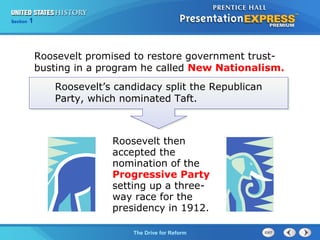
Roosevelt promised to restore government trust-
busting in a program he called New Nationalism.
Roosevelt then
accepted the
nomination of the
Progressive Party
setting up a three-
way race for the
presidency in 1912.
Roosevelt’s candidacy split the Republican
Party, which nominated Taft.
Chapter 25 Section 1
The Cold War Begins
Section 1
The Drive for Reform
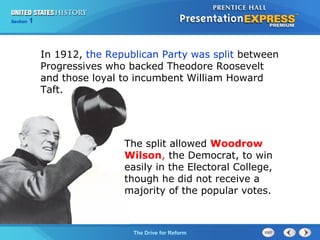
In 1912, the Republican Party was split between
Progressives who backed Theodore Roosevelt
and those loyal to incumbent William Howard
Taft.
The split allowed Woodrow
Wilson, the Democrat, to win
easily in the Electoral College,
though he did not receive a
majority of the popular votes.
Chapter 25 Section 1
The Cold War Begins
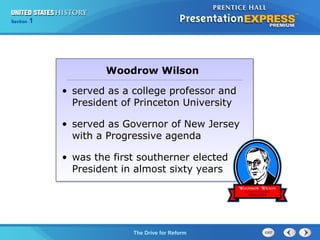
Section 1
The Drive for Reform
• served as a college professor and
President of Princeton University
• served as Governor of New Jersey
with a Progressive agenda
• was the first southerner elected
President in almost sixty years
Woodrow Wilson
Chapter 25 Section 1
The Cold War Begins
Section 1
The Drive for Reform
Wilson promised to bring
down the “triple wall of
privilege,” tariffs, banks, and
trusts.
In 1913, the
Underwood Tariff
Act cut tariffs
leading to lower
consumer prices.
Wilson felt that laws shouldn’t allow the strong to crush
the weak. His New Freedom plan was similar to
Roosevelt’s New Nationalism. It called for strict
government controls over corporations.
Chapter 25 Section 1
The Cold War Begins
Section 1
The Drive for Reform
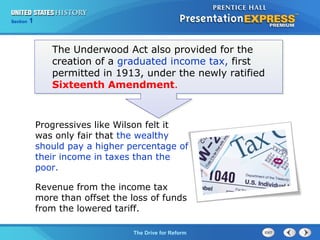
The Underwood Act also provided for the
creation of a graduated income tax, first
permitted in 1913, under the newly ratified
Sixteenth Amendment.
Progressives like Wilson felt it
was only fair that the wealthy
should pay a higher percentage of
their income in taxes than the
poor.
Revenue from the income tax
more than offset the loss of funds
from the lowered tariff.
Chapter 25 Section 1
The Cold War Begins
Section 1
The Drive for Reform
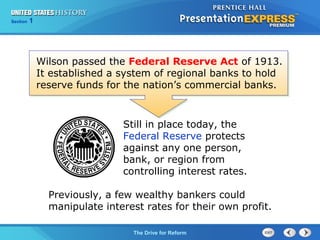
Wilson passed the Federal Reserve Act of 1913.
It established a system of regional banks to hold
reserve funds for the nation’s commercial banks.
Still in place today, the
Federal Reserve protects
against any one person,
bank, or region from
controlling interest rates.
Previously, a few wealthy bankers could
manipulate interest rates for their own profit.
Chapter 25 Section 1
The Cold War Begins
Section 1
The Drive for Reform
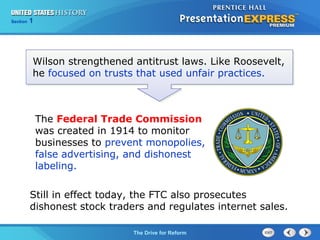
Wilson strengthened antitrust laws. Like Roosevelt,
he focused on trusts that used unfair practices.
Still in effect today, the FTC also prosecutes
dishonest stock traders and regulates internet sales.
The Federal Trade Commission
was created in 1914 to monitor
businesses to prevent monopolies,
false advertising, and dishonest
labeling.
Chapter 25 Section 1
The Cold War Begins
Section 1
The Drive for Reform
In 1914, the
Clayton Antitrust
Act defined
specific activities
in which
businesses could
not engage.
• Like Roosevelt,
Wilson only opposed
trusts that engaged
in unfair practices.
• The Clayton Act also
protected unions
from being defined
as trusts, allowing
them more freedom
to organize.
Chapter 25 Section 1
The Cold War Begins
Section 1
The Drive for Reform
Wilson
passed
several
Progressive
laws that
supported
workers.
• In 1916, the
Workingman’s
Compensation Act
provided wages for
temporarily disabled civil
service employees.
• In 1916, the Adamson
Act provided an eight-
hour day for railway
workers.
Federal laws today protect workers who are hurt
on the job and limit hours in many industries.
Chapter 25 Section 1
The Cold War Begins
Section 1
The Drive for Reform
• In 1913, coal miners went on strike in Ludlow,
Colorado.
• The company refused their demands and evicted
workers from company housing.
• Workers set up tents outside the company.
• The Colorado National Guard was called. The
Guardsmen fired on the tents and killed twenty-six
people.
• Wilson sent federal troops to restore order and
break up the strike.
Wilson did not always support workers,
as shown in the Ludlow Massacre.
Chapter 25 Section 1
The Cold War Begins
Section 1
The Drive for Reform
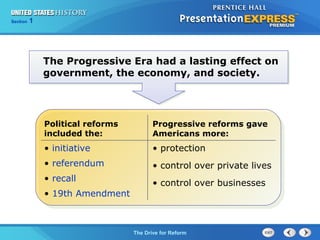
Progressive reforms gave
Americans more:
• protection
• control over private lives
• control over businesses
The Progressive Era had a lasting effect on
government, the economy, and society.
Political reforms
included the:
• initiative
• referendum
• recall
• 19th Amendment
Chapter 25 Section 1
The Cold War Begins
Section 1
The Drive for Reform
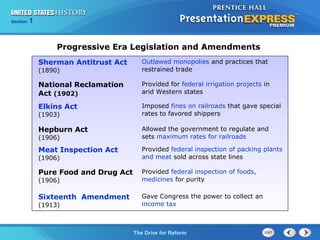
Progressive Era Legislation and Amendments
Sherman Antitrust Act
(1890)
Outlawed monopolies and practices that
restrained trade
National Reclamation
Act (1902)
Provided for federal irrigation projects in
arid Western states
Elkins Act
(1903)
Imposed fines on railroads that gave special
rates to favored shippers
Hepburn Act
(1906)
Allowed the government to regulate and
sets maximum rates for railroads
Meat Inspection Act
(1906)
Provided federal inspection of packing plants
and meat sold across state lines
Pure Food and Drug Act
(1906)
Provided federal inspection of foods,
medicines for purity
Sixteenth Amendment
(1913)
Gave Congress the power to collect an
income tax
Chapter 25 Section 1
The Cold War Begins
Section 1
The Drive for Reform
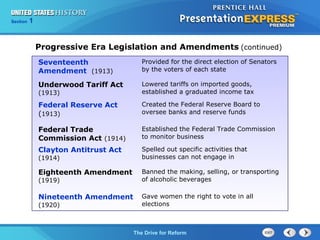
Progressive Era Legislation and Amendments (continued)
Seventeenth
Amendment (1913)
Provided for the direct election of Senators
by the voters of each state
Underwood Tariff Act
(1913)
Lowered tariffs on imported goods,
established a graduated income tax
Federal Reserve Act
(1913)
Created the Federal Reserve Board to
oversee banks and reserve funds
Federal Trade
Commission Act (1914)
Established the Federal Trade Commission
to monitor business
Clayton Antitrust Act
(1914)
Spelled out specific activities that
businesses can not engage in
Eighteenth Amendment
(1919)
Banned the making, selling, or transporting
of alcoholic beverages
Nineteenth Amendment
(1920)
Gave women the right to vote in all
elections
Chapter 25 Section 1
The Cold War Begins
Section 1
The Drive for Reform
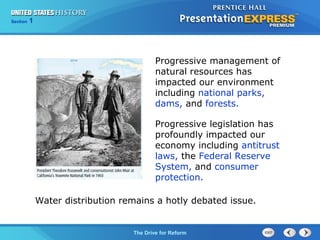
Progressive management of
natural resources has
impacted our environment
including national parks,
dams, and forests.
Progressive legislation has
profoundly impacted our
economy including antitrust
laws, the Federal Reserve
System, and consumer
protection.
Water distribution remains a hotly debated issue.
Chapter 25 Section 1
The Cold War Begins
Section 1
The Drive for Reform
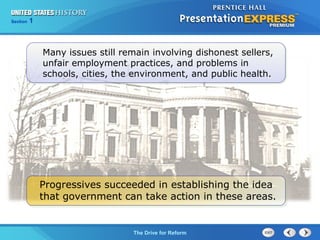
Many issues still remain involving dishonest sellers,
unfair employment practices, and problems in
schools, cities, the environment, and public health.
Progressives succeeded in establishing the idea
that government can take action in these areas.
Chapter 25 Section 1
The Cold War Begins
Section 1
The Drive for Reform
Section 5
American Influence Grows
Chapter 25 Section 1
The Cold War Begins
Section 1
The Drive for Reform
• Identify the key factors that prodded America
to expand.
• Explain how the United States took its first
steps toward increased global power.
• Summarize the chain of events leading up to
the U.S. annexation of Hawaii.
Objectives
Chapter 25 Section 1
The Cold War Begins
Section 1
The Drive for Reform
Terms and People
• imperialism – policy by which stronger nations
extend their political, economic, and military,
control over weaker territories
• extractive economy – colonial economies based
on an imperialist nation extracting or removing
raw materials
• Alfred T. Mahan – naval historian who advocated
for naval power as the basis for a great nation;
urged the U.S. to build a modern fleet
Chapter 25 Section 1
The Cold War Begins
Section 1
The Drive for Reform
Terms and People (continued)
• Social Darwinism − belief that Darwin’s theory
of the survival of the fittest should be applied to
societies, justifying imperialism
• Frederick J. Turner – historian who noted the
closure of the American frontier; his ideas were
used by others to urge U.S. overseas expansion
• Matthew Perry – U.S. naval commander who
sailed a fleet into Tokyo Bay and opened trade
with Japan in 1853
Chapter 25 Section 1
The Cold War Begins
Section 1
The Drive for Reform
Terms and People (continued)
• Queen Liliuokalani – Hawaiian monarch
dethroned in 1893 by rebel American planters in
an action backed by U.S. Marines
Chapter 25 Section 1
The Cold War Begins
Section 1
The Drive for Reform
How and why did the United States
take a more active role in world affairs?
For most of its early history, the United States
played a small role in world affairs. But in the
late 1800s, some began calling for the U.S. to
join the ranks of the world’s major powers.
Eventually, the United States abandoned
isolationism and began to acquire influence
and territories outside its continental borders.
Chapter 25 Section 1
The Cold War Begins
Section 1
The Drive for Reform
The mid-1800s
through the
early 1900s was
an “Age of
Imperialism.”
• Powerful European nations
extended their political,
economic, and military
influence by adding
colonies in Africa and Asia.
• Meanwhile, the United
States and Japan
considered the benefits
and implemented similar
imperialist policies.
Chapter 25 Section 1
The Cold War Begins
Section 1
The Drive for Reform
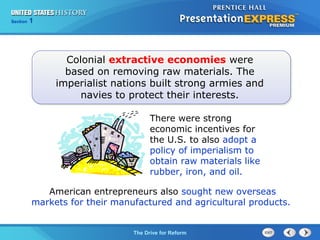
Colonial extractive economies were
based on removing raw materials. The
imperialist nations built strong armies and
navies to protect their interests.
American entrepreneurs also sought new overseas
markets for their manufactured and agricultural products.
There were strong
economic incentives for
the U.S. to also adopt a
policy of imperialism to
obtain raw materials like
rubber, iron, and oil.
Chapter 25 Section 1
The Cold War Begins
Section 1
The Drive for Reform
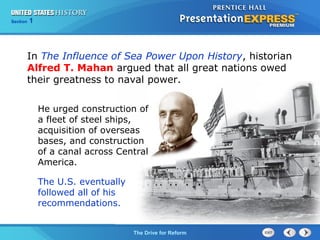
In The Influence of Sea Power Upon History, historian
Alfred T. Mahan argued that all great nations owed
their greatness to naval power.
He urged construction of
a fleet of steel ships,
acquisition of overseas
bases, and construction
of a canal across Central
America.
The U.S. eventually
followed all of his
recommendations.
Chapter 25 Section 1
The Cold War Begins
Section 1
The Drive for Reform
Social Darwinism applied Darwin’s theories of
natural selection to societies. In a competitive
world, only the fittest nations survive.
Americans extended their belief in Manifest
Destiny overseas, justifying imperialism as
God’s will.
Imperialists justified their actions
based on beliefs about their own racial,
national, and cultural superiority.
Chapter 25 Section 1
The Cold War Begins
Section 1
The Drive for Reform
Historian Frederick J. Turner argued that the
frontier served as a “safety valve,” siphoning
off potential discontent in the U.S.
Turner’s followers urged overseas
expansion as America’s next frontier to
avert future discontent in the U.S.
Chapter 25 Section 1
The Cold War Begins
Section 1
The Drive for Reform
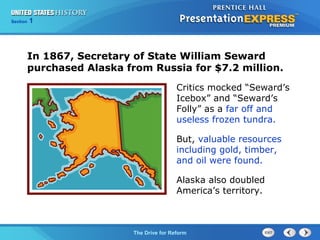
Critics mocked “Seward’s
Icebox” and “Seward’s
Folly” as a far off and
useless frozen tundra.
But, valuable resources
including gold, timber,
and oil were found.
Alaska also doubled
America’s territory.
In 1867, Secretary of State William Seward
purchased Alaska from Russia for $7.2 million.
Chapter 25 Section 1
The Cold War Begins
Section 1
The Drive for Reform
• In the 1790s Americans planters
established sugar cane plantations
in Hawaii.
• In 1887, these planters gained
control of the government from
King Kalakaua.
• In 1891, Queen Liliuokalani,
attempted to regain control of her
island.
• In 1893, with the help of U.S.
Marines, the Queen was dethroned.
President McKinley backed
annexation when he took office.
In 1898
Congress
voted to
annex
Hawaii.
Chapter 25 Section 1
The Cold War Begins
Section 1
The Drive for Reform
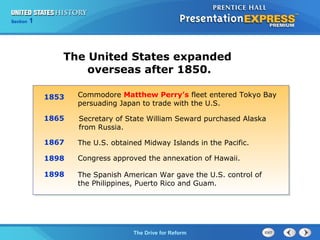
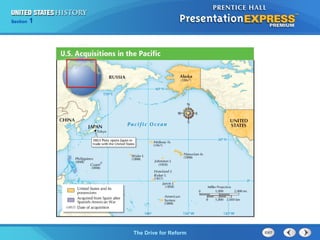
The United States expanded
overseas after 1850.
1853
1865
1867
1898
1898
Commodore Matthew Perry’s fleet entered Tokyo Bay
persuading Japan to trade with the U.S.
Secretary of State William Seward purchased Alaska
from Russia.
The U.S. obtained Midway Islands in the Pacific.
Congress approved the annexation of Hawaii.
The Spanish American War gave the U.S. control of
the Philippines, Puerto Rico and Guam.
Chapter 25 Section 1
The Cold War Begins
Section 1
The Drive for Reform
Chapter 25 Section 1
The Cold War Begins
Section 1
The Drive for Reform
Section 6
The Spanish-American War
Chapter 25 Section 1
The Cold War Begins
Section 1
The Drive for Reform
• Explain the causes of the Spanish-American
War.
• Identify the major battles of the war.
• Describe the consequences of the war,
including the debate over imperialism.
Objectives
Chapter 25 Section 1
The Cold War Begins
Section 1
The Drive for Reform
Terms and People
• José Martí – Cuban patriot who launched a war
for independence from Spain in 1895
• William Randolph Hearst – owner of the New
York Journal who, along with Joseph Pulitzer of the
New York World, started the Yellow Press
• Yellow Press – sensationalized and exaggerated
reporting on Spanish atrocities in Cuba
• jingoism – aggressive nationalism
• George Dewey – commodore of the U.S. squadron
that destroyed the Spanish fleet in Manila Bay
Chapter 25 Section 1
The Cold War Begins
Section 1
The Drive for Reform
Terms and People (continued)
• Emilio Aguinaldo – leader of Filipino
nationalists who defeated the Spanish Army
• Rough Riders – volunteer cavalry unit
assembled by Theodore Roosevelt, famous for
their 1898 charge at San Juan Hill
• Treaty of Paris – ended the Spanish-American
War and included U.S. acquisition of Puerto Rico
and the purchase of the Philippines
Chapter 25 Section 1
The Cold War Begins
Section 1
The Drive for Reform
What were the causes and effects of
the Spanish-American War?
American economic interests, the growth of
a national imperialist spirit, and an
aggressive Yellow Press brought the United
States to the brink of war in 1898.
The United States acquired colonies and
became a world power as a result of the
Spanish-American War.
Chapter 25 Section 1
The Cold War Begins
Section 1
The Drive for Reform
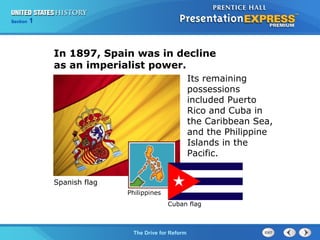
Its remaining
possessions
included Puerto
Rico and Cuba in
the Caribbean Sea,
and the Philippine
Islands in the
Pacific.
In 1897, Spain was in decline
as an imperialist power.
Cuban flag
Philippines
Spanish flag
Chapter 25 Section 1
The Cold War Begins
Section 1
The Drive for Reform
Tens of
thousands of
rural farmers
died of disease
and starvation
in concentration
camps.
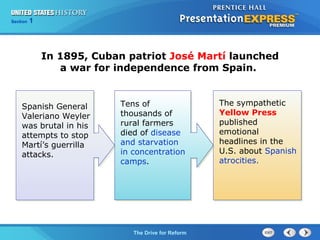
In 1895, Cuban patriot José Martí launched
a war for independence from Spain.
Spanish General
Valeriano Weyler
was brutal in his
attempts to stop
Martí’s guerrilla
attacks.
The sympathetic
Yellow Press
published
emotional
headlines in the
U.S. about Spanish
atrocities.
Chapter 25 Section 1
The Cold War Begins
Section 1
The Drive for Reform
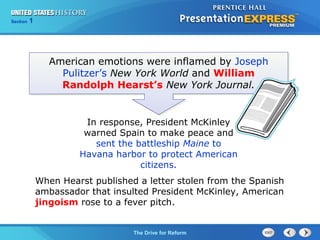
American emotions were inflamed by Joseph
Pulitzer’s New York World and William
Randolph Hearst’s New York Journal.
In response, President McKinley
warned Spain to make peace and
sent the battleship Maine to
Havana harbor to protect American
citizens.
When Hearst published a letter stolen from the Spanish
ambassador that insulted President McKinley, American
jingoism rose to a fever pitch.
Chapter 25 Section 1
The Cold War Begins
Section 1
The Drive for Reform
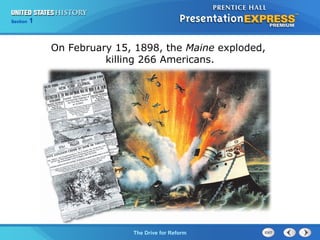
On February 15, 1898, the Maine exploded,
killing 266 Americans.
Chapter 25 Section 1
The Cold War Begins
Section 1
The Drive for Reform
A naval board of inquiry blamed a mine
for the explosion.
The Yellow Press demanded war. Headlines
screamed, “Remember the Maine!”
In response, Spain
agreed to American
demands, including
an end to the
concentration camps.
Despite Spanish
concessions,
President McKinley
sought permission
to use force.
Chapter 25 Section 1
The Cold War Begins
Section 1
The Drive for Reform
In April 1898, following a heated debate,
Congress agreed to McKinley’s request.
The U.S. Navy was sent to blockade Cuban ports.
President McKinley called for 100,000 volunteers.
Critics charged
that the real goal
was an American
take-over of Cuba.
As a result, the Teller
Amendment was
added, stipulating
that the U.S. would
not annex Cuba.
Chapter 25 Section 1
The Cold War Begins
Section 1
The Drive for Reform
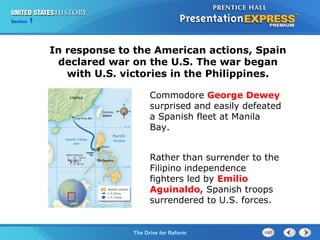
Commodore George Dewey
surprised and easily defeated
a Spanish fleet at Manila
Bay.
Rather than surrender to the
Filipino independence
fighters led by Emilio
Aguinaldo, Spanish troops
surrendered to U.S. forces.
In response to the American actions, Spain
declared war on the U.S. The war began
with U.S. victories in the Philippines.
Chapter 25 Section 1
The Cold War Begins
Section 1
The Drive for Reform
• Guantanamo Bay was
captured.
• Theodore Roosevelt’s
Rough Riders, and two
regiments of African
American soldiers, stormed
San Juan Hill.
• A Spanish fleet was
destroyed at Santiago.
• Spanish troops surrendered
in Cuba and on the island of
Puerto Rico.
U.S. troops
easily defeated
the Spanish in
Cuba.
Chapter 25 Section 1
The Cold War Begins
Section 1
The Drive for Reform
• Spain sold the
Philippines to the
U.S. for $20 million.
• Guam and Puerto
Rico became
American territories.
• Under the Teller
Amendment, Cuba
could not be
annexed by the
United States.
In the Treaty
of Paris, Spain
gave up control
of Cuba, Puerto
Rico, and
Guam.
Chapter 25 Section 1
The Cold War Begins
Section 1
The Drive for Reform
While Secretary of State John Hay called it a
“splendid little war” debate soon arose over
the Philippines and U.S. imperialism.
• President McKinley
argued that the U.S.
had a responsibility
to “uplift and civilize”
the Filipino people.
However, the U.S.
brutally suppressed a
Filipino rebellion.
• Critics like William
Jennings Bryan and
Mark Twain attacked
imperialism as
against American
principles.
Chapter 25 Section 1
The Cold War Begins
Section 1
The Drive for Reform
In February 1899, the U.S. Senate ratified the
Treaty of Paris by just one vote.
In the
election of
1900
McKinley
faced Bryan
for the
Presidency.
McKinley and
Roosevelt
won easily.
McKinley chose
Theodore
Roosevelt, “the
hero of San
Juan Hill” as
his running
mate.
The United States now had an empire and a
new stature in world affairs.
Chapter 25 Section 1
The Cold War Begins
Section 1
The Drive for Reform
Section 7
The United States Emerges as a
World Power
Chapter 25 Section 1
The Cold War Begins
Section 1
The Drive for Reform
• Examine the causes and consequences of the
Philippine insurrection.
• Analyze the effects of the Open Door Policy.
• Describe how the United States dealt with
the rising power of Japan.
Objectives
Chapter 25 Section 1
The Cold War Begins
Section 1
The Drive for Reform
• Examine what happened to Puerto Rico and
Cuba after the Spanish-American War.
• Analyze the effects of Roosevelt’s “big stick”
diplomacy.
• Compare Wilson’s “moral diplomacy” with the
foreign policies of his predecessors.
Objectives
Chapter 25 Section 1
The Cold War Begins
Section 1
The Drive for Reform
Terms and People
• insurrection – a rebellion or revolt
• guerrilla warfare – form of non-traditional
warfare, generally by small bands of fighters
• William Howard Taft – future president,
appointed governor of the Philippines in 1901
• sphere of influence – zones in China that gave
European powers exclusive access to commerce
• John Hay – U.S. Secretary of State who asserted
the “Open Door Policy” in China
Chapter 25 Section 1
The Cold War Begins
Section 1
The Drive for Reform
Terms and People (continued)
• Boxer Rebellion – 1900 revolt by secret Chinese
societies against outside influences
• Open Door Policy – Secretary of State John
Hay’s policy of opposing European colonies and
“spheres of influence” in China
• Russo-Japanese War – war launched by Japan
in 1904 to remove Russian influence in China;
settled by Theodore Roosevelt in the Treaty of
Portsmouth
Chapter 25 Section 1
The Cold War Begins
Section 1
The Drive for Reform
Terms and People (continued)
• “Gentlemen’s Agreement” – allowed Japanese
children to attend public schools with whites in
California while Japan agreed to limit emigration to
the U.S.
• Great White Fleet – 1907 world cruise by an
armada of U.S. battleships to demonstrate
American naval strength
Chapter 25 Section 1
The Cold War Begins
Section 1
The Drive for Reform
Terms and People
• Foraker Act – established civil government in
Puerto Rico with an appointed governor
• Platt Amendment – addendum to Cuba’s
constitution restricting Cuba’s independence from
the United States
• “big stick” diplomacy – Theodore Roosevelt’s
approach to international relations that depended
on a strong military to achieve its aims
• Panama Canal – waterway dug across Panama to
shorten the trip between the Atlantic and the
Pacific
Chapter 25 Section 1
The Cold War Begins
Section 1
The Drive for Reform
Terms and People (continued)
• Roosevelt Corollary – Roosevelt’s addition to the
Monroe Doctrine, which stated that the U.S. would
intervene in Latin America in order to prevent
European intervention
• “dollar diplomacy” – President Taft’s policy to
encourage investment rather than use force in
Latin America
• “moral diplomacy” – President Wilson’s policy to
encourage human rights and opportunity rather
than act in our own self-interest in Latin America
Chapter 25 Section 1
The Cold War Begins
Section 1
The Drive for Reform
Terms and People (continued)
• Francisco “Pancho” Villa – Mexican guerrilla
and outlaw who eluded capture by General
Pershing for 11 months in 1916-1917
Chapter 25 Section 1
The Cold War Begins
Section 1
The Drive for Reform
How did the United States extend its
influence in Asia?
America’s decision to keep the Philippines
helped expand U.S. influence, compete with
European colonial powers, gain Asian
markets, and extend American culture to
the people of Asia.
Imperialism in East Asia brought greater
power and wealth to Americans, but it also
increased political tensions in Asia.
Chapter 25 Section 1
The Cold War Begins
Section 1
The Drive for Reform
What actions did the United States take
to achieve its goals in Latin America?
American entrepreneurs and political leaders
called for an aggressive and exclusive role for
the U.S. in Latin America.
While beneficial to the United States, this
approach engendered anti-American sentiment
and instability in area.
Chapter 25 Section 1
The Cold War Begins
Section 1
The Drive for Reform
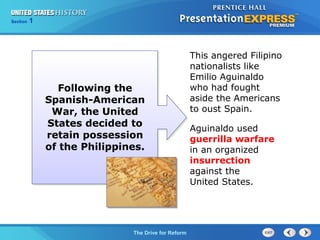
This angered Filipino
nationalists like
Emilio Aguinaldo
who had fought
aside the Americans
to oust Spain.
Aguinaldo used
guerrilla warfare
in an organized
insurrection
against the
United States.
Following the
Spanish-American
War, the United
States decided to
retain possession
of the Philippines.
Chapter 25 Section 1
The Cold War Begins
Section 1
The Drive for Reform
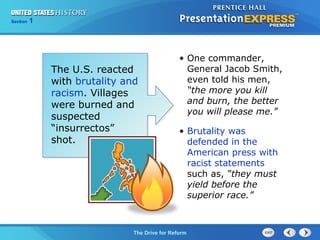
• One commander,
General Jacob Smith,
even told his men,
“the more you kill
and burn, the better
you will please me.”
• Brutality was
defended in the
American press with
racist statements
such as, “they must
yield before the
superior race.”
The U.S. reacted
with brutality and
racism. Villages
were burned and
suspected
“insurrectos”
shot.
Chapter 25 Section 1
The Cold War Begins
Section 1
The Drive for Reform
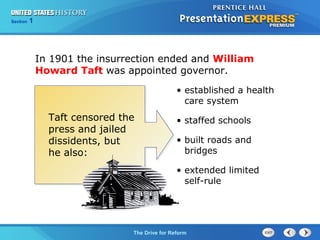
In 1901 the insurrection ended and William
Howard Taft was appointed governor.
• established a health
care system
• staffed schools
• built roads and
bridges
• extended limited
self-rule
Taft censored the
press and jailed
dissidents, but
he also:
Chapter 25 Section 1
The Cold War Begins
Section 1
The Drive for Reform
• U.S. Secretary of State John Hay announced that
the U.S. expected “equality of treatment for
commerce in China.”
• This Open Door Policy guided future U.S. actions.
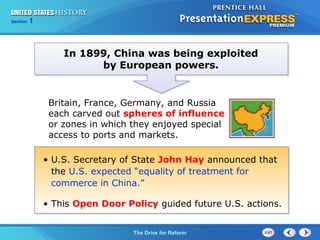
In 1899, China was being exploited
by European powers.
Britain, France, Germany, and Russia
each carved out spheres of influence
or zones in which they enjoyed special
access to ports and markets.
Chapter 25 Section 1
The Cold War Begins
Section 1
The Drive for Reform
In 1900, Chinese secret societies began
attacking foreigners and missionaries.
• A multinational force from the U.S., Europe,
and Japan, put down this Boxer Rebellion.
• The Chinese government was forced to pay
for damages done during the rebellion.
• This raised nationalist anger and contributed
to a 1911 revolt against the Emperor.
Chapter 25 Section 1
The Cold War Begins
Section 1
The Drive for Reform
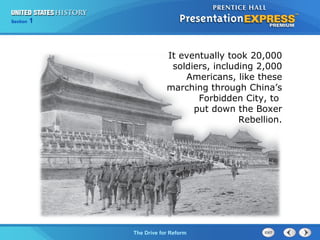
It eventually took 20,000
soldiers, including 2,000
Americans, like these
marching through China’s
Forbidden City, to
put down the Boxer
Rebellion.
Chapter 25 Section 1
The Cold War Begins
Section 1
The Drive for Reform
Japan also opposed European interference
in China, especially by Russia.
The Russo-Japanese War
● In 1904, Japan attacked a Russian fleet at Port Arthur
in China.
● The resulting Russo-Japanese War was resolved by
Theodore Roosevelt at a conference in Portsmouth, New
Hampshire.
● In 1905, Roosevelt was awarded the Nobel Peace Prize
for his role, demonstrating America’s new stature in the
world.
Chapter 25 Section 1
The Cold War Begins
Section 1
The Drive for Reform
Anti-Asian prejudice, especially on
the West Coast, disrupted
relations with Japan.
Roosevelt
negotiated a
“Gentlemen’s
Agreement” in
which the school
board removed
the ban and in
exchange, Japan
limited emigration
to the U.S.
When the San
Francisco School
Board banned Asian
students from
attending classes
with white students,
Japan was insulted.
Chapter 25 Section 1
The Cold War Begins
Section 1
The Drive for Reform
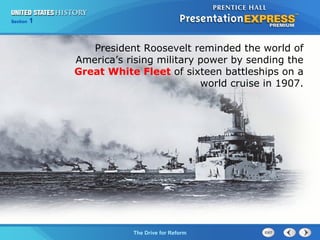
President Roosevelt reminded the world of
America’s rising military power by sending the
Great White Fleet of sixteen battleships on a
world cruise in 1907.
Chapter 25 Section 1
The Cold War Begins
Section 1
The Drive for Reform
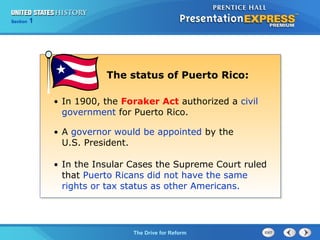
The status of Puerto Rico:
● In 1900, the Foraker Act authorized a civil
government for Puerto Rico.
● A governor would be appointed by the
U.S. President.
● In the Insular Cases the Supreme Court ruled
that Puerto Ricans did not have the same
rights or tax status as other Americans.
Chapter 25 Section 1
The Cold War Begins
Section 1
The Drive for Reform
Cubans disliked the Platt Amendment but accepted
their status since they were protected by the U.S.
The Platt Amendment made it a protectorate of
the United States which retained the rights to:
Cuba became independent in 1902.
• approve or reject any treaty signed by
Cuba.
• intervene to preserve order in Cuba.
• lease military bases in Cuba.
Chapter 25 Section 1
The Cold War Begins
Section 1
The Drive for Reform
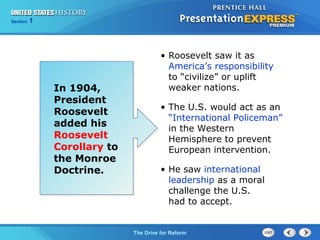
In 1904,
President
Roosevelt
added his
Roosevelt
Corollary to
the Monroe
Doctrine.
• Roosevelt saw it as
America’s responsibility
to “civilize” or uplift
weaker nations.
• The U.S. would act as an
“International Policeman”
in the Western
Hemisphere to prevent
European intervention.
• He saw international
leadership as a moral
challenge the U.S.
had to accept.
Chapter 25 Section 1
The Cold War Begins
Section 1
The Drive for Reform
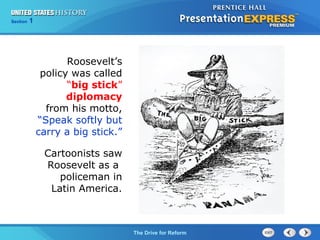
Roosevelt’s
policy was called
“big stick”
diplomacy
from his motto,
“Speak softly but
carry a big stick.”
Cartoonists saw
Roosevelt as a
policeman in
Latin America.
Chapter 25 Section 1
The Cold War Begins
Section 1
The Drive for Reform
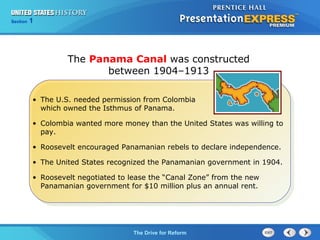
• The U.S. needed permission from Colombia
which owned the Isthmus of Panama.
• Colombia wanted more money than the United States was willing to
pay.
• Roosevelt encouraged Panamanian rebels to declare independence.
• The United States recognized the Panamanian government in 1904.
• Roosevelt negotiated to lease the “Canal Zone” from the new
Panamanian government for $10 million plus an annual rent.
The Panama Canal was constructed
between 1904–1913
Chapter 25 Section 1
The Cold War Begins
Section 1
The Drive for Reform
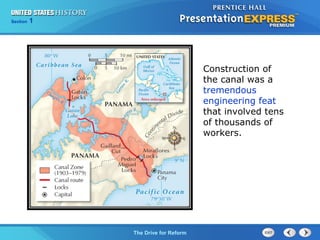
Construction of
the canal was a
tremendous
engineering feat
that involved tens
of thousands of
workers.
Chapter 25 Section 1
The Cold War Begins
Section 1
The Drive for Reform
• Rather than
emphasizing military
force, Taft looked to
increase American
investments in
plantations, mines,
and railroads.
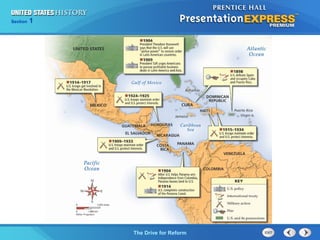
In 1909 William Howard Taft became
President. He replaced the “big stick,” which
was unpopular among Latin Americans, with
“dollar diplomacy.”
• Taft did not dismiss
the use of force as he
sent troops into
Nicaragua in 1909
and 1912.
Chapter 25 Section 1
The Cold War Begins
Section 1
The Drive for Reform
Chapter 25 Section 1
The Cold War Begins
Section 1
The Drive for Reform
President,
Woodrow
Wilson
proclaimed a
new policy
of “moral
diplomacy”
in 1913.
• supported human rights
and national integrity
rather than U.S. self-
interest
• stated that the U.S.
needed to be a friend
even when it was not in
our best interests
• promised the U.S. would
“never again seek one
additional foot of territory
by conquest”
Chapter 25 Section 1
The Cold War Begins
Section 1
The Drive for Reform
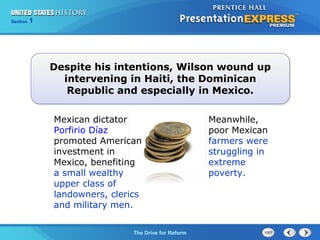
Despite his intentions, Wilson wound up
intervening in Haiti, the Dominican
Republic and especially in Mexico.
Mexican dictator
Porfirio Díaz
promoted American
investment in
Mexico, benefiting
a small wealthy
upper class of
landowners, clerics
and military men.
Meanwhile,
poor Mexican
farmers were
struggling in
extreme
poverty.
Chapter 25 Section 1
The Cold War Begins
Section 1
The Drive for Reform
Wilson refused to
recognize a
“government of
butchers.” When
American sailors
were arrested, he
sent U.S. Marines
into Mexico
Huerta’s
government
collapsed and
he was in turn
replaced by
Venustiano
Carrenza.
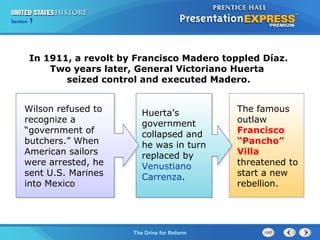
In 1911, a revolt by Francisco Madero toppled Díaz.
Two years later, General Victoriano Huerta
seized control and executed Madero.
The famous
outlaw
Francisco
“Pancho”
Villa
threatened to
start a new
rebellion.
Chapter 25 Section 1
The Cold War Begins
Section 1
The Drive for Reform
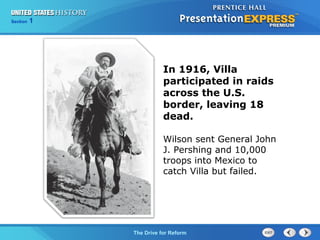
In 1916, Villa
participated in raids
across the U.S.
border, leaving 18
dead.
Wilson sent General John
J. Pershing and 10,000
troops into Mexico to
catch Villa but failed.

Topic 11

  • 1.
    Chapter 25 Section1 The Cold War Begins Section 1 The Drive for Reform • Identify the causes of Progressivism and compare it to Populism. • Analyze the role that journalists played in the Progressive Movement. • Evaluate some of the social reforms that Progressives tackled. • Explain what Progressives hoped to achieve through political reforms. Objectives
  • 2.
    Chapter 25 Section1 The Cold War Begins Section 1 The Drive for Reform Terms and People • Progressivism – movement that believed honest and efficient government could bring about social justice • muckrakers – socially conscious journalists and writers who dramatized the need for reform • Lincoln Steffens – muckraking author of Shame of the Cities, exposed corruption in urban government • Jacob Riis – muckraking photographer and author of How The Other Half Lives, exposed the condition of the urban poor
  • 3.
    Chapter 25 Section1 The Cold War Begins Section 1 The Drive for Reform Terms and People (continued) • Social Gospel – belief that following Christian principles could bring about social justice • settlement house – community center that provided services for the urban poor • Jane Addams – leader in the settlement house movement • direct primary – allowed voters to select candidates rather than having them selected by party leaders
  • 4.
    Chapter 25 Section1 The Cold War Begins Section 1 The Drive for Reform Terms and People (continued) • initiative – gave citizens the power to propose laws • referendum – allowed citizens to reject or accept laws passed by their legislature • recall – gave voters the power to remove legislators before their term is up
  • 5.
    Chapter 25 Section1 The Cold War Begins Section 1 The Drive for Reform What areas did Progressives think were in need of the greatest reform? Progressivism was a movement that believed the social challenges caused by industrialization, urbanization, and immigration in the 1890s and 1900s could be addressed. Progressives believed that honest and efficient government could bring about social justice.
  • 6.
    Chapter 25 Section1 The Cold War Begins Section 1 The Drive for Reform • believed industrialization and urbanization had created social and political problems. • were mainly from the emerging middle class. • wanted to reform by using logic and reason. Progressives were reformers who:
  • 7.
    Chapter 25 Section1 The Cold War Begins Section 1 The Drive for Reform Progressives believed honest and efficient government could bring about social justice. They wanted to end corruption. They tried to make government more responsive to people’s needs. They believed that educated leaders should use modern ideas and scientific techniques to improve society.
  • 8.
    Chapter 25 Section1 The Cold War Begins Section 1 The Drive for Reform Progressives targeted a variety of issues and problems. • corrupt political machines • trusts and monopolies • inequities • safety • city services • women’s suffrage
  • 9.
    Chapter 25 Section1 The Cold War Begins Section 1 The Drive for Reform Muckrakers used investigative reporting to uncover and dramatize societal ills. Lincoln Steffens The Shame of the Cities John Spargo The Bitter Cry of the Children Ida Tarbell The History of Standard Oil
  • 10.
    Chapter 25 Section1 The Cold War Begins Section 1 The Drive for Reform Jacob Riis exposed the deplorable conditions poor people were forced to live under in How the Other Half Lives.
  • 11.
    Chapter 25 Section1 The Cold War Begins Section 1 The Drive for Reform Upton Sinclair’s novel, The Jungle, provided a shocking look at meatpacking in Chicago’s stockyards. The naturalist novel portrayed the struggle of common people.
  • 12.
    Chapter 25 Section1 The Cold War Begins Section 1 The Drive for Reform Progressive novelists covered a wide range of topics. • Theodore Dreiser’s, Sister Carrie, discussed factory conditions for working women. • Francis Ellen Watkins’s, Iola Leroy, focused on racial issues. • Frank Norris’s, The Octopus, centered on the tensions between farmers and the railroads.
  • 13.
    Chapter 25 Section1 The Cold War Begins Section 1 The Drive for Reform Christian reformers’ Social Gospel demanded a shorter work day and the end of child labor. Jane Addams led the settlement house movement. Her urban community centers provided social services for immigrants and the poor.
  • 14.
    Chapter 25 Section1 The Cold War Begins Section 1 The Drive for Reform Progressives succeeded in reducing child labor and improving school enrollment. The United States Children’s Bureau was created in 1912.
  • 15.
    Chapter 25 Section1 The Cold War Begins Section 1 The Drive for Reform In 1911, 156 workers died in the Triangle Shirtwaist Fire. Many young women jumped to their deaths or burned. In the 1900s, the U.S. had the world’s worst rate of industrial accidents. Worker safety was an important issue for Progressives.
  • 16.
    Chapter 25 Section1 The Cold War Begins Section 1 The Drive for Reform To reform society, Progressives realized they must also reform government. • Government could not be controlled by political bosses and business interests. • Government needed to be more efficient and more accountable to the people.
  • 17.
    Chapter 25 Section1 The Cold War Begins Section 1 The Drive for Reform Cities and states experimented with new methods of governing. In Wisconsin, Governor Robert M. La Follette and other Progressives reformed state government to restore political control to the people. • direct primaries • initiatives • referendums • recalls
  • 18.
    Chapter 25 Section1 The Cold War Begins Section 1 The Drive for Reform Progressive governors achieved state-level reforms of the railroads and taxes. On the national level, in 1913, Progressives helped pass the 17th Amendment, providing for the direct election of United States Senators. Two Progressive Governors, Theodore Roosevelt of New York and Woodrow Wilson of New Jersey, would become Progressive Presidents.
  • 19.
    Chapter 25 Section1 The Cold War Begins Section 1 The Drive for Reform Section 2 Women Gain Rights
  • 20.
    Chapter 25 Section1 The Cold War Begins Section 1 The Drive for Reform • Analyze the impact of changes in women’s education on women’s roles in society. • Explain what women did to win workers’ rights and to improve family life. • Evaluate the tactics women used to win passage of the Nineteenth Amendment. Objectives
  • 21.
    Chapter 25 Section1 The Cold War Begins Section 1 The Drive for Reform Terms and People • Florence Kelley – founded the National Consumer’s League known as the NCL • National Consumer’s League (NCL) – labeled and publicized “goods produced under fair, safe, and healthy working conditions” • temperance movement – campaign to end the production, sale, and use of alcohol • Margaret Sanger – opened the first birth control clinic • Ida B. Wells – helped to found the National Association of Colored Women
  • 22.
    Chapter 25 Section1 The Cold War Begins Section 1 The Drive for Reform Terms and People (continued) • suffrage – the right to vote • Carrie Chapman Catt – president of the NAWSA, campaigned to pass women’s suffrage at both the state and national levels • NAWSA – National American Woman Suffrage Association • Alice Paul – social activist, led women to picket at the White House • Nineteenth Amendment – 1919, granted women the right to vote
  • 23.
    Chapter 25 Section1 The Cold War Begins Section 1 The Drive for Reform In the early 1900s, many women were no longer content playing a limited role in society. Activists helped bring about Progressive reforms including women’s suffrage. Women would continue the struggle to expand their roles and rights in the future. How did women of the Progressive Era make progress and win the right to vote?
  • 24.
    Chapter 25 Section1 The Cold War Begins Section 1 The Drive for Reform However, most poor women continued to labor long hours, often under dangerous or dirty conditions. By the early 1900s, a growing number of middle-class women wanted to do more than stay at home as wives and mothers. Colleges like Pennsylvania’s Bryn Mawr and New York’s School of Social Work armed middle-class women with education and modern ideas.
  • 25.
    Chapter 25 Section1 The Cold War Begins Section 1 The Drive for Reform Progressive reforms addressed working women’s conditions: • They worked long hours in factories and sweatshops, or as maids, laundresses or servants. • They were paid less and often didn’t get to keep their wages. • They were intimidated and bullied by employers.
  • 26.
    Chapter 25 Section1 The Cold War Begins Section 1 The Drive for Reform In Muller v. Oregon, the Supreme Court ruled that states could legally limit a women’s work day. This ruling recognized the unique role of women as mothers. Reformers saw limiting the length of a woman’s work day as an important goal and succeeded in several states.
  • 27.
    Chapter 25 Section1 The Cold War Begins Section 1 The Drive for Reform In 1899, Florence Kelley founded the Women’s Trade Union League which worked for a federal minimum wage and a national eight-hour workday. The WTUL also created the first workers’ strike fund, which helped support families who refused to work in unsafe or unfair conditions.
  • 28.
    Chapter 25 Section1 The Cold War Begins Section 1 The Drive for Reform The Woman’s Christian Temperance Union grew steadily until the passage of the 18th Amendment which banned the sale and production of alcohol in 1919. Progressives supported the temperance movement. They felt that alcohol often led men to spend their earnings on liquor, neglect their families, and abuse their wives.
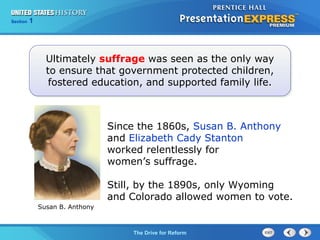
  • 29.
    Chapter 25 Section1 The Cold War Begins Section 1 The Drive for Reform In 1921, Sanger founded the American Birth Control League to make information available to women. In 1916, Margaret Sanger opened the first birth control clinic. She believed that having fewer children would lead to healthier women. She was jailed. The courts eventually ruled that doctors could give out family planning information.
  • 30.
    Chapter 25 Section1 The Cold War Begins Section 1 The Drive for Reform • Ida B. Wells founded the National Association of Colored Women or NACW in 1896. • The NACW supported day care centers for the children of working parents. • Wells also worked for suffrage, to end lynchings, and to stop segregation in the Chicago schools. African Americans also worked for women’s rights.
  • 31.
    Chapter 25 Section1 The Cold War Begins Section 1 The Drive for Reform Ultimately suffrage was seen as the only way to ensure that government protected children, fostered education, and supported family life. Since the 1860s, Susan B. Anthony and Elizabeth Cady Stanton worked relentlessly for women’s suffrage. Still, by the 1890s, only Wyoming and Colorado allowed women to vote. Susan B. Anthony
  • 32.
    Chapter 25 Section1 The Cold War Begins Section 1 The Drive for Reform In 1917, social activists led by Alice Paul formed the National Woman’s Party. Their radical actions made the suffrage movement’s goals seem less dramatic by comparison. The NWP picketed the White House. Hundreds of suffragettes were arrested and jailed.
  • 33.
    Chapter 25 Section1 The Cold War Begins Section 1 The Drive for Reform President of the National American Suffrage Association, Carrie Chapman Catt, promoted a two-part strategy to gain the vote for women. NAWSA lobbied Congress for a constitutional amendment. Supporters, called suffragettes, used the referendum process to pass state laws. 1 2
  • 34.
    Chapter 25 Section1 The Cold War Begins Section 1 The Drive for Reform The National Association Opposed to Woman’s Suffrage feared voting would distract women from their family roles. Many men and women were offended by Paul’s protests in front of the White House. A mob shredded her signs and pickets. Not all women supported suffrage.
  • 35.
    Chapter 25 Section1 The Cold War Begins Section 1 The Drive for Reform States gradually granted suffrage to women, starting in the western states.
  • 36.
    Chapter 25 Section1 The Cold War Begins Section 1 The Drive for Reform In June 1919, the Nineteenth Amendment was passed by Congress. The amendment stated that the vote “shall not be denied or abridged on account of sex.” In November 1920, women nationwide voted in a presidential election for the first time.
  • 37.
    Chapter 25 Section1 The Cold War Begins Section 1 The Drive for Reform Section 3 Striving for Equality
  • 38.
    Chapter 25 Section1 The Cold War Begins Section 1 The Drive for Reform Objectives • Analyze Progressives’ attitudes toward minority rights. • Explain why African Americans organized. • Examine the strategies used by members of other minority groups to defend their rights.
  • 39.
    Chapter 25 Section1 The Cold War Begins Section 1 The Drive for Reform Terms and People • Americanization – effort to replace immigrant customs with white, Protestant, middle-class practices and values • Booker T. Washington – favored a gradualist approach for blacks to earn rights through economic progress and employment in the skilled trades • W.E.B. Du Bois – demanded immediate and full rights for blacks as guaranteed by the Constitution
  • 40.
    Chapter 25 Section1 The Cold War Begins Section 1 The Drive for Reform Terms and People (continued) • Niagara Movement – opposed Washington’s approach; favored education in history, literature, and philosophy, not just in the trades • NAACP – National Association for the Advancement of Colored People, viewed full legal rights as the only solution to racial discrimination • Urban League – organization to assist working class African Americans with relief, jobs, clothing, and schools
  • 41.
    Chapter 25 Section1 The Cold War Begins Section 1 The Drive for Reform • Anti-Defamation League – organization to defend Jews and others from false statements, and verbal or physical attacks • mutualistas – Mexican American groups that provided loans, legal assistance, and disability insurance for members Terms and People (continued)
  • 42.
    Chapter 25 Section1 The Cold War Begins Section 1 The Drive for Reform Prejudice and discrimination continued even during the Progressive era. Minorities, including African Americans, Latinos, Catholics, Jews, and Native Americans, worked to help themselves. Their efforts paved the way for the era of civil rights several decades later. What steps did minorities take to combat social problems and discrimination?
  • 43.
    Chapter 25 Section1 The Cold War Begins Section 1 The Drive for Reform Most Progressives were white, middle-class Protestants who held the racial and ethnic prejudices common in that era. They envisioned a model America based on Protestant ethics and a white middle- class lifestyle. As a result, they were often hostile to minority or immigrant cultures.
  • 44.
    Chapter 25 Section1 The Cold War Begins Section 1 The Drive for Reform Progressives believed assimilation would turn immigrants into loyal and moral citizens. • The results were well-intentioned, but often insensitive or racist efforts to change the immigrants. • While teaching English they also advised immigrants to replace their customs with middle-class practices and Protestant values. • Settlement houses and other civic groups played a prominent role in Americanization efforts.
  • 45.
    Chapter 25 Section1 The Cold War Begins Section 1 The Drive for Reform This prejudice against immigrant customs and culture gave strength to the temperance movement. Progressives saw many immigrant customs as moral failures. Immigrant use of alcohol, such as the serving of wine with meals, alarmed some people.
  • 46.
    Chapter 25 Section1 The Cold War Begins Section 1 The Drive for Reform • The Plessy v. Ferguson decision furthered discrimination in the North as well as the South. • By 1910, segregation was the norm nationwide. • In 1914, even federal offices were segregated by Progressive President Woodrow Wilson. Racial theories were also used to justify laws that kept blacks from voting. Many Progressives supported racial prejudices.
  • 47.
    Chapter 25 Section1 The Cold War Begins Section 1 The Drive for Reform African Americans were split over how to end racial discrimination. Booker T. Washington urged a patient, gradual effort based on earning equality through training and work in the skilled trades. W.E.B. DuBois demanded that African Americans receive all constitutional rights immediately.
  • 48.
    Chapter 25 Section1 The Cold War Begins Section 1 The Drive for Reform • Their Niagara Movement rejected the gradualist approach stating that trade skills “create workers, but cannot make men.” • They also believed African Americans should learn how to think for themselves through the study of history, literature, and philosophy. In 1905, DuBois and William Monroe Trotter were concerned that all across the South, black men could not vote.
  • 49.
    Chapter 25 Section1 The Cold War Begins Section 1 The Drive for Reform After a 1908 riot against African Americans in Springfield, Illinois, a number of white Progressives joined together with the Niagara Movement to help form the NAACP.
  • 50.
    Chapter 25 Section1 The Cold War Begins Section 1 The Drive for Reform The NAACP aimed to help African Americans become “physically free from peonage, mentally free from ignorance, politically free from disfranchisement, and socially free from insult.” The NAACP or National Association for the Advancement of Colored People was founded to demand voting and civil rights for African Americans.
  • 51.
    Chapter 25 Section1 The Cold War Begins Section 1 The Drive for Reform The NAACP attracted prominent Progressives to their cause. Supporters: Their tactics: Jane Addams Ray Stannard Baker Florence Kelley Ida B. Wells • used their newspapers to publicize the horrors of race riots and lynchings. • used the courts to challenge unfair housing laws. • promoted professional careers for African Americans.
  • 52.
    Chapter 25 Section1 The Cold War Begins Section 1 The Drive for Reform In 1911, the Urban League was formed to create a network of local clubs and churches to assist African Americans migrating to northern cities. While the NAACP focused on political justice, the Urban League helped the poor find jobs, housing, clothing, and schools for their children.
  • 53.
    Chapter 25 Section1 The Cold War Begins Section 1 The Drive for Reform Many ethnic groups formed self- help organizations to combat prejudice and protect their rights. African Americans NAACP Jews B’nai Brith Mexican Americans Mutualistas Native Americans Society of American Indians
  • 54.
    Chapter 25 Section1 The Cold War Begins Section 1 The Drive for Reform In 1843, Jewish families formed the B’nai B’rith to provide religious education and self-help. In 1913, the Anti-Defamation League was formed to defend against physical and verbal attacks, false statements, and to “secure justice and fair treatment for all citizens alike.”
  • 55.
    Chapter 25 Section1 The Cold War Begins Section 1 The Drive for Reform Mexican Americans formed mutualistas, groups that provided legal assistance and disability insurance. The Partido Liberal Mexicano in Arizona served a role similar to the Urban League for Mexican Americans. Many Latinos were subject to unfair labor contracts, which the mutualistas helped to defeat.
  • 56.
    Chapter 25 Section1 The Cold War Begins Section 1 The Drive for Reform In 1911, Carlos Montezuma helped form the Society of American Indians to protest federal policy. Nevertheless, by 1932, two-thirds of all tribal lands had been sold off. Despite organized protests, Native Americans and Japanese lost their ownership of land. In 1913, California restricted land ownership to American citizens only, which excluded the Japanese, who were not allowed to become citizens. In a 1922 decision, the Supreme Court allowed the limitation.
  • 57.
    Chapter 25 Section1 The Cold War Begins Section 1 The Drive for Reform Section 4 Reformers in the White House
  • 58.
    Chapter 25 Section1 The Cold War Begins Section 1 The Drive for Reform Objectives • Discuss Theodore Roosevelt’s ideas on the role of government. • Analyze how Roosevelt changed the government’s role in the economy. • Explain the impact of Roosevelt’s actions on natural resources. • Compare and contrast Taft’s policies with Roosevelt’s.
  • 59.
    Chapter 25 Section1 The Cold War Begins Section 1 The Drive for Reform Objectives • Evaluate what Wilson hoped to do with his “New Freedom” program. • Describe Wilson’s efforts to regulate the economy. • Assess the legacy of the Progressive Era.
  • 60.
    Chapter 25 Section1 The Cold War Begins Section 1 The Drive for Reform Terms and People • Theodore Roosevelt – energetic Progressive who became the youngest president in 1901 • Square Deal – Roosevelt’s program to keep the wealthy and powerful from taking advantage of small business owners and the poor • Hepburn Act – gave the Interstate Commerce Committee power to limit railroad company prices • Meat Inspection Act – gave federal agents power to inspect and monitor the meatpacking industry
  • 61.
    Chapter 25 Section1 The Cold War Begins Section 1 The Drive for Reform Terms and People (continued) • Pure Food and Drug Act – gave the federal government responsibility for insuring food and medicine are safe • John Muir – California naturalist who advocated for the creation of Yosemite National Park • Gifford Pinchot – forestry official who proposed managing the forests for later public use
  • 62.
    Chapter 25 Section1 The Cold War Begins Section 1 The Drive for Reform • National Reclamation Act – gave the federal government power to decide where and how water would be distributed in arid western states • New Nationalism – Roosevelt’s 1912 plan to restore the government’s trustbusting power • Progressive Party – Roosevelt’s party in the 1912 election Terms and People (continued)
  • 63.
    Chapter 25 Section1 The Cold War Begins Section 1 The Drive for Reform Terms and People • Woodrow Wilson – Progressive Democrat elected President in 1912 • New Freedom – Wilson’s program to place strict government controls on corporations • Sixteenth Amendment – gave Congress the power to impose an income tax • Federal Reserve Act – placed the national banks under the control of a Federal Reserve Board
  • 64.
    Chapter 25 Section1 The Cold War Begins Section 1 The Drive for Reform Terms and People (continued) • Federal Trade Commission – group appointed by the President to monitor business practices that might lead to a monopoly • Clayton Antitrust Act – strengthened anti- trust laws by spelling out specific practices in which businesses could not engage
  • 65.
    Chapter 25 Section1 The Cold War Begins Section 1 The Drive for Reform What did Roosevelt think government should do for citizens? After a number of weak and ineffective Presidents, Theodore Roosevelt was a charismatic figure who ushered in a new era. Roosevelt passed Progressive reforms, expanded the powers of the presidency, and changed how Americans viewed the roles of the President and the government.
  • 66.
    Chapter 25 Section1 The Cold War Begins Section 1 The Drive for Reform Woodrow Wilson used the expanded power of the presidency to promote a far-reaching reform agenda. Some of Wilson’s economic and antitrust measures are still important in American life today. What steps did Wilson take to increase the government’s role in the economy?
  • 67.
    Chapter 25 Section1 The Cold War Begins Section 1 The Drive for Reform • Shortly after graduation from Harvard in 1880, he was elected to the New York State Assembly. • Following the death of his wife three years later, he headed west to become a rancher. • He had a reputation for being smart, opinionated, and extremely energetic. In 1901, 43-year-old Theodore Roosevelt became the United States’ youngest president, rising quickly as a Progressive idealist.
  • 68.
    Chapter 25 Section1 The Cold War Begins Section 1 The Drive for Reform • Chosen by President McKinley to be Assistant Secretary of the Navy, he resigned to organize the Rough Riders at the start of the Spanish American War. • He returned a war hero and was elected Governor of New York in 1898. In 1889 he returned, earning a reputation for fighting corruption on New York City’s Board of Police Commissioners.
  • 69.
    Chapter 25 Section1 The Cold War Begins Section 1 The Drive for Reform But, in 1901, William McKinley was assassinated. As Governor, his Progressive reforms upset Republican leaders. To get him out of New York, President McKinley agreed to make Roosevelt his running mate in 1900. They won easily. As President, Roosevelt dominated Washington. He was so popular that even a toy, the teddy bear, was named for him.
  • 70.
    Chapter 25 Section1 The Cold War Begins Section 1 The Drive for Reform Roosevelt greatly expanded the power of the presidency and the role of government beyond that of helping big business. • He used the power of the federal government on behalf of workers and the people. • His Square Deal program promised fairness and honesty from government.
  • 71.
    Chapter 25 Section1 The Cold War Begins Section 1 The Drive for Reform In 1902, Roosevelt threatened a federal take-over of coal mines when owners refused to compromise on hours. This was the first time the federal government had stepped into a labor dispute on the side of workers. The Department of Commerce and Labor was established to prevent capitalists from abusing their power.
  • 72.
    Chapter 25 Section1 The Cold War Begins Section 1 The Drive for Reform Roosevelt also took on the railroads after the courts stripped the Interstate Commerce Commission’s authority to oversee rail rates. Elkins Act (1903) Allowed the government to fine railroads that gave special rates to favored shippers, a practice that hurt farmers Hepburn Act (1906) Empowered the ICC to enforce limits on the prices charged by railroad companies for shipping, tolls, ferries, and pipelines
  • 73.
    Chapter 25 Section1 The Cold War Begins Section 1 The Drive for Reform Roosevelt was known as a trustbuster. He used the Sherman Antitrust Act to file suits against what he saw as “bad” trusts, those that bullied small businesses or cheated consumers.
  • 74.
    Chapter 25 Section1 The Cold War Begins Section 1 The Drive for Reform Roosevelt backed Progressive goals to protect consumers by making the federal government responsible for food safety. Today, the Food and Drug Administration (FDA) tests and monitors the safety of food and medicine. • The Meat Inspection Act provided for federal inspections and monitoring of meat plants. • The Pure Food and Drug Act banned the interstate shipments of impure or mislabeled food or medicine.
  • 75.
    Chapter 25 Section1 The Cold War Begins Section 1 The Drive for Reform Roosevelt had a deep reverence for nature, which shaped his policies. As a Progressive, Roosevelt supported Gifford Pinchot’s philosophy on the preservation of resources. Pinchot felt that resources should be managed and preserved for public use. Roosevelt also admired John Muir, who helped establish Yosemite National Park, and who advised him to set aside millions of acres of forestland.
  • 76.
    Chapter 25 Section1 The Cold War Begins Section 1 The Drive for Reform Roosevelt added 100 million acres to the National Park and Forest System.
  • 77.
    Chapter 25 Section1 The Cold War Begins Section 1 The Drive for Reform This Act gave the federal government power to distribute water in the arid west, effectively giving government the power to decide where and how water would be dispensed. In another example of the government’s authority, Congress passed the National Reclamation Act of 1902.
  • 78.
    Chapter 25 Section1 The Cold War Begins Section 1 The Drive for Reform 1909 Taft approved the Aldrich Act which didn’t lower tariffs as much as Roosevelt wanted. 1910 Taft signed the Mann-Elkins Act providing for federal control over telephone and telegraph rates. 1911 Taft relaxed the hard line set by the Sherman Antitrust Act. In 1908, Roosevelt retired. But he soon disagreed with his successor William Howard Taft on several issues.
  • 79.
    Chapter 25 Section1 The Cold War Begins Section 1 The Drive for Reform Taft believed that a monopoly was acceptable as long as it didn’t unreasonably squeeze out smaller companies. When Taft fired Gifford Pinchot and overturned an earlier antitrust decision, Roosevelt angrily decided to oppose Taft and ran for president again. Taft did not share Roosevelt’s views on trusts but this was not the only area in which they disagreed.
  • 80.
    Chapter 25 Section1 The Cold War Begins Section 1 The Drive for Reform Roosevelt promised to restore government trust- busting in a program he called New Nationalism. Roosevelt then accepted the nomination of the Progressive Party setting up a three- way race for the presidency in 1912. Roosevelt’s candidacy split the Republican Party, which nominated Taft.
  • 81.
    Chapter 25 Section1 The Cold War Begins Section 1 The Drive for Reform In 1912, the Republican Party was split between Progressives who backed Theodore Roosevelt and those loyal to incumbent William Howard Taft. The split allowed Woodrow Wilson, the Democrat, to win easily in the Electoral College, though he did not receive a majority of the popular votes.
  • 82.
    Chapter 25 Section1 The Cold War Begins Section 1 The Drive for Reform • served as a college professor and President of Princeton University • served as Governor of New Jersey with a Progressive agenda • was the first southerner elected President in almost sixty years Woodrow Wilson
  • 83.
    Chapter 25 Section1 The Cold War Begins Section 1 The Drive for Reform Wilson promised to bring down the “triple wall of privilege,” tariffs, banks, and trusts. In 1913, the Underwood Tariff Act cut tariffs leading to lower consumer prices. Wilson felt that laws shouldn’t allow the strong to crush the weak. His New Freedom plan was similar to Roosevelt’s New Nationalism. It called for strict government controls over corporations.
  • 84.
    Chapter 25 Section1 The Cold War Begins Section 1 The Drive for Reform The Underwood Act also provided for the creation of a graduated income tax, first permitted in 1913, under the newly ratified Sixteenth Amendment. Progressives like Wilson felt it was only fair that the wealthy should pay a higher percentage of their income in taxes than the poor. Revenue from the income tax more than offset the loss of funds from the lowered tariff.
  • 85.
    Chapter 25 Section1 The Cold War Begins Section 1 The Drive for Reform Wilson passed the Federal Reserve Act of 1913. It established a system of regional banks to hold reserve funds for the nation’s commercial banks. Still in place today, the Federal Reserve protects against any one person, bank, or region from controlling interest rates. Previously, a few wealthy bankers could manipulate interest rates for their own profit.
  • 86.
    Chapter 25 Section1 The Cold War Begins Section 1 The Drive for Reform Wilson strengthened antitrust laws. Like Roosevelt, he focused on trusts that used unfair practices. Still in effect today, the FTC also prosecutes dishonest stock traders and regulates internet sales. The Federal Trade Commission was created in 1914 to monitor businesses to prevent monopolies, false advertising, and dishonest labeling.
  • 87.
    Chapter 25 Section1 The Cold War Begins Section 1 The Drive for Reform In 1914, the Clayton Antitrust Act defined specific activities in which businesses could not engage. • Like Roosevelt, Wilson only opposed trusts that engaged in unfair practices. • The Clayton Act also protected unions from being defined as trusts, allowing them more freedom to organize.
  • 88.
    Chapter 25 Section1 The Cold War Begins Section 1 The Drive for Reform Wilson passed several Progressive laws that supported workers. • In 1916, the Workingman’s Compensation Act provided wages for temporarily disabled civil service employees. • In 1916, the Adamson Act provided an eight- hour day for railway workers. Federal laws today protect workers who are hurt on the job and limit hours in many industries.
  • 89.
    Chapter 25 Section1 The Cold War Begins Section 1 The Drive for Reform • In 1913, coal miners went on strike in Ludlow, Colorado. • The company refused their demands and evicted workers from company housing. • Workers set up tents outside the company. • The Colorado National Guard was called. The Guardsmen fired on the tents and killed twenty-six people. • Wilson sent federal troops to restore order and break up the strike. Wilson did not always support workers, as shown in the Ludlow Massacre.
  • 90.
    Chapter 25 Section1 The Cold War Begins Section 1 The Drive for Reform Progressive reforms gave Americans more: • protection • control over private lives • control over businesses The Progressive Era had a lasting effect on government, the economy, and society. Political reforms included the: • initiative • referendum • recall • 19th Amendment
  • 91.
    Chapter 25 Section1 The Cold War Begins Section 1 The Drive for Reform Progressive Era Legislation and Amendments Sherman Antitrust Act (1890) Outlawed monopolies and practices that restrained trade National Reclamation Act (1902) Provided for federal irrigation projects in arid Western states Elkins Act (1903) Imposed fines on railroads that gave special rates to favored shippers Hepburn Act (1906) Allowed the government to regulate and sets maximum rates for railroads Meat Inspection Act (1906) Provided federal inspection of packing plants and meat sold across state lines Pure Food and Drug Act (1906) Provided federal inspection of foods, medicines for purity Sixteenth Amendment (1913) Gave Congress the power to collect an income tax
  • 92.
    Chapter 25 Section1 The Cold War Begins Section 1 The Drive for Reform Progressive Era Legislation and Amendments (continued) Seventeenth Amendment (1913) Provided for the direct election of Senators by the voters of each state Underwood Tariff Act (1913) Lowered tariffs on imported goods, established a graduated income tax Federal Reserve Act (1913) Created the Federal Reserve Board to oversee banks and reserve funds Federal Trade Commission Act (1914) Established the Federal Trade Commission to monitor business Clayton Antitrust Act (1914) Spelled out specific activities that businesses can not engage in Eighteenth Amendment (1919) Banned the making, selling, or transporting of alcoholic beverages Nineteenth Amendment (1920) Gave women the right to vote in all elections
  • 93.
    Chapter 25 Section1 The Cold War Begins Section 1 The Drive for Reform Progressive management of natural resources has impacted our environment including national parks, dams, and forests. Progressive legislation has profoundly impacted our economy including antitrust laws, the Federal Reserve System, and consumer protection. Water distribution remains a hotly debated issue.
  • 94.
    Chapter 25 Section1 The Cold War Begins Section 1 The Drive for Reform Many issues still remain involving dishonest sellers, unfair employment practices, and problems in schools, cities, the environment, and public health. Progressives succeeded in establishing the idea that government can take action in these areas.
  • 95.
    Chapter 25 Section1 The Cold War Begins Section 1 The Drive for Reform Section 5 American Influence Grows
  • 96.
    Chapter 25 Section1 The Cold War Begins Section 1 The Drive for Reform • Identify the key factors that prodded America to expand. • Explain how the United States took its first steps toward increased global power. • Summarize the chain of events leading up to the U.S. annexation of Hawaii. Objectives
  • 97.
    Chapter 25 Section1 The Cold War Begins Section 1 The Drive for Reform Terms and People • imperialism – policy by which stronger nations extend their political, economic, and military, control over weaker territories • extractive economy – colonial economies based on an imperialist nation extracting or removing raw materials • Alfred T. Mahan – naval historian who advocated for naval power as the basis for a great nation; urged the U.S. to build a modern fleet
  • 98.
    Chapter 25 Section1 The Cold War Begins Section 1 The Drive for Reform Terms and People (continued) • Social Darwinism − belief that Darwin’s theory of the survival of the fittest should be applied to societies, justifying imperialism • Frederick J. Turner – historian who noted the closure of the American frontier; his ideas were used by others to urge U.S. overseas expansion • Matthew Perry – U.S. naval commander who sailed a fleet into Tokyo Bay and opened trade with Japan in 1853
  • 99.
    Chapter 25 Section1 The Cold War Begins Section 1 The Drive for Reform Terms and People (continued) • Queen Liliuokalani – Hawaiian monarch dethroned in 1893 by rebel American planters in an action backed by U.S. Marines
  • 100.
    Chapter 25 Section1 The Cold War Begins Section 1 The Drive for Reform How and why did the United States take a more active role in world affairs? For most of its early history, the United States played a small role in world affairs. But in the late 1800s, some began calling for the U.S. to join the ranks of the world’s major powers. Eventually, the United States abandoned isolationism and began to acquire influence and territories outside its continental borders.
  • 101.
    Chapter 25 Section1 The Cold War Begins Section 1 The Drive for Reform The mid-1800s through the early 1900s was an “Age of Imperialism.” • Powerful European nations extended their political, economic, and military influence by adding colonies in Africa and Asia. • Meanwhile, the United States and Japan considered the benefits and implemented similar imperialist policies.
  • 102.
    Chapter 25 Section1 The Cold War Begins Section 1 The Drive for Reform Colonial extractive economies were based on removing raw materials. The imperialist nations built strong armies and navies to protect their interests. American entrepreneurs also sought new overseas markets for their manufactured and agricultural products. There were strong economic incentives for the U.S. to also adopt a policy of imperialism to obtain raw materials like rubber, iron, and oil.
  • 103.
    Chapter 25 Section1 The Cold War Begins Section 1 The Drive for Reform In The Influence of Sea Power Upon History, historian Alfred T. Mahan argued that all great nations owed their greatness to naval power. He urged construction of a fleet of steel ships, acquisition of overseas bases, and construction of a canal across Central America. The U.S. eventually followed all of his recommendations.
  • 104.
    Chapter 25 Section1 The Cold War Begins Section 1 The Drive for Reform Social Darwinism applied Darwin’s theories of natural selection to societies. In a competitive world, only the fittest nations survive. Americans extended their belief in Manifest Destiny overseas, justifying imperialism as God’s will. Imperialists justified their actions based on beliefs about their own racial, national, and cultural superiority.
  • 105.
    Chapter 25 Section1 The Cold War Begins Section 1 The Drive for Reform Historian Frederick J. Turner argued that the frontier served as a “safety valve,” siphoning off potential discontent in the U.S. Turner’s followers urged overseas expansion as America’s next frontier to avert future discontent in the U.S.
  • 106.
    Chapter 25 Section1 The Cold War Begins Section 1 The Drive for Reform Critics mocked “Seward’s Icebox” and “Seward’s Folly” as a far off and useless frozen tundra. But, valuable resources including gold, timber, and oil were found. Alaska also doubled America’s territory. In 1867, Secretary of State William Seward purchased Alaska from Russia for $7.2 million.
  • 107.
    Chapter 25 Section1 The Cold War Begins Section 1 The Drive for Reform • In the 1790s Americans planters established sugar cane plantations in Hawaii. • In 1887, these planters gained control of the government from King Kalakaua. • In 1891, Queen Liliuokalani, attempted to regain control of her island. • In 1893, with the help of U.S. Marines, the Queen was dethroned. President McKinley backed annexation when he took office. In 1898 Congress voted to annex Hawaii.
  • 108.
    Chapter 25 Section1 The Cold War Begins Section 1 The Drive for Reform The United States expanded overseas after 1850. 1853 1865 1867 1898 1898 Commodore Matthew Perry’s fleet entered Tokyo Bay persuading Japan to trade with the U.S. Secretary of State William Seward purchased Alaska from Russia. The U.S. obtained Midway Islands in the Pacific. Congress approved the annexation of Hawaii. The Spanish American War gave the U.S. control of the Philippines, Puerto Rico and Guam.
  • 109.
    Chapter 25 Section1 The Cold War Begins Section 1 The Drive for Reform
  • 110.
    Chapter 25 Section1 The Cold War Begins Section 1 The Drive for Reform Section 6 The Spanish-American War
  • 111.
    Chapter 25 Section1 The Cold War Begins Section 1 The Drive for Reform • Explain the causes of the Spanish-American War. • Identify the major battles of the war. • Describe the consequences of the war, including the debate over imperialism. Objectives
  • 112.
    Chapter 25 Section1 The Cold War Begins Section 1 The Drive for Reform Terms and People • José Martí – Cuban patriot who launched a war for independence from Spain in 1895 • William Randolph Hearst – owner of the New York Journal who, along with Joseph Pulitzer of the New York World, started the Yellow Press • Yellow Press – sensationalized and exaggerated reporting on Spanish atrocities in Cuba • jingoism – aggressive nationalism • George Dewey – commodore of the U.S. squadron that destroyed the Spanish fleet in Manila Bay
  • 113.
    Chapter 25 Section1 The Cold War Begins Section 1 The Drive for Reform Terms and People (continued) • Emilio Aguinaldo – leader of Filipino nationalists who defeated the Spanish Army • Rough Riders – volunteer cavalry unit assembled by Theodore Roosevelt, famous for their 1898 charge at San Juan Hill • Treaty of Paris – ended the Spanish-American War and included U.S. acquisition of Puerto Rico and the purchase of the Philippines
  • 114.
    Chapter 25 Section1 The Cold War Begins Section 1 The Drive for Reform What were the causes and effects of the Spanish-American War? American economic interests, the growth of a national imperialist spirit, and an aggressive Yellow Press brought the United States to the brink of war in 1898. The United States acquired colonies and became a world power as a result of the Spanish-American War.
  • 115.
    Chapter 25 Section1 The Cold War Begins Section 1 The Drive for Reform Its remaining possessions included Puerto Rico and Cuba in the Caribbean Sea, and the Philippine Islands in the Pacific. In 1897, Spain was in decline as an imperialist power. Cuban flag Philippines Spanish flag
  • 116.
    Chapter 25 Section1 The Cold War Begins Section 1 The Drive for Reform Tens of thousands of rural farmers died of disease and starvation in concentration camps. In 1895, Cuban patriot José Martí launched a war for independence from Spain. Spanish General Valeriano Weyler was brutal in his attempts to stop Martí’s guerrilla attacks. The sympathetic Yellow Press published emotional headlines in the U.S. about Spanish atrocities.
  • 117.
    Chapter 25 Section1 The Cold War Begins Section 1 The Drive for Reform American emotions were inflamed by Joseph Pulitzer’s New York World and William Randolph Hearst’s New York Journal. In response, President McKinley warned Spain to make peace and sent the battleship Maine to Havana harbor to protect American citizens. When Hearst published a letter stolen from the Spanish ambassador that insulted President McKinley, American jingoism rose to a fever pitch.
  • 118.
    Chapter 25 Section1 The Cold War Begins Section 1 The Drive for Reform On February 15, 1898, the Maine exploded, killing 266 Americans.
  • 119.
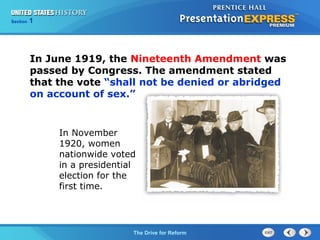
    Chapter 25 Section1 The Cold War Begins Section 1 The Drive for Reform A naval board of inquiry blamed a mine for the explosion. The Yellow Press demanded war. Headlines screamed, “Remember the Maine!” In response, Spain agreed to American demands, including an end to the concentration camps. Despite Spanish concessions, President McKinley sought permission to use force.
  • 120.
    Chapter 25 Section1 The Cold War Begins Section 1 The Drive for Reform In April 1898, following a heated debate, Congress agreed to McKinley’s request. The U.S. Navy was sent to blockade Cuban ports. President McKinley called for 100,000 volunteers. Critics charged that the real goal was an American take-over of Cuba. As a result, the Teller Amendment was added, stipulating that the U.S. would not annex Cuba.
  • 121.
    Chapter 25 Section1 The Cold War Begins Section 1 The Drive for Reform Commodore George Dewey surprised and easily defeated a Spanish fleet at Manila Bay. Rather than surrender to the Filipino independence fighters led by Emilio Aguinaldo, Spanish troops surrendered to U.S. forces. In response to the American actions, Spain declared war on the U.S. The war began with U.S. victories in the Philippines.
  • 122.
    Chapter 25 Section1 The Cold War Begins Section 1 The Drive for Reform • Guantanamo Bay was captured. • Theodore Roosevelt’s Rough Riders, and two regiments of African American soldiers, stormed San Juan Hill. • A Spanish fleet was destroyed at Santiago. • Spanish troops surrendered in Cuba and on the island of Puerto Rico. U.S. troops easily defeated the Spanish in Cuba.
  • 123.
    Chapter 25 Section1 The Cold War Begins Section 1 The Drive for Reform • Spain sold the Philippines to the U.S. for $20 million. • Guam and Puerto Rico became American territories. • Under the Teller Amendment, Cuba could not be annexed by the United States. In the Treaty of Paris, Spain gave up control of Cuba, Puerto Rico, and Guam.
  • 124.
    Chapter 25 Section1 The Cold War Begins Section 1 The Drive for Reform While Secretary of State John Hay called it a “splendid little war” debate soon arose over the Philippines and U.S. imperialism. • President McKinley argued that the U.S. had a responsibility to “uplift and civilize” the Filipino people. However, the U.S. brutally suppressed a Filipino rebellion. • Critics like William Jennings Bryan and Mark Twain attacked imperialism as against American principles.
  • 125.
    Chapter 25 Section1 The Cold War Begins Section 1 The Drive for Reform In February 1899, the U.S. Senate ratified the Treaty of Paris by just one vote. In the election of 1900 McKinley faced Bryan for the Presidency. McKinley and Roosevelt won easily. McKinley chose Theodore Roosevelt, “the hero of San Juan Hill” as his running mate. The United States now had an empire and a new stature in world affairs.
  • 126.
    Chapter 25 Section1 The Cold War Begins Section 1 The Drive for Reform Section 7 The United States Emerges as a World Power
  • 127.
    Chapter 25 Section1 The Cold War Begins Section 1 The Drive for Reform • Examine the causes and consequences of the Philippine insurrection. • Analyze the effects of the Open Door Policy. • Describe how the United States dealt with the rising power of Japan. Objectives
  • 128.
    Chapter 25 Section1 The Cold War Begins Section 1 The Drive for Reform • Examine what happened to Puerto Rico and Cuba after the Spanish-American War. • Analyze the effects of Roosevelt’s “big stick” diplomacy. • Compare Wilson’s “moral diplomacy” with the foreign policies of his predecessors. Objectives
  • 129.
    Chapter 25 Section1 The Cold War Begins Section 1 The Drive for Reform Terms and People • insurrection – a rebellion or revolt • guerrilla warfare – form of non-traditional warfare, generally by small bands of fighters • William Howard Taft – future president, appointed governor of the Philippines in 1901 • sphere of influence – zones in China that gave European powers exclusive access to commerce • John Hay – U.S. Secretary of State who asserted the “Open Door Policy” in China
  • 130.
    Chapter 25 Section1 The Cold War Begins Section 1 The Drive for Reform Terms and People (continued) • Boxer Rebellion – 1900 revolt by secret Chinese societies against outside influences • Open Door Policy – Secretary of State John Hay’s policy of opposing European colonies and “spheres of influence” in China • Russo-Japanese War – war launched by Japan in 1904 to remove Russian influence in China; settled by Theodore Roosevelt in the Treaty of Portsmouth
  • 131.
    Chapter 25 Section1 The Cold War Begins Section 1 The Drive for Reform Terms and People (continued) • “Gentlemen’s Agreement” – allowed Japanese children to attend public schools with whites in California while Japan agreed to limit emigration to the U.S. • Great White Fleet – 1907 world cruise by an armada of U.S. battleships to demonstrate American naval strength
  • 132.
    Chapter 25 Section1 The Cold War Begins Section 1 The Drive for Reform Terms and People • Foraker Act – established civil government in Puerto Rico with an appointed governor • Platt Amendment – addendum to Cuba’s constitution restricting Cuba’s independence from the United States • “big stick” diplomacy – Theodore Roosevelt’s approach to international relations that depended on a strong military to achieve its aims • Panama Canal – waterway dug across Panama to shorten the trip between the Atlantic and the Pacific
  • 133.
    Chapter 25 Section1 The Cold War Begins Section 1 The Drive for Reform Terms and People (continued) • Roosevelt Corollary – Roosevelt’s addition to the Monroe Doctrine, which stated that the U.S. would intervene in Latin America in order to prevent European intervention • “dollar diplomacy” – President Taft’s policy to encourage investment rather than use force in Latin America • “moral diplomacy” – President Wilson’s policy to encourage human rights and opportunity rather than act in our own self-interest in Latin America
  • 134.
    Chapter 25 Section1 The Cold War Begins Section 1 The Drive for Reform Terms and People (continued) • Francisco “Pancho” Villa – Mexican guerrilla and outlaw who eluded capture by General Pershing for 11 months in 1916-1917
  • 135.
    Chapter 25 Section1 The Cold War Begins Section 1 The Drive for Reform How did the United States extend its influence in Asia? America’s decision to keep the Philippines helped expand U.S. influence, compete with European colonial powers, gain Asian markets, and extend American culture to the people of Asia. Imperialism in East Asia brought greater power and wealth to Americans, but it also increased political tensions in Asia.
  • 136.
    Chapter 25 Section1 The Cold War Begins Section 1 The Drive for Reform What actions did the United States take to achieve its goals in Latin America? American entrepreneurs and political leaders called for an aggressive and exclusive role for the U.S. in Latin America. While beneficial to the United States, this approach engendered anti-American sentiment and instability in area.
  • 137.
    Chapter 25 Section1 The Cold War Begins Section 1 The Drive for Reform This angered Filipino nationalists like Emilio Aguinaldo who had fought aside the Americans to oust Spain. Aguinaldo used guerrilla warfare in an organized insurrection against the United States. Following the Spanish-American War, the United States decided to retain possession of the Philippines.
  • 138.
    Chapter 25 Section1 The Cold War Begins Section 1 The Drive for Reform • One commander, General Jacob Smith, even told his men, “the more you kill and burn, the better you will please me.” • Brutality was defended in the American press with racist statements such as, “they must yield before the superior race.” The U.S. reacted with brutality and racism. Villages were burned and suspected “insurrectos” shot.
  • 139.
    Chapter 25 Section1 The Cold War Begins Section 1 The Drive for Reform In 1901 the insurrection ended and William Howard Taft was appointed governor. • established a health care system • staffed schools • built roads and bridges • extended limited self-rule Taft censored the press and jailed dissidents, but he also:
  • 140.
    Chapter 25 Section1 The Cold War Begins Section 1 The Drive for Reform • U.S. Secretary of State John Hay announced that the U.S. expected “equality of treatment for commerce in China.” • This Open Door Policy guided future U.S. actions. In 1899, China was being exploited by European powers. Britain, France, Germany, and Russia each carved out spheres of influence or zones in which they enjoyed special access to ports and markets.
  • 141.
    Chapter 25 Section1 The Cold War Begins Section 1 The Drive for Reform In 1900, Chinese secret societies began attacking foreigners and missionaries. • A multinational force from the U.S., Europe, and Japan, put down this Boxer Rebellion. • The Chinese government was forced to pay for damages done during the rebellion. • This raised nationalist anger and contributed to a 1911 revolt against the Emperor.
  • 142.
    Chapter 25 Section1 The Cold War Begins Section 1 The Drive for Reform It eventually took 20,000 soldiers, including 2,000 Americans, like these marching through China’s Forbidden City, to put down the Boxer Rebellion.
  • 143.
    Chapter 25 Section1 The Cold War Begins Section 1 The Drive for Reform Japan also opposed European interference in China, especially by Russia. The Russo-Japanese War ● In 1904, Japan attacked a Russian fleet at Port Arthur in China. ● The resulting Russo-Japanese War was resolved by Theodore Roosevelt at a conference in Portsmouth, New Hampshire. ● In 1905, Roosevelt was awarded the Nobel Peace Prize for his role, demonstrating America’s new stature in the world.
  • 144.
    Chapter 25 Section1 The Cold War Begins Section 1 The Drive for Reform Anti-Asian prejudice, especially on the West Coast, disrupted relations with Japan. Roosevelt negotiated a “Gentlemen’s Agreement” in which the school board removed the ban and in exchange, Japan limited emigration to the U.S. When the San Francisco School Board banned Asian students from attending classes with white students, Japan was insulted.
  • 145.
    Chapter 25 Section1 The Cold War Begins Section 1 The Drive for Reform President Roosevelt reminded the world of America’s rising military power by sending the Great White Fleet of sixteen battleships on a world cruise in 1907.
  • 146.
    Chapter 25 Section1 The Cold War Begins Section 1 The Drive for Reform The status of Puerto Rico: ● In 1900, the Foraker Act authorized a civil government for Puerto Rico. ● A governor would be appointed by the U.S. President. ● In the Insular Cases the Supreme Court ruled that Puerto Ricans did not have the same rights or tax status as other Americans.
  • 147.
    Chapter 25 Section1 The Cold War Begins Section 1 The Drive for Reform Cubans disliked the Platt Amendment but accepted their status since they were protected by the U.S. The Platt Amendment made it a protectorate of the United States which retained the rights to: Cuba became independent in 1902. • approve or reject any treaty signed by Cuba. • intervene to preserve order in Cuba. • lease military bases in Cuba.
  • 148.
    Chapter 25 Section1 The Cold War Begins Section 1 The Drive for Reform In 1904, President Roosevelt added his Roosevelt Corollary to the Monroe Doctrine. • Roosevelt saw it as America’s responsibility to “civilize” or uplift weaker nations. • The U.S. would act as an “International Policeman” in the Western Hemisphere to prevent European intervention. • He saw international leadership as a moral challenge the U.S. had to accept.
  • 149.
    Chapter 25 Section1 The Cold War Begins Section 1 The Drive for Reform Roosevelt’s policy was called “big stick” diplomacy from his motto, “Speak softly but carry a big stick.” Cartoonists saw Roosevelt as a policeman in Latin America.
  • 150.
    Chapter 25 Section1 The Cold War Begins Section 1 The Drive for Reform • The U.S. needed permission from Colombia which owned the Isthmus of Panama. • Colombia wanted more money than the United States was willing to pay. • Roosevelt encouraged Panamanian rebels to declare independence. • The United States recognized the Panamanian government in 1904. • Roosevelt negotiated to lease the “Canal Zone” from the new Panamanian government for $10 million plus an annual rent. The Panama Canal was constructed between 1904–1913
  • 151.
    Chapter 25 Section1 The Cold War Begins Section 1 The Drive for Reform Construction of the canal was a tremendous engineering feat that involved tens of thousands of workers.
  • 152.
    Chapter 25 Section1 The Cold War Begins Section 1 The Drive for Reform • Rather than emphasizing military force, Taft looked to increase American investments in plantations, mines, and railroads. In 1909 William Howard Taft became President. He replaced the “big stick,” which was unpopular among Latin Americans, with “dollar diplomacy.” • Taft did not dismiss the use of force as he sent troops into Nicaragua in 1909 and 1912.
  • 153.
    Chapter 25 Section1 The Cold War Begins Section 1 The Drive for Reform
  • 154.
    Chapter 25 Section1 The Cold War Begins Section 1 The Drive for Reform President, Woodrow Wilson proclaimed a new policy of “moral diplomacy” in 1913. • supported human rights and national integrity rather than U.S. self- interest • stated that the U.S. needed to be a friend even when it was not in our best interests • promised the U.S. would “never again seek one additional foot of territory by conquest”
  • 155.
    Chapter 25 Section1 The Cold War Begins Section 1 The Drive for Reform Despite his intentions, Wilson wound up intervening in Haiti, the Dominican Republic and especially in Mexico. Mexican dictator Porfirio Díaz promoted American investment in Mexico, benefiting a small wealthy upper class of landowners, clerics and military men. Meanwhile, poor Mexican farmers were struggling in extreme poverty.
  • 156.
    Chapter 25 Section1 The Cold War Begins Section 1 The Drive for Reform Wilson refused to recognize a “government of butchers.” When American sailors were arrested, he sent U.S. Marines into Mexico Huerta’s government collapsed and he was in turn replaced by Venustiano Carrenza. In 1911, a revolt by Francisco Madero toppled Díaz. Two years later, General Victoriano Huerta seized control and executed Madero. The famous outlaw Francisco “Pancho” Villa threatened to start a new rebellion.
  • 157.
    Chapter 25 Section1 The Cold War Begins Section 1 The Drive for Reform In 1916, Villa participated in raids across the U.S. border, leaving 18 dead. Wilson sent General John J. Pershing and 10,000 troops into Mexico to catch Villa but failed.