

Designing RPD’s
              Planning sequence for RPD patients

                          Ting Ling Chang DDS
Division of Advanced Prosthodontics, Biomaterials and
                   Hospital Dentistry
               UCLA School of Dentistry


This program of instruction is protected by copyright ©. No portion of
this program of instruction may be reproduced, recorded or transferred
by any means electronic, digital, photographic, mechanical etc., or by
any information storage or retrieval system, without prior permission.
Designing RPD’s
         Planning sequence for RPD patients

v    Diagnostic assessment and preliminary impressions
v    Diagnostic casts mounted in centric relation
v    Draw the ideal RPD design (on paper)
v    Survey the study casts and determine the most
      advantageous position (MAP) of the designed RPD
      path of insertion and withdrawal
v    Revise and finalize the RPD design
Designing RPD’s
       Planning sequence for RPD patients
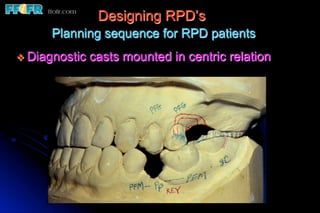
v  Diagnostic   casts mounted in centric relation
Designing RPD Frameworks
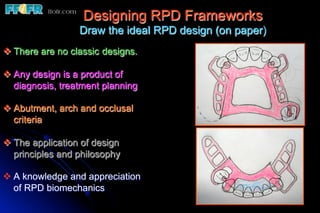
                  Draw the ideal RPD design (on paper)
v There are no classic designs.

v Any design is a product of
   diagnosis, treatment planning

v Abutment, arch and occlusal
   criteria

v The application of design
   principles and philosophy

v A knowledge and appreciation
   of RPD biomechanics
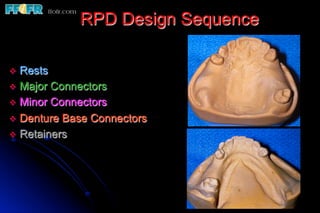
RPD Design Sequence

v  Rests
v  Major Connectors
v  Minor Connectors
v  Denture Base Connectors
v  Retainers
Mandibular Design
                              Issues of concern
v    Proximal Plates – include 2.0 mm of mucosal coverage. Reduce
      if visible and non-esthetic.

v    Minor Connectors to Rests - The vertical components to the
      rests should be at least 5.0 mm apart to reduce food
      entrapment. Consider lingual plate if closer.

v    Denture Base Connectors –
      v    Retention of the resin saddle.
      v    Must be short of movable tissues.
      v    Should have relief.
      v    Allow spot metal seating check on master cast. Connectors are placed
            toward the lingual to prevent impingement
Mandibular RPD Design
                           Issues of concern

v    The major connectors may not impinge upon movable soft tissues
      such as frenum, or vestibular areas.

v    Superior horizontal components must be clear of marginal gingival
      tissue edge by 3.0 mm or consider lingual plate.

v    The lingual borders of the plate or bar may need to be
      physiologically molded for the final impression/master cast.

v    Finishing lines between the metal and resin must be marked.

v    Relief is commonly utilized under the major connectors.
Maxillary RPD Design
                           Issues of concern
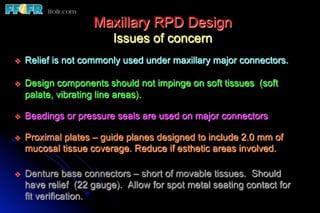
v    Relief is not commonly used under maxillary major connectors.

v    Design components should not impinge on soft tissues (soft
      palate, vibrating line areas).

v    Beadings or pressure seals are used on major connectors

v    Proximal plates – guide planes designed to include 2.0 mm of
      mucosal tissue coverage. Reduce if esthetic areas involved.

v    Denture base connectors – short of movable tissues. Should
      have relief (22 gauge). Allow for spot metal seating contact for
      fit verification.
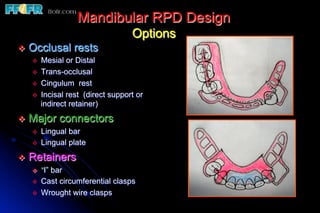
Mandibular RPD Design
                                   Options
v  Occlusal rests
    v  Mesial or Distal
    v  Trans-occlusal
    v  Cingulum rest
    v  Incisal rest (direct support or
        indirect retainer)
v  Major connectors
    v  Lingual bar
    v  Lingual plate

v  Retainers
    v  “I” bar
    v  Cast circumferential clasps
    v  Wrought wire clasps
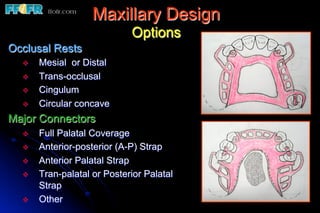
Maxillary Design
                              Options
Occlusal Rests
  v    Mesial or Distal
  v    Trans-occlusal
  v    Cingulum
  v    Circular concave
Major Connectors
  v    Full Palatal Coverage
  v    Anterior-posterior (A-P) Strap
  v    Anterior Palatal Strap
  v    Tran-palatal or Posterior Palatal
        Strap
  v    Other
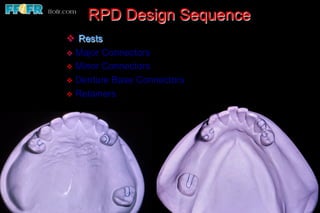
RPD Design Sequence
v  Rests
v  Major Connectors
v  Minor Connectors
v  Denture Base Connectors
v  Retainers
RPD Design Sequence
v  Rests
v  Major Connectors
v  Minor Connectors
v  Denture Base Connectors
v  Retainers

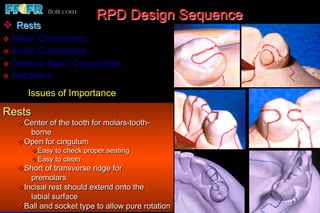
      Issues of Importance

Rests
   v Center of the tooth for molars-tooth-
       borne
   v Open for cingulum
        v Easy to check proper seating
        v Easy to clean
   v Short of transverse ridge for
        premolars
   v Incisal rest should extend onto the
        labial surface
   v Ball and socket type to allow pure rotation
RPD Design Sequence
v  Rests
v  Major Connectors
v  Minor Connectors
v  Denture Base Connectors
v  Retainers

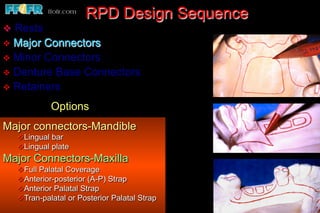
             Options
Major connectors-Mandible
   v Lingual bar
   v Lingual plate
Major Connectors-Maxilla
   v Full Palatal Coverage
   v Anterior-posterior (A-P) Strap
   v Anterior Palatal Strap
   v Tran-palatal or Posterior Palatal Strap
RPD Design Sequence
v  Rests
v  Major Connectors
v  Minor Connectors
v  Denture Base Connectors
v  Retainers


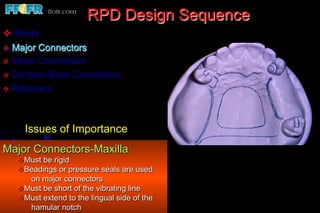
     Issues of Importance
Major Connectors-Maxilla
   v Must be rigid
   v Beadings or pressure seals are used
       on major connectors
   v Must be short of the vibrating line
   v Must extend to the lingual side of the
       hamular notch
RPD Design Sequence
v  Rests
v  Major Connectors
v  Minor Connectors
v  Denture Base Connectors
v  Retainers

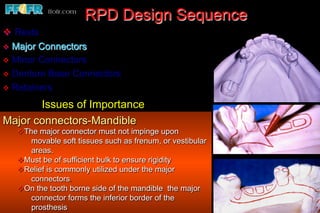
       Issues of Importance
Major connectors-Mandible
   v The major connector must not impinge upon
        movable soft tissues such as frenum, or vestibular
        areas.
   v Must be of sufficient bulk to ensure rigidity
   v Relief is commonly utilized under the major
        connectors.
   v On the tooth borne side of the mandible the major
        connector forms the inferior border of the
        prosthesis
RPD Design Sequence
v  Rests
v  Major Connectors
v  Minor Connectors
v  Denture Base Connectors
v  Retainers


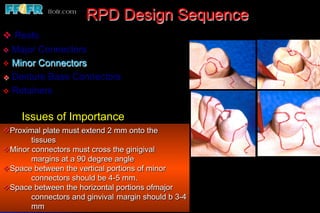
     Issues of Importance
v Proximal plate must extend 2 mm onto the
         tissues
v Minor connectors must cross the ginigival
         margins at a 90 degree angle
v Space between the vertical portions of minor
         connectors should be 4-5 mm.
v Space between the horizontal portions ofmajor
         connectors and ginvival margin should b 3-4
         mm
RPD Design Sequence
 v  Rests
 v  Major Connectors
 v  Minor Connectors
 v  Denture Base Connectors
 v  Retainers


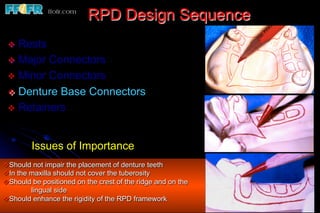
         Issues of Importance
v Should not impair the placement of denture teeth
v In the maxilla should not cover the tuberosity
v Should be positioned on the crest of the ridge and on the
          lingual side
v Should enhance the rigidity of the RPD framework
RPD Design Sequence
v  Rests
v  Major Connectors
v  Minor Connectors
v  Denture Base Connectors
v  Retainers


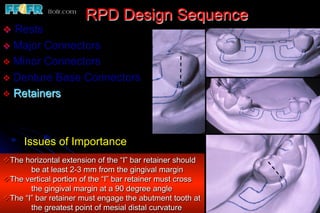
      Issues of Importance
v The horizontal extension of the “I” bar retainer should
         be at least 2-3 mm from the gingival margin
v The vertical portion of the “I” bar retainer must cross
         the gingival margin at a 90 degree angle
v The “I” bar retainer must engage the abutment tooth at
         the greatest point of mesial distal curvature
RPD Design Sequence
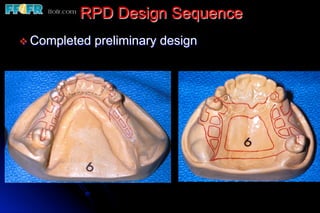
v  Completed   preliminary design
Designing RPD Frameworks
Draw the ideal RPD design (on paper)
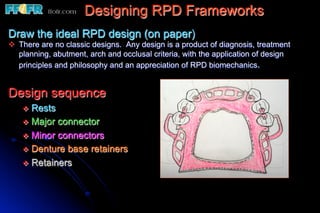
v  There are no classic designs. Any design is a product of diagnosis, treatment
    planning, abutment, arch and occlusal criteria, with the application of design
    principles and philosophy and an appreciation of RPD biomechanics.


Design sequence
    v  Rests
    v  Major connector
    v  Minor connectors
    v  Denture base retainers
    v  Retainers
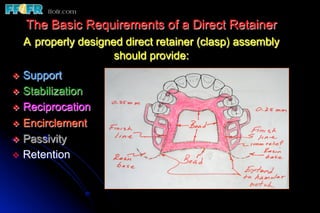
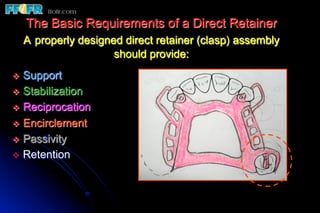
The Basic Requirements of a Direct Retainer
  A properly designed direct retainer (clasp) assembly
                    should provide:
v  Support
v  Stabilization
v  Reciprocation
v  Encirclement
v  Passivity
v  Retention
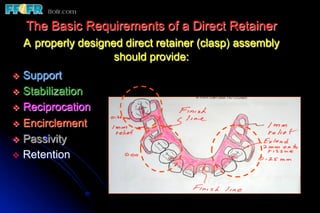
The Basic Requirements of a Direct Retainer
  A properly designed direct retainer (clasp) assembly
                    should provide:
v  Support
v  Stabilization
v  Reciprocation
v  Encirclement
v  Passivity
v  Retention
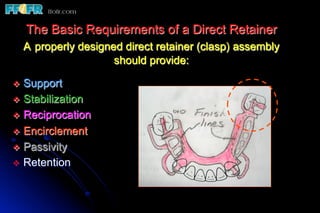
The Basic Requirements of a Direct Retainer
  A properly designed direct retainer (clasp) assembly
                    should provide:

v  Support
v  Stabilization
v  Reciprocation
v  Encirclement
v  Passivity
v  Retention
The Basic Requirements of a Direct Retainer
  A properly designed direct retainer (clasp) assembly
                    should provide:
v  Support
v  Stabilization
v  Reciprocation
v  Encirclement
v  Passivity
v  Retention
Designing RPD Frameworks
Draw the ideal RPD design (on paper)
v  There are no classic designs. Any design is a product of diagnosis, treatment
    planning, abutment, arch and occlusal criteria, with the application of design principles
    and philosophy and an appreciation of RPD biomechanics.

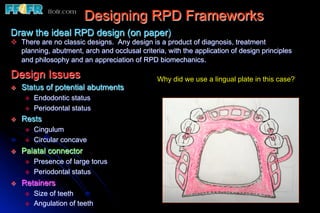
Design Issues                                   Why did we use a lingual plate in this case?
v    Status of potential abutments
       v    Endodontic status
       v    Periodontal status
v    Rests
       v    Cingulum
       v    Circular concave
v    Palatal connector
       v    Presence of large torus
       v    Periodontal status
v    Retainers
       v    Size of teeth
       v    Angulation of teeth
Designing RPD Frameworks
Draw the ideal RPD design (on paper)
v  There are no classic designs. Any design is a product of diagnosis, treatment
    planning, abutment, arch and occlusal criteria, with the application of design principles
    and philosophy and an appreciation of RPD biomechanics.

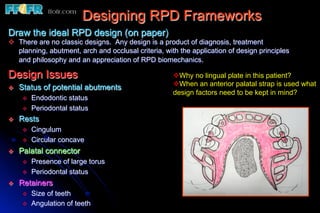
Design Issues                                         v Why no lingual plate in this patient?
v    Status of potential abutments                   v When an anterior palatal strap is used what
                                                      design factors need to be kept in mind?
       v    Endodontic status
       v    Periodontal status
v    Rests
       v    Cingulum
       v    Circular concave
v    Palatal connector
       v    Presence of large torus
       v    Periodontal status
v    Retainers
       v    Size of teeth
       v    Angulation of teeth
Designing RPD Frameworks
Draw the ideal RPD design (on paper)
v  There are no classic designs. Any design is a product of diagnosis, treatment
    planning, abutment, arch and occlusal criteria, with the application of design
    principles and philosophy and an appreciation of RPD biomechanics.
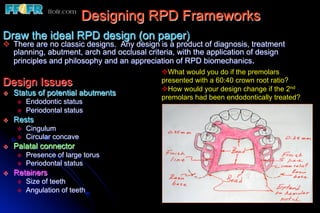
                                              v What would you do if the premolars
Design Issues                                 presented with a 60:40 crown root ratio?
                                              v How would your design change if the 2nd
v    Status of potential abutments
                                              premolars had been endodontically treated?
       v    Endodontic status
       v    Periodontal status
v    Rests
       v    Cingulum
       v    Circular concave
v    Palatal connector
       v    Presence of large torus
       v    Periodontal status
v    Retainers
       v    Size of teeth
       v    Angulation of teeth
Designing RPD Frameworks
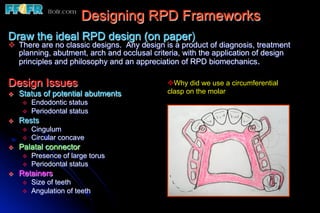
Draw the ideal RPD design (on paper)
v  There are no classic designs. Any design is a product of diagnosis, treatment
    planning, abutment, arch and occlusal criteria, with the application of design
    principles and philosophy and an appreciation of RPD biomechanics.

Design Issues                                 v Why did we use a circumferential
v    Status of potential abutments           clasp on the molar
       v    Endodontic status
       v    Periodontal status
v    Rests
       v    Cingulum
       v    Circular concave
v    Palatal connector
       v    Presence of large torus
       v    Periodontal status
v    Retainers
       v    Size of teeth
       v    Angulation of teeth
Designing RPD Frameworks
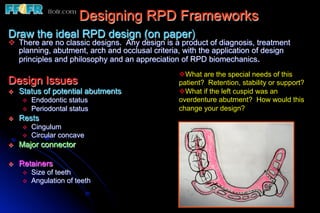
Draw the ideal RPD design (on paper)
v  There are no classic designs. Any design is a product of diagnosis, treatment
    planning, abutment, arch and occlusal criteria, with the application of design
    principles and philosophy and an appreciation of RPD biomechanics.
                                                 v What are the special needs of this
Design Issues                                    patient? Retention, stability or support?
v    Status of potential abutments              v What if the left cuspid was an
       v    Endodontic status                   overdenture abutment? How would this
       v    Periodontal status                  change your design?
v    Rests
       v    Cingulum
       v    Circular concave
v    Major connector

v    Retainers
       v    Size of teeth
       v    Angulation of teeth
Designing RPD Frameworks
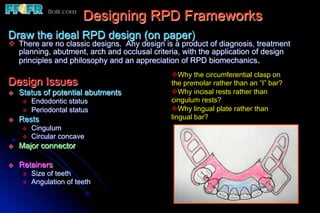
Draw the ideal RPD design (on paper)
v  There are no classic designs. Any design is a product of diagnosis, treatment
    planning, abutment, arch and occlusal criteria, with the application of design
    principles and philosophy and an appreciation of RPD biomechanics.
                                               v Why the circumferential clasp on
Design Issues                                  the premolar rather than an “I” bar?
v    Status of potential abutments            v Why incisal rests rather than
       v    Endodontic status                 cingulum rests?
       v    Periodontal status                v Why lingual plate rather than
v    Rests                                    lingual bar?
       v    Cingulum
       v    Circular concave
v    Major connector

v    Retainers
       v    Size of teeth
       v    Angulation of teeth
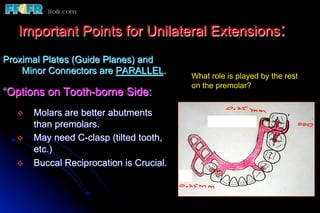
Important Points for Unilateral Extensions:
Proximal Plates (Guide Planes) and
    Minor Connectors are PARALLEL.
                                           What role is played by the rest
                                           on the premolar?
“Options on Tooth-borne Side:
  v    Molars are better abutments
        than premolars.
  v    May need C-clasp (tilted tooth,
        etc.)
  v    Buccal Reciprocation is Crucial.
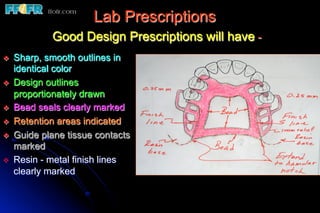
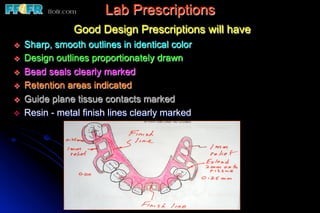
Lab Prescriptions
              Good Design Prescriptions will have -
v    Sharp, smooth outlines in
      identical color
v    Design outlines
      proportionately drawn
v    Bead seals clearly marked
v    Retention areas indicated
v    Guide plane tissue contacts
      marked
v    Resin - metal finish lines
      clearly marked
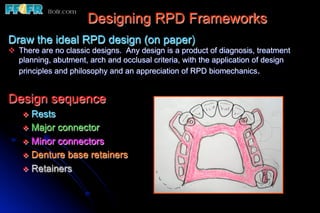
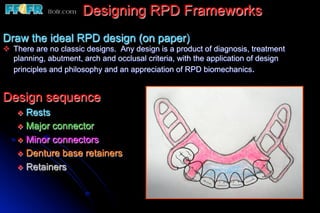
Designing RPD Frameworks
Draw the ideal RPD design (on paper)
v  There are no classic designs. Any design is a product of diagnosis, treatment
    planning, abutment, arch and occlusal criteria, with the application of design
    principles and philosophy and an appreciation of RPD biomechanics.


Design sequence
    v  Rests
    v  Major connector
    v  Minor connectors
    v  Denture base retainers
    v  Retainers
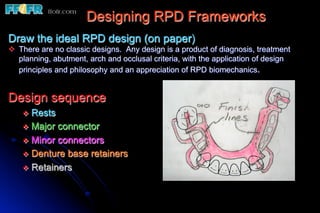
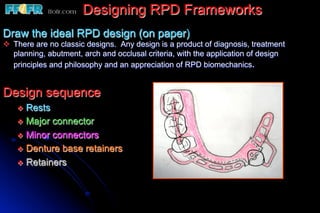
Designing RPD Frameworks
Draw the ideal RPD design (on paper)
v  There are no classic designs. Any design is a product of diagnosis, treatment
    planning, abutment, arch and occlusal criteria, with the application of design
    principles and philosophy and an appreciation of RPD biomechanics.


Design sequence
    v  Rests
    v  Major connector
    v  Minor connectors
    v  Denture base retainers
    v  Retainers
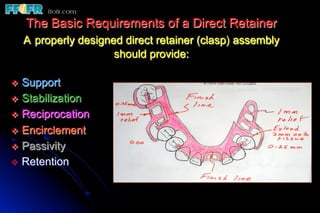
The Basic Requirements of a Direct Retainer
  A properly designed direct retainer (clasp) assembly
                    should provide:

v  Support
v  Stabilization
v  Reciprocation
v  Encirclement
v  Passivity
v  Retention
Lab Prescriptions
                  Good Design Prescriptions will have
v    Sharp, smooth outlines in identical color
v    Design outlines proportionately drawn
v    Bead seals clearly marked
v    Retention areas indicated
v    Guide plane tissue contacts marked
v    Resin - metal finish lines clearly marked
Designing RPD Frameworks
Draw the ideal RPD design (on paper)
v  There are no classic designs. Any design is a product of diagnosis, treatment
    planning, abutment, arch and occlusal criteria, with the application of design
    principles and philosophy and an appreciation of RPD biomechanics.


Design sequence
    v  Rests
    v  Major connector
    v  Minor connectors
    v  Denture base retainers
    v  Retainers
Designing RPD Frameworks
Draw the ideal RPD design (on paper)
v  There are no classic designs. Any design is a product of diagnosis, treatment
    planning, abutment, arch and occlusal criteria, with the application of design
    principles and philosophy and an appreciation of RPD biomechanics.


Design sequence
    v  Rests
    v  Major connector
    v  Minor connectors
    v  Denture base retainers
    v  Retainers
RPD Design Exercise
                Clean, smooth and legible
Designs must:
  v  Specify retention
  v  Bead seals clear marked
  v  Resin–metal finish lines clearly marked
  v  Sharp, smooth outlines in identical color
  v  Design outlines proportionately drawn
  v  Guide plane tissue contact area clearly marked
Laboratory Prescription
v  Rx must be clearly defined
v  Clearances and anatomic concerns marked
v  Specify retention
v  Specify materials to be used
v  Special Requests
   v Evaluation  of Wax-up on Refractory
   v Inclusion of PFM restoration on Master Cast
Clean and legible
       Good Design Prescriptions will have:
v  Sharp,  smooth outlines in identical color
v  Design outlines proportionately drawn
v  Lightly shade relief areas in light red
v  Retention areas marked in heavy red
v  Guide plane tissue contacts marked
v  Resin - metal finish lines clearly marked
Ability of Major Connectors to Provide
             Rigidity and Support

Major Connector                  Support              Rigidity
Palatal strap                    good to excellent   good to excellent
Anterior-posterior strap         good                excellent
Complete palatal plate           excellent           excellent
Anterior-posterior palatal bar   poor                good
Palatal bar                      poor                poor
Horseshoe (anterior strap)       poor                poor

Lingual bar                      poor                good
Lingual plate                    poor                good to excellent
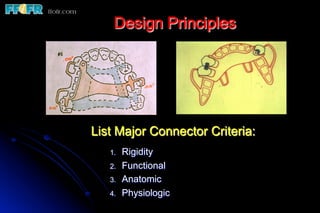
Design Principles


List Major Connector Criteria:
   1.    Rigidity
   2.    Functional
   3.    Anatomic
   4.    Physiologic
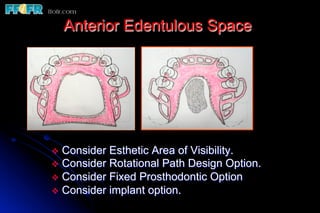
Anterior Edentulous Space


v  Consider Esthetic Area of Visibility.
v  Consider Rotational Path Design Option.
v  Consider Fixed Prosthodontic Option
v  Consider implant option.
v  Visitffofr.org for hundreds of additional lectures on
    Complete Dentures, Implant Dentistry, Removable
    Partial Dentures, Esthetic Dentistry and Maxillofacial
    Prosthetics.
v  The lectures are free.
v  Our objective is to create the best and most
    comprehensive online programs of instruction in
    Prosthodontics

7.designing rpd's, planning sequence for rpd patients

  • 1.
    Designing RPD’s Planning sequence for RPD patients Ting Ling Chang DDS Division of Advanced Prosthodontics, Biomaterials and Hospital Dentistry UCLA School of Dentistry This program of instruction is protected by copyright ©. No portion of this program of instruction may be reproduced, recorded or transferred by any means electronic, digital, photographic, mechanical etc., or by any information storage or retrieval system, without prior permission.
  • 2.
    Designing RPD’s Planning sequence for RPD patients v  Diagnostic assessment and preliminary impressions v  Diagnostic casts mounted in centric relation v  Draw the ideal RPD design (on paper) v  Survey the study casts and determine the most advantageous position (MAP) of the designed RPD path of insertion and withdrawal v  Revise and finalize the RPD design
  • 3.
    Designing RPD’s Planning sequence for RPD patients v  Diagnostic casts mounted in centric relation
  • 4.
    Designing RPD Frameworks Draw the ideal RPD design (on paper) v There are no classic designs. v Any design is a product of diagnosis, treatment planning v Abutment, arch and occlusal criteria v The application of design principles and philosophy v A knowledge and appreciation of RPD biomechanics
  • 5.
    RPD Design Sequence v Rests v  Major Connectors v  Minor Connectors v  Denture Base Connectors v  Retainers
  • 6.
    Mandibular Design Issues of concern v  Proximal Plates – include 2.0 mm of mucosal coverage. Reduce if visible and non-esthetic. v  Minor Connectors to Rests - The vertical components to the rests should be at least 5.0 mm apart to reduce food entrapment. Consider lingual plate if closer. v  Denture Base Connectors – v  Retention of the resin saddle. v  Must be short of movable tissues. v  Should have relief. v  Allow spot metal seating check on master cast. Connectors are placed toward the lingual to prevent impingement
  • 7.
    Mandibular RPD Design Issues of concern v  The major connectors may not impinge upon movable soft tissues such as frenum, or vestibular areas. v  Superior horizontal components must be clear of marginal gingival tissue edge by 3.0 mm or consider lingual plate. v  The lingual borders of the plate or bar may need to be physiologically molded for the final impression/master cast. v  Finishing lines between the metal and resin must be marked. v  Relief is commonly utilized under the major connectors.
  • 8.
    Maxillary RPD Design Issues of concern v  Relief is not commonly used under maxillary major connectors. v  Design components should not impinge on soft tissues (soft palate, vibrating line areas). v  Beadings or pressure seals are used on major connectors v  Proximal plates – guide planes designed to include 2.0 mm of mucosal tissue coverage. Reduce if esthetic areas involved. v  Denture base connectors – short of movable tissues. Should have relief (22 gauge). Allow for spot metal seating contact for fit verification.
  • 9.
    Mandibular RPD Design Options v  Occlusal rests v  Mesial or Distal v  Trans-occlusal v  Cingulum rest v  Incisal rest (direct support or indirect retainer) v  Major connectors v  Lingual bar v  Lingual plate v  Retainers v  “I” bar v  Cast circumferential clasps v  Wrought wire clasps
  • 10.
    Maxillary Design Options Occlusal Rests v  Mesial or Distal v  Trans-occlusal v  Cingulum v  Circular concave Major Connectors v  Full Palatal Coverage v  Anterior-posterior (A-P) Strap v  Anterior Palatal Strap v  Tran-palatal or Posterior Palatal Strap v  Other
  • 11.
    RPD Design Sequence v Rests v  Major Connectors v  Minor Connectors v  Denture Base Connectors v  Retainers
  • 12.
    RPD Design Sequence v Rests v  Major Connectors v  Minor Connectors v  Denture Base Connectors v  Retainers Issues of Importance Rests v Center of the tooth for molars-tooth- borne v Open for cingulum v Easy to check proper seating v Easy to clean v Short of transverse ridge for premolars v Incisal rest should extend onto the labial surface v Ball and socket type to allow pure rotation
  • 13.
    RPD Design Sequence v Rests v  Major Connectors v  Minor Connectors v  Denture Base Connectors v  Retainers Options Major connectors-Mandible v Lingual bar v Lingual plate Major Connectors-Maxilla v Full Palatal Coverage v Anterior-posterior (A-P) Strap v Anterior Palatal Strap v Tran-palatal or Posterior Palatal Strap
  • 14.
    RPD Design Sequence v Rests v  Major Connectors v  Minor Connectors v  Denture Base Connectors v  Retainers Issues of Importance Major Connectors-Maxilla v Must be rigid v Beadings or pressure seals are used on major connectors v Must be short of the vibrating line v Must extend to the lingual side of the hamular notch
  • 15.
    RPD Design Sequence v Rests v  Major Connectors v  Minor Connectors v  Denture Base Connectors v  Retainers Issues of Importance Major connectors-Mandible v The major connector must not impinge upon movable soft tissues such as frenum, or vestibular areas. v Must be of sufficient bulk to ensure rigidity v Relief is commonly utilized under the major connectors. v On the tooth borne side of the mandible the major connector forms the inferior border of the prosthesis
  • 16.
    RPD Design Sequence v Rests v  Major Connectors v  Minor Connectors v  Denture Base Connectors v  Retainers Issues of Importance v Proximal plate must extend 2 mm onto the tissues v Minor connectors must cross the ginigival margins at a 90 degree angle v Space between the vertical portions of minor connectors should be 4-5 mm. v Space between the horizontal portions ofmajor connectors and ginvival margin should b 3-4 mm
  • 17.
    RPD Design Sequence v  Rests v  Major Connectors v  Minor Connectors v  Denture Base Connectors v  Retainers Issues of Importance v Should not impair the placement of denture teeth v In the maxilla should not cover the tuberosity v Should be positioned on the crest of the ridge and on the lingual side v Should enhance the rigidity of the RPD framework
  • 18.
    RPD Design Sequence v Rests v  Major Connectors v  Minor Connectors v  Denture Base Connectors v  Retainers Issues of Importance v The horizontal extension of the “I” bar retainer should be at least 2-3 mm from the gingival margin v The vertical portion of the “I” bar retainer must cross the gingival margin at a 90 degree angle v The “I” bar retainer must engage the abutment tooth at the greatest point of mesial distal curvature
  • 19.
    RPD Design Sequence v Completed preliminary design
  • 20.
    Designing RPD Frameworks Drawthe ideal RPD design (on paper) v  There are no classic designs. Any design is a product of diagnosis, treatment planning, abutment, arch and occlusal criteria, with the application of design principles and philosophy and an appreciation of RPD biomechanics. Design sequence v  Rests v  Major connector v  Minor connectors v  Denture base retainers v  Retainers
  • 21.
    The Basic Requirementsof a Direct Retainer A properly designed direct retainer (clasp) assembly should provide: v  Support v  Stabilization v  Reciprocation v  Encirclement v  Passivity v  Retention
  • 22.
    The Basic Requirementsof a Direct Retainer A properly designed direct retainer (clasp) assembly should provide: v  Support v  Stabilization v  Reciprocation v  Encirclement v  Passivity v  Retention
  • 23.
    The Basic Requirementsof a Direct Retainer A properly designed direct retainer (clasp) assembly should provide: v  Support v  Stabilization v  Reciprocation v  Encirclement v  Passivity v  Retention
  • 24.
    The Basic Requirementsof a Direct Retainer A properly designed direct retainer (clasp) assembly should provide: v  Support v  Stabilization v  Reciprocation v  Encirclement v  Passivity v  Retention
  • 25.
    Designing RPD Frameworks Drawthe ideal RPD design (on paper) v  There are no classic designs. Any design is a product of diagnosis, treatment planning, abutment, arch and occlusal criteria, with the application of design principles and philosophy and an appreciation of RPD biomechanics. Design Issues Why did we use a lingual plate in this case? v  Status of potential abutments v  Endodontic status v  Periodontal status v  Rests v  Cingulum v  Circular concave v  Palatal connector v  Presence of large torus v  Periodontal status v  Retainers v  Size of teeth v  Angulation of teeth
  • 26.
    Designing RPD Frameworks Drawthe ideal RPD design (on paper) v  There are no classic designs. Any design is a product of diagnosis, treatment planning, abutment, arch and occlusal criteria, with the application of design principles and philosophy and an appreciation of RPD biomechanics. Design Issues v Why no lingual plate in this patient? v  Status of potential abutments v When an anterior palatal strap is used what design factors need to be kept in mind? v  Endodontic status v  Periodontal status v  Rests v  Cingulum v  Circular concave v  Palatal connector v  Presence of large torus v  Periodontal status v  Retainers v  Size of teeth v  Angulation of teeth
  • 27.
    Designing RPD Frameworks Drawthe ideal RPD design (on paper) v  There are no classic designs. Any design is a product of diagnosis, treatment planning, abutment, arch and occlusal criteria, with the application of design principles and philosophy and an appreciation of RPD biomechanics. v What would you do if the premolars Design Issues presented with a 60:40 crown root ratio? v How would your design change if the 2nd v  Status of potential abutments premolars had been endodontically treated? v  Endodontic status v  Periodontal status v  Rests v  Cingulum v  Circular concave v  Palatal connector v  Presence of large torus v  Periodontal status v  Retainers v  Size of teeth v  Angulation of teeth
  • 28.
    Designing RPD Frameworks Drawthe ideal RPD design (on paper) v  There are no classic designs. Any design is a product of diagnosis, treatment planning, abutment, arch and occlusal criteria, with the application of design principles and philosophy and an appreciation of RPD biomechanics. Design Issues v Why did we use a circumferential v  Status of potential abutments clasp on the molar v  Endodontic status v  Periodontal status v  Rests v  Cingulum v  Circular concave v  Palatal connector v  Presence of large torus v  Periodontal status v  Retainers v  Size of teeth v  Angulation of teeth
  • 29.
    Designing RPD Frameworks Drawthe ideal RPD design (on paper) v  There are no classic designs. Any design is a product of diagnosis, treatment planning, abutment, arch and occlusal criteria, with the application of design principles and philosophy and an appreciation of RPD biomechanics. v What are the special needs of this Design Issues patient? Retention, stability or support? v  Status of potential abutments v What if the left cuspid was an v  Endodontic status overdenture abutment? How would this v  Periodontal status change your design? v  Rests v  Cingulum v  Circular concave v  Major connector v  Retainers v  Size of teeth v  Angulation of teeth
  • 30.
    Designing RPD Frameworks Drawthe ideal RPD design (on paper) v  There are no classic designs. Any design is a product of diagnosis, treatment planning, abutment, arch and occlusal criteria, with the application of design principles and philosophy and an appreciation of RPD biomechanics. v Why the circumferential clasp on Design Issues the premolar rather than an “I” bar? v  Status of potential abutments v Why incisal rests rather than v  Endodontic status cingulum rests? v  Periodontal status v Why lingual plate rather than v  Rests lingual bar? v  Cingulum v  Circular concave v  Major connector v  Retainers v  Size of teeth v  Angulation of teeth
  • 31.
    Important Points forUnilateral Extensions: Proximal Plates (Guide Planes) and Minor Connectors are PARALLEL. What role is played by the rest on the premolar? “Options on Tooth-borne Side: v  Molars are better abutments than premolars. v  May need C-clasp (tilted tooth, etc.) v  Buccal Reciprocation is Crucial.
  • 32.
    Lab Prescriptions Good Design Prescriptions will have - v  Sharp, smooth outlines in identical color v  Design outlines proportionately drawn v  Bead seals clearly marked v  Retention areas indicated v  Guide plane tissue contacts marked v  Resin - metal finish lines clearly marked
  • 33.
    Designing RPD Frameworks Drawthe ideal RPD design (on paper) v  There are no classic designs. Any design is a product of diagnosis, treatment planning, abutment, arch and occlusal criteria, with the application of design principles and philosophy and an appreciation of RPD biomechanics. Design sequence v  Rests v  Major connector v  Minor connectors v  Denture base retainers v  Retainers
  • 34.
    Designing RPD Frameworks Drawthe ideal RPD design (on paper) v  There are no classic designs. Any design is a product of diagnosis, treatment planning, abutment, arch and occlusal criteria, with the application of design principles and philosophy and an appreciation of RPD biomechanics. Design sequence v  Rests v  Major connector v  Minor connectors v  Denture base retainers v  Retainers
  • 35.
    The Basic Requirementsof a Direct Retainer A properly designed direct retainer (clasp) assembly should provide: v  Support v  Stabilization v  Reciprocation v  Encirclement v  Passivity v  Retention
  • 36.
    Lab Prescriptions Good Design Prescriptions will have v  Sharp, smooth outlines in identical color v  Design outlines proportionately drawn v  Bead seals clearly marked v  Retention areas indicated v  Guide plane tissue contacts marked v  Resin - metal finish lines clearly marked
  • 37.
    Designing RPD Frameworks Drawthe ideal RPD design (on paper) v  There are no classic designs. Any design is a product of diagnosis, treatment planning, abutment, arch and occlusal criteria, with the application of design principles and philosophy and an appreciation of RPD biomechanics. Design sequence v  Rests v  Major connector v  Minor connectors v  Denture base retainers v  Retainers
  • 38.
    Designing RPD Frameworks Drawthe ideal RPD design (on paper) v  There are no classic designs. Any design is a product of diagnosis, treatment planning, abutment, arch and occlusal criteria, with the application of design principles and philosophy and an appreciation of RPD biomechanics. Design sequence v  Rests v  Major connector v  Minor connectors v  Denture base retainers v  Retainers
  • 39.
    RPD Design Exercise Clean, smooth and legible Designs must: v  Specify retention v  Bead seals clear marked v  Resin–metal finish lines clearly marked v  Sharp, smooth outlines in identical color v  Design outlines proportionately drawn v  Guide plane tissue contact area clearly marked
  • 40.
    Laboratory Prescription v  Rxmust be clearly defined v  Clearances and anatomic concerns marked v  Specify retention v  Specify materials to be used v  Special Requests v Evaluation of Wax-up on Refractory v Inclusion of PFM restoration on Master Cast
  • 41.
    Clean and legible Good Design Prescriptions will have: v  Sharp, smooth outlines in identical color v  Design outlines proportionately drawn v  Lightly shade relief areas in light red v  Retention areas marked in heavy red v  Guide plane tissue contacts marked v  Resin - metal finish lines clearly marked
  • 42.
    Ability of MajorConnectors to Provide Rigidity and Support Major Connector Support Rigidity Palatal strap good to excellent good to excellent Anterior-posterior strap good excellent Complete palatal plate excellent excellent Anterior-posterior palatal bar poor good Palatal bar poor poor Horseshoe (anterior strap) poor poor Lingual bar poor good Lingual plate poor good to excellent
  • 43.
    Design Principles List MajorConnector Criteria: 1.  Rigidity 2.  Functional 3.  Anatomic 4.  Physiologic
  • 44.
    Anterior Edentulous Space v Consider Esthetic Area of Visibility. v  Consider Rotational Path Design Option. v  Consider Fixed Prosthodontic Option v  Consider implant option.
  • 45.
    v  Visitffofr.org forhundreds of additional lectures on Complete Dentures, Implant Dentistry, Removable Partial Dentures, Esthetic Dentistry and Maxillofacial Prosthetics. v  The lectures are free. v  Our objective is to create the best and most comprehensive online programs of instruction in Prosthodontics