Dental Implants
Computer guided treatment planning and
implant placement
John Beumer III DDS, MS
Allesandro Pozzi DDS
Robert Faulkner DDS
Division of Advanced Prosthodontics, UCLA
This	
  program	
  of	
  instruc1on	
  is	
  protected	
  by	
  copyright	
  ©.	
  	
  No	
  por1on	
  of	
  this	
  
program	
  of	
  instruc1on	
  may	
  be	
  reproduced,	
  recorded	
  or	
  transferred	
  by	
  any	
  
means	
  electronic,	
  digital,	
  photographic,	
  mechanical	
  etc.,	
  or	
  by	
  any	
  informa1on	
  
storage	
  or	
  retrieval	
  system,	
  without	
  prior	
  permission.	
  
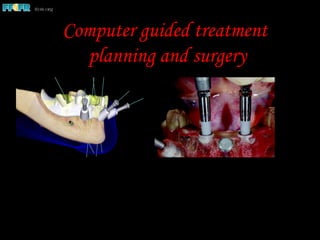
Computer guided treatment
planning and surgery
Computer	
  guided	
  planning	
  and	
  surgery	
  
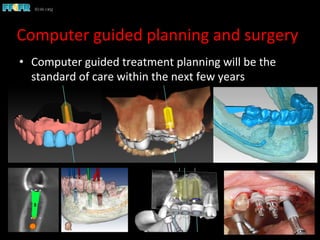
•  Computer	
  guided	
  treatment	
  planning	
  will	
  be	
  the	
  
standard	
  of	
  care	
  within	
  the	
  next	
  few	
  years	
  
Computer	
  guided	
  planning	
  and	
  surgery	
  
Defini1on	
  –	
  selec1on	
  of	
  implant	
  sites	
  and	
  placement	
  of	
  
dental	
  implants	
  employing	
  surgical	
  templates	
  
developed	
  with	
  CBCT	
  scans	
  and	
  soCware	
  programs.	


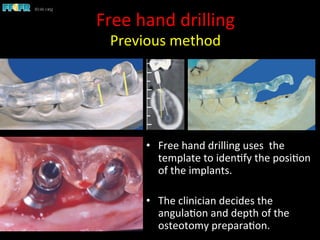
Free	
  hand	
  drilling	
  
Previous	
  method	
  
•  Free	
  hand	
  drilling	
  uses	
  	
  the	
  
template	
  to	
  iden1fy	
  the	
  posi1on	
  
of	
  the	
  implants.	
  	
  
•  The	
  clinician	
  decides	
  the	
  
angula1on	
  and	
  depth	
  of	
  the	
  
osteotomy	
  prepara1on.	
  
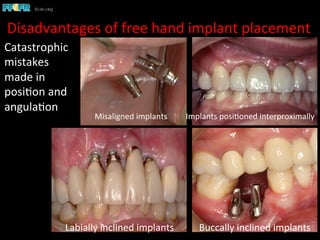
Disadvantages	
  of	
  free	
  hand	
  implant	
  placement	
  
Catastrophic	
  
mistakes	
  
made	
  in	
  
posi1on	
  and	
  
angula1on	
  
Labially	
  inclined	
  implants	
   Buccally	
  inclined	
  implants	
  
Implants	
  posi1oned	
  interproximally	
  Misaligned	
  implants	
  
Advantages	
  of	
  computer	
  guided	
  
treatment	
  planning	
  and	
  surgery	
  
•  Visualize	
  poten1al	
  implant	
  sites	
  in	
  3D	
  in	
  rela1on	
  
to	
  the	
  proposed	
  prosthesis	
  
•  Precise	
  implant	
  placement	
  
•  Less	
  risk	
  of	
  compromising	
  adjacent	
  vital	
  
structures	
  
•  Prefabrica1on	
  of	
  the	
  prosthesis,	
  abutments	
  and	
  
immediate	
  loading	
  
•  Enables	
  flapless	
  surgery	
  
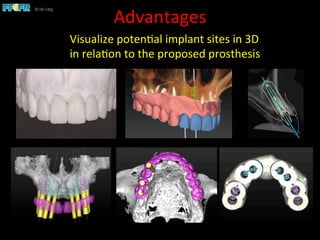
Advantages	
  
Visualize	
  poten1al	
  implant	
  sites	
  in	
  3D	
  
in	
  rela1on	
  to	
  the	
  proposed	
  prosthesis	
  
Advantages	
  
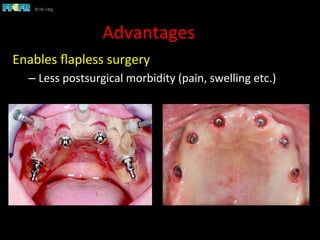
Enables	
  flapless	
  surgery	
  
– Less	
  postsurgical	
  morbidity	
  (pain,	
  swelling	
  etc.)	
  
Advantages	
  
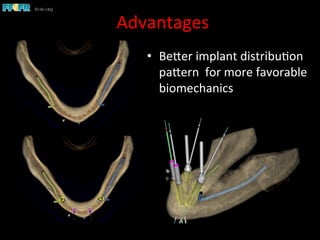
•  BeSer	
  implant	
  distribu1on	
  
paSern	
  	
  for	
  more	
  favorable	
  
biomechanics	
  
Advantages	
  
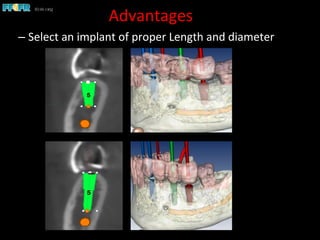
– Select	
  an	
  implant	
  of	
  proper	
  Length	
  and	
  diameter	
  
Advantages	
  
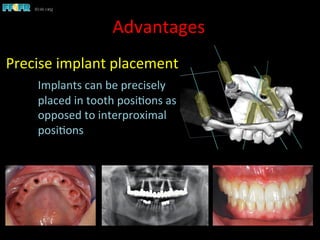
Precise	
  implant	
  placement	
  
	
  Implants	
  can	
  be	
  precisely	


  placed	
  in	
  tooth	
  posi1ons	
  as	
  
	
  opposed	
  to	
  interproximal	
  
	
  posi1ons	
  
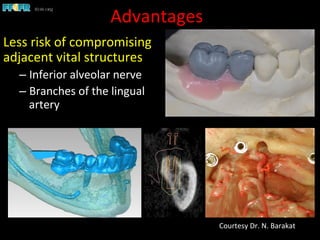
Advantages	
  
Less	
  risk	
  of	
  compromising	
  
adjacent	
  vital	
  structures	
  
– Inferior	
  alveolar	
  nerve	
  
– Branches	
  of	
  the	
  lingual	
  
artery	
  
Courtesy	
  Dr.	
  N.	
  Barakat	
  
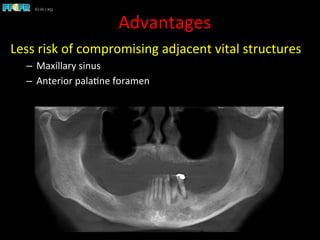
Advantages	
  
Less	
  risk	
  of	
  compromising	
  adjacent	
  vital	
  structures	
  
–  Maxillary	
  sinus	
  
–  Anterior	
  pala1ne	
  foramen	
  
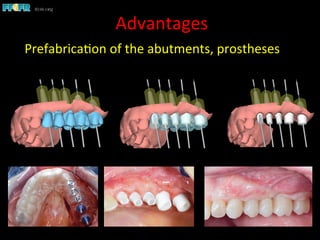
Advantages	
  
Prefabrica1on	
  of	
  the	
  abutments,	
  prostheses	
  	
  
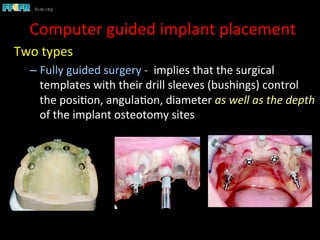
Two	
  types	
  
– Fully	
  guided	
  surgery	
  -­‐	
  	
  implies	
  that	
  the	
  surgical	
  
templates	
  with	
  their	
  drill	
  sleeves	
  (bushings)	
  control	
  
the	
  posi1on,	
  angula1on,	
  diameter	
  as	
  well	
  as	
  the	
  depth	
  
of	
  the	
  implant	
  osteotomy	
  sites	
  
Computer	
  guided	
  implant	
  placement	
  
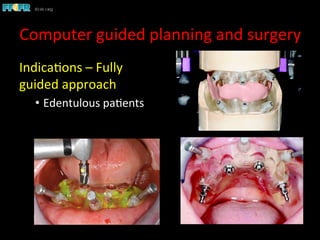
Indica1ons	
  –	
  Fully	
  
guided	
  approach	
  
•  Edentulous	
  pa1ents	


Computer	
  guided	
  planning	
  and	
  surgery	
  
Fully	
  guided	
  implant	
  placement	
  
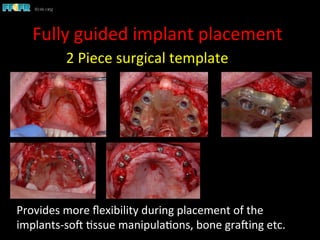
Provides	
  more	
  flexibility	
  during	
  placement	
  of	
  the	
  
implants-­‐soC	
  1ssue	
  manipula1ons,	
  bone	
  graCing	
  etc.	
  
2	
  Piece	
  surgical	
  template	
  
 2	
  Piece	
  surgical	
  template	
  
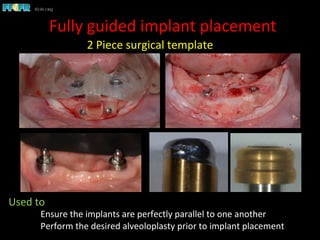
Fully	
  guided	
  implant	
  placement	
  
Used	
  to	


  Ensure	
  the	
  implants	
  are	
  perfectly	
  parallel	
  to	
  one	
  another	
  
	
  Perform	
  the	
  desired	
  alveoloplasty	
  prior	
  to	
  implant	
  placement	
  
Fully	
  guided	
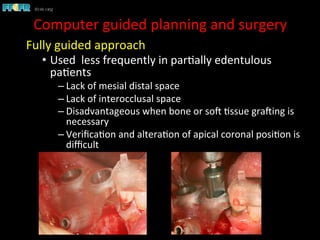
  approach	
  
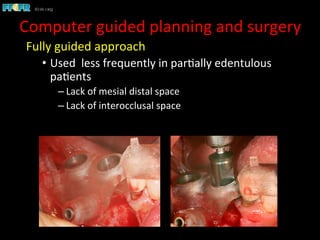
•  Used	
  	
  less	
  frequently	
  in	
  par1ally	
  edentulous	
  
pa1ents	
  
– Lack	
  of	
  mesial	
  distal	
  space	
  
– Lack	
  of	
  interocclusal	
  space	


Computer	
  guided	
  planning	
  and	
  surgery	
  
Fully	
  guided	
  approach	
  
•  Used	
  	
  less	
  frequently	
  in	
  par1ally	
  edentulous	
  
pa1ents	
  
– Lack	
  of	
  mesial	
  distal	
  space	
  
– Lack	
  of	
  interocclusal	
  space	
  
– Disadvantageous	
  when	
  bone	
  or	
  soC	
  1ssue	
  graCing	
  is	
  
necessary	
  
– Verifica1on	
  and	
  altera1on	
  of	
  apical	
  coronal	
  posi1on	
  is	
  
difficult	


Computer	
  guided	
  planning	
  and	
  surgery	
  
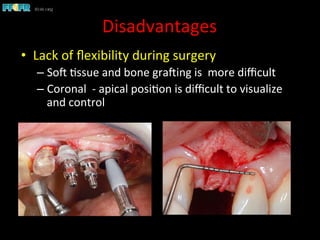
Disadvantages	
  
•  Lack	
  of	
  flexibility	
  during	
  surgery	
  
– SoC	
  1ssue	
  and	
  bone	
  graCing	
  is	
  	
  more	
  difficult	
  
– Coronal	
  	
  -­‐	
  apical	
  posi1on	
  is	
  difficult	
  to	
  visualize	
  
and	
  control	
  
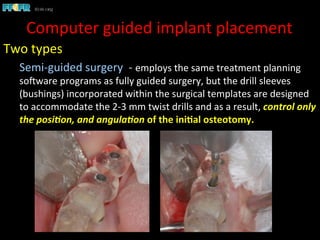
Two	
  types	
  
Semi-­‐guided	
  surgery	
  	
  -­‐	
  employs	
  the	
  same	
  treatment	
  planning	
  
soCware	
  programs	
  as	
  fully	
  guided	
  surgery,	
  but	
  the	
  drill	
  sleeves	
  
(bushings)	
  incorporated	
  within	
  the	
  surgical	
  templates	
  are	
  designed	
  
to	
  accommodate	
  the	
  2-­‐3	
  mm	
  twist	
  drills	
  and	
  as	
  a	
  result,	
  control	
  only	
  
the	
  posi.on,	
  and	
  angula.on	
  of	
  the	
  ini)al	
  osteotomy.	
  
Computer	
  guided	
  implant	
  placement	
  
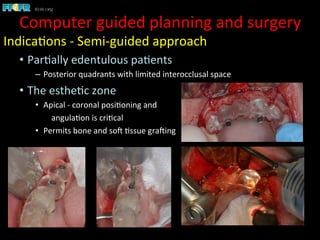
Indica1ons	
  -­‐	
  Semi-­‐guided	
  approach	
  
•  Par1ally	
  edentulous	
  pa1ents	
  
–  Posterior	
  quadrants	
  with	
  limited	
  interocclusal	
  space	
  
•  The	
  esthe1c	
  zone	
  
•  Apical	
  -­‐	
  coronal	
  posi1oning	
  and	


  angula1on	
  is	
  cri1cal	
  
•  Permits	
  bone	
  and	
  soC	
  1ssue	
  graCing	


Computer	
  guided	
  planning	
  and	
  surgery	
  
Semi-­‐guided	
  implant	
  placement	
  
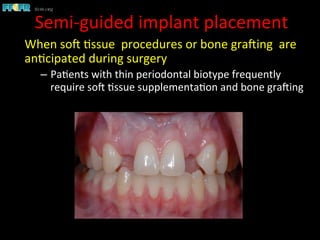
When	
  soC	
  1ssue	
  	
  procedures	
  or	
  bone	
  graCing	
  	
  are	
  
an1cipated	
  during	
  surgery	
  
–  Pa1ents	
  with	
  thin	
  periodontal	
  biotype	
  frequently	
  
require	
  soC	
  1ssue	
  supplementa1on	
  and	
  bone	
  graCing	
  
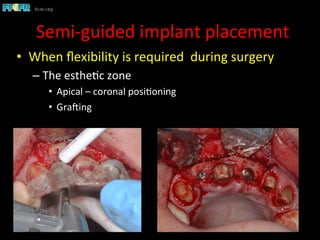
•  When	
  flexibility	
  is	
  required	
  	
  during	
  surgery	
  
– The	
  esthe1c	
  zone	
  
•  Apical	
  –	
  coronal	
  posi1oning	
  
•  GraCing	
  
Semi-­‐guided	
  implant	
  placement	
  
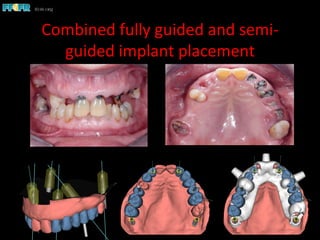
Combined	
  fully	
  guided	
  and	
  semi-­‐
guided	
  implant	
  placement	
  
Combined	
  fully	
  guided	
  and	
  semi-­‐
guided	
  implant	
  placement	
  
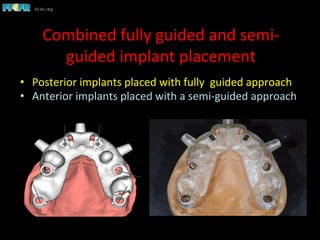
•  Posterior	
  implants	
  placed	
  with	
  fully	
  	
  guided	
  approach	
  
•  Anterior	
  implants	
  placed	
  with	
  a	
  semi-­‐guided	
  approach	
  
Combined	
  fully	
  guided	
  and	
  semi-­‐
guided	
  implant	
  placement	
  
•  The	
  1lted	
  implants	
  were	
  placed	
  using	
  fully	
  guided	
  technique	
  
•  The	
  anterior	
  implants	
  were	
  placed	
  with	
  a	
  semi-­‐guided	
  
technique	
  
Fully	
  guided	
  or	
  semi-­‐
guided	
  approach?	
  
•  Interocclusal	
  space	
  	
  
•  Mesial	
  distal	
  space	
  
•  The	
  need	
  for	
  bone	
  or	
  
soC	
  1ssue	
  graCing	
  
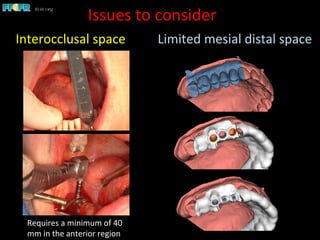
Issues	
  to	
  consider	
  
Interocclusal	
  space	


  Limited	
  mesial	
  distal	
  space	
  
Requires	
  a	
  minimum	
  of	
  40	
  
mm	
  in	
  the	
  anterior	
  region	
  	
  
v Visit	
  ffofr.org	
  for	
  hundreds	
  of	
  
addi1onal	
  lectures	
  on	
  Complete	
  
Dentures,	
  Fixed	
  Prosthodon1cs,	
  
Implant	
  Den1stry,	
  Removable	
  
Par1al	
  Dentures,	
  Esthe1c	
  Den1stry	
  
and	
  Maxillofacial	
  Prosthe1cs.	
  
v The	
  lectures	
  are	
  free.	
  	
  
v Our	
  objec1ve	
  is	
  to	
  create	
  the	
  best	
  
and	
  most	
  comprehensive	
  online	
  
programs	
  of	
  instruc1on	
  in	
  
Prosthodon1cs	
  
v  Visit	
  ffofr.org	
  for	
  hundreds	
  of	
  
addi1onal	
  lectures	
  on	
  
Complete	
  Dentures,	
  Implant	
  
Den1stry,	
  Removable	
  Par1al	
  
Dentures,	
  Esthe1c	
  Den1stry	
  
and	
  Maxillofacial	
  Prosthe1cs.	
  
v  The	
  lectures	
  are	
  free.	
  	
  
v  Our	
  objec1ve	
  is	
  to	
  create	
  the	
  
best	
  and	
  most	
  comprehensive	
  
online	
  programs	
  of	
  instruc1on	
  
in	
  Prosthodon1cs	
  

Computer guided

  • 1.
    Dental Implants Computer guidedtreatment planning and implant placement John Beumer III DDS, MS Allesandro Pozzi DDS Robert Faulkner DDS Division of Advanced Prosthodontics, UCLA This  program  of  instruc1on  is  protected  by  copyright  ©.    No  por1on  of  this   program  of  instruc1on  may  be  reproduced,  recorded  or  transferred  by  any   means  electronic,  digital,  photographic,  mechanical  etc.,  or  by  any  informa1on   storage  or  retrieval  system,  without  prior  permission.  
  • 2.
  • 3.
    Computer  guided  planning  and  surgery   •  Computer  guided  treatment  planning  will  be  the   standard  of  care  within  the  next  few  years  
  • 4.
    Computer  guided  planning  and  surgery   Defini1on  –  selec1on  of  implant  sites  and  placement  of   dental  implants  employing  surgical  templates   developed  with  CBCT  scans  and  soCware  programs.        
  • 5.
    Free  hand  drilling   Previous  method   •  Free  hand  drilling  uses    the   template  to  iden1fy  the  posi1on   of  the  implants.     •  The  clinician  decides  the   angula1on  and  depth  of  the   osteotomy  prepara1on.  
  • 6.
    Disadvantages  of  free  hand  implant  placement   Catastrophic   mistakes   made  in   posi1on  and   angula1on   Labially  inclined  implants   Buccally  inclined  implants   Implants  posi1oned  interproximally  Misaligned  implants  
  • 7.
    Advantages  of  computer  guided   treatment  planning  and  surgery   •  Visualize  poten1al  implant  sites  in  3D  in  rela1on   to  the  proposed  prosthesis   •  Precise  implant  placement   •  Less  risk  of  compromising  adjacent  vital   structures   •  Prefabrica1on  of  the  prosthesis,  abutments  and   immediate  loading   •  Enables  flapless  surgery  
  • 8.
    Advantages   Visualize  poten1al  implant  sites  in  3D   in  rela1on  to  the  proposed  prosthesis  
  • 9.
    Advantages   Enables  flapless  surgery   – Less  postsurgical  morbidity  (pain,  swelling  etc.)  
  • 10.
    Advantages   •  BeSer  implant  distribu1on   paSern    for  more  favorable   biomechanics  
  • 11.
    Advantages   – Select  an  implant  of  proper  Length  and  diameter  
  • 12.
    Advantages   Precise  implant  placement    Implants  can  be  precisely      placed  in  tooth  posi1ons  as    opposed  to  interproximal    posi1ons  
  • 13.
    Advantages   Less  risk  of  compromising   adjacent  vital  structures   – Inferior  alveolar  nerve   – Branches  of  the  lingual   artery   Courtesy  Dr.  N.  Barakat  
  • 14.
    Advantages   Less  risk  of  compromising  adjacent  vital  structures   –  Maxillary  sinus   –  Anterior  pala1ne  foramen  
  • 15.
    Advantages   Prefabrica1on  of  the  abutments,  prostheses    
  • 16.
    Two  types   – Fully  guided  surgery  -­‐    implies  that  the  surgical   templates  with  their  drill  sleeves  (bushings)  control   the  posi1on,  angula1on,  diameter  as  well  as  the  depth   of  the  implant  osteotomy  sites   Computer  guided  implant  placement  
  • 17.
    Indica1ons  –  Fully   guided  approach   •  Edentulous  pa1ents     Computer  guided  planning  and  surgery  
  • 18.
    Fully  guided  implant  placement   Provides  more  flexibility  during  placement  of  the   implants-­‐soC  1ssue  manipula1ons,  bone  graCing  etc.   2  Piece  surgical  template  
  • 19.
     2  Piece  surgical  template   Fully  guided  implant  placement   Used  to      Ensure  the  implants  are  perfectly  parallel  to  one  another    Perform  the  desired  alveoloplasty  prior  to  implant  placement  
  • 20.
    Fully  guided  approach   •  Used    less  frequently  in  par1ally  edentulous   pa1ents   – Lack  of  mesial  distal  space   – Lack  of  interocclusal  space     Computer  guided  planning  and  surgery  
  • 21.
    Fully  guided  approach   •  Used    less  frequently  in  par1ally  edentulous   pa1ents   – Lack  of  mesial  distal  space   – Lack  of  interocclusal  space   – Disadvantageous  when  bone  or  soC  1ssue  graCing  is   necessary   – Verifica1on  and  altera1on  of  apical  coronal  posi1on  is   difficult     Computer  guided  planning  and  surgery  
  • 22.
    Disadvantages   •  Lack  of  flexibility  during  surgery   – SoC  1ssue  and  bone  graCing  is    more  difficult   – Coronal    -­‐  apical  posi1on  is  difficult  to  visualize   and  control  
  • 23.
    Two  types   Semi-­‐guided  surgery    -­‐  employs  the  same  treatment  planning   soCware  programs  as  fully  guided  surgery,  but  the  drill  sleeves   (bushings)  incorporated  within  the  surgical  templates  are  designed   to  accommodate  the  2-­‐3  mm  twist  drills  and  as  a  result,  control  only   the  posi.on,  and  angula.on  of  the  ini)al  osteotomy.   Computer  guided  implant  placement  
  • 24.
    Indica1ons  -­‐  Semi-­‐guided  approach   •  Par1ally  edentulous  pa1ents   –  Posterior  quadrants  with  limited  interocclusal  space   •  The  esthe1c  zone   •  Apical  -­‐  coronal  posi1oning  and      angula1on  is  cri1cal   •  Permits  bone  and  soC  1ssue  graCing     Computer  guided  planning  and  surgery  
  • 25.
    Semi-­‐guided  implant  placement   When  soC  1ssue    procedures  or  bone  graCing    are   an1cipated  during  surgery   –  Pa1ents  with  thin  periodontal  biotype  frequently   require  soC  1ssue  supplementa1on  and  bone  graCing  
  • 26.
    •  When  flexibility  is  required    during  surgery   – The  esthe1c  zone   •  Apical  –  coronal  posi1oning   •  GraCing   Semi-­‐guided  implant  placement  
  • 27.
    Combined  fully  guided  and  semi-­‐ guided  implant  placement  
  • 28.
    Combined  fully  guided  and  semi-­‐ guided  implant  placement   •  Posterior  implants  placed  with  fully    guided  approach   •  Anterior  implants  placed  with  a  semi-­‐guided  approach  
  • 29.
    Combined  fully  guided  and  semi-­‐ guided  implant  placement   •  The  1lted  implants  were  placed  using  fully  guided  technique   •  The  anterior  implants  were  placed  with  a  semi-­‐guided   technique  
  • 30.
    Fully  guided  or  semi-­‐ guided  approach?   •  Interocclusal  space     •  Mesial  distal  space   •  The  need  for  bone  or   soC  1ssue  graCing  
  • 31.
    Issues  to  consider   Interocclusal  space                    Limited  mesial  distal  space   Requires  a  minimum  of  40   mm  in  the  anterior  region    
  • 32.
    v Visit  ffofr.org  for  hundreds  of   addi1onal  lectures  on  Complete   Dentures,  Fixed  Prosthodon1cs,   Implant  Den1stry,  Removable   Par1al  Dentures,  Esthe1c  Den1stry   and  Maxillofacial  Prosthe1cs.   v The  lectures  are  free.     v Our  objec1ve  is  to  create  the  best   and  most  comprehensive  online   programs  of  instruc1on  in   Prosthodon1cs  
  • 33.
    v  Visit  ffofr.org  for  hundreds  of   addi1onal  lectures  on   Complete  Dentures,  Implant   Den1stry,  Removable  Par1al   Dentures,  Esthe1c  Den1stry   and  Maxillofacial  Prosthe1cs.   v  The  lectures  are  free.     v  Our  objec1ve  is  to  create  the   best  and  most  comprehensive   online  programs  of  instruc1on   in  Prosthodon1cs