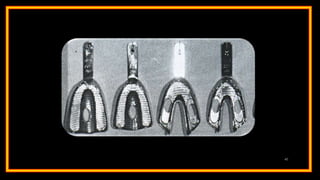

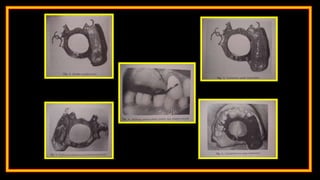

“ Good technique pays off ” is not
merely a motto to hang on a wall but
these are words of wisdom…
IMPRESSION TECHNIQUES
IN
RPD
PRESENTED BY:
APURVA THAMPI
1ST YR PG
CONTENTS
• INTRODUCTION
• TERMINOLOGIES
• COMPLETE DENTURE IMPRESSION V/S RPD IMPRESSION
• IMPRESSION MATERIALS
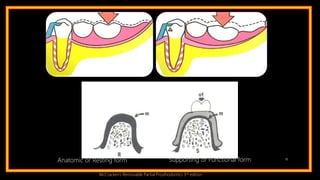
• ANATOMIC FORM AND FUNCTIONAL FORM
• CONCEPT OF FUNCTIONAL IMPRESSION
• NEED OF FUNCTIONAL IMPRESSION
• INDICATION FOR FUNCTIONAL IMPRESSION
• OBJECTIVES OF FUNCTIONAL IMPRESSION
• DISTAL EXTENSION BASED PARTIAL DENTURE
3
CONTENTS
• MCLEAN’S PHYSIOLOGIC IMPRESSION TECHNIQUE
• HINDEL’S MODIFICATIONS
• FUNCTIONAL RELINING METHOD
• FLUID WAX TECHNIQUE
• SELECTIVE PRESSURE IMPRESSION
• ALTERED CAST TECHNIQUE
• MODIFICATIONS OF ALTERED CAST TECHNIQUE
• REVIEW OF LITERATURE
• SUMMARY
• CONCLUSION
• BIBLIOGRAPHY 4
INTRODUCTION
• Preservation of remaining tissues.
• Contribute to trauma to the surrounding
tissues.
• Stress tolerance of supporting anatomic
structures,
• Denture base always moves towards the
supporting muscle.
• Support for the partial denture  to be
considered
Rationale
behind using
RPD….
IMPRESSION
A NEGATIVE LIKENESS OR COPY IN REVERSE OF THE SURFACE OF AN
OBJECT ; IMPRINT OF TEETH AND ADJACENT STRUCTURES FOR USE IN
DENTISTRY.
GPT – 8
PARTIAL DENTURE IMPRESSION
A NEGATIVE LIKENESS OF A PART OR ALL OF A PARTIALLY EDENTULOUS
ARCH –
GPT – 8
Terminology
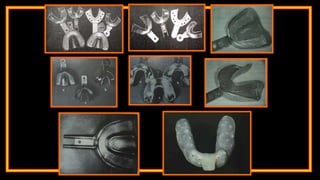
A RECEPTACLE IN TO WHICH SUITABLE IMPRESSION MATERIAL IS
PLACED TO MAKE NEGATIVE LIKENESS
OR
A DEVICE THAT IS USED TO CARRY, CONFINE AND CONTROL
IMPRESSION MATERIAL WHILE MAKING AN IMPRESSION.
IMPRESSION TRAYS
RPD IMPRESSION VS COMPLETE DENTURE
COMPLETE DENTURE IMPRESSION THE EDENTULOUS MUCOSA WITH
UNDERLYING BONE ONLY
PARTIAL DENTURE IMPRESSION  RELATIVE SOFT YIELDING TISSUES (THE
ORAL MUCOSA) + HARD UNYIELDING SUBSTANCE (THE REMAINING
TEETH).
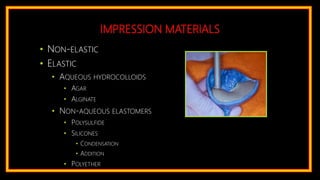
IMPRESSION MATERIALS
• NON-ELASTIC
• ELASTIC
• AQUEOUS HYDROCOLLOIDS
• AGAR
• ALGINATE
• NON-AQUEOUS ELASTOMERS
• POLYSULFIDE
• SILICONES
• CONDENSATION
• ADDITION
• POLYETHER
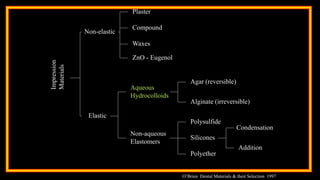
Impression
Materials
Non-elastic
Elastic
Aqueous
Hydrocolloids
Non-aqueous
Elastomers
Polysulfide
Silicones
Polyether
Condensation
Addition
Agar (reversible)
Alginate (irreversible)
Plaster
Compound
ZnO - Eugenol
Waxes
O’Brien Dental Materials & their Selection 1997
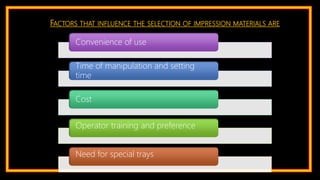
FACTORS THAT INFLUENCE THE SELECTION OF IMPRESSION MATERIALS ARE
Convenience of use
Time of manipulation and setting
time
Cost
Operator training and preference
Need for special trays
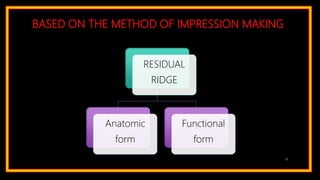
BASED ON THE METHOD OF IMPRESSION MAKING
13
RESIDUAL
RIDGE
Anatomic
form
Functional
form
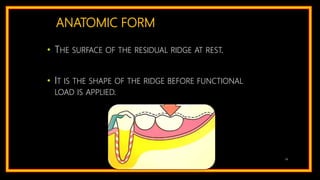
ANATOMIC FORM
• THE SURFACE OF THE RESIDUAL RIDGE AT REST.
• IT IS THE SHAPE OF THE RIDGE BEFORE FUNCTIONAL
LOAD IS APPLIED.
14
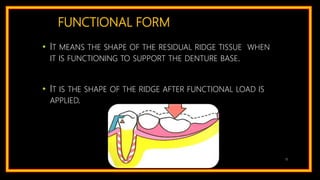
FUNCTIONAL FORM
• IT MEANS THE SHAPE OF THE RESIDUAL RIDGE TISSUE WHEN
IT IS FUNCTIONING TO SUPPORT THE DENTURE BASE.
• IT IS THE SHAPE OF THE RIDGE AFTER FUNCTIONAL LOAD IS
APPLIED.
15
16
Anatomic or Resting form Supporting or Functional form
McCracken’s Removable Partial Prosthodontics 3rd edition
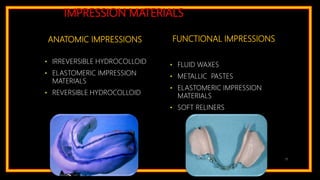
IMPRESSION MATERIALS
ANATOMIC IMPRESSIONS
• IRREVERSIBLE HYDROCOLLOID
• ELASTOMERIC IMPRESSION
MATERIALS
• REVERSIBLE HYDROCOLLOID
FUNCTIONAL IMPRESSIONS
• FLUID WAXES
• METALLIC PASTES
• ELASTOMERIC IMPRESSION
MATERIALS
• SOFT RELINERS
17
CONCEPT OF FUNCTIONAL
IMPRESSION
THE TERM FUNCTIONAL IMPRESSION
MEANS RECORDING THE FUNCTIONAL
FORM OF THE RESIDUAL RIDGE TISSUE & TO
OBTAIN UNIFORMITY OF SUPPORT WHEN
THE FUNCTIONAL LOAD IS APPLIED.
18
• Record and relate the tissues under uniform loading
• Distribute the load over as large an area as possible
• Accurately delineate the peripheral extent of the
denture base
Therefore, the impression must…
INITIALLY…..
• APPLEGATE IMPRESSION WAX TO LOAD FUNCTIONALLY THE RESIDUAL RIDGE
• HINDEL FREE END DENTURE BASE UNDER MASTICATORY LOAD SHOULD BE
RELATED TO METAL FRAMEWORK WHEN IT IS SEATED
• HOLMES USED FOUR DIFFERENT MATERIALS WITH ALTERED CAST TECHNIQUE
• LEUPOLD & KRATOCHVIL USED ZINC-OXIDE EUGENOL PASTE TO RECORD
THE SHAPE OF RESIDUAL RIDGES
Leupold RJ, A comparative study of impression procedures for distal extension removable partial dentures. J Prosthet Dent
1966; 16:708.
20
• KRAMER & SINGER USED A DOUBLE IMPRESSION TECHNIQUE BASED ON
LOAD DISTRIBUTION BY HINDEL
• MCCRACKEN FUNCTIONAL TECHNIQUE SHOULD BE USED WHEN
CONSTRUCTING MANDIBULAR DISTAL EXTENSION BASED PARTIAL DENTURE
Leupold RJ, A comparative study of impression procedures for distal extension removable partial dentures. J Prosthet Dent
1966; 16:708.
21
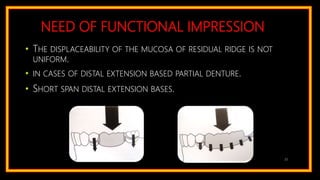
NEED OF FUNCTIONAL IMPRESSION
• THE DISPLACEABILITY OF THE MUCOSA OF RESIDUAL RIDGE IS NOT
UNIFORM.
• IN CASES OF DISTAL EXTENSION BASED PARTIAL DENTURE.
• SHORT SPAN DISTAL EXTENSION BASES.
22
INDICATIONS FOR FUNCTIONAL
IMPRESSION
Mandibular distal
extension partial
dentures
• Mainly kennedy’s class I &
II edentulous arches.
23
OBJECTIVES OF FUNCTIONAL IMPRESSION
(O.C. APPLEGATE)
To obtain the maximum area of coverage
Traumatic impact on any area must be avoided
At rest there must be no islands of ischemia
Under work loads all areas must receive massage
24
SUPPORT OF DISTAL EXTENSION BASED
PARTIAL DENTURE
minor support abutment teeth
major support elastic fibrous connective tissue pad
25
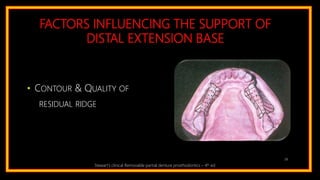
FACTORS INFLUENCING THE SUPPORT OF
DISTAL EXTENSION BASE
• CONTOUR & QUALITY OF
RESIDUAL RIDGE
26
Stewart’s clinical Removable partial denture prosthodontics – 4th ed
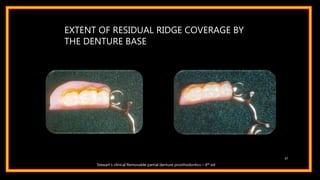
EXTENT OF RESIDUAL RIDGE COVERAGE BY
THE DENTURE BASE
27
Stewart’s clinical Removable partial denture prosthodontics – 4th ed
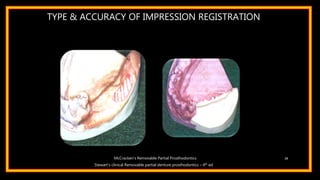
TYPE & ACCURACY OF IMPRESSION REGISTRATION
28
Stewart’s clinical Removable partial denture prosthodontics – 4th ed
McCracken’s Removable Partial Prosthodontics
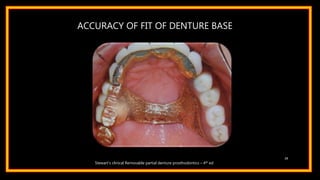
ACCURACY OF FIT OF DENTURE BASE
29
Stewart’s clinical Removable partial denture prosthodontics – 4th ed
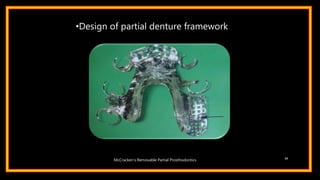
•Design of partial denture framework
30
McCracken’s Removable Partial Prosthodontics
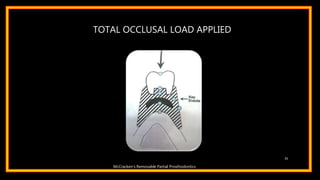
TOTAL OCCLUSAL LOAD APPLIED
31
McCracken’s Removable Partial Prosthodontics
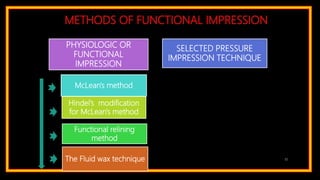
METHODS OF FUNCTIONAL IMPRESSION
PHYSIOLOGIC OR
FUNCTIONAL
IMPRESSION
SELECTED PRESSURE
IMPRESSION TECHNIQUE
McLean's method
Functional relining
method
Hindel’s modification
for McLean's method
The Fluid wax technique 32
MCLEAN’S PHYSIOLOGIC
METHOD
33
Clinical Removable Partial Prosthodontics – Stewart. 3rd edition
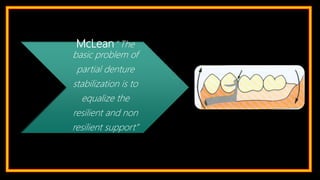
McLean “The
basic problem of
partial denture
stabilization is to
equalize the
resilient and non
resilient support”
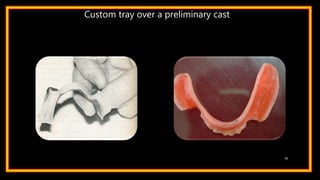
Custom tray over a preliminary cast
35
36
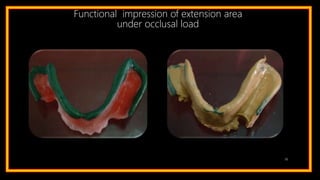
Functional impression of extension area
under occlusal load
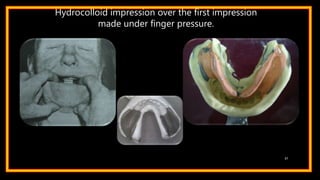
Hydrocolloid impression over the first impression
made under finger pressure.
37
• FINGER PRESSURE NOT EQUAL TO BITING PRESSURE
• CLOSELY AFFECT THE DIRECT RETENTION
38
Disadvantages-
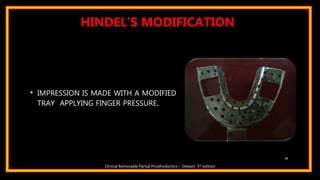
• IMPRESSION IS MADE WITH A MODIFIED
TRAY APPLYING FINGER PRESSURE.
39
Clinical Removable Partial Prosthodontics – Stewart. 3rd edition
HINDEL’S MODIFICATION
40
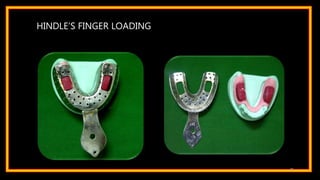
HINDLE’S FINGER LOADING
41
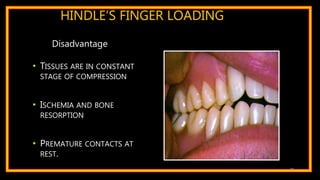
HINDLE’S FINGER LOADING
• TISSUES ARE IN CONSTANT
STAGE OF COMPRESSION
• ISCHEMIA AND BONE
RESORPTION
• PREMATURE CONTACTS AT
REST.
42
Disadvantage
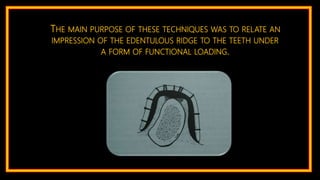
THE MAIN PURPOSE OF THESE TECHNIQUES WAS TO RELATE AN
IMPRESSION OF THE EDENTULOUS RIDGE TO THE TEETH UNDER
A FORM OF FUNCTIONAL LOADING.
FUNCTIONAL RELINE METHOD
44
Clinical Removable Partial Prosthodontics – Stewart. 3rd edition
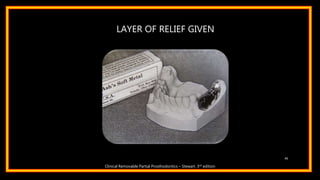
LAYER OF RELIEF GIVEN
45
Clinical Removable Partial Prosthodontics – Stewart. 3rd edition
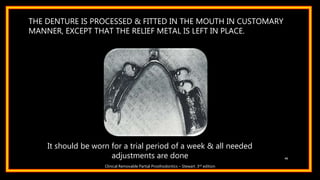
THE DENTURE IS PROCESSED & FITTED IN THE MOUTH IN CUSTOMARY
MANNER, EXCEPT THAT THE RELIEF METAL IS LEFT IN PLACE.
46
It should be worn for a trial period of a week & all needed
adjustments are done
Clinical Removable Partial Prosthodontics – Stewart. 3rd edition
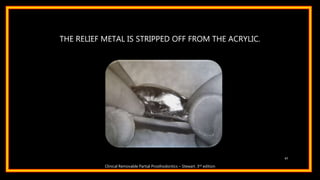
THE RELIEF METAL IS STRIPPED OFF FROM THE ACRYLIC.
47
Clinical Removable Partial Prosthodontics – Stewart. 3rd edition
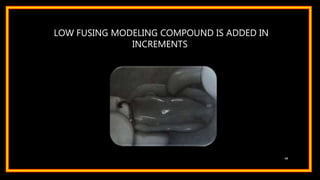
LOW FUSING MODELING COMPOUND IS ADDED IN
INCREMENTS
48
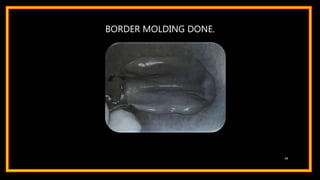
BORDER MOLDING DONE.
49
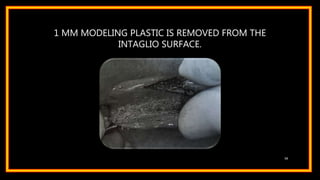
1 MM MODELING PLASTIC IS REMOVED FROM THE
INTAGLIO SURFACE.
50
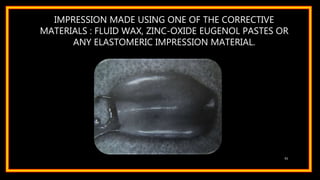
IMPRESSION MADE USING ONE OF THE CORRECTIVE
MATERIALS : FLUID WAX, ZINC-OXIDE EUGENOL PASTES OR
ANY ELASTOMERIC IMPRESSION MATERIAL.
51
FUNCTIONAL RELINE METHOD
DISADVANTAGE
• OCCLUSION MAY BE ALTERED SLIGHTLY
• FINE LINE OF DEMARCATION BETWEEN THE NEWLY
ADDED & OLD RESIN OF THE DENTURE
52
FLUID WAX TECHNIQUE
53
Clinical Removable Partial Prosthodontics – Stewart. 3rd edition
THE MOST FREQUENTLY USED WAXES ARE
Korrecta wax no. 4 - Dr. O.C.& S.G.
Applegate at University of Michigan
IOWA wax -Developed by Dr.Smith at
University of IOWA
54
Korrecta wax no. 4 is slightly more fluid than IOWA wax
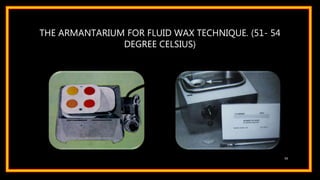
THE ARMANTARIUM FOR FLUID WAX TECHNIQUE. (51- 54
DEGREE CELSIUS)
55
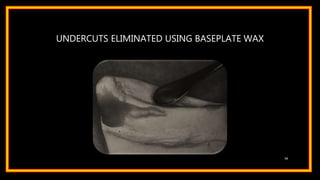
UNDERCUTS ELIMINATED USING BASEPLATE WAX
56
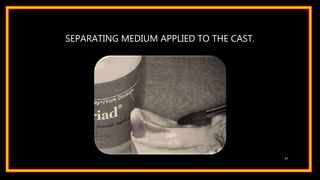
SEPARATING MEDIUM APPLIED TO THE CAST.
57
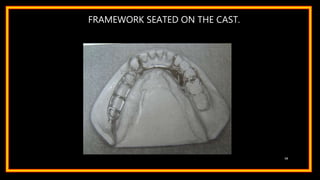
FRAMEWORK SEATED ON THE CAST.
58
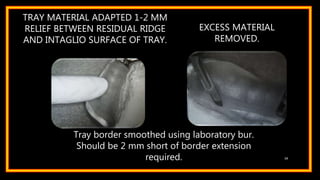
TRAY MATERIAL ADAPTED 1-2 MM
RELIEF BETWEEN RESIDUAL RIDGE
AND INTAGLIO SURFACE OF TRAY.
59
EXCESS MATERIAL
REMOVED.
Tray border smoothed using laboratory bur.
Should be 2 mm short of border extension
required.
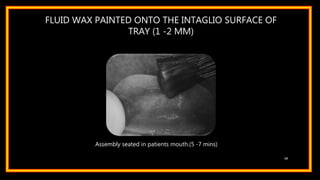
FLUID WAX PAINTED ONTO THE INTAGLIO SURFACE OF
TRAY (1 -2 MM)
60
Assembly seated in patients mouth.(5 -7 mins)
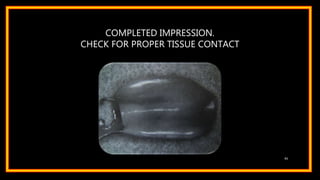
COMPLETED IMPRESSION.
CHECK FOR PROPER TISSUE CONTACT
61
SELECTIVE TISSUE PLACEMENT
IMPRESSION METHOD
62
Direct more force to those
portions of ridge able to
absorb stress without
adverse response & to
protect the areas of ridge
which are least able to
absorb forces.
63
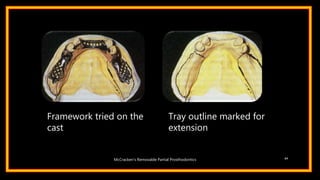
Framework tried on the
cast
Tray outline marked for
extension
64McCracken’s Removable Partial Prosthodontics
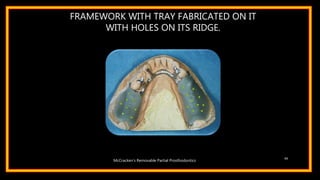
FRAMEWORK WITH TRAY FABRICATED ON IT
WITH HOLES ON ITS RIDGE.
65
McCracken’s Removable Partial Prosthodontics
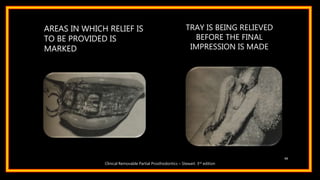
AREAS IN WHICH RELIEF IS
TO BE PROVIDED IS
MARKED
66
TRAY IS BEING RELIEVED
BEFORE THE FINAL
IMPRESSION IS MADE
Clinical Removable Partial Prosthodontics – Stewart. 3rd edition
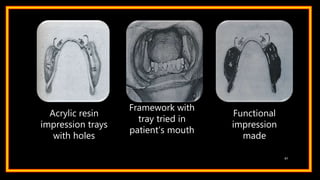
Acrylic resin
impression trays
with holes
Framework with
tray tried in
patient’s mouth
Functional
impression
made
67
WELCOME BACK!
ALTERED CAST TECHNIQUE
ALTERED CAST : A FINAL CAST THAT IS REVISED IN PART
BEFORE PROCESSING A DENTURE BASE—CALLED ALSO
CORRECTED CAST, MODIFIED CAST
ALTERED CAST PARTIAL DENTURE IMPRESSION : A NEGATIVE
LIKENESS OF A PORTION OR PORTIONS OF THE
DENTURE BEARING AREA(S) MADE INDEPENDENT OF AND
AFTER THE INITIAL IMPRESSION OF THE NATURAL TEETH.
70
• ALSO KNOWN AS CORRECTED CAST OR SPLIT CAST
TECHNIQUE.
• IT IS MAINLY A MODIFICATION OF FUNCTIONAL IMPRESSION
THROUGH LABORATORY PROCEDURE.
• FUNCTIONAL IMPRESSION FOR THIS TECHNIQUE CAN BE
MADE USING ANY MENTIONED MATERIALS AND TECHNIQUES.
71
Robert J. Leupold And Frank J. Kratochvil:An Altered-cast Procedure To Improve Tissue Support
For Removable Partial Dentures .J Prosthet Dent 1965:672-679
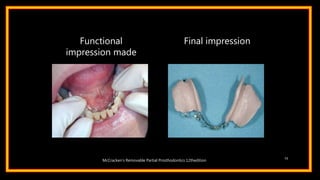
Functional
impression made
Final impression
72
McCracken’s Removable Partial Prosthodontics 12thedition
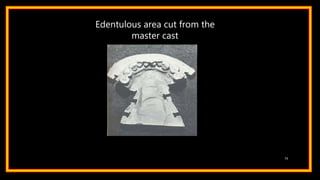
Edentulous area cut from the
master cast
73
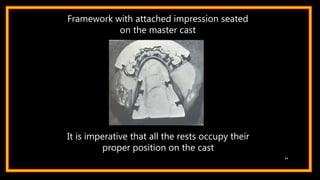
Framework with attached impression seated
on the master cast
It is imperative that all the rests occupy their
proper position on the cast
74
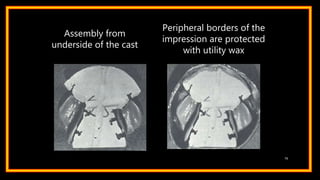
Assembly from
underside of the cast
Peripheral borders of the
impression are protected
with utility wax
75
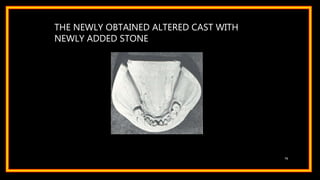
THE NEWLY OBTAINED ALTERED CAST WITH
NEWLY ADDED STONE
76
ALTERNATE TECHNIQUES
77
78
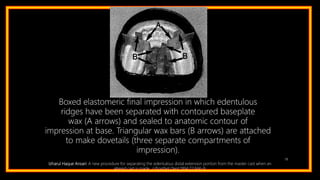
Boxed elastomeric final impression in which edentulous
ridges have been separated with contoured baseplate
wax (A arrows) and sealed to anatomic contour of
impression at base. Triangular wax bars (B arrows) are attached
to make dovetails (three separate compartments of
impression).
Izharul Haque Ansari: A new procedure for separating the edentulous distal extension portion from the master cast when an
altered cast is made. J Prosthet Dent 1994;72:666-9.
79
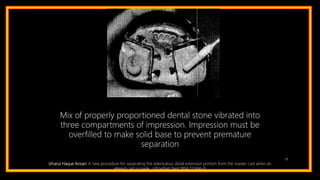
Mix of properly proportioned dental stone vibrated into
three compartments of impression. Impression must be
overfilled to make solid base to prevent premature
separation
Izharul Haque Ansari: A new procedure for separating the edentulous distal extension portion from the master cast when an
altered cast is made. J Prosthet Dent 1994;72:666-9.
80
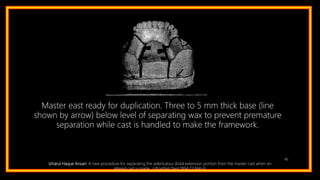
Master east ready for duplication. Three to 5 mm thick base (line
shown by arrow) below level of separating wax to prevent premature
separation while cast is handled to make the framework.
Izharul Haque Ansari: A new procedure for separating the edentulous distal extension portion from the master cast when an
altered cast is made. J Prosthet Dent 1994;72:666-9.
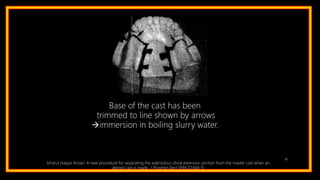
81
Base of the cast has been
trimmed to line shown by arrows
immersion in boiling slurry water.
Izharul Haque Ansari: A new procedure for separating the edentulous distal extension portion from the master cast when an
altered cast is made. J Prosthet Dent 1994;72:666-9.
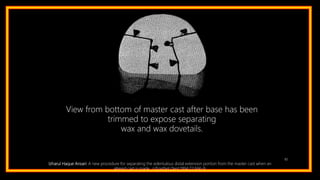
82
View from bottom of master cast after base has been
trimmed to expose separating
wax and wax dovetails.
Izharul Haque Ansari: A new procedure for separating the edentulous distal extension portion from the master cast when an
altered cast is made. J Prosthet Dent 1994;72:666-9.
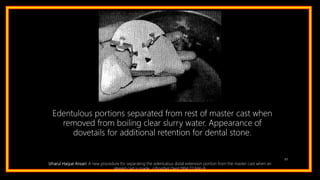
83
Edentulous portions separated from rest of master cast when
removed from boiling clear slurry water. Appearance of
dovetails for additional retention for dental stone.
Izharul Haque Ansari: A new procedure for separating the edentulous distal extension portion from the master cast when an
altered cast is made. J Prosthet Dent 1994;72:666-9.
ALTERNATE BOXING TECHNIQUE
84
Leila Jahangiri, Patrick Mascarenhas and Donald Kitzis: A simple technique for boxing impressions for fabrication of altered casts. J
Prosthet Dent 2001;85:519-20
Kevin D. Plummer:Technique for boxing an altered cast impression. J Prosthet Dent 1982;47:573-575
85
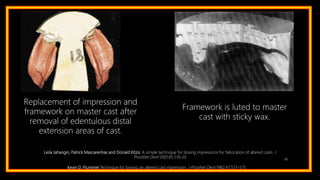
Replacement of impression and
framework on master cast after
removal of edentulous distal
extension areas of cast.
Framework is luted to master
cast with sticky wax.
Leila Jahangiri, Patrick Mascarenhas and Donald Kitzis: A simple technique for boxing impressions for fabrication of altered casts. J
Prosthet Dent 2001;85:519-20
Kevin D. Plummer:Technique for boxing an altered cast impression. J Prosthet Dent 1982;47:573-575
86
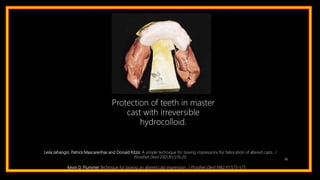
Protection of teeth in master
cast with irreversible
hydrocolloid.
Leila Jahangiri, Patrick Mascarenhas and Donald Kitzis: A simple technique for boxing impressions for fabrication of altered casts. J
Prosthet Dent 2001;85:519-20
Kevin D. Plummer:Technique for boxing an altered cast impression. J Prosthet Dent 1982;47:573-575
87
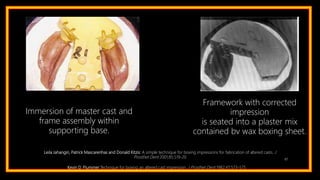
Immersion of master cast and
frame assembly within
supporting base.
Framework with corrected
impression
is seated into a plaster mix
contained bv wax boxing sheet.
Leila Jahangiri, Patrick Mascarenhas and Donald Kitzis: A simple technique for boxing impressions for fabrication of altered casts. J
Prosthet Dent 2001;85:519-20
Kevin D. Plummer:Technique for boxing an altered cast impression. J Prosthet Dent 1982;47:573-575
• MAKE A SUPPORT BASE MIX WITH
• 2 PARTS (26 ML) CORNSTARCH
• 1 PART (13 ML) FINE PUMICE, AND
• 1 PART (13 ML) PLASTER.
• ADD TO 115 ML WATER. POUR THE MATERIAL INTO A DENTURE FLASK.
• LET SET FOR 15 MINUTES.
• SEPARATE MASTER CAST FROM THE SUPPORTING BASE AND IRREVERSIBLE
HYDROCOLLOID
88
Leila Jahangiri, Patrick Mascarenhas and Donald Kitzis: A simple technique for boxing impressions for fabrication of altered casts.
J Prosthet Dent 2001;85:519-20
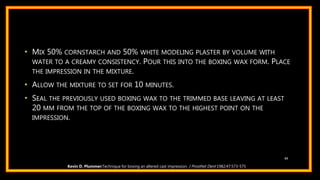
• MIX 50% CORNSTARCH AND 50% WHITE MODELING PLASTER BY VOLUME WITH
WATER TO A CREAMY CONSISTENCY. POUR THIS INTO THE BOXING WAX FORM. PLACE
THE IMPRESSION IN THE MIXTURE.
• ALLOW THE MIXTURE TO SET FOR 10 MINUTES.
• SEAL THE PREVIOUSLY USED BOXING WAX TO THE TRIMMED BASE LEAVING AT LEAST
20 MM FROM THE TOP OF THE BOXING WAX TO THE HIGHEST POINT ON THE
IMPRESSION.
89
Kevin D. Plummer:Technique for boxing an altered cast impression. J Prosthet Dent 1982;47:573-575
• SOAK THE MASTER CAST IN SLURRY WATER FOR 5 MINUTES. POUR THE CAST
USING THE SAME STONE AS THE ORIGINAL MASTER CAST. NO SEPARATING
MEDIUM IS NEEDED
• WHEN THE STONE IS SET, REMOVE THE BOXING WAX AND PLACE THE CAST IN A
WATER BATH OF 110” F
• SEPARATE THE PLASTER/CORNSTARCH MIXTURE WITH PLASTER PLIERS AND YOUR
FINGERS.
91
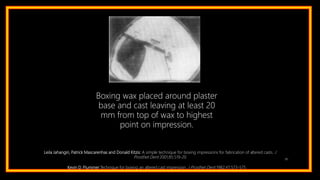
Boxing wax placed around plaster
base and cast leaving at least 20
mm from top of wax to highest
point on impression.
Leila Jahangiri, Patrick Mascarenhas and Donald Kitzis: A simple technique for boxing impressions for fabrication of altered casts. J
Prosthet Dent 2001;85:519-20
Kevin D. Plummer:Technique for boxing an altered cast impression. J Prosthet Dent 1982;47:573-575
92
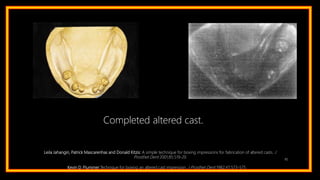
Completed altered cast.
Leila Jahangiri, Patrick Mascarenhas and Donald Kitzis: A simple technique for boxing impressions for fabrication of altered casts. J
Prosthet Dent 2001;85:519-20
Kevin D. Plummer:Technique for boxing an altered cast impression. J Prosthet Dent 1982;47:573-575
ALTERNATE BOXING TECHNIQUE
93
Ming-Sheh Chen, W.A. Eichhold, Chao-Chin Chien and D.A. Curtis : An altered-cast impression technique that eliminates
conventional cast dissecting and impression boxing. J Prosthet Dent 1987;57:471-474
94Ming-Sheh Chen, W.A. Eichhold, Chao-Chin Chien and D.A. Curtis : An altered-cast impression technique that eliminates
conventional cast dissecting and impression boxing. J Prosthet Dent 1987;57:471-474
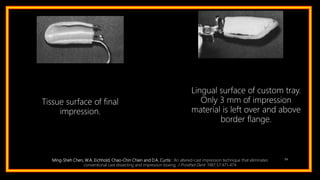
Tissue surface of final
impression.
Lingual surface of custom tray.
Only 3 mm of impression
material is left over and above
border flange.
95
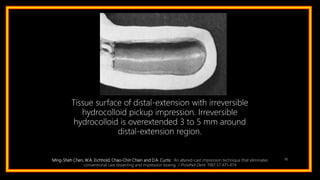
Tissue surface of distal-extension with irreversible
hydrocolloid pickup impression. Irreversible
hydrocolloid is overextended 3 to 5 mm around
distal-extension region.
Ming-Sheh Chen, W.A. Eichhold, Chao-Chin Chien and D.A. Curtis : An altered-cast impression technique that eliminates
conventional cast dissecting and impression boxing. J Prosthet Dent 1987;57:471-474
96
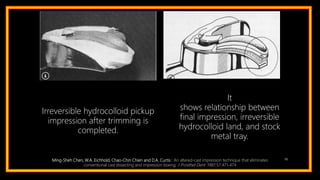
Irreversible hydrocolloid pickup
impression after trimming is
completed.
It
shows relationship between
final impression, irreversible
hydrocolloid land, and stock
metal tray.
Ming-Sheh Chen, W.A. Eichhold, Chao-Chin Chien and D.A. Curtis : An altered-cast impression technique that eliminates
conventional cast dissecting and impression boxing. J Prosthet Dent 1987;57:471-474
97
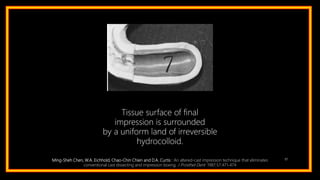
Tissue surface of final
impression is surrounded
by a uniform land of irreversible
hydrocolloid.
Ming-Sheh Chen, W.A. Eichhold, Chao-Chin Chien and D.A. Curtis : An altered-cast impression technique that eliminates
conventional cast dissecting and impression boxing. J Prosthet Dent 1987;57:471-474
98
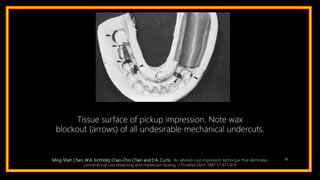
Tissue surface of pickup impression. Note wax
blockout (arrows) of all undesirable mechanical undercuts.
Ming-Sheh Chen, W.A. Eichhold, Chao-Chin Chien and D.A. Curtis : An altered-cast impression technique that eliminates
conventional cast dissecting and impression boxing. J Prosthet Dent 1987;57:471-474
99
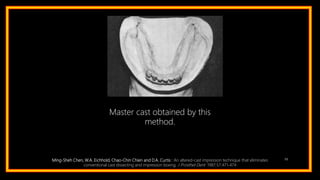
Master cast obtained by this
method.
Ming-Sheh Chen, W.A. Eichhold, Chao-Chin Chien and D.A. Curtis : An altered-cast impression technique that eliminates
conventional cast dissecting and impression boxing. J Prosthet Dent 1987;57:471-474
ALTERNATIVE TO ALTERED CAST
TECHNIQUE
100
Herman B. Dumbrigue and Josephine F. Esquivel: Selective-pressure single impression procedure for tooth-mucosa–supported
removable partial dentures. J Prosthet Dent 1998;80:259-61
101Herman B. Dumbrigue and Josephine F. Esquivel: Selective-pressure single impression procedure for tooth-mucosa–supported
removable partial dentures. J Prosthet Dent 1998;80:259-61
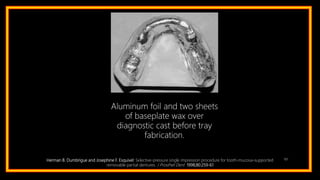
Aluminum foil and two sheets
of baseplate wax over
diagnostic cast before tray
fabrication.
102Herman B. Dumbrigue and Josephine F. Esquivel: Selective-pressure single impression procedure for tooth-mucosa–supported
removable partial dentures. J Prosthet Dent 1998;80:259-61
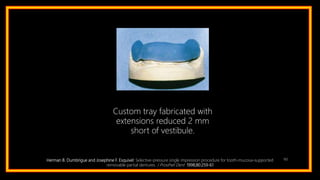
Custom tray fabricated with
extensions reduced 2 mm
short of vestibule.
103Herman B. Dumbrigue and Josephine F. Esquivel: Selective-pressure single impression procedure for tooth-mucosa–supported
removable partial dentures. J Prosthet Dent 1998;80:259-61
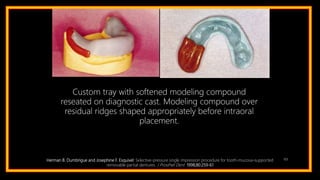
Custom tray with softened modeling compound
reseated on diagnostic cast. Modeling compound over
residual ridges shaped appropriately before intraoral
placement.
104Herman B. Dumbrigue and Josephine F. Esquivel: Selective-pressure single impression procedure for tooth-mucosa–supported
removable partial dentures. J Prosthet Dent 1998;80:259-61
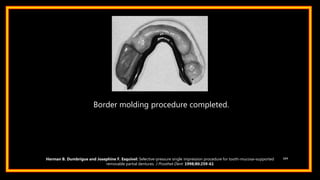
Border molding procedure completed.
Richard P. Frank et al :clinical outcome of altered cast impression procedure compared with use of A one piece cast
J prosthet dent 2004;91:468-76
ALTERED CAST PROCEDURE DOES NOT OFFER SIGNIFICANT
ADVANTAGES OVER ONE PIECE CAST IF THE FOLLOWING
STANDARDS ARE MET :
• COMPLETE EXTENSION OF IMPRESSION
• USE OF MAGNIFICATION TO ADJUST AND ENSURE COMPLETE
SEATING OF THE FRAMEWORK.
• COVERAGE OF RETROMOLAR PAD AND BUCCAL SHELF AREA
BY THE BASE
105
92
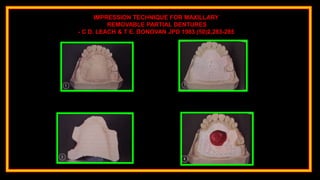
IMPRESSION TECHNIQUE FOR MAXILLARY
REMOVABLE PARTIAL DENTURES
- C D. LEACH & T E. DONOVAN JPD 1983 (50)2,283-285
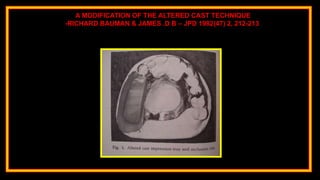
A MODIFICATION OF THE ALTERED CAST TECHNIQUE
-RICHARD BAUMAN & JAMES .D B – JPD 1982(47) 2, 212-213
FOR THE PRODUCTION OF ACCURATE MASTER CAST THE
IMPRESSION TECHNIQUE FAR OUT WEIGHTS THE
SELECTION OF THE IMPRESSION MATERIAL.
CONCLUSION
1. GLOSSARY OF PROSTHODONTIC TERMS -8 TH EDN, 2005.
2. STEWART, RUDD, KUEBKER : CLINICAL REMOVABLE PARTIAL
PROSTHODONTICS.
3. MCGIVNEY GP, ALAN B CARR DAVID T BROWN :
MCCRACKEN’S REMOVABLE PARTIAL DENTURES-11 TH EDN.
4. KENNETH D RUDD, MORROW: DENTAL LAB, PROCEDURE FOR
REMOVABLE PARTIAL DENTURES.
BIBLIOGRAPHY
AN ALTERED CAST PROCEDURE TO IMPROVE TISSUE SUPPORT FOR REMOVABLE PARTIAL
DENTURES - R J. LEUPOLD, F J. KRATOCHVIL : JPD 1965(15), 4, 672- 678
SINGLE- TRAY DUAL- IMPRESSION TECHNIQUE FOR DISTAL EXTENSION
PARTIAL DENTURES JOSEPH A. R- JPD 1970(24,1,41-46)
IMPRESSION TECHNIQUE FOR MAXILLARY REMOVABLE PARTIAL DENTURES- C D. LEACH & T E.
DONOVAN JPD 1983 (50)2,283-285
AN ALTERED CAST IMPRESSION TECHNIQUE THAT ELIMINATES CONVENTIONAL CAST
DISSECTING & IMPRESSSION BOXING - M S. CHEN AND et al - JPD 1987 (57) 4, 471-474
A MODIFICATION OF THE ALTERED CAST TECHNIQUE -RICHARD BAUMAN & JAMES .D B –
JPD 1982(47) 2, 212-213
AN IMPRESSION TECHNIQUE TO MAKE NEW MASTER CAST FOR AN EXISTING
REMOVABLE PARTIAL DENTURE -PHILIP J. R - JPD 1992 (67) 4, 488-490
THANK YOU
AND
HAVE A PLEASANT DAY!

Impression techniques in rpd

  • 1.
    “ Good techniquepays off ” is not merely a motto to hang on a wall but these are words of wisdom…
  • 2.
  • 3.
    CONTENTS • INTRODUCTION • TERMINOLOGIES •COMPLETE DENTURE IMPRESSION V/S RPD IMPRESSION • IMPRESSION MATERIALS • ANATOMIC FORM AND FUNCTIONAL FORM • CONCEPT OF FUNCTIONAL IMPRESSION • NEED OF FUNCTIONAL IMPRESSION • INDICATION FOR FUNCTIONAL IMPRESSION • OBJECTIVES OF FUNCTIONAL IMPRESSION • DISTAL EXTENSION BASED PARTIAL DENTURE 3
  • 4.
    CONTENTS • MCLEAN’S PHYSIOLOGICIMPRESSION TECHNIQUE • HINDEL’S MODIFICATIONS • FUNCTIONAL RELINING METHOD • FLUID WAX TECHNIQUE • SELECTIVE PRESSURE IMPRESSION • ALTERED CAST TECHNIQUE • MODIFICATIONS OF ALTERED CAST TECHNIQUE • REVIEW OF LITERATURE • SUMMARY • CONCLUSION • BIBLIOGRAPHY 4
  • 5.
    INTRODUCTION • Preservation ofremaining tissues. • Contribute to trauma to the surrounding tissues. • Stress tolerance of supporting anatomic structures, • Denture base always moves towards the supporting muscle. • Support for the partial denture  to be considered Rationale behind using RPD….
  • 6.
    IMPRESSION A NEGATIVE LIKENESSOR COPY IN REVERSE OF THE SURFACE OF AN OBJECT ; IMPRINT OF TEETH AND ADJACENT STRUCTURES FOR USE IN DENTISTRY. GPT – 8 PARTIAL DENTURE IMPRESSION A NEGATIVE LIKENESS OF A PART OR ALL OF A PARTIALLY EDENTULOUS ARCH – GPT – 8 Terminology
  • 7.
    A RECEPTACLE INTO WHICH SUITABLE IMPRESSION MATERIAL IS PLACED TO MAKE NEGATIVE LIKENESS OR A DEVICE THAT IS USED TO CARRY, CONFINE AND CONTROL IMPRESSION MATERIAL WHILE MAKING AN IMPRESSION. IMPRESSION TRAYS
  • 9.
    RPD IMPRESSION VSCOMPLETE DENTURE COMPLETE DENTURE IMPRESSION THE EDENTULOUS MUCOSA WITH UNDERLYING BONE ONLY PARTIAL DENTURE IMPRESSION  RELATIVE SOFT YIELDING TISSUES (THE ORAL MUCOSA) + HARD UNYIELDING SUBSTANCE (THE REMAINING TEETH).
  • 10.
    IMPRESSION MATERIALS • NON-ELASTIC •ELASTIC • AQUEOUS HYDROCOLLOIDS • AGAR • ALGINATE • NON-AQUEOUS ELASTOMERS • POLYSULFIDE • SILICONES • CONDENSATION • ADDITION • POLYETHER
  • 11.
  • 12.
    FACTORS THAT INFLUENCETHE SELECTION OF IMPRESSION MATERIALS ARE Convenience of use Time of manipulation and setting time Cost Operator training and preference Need for special trays
  • 13.
    BASED ON THEMETHOD OF IMPRESSION MAKING 13 RESIDUAL RIDGE Anatomic form Functional form
  • 14.
    ANATOMIC FORM • THESURFACE OF THE RESIDUAL RIDGE AT REST. • IT IS THE SHAPE OF THE RIDGE BEFORE FUNCTIONAL LOAD IS APPLIED. 14
  • 15.
    FUNCTIONAL FORM • ITMEANS THE SHAPE OF THE RESIDUAL RIDGE TISSUE WHEN IT IS FUNCTIONING TO SUPPORT THE DENTURE BASE. • IT IS THE SHAPE OF THE RIDGE AFTER FUNCTIONAL LOAD IS APPLIED. 15
  • 16.
    16 Anatomic or Restingform Supporting or Functional form McCracken’s Removable Partial Prosthodontics 3rd edition
  • 17.
    IMPRESSION MATERIALS ANATOMIC IMPRESSIONS •IRREVERSIBLE HYDROCOLLOID • ELASTOMERIC IMPRESSION MATERIALS • REVERSIBLE HYDROCOLLOID FUNCTIONAL IMPRESSIONS • FLUID WAXES • METALLIC PASTES • ELASTOMERIC IMPRESSION MATERIALS • SOFT RELINERS 17
  • 18.
    CONCEPT OF FUNCTIONAL IMPRESSION THETERM FUNCTIONAL IMPRESSION MEANS RECORDING THE FUNCTIONAL FORM OF THE RESIDUAL RIDGE TISSUE & TO OBTAIN UNIFORMITY OF SUPPORT WHEN THE FUNCTIONAL LOAD IS APPLIED. 18
  • 19.
    • Record andrelate the tissues under uniform loading • Distribute the load over as large an area as possible • Accurately delineate the peripheral extent of the denture base Therefore, the impression must…
  • 20.
    INITIALLY….. • APPLEGATE IMPRESSIONWAX TO LOAD FUNCTIONALLY THE RESIDUAL RIDGE • HINDEL FREE END DENTURE BASE UNDER MASTICATORY LOAD SHOULD BE RELATED TO METAL FRAMEWORK WHEN IT IS SEATED • HOLMES USED FOUR DIFFERENT MATERIALS WITH ALTERED CAST TECHNIQUE • LEUPOLD & KRATOCHVIL USED ZINC-OXIDE EUGENOL PASTE TO RECORD THE SHAPE OF RESIDUAL RIDGES Leupold RJ, A comparative study of impression procedures for distal extension removable partial dentures. J Prosthet Dent 1966; 16:708. 20
  • 21.
    • KRAMER &SINGER USED A DOUBLE IMPRESSION TECHNIQUE BASED ON LOAD DISTRIBUTION BY HINDEL • MCCRACKEN FUNCTIONAL TECHNIQUE SHOULD BE USED WHEN CONSTRUCTING MANDIBULAR DISTAL EXTENSION BASED PARTIAL DENTURE Leupold RJ, A comparative study of impression procedures for distal extension removable partial dentures. J Prosthet Dent 1966; 16:708. 21
  • 22.
    NEED OF FUNCTIONALIMPRESSION • THE DISPLACEABILITY OF THE MUCOSA OF RESIDUAL RIDGE IS NOT UNIFORM. • IN CASES OF DISTAL EXTENSION BASED PARTIAL DENTURE. • SHORT SPAN DISTAL EXTENSION BASES. 22
  • 23.
    INDICATIONS FOR FUNCTIONAL IMPRESSION Mandibulardistal extension partial dentures • Mainly kennedy’s class I & II edentulous arches. 23
  • 24.
    OBJECTIVES OF FUNCTIONALIMPRESSION (O.C. APPLEGATE) To obtain the maximum area of coverage Traumatic impact on any area must be avoided At rest there must be no islands of ischemia Under work loads all areas must receive massage 24
  • 25.
    SUPPORT OF DISTALEXTENSION BASED PARTIAL DENTURE minor support abutment teeth major support elastic fibrous connective tissue pad 25
  • 26.
    FACTORS INFLUENCING THESUPPORT OF DISTAL EXTENSION BASE • CONTOUR & QUALITY OF RESIDUAL RIDGE 26 Stewart’s clinical Removable partial denture prosthodontics – 4th ed
  • 27.
    EXTENT OF RESIDUALRIDGE COVERAGE BY THE DENTURE BASE 27 Stewart’s clinical Removable partial denture prosthodontics – 4th ed
  • 28.
    TYPE & ACCURACYOF IMPRESSION REGISTRATION 28 Stewart’s clinical Removable partial denture prosthodontics – 4th ed McCracken’s Removable Partial Prosthodontics
  • 29.
    ACCURACY OF FITOF DENTURE BASE 29 Stewart’s clinical Removable partial denture prosthodontics – 4th ed
  • 30.
    •Design of partialdenture framework 30 McCracken’s Removable Partial Prosthodontics
  • 31.
    TOTAL OCCLUSAL LOADAPPLIED 31 McCracken’s Removable Partial Prosthodontics
  • 32.
    METHODS OF FUNCTIONALIMPRESSION PHYSIOLOGIC OR FUNCTIONAL IMPRESSION SELECTED PRESSURE IMPRESSION TECHNIQUE McLean's method Functional relining method Hindel’s modification for McLean's method The Fluid wax technique 32
  • 33.
    MCLEAN’S PHYSIOLOGIC METHOD 33 Clinical RemovablePartial Prosthodontics – Stewart. 3rd edition
  • 34.
    McLean “The basic problemof partial denture stabilization is to equalize the resilient and non resilient support”
  • 35.
    Custom tray overa preliminary cast 35
  • 36.
    36 Functional impression ofextension area under occlusal load
  • 37.
    Hydrocolloid impression overthe first impression made under finger pressure. 37
  • 38.
    • FINGER PRESSURENOT EQUAL TO BITING PRESSURE • CLOSELY AFFECT THE DIRECT RETENTION 38 Disadvantages-
  • 39.
    • IMPRESSION ISMADE WITH A MODIFIED TRAY APPLYING FINGER PRESSURE. 39 Clinical Removable Partial Prosthodontics – Stewart. 3rd edition HINDEL’S MODIFICATION
  • 40.
  • 41.
  • 42.
    HINDLE’S FINGER LOADING •TISSUES ARE IN CONSTANT STAGE OF COMPRESSION • ISCHEMIA AND BONE RESORPTION • PREMATURE CONTACTS AT REST. 42 Disadvantage
  • 43.
    THE MAIN PURPOSEOF THESE TECHNIQUES WAS TO RELATE AN IMPRESSION OF THE EDENTULOUS RIDGE TO THE TEETH UNDER A FORM OF FUNCTIONAL LOADING.
  • 44.
    FUNCTIONAL RELINE METHOD 44 ClinicalRemovable Partial Prosthodontics – Stewart. 3rd edition
  • 45.
    LAYER OF RELIEFGIVEN 45 Clinical Removable Partial Prosthodontics – Stewart. 3rd edition
  • 46.
    THE DENTURE ISPROCESSED & FITTED IN THE MOUTH IN CUSTOMARY MANNER, EXCEPT THAT THE RELIEF METAL IS LEFT IN PLACE. 46 It should be worn for a trial period of a week & all needed adjustments are done Clinical Removable Partial Prosthodontics – Stewart. 3rd edition
  • 47.
    THE RELIEF METALIS STRIPPED OFF FROM THE ACRYLIC. 47 Clinical Removable Partial Prosthodontics – Stewart. 3rd edition
  • 48.
    LOW FUSING MODELINGCOMPOUND IS ADDED IN INCREMENTS 48
  • 49.
  • 50.
    1 MM MODELINGPLASTIC IS REMOVED FROM THE INTAGLIO SURFACE. 50
  • 51.
    IMPRESSION MADE USINGONE OF THE CORRECTIVE MATERIALS : FLUID WAX, ZINC-OXIDE EUGENOL PASTES OR ANY ELASTOMERIC IMPRESSION MATERIAL. 51
  • 52.
    FUNCTIONAL RELINE METHOD DISADVANTAGE •OCCLUSION MAY BE ALTERED SLIGHTLY • FINE LINE OF DEMARCATION BETWEEN THE NEWLY ADDED & OLD RESIN OF THE DENTURE 52
  • 53.
    FLUID WAX TECHNIQUE 53 ClinicalRemovable Partial Prosthodontics – Stewart. 3rd edition
  • 54.
    THE MOST FREQUENTLYUSED WAXES ARE Korrecta wax no. 4 - Dr. O.C.& S.G. Applegate at University of Michigan IOWA wax -Developed by Dr.Smith at University of IOWA 54 Korrecta wax no. 4 is slightly more fluid than IOWA wax
  • 55.
    THE ARMANTARIUM FORFLUID WAX TECHNIQUE. (51- 54 DEGREE CELSIUS) 55
  • 56.
  • 57.
  • 58.
    FRAMEWORK SEATED ONTHE CAST. 58
  • 59.
    TRAY MATERIAL ADAPTED1-2 MM RELIEF BETWEEN RESIDUAL RIDGE AND INTAGLIO SURFACE OF TRAY. 59 EXCESS MATERIAL REMOVED. Tray border smoothed using laboratory bur. Should be 2 mm short of border extension required.
  • 60.
    FLUID WAX PAINTEDONTO THE INTAGLIO SURFACE OF TRAY (1 -2 MM) 60 Assembly seated in patients mouth.(5 -7 mins)
  • 61.
    COMPLETED IMPRESSION. CHECK FORPROPER TISSUE CONTACT 61
  • 62.
  • 63.
    Direct more forceto those portions of ridge able to absorb stress without adverse response & to protect the areas of ridge which are least able to absorb forces. 63
  • 64.
    Framework tried onthe cast Tray outline marked for extension 64McCracken’s Removable Partial Prosthodontics
  • 65.
    FRAMEWORK WITH TRAYFABRICATED ON IT WITH HOLES ON ITS RIDGE. 65 McCracken’s Removable Partial Prosthodontics
  • 66.
    AREAS IN WHICHRELIEF IS TO BE PROVIDED IS MARKED 66 TRAY IS BEING RELIEVED BEFORE THE FINAL IMPRESSION IS MADE Clinical Removable Partial Prosthodontics – Stewart. 3rd edition
  • 67.
    Acrylic resin impression trays withholes Framework with tray tried in patient’s mouth Functional impression made 67
  • 68.
  • 69.
  • 70.
    ALTERED CAST :A FINAL CAST THAT IS REVISED IN PART BEFORE PROCESSING A DENTURE BASE—CALLED ALSO CORRECTED CAST, MODIFIED CAST ALTERED CAST PARTIAL DENTURE IMPRESSION : A NEGATIVE LIKENESS OF A PORTION OR PORTIONS OF THE DENTURE BEARING AREA(S) MADE INDEPENDENT OF AND AFTER THE INITIAL IMPRESSION OF THE NATURAL TEETH. 70
  • 71.
    • ALSO KNOWNAS CORRECTED CAST OR SPLIT CAST TECHNIQUE. • IT IS MAINLY A MODIFICATION OF FUNCTIONAL IMPRESSION THROUGH LABORATORY PROCEDURE. • FUNCTIONAL IMPRESSION FOR THIS TECHNIQUE CAN BE MADE USING ANY MENTIONED MATERIALS AND TECHNIQUES. 71 Robert J. Leupold And Frank J. Kratochvil:An Altered-cast Procedure To Improve Tissue Support For Removable Partial Dentures .J Prosthet Dent 1965:672-679
  • 72.
    Functional impression made Final impression 72 McCracken’sRemovable Partial Prosthodontics 12thedition
  • 73.
    Edentulous area cutfrom the master cast 73
  • 74.
    Framework with attachedimpression seated on the master cast It is imperative that all the rests occupy their proper position on the cast 74
  • 75.
    Assembly from underside ofthe cast Peripheral borders of the impression are protected with utility wax 75
  • 76.
    THE NEWLY OBTAINEDALTERED CAST WITH NEWLY ADDED STONE 76
  • 77.
  • 78.
    78 Boxed elastomeric finalimpression in which edentulous ridges have been separated with contoured baseplate wax (A arrows) and sealed to anatomic contour of impression at base. Triangular wax bars (B arrows) are attached to make dovetails (three separate compartments of impression). Izharul Haque Ansari: A new procedure for separating the edentulous distal extension portion from the master cast when an altered cast is made. J Prosthet Dent 1994;72:666-9.
  • 79.
    79 Mix of properlyproportioned dental stone vibrated into three compartments of impression. Impression must be overfilled to make solid base to prevent premature separation Izharul Haque Ansari: A new procedure for separating the edentulous distal extension portion from the master cast when an altered cast is made. J Prosthet Dent 1994;72:666-9.
  • 80.
    80 Master east readyfor duplication. Three to 5 mm thick base (line shown by arrow) below level of separating wax to prevent premature separation while cast is handled to make the framework. Izharul Haque Ansari: A new procedure for separating the edentulous distal extension portion from the master cast when an altered cast is made. J Prosthet Dent 1994;72:666-9.
  • 81.
    81 Base of thecast has been trimmed to line shown by arrows immersion in boiling slurry water. Izharul Haque Ansari: A new procedure for separating the edentulous distal extension portion from the master cast when an altered cast is made. J Prosthet Dent 1994;72:666-9.
  • 82.
    82 View from bottomof master cast after base has been trimmed to expose separating wax and wax dovetails. Izharul Haque Ansari: A new procedure for separating the edentulous distal extension portion from the master cast when an altered cast is made. J Prosthet Dent 1994;72:666-9.
  • 83.
    83 Edentulous portions separatedfrom rest of master cast when removed from boiling clear slurry water. Appearance of dovetails for additional retention for dental stone. Izharul Haque Ansari: A new procedure for separating the edentulous distal extension portion from the master cast when an altered cast is made. J Prosthet Dent 1994;72:666-9.
  • 84.
    ALTERNATE BOXING TECHNIQUE 84 LeilaJahangiri, Patrick Mascarenhas and Donald Kitzis: A simple technique for boxing impressions for fabrication of altered casts. J Prosthet Dent 2001;85:519-20 Kevin D. Plummer:Technique for boxing an altered cast impression. J Prosthet Dent 1982;47:573-575
  • 85.
    85 Replacement of impressionand framework on master cast after removal of edentulous distal extension areas of cast. Framework is luted to master cast with sticky wax. Leila Jahangiri, Patrick Mascarenhas and Donald Kitzis: A simple technique for boxing impressions for fabrication of altered casts. J Prosthet Dent 2001;85:519-20 Kevin D. Plummer:Technique for boxing an altered cast impression. J Prosthet Dent 1982;47:573-575
  • 86.
    86 Protection of teethin master cast with irreversible hydrocolloid. Leila Jahangiri, Patrick Mascarenhas and Donald Kitzis: A simple technique for boxing impressions for fabrication of altered casts. J Prosthet Dent 2001;85:519-20 Kevin D. Plummer:Technique for boxing an altered cast impression. J Prosthet Dent 1982;47:573-575
  • 87.
    87 Immersion of mastercast and frame assembly within supporting base. Framework with corrected impression is seated into a plaster mix contained bv wax boxing sheet. Leila Jahangiri, Patrick Mascarenhas and Donald Kitzis: A simple technique for boxing impressions for fabrication of altered casts. J Prosthet Dent 2001;85:519-20 Kevin D. Plummer:Technique for boxing an altered cast impression. J Prosthet Dent 1982;47:573-575
  • 88.
    • MAKE ASUPPORT BASE MIX WITH • 2 PARTS (26 ML) CORNSTARCH • 1 PART (13 ML) FINE PUMICE, AND • 1 PART (13 ML) PLASTER. • ADD TO 115 ML WATER. POUR THE MATERIAL INTO A DENTURE FLASK. • LET SET FOR 15 MINUTES. • SEPARATE MASTER CAST FROM THE SUPPORTING BASE AND IRREVERSIBLE HYDROCOLLOID 88 Leila Jahangiri, Patrick Mascarenhas and Donald Kitzis: A simple technique for boxing impressions for fabrication of altered casts. J Prosthet Dent 2001;85:519-20
  • 89.
    • MIX 50%CORNSTARCH AND 50% WHITE MODELING PLASTER BY VOLUME WITH WATER TO A CREAMY CONSISTENCY. POUR THIS INTO THE BOXING WAX FORM. PLACE THE IMPRESSION IN THE MIXTURE. • ALLOW THE MIXTURE TO SET FOR 10 MINUTES. • SEAL THE PREVIOUSLY USED BOXING WAX TO THE TRIMMED BASE LEAVING AT LEAST 20 MM FROM THE TOP OF THE BOXING WAX TO THE HIGHEST POINT ON THE IMPRESSION. 89 Kevin D. Plummer:Technique for boxing an altered cast impression. J Prosthet Dent 1982;47:573-575
  • 90.
    • SOAK THEMASTER CAST IN SLURRY WATER FOR 5 MINUTES. POUR THE CAST USING THE SAME STONE AS THE ORIGINAL MASTER CAST. NO SEPARATING MEDIUM IS NEEDED • WHEN THE STONE IS SET, REMOVE THE BOXING WAX AND PLACE THE CAST IN A WATER BATH OF 110” F • SEPARATE THE PLASTER/CORNSTARCH MIXTURE WITH PLASTER PLIERS AND YOUR FINGERS.
  • 91.
    91 Boxing wax placedaround plaster base and cast leaving at least 20 mm from top of wax to highest point on impression. Leila Jahangiri, Patrick Mascarenhas and Donald Kitzis: A simple technique for boxing impressions for fabrication of altered casts. J Prosthet Dent 2001;85:519-20 Kevin D. Plummer:Technique for boxing an altered cast impression. J Prosthet Dent 1982;47:573-575
  • 92.
    92 Completed altered cast. LeilaJahangiri, Patrick Mascarenhas and Donald Kitzis: A simple technique for boxing impressions for fabrication of altered casts. J Prosthet Dent 2001;85:519-20 Kevin D. Plummer:Technique for boxing an altered cast impression. J Prosthet Dent 1982;47:573-575
  • 93.
    ALTERNATE BOXING TECHNIQUE 93 Ming-ShehChen, W.A. Eichhold, Chao-Chin Chien and D.A. Curtis : An altered-cast impression technique that eliminates conventional cast dissecting and impression boxing. J Prosthet Dent 1987;57:471-474
  • 94.
    94Ming-Sheh Chen, W.A.Eichhold, Chao-Chin Chien and D.A. Curtis : An altered-cast impression technique that eliminates conventional cast dissecting and impression boxing. J Prosthet Dent 1987;57:471-474 Tissue surface of final impression. Lingual surface of custom tray. Only 3 mm of impression material is left over and above border flange.
  • 95.
    95 Tissue surface ofdistal-extension with irreversible hydrocolloid pickup impression. Irreversible hydrocolloid is overextended 3 to 5 mm around distal-extension region. Ming-Sheh Chen, W.A. Eichhold, Chao-Chin Chien and D.A. Curtis : An altered-cast impression technique that eliminates conventional cast dissecting and impression boxing. J Prosthet Dent 1987;57:471-474
  • 96.
    96 Irreversible hydrocolloid pickup impressionafter trimming is completed. It shows relationship between final impression, irreversible hydrocolloid land, and stock metal tray. Ming-Sheh Chen, W.A. Eichhold, Chao-Chin Chien and D.A. Curtis : An altered-cast impression technique that eliminates conventional cast dissecting and impression boxing. J Prosthet Dent 1987;57:471-474
  • 97.
    97 Tissue surface offinal impression is surrounded by a uniform land of irreversible hydrocolloid. Ming-Sheh Chen, W.A. Eichhold, Chao-Chin Chien and D.A. Curtis : An altered-cast impression technique that eliminates conventional cast dissecting and impression boxing. J Prosthet Dent 1987;57:471-474
  • 98.
    98 Tissue surface ofpickup impression. Note wax blockout (arrows) of all undesirable mechanical undercuts. Ming-Sheh Chen, W.A. Eichhold, Chao-Chin Chien and D.A. Curtis : An altered-cast impression technique that eliminates conventional cast dissecting and impression boxing. J Prosthet Dent 1987;57:471-474
  • 99.
    99 Master cast obtainedby this method. Ming-Sheh Chen, W.A. Eichhold, Chao-Chin Chien and D.A. Curtis : An altered-cast impression technique that eliminates conventional cast dissecting and impression boxing. J Prosthet Dent 1987;57:471-474
  • 100.
    ALTERNATIVE TO ALTEREDCAST TECHNIQUE 100 Herman B. Dumbrigue and Josephine F. Esquivel: Selective-pressure single impression procedure for tooth-mucosa–supported removable partial dentures. J Prosthet Dent 1998;80:259-61
  • 101.
    101Herman B. Dumbrigueand Josephine F. Esquivel: Selective-pressure single impression procedure for tooth-mucosa–supported removable partial dentures. J Prosthet Dent 1998;80:259-61 Aluminum foil and two sheets of baseplate wax over diagnostic cast before tray fabrication.
  • 102.
    102Herman B. Dumbrigueand Josephine F. Esquivel: Selective-pressure single impression procedure for tooth-mucosa–supported removable partial dentures. J Prosthet Dent 1998;80:259-61 Custom tray fabricated with extensions reduced 2 mm short of vestibule.
  • 103.
    103Herman B. Dumbrigueand Josephine F. Esquivel: Selective-pressure single impression procedure for tooth-mucosa–supported removable partial dentures. J Prosthet Dent 1998;80:259-61 Custom tray with softened modeling compound reseated on diagnostic cast. Modeling compound over residual ridges shaped appropriately before intraoral placement.
  • 104.
    104Herman B. Dumbrigueand Josephine F. Esquivel: Selective-pressure single impression procedure for tooth-mucosa–supported removable partial dentures. J Prosthet Dent 1998;80:259-61 Border molding procedure completed.
  • 105.
    Richard P. Franket al :clinical outcome of altered cast impression procedure compared with use of A one piece cast J prosthet dent 2004;91:468-76 ALTERED CAST PROCEDURE DOES NOT OFFER SIGNIFICANT ADVANTAGES OVER ONE PIECE CAST IF THE FOLLOWING STANDARDS ARE MET : • COMPLETE EXTENSION OF IMPRESSION • USE OF MAGNIFICATION TO ADJUST AND ENSURE COMPLETE SEATING OF THE FRAMEWORK. • COVERAGE OF RETROMOLAR PAD AND BUCCAL SHELF AREA BY THE BASE 105 92
  • 106.
    IMPRESSION TECHNIQUE FORMAXILLARY REMOVABLE PARTIAL DENTURES - C D. LEACH & T E. DONOVAN JPD 1983 (50)2,283-285
  • 108.
    A MODIFICATION OFTHE ALTERED CAST TECHNIQUE -RICHARD BAUMAN & JAMES .D B – JPD 1982(47) 2, 212-213
  • 110.
    FOR THE PRODUCTIONOF ACCURATE MASTER CAST THE IMPRESSION TECHNIQUE FAR OUT WEIGHTS THE SELECTION OF THE IMPRESSION MATERIAL. CONCLUSION
  • 111.
    1. GLOSSARY OFPROSTHODONTIC TERMS -8 TH EDN, 2005. 2. STEWART, RUDD, KUEBKER : CLINICAL REMOVABLE PARTIAL PROSTHODONTICS. 3. MCGIVNEY GP, ALAN B CARR DAVID T BROWN : MCCRACKEN’S REMOVABLE PARTIAL DENTURES-11 TH EDN. 4. KENNETH D RUDD, MORROW: DENTAL LAB, PROCEDURE FOR REMOVABLE PARTIAL DENTURES. BIBLIOGRAPHY
  • 112.
    AN ALTERED CASTPROCEDURE TO IMPROVE TISSUE SUPPORT FOR REMOVABLE PARTIAL DENTURES - R J. LEUPOLD, F J. KRATOCHVIL : JPD 1965(15), 4, 672- 678 SINGLE- TRAY DUAL- IMPRESSION TECHNIQUE FOR DISTAL EXTENSION PARTIAL DENTURES JOSEPH A. R- JPD 1970(24,1,41-46) IMPRESSION TECHNIQUE FOR MAXILLARY REMOVABLE PARTIAL DENTURES- C D. LEACH & T E. DONOVAN JPD 1983 (50)2,283-285 AN ALTERED CAST IMPRESSION TECHNIQUE THAT ELIMINATES CONVENTIONAL CAST DISSECTING & IMPRESSSION BOXING - M S. CHEN AND et al - JPD 1987 (57) 4, 471-474 A MODIFICATION OF THE ALTERED CAST TECHNIQUE -RICHARD BAUMAN & JAMES .D B – JPD 1982(47) 2, 212-213 AN IMPRESSION TECHNIQUE TO MAKE NEW MASTER CAST FOR AN EXISTING REMOVABLE PARTIAL DENTURE -PHILIP J. R - JPD 1992 (67) 4, 488-490
  • 113.
    THANK YOU AND HAVE APLEASANT DAY!

Editor's Notes

  • #6 Based on tissue borne/ tissue tooth borne  the stress over the underlying tissues
  • #19 Occlusal forces must be equally distributed to the abutment and the tissues of the ridge  cannot be accomplished by a single impression
  • #27 Compressibility of tissue  recognised  vary from patient to patient and site to site Thick and displacable  less support Firm and tightly attached  2-3mm moderate thickness  greatest support Redundant tissues over tuberosities  surgically removed
  • #30 Made to fit the areas that serve as the primary stress bearing areas
  • #33 P record the ridge in its functional form  place an occlusal load on the tray S equalize the support between the abutments and soft tissue  relieve the tray in some areas
  • #35 As a result they developed a dual impression technique
  • #39 Clasps sufficient to maintain the positiontissues of ridge in functional form compromised blood flow Clasps not sufficient  DB occlusally positioned  premature contact
  • #72 AN ALTERED-CAST PROCEDURE TO IMPROVE TISSUE SUPPORT FOR REMOVABLE PARTIAL DENTURES