Single tooth defects in the posterior
quadrants
John Beumer III DDS, MS
Robert Faulkner DDS
Division of Advanced Prosthodontics, UCLA
This program of instruction is protected by copyright ©. No portion of
this program of instruction may be reproduced, recorded or transferred
by any means electronic, digital, photographic, mechanical etc., or by
any information storage or retrieval system, without prior permission.
Single tooth defects – Posterior quadrants
Fixed dental prostheses
Delivery 15 year follow-up
Fixed vs Implant
Implant is preferred when:
l  Adjacent natural teeth are virgin or nearly virgin
l  The long term prognosis of the abutments is
questionable due to previous endondotic treatment or
periodontal compromise
Fixed is preferred
l  Maxillary 1st molar defects -
l  Pneumatization of the maxillary sinus
l  Higher failure rates
Restoration of endodonticallly treated teeth
vs Implant crown
Endo is preferred (given a successful endodontic
treatment outcome)
l  Reasonable volume of tooth structure remains
l  Occlusion is ideal
l  Parafunctional activity is minimal
Courtesy Dr. C. Goodacre
Mandible
Anatomic issues
l  Buccal-lingual dimension.
l  Thickness of the buccal plate
(immediate load)
l  The lingual concavity
l  Inferior alveolar nerve
l  Mental nerve
Courtesy Dr. N. Barakat
Mandible
Anatomic issues
l  Buccal-lingual dimension.
l  Thickness of the buccal
plate (immediate load)
l  The lingual concavity
l  Inferior alveolar nerve
l  Mental nerve
These structures are best appreciated with CT scans
Courtesy Dr. N. Barakat
COURTESY DR N. GEHA
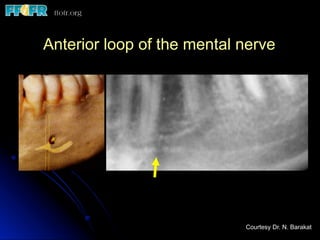
Anterior loop of the mental nerve
Courtesy Dr. N. Barakat
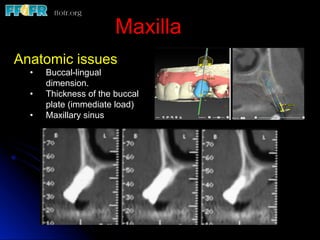
Anatomic issues
•  Buccal-lingual
dimension.
•  Thickness of the buccal
plate (immediate load)
•  Maxillary sinus
Maxilla
Site enhancement
l  Most commonly necessary in the
maxillary premolar region
Timing for implant placement
Immediate vs delayed vs staged
Immediate placement - placing the implant at the same time as extraction of the tooth
ª  Delayed placement - placement of the implant 2-3 months following extraction.
ª  Staged placement - placement of the implant 4-6 months after tooth extraction in
order to allow for bone healing of the extraction site.
The intent of these strategies is to minimize bone resorption,
particularly on the facial surfaces of the implant.
ª  However, following tooth removal, resorption of labial and lingual
bone occurs regardless of whether an implant is placed into the
extraction site, whether placement of the implant is delayed for 2-3
months, or whether the socket is augmented with bone substitutes.
ª  Two hypotheses for resorption
ª  Bone resorption is secondary to the contraction of the mucosal tissues
secondary to expression of the WIT genes (Suwanwela, et al, 2011)
ª  Compromise of the blood supply to the facial bone following extraction
(DeRouk et al, 2008)
Timing for implant placement
Immediate vs delayed vs staged implant placement
Immediate implant placement
ª  Tooth fracture, defects with no infection and
intact labial plates
ª  Sufficient bone apical to the tooth socket to
insure adequate primary stabilization
ª  Patients with significant bone loss are poor candidates. Those presenting with
loss of labial bone with extended biologic width requiring bone augmentation are
best treated with a staged technique
ª  Patients presenting with periodontal or peri-apical infections are poor candidates
for immediate placement primarily because of the compromised blood supply
associated with the potential implant site. They are best treated with “staged
implant placement.”
Immediate placement
ª  Tooth fracture, defects with no infection and
intact labial plates
ª  Sufficient bone apical to the tooth socket to
insure adequate primary stabilization
ª  Immediate placement helps retain the levels of the interdental papilla, but will not
preserve the bone on the labial side of the implant (Araugo et al, 2005; Botticelli et
al, 2006; Araujo and Lindhe, 2009).
ª  If immediate placement is considered, there should be sufficient bone apical to
the tooth socket order to insure adequate primary stabilization of the implant.
Delayed implant placement
l  Delayed placement - placement of the implant 2-3
months following extraction.
Site enhancement
ª Socket augmentation
ª  Treatment of fresh extraction sockets with intact
buccal and lingual bone walls.
ª Ridge preservation
ª  Augmenting edentulous sites that are insufficient
for implant placement.
ª Ridge reconstruction
Ridge preservation
Defined as treatment of fresh extraction sockets with deficient
bone walls in order to maintain ridge contours.
When successful, these procedures
permit placement of implants in ideal
position and angulation. There is no
evidence to indicate which particular
approach might be the most
efficacious (Chen and Buser, 2009).
Courtesy Dr. Krill
Site requirements and implant selection
Premolars
Bone volumes necessary
l  Implant diameters 4.0-4.5 mm
l  There should be sufficient volume of buccal-lingually
and mesial-distally to encompass the implant with at
least 2 mm of bone on each side
l  7 mm of mesial-distal space required
l  Implant lengths
l  Mandible – 8-10mm
l  Maxilla – 10-12 mm
Beware of the use of excessively wide implants in the premolar region.
When the bone is excessively thin on the buccal side of the implant there is
risk of loss of gthe facial plate and apical migration of bone and soft tissue.
10 year follow-up
Site requirements and implant selection
Molars
Bone volumes necessary
l  Implant diameters 5-6 mm
l  Two implants, 4 mm in
diameter are preferred
when the mesial – distal
space permits
l  Preferred in extension areas
l  Implant lengths
l  Mandible – 8-10mm
l  Maxilla – 10-12 mm
Solitary implants restoring single molars
Avoid the use of 4mm implants - Cantilever effect
When the food bolus is applied to the marginal ridge (B), the restoration
is easily tipped because the crown is supported by such a narrow
platform.
Result: Cantilever forces lead to screw loosening, implant fracture
and overload the bone anchoring the implant.
Immediate loading
Generally discouraged in the posterior
quadrants
Immediate placement into
extraction sites
Generally discouraged in the molaer sites
Possible in premolar sites
Selection of implants
External hex vs internal interlocking
l  Internal interlocking is preferred but
both have been used successfully
Tapered implants
l  In extraction sites
l  Semi-guided or fully guided site preparation
using surgical drill guides is preferred
Surgical placement
Prosthodontic Issues - Single tooth defects
Posterior quadrants
ª  Internal connections are favored as opposed the
external hex
ª  Custom abutments must be designed with
appropriate resistance and retention form if cement
retention is planned
ª  Avoid ridge laps
ª  Occlusal surfaces
ª  Metal vs ceramic
ª  Screw retention preferred over cement retention
ª  Occlusion is centric only contact
ª  Lingualized or buccalized
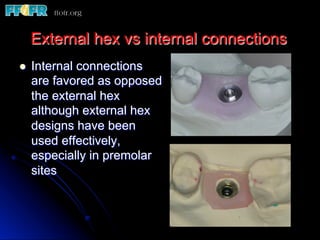
l  Internal connections
are favored as opposed
the external hex
although external hex
designs have been
used effectively,
especially in premolar
sites
External hex vs internal connections
Custom abutments
CAD-CAM vs Hand Milled
l  Hand milled when retention is with cross
linking scews
l  CAD-CAM when cement retention is used
Abutment materials
l  Titanium
l  Metal ceramic
l  Zirconia
l  Not recommended
because of the risk of
fracture
Custom abutments
Retention and resistance form
l  3 degree taper
l  Add grooves for additional resistance form
Custom abutments
Retention and resistance form
l  Note the groove
l  Important even for crowns
retained with cross linking screws
l  Hygiene becomes problematic
Avoid ridge laps
Maxillary premolars
l  Ridge lapping
is discouraged
except in the
esthetic zone
Smooth emergence profiles preferred
Occlusal materials
Metal vs ceramic
Laminated porcelain occlusal surfaces
are at risk for chipping and fracture
Avoid buccal and lingual cantilevers
The occlusal table must be narrowed to
avoid buccal and lingual cantilevers. Molars
should be no wider than premolars as
shown in these two examples.
Occlusion
Centric only contact
(during clenching)
Occlusion contacts
l  Occlusal adjustment
l  Two thicknesses of mylar should pass through the implant contact
when the natural teeth hold one thickness
Proximal contacts
Proximal adjustments
Two thicknesses of mylar
Premolar Sites
 4 mm diameter
implants are ideal
for premolar sites
 Occlusion should
be centric only
contact
 This 1st premolar
site was restored
with a 4 mm implant
fixture and a UCLA
abutment
Premolar Sites
 This mandibular 1st premolar site was restored
with a 4 mm implant fixture and a conical abutment
Single Tooth Restorations Distal
Extension Defects
Distal Extension Defects
ª  Two implants are recommended
when restoring a single molar in an
edentulous extension area.
ª  Note the access for a proxy brush
Restoration of single molar sites
Custom abutment Lingual set screw
In this patient, two 4 mm diameter implant were used to
restore the first molar. The width of the occlusal table was
limited to the width of the
natural premolar,
thereby eliminating any
possible buccal or
lingual cantilevers.
Restoration of single molar sites
Note:
  Hygiene access for proxy brush
  Note width of occlusal table
Restoration of single molar sites - Solutions
In this patient a wide diameter implant was used to
restore the first molar.
When there is insufficient space for two
implants, a wide diameter implant is preferred
Cement vs screw retention
l  Screw retention preferred
l  Cement retention
Problem - Insufficient interocclusal space to design
an abutment with appropriate resistance and retention
form.
Solution – Screw retention
l  Another advantage is with screw retention the
emergence profile of the crown is improved
Courtesy G. Perri
Lack of interocclusal space
Challenges of cementation
Platform reduction (platform switching)
l  If the cement becomes impacted below the margin, its
removal is problematic
l  Access is extremely difficult if not impossible without
laying a soft tissue flap
Courtesy Dr. G. Perri
Challenges of cementation
l  How will you remove the cement if it becomes
impacted beneath the margins of this implant
crown?
l  More than likely, you will not given the severity
of the undercut associated with the custom
abutment.
l  Therefore, under these circumstances it is
advisable to place the margins supra-gingival.
Avoid the use of preformed non-
preparable abutments
Issues of concern
v Position of the cement margin
in relation to the gingival
margin
v Particularly significant in the
anterior region
v Impaction of cement into the
gingival sulcus is highly likely
v Difficulty in seating the crown
because of hydraulic pressure
Avoid the use of preformed non-
preparable abutments
l  Cementing crowns
with platform
reduction
l  Cement the crown
extra-orally
Cement retention with platform reduction
Complications
l  Implant fracture
l  Implant overload
l  Recurrent screw loosening
l  Subgingival cement accumulation leading
to peri-implantitis and loss of the implant
The combination of a small diameter implant,
restoring a large mesial – distal space leads
to either screw loosening, implant fracture or
resorption of bone anchoring the implant.
Fracture
Implant fractured after 30 months of function
Solitary implants restoring single molars
Cantilever effect
Solitary implants restoring single molars
Cantilever effect
Fracture
l  Implant fractured after 18 months of function
Single tooth restorations in the molar
region – Cantilever effect
This implant was too short and too narrow to
withstand occlusal loads and bone loss caused by
the resorptive remodeling response led to its loss.
4 mm
diameter
implant
Mesial cantilever
Subgingival cement accumulation and implant loss
v  Visit ffofr.org for hundreds of
additional lectures on Complete
Dentures, Fixed Prosthodontics
Implant Dentistry, Removable
Partial Dentures, Fixed
Prosthodontics and
Maxillofacial Prosthetics.
v  The lectures are free.
v  Our objective is to create the
best and most comprehensive
online programs of instruction in
Prosthodontics

Single tooth

  • 1.
    Single tooth defectsin the posterior quadrants John Beumer III DDS, MS Robert Faulkner DDS Division of Advanced Prosthodontics, UCLA This program of instruction is protected by copyright ©. No portion of this program of instruction may be reproduced, recorded or transferred by any means electronic, digital, photographic, mechanical etc., or by any information storage or retrieval system, without prior permission.
  • 2.
    Single tooth defects– Posterior quadrants Fixed dental prostheses Delivery 15 year follow-up
  • 3.
    Fixed vs Implant Implantis preferred when: l  Adjacent natural teeth are virgin or nearly virgin l  The long term prognosis of the abutments is questionable due to previous endondotic treatment or periodontal compromise Fixed is preferred l  Maxillary 1st molar defects - l  Pneumatization of the maxillary sinus l  Higher failure rates
  • 4.
    Restoration of endodonticalllytreated teeth vs Implant crown Endo is preferred (given a successful endodontic treatment outcome) l  Reasonable volume of tooth structure remains l  Occlusion is ideal l  Parafunctional activity is minimal Courtesy Dr. C. Goodacre
  • 5.
    Mandible Anatomic issues l  Buccal-lingualdimension. l  Thickness of the buccal plate (immediate load) l  The lingual concavity l  Inferior alveolar nerve l  Mental nerve Courtesy Dr. N. Barakat
  • 6.
    Mandible Anatomic issues l  Buccal-lingualdimension. l  Thickness of the buccal plate (immediate load) l  The lingual concavity l  Inferior alveolar nerve l  Mental nerve These structures are best appreciated with CT scans Courtesy Dr. N. Barakat
  • 7.
    COURTESY DR N.GEHA Anterior loop of the mental nerve Courtesy Dr. N. Barakat
  • 8.
    Anatomic issues •  Buccal-lingual dimension. • Thickness of the buccal plate (immediate load) •  Maxillary sinus Maxilla
  • 9.
    Site enhancement l  Mostcommonly necessary in the maxillary premolar region
  • 10.
    Timing for implantplacement Immediate vs delayed vs staged Immediate placement - placing the implant at the same time as extraction of the tooth ª  Delayed placement - placement of the implant 2-3 months following extraction. ª  Staged placement - placement of the implant 4-6 months after tooth extraction in order to allow for bone healing of the extraction site.
  • 11.
    The intent ofthese strategies is to minimize bone resorption, particularly on the facial surfaces of the implant. ª  However, following tooth removal, resorption of labial and lingual bone occurs regardless of whether an implant is placed into the extraction site, whether placement of the implant is delayed for 2-3 months, or whether the socket is augmented with bone substitutes. ª  Two hypotheses for resorption ª  Bone resorption is secondary to the contraction of the mucosal tissues secondary to expression of the WIT genes (Suwanwela, et al, 2011) ª  Compromise of the blood supply to the facial bone following extraction (DeRouk et al, 2008) Timing for implant placement Immediate vs delayed vs staged implant placement
  • 12.
    Immediate implant placement ª Tooth fracture, defects with no infection and intact labial plates ª  Sufficient bone apical to the tooth socket to insure adequate primary stabilization ª  Patients with significant bone loss are poor candidates. Those presenting with loss of labial bone with extended biologic width requiring bone augmentation are best treated with a staged technique ª  Patients presenting with periodontal or peri-apical infections are poor candidates for immediate placement primarily because of the compromised blood supply associated with the potential implant site. They are best treated with “staged implant placement.”
  • 13.
    Immediate placement ª  Toothfracture, defects with no infection and intact labial plates ª  Sufficient bone apical to the tooth socket to insure adequate primary stabilization ª  Immediate placement helps retain the levels of the interdental papilla, but will not preserve the bone on the labial side of the implant (Araugo et al, 2005; Botticelli et al, 2006; Araujo and Lindhe, 2009). ª  If immediate placement is considered, there should be sufficient bone apical to the tooth socket order to insure adequate primary stabilization of the implant.
  • 14.
    Delayed implant placement l Delayed placement - placement of the implant 2-3 months following extraction.
  • 15.
    Site enhancement ª Socket augmentation ª Treatment of fresh extraction sockets with intact buccal and lingual bone walls. ª Ridge preservation ª  Augmenting edentulous sites that are insufficient for implant placement. ª Ridge reconstruction
  • 16.
    Ridge preservation Defined astreatment of fresh extraction sockets with deficient bone walls in order to maintain ridge contours. When successful, these procedures permit placement of implants in ideal position and angulation. There is no evidence to indicate which particular approach might be the most efficacious (Chen and Buser, 2009). Courtesy Dr. Krill
  • 17.
    Site requirements andimplant selection Premolars Bone volumes necessary l  Implant diameters 4.0-4.5 mm l  There should be sufficient volume of buccal-lingually and mesial-distally to encompass the implant with at least 2 mm of bone on each side l  7 mm of mesial-distal space required l  Implant lengths l  Mandible – 8-10mm l  Maxilla – 10-12 mm Beware of the use of excessively wide implants in the premolar region. When the bone is excessively thin on the buccal side of the implant there is risk of loss of gthe facial plate and apical migration of bone and soft tissue. 10 year follow-up
  • 18.
    Site requirements andimplant selection Molars Bone volumes necessary l  Implant diameters 5-6 mm l  Two implants, 4 mm in diameter are preferred when the mesial – distal space permits l  Preferred in extension areas l  Implant lengths l  Mandible – 8-10mm l  Maxilla – 10-12 mm
  • 19.
    Solitary implants restoringsingle molars Avoid the use of 4mm implants - Cantilever effect When the food bolus is applied to the marginal ridge (B), the restoration is easily tipped because the crown is supported by such a narrow platform. Result: Cantilever forces lead to screw loosening, implant fracture and overload the bone anchoring the implant.
  • 20.
    Immediate loading Generally discouragedin the posterior quadrants Immediate placement into extraction sites Generally discouraged in the molaer sites Possible in premolar sites
  • 21.
    Selection of implants Externalhex vs internal interlocking l  Internal interlocking is preferred but both have been used successfully Tapered implants l  In extraction sites
  • 22.
    l  Semi-guided orfully guided site preparation using surgical drill guides is preferred Surgical placement
  • 23.
    Prosthodontic Issues -Single tooth defects Posterior quadrants ª  Internal connections are favored as opposed the external hex ª  Custom abutments must be designed with appropriate resistance and retention form if cement retention is planned ª  Avoid ridge laps ª  Occlusal surfaces ª  Metal vs ceramic ª  Screw retention preferred over cement retention ª  Occlusion is centric only contact ª  Lingualized or buccalized
  • 24.
    l  Internal connections arefavored as opposed the external hex although external hex designs have been used effectively, especially in premolar sites External hex vs internal connections
  • 25.
    Custom abutments CAD-CAM vsHand Milled l  Hand milled when retention is with cross linking scews l  CAD-CAM when cement retention is used
  • 26.
    Abutment materials l  Titanium l Metal ceramic l  Zirconia l  Not recommended because of the risk of fracture
  • 27.
    Custom abutments Retention andresistance form l  3 degree taper l  Add grooves for additional resistance form
  • 28.
    Custom abutments Retention andresistance form l  Note the groove l  Important even for crowns retained with cross linking screws
  • 29.
    l  Hygiene becomesproblematic Avoid ridge laps
  • 30.
    Maxillary premolars l  Ridgelapping is discouraged except in the esthetic zone
  • 31.
  • 32.
    Occlusal materials Metal vsceramic Laminated porcelain occlusal surfaces are at risk for chipping and fracture
  • 33.
    Avoid buccal andlingual cantilevers The occlusal table must be narrowed to avoid buccal and lingual cantilevers. Molars should be no wider than premolars as shown in these two examples.
  • 34.
  • 35.
    Occlusion contacts l  Occlusaladjustment l  Two thicknesses of mylar should pass through the implant contact when the natural teeth hold one thickness
  • 36.
  • 37.
    Premolar Sites  4 mmdiameter implants are ideal for premolar sites  Occlusion should be centric only contact  This 1st premolar site was restored with a 4 mm implant fixture and a UCLA abutment
  • 38.
    Premolar Sites  This mandibular1st premolar site was restored with a 4 mm implant fixture and a conical abutment
  • 39.
    Single Tooth RestorationsDistal Extension Defects
  • 40.
    Distal Extension Defects ª Two implants are recommended when restoring a single molar in an edentulous extension area. ª  Note the access for a proxy brush
  • 41.
    Restoration of singlemolar sites Custom abutment Lingual set screw In this patient, two 4 mm diameter implant were used to restore the first molar. The width of the occlusal table was limited to the width of the natural premolar, thereby eliminating any possible buccal or lingual cantilevers.
  • 42.
    Restoration of singlemolar sites Note:   Hygiene access for proxy brush   Note width of occlusal table
  • 43.
    Restoration of singlemolar sites - Solutions In this patient a wide diameter implant was used to restore the first molar. When there is insufficient space for two implants, a wide diameter implant is preferred
  • 44.
    Cement vs screwretention l  Screw retention preferred l  Cement retention
  • 45.
    Problem - Insufficientinterocclusal space to design an abutment with appropriate resistance and retention form. Solution – Screw retention l  Another advantage is with screw retention the emergence profile of the crown is improved Courtesy G. Perri Lack of interocclusal space
  • 46.
    Challenges of cementation Platformreduction (platform switching) l  If the cement becomes impacted below the margin, its removal is problematic l  Access is extremely difficult if not impossible without laying a soft tissue flap Courtesy Dr. G. Perri
  • 47.
    Challenges of cementation l How will you remove the cement if it becomes impacted beneath the margins of this implant crown? l  More than likely, you will not given the severity of the undercut associated with the custom abutment. l  Therefore, under these circumstances it is advisable to place the margins supra-gingival.
  • 48.
    Avoid the useof preformed non- preparable abutments Issues of concern v Position of the cement margin in relation to the gingival margin v Particularly significant in the anterior region v Impaction of cement into the gingival sulcus is highly likely v Difficulty in seating the crown because of hydraulic pressure
  • 49.
    Avoid the useof preformed non- preparable abutments
  • 50.
    l  Cementing crowns withplatform reduction l  Cement the crown extra-orally Cement retention with platform reduction
  • 51.
    Complications l  Implant fracture l Implant overload l  Recurrent screw loosening l  Subgingival cement accumulation leading to peri-implantitis and loss of the implant
  • 52.
    The combination ofa small diameter implant, restoring a large mesial – distal space leads to either screw loosening, implant fracture or resorption of bone anchoring the implant.
  • 53.
    Fracture Implant fractured after30 months of function Solitary implants restoring single molars Cantilever effect
  • 54.
    Solitary implants restoringsingle molars Cantilever effect Fracture l  Implant fractured after 18 months of function
  • 55.
    Single tooth restorationsin the molar region – Cantilever effect This implant was too short and too narrow to withstand occlusal loads and bone loss caused by the resorptive remodeling response led to its loss. 4 mm diameter implant Mesial cantilever
  • 56.
  • 57.
    v  Visit ffofr.orgfor hundreds of additional lectures on Complete Dentures, Fixed Prosthodontics Implant Dentistry, Removable Partial Dentures, Fixed Prosthodontics and Maxillofacial Prosthetics. v  The lectures are free. v  Our objective is to create the best and most comprehensive online programs of instruction in Prosthodontics