Charles J. Goodacre, DDS, MSD
Professor of Restorative Dentistry
Loma Linda University School of Dentistry
This program of instruction is protected by copyright ©. No portion of this
program of instruction may be reproduced, recorded or transferred by any
means electronic, digital, photographic, mechanical etc., or by any information
storage or retrieval system, without prior permission.
Fluid Control and Tissue Management
for Fixed Prosthodontic Impressions
Reasons for Fluid Control
•  Fluid / moisture control is imperative to make a good impression
•  A good impression requires lateral displacement of the gingiva so the
impression material can be deposited on the finish line and also record
some of the unprepared tooth located apical to the finish line
•  The gingiva is moist and may bleed from the displacement,
necessitating fluid control
•  Fluid / moisture is also needed to prevent saliva from coating the
gingiva and prepared tooth and thereby interfering with impression
making
Types of Fluid Control
•  Retraction cord in
the sulcus
•  Cotton rolls in the
vestibules
to contain saliva
•  Dri-Angles placed
on the cheek
Types of Fluid Control
•  Saliva ejector
•  Suction by dental
assistant
•  Isolite system
(suction, light,
and tongue
displacement)
The Purpose of Tissue Retraction is to
Displace the Gingiva so:
•  The finish line can be evaluated
•  The tooth structure apical to the finish line
can be examined
•  The gingiva is less likely to be traumatized by
rotary instruments
•  Impression material can record the finish line
plus some tooth structure apical to the finish
line
Gingival Displacement
(Retraction) Methods
•  Mechanical
Cord;
Instrument; or
Cord & Instrument
Gingival Displacement
(Retraction) Methods
•  Mechanical-Chemical
Cord & Hemostatic agent
Gingival Displacement
(Retraction) Methods
•  Surgical
Electrosurgery; or
Laser surgery
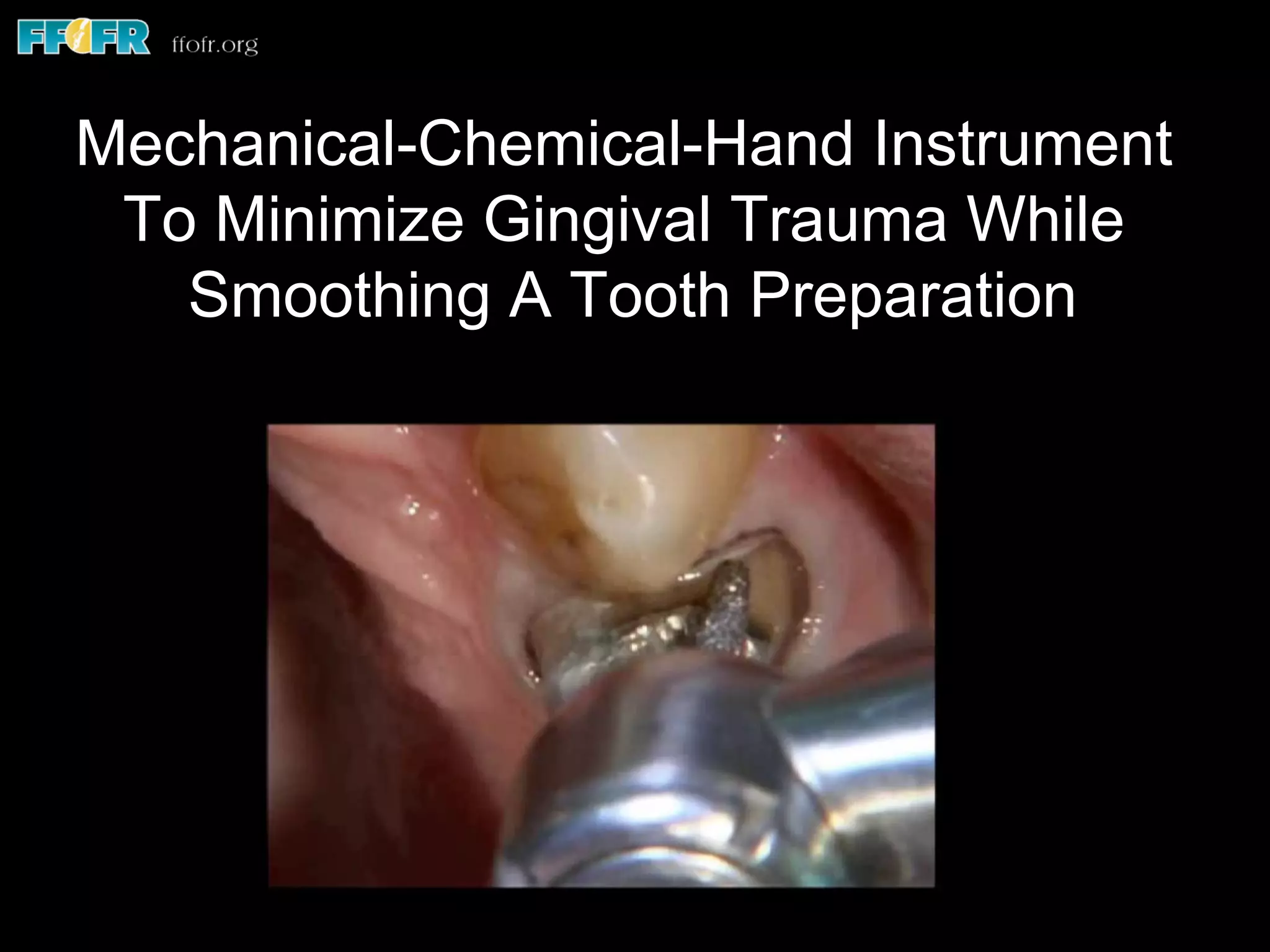
Mechanical-Chemical-Hand Instrument
To Minimize Gingival Trauma While
Smoothing A Tooth Preparation
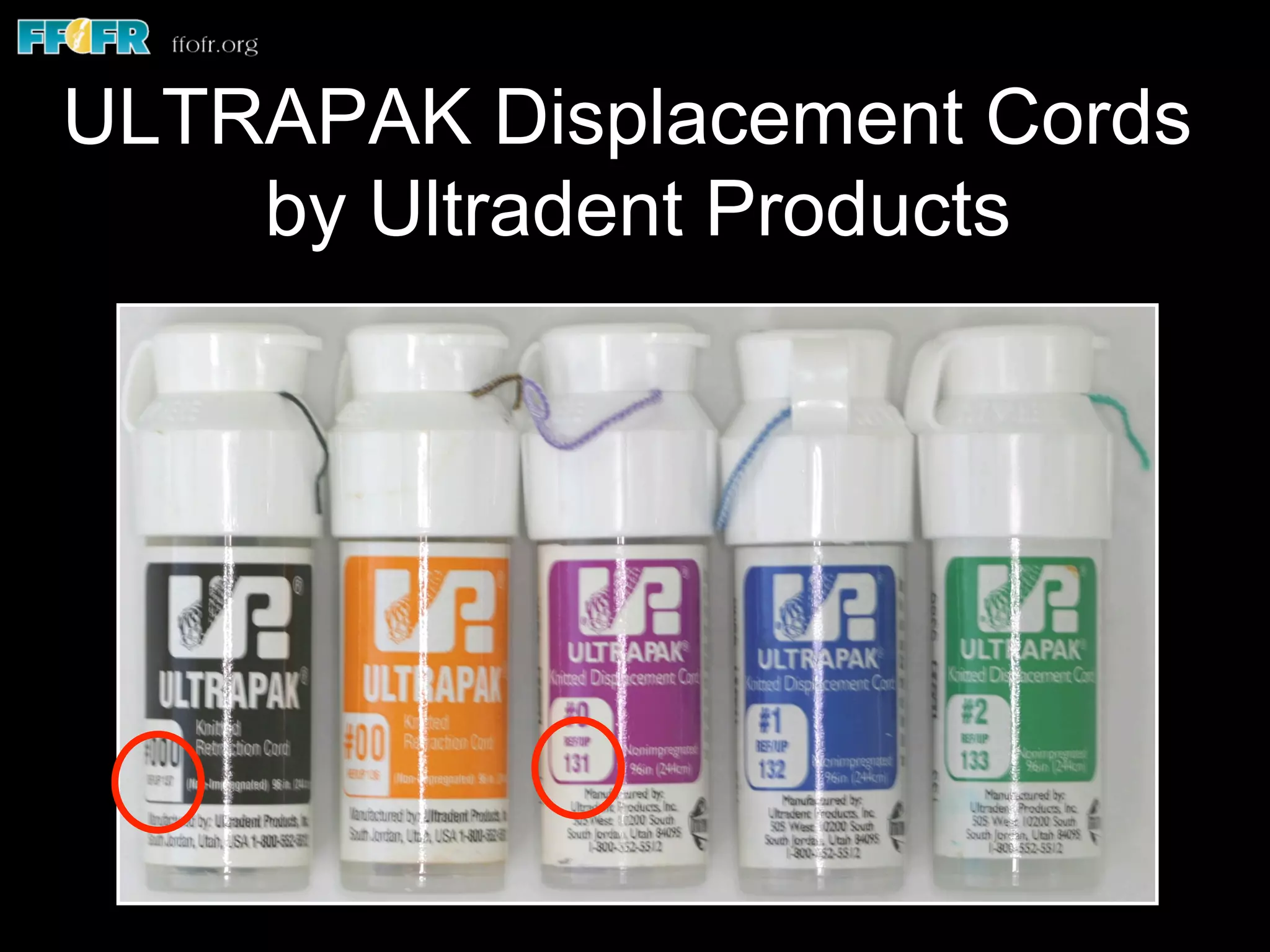
ULTRAPAK Displacement Cords
by Ultradent Products
Retraction Instruments
•  Smooth bladed instruments
•  Blades with perimeter serrations
•  Periodontal probe
Smooth-Sided & Serrated Perimeters
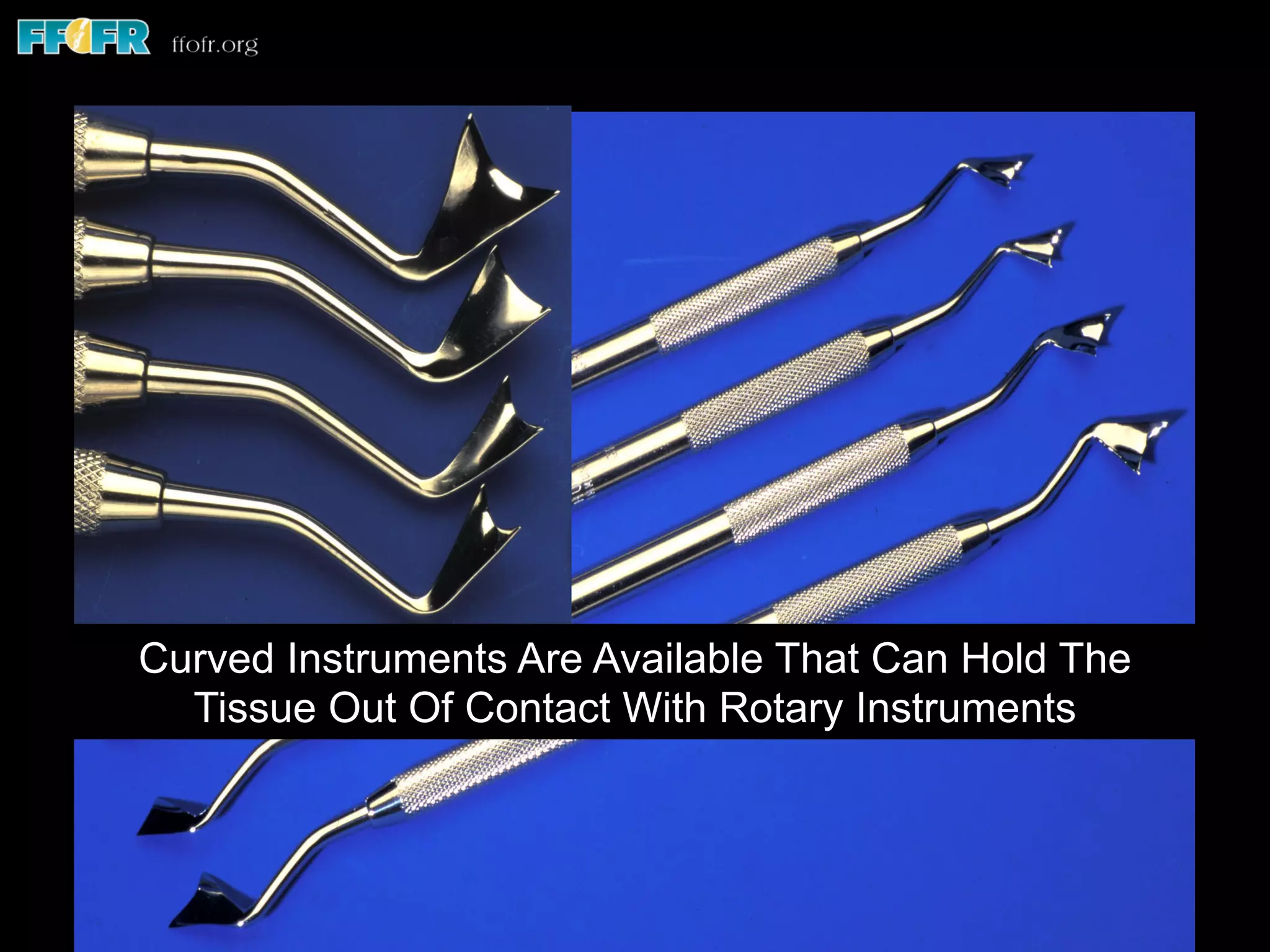
Curved Instruments Are Available That Can Hold The
Tissue Out Of Contact With Rotary Instruments
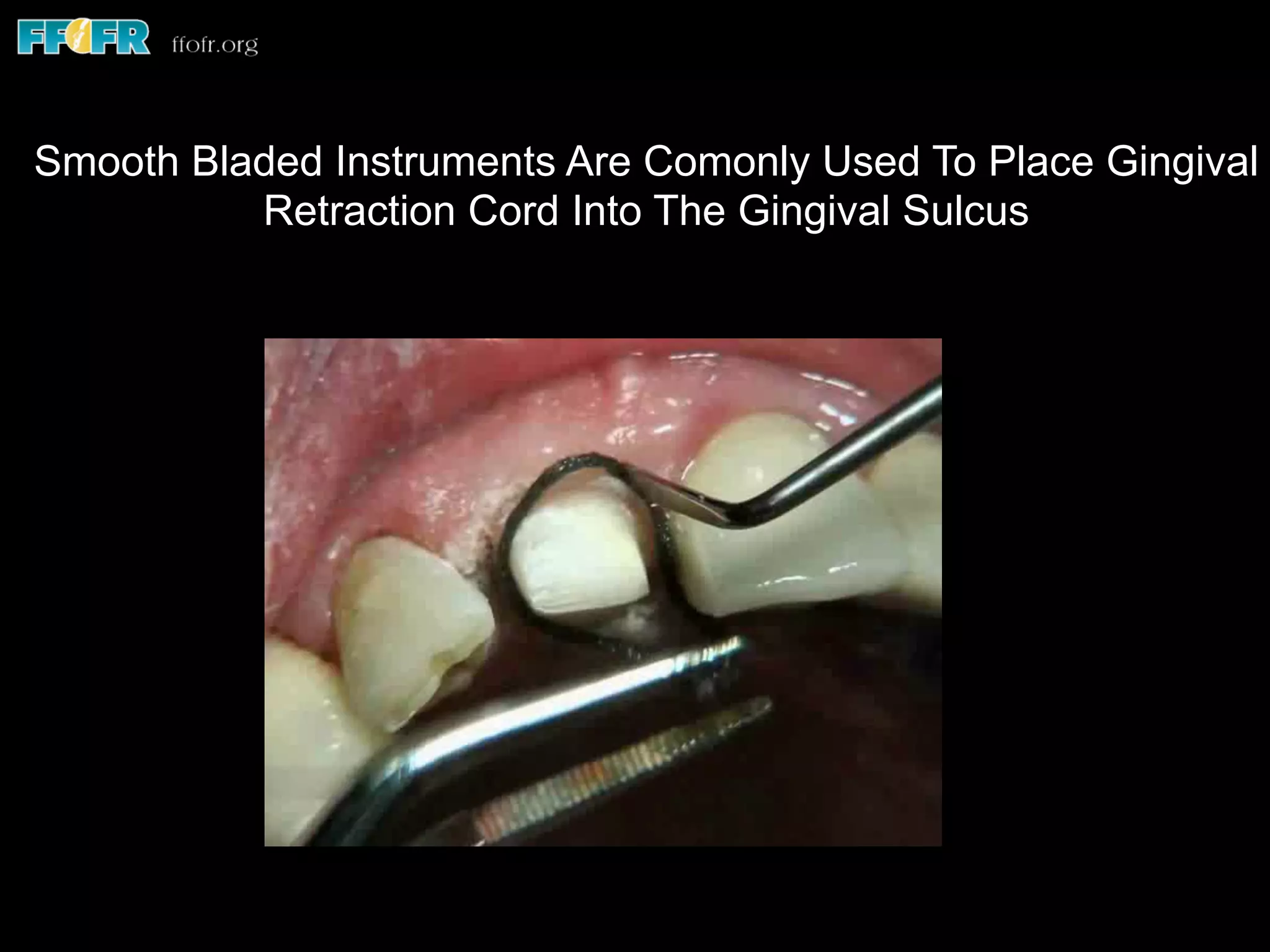
Serrated Instruments Can Lift Cords Out Of The SulcusSmooth Bladed Instruments Are Comonly Used To Place Gingival
Retraction Cord Into The Gingival Sulcus
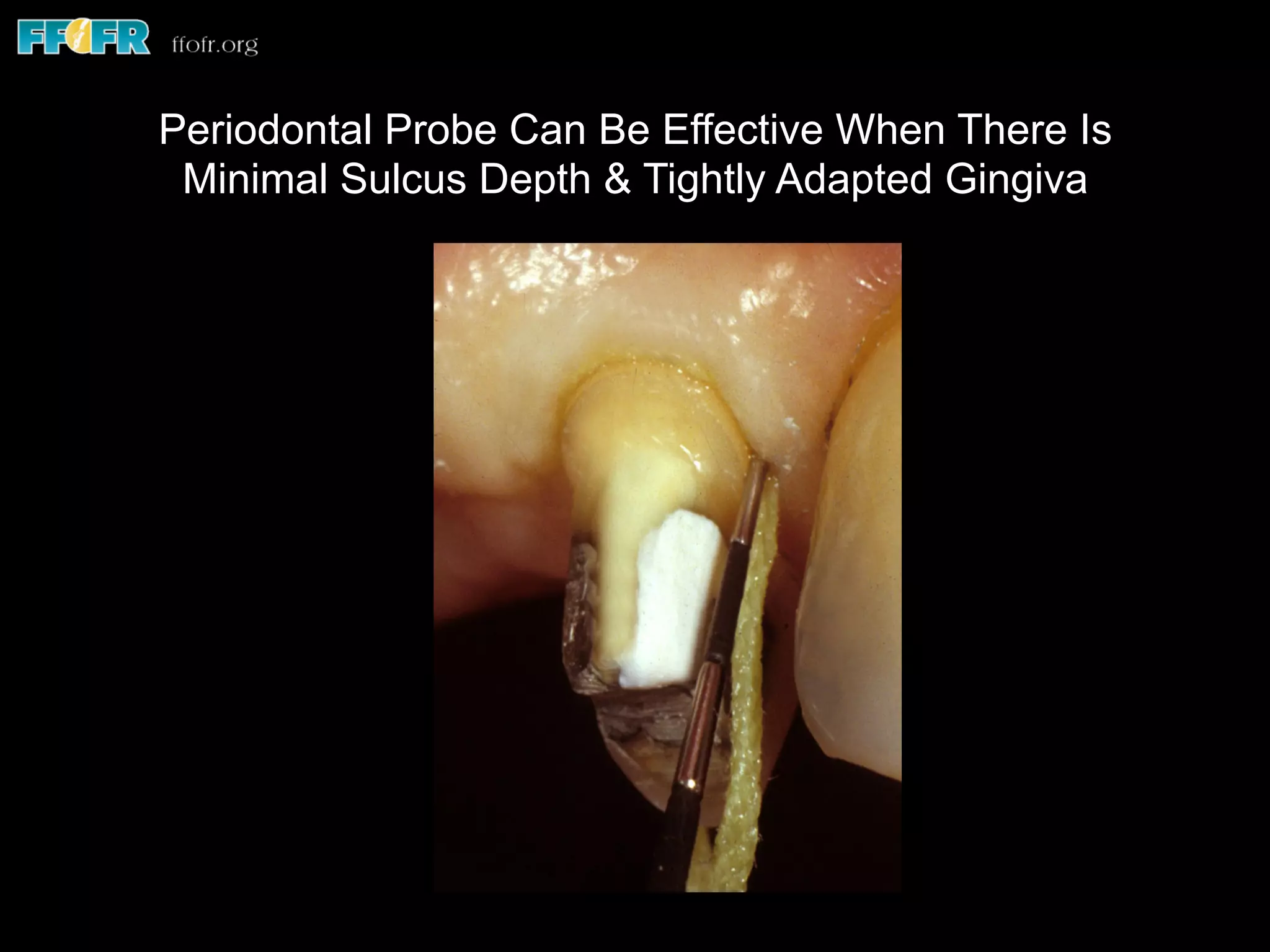
Periodontal Probe Can Be Effective When There Is
Minimal Sulcus Depth & Tightly Adapted Gingiva
Serrated Instruments Can Lift Cords Out Of The Sulcus
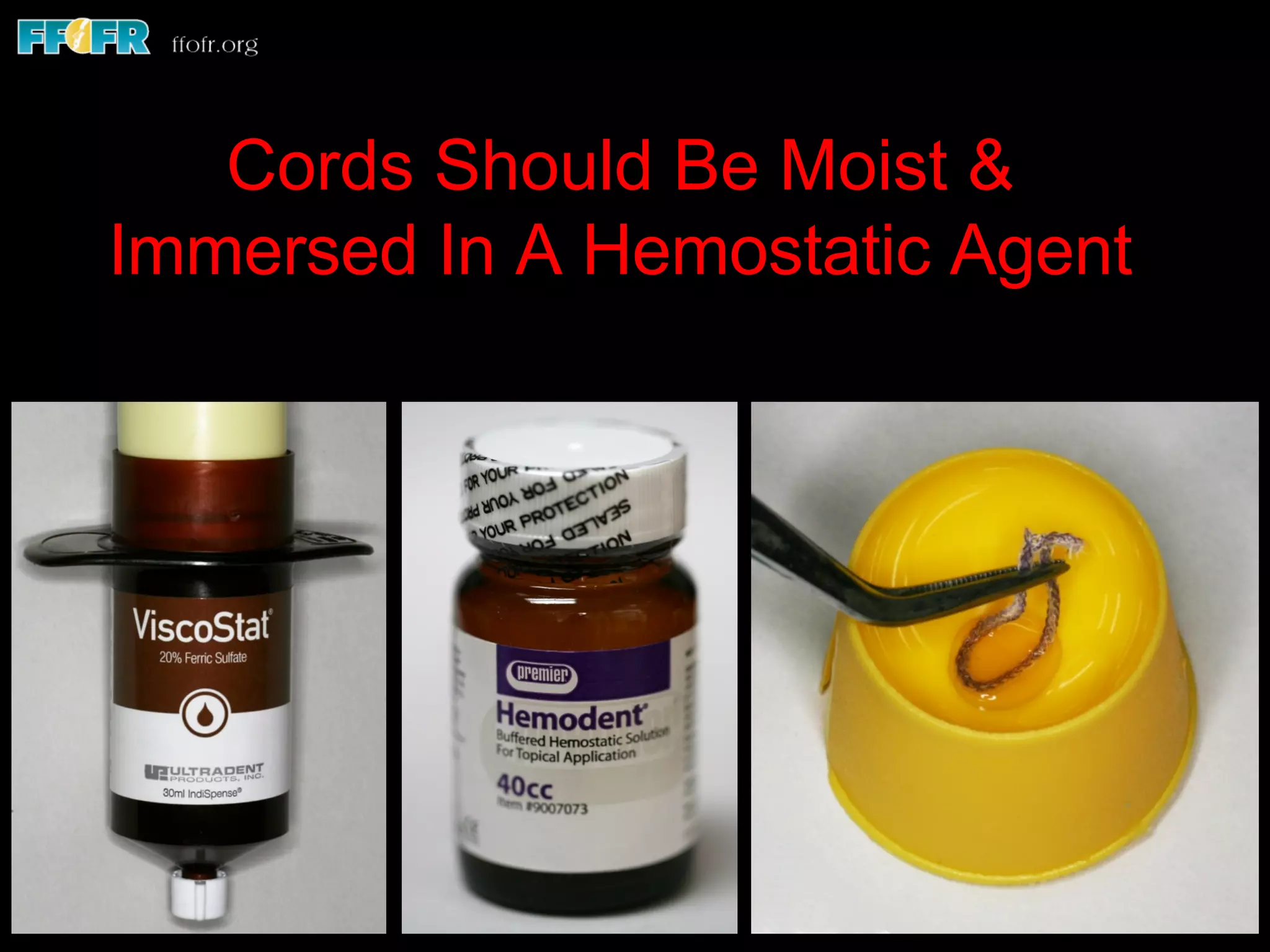
Cords Should Be Moist &
Immersed In A Hemostatic Agent
Never Pack Dry Cord
•  Dry cords adhere to the crevicular epithelium and
their removal tears the epithelium and elicits a wound
healing reaction
Anneroth, Odontol Revy 1969;20:301-310
•  Dry cord is harder to pack into the sulcus, leads to
more bleeding upon cord removal and an
unaccpetable impression, and makes it more likely
that a less than ideal gingival response will follow
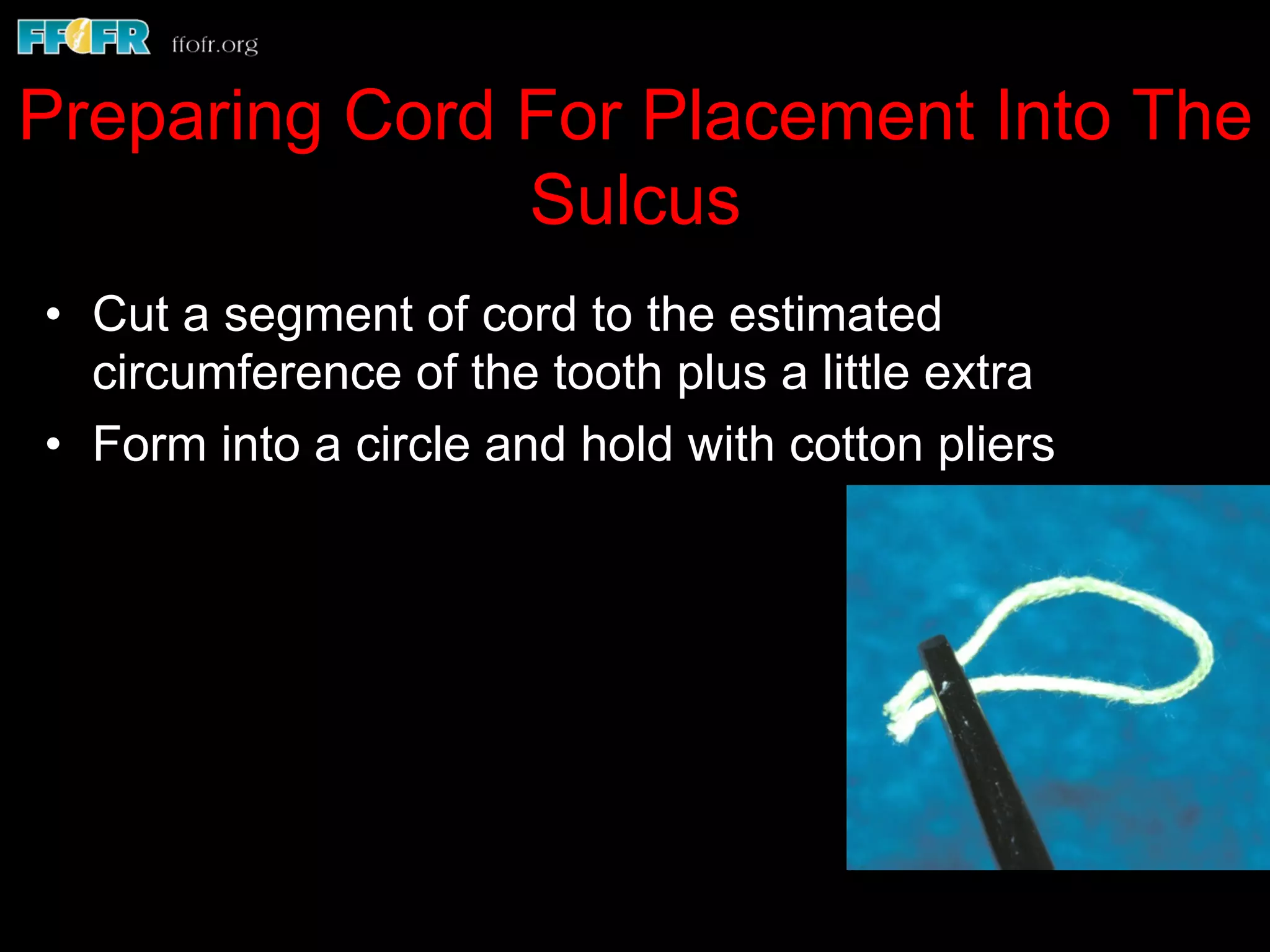
Preparing Cord For Placement Into The
Sulcus
•  Cut a segment of cord to the estimated
circumference of the tooth plus a little extra
•  Form into a circle and hold with cotton pliers
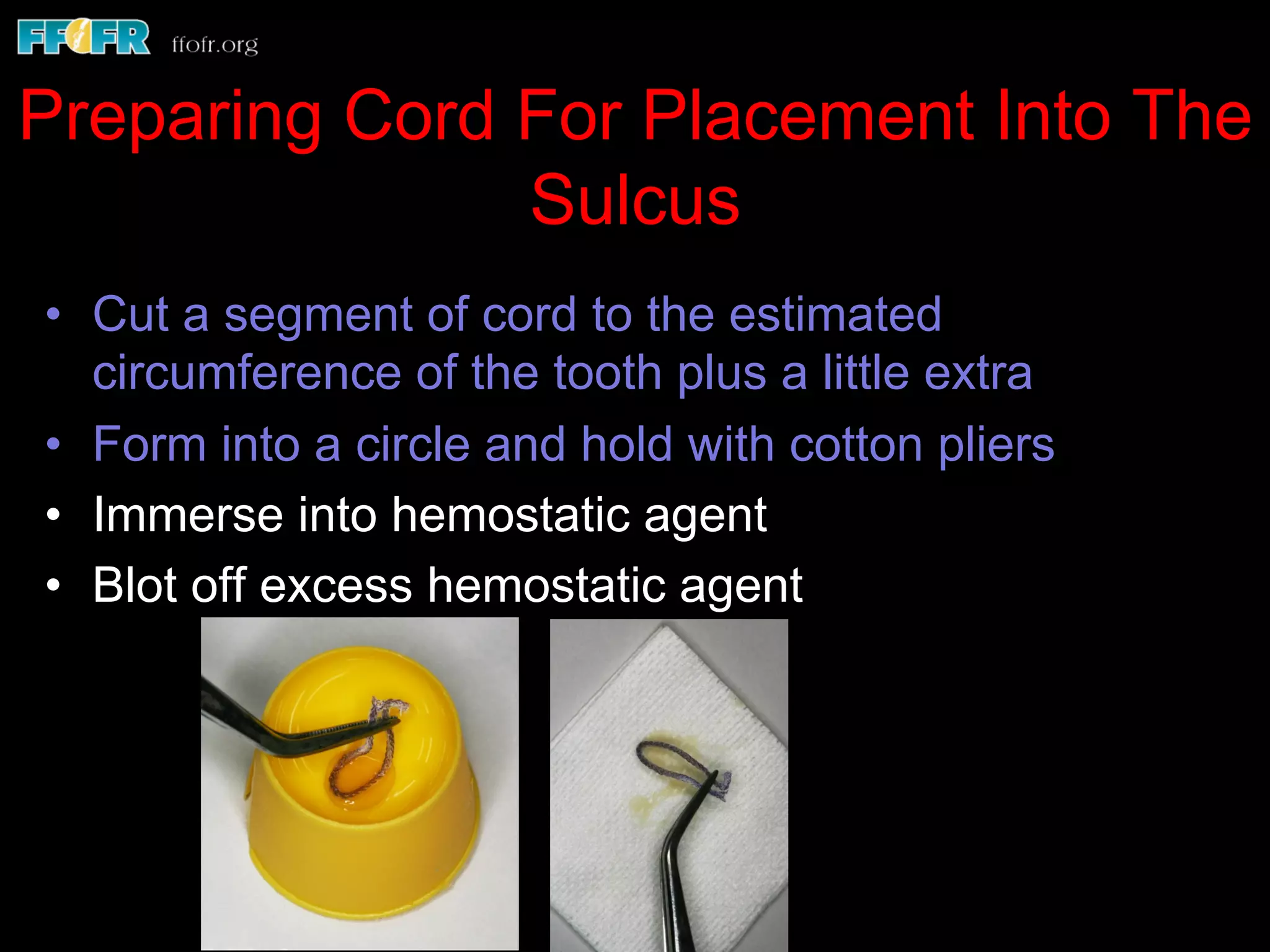
Preparing Cord For Placement Into The
Sulcus
•  Cut a segment of cord to the estimated
circumference of the tooth plus a little extra
•  Form into a circle and hold with cotton pliers
•  Immerse into hemostatic agent
•  Blot off excess hemostatic agent
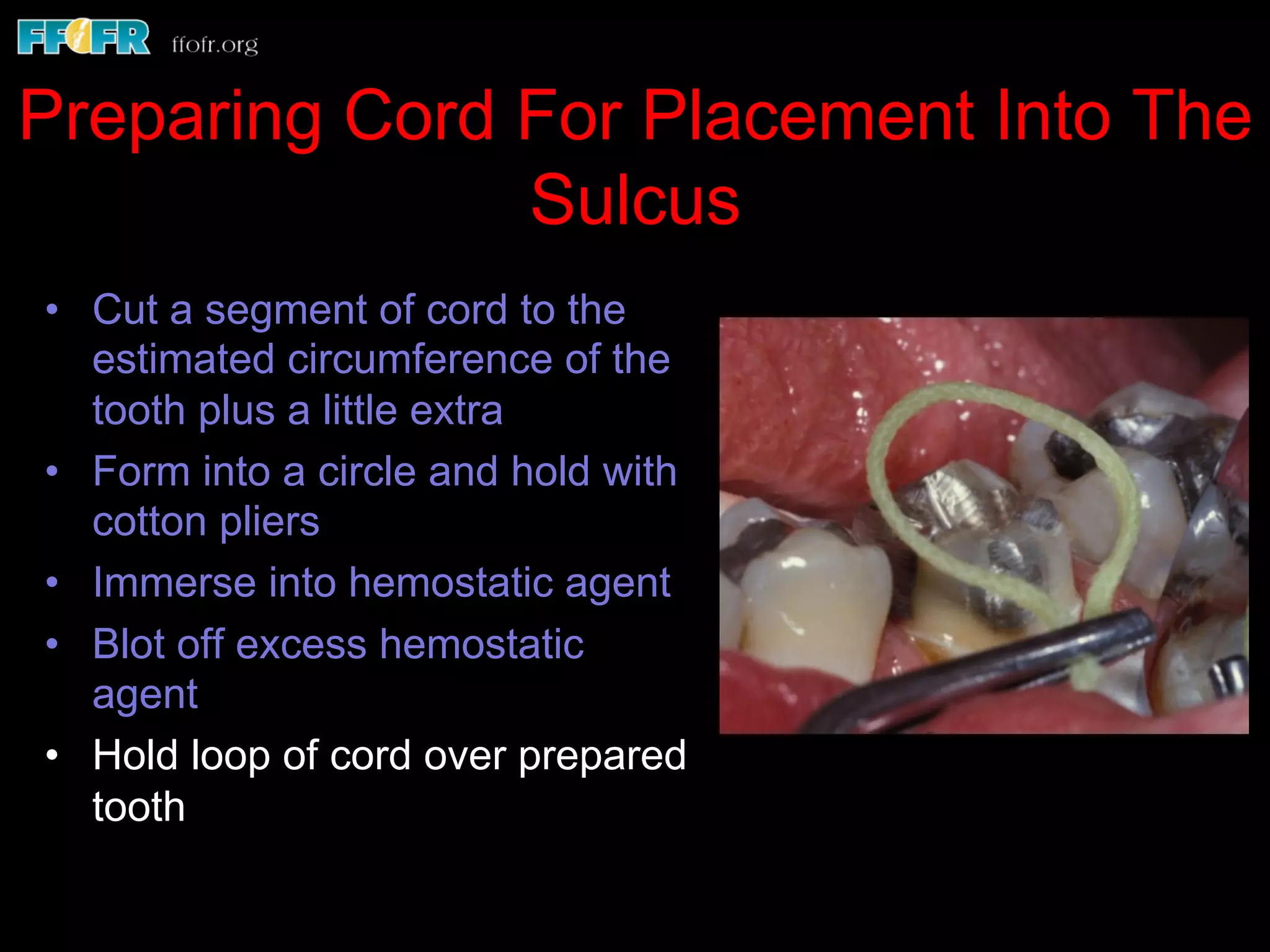
Preparing Cord For Placement Into The
Sulcus
•  Cut a segment of cord to the
estimated circumference of the
tooth plus a little extra
•  Form into a circle and hold with
cotton pliers
•  Immerse into hemostatic agent
•  Blot off excess hemostatic
agent
•  Hold loop of cord over prepared
tooth
Preparing Cord For Placement Into The
Sulcus•  Cut a segment of cord to the
estimated circumference of the
tooth plus a little extra
•  Form into a circle and hold with
cotton pliers
•  Immerse into hemostatic agent
•  Blot off excess hemostatic
agent
•  Hold loop of cord over
prepared tooth
•  Place cord into sulcus with
instrument starting on the
proximal surface
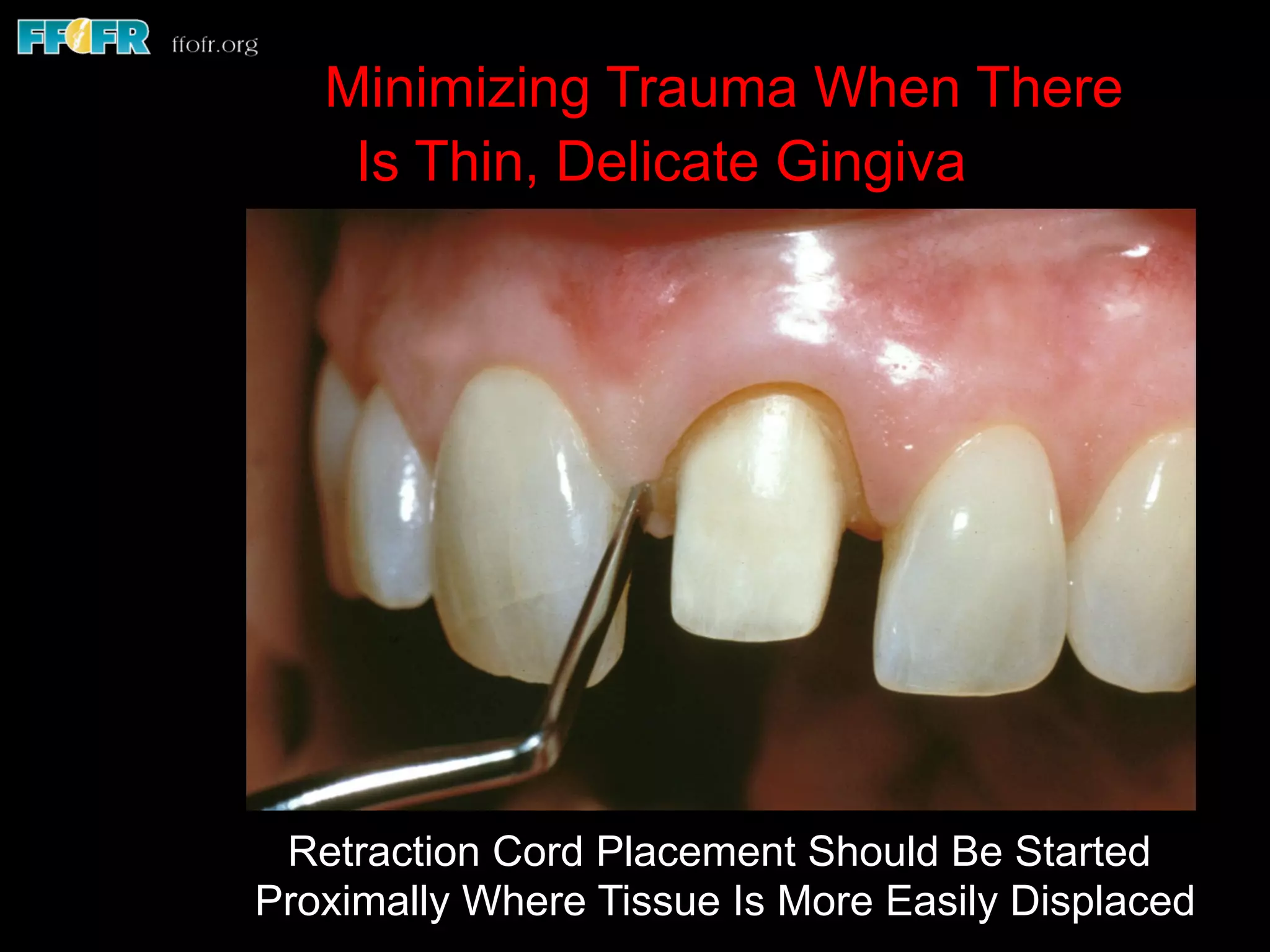
Minimizing Trauma When There
Is Thin, Delicate Gingiva
Retraction Cord Placement Should Be Started
Proximally Where Tissue Is More Easily Displaced
Gingival Retraction Techniques
Commonly Used By Prosthodontists
•  Results from 1,246 survey responses
•  98% of prosthodontists use retraction cord
•  43% of those using cord routinely use a two
cord technique for more than half of their
impressions
Hansen, J Prosthod 1999;8:163-170
Cord Medicament Usage
•  81% of prosthodontists soak cords before placing them
into sulcus
•  55% use aluminum chloride (like Hemodent)
•  23% use ferric sulfate / ferric subsulfate (like
Astringedent)
•  70% use an additional agent after the cord is placed.
Ferric sulfate with an infuser / burnisher was the most
common additional agent
Hansen, J Prosthod 1999;8:163-170
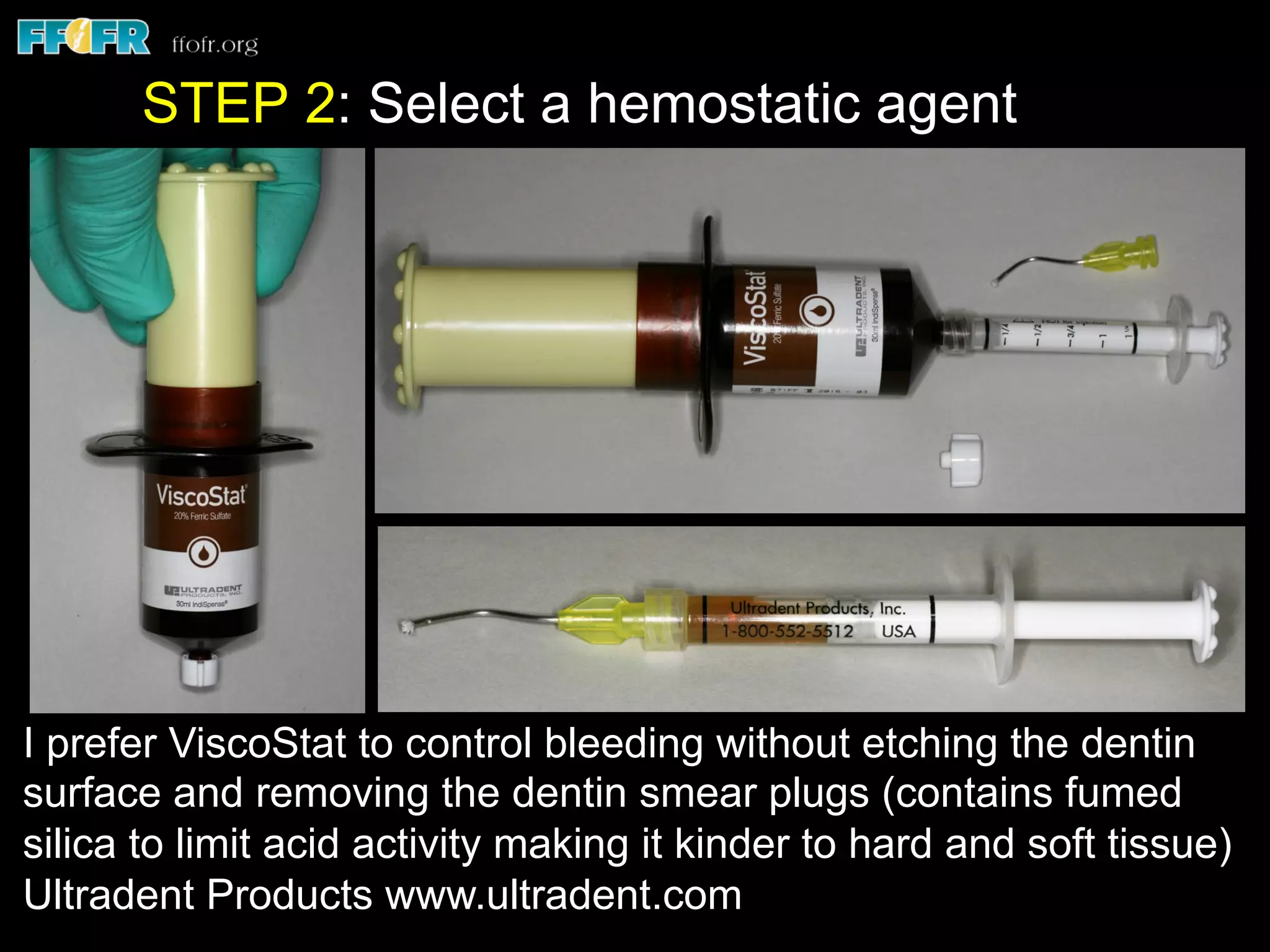
ViscoStat®
Ultradent Products
www.ultradent.com
Control Bleeding Using
Dento-Infuser Syringe Tip
Hemorrhage Control
Epinephrine Cords vs. Others
•  22 students & 8 faculty could not tell difference
(epinephrine vs. aluminum sulfate in a blind study)
Jokstad, J Prosthet Dent 1999;81:258-261
•  Epinephrine did not produce superior displacement to
Hemodent (AlCl3)
Weir, J Prosthet Dent 1984;51:326-329
•  No practical difference between aluminum sulfate,
epinephrine, and aluminum chloride
Gennaro, J Prosthet Dent 1982;47:384-386
My Preferred Technique
STEP 1: Cut a segment of a smaller diameter cord to
the estimated circumference of the tooth plus a little
extra. Form into a circle and hold with cotton pliers
I prefer ViscoStat to control bleeding without etching the dentin
surface and removing the dentin smear plugs (contains fumed
silica to limit acid activity making it kinder to hard and soft tissue)
Ultradent Products www.ultradent.com
STEP 2: Select a hemostatic agent
ViscoStat® Is Very Effective At Controlling Bleeding But It
Can Leave A Brown Residue When There Is A Lot Of
Bleeding. The Residue Can Be Removed Using A Cotton
Pellet Soaked In Hemodent
STEP 3: The cords are immersed into the solution in the dappen
dish, and then the excess solution blotted on a cotton roll while
leaving the cord saturated with the ViscoStat.
STEP 4: Pack the smaller diameter cord (#000 black cord)
into the gingival sulcus using a smooth-blade cord packing
instrument, cut off the excess length, and place it completely
into sulcus. The finish line should be visible after the first cord
is placed into the sulcus
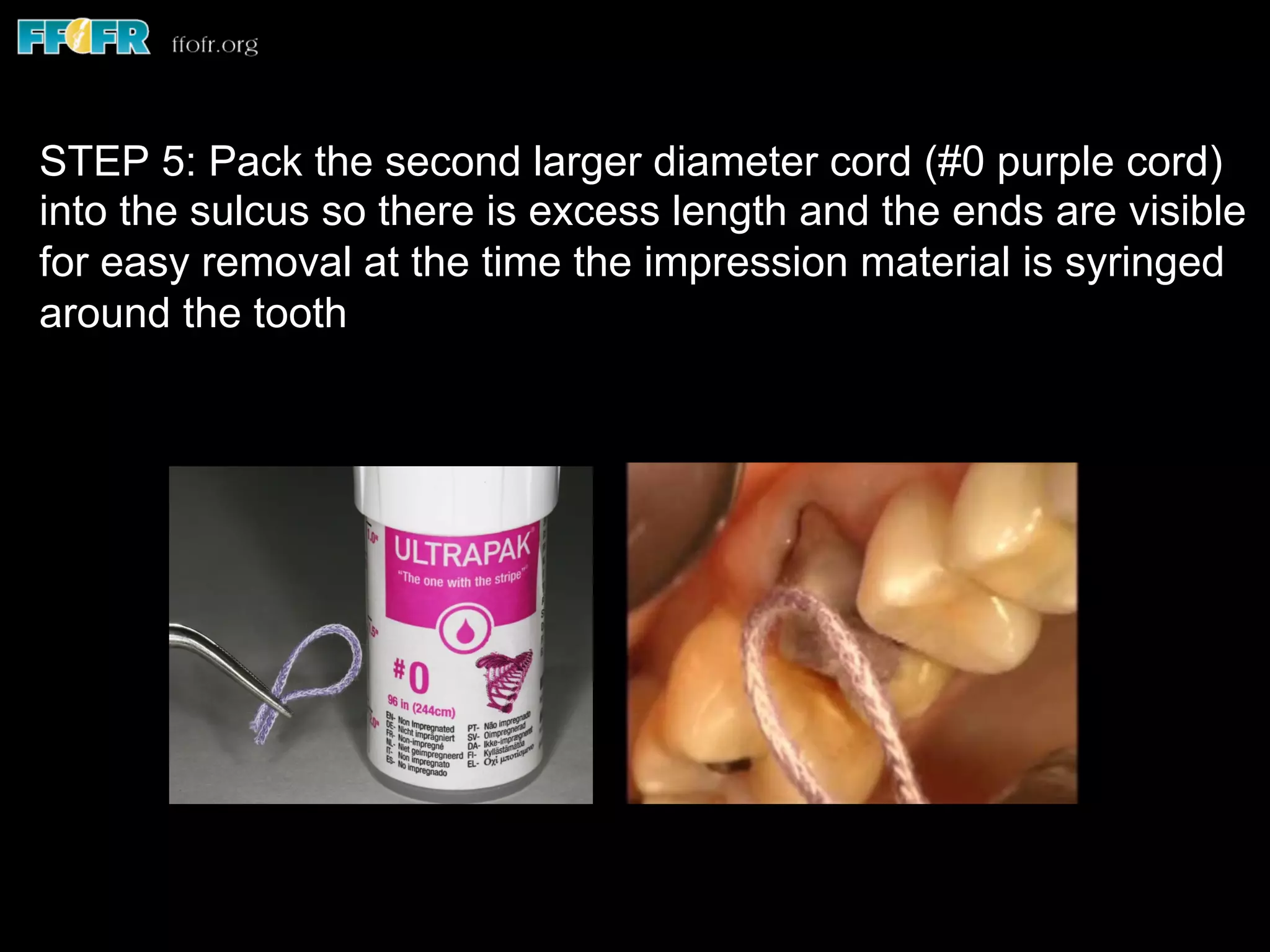
STEP 5: Pack the second larger diameter cord (#0 purple cord)
into the sulcus so there is excess length and the ends are visible
for easy removal at the time the impression material is syringed
around the tooth
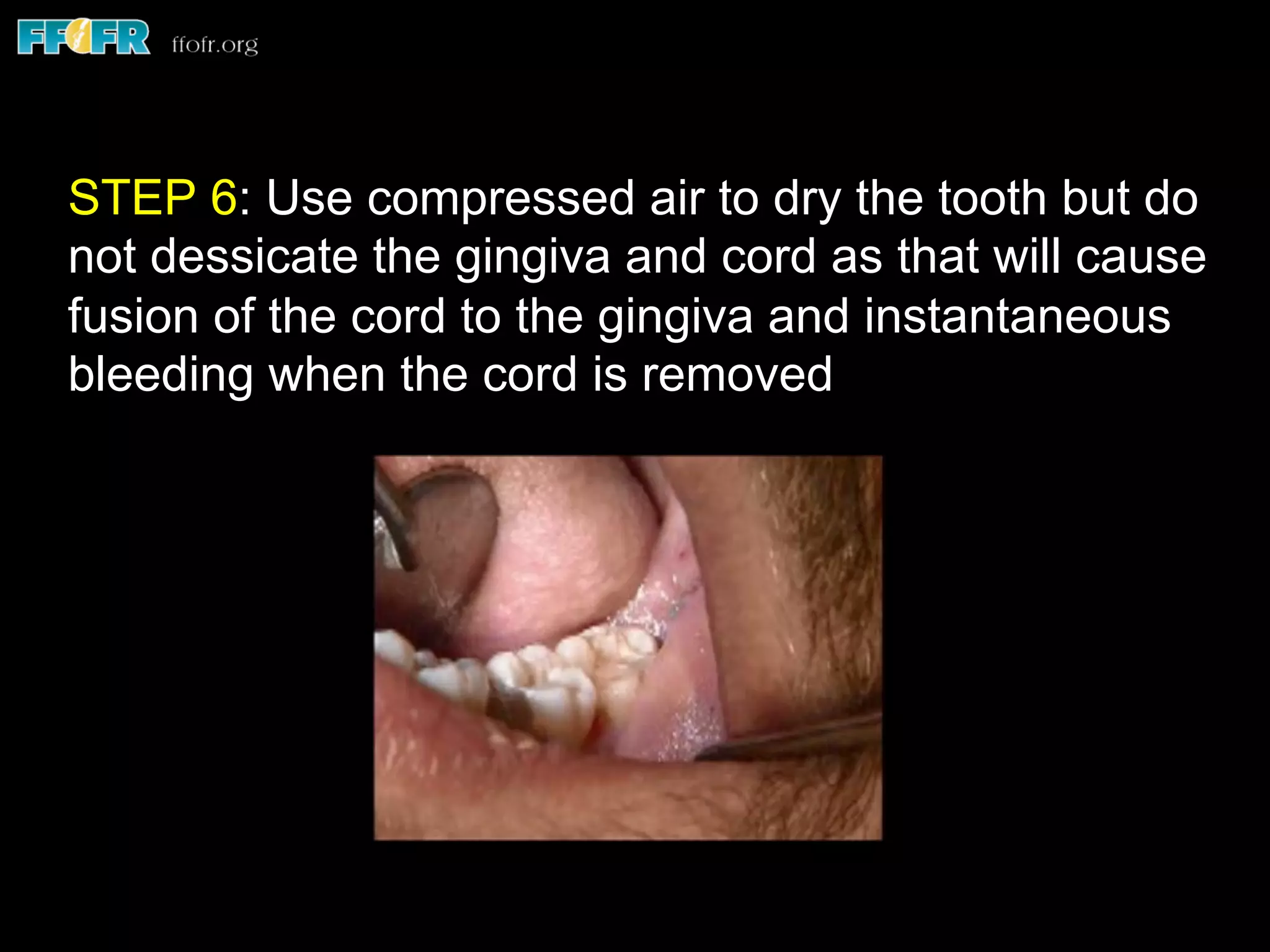
STEP 6: Use compressed air to dry the tooth but do
not dessicate the gingiva and cord as that will cause
fusion of the cord to the gingiva and instantaneous
bleeding when the cord is removed
Remove the 2nd cord (leaving the 1st cord to control
moisture and hemorrhage) and syringe impression
material directly behind the exiting second cord to
minimize the opportunity for moisture or hemorrhage
to reach the finish line before the impression material
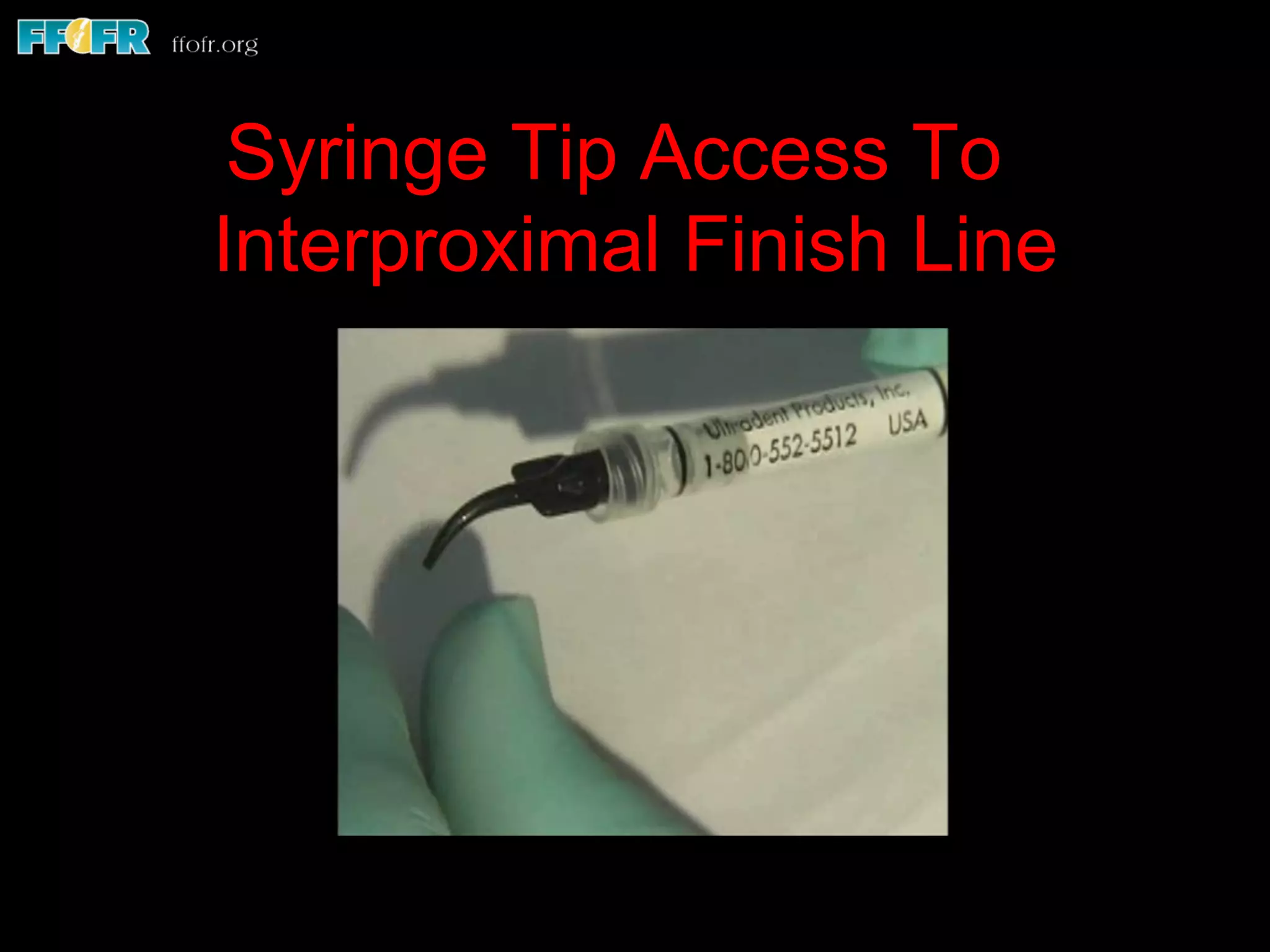
Syringe Tip Access To
Interproximal Finish Line
Thank You For Your
Kind Attention
Charles J. Goodacre, DDS, MSD
Professor of Restorative Dentistry
Loma Linda University School of Dentistry
v Visit ffofr.org for hundreds of
additional lectures on Complete
Dentures, Fixed Prosthodontics,
Implant Dentistry, Removable
Partial Dentures, Esthetic
Dentistry and Maxillofacial
Prosthetics.
v The lectures are free.
v Our objective is to create the
best and most comprehensive
online programs of instruction in
Prosthodontics

Fluid control and tissue managemtent

  • 1.
    Charles J. Goodacre,DDS, MSD Professor of Restorative Dentistry Loma Linda University School of Dentistry This program of instruction is protected by copyright ©. No portion of this program of instruction may be reproduced, recorded or transferred by any means electronic, digital, photographic, mechanical etc., or by any information storage or retrieval system, without prior permission. Fluid Control and Tissue Management for Fixed Prosthodontic Impressions
  • 2.
    Reasons for FluidControl •  Fluid / moisture control is imperative to make a good impression •  A good impression requires lateral displacement of the gingiva so the impression material can be deposited on the finish line and also record some of the unprepared tooth located apical to the finish line •  The gingiva is moist and may bleed from the displacement, necessitating fluid control •  Fluid / moisture is also needed to prevent saliva from coating the gingiva and prepared tooth and thereby interfering with impression making
  • 3.
    Types of FluidControl •  Retraction cord in the sulcus •  Cotton rolls in the vestibules to contain saliva •  Dri-Angles placed on the cheek
  • 4.
    Types of FluidControl •  Saliva ejector •  Suction by dental assistant •  Isolite system (suction, light, and tongue displacement)
  • 5.
    The Purpose ofTissue Retraction is to Displace the Gingiva so: •  The finish line can be evaluated •  The tooth structure apical to the finish line can be examined •  The gingiva is less likely to be traumatized by rotary instruments •  Impression material can record the finish line plus some tooth structure apical to the finish line
  • 6.
    Gingival Displacement (Retraction) Methods • Mechanical Cord; Instrument; or Cord & Instrument
  • 7.
    Gingival Displacement (Retraction) Methods • Mechanical-Chemical Cord & Hemostatic agent
  • 8.
    Gingival Displacement (Retraction) Methods • Surgical Electrosurgery; or Laser surgery
  • 9.
    Mechanical-Chemical-Hand Instrument To MinimizeGingival Trauma While Smoothing A Tooth Preparation
  • 10.
  • 11.
    Retraction Instruments •  Smoothbladed instruments •  Blades with perimeter serrations •  Periodontal probe
  • 12.
  • 13.
    Curved Instruments AreAvailable That Can Hold The Tissue Out Of Contact With Rotary Instruments
  • 14.
    Serrated Instruments CanLift Cords Out Of The SulcusSmooth Bladed Instruments Are Comonly Used To Place Gingival Retraction Cord Into The Gingival Sulcus
  • 15.
    Periodontal Probe CanBe Effective When There Is Minimal Sulcus Depth & Tightly Adapted Gingiva
  • 16.
    Serrated Instruments CanLift Cords Out Of The Sulcus
  • 17.
    Cords Should BeMoist & Immersed In A Hemostatic Agent
  • 18.
    Never Pack DryCord •  Dry cords adhere to the crevicular epithelium and their removal tears the epithelium and elicits a wound healing reaction Anneroth, Odontol Revy 1969;20:301-310 •  Dry cord is harder to pack into the sulcus, leads to more bleeding upon cord removal and an unaccpetable impression, and makes it more likely that a less than ideal gingival response will follow
  • 19.
    Preparing Cord ForPlacement Into The Sulcus •  Cut a segment of cord to the estimated circumference of the tooth plus a little extra •  Form into a circle and hold with cotton pliers
  • 20.
    Preparing Cord ForPlacement Into The Sulcus •  Cut a segment of cord to the estimated circumference of the tooth plus a little extra •  Form into a circle and hold with cotton pliers •  Immerse into hemostatic agent •  Blot off excess hemostatic agent
  • 21.
    Preparing Cord ForPlacement Into The Sulcus •  Cut a segment of cord to the estimated circumference of the tooth plus a little extra •  Form into a circle and hold with cotton pliers •  Immerse into hemostatic agent •  Blot off excess hemostatic agent •  Hold loop of cord over prepared tooth
  • 22.
    Preparing Cord ForPlacement Into The Sulcus•  Cut a segment of cord to the estimated circumference of the tooth plus a little extra •  Form into a circle and hold with cotton pliers •  Immerse into hemostatic agent •  Blot off excess hemostatic agent •  Hold loop of cord over prepared tooth •  Place cord into sulcus with instrument starting on the proximal surface
  • 23.
    Minimizing Trauma WhenThere Is Thin, Delicate Gingiva Retraction Cord Placement Should Be Started Proximally Where Tissue Is More Easily Displaced
  • 24.
    Gingival Retraction Techniques CommonlyUsed By Prosthodontists •  Results from 1,246 survey responses •  98% of prosthodontists use retraction cord •  43% of those using cord routinely use a two cord technique for more than half of their impressions Hansen, J Prosthod 1999;8:163-170
  • 25.
    Cord Medicament Usage • 81% of prosthodontists soak cords before placing them into sulcus •  55% use aluminum chloride (like Hemodent) •  23% use ferric sulfate / ferric subsulfate (like Astringedent) •  70% use an additional agent after the cord is placed. Ferric sulfate with an infuser / burnisher was the most common additional agent Hansen, J Prosthod 1999;8:163-170
  • 26.
  • 27.
  • 28.
    Epinephrine Cords vs.Others •  22 students & 8 faculty could not tell difference (epinephrine vs. aluminum sulfate in a blind study) Jokstad, J Prosthet Dent 1999;81:258-261 •  Epinephrine did not produce superior displacement to Hemodent (AlCl3) Weir, J Prosthet Dent 1984;51:326-329 •  No practical difference between aluminum sulfate, epinephrine, and aluminum chloride Gennaro, J Prosthet Dent 1982;47:384-386
  • 29.
  • 30.
    STEP 1: Cuta segment of a smaller diameter cord to the estimated circumference of the tooth plus a little extra. Form into a circle and hold with cotton pliers
  • 31.
    I prefer ViscoStatto control bleeding without etching the dentin surface and removing the dentin smear plugs (contains fumed silica to limit acid activity making it kinder to hard and soft tissue) Ultradent Products www.ultradent.com STEP 2: Select a hemostatic agent
  • 32.
    ViscoStat® Is VeryEffective At Controlling Bleeding But It Can Leave A Brown Residue When There Is A Lot Of Bleeding. The Residue Can Be Removed Using A Cotton Pellet Soaked In Hemodent
  • 33.
    STEP 3: Thecords are immersed into the solution in the dappen dish, and then the excess solution blotted on a cotton roll while leaving the cord saturated with the ViscoStat.
  • 34.
    STEP 4: Packthe smaller diameter cord (#000 black cord) into the gingival sulcus using a smooth-blade cord packing instrument, cut off the excess length, and place it completely into sulcus. The finish line should be visible after the first cord is placed into the sulcus
  • 35.
    STEP 5: Packthe second larger diameter cord (#0 purple cord) into the sulcus so there is excess length and the ends are visible for easy removal at the time the impression material is syringed around the tooth
  • 36.
    STEP 6: Usecompressed air to dry the tooth but do not dessicate the gingiva and cord as that will cause fusion of the cord to the gingiva and instantaneous bleeding when the cord is removed
  • 37.
    Remove the 2ndcord (leaving the 1st cord to control moisture and hemorrhage) and syringe impression material directly behind the exiting second cord to minimize the opportunity for moisture or hemorrhage to reach the finish line before the impression material
  • 38.
    Syringe Tip AccessTo Interproximal Finish Line
  • 39.
    Thank You ForYour Kind Attention Charles J. Goodacre, DDS, MSD Professor of Restorative Dentistry Loma Linda University School of Dentistry
  • 40.
    v Visit ffofr.org forhundreds of additional lectures on Complete Dentures, Fixed Prosthodontics, Implant Dentistry, Removable Partial Dentures, Esthetic Dentistry and Maxillofacial Prosthetics. v The lectures are free. v Our objective is to create the best and most comprehensive online programs of instruction in Prosthodontics