Dr. JISSA SUNNY
1
UNCONVENTIONAL
DENTURES
CONTENTS
 INTRODUCTION
 COMPLETE DENTURE FOR PATIENTS
WITH FLABBY RIDGE
 IMMEDIATE COMPLETE DENTURE
 TOOTH SUPPORTED
OVERDENTURES
 LIQUID SUPPORTED DENTURES
 HOLLOW DENTURES
 SECTIONAL COMPLETE DENTURES
 METAL REINFORCED COMPLETE
DENTURES
 FLEXIBLE DENTURES
 DENTURES WITH SALIVARY
RESERVOIRS
2
 CHEEK PLUMPER PROSTHESIS
 LABELED DENTURES
 DENTURES WITH CHARACTERIZATION
 DUPLICATE DENTURES
 MODIFIED FLANGE COMPLETE DENTURES
 DENTURES WITH MECHANICAL RETENTIVE
COMPONENTS
 REVIEW OF LITERATURES
 CONCLUSION
 REFERENCES
INTRODUCTION
 Transforming conventional into unconventional approach is a characteristic
feature of evergrowing prosthodontic branch.
 The increasing demand of patients and revolutionary thought of
prosthodontists have led to the outcome of the special, i.e the
unconventional approach for fabricating complete dentures.
 Complete dentures made in conventional manner proves satisfactory in
most of the patients, but in compromised patients, conventional method
brings with it certain disadvantages. So new techniques based on same old
fundamentals of prosthodontia is known as the unconventional complete
dentures.
3
 Routine complications faced by the dentist include atrophic ridge,
microstomia, flabby tissue, xerostomia, bony exostosis, labially inclined
premaxilla, esthetic demand, bruxism, systemic disorders, patient’s demand
for duplicating dentures,etc.
 Management of these difficulties can be done by proper incorporating of
suitable materials and advanced techniques.
 The conventional approach may not fulfill the five basic principles of
complete denture like retention, stability, support, esthetics and
preservation of supporting structures which are of utmost importance for
the complete satisfaction of the patient.
4
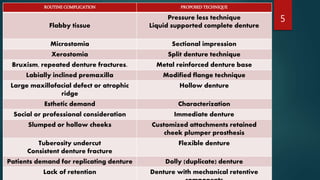
ROUTINE COMPLICATION PROPOSED TECHNIQUE
Flabby tissue
Pressure less technique
Liquid supported complete denture
Microstomia Sectional impression
Xerostomia Split denture technique
Bruxism, repeated denture fractures. Metal reinforced denture base
Labially inclined premaxilla Modified flange technique
Large maxillofacial defect or atrophic
ridge
Hollow denture
Esthetic demand Characterization
Social or professional consideration Immediate denture
Slumped or hollow cheeks Customized attachments retained
cheek plumper prosthesis
Tuberosity undercut
Consistent denture fracture
Flexible denture
Patients demand for replicating denture Dolly (duplicate) denture
Lack of retention Denture with mechanical retentive
5
COMPLETE DENTURE FOR PATIENT WITH FLABBY
TISSUE
6
 Mobile or extremely resilient alveolar ridge.
 Replacement of bone by fibrous tissue.
 Anterior part of maxilla.
 Poor support for denture.
 The lesion may be localized, or generalized
 Caused by hyperplasia or by hypertrophy
7
ETIOLOGY
 Excessive load on the RR caused by unstable occlusal
condition.
 Old loose dentures (chronic irritation).
 Load concentration on the anterior segment of the ridge.
 Rapid ridge resorption
 Combination syndrome
 Not removing the dentures during night.
 Anterior over-erupted natural teeth against edentulous ridge.
8
Conservative approach
 Tissue rest
 Soft tissue massage
 Modification of the denture by flange and occlusal
adjustment
 Tissue Conditioning
Prosthetic approach
 Impression
 Centric Occluding record
 Occlusal form and posterior teeth arrangement
9
Impression
 If the flabby tissue is compressed during conventional impression
making, it will later tend to recoil and dislodge the resulting
overlying denture.
10
Sectional impression technique
Selective impression technique
Sectional Impression Technique (Window Technique)
 The special tray is close fitting and has a
hole or window over the area
corresponding to the flabby ridge.
 An impression is taken in impression paste
 Once this has set it is left in place and
impression plaster is painted over the
flabby ridge and allowed to set and
removed as one impression.
11
Selective Impression Technique
 A spaced special tray for an impression compound
impression is then constructed.
 The tray is loaded with compound and an impression is
made.
 The tray is then warmed and placed in the patient's
mouth. It is adapted and border molded.
 The impression is removed and warmed all over apart
from the flabby ridge area. The impression is retaken.
 Wash impression – impression paste
12
Controlled lateral pressure technique
 The fibrous ridge will assume a resting central position when
subjected to even lateral pressure.
 Tracing compound is used to record the denture bearing area .
 A heated instrument is used to remove the greenstick and tray
is perforated in this region.
 Light bodied silicone impression material is then syringed onto
the buccal and lingual aspects of the greenstick and impression
is gently inserted.
13
Palatal Splinting Using A Two Part Tray System
 In 1964, Osborne
 Impression technique involving two overlying impression trays used
for recording maxillary arches with displaceable anterior ridges.
 Aim of this technique is to maintain the contour of the easy
displaceable tissue while rest of the denture bearing area is recorded.
14 The primary model is constructed using the
fitting surface contour of the previous denture.
 From this palatal tray is fabricated with wax
spacer.
 A low viscosity zinc oxide paste impression is
made of the palate.
 An upward force is maintained until it is
apparent that the mobile ridge is just beginning
to have pressure applied to it.
 Once this has set, second special tray impression
Centric Occluding Record
 The jaw relation is recorded using the check bite technique
with the least possible displacement of the supporting
structures.
Occlusal Form And Posterior Teeth Arrangement
 Posterior teeth are arranged in relation to neutral zone.
 Reduce bucco-lingual width of the teeth to decrease the pressure on
the tissues.
Surgical Management
 Removal of the fibrous tissue to leave a firm ridge.
 Ridge augmentation by subperiosteal injection of
hydroxyapatite.
15
IMMEDIATE COMPLETE DENTURE
16
 Any fixed or removable dental prosthesis fabricated for
placement immediately following the removal of a natural
tooth/teeth (GPT-9)
 A denture which is entirely constructed before the extraction of the teeth
which it replaces and is inserted immediately after the extraction of teeth
(Fenn)
REQUIREMENTS
 Compatibility with the surrounding oral environment
 restoration of masticatory efficiency within limits
 Harmony with the functions of speech, respiration and deglutition
 Esthetic acceptability
17
INDICATIONS 18
CONTRAINDICATIONS
 Patient is unavailable for appointment.
 Patient is debilitated or with systemic conditions.
 Acute infections that require drainage.
 Emotionally disturbed or diminished mental capacity and
indifferent patients.
 Patient who have undergone radiation therapy
(extraction itself is contraindicated).
 Patient with a severe gagging reflex.
 Patients with extensive bone loss.
19
ADVANTAGES
 No time will he or she be without
teeth
 The digestive function is
uninterrupted
 General appearance of patient is
less affected.
 Less resorption of the ridge,
residual ridges are better
preserved.
 Healing period is faster and less
painful
 It controls hemorrhage, prevents
contamination and provides
protective covering over the
wound.
20
DISADVANTAGES
 Increased patient visits.
 Traumatic procedure.
 Complex clinical and laboratory
procedures
 Variation in bone and soft tissue
change leads to compromised
retention, rebasing required.
 More chair side time and cost.
 Esthetics of the denture cannot be
evaluated until insertion appointment
TYPES OF IMMEDIATE DENTURES:
Acc. To Fenn
 Without alveolectomy
 Following alveolectomy
 Without prior extraction of the posterior teeth
 Partial immediate dentures
Acc. To Boucher
 Conventional/classic immediate dentures (CID)
 Interim/transitional/non traditional immediate dentures (IID)
21
CONVENTIONAL IMMEDIATE DENTURE (CID)
 A complete or removable partial denture or overdenture fabricated for
placement immediately after the removal of natural teeth.
 The posterior teeth would be extracted and allowed to heal before the
anterior teeth extraction
 The denture is intended to be relined to serve as the long—term
prosthesis.
Indications
 Patients with periodontally weak teeth indicated for extraction.
 Socially active people who are very self conscious about their
appearance.
22
INTERIM IMMEDIATE DENTURE (IID)
 Type of immediate denture in which after the healing
is completed, a second new complete denture is
fabricated as the long term prosthesis.
 The placement of interim dentures allows, progressive
occlusal adjustments
 Helps the basal seat tissues, muscles and joints reach
normal and healthy conditions.
 Preservation of the maximum amount of ridge bulk
with the minimum of trauma and swelling.
23
 A removable partial denture serving as an
interim prosthesis to which artificial teeth will be
added as all natural teeth are lost.
 A transitional denture may become an interim
complete denture when all of the natural teeth
have been removed from the dental arch.
24TRANSITIONAL IMMEDIATE DENTURE
25
CID IID
 Intended as a definite or long term prosthesis,
relined after healing
 Transitional or short term prosthesis
 After healing, a second denture is made.
 Generally indicated when only anterior teeth
are present or few posterior teeth remain that
donot support a partial denture.
 Generally indicated when there are multiple
anterior and posterior teeth remaining or full
arch extractions.
 Good retention and stability at placement
which is possible to maintain during healing
 Fair retention and stability at insertion which
must be improved by provisional reliners.
 Cost is less  Cost is higher
 Longer treatment period  Less time
 At placement only anterior teeth(premolars)
would be extracted.
 All remaining teeth would be extracted.
 Esthetics cannot be changed.  Esthetics can be improved in the second
denture.
 No transitional denture.  Can be made from transitional denture.
Preliminary
impression
• Dentate or partially edentulous stock
tray
• Alginate impression.
Border
molding
Final
impression
Single full arch custom tray Two tray or sectional custom tray
26
Jaw relation
Teeth arrangement
and try-in
27
Extraction and
denture insertion
28
CAST MODIFICATION METHODS
 STANDARD (1958)
 JERBI (1961)
 SPATIAL MODELLING (2008)
29
STANDARD CAST MODIFICATION METHOD
30
JERBI’S CAST MODIFICATION METHOD
POST INSERTION CARE 31
24 hour appointment
 Remove and clean denture.
 Relieve sore spots and check for
overextensions.
32
Follow up
• Use tissue conditioner to refit as needed.
• Remove any socket convexities to avoid healing defects.
• Reline or remake in 6 to 9 months.
TOOTH SUPPORTED OVERDENTURES
33
 Any removable dental prosthesis that covers and rests on one
or more remaining natural teeth, the roots of natural teeth,
and/or dental implants; a dental prosthesis that covers and is
partially supported by natural teeth, natural tooth roots,
and/or dental implants (GPT 9)
GOALS
 It maintains teeth as part of the residual ridge
 Decreases the rate of resorption
 Increases the patients manipulative skills in handling the denture.
REQUIREMENTS
 Maintenance of health
 Reduction in crown to root ratio.
 Basal seat tissue
 Simplicity of construction
 Ease of manipulation
34
TYPES OF OVERDENTURES
35
Transitional overdentures Modification of partial
denture to replace further
lost teeth or to cover the
roots of overdenture
abutments once the teeth
have been cut down.
Training dentures Commonly employed to
replace hopeless posterior
teeth once they have been
extracted.
Immediate replacement
overdenture
Constructed before the last
remaining teeth are
extracted and the
overdenture abutments
prepared
Definitive prostheses Constructed atleast 6 months
following extraction of the
ADVANTAGES
 preservation of alveolar bone
 Preservation of Proprioceptive
response
 Support and retention
 Periodontal maintenance
 Convertibility
 Harmony of arch form
 Patient acceptance is more
36
DISADVANTAGES
 Caries susceptibility
 Periodontal disease around abutments
 Over contour
 Under contour
 Bony undercuts
 Encroachment of inter occlusal distance
 Meticulous oral hygiene is required
 Time consuming
 Technique sensitive
INDICATIONS
 Patient with badly worn teeth.
 Pt. with few natural remaining teeth.
 Poor prognosis for routine complete denture
 Congenital or acquired intra oral defects
 Mandibular arch where loss of bone is more rapid
 Edentulous maxilla opposing intact mandibular
dentition
 Post traumatic or post surgical cases
 Severe attrition and loss of vertical dimension
 Young patient
 Cleft palate causing large free way space
 Hypodontia
 Tooth wear cases
37
CONTRAINDICATIONS
 High caries index
 Poor oral hygiene
 Poor prognosis of abutment
 Reduced inter-arch space
 Undercuts
 Sufficient attached gingiva not present
 Where endo and perio treatment cannot
be performed satisfactorily
 Grade III mobility
PROCEDURE
PERIODONTAL AND ENDODONTIC CONSIDERATIONS
ABUTMENT LOCATION
 Ideal: two teeth per quadrant
 Tripod is next most favorable form for support and
stability.
 Isolated teeth are preferred to several adjacent teeth as
inter dental areas are difficult to clean and susceptible to
gingivitis. (Robert M. Morrow, colonel , ret. USAFDC,
virginia, 1970)
 Anterior mandibular ridge is most vulnerable to time
dependent RRR canines and premolars are regarded as
best overdenture abutments
 In maxilla central incisors are ideal as overdenture
38
ABUTMENT PREPARATION
Techniques
 Simple tooth modification and reduction
 Tooth reduction and cast copings
 Endodontic therapy and amalgam plug
 Endodontic therapy and cast copings
 With attachments
39Simple and short
Convex, dome shaped
Chamfer finish line
RETENTION
 Retention can be improved by the use of
retentive elements that are placed in the
retaining roots or implants.
 Can be internal or external
METAL COPINGS
 Single, unconnected copings
 Cutting root filled teeth down and preparing
dome shaped copings that extend only 1 or
2 mm above the ridge crest.
 When crowned teeth are to be reduced,
either remove the crown or cut through
them.
 Timple shaped or dome shaped copings.
40
ATTACHMENTS
 Small precision devices
 To improve retention of the denture base
REQUIREMENTS
 Low caries index
 Perform proper home care
 Sound periodontal health
 Proper bone support.
RIGID ATTACHMENT
 Doesnot allow movement of denture base
 provides adequate retention
 Induce more torque on abutment
41
RESILIENT ATTACHMENTS
 Allows some control of movements
 Induces less torque on abutments
42
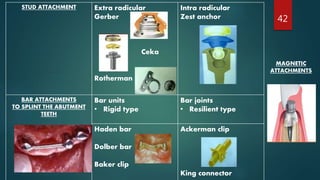
STUD ATTACHMENT Extra radicular
Gerber
Ceka
Rotherman
Intra radicular
Zest anchor
BAR ATTACHMENTS
TO SPLINT THE ABUTMENT
TEETH
Bar units
• Rigid type
Bar joints
• Resilient type
Haden bar
Dolber bar
Baker clip
Ackerman clip
King connector
MAGNETIC
ATTACHMENTS
43
Primary impression
Border molding
Secondary impression
Jaw relation
Try-in
Denture insertion
Maintenace and periodic recall
44
One frequently encountered problem for tooth-supported
complete denture is the tendency for an unfavourable
gingival response around the abutment teeth.
 movement of denture base
 Poor oral hygiene
 Excess space in the prosthesis around the gingival
margins
MAINTENANCE
 Periodic recall and maintenance
 Topical fluoride and antibacterial rinses
 Brushing and flossing
LIQUID SUPPORTED DENTURES
45
INTRODUCTION
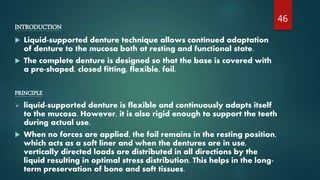
 Liquid-supported denture technique allows continued adaptation
of denture to the mucosa both at resting and functional state.
 The complete denture is designed so that the base is covered with
a pre-shaped, closed fitting, flexible, foil.
PRINCIPLE
 liquid-supported denture is flexible and continuously adapts itself
to the mucosa. However, it is also rigid enough to support the teeth
during actual use.
 When no forces are applied, the foil remains in the resting position,
which acts as a soft liner and when the dentures are in use,
vertically directed loads are distributed in all directions by the
liquid resulting in optimal stress distribution. This helps in the long-
term preservation of bone and soft tissues.
46
PROCEDURE
47
Vacuum heat pressed
polyethylene sheet of 1.5
mm thickness was
adapted on the master
cast
After dewaxing the
polyethylene sheet is adapted
on the cast, acrylisation of the
denture using heat cure resin
Denture – finished and
polished
AFTER 2 WEEKS
 Temporary 1.5 mm polyethylene sheet is removed
 Additional silicone putty impression was made of the tissue surface of the
denture
 Polyethylene sheet 0.5 mm is cut and adapted in the crevice formed due to
removal of 1.5 mm sheet.
 The space created is filled with viscous liquid glycerine.
 The occlusal vertical dimension adjusted in pt’s mouth.
48
PRECAUTIONS
 Thickness of the denture base should be at least 3 mm.
 Seal should be perfect and should be checked for microleakage.
 Denture care instructions should be given to the patients.
 In case the liquid leaks out, the patient should inform the dentist and the denture should be
refilled.
 Repair is possible if the sheet gets ruptured and can be replaced over the preserved stone
replica.
ADVANTAGES
 Preservation of residual ridge by optimal distribution of masticatory forces.
 Better retention, stability, support, and comfort due to close adaptation.
 Optimized atmospheric pressure, adhesion, cohesion and mechanical interlocking in
undercuts.
 Improved patient tolerance because of great comfort due to smooth flexible surfaces
 Prevention of chronic soreness from rigid denture surface.
49
Dammani B, Shingote S, Athavale S, Kakade D. Liquid-supported
denture: A gentle option. J Indian Prosthodont Soc 2007;7:35-9
HOLLOW DENTURES
50
INTRODUCTION
 In the large maxillofacial defects and in severely resorbed edentulous ridges,
there is a decreased denture bearing area for support, retention and stability.
Increase interridge space compounds this problem. To decrease the leverage
forces, reduction in the weight of the prosthesis was recommended and was
also found to be beneficial.
 Different weight reduction approaches have been achieved using a solid 3
dimensional spacer, including dental stone, cellophane wrapped
asbestos, silicone putty or modeling clay have been used during laboratory
processes to exclude denture base material from the planned hollow cavity of
the prosthesis.
 Holt et al. processed a shim of indexed acrylic resin over the residual ridge and
used a spacer, which was then removed and the two halves luted with auto
polymerized acrylic resin.
 Fattore et al. used a variation of the double flask technique.
51
INDICATIONS
 Resorbed residual ridges.
 Increased interridge distance.
ADVANTAGES
 Commonly used materials are used for its fabrication.
 Reduces weight of the prosthesis which in turn enhances retention.
DISADVANTAGES
 Time-consuming procedure.
 Hollow denture is prone to fracture.
 Removal of putty from the cavity is difficult.
52
PROCEDURE
53
A template of the duplicated trial denture
was made by adapting 0.5-mm
thermoplastic sheet on the recovered cast
using vacuum heat-pressed machine
Two layers of baseplate wax
were adapted to the definite
cast
The trial denture was
duplicated in reversible
hydrocolloid
Hollow Maxillary Complete Denture
Usha Radke, Darshana Mundhe
J Indian Prosthodont Soc. 2011
Dec; 11(4): 246–249.
Acrylic resin is packed over
putty and processed
54After deflasking the clear matrix is placed on
the definite cast using indices the land area.
An endodontic file is used to measure the
space between the matrix and the processed
base
Vinyl polysiloxane putty is mixed
and adapted on the base and
shaped
The silicone putty was
removed
after complete remova
of putty, two covers
were fabricated using
clear autopolymerizing
resin.
The clear resin covers
were attached using
autopolymerizing resin
PRECAUTIONS
 There should be adequate thickness of resin around
the cavity.
 Seal around the window should be perfect and
should be checked for leakage.
 Denture care instructions should be given to the
patients.
 Special instructions regarding handling of the
denture should be given as the dentures are prone
to fracture.
55
SECTIONAL COMPLETE DENTURE
56
HINGE DENTURE
INDICATIONS
Restricted mouth opening
Orofacial carcinoma
Cleftlip
Trauma
Burns
microstomia
Plummer vinson syndrome
Temeperomandibular joinj dysfunction
Oral submucous fibrosis
Any damage to masticatory muscles
57
PROCEDURE
58
Sectional denture bases with occlusal rims Sectional denture bases with teeth arrangement
Hinged and sectional complete dentures for
restricted mouth opening: A case report and review
Aditi Sharma, Pallak Arora, Sartaj Singh Wazir
Contemp Clin Dent. 2013 Jan-Mar; 4(1): 74–77.
ma 59
(a) Maxillary denture sectioned from the midline incorporating two hinge assemblies in the palatal Region
(b) Mandibular denture with hinge assembly in the anterior region
60
(A) Collapsed maxillary hinged (B) mandibular sectioned and hinged complete denture with
anterior removable partial denture
ADVANTAGES
 Better function, health, esthetics, and overall well-being of the patient.
 This technique can be accomplished in any dental laboratory, without using
complicated machinery or attachment devices for sectioning or assembling
the trays/prosthesis together.
 The press buttons and mandibular molar bands are easily available and are
easy to maintain.
DISADVANTAGES
 Additional time, labor, and materials.
61
METAL REINFORCED COMPLETE DENTURE
62
INDICATIONS
 Deep palatal vault, prominent residual ridges
 Shallow flat palates and mentally compromised patients
 poor neuro muscular coordination
MATERIALS USED FOR METAL DENTURE BASE
 Metal, gold or cobalt-chrome-molybdenum or cobalt-chrome alloy
dentures have superior physical properties
 Cr-Co - most retentive.
 Al - has advantage of being less dense, but construction technique, less
available & Al toxicity may be contributor to Alzheimer disease.
 Ni - Cr
 Titanium
 Gold- less retentive for maxillary denture but may be a value for
mandibular denture due to its viscosity.
63
ADVANTAGES OF METALLIC BASES
 Lack of bulk with more strength
 The metal base prevents warpage during processing. Stronger
and are less subject to breakage.
 More accurate fit and more faithful reproduction of tissue details.
 Less tissue changes occur under metal bases.
 Dimensional accuracy.
 Less porous.
 Better thermal conductivity
 Show less lateral deformation in function.
64
65
 The equal amount of heat cure material mix in
dough stage was placed in both halves of the
flask and cellophane paper was placed in
between and trial closure was done.
 After trial closure, the cellophane paper was
removed and the properly adapted stainless
steel metal mesh was placed between the 2
halves of the flasks, covering the entire
palatal surface till the crest of the ridge.
 Then the flasks were pressed in the hydraulic
press, at 10,000 n.
PROCEDURE
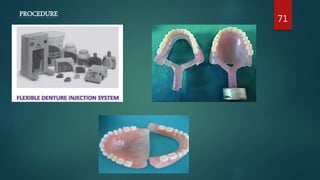
FLEXIBLE DENTURES
66
Flexible denture base material is a bio-compatible nylon- based thermoplastic
resin.
VALPLAST
 Retention - flexes into a retentive position, below the undercut.
 Comfort - thin, lightweight & flexible.
 Aesthetics
 Ease - no tooth or tissue preparation is required so you can offer patients a
conservative & pain-free solution.
 Strength - clinically unbreakable, more durable than acrylic & won't absorb stains
or odors.
67
commercially available products are
Valplast Duraflex
Flexite Lucitone
Impak Proflex
SUNFLEX
 virtually invisible, unbreakable, metal-free, light weight and
incredibly comfortable.
 Advantages
No need of metal clasps
More stain-resistant than other flexible acrylics
Has the perfect degree of flexibility
Can be relined and repaired
Will not warp or become brittle
Stands aesthetically superior
PRO-FLEX
 Pro-flex is the flexible denture base material which can be
used for full & partial flexible denture.
 Indicated in some of the anatomical considerations where
tooth and tissue undercuts are a hindrance
68
INDICATIONS
 Full dentures, partial dentures, Bases and relines
 in cases with bilateral in-operable undercuts
 when pre-prosthetic surgery is contraindicated.
 for TMJ splints
 for the patients allergic to acrylic monomers
 as cosmetic veneers/gum veneers to mask gingival recession
 in periodontally involved teeth
 Sensitive teeth
 cancerous mouths or other conditions in which the teeth are compromised
 treatments involving high torus or cleft palate conditions
 as mouth guards in sports
 Bruxisum splints/ Night guards
 Bite splints, Space maintainer, Paediatric cases
 Obturators
 Speech therapy appliances
 orthodontic retainers.
69
CONTRAINDICATIONS
 Bilateral distal extension maxillary &
mandibular ridges
 Deep overbite
ADVANTAGES
 Translucency
 Dentures can be made very thin and light weight.
 Better accuracy.
 Absolute biocompatibility.
 Can be used as temporary dentures during the therapeutic episodes after
surgical reconstruction of jaw.
 Reduced midline denture fractures.
 Excellent mouldability, light weight to density ratio and high thermal strength.
 reduces post-insertion complaints of denture-induced trauma [ulceration].
DISADVANTAGES
 Flexibility is normally, not an advantage in complete dentures as retentive
peripheral seal can be broken in function.
 Also a greater than normal shrinkage makes it difficult to fabricate
70
71
PROCEDURE
DENTURES WITH SALIVARY RESERVOIRS
72
 Xerostomia is a subjective feeling of dryness in the mouth.
 Flow of saliva decreases to almost half the normal unstimulated rate of
around 0.3 ml/min.
 Mild xerostomia - gustatory stimulation of salivary glands by mastication of
sugar-free chewing gums or lozenges is helpful.
 In severe cases, salivary substitutes are used.
CAUSES
 Anxiety
 Sjogren's syndrome
 Salivary gland disease
 Medication-related side effects
 Head and neck radiation sequelae
 General medical conditions such as diabetes mellitus
Common complaint’s of dry mouth
 Difficulty in normal oral and oropharyngeal functions.
 Extreme discomfort in wearing dentures
73
PROCEDURE
74
Palatal contours recorded
using tissue conditioning
material at the try‐in
appointment
Template of 1‐mm thick
thermoplastic material
fabricated on working cast
Wax‐up of reservoir
walls and lid rim with
Functional salivary reservoir in maxillary complete denture – technique
redefined
Angel Mary Joseph Clin Case Rep. 2016 Dec; 4(12): 1082–1087.
75
Trial denture after dewaxing Finished and polished complete
denture with reservoir walls
Reservoir lid fabricated with
2‐mm flexible thermoplastic sheet
on duplicated cast of the denture
76
Polished surface of
maxillary salivary
reservoir complete
denture with salivary
substitute
Intraoral view
Intraoral view
77ADVANTAGES
• Simplified technique.
• Cost‐effective.
• Laboratory procedures are less time‐consuming.
• No additional clinical steps.
• Physiologic mechanism of salivary release.
• Easy to use, clean, and refill the reservoir.
• Sustained and slow release of salivary substitute.
• Does not interfere with normal oral functions.
• Easy visibility of salivary substitute in the chamber.
• Reservoir is less bulky compared to the conventional techniques.
DISADVANTAGES
• Additional laboratory steps.
• The patient should manually refill the reservoir at regular intervals.
• High degree of precision is mandatory to ensure accurate and smoothly
fitting the reservoir lid.
CHEEK PLUMPER PROSTHESIS
78
 Esthetic factor not only confined to teeth but also to be considered for facial
appearance.
 Facial esthetic may be compromised due to lack of support from the internal
structures. This results in slumped or hollow cheek proving detrimental to facial
esthetics.
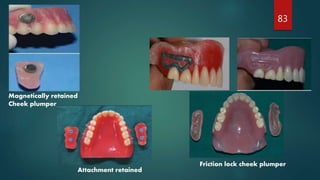
 Cheek plumper help to enhance facial appearance by supporting the slumped cheeks.
 It is attached to complete denture by customized attachments or magnets.
 A conventional cheek plumper would be a part of the complete maxillary denture
prosthesis forming single unit prosthesis with extensions on either side in the region of
the polished buccal surfaces of the denture and are continuous with the rest of the
denture.
79
INDICATION
 To provide a youthful appearance in patients with hollow cheeks.
 To restore esthetics in patient with Maxillofacial defect.
DRAWBACKS
 Excessive weight added to the upper denture thus compromising retention.
 Interference with masseter muscle and the coronoid process of the mandible and
so difficulty in chewing, difficulty in insertion and removal.
80
81
Flasking of cheek plumpers Finished and polished acrylic cheek plumpers
Impression compound cheek
plumpers separated from denture
base
Impression
AggarwalPetal.:ImprovingCompleteDentureAestheticsUsing
CheekPlumperAppliance
82
Holes for push button Push button attached on the denture base
Cheek plumper attached to denture base
83
Magnetically retained
Cheek plumper
Attachment retained
Friction lock cheek plumper
84
Pre operative
view
Post-operative viewIntraoral view
LABELED DENTURES
85
Denture labeling was introduced in prosthetic dentistry due to the necessity of
forensic experts. The importance of denture identification was brought into
focus by Dr. Robert H Griffiths.
Five requirements of marking dentures were suggested by Kruger–Monson.
 Strength of the prosthesis must not be jeopardised
 Fabrication should be easy and inexpensive
 Identification system should be efficient
 Markings should be durable and visible
 Markings should withstand fire and humidity.
86
SURFACE METHODS
 The marks are located on one of the denture’s surface and can be done by SCRIBING or
ENGRAVING the denture itself.
 Letters, or numbers are engraved with a small round dental bur.
 On the fitting surface of the maxillary complete denture.
 This engraving can cause detrimental effects such as food debris getting lodged leading to
bacterial infection.
 Writing on the tissue-fitting surface or the polished surface of the finished denture surface with a
FIBRE-TIP PEN.
 Covered with 2 thin coats of varnish which prolong the life of the marking.
 The varnish used is made by dissolving 5g of acrylic resin polymer in 20 ml of chloroform.
 Inexpensive
 Unaffected by denture cleaners, antiseptics and mouthwashes
87
EMBOSSING
 Comprises initials of the name and the surname of the patient that are scratched
with a dental bur on the master cast.
 This technique produces embossed lettering on the fitting surface of the denture.
88
Embossed Plastic tape
applied to wax pattern
Cast framework Processed denture
INCLUSION METHODS
 The marks are made by using metallic or non-metallic materials, microchips and
micro labels which are enclosed in the denture at the packing stage.
 Disadvantage dislocation, wrinkling or tear can occur.
Technique sensitive and time consuming.
T-BAR
 A t-shaped clear PMMA resin bar is constructed by cutting baseplate wax and
then is flasked, packed, processed, and finished in clear PMMA.
 An identification printed label against the flat section of the bar is fixed. It is then
surface polished to produce a clear window displaying the ID label.
 Easy, inexpensive and time-effective
89
PAPER STRIPS
 This method is a less expensive ,utilizing a piece of onion skin paper.
 The acrylic resin fitting surface situated adjacent palatally between the ridge and
the center of the palate is moistened with monomer on a small brush. The strip of
typed paper is laid on this surface and the paper is moistened with the monomer.
 Clear or pink polymethyl methacrylate (PMMA) is then placed over the paper
before final closure of the denture flask.
90
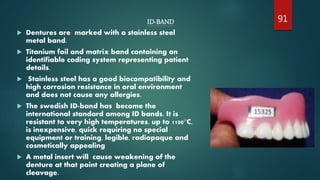
ID-BAND
 Dentures are marked with a stainless steel
metal band.
 Titanium foil and matrix band containing an
identifiable coding system representing patient
details.
 Stainless steel has a good biocompatibility and
high corrosion resistance in oral environment
and does not cause any allergies.
 The swedish ID-band has become the
international standard among ID bands. It is
resistant to very high temperatures, up to 1100°C,
is inexpensive, quick requiring no special
equipment or training, legible, radiopaque and
cosmetically appealing
 A metal insert will cause weakening of the
denture at that point creating a plane of
cleavage.
91
LASER ETCHING
 copper vapor laser (CVL)
 metal surface of a partial denture.
 can label the cobalt-chromium components of dentures.
 expensive method and requires specialized equipment and technicians to perform
the procedure.
ELECTRON MICROCHIPS
 Chip measuring 5×5×0.6 mm.
Advantages
 Resistant to high temperature above 6000c
 Excellent acid resistance,
 Radio-opaque
 Bonds well with acrylic resin.
Disadvantages
 It could be inscribed only by the manufacturer and not by the dentist.
92
RFID TAGS
 Radio frequency identification tags.
Advantages
 Cosmetic, effective labeling method
 Small size (8.5×2.2 mm)
 the large amount of denture user data that can be stored.
 No weakening of the denture
 The chip remains intact and readable in sub-zero temperature as well as after burning for 1 hr
at 1500°C.
Disadvantages
 High cost of manufacture
 Data incorporation and may not be available in most dental set-ups
93
LENTICULAR PRINTING
 Simple, cheap and quick method
 Lenticular lens is used to produce images with an illusion of depth, morph, or the
ability to change or move as the image is viewed from different angles.
 Lenticular technology allows images to be printed on the back of a synthetic
paper and laminated on the lens.
Denture barcoding
 Machine-readable code of a series of bars and spaces printed in defined ratios.
 Denture barcoding provides exact information, and is resistant to high
temperatures and commonly used oral solutions.
 It requires expensive special equipment
94
PHOTOGRAPH
 Patient’s photograph embedded in clear acrylic denture base.
 Only resistant to around 200–300°c
 Incorporation of lead foil
 Incorporation of SIM card
95
DENTURE WITH CHARACTERIZATION
96
 Denture characterization is a modification of the form and color of the denture base and
teeth to produce a more lifelike appearance.
METHODS:
 Characterization by selection, arrangement, and modification of artificial teeth
 Characterization by tinting the denture bases.
INDICATIONS
 For patients demanding for enhanced esthetics
 High smile line
 Socially active
 Stage performers.
97
CHARACTERIZATION BY SELECTION, ARRANGEMENT AND MODIFICATION
OF ARTIFICIAL TEETH
The teeth can be modified to harmonize with the patient's age, sex, and personality to
provide subjective unity.
 Varying the direction of the long axis of teeth.
 Create asymmetry in the divergences of the proximal surfaces of the teeth
from the contact points.
 Use an eccentric midline.
 Gingival tissues recede with age. Selecting a long tooth, contouring the
wax to show gingival recession and then staining it a bit, can give natural
appearance.
 Grinding the incisal edges.
98
 Overlapping, tilting, rotation and incisal variations may contribute to a natural-
looking denture.
 Spacing and diastemas .
 A hair line crack can be given in the teeth.
 Silver filling can be given on posterior teeth.
 Cast crown can be given on posterior teeth.
 Discolored tooth.
CHARACTERIZATION OF THE DENTURE BASES
Indication
 Patients with an active upper lip.
 Patients with a prominent pre-maxillary process.
 Patients who may expose gum tissues during smiling.
 The psychological acceptance of the dentures by the patient.
99
STIPPLING
 Lynn C. Dirksen
 The stippled surface produced by plastic veneer
forms enhances the esthetic appearance of plain
pink acrylic resin.
 The stippled plastic contour veneer is applied to
a wax-up in approximately five minutes, and the
carving and polishing of the buccal and the labial
surfaces of the cured denture is practically
eliminated.
100
INFLAMED OR BULBOUS GINGIVA:
by leaving more interdental wax.
ALVEOLAR EMINENCE:
 To imitate the anatomy the gingivae and alveolus.
 The labial flange of a complete denture should show a series of swellings corresponding to
the alveolar eminencies over the roots of the teeth.
 These are most marked anteriorly and become progressively less marked in the pre-molar
and molar region.
 In the upper anterior region, the canine eminence is most marked. The lateral incisor
eminence is small.
 In the lower jaw, again the canine eminence is most marked
and a series of smaller ridges mark the presence
of the incisor roots.
101
USE OF TINTS IN THE DENTURE BASES:
 Usually heat curing or auto-polymerizing resins of various shades or
colors are painted on the denture base or are shifted on to the mold
during denture construction to obtain a tinted denture.
IDEAL REQUIREMENTS
1. It should be readily miscible with methyl methacrylate
resin.
2. It should be non-toxic
3. It should not add appreciable bulk to denture bases.
4. It should be stable and non-fading.
5. It should be resistant to loss from abrasion in cleaning and
in normal function.
6. It should not alter the properties of the denture base
resins.
Kayon dental stains or tinting resins
102
DUPLICATE DENTURES
103
 Dolly Denture
 Copy denture
 Replica denture
 Template denture
 Repeated denture
INDICATIONS
 For physically or psychologically impaired patient who cannot adapt to new
dentures.
 Patients asking for a spare set of dentures
 Patients treated with immediate dentures that require replacement
 Patients with worn dentition but satisfied with the fitting of an old denture.
CONTRAINDICATIONS
 Any serious defects of the denture prosthesis
104
TECHNIQUES
 Modified denture flask method
 Soap container method
 Duplicating flask method
 Pour resin flask method
 Cup flask method
 Agar containing method
105
ADVANTAGES
 Less clinical and laboratory stages
 Less work for dental technician
 Can make copy without damaging the old ones and
without needing to take the dentures away from the
patient between appointments.
DENTURE FLASK TECHNIQUE
106
SOAP DISH TECHNIQUE
107
108
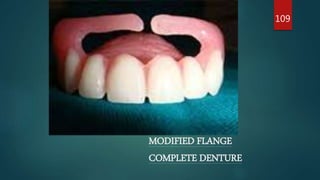
MODIFIED FLANGE
COMPLETE DENTURE
109
INTRODUCTION
 Residual ridge anatomy of different patients shows different contour and forms
of residual ridges that may range from severe resorption to well-formed to
bulky ridges.
 The usual pattern of resorption in maxilla is upward and inward, whereas in
mandible it follows outward and downward direction.
 However, in some cases, maxilla is overdeveloped, irrespective of resorption.
This may be due to the developmental or pathological reasons. This could be
accentuated by minimum bone resorption and expansion of labial plate during
extraction.
 One of the conditions affecting the denture insertion and esthetics is labially
inclined premaxilla and associated undercut.
 Esthetic principle will be compromised with the complete denture if it is
fabricated by conventional approach because of the excessive fullness by thick
labial flange.
110
111
Try-in labial flange was completely
removed from canine to canine leaving two
acrylic spikes extending anteriorly from the
distal side by engaging the undercut.
Regaining esthetics with unconventional complete denture, Clinical case series. Daniel AY, Mehdiratta S, Talwar H, Daniel S. : CHRISMED J
Health Res 2018;5:60-2
112
Removing the entire acrylic extensions
and use of stainless steel to engage the
labial undercut. Tip of wire was covered
with acrylic tags to avoid mucosal
impingement
Wax up processing, polishing, finishing of the denture
FLANGELESS COMPLETE DENTURE AND OBLITERATED LABIAL VESTIBULE SPACE
Vishwadeepak Singh et al. International Journal of Medical Reviews and Case
Reports
 This article presents a unique case where no evidence of
premaxillary proclination existed, yet the labial vestibule space
was considerably obliterated.
 Extraoral examination revealed hypertonic and tight maxillary
lip, besides increased lower third dimensions of the face.
 Intraoral examination revealed a moderately formed maxillary
and mandibular residual alveolar ridges.
113
114
Maxillary labial flange was removed
Before facebow transfer.
Teeth arrangement and try-in
Denture processing
(conventional method)
Finishing and polishing
 After try- in, while sealing the wax up, tin foil can be incorporated in
the areas which had to be left open in the final denture.
 Processing of the denture was done in conventional manner.
 After deflasking the denture, the tinfoil was removed.
 A window is hence formed on the labial aspect of the ridge in the
area of prominence.
115
DENTURE WITH MECHANICAL RETENTIVE COMPONENTS
 The various mechanical factors which aid in retention are retentive springs,
magnetic forces , suction chambers and suction discs.
116
PROSTHODONTIC REHABILITATION OF A COMPLETELY EDENTULOUS CLEFT PALATE PATIENT
USING AN UNCONVENTIONAL COMPLETE DENTURE-A CASE REPORT.
Ferreira, A. N., E, P., Aras, M., Chitre, V., & Coutinho, (2018). Dentistry,
08(04)
117
Intraoral examination revealed completely edentulous upper arch
with a palatal defect restricted to the premaxilla measuring
approximately 3 mm × 4 mm × 5 mm and resorbed completely
edentulous mandibular arch
118
For recording the neutral zone,
 The lower wax occlusal rim was replaced with tissue
conditioner material supported with wire loops of 21 gauge
and three autopolymerising acrylic resin pillars; one anterior
and two in the molar region as vertical stops .
 The patient was asked to carryout different functional
movements to mould the tissue conditioner material.
 An addition silicone putty index of the moulded rim was
made and the artificial teeth were arranged in the neutral
zone following the indexA neutral zone impression
technique for the lower prosthesis
to improve retention and stability
of the denture.
Palatogram recorded with tissue
conditioner and green food color
 A multiple U-loop shaped retainer made up of
20 gauge wire was attached to the maxillary
master cast after the dewaxing procedure to
retain the obturator into the prosthesis.
 The dentures were acrylised, finished and
polished.
 The maxillary denture was relined in the cleft
area with a temporary soft denture liner
taking support from the retainer
119
After one month, the obturator was
replaced by a permanent hard denture liner
THE PRONG DENTURE. A COMBINED SURGICAL-PROSTHETIC APPROACH TO
ENHANCE DENTURE RETENTION.
Braun, E., & Lepley, J. B. (1981). : The Journal of Prosthetic Dentistry, 46(2), 196-200
120
INDICATIONS
CONTRAINDICATIONS
• Severely resorbed
maxillae or mandibles
• Only after conventional
denture techniques
have failed
Normal alveolar ridge
PREFABRICATED PRONGS
The maxillary prongs are 24 mm long with a width of 5 to 7 mm at the
base and 3 to 4 mm at the tip. A wire handle 3 cm long is attached to
the prongs. The mandibular prongs are 15 mm long, 13 mm wide, and
3 mm thick.
 PREPROSTHETIC SURGICAL PHASE
121
• Under general anesthesia, the upper lip is
elevated and a 1 cm horizontal incision is made
through the mucosa on both sides of the
midline.
• Blunt dissection is performed to the piriform
aperture and continued into the floor of the
nose, where a perforation is made into the
nasal cavity.
• The prefabricated prongs are then placed into
each surgically created defect, and a parallel
path of withdrawal is obtained by
manipulating the prongs simultaneously with
hemostats.
• A methyl methacrylate resin stent is placed in the
mouth; autopolymerizing methyl methacrylate
resin is used to attach the prongs to the stent.
122 A split-thickness skin graft is obtained from the inner
aspect of the upper left arm. The skin graft is placed
on the prongs, making sure that the connective tissue
side is against the mucosal surface and that the graft
completely covers the prong.
 three small holes are placed in the stent, and silk
sutures are placed to secure the stent and graft
covered prongs.
PROSTHETIC PHASE
The patient’s existing maxillary denture is
then transferred to the prongs in the mouth
using autopolymerizing methyl
methacrylate resin
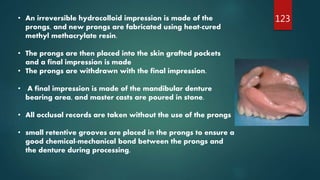
123• An irreversible hydrocolloid impression is made of the
prongs, and new prongs are fabricated using heat-cured
methyl methacrylate resin.
• The prongs are then placed into the skin grafted pockets
and a final impression is made
• The prongs are withdrawn with the final impression.
• A final impression is made of the mandibular denture
bearing area, and master casts are poured in stone.
• All occlusal records are taken without the use of the prongs
• small retentive grooves are placed in the prongs to ensure a
good chemical-mechanical bond between the prongs and
the denture during processing.
124
ADVANTAGES DISADVANTAGES
• Improved esthetic
appearance
• Prongs give adequate
support to the anterior
maxillary lip, along
with the anterior
border of the denture.
• Increased masticatory
efficiency.
• Improved speech
• Excellent retention
• Patients fear
• Delayed healing of the
skin graft donor site.
• Postoperative infection
• Oronasal fistula
PROSTHODONTIC REHABILITATION OF A PATIENT WITH TOTAL AVULSION OF THE MAXILLA: A CLINICAL
REPORT.
Sykes, L. M., Wolfaardt, J. F., & Sukha, A. (2002). The Journal of Prosthetic Dentistry, 88(4),
362–366.
 Intraoral examination revealed the absence of the palatal vault,
maxillary teeth, and residual alveolar ridges. The roof of the patient’s
mouth was lined with a skin graft and had openings into the maxillary
sinus on either side. This surface was mobile and tender to palpation
 Extraorally, 2 large scars extended from the commisures of the mouth
toward the ears.
125
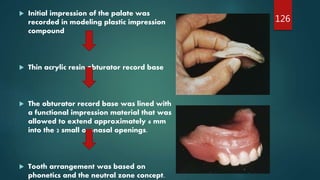
 Initial impression of the palate was
recorded in modeling plastic impression
compound
 Thin acrylic resin obturator record base
 The obturator record base was lined with
a functional impression material that was
allowed to extend approximately 6 mm
into the 2 small oronasal openings.
 Tooth arrangement was based on
phonetics and the neutral zone concept.
126
127
• Warm modeling plastic impression compound was placed over
the posterior ridge areas. The molded rims were used to record
the occlusal plane, occlusal vertical dimension, and centric
relation. Teeth were placed according to the functional shape
produced.
• The first prosthesis was completed with a heat-polymerized
silicone resilient lining material on the fitting surface
• The soft liner was replaced with hard acrylic resin, which the
patient found more comfortable and easier to clean
RUGAE DUPLICATION – DIFFERENT TECHNIQUES OF CUSTOMIZING PALATAL RUGAE IN
MAXILLARY COMPLETE DENTURE TO ENHANCE PHONETICS
Anupama, Dhaded. KPJ. June 2016, Volume: 1, Issue:1
 Palatal rugae refers to the ridges on the anterior part of the palatal
mucosa, each side of the median palatal raphe and behind the
incisive papilla.
 Palatine rugae are elevations of the mucous membrane and are very
prominent where they help in gripping the food before tearing it with
brute force
 Associated with functions like speech, adaptation, proprioception and
taste
 The production of palatolingual group of sounds involves firm contact
of the tip of the tongue against the rugae. When these rugae and the
hard palate are covered by the denture, proprioceptive feedback
may be changed. Therefore phonetics may be affected by the
128
 RUGAE DUPLICATION USING PUTTY IMPRESSION TECHNIQUE
 RUGAE DUPLICATION USING DENTAL FLOSS
129
• Mark the rugae patterns in maxillary cast.
• Apply auto-polymerizing resin in sprinkle on method
on the rugae portion.
• Jaw Relation Teeth Arrangement Try-in
130• Cut dental floss as per the required length
and lute them over The rugae marking
seen through the record base using inlay
casting wax
• Denture processing, finishing and
polishing
RUGAE DUPLICATION USING TIN FOIL
• Cut tinfoil to the desired shape
and adapt it to the rugae area
• Tinfoil pattern is then removed
and sealed to the palatal area
of the completed wax-up with
hot baseplate wax .
CONCLUSION
 Correct treatment starts with correct diagnosis and correct
treatment planning.
 Correct diagnosis and appropriate treatment plan must be
implemented so as to achieve utmost patient satisfaction
 Each complete denture patient should be evaluated
individually, and the dentist should strive to make the complete
denture unique to that person.
131
REFERENCES
 Sheldom winkler, Essentials of complete denture prosthodontics, third edition.
 Overdentures made easy, Harold w prieskal
 Zarb, Bolender:prosthodontic Treatment For Edentuloys Patients, 12th Edition
 Special dentures, meenakshi. Year : 2017 | volume: 8 | issue number: 3 | page: 126-131
 Hollow maxillary complete denture,usha radke, darshana mundhe J indian prosthodont
soc. 2011 dec; 11(4): 246–249.
 Hinged and sectional complete dentures for restricted mouth opening: a case report and
review, aditi sharma, pallak arora, sartaj singh wazir. Contemp clin dent. 2013 jan-
mar; 4(1): 74–77.
 Design of complete denture reinforced with metal base, srđan d poštić stomatoloski
glasnik srbije 60(1):15 · january 2013
 Flexible dentures in prosthodontics -an overview, prafulla thumati september 2013
 Functional salivary reservoir in maxillary complete denture – technique redefined,angel
mary joseph, clin case rep. 2016 dec; 4(12): 1082–1087.
 Dammani B, Shingote S, Athavale S, Kakade D. Liquid-supported denture: A gentle option. J
Indian Prosthodont Soc 2007;7:35-9
132
 Customized cheek plumper with friction lock attachment for a completely edentulous
patient to enhance esthetics: a clinical report, prem bhushan, january 2017
 Fabrication of duplicate denture from existing complete dentures
sendhilnathan dakshinamurthy, nayar sanjna v, year : 2007 | volume: 7 | issue
number: 4 | page: 188-190
 Regaining esthetics with unconventional complete denture: clinical case series,daniel
angleena y, mehdiratta surbhi, talwar harit, daniel smitha,year : 2018 | volume: 5 |
issue number: 1 | page: 60-62
 Flangeless complete denture and obliterated labial vestibule space,vishwadeepak
singh et al. International journal of medical reviews and case reports
 Prosthodontic rehabilitation of a completely edentulous cleft palate patient using an
unconventional complete denture-a case report.
Ferreira, a. N., E, p., Aras, m., Chitre, v., & Coutinho, (2018). Dentistry, 08(04)
 The prong denture. A combined surgical-prosthetic approach to enhance denture
retention.
Braun, e., & Lepley, j. B. (1981). : The journal of prosthetic dentistry, 46(2), 196-200
 Prosthodontic rehabilitation of a patient with total avulsion of the maxilla: a clinical
report.
Sykes, l. M., Wolfaardt, j. F., & Sukha, a. (2002). The journal of prosthetic dentistry, 88(4),
362–366.
 Rugae duplication – different techniques of customizing palatal rugae in maxillary
133
134

UNCONVENTIONAL DENTURES

  • 1.
  • 2.
    CONTENTS  INTRODUCTION  COMPLETEDENTURE FOR PATIENTS WITH FLABBY RIDGE  IMMEDIATE COMPLETE DENTURE  TOOTH SUPPORTED OVERDENTURES  LIQUID SUPPORTED DENTURES  HOLLOW DENTURES  SECTIONAL COMPLETE DENTURES  METAL REINFORCED COMPLETE DENTURES  FLEXIBLE DENTURES  DENTURES WITH SALIVARY RESERVOIRS 2  CHEEK PLUMPER PROSTHESIS  LABELED DENTURES  DENTURES WITH CHARACTERIZATION  DUPLICATE DENTURES  MODIFIED FLANGE COMPLETE DENTURES  DENTURES WITH MECHANICAL RETENTIVE COMPONENTS  REVIEW OF LITERATURES  CONCLUSION  REFERENCES
  • 3.
    INTRODUCTION  Transforming conventionalinto unconventional approach is a characteristic feature of evergrowing prosthodontic branch.  The increasing demand of patients and revolutionary thought of prosthodontists have led to the outcome of the special, i.e the unconventional approach for fabricating complete dentures.  Complete dentures made in conventional manner proves satisfactory in most of the patients, but in compromised patients, conventional method brings with it certain disadvantages. So new techniques based on same old fundamentals of prosthodontia is known as the unconventional complete dentures. 3
  • 4.
     Routine complicationsfaced by the dentist include atrophic ridge, microstomia, flabby tissue, xerostomia, bony exostosis, labially inclined premaxilla, esthetic demand, bruxism, systemic disorders, patient’s demand for duplicating dentures,etc.  Management of these difficulties can be done by proper incorporating of suitable materials and advanced techniques.  The conventional approach may not fulfill the five basic principles of complete denture like retention, stability, support, esthetics and preservation of supporting structures which are of utmost importance for the complete satisfaction of the patient. 4
  • 5.
    ROUTINE COMPLICATION PROPOSEDTECHNIQUE Flabby tissue Pressure less technique Liquid supported complete denture Microstomia Sectional impression Xerostomia Split denture technique Bruxism, repeated denture fractures. Metal reinforced denture base Labially inclined premaxilla Modified flange technique Large maxillofacial defect or atrophic ridge Hollow denture Esthetic demand Characterization Social or professional consideration Immediate denture Slumped or hollow cheeks Customized attachments retained cheek plumper prosthesis Tuberosity undercut Consistent denture fracture Flexible denture Patients demand for replicating denture Dolly (duplicate) denture Lack of retention Denture with mechanical retentive 5
  • 6.
    COMPLETE DENTURE FORPATIENT WITH FLABBY TISSUE 6
  • 7.
     Mobile orextremely resilient alveolar ridge.  Replacement of bone by fibrous tissue.  Anterior part of maxilla.  Poor support for denture.  The lesion may be localized, or generalized  Caused by hyperplasia or by hypertrophy 7
  • 8.
    ETIOLOGY  Excessive loadon the RR caused by unstable occlusal condition.  Old loose dentures (chronic irritation).  Load concentration on the anterior segment of the ridge.  Rapid ridge resorption  Combination syndrome  Not removing the dentures during night.  Anterior over-erupted natural teeth against edentulous ridge. 8
  • 9.
    Conservative approach  Tissuerest  Soft tissue massage  Modification of the denture by flange and occlusal adjustment  Tissue Conditioning Prosthetic approach  Impression  Centric Occluding record  Occlusal form and posterior teeth arrangement 9
  • 10.
    Impression  If theflabby tissue is compressed during conventional impression making, it will later tend to recoil and dislodge the resulting overlying denture. 10 Sectional impression technique Selective impression technique
  • 11.
    Sectional Impression Technique(Window Technique)  The special tray is close fitting and has a hole or window over the area corresponding to the flabby ridge.  An impression is taken in impression paste  Once this has set it is left in place and impression plaster is painted over the flabby ridge and allowed to set and removed as one impression. 11
  • 12.
    Selective Impression Technique A spaced special tray for an impression compound impression is then constructed.  The tray is loaded with compound and an impression is made.  The tray is then warmed and placed in the patient's mouth. It is adapted and border molded.  The impression is removed and warmed all over apart from the flabby ridge area. The impression is retaken.  Wash impression – impression paste 12
  • 13.
    Controlled lateral pressuretechnique  The fibrous ridge will assume a resting central position when subjected to even lateral pressure.  Tracing compound is used to record the denture bearing area .  A heated instrument is used to remove the greenstick and tray is perforated in this region.  Light bodied silicone impression material is then syringed onto the buccal and lingual aspects of the greenstick and impression is gently inserted. 13 Palatal Splinting Using A Two Part Tray System  In 1964, Osborne  Impression technique involving two overlying impression trays used for recording maxillary arches with displaceable anterior ridges.  Aim of this technique is to maintain the contour of the easy displaceable tissue while rest of the denture bearing area is recorded.
  • 14.
    14 The primarymodel is constructed using the fitting surface contour of the previous denture.  From this palatal tray is fabricated with wax spacer.  A low viscosity zinc oxide paste impression is made of the palate.  An upward force is maintained until it is apparent that the mobile ridge is just beginning to have pressure applied to it.  Once this has set, second special tray impression
  • 15.
    Centric Occluding Record The jaw relation is recorded using the check bite technique with the least possible displacement of the supporting structures. Occlusal Form And Posterior Teeth Arrangement  Posterior teeth are arranged in relation to neutral zone.  Reduce bucco-lingual width of the teeth to decrease the pressure on the tissues. Surgical Management  Removal of the fibrous tissue to leave a firm ridge.  Ridge augmentation by subperiosteal injection of hydroxyapatite. 15
  • 16.
  • 17.
     Any fixedor removable dental prosthesis fabricated for placement immediately following the removal of a natural tooth/teeth (GPT-9)  A denture which is entirely constructed before the extraction of the teeth which it replaces and is inserted immediately after the extraction of teeth (Fenn) REQUIREMENTS  Compatibility with the surrounding oral environment  restoration of masticatory efficiency within limits  Harmony with the functions of speech, respiration and deglutition  Esthetic acceptability 17
  • 18.
  • 19.
    CONTRAINDICATIONS  Patient isunavailable for appointment.  Patient is debilitated or with systemic conditions.  Acute infections that require drainage.  Emotionally disturbed or diminished mental capacity and indifferent patients.  Patient who have undergone radiation therapy (extraction itself is contraindicated).  Patient with a severe gagging reflex.  Patients with extensive bone loss. 19
  • 20.
    ADVANTAGES  No timewill he or she be without teeth  The digestive function is uninterrupted  General appearance of patient is less affected.  Less resorption of the ridge, residual ridges are better preserved.  Healing period is faster and less painful  It controls hemorrhage, prevents contamination and provides protective covering over the wound. 20 DISADVANTAGES  Increased patient visits.  Traumatic procedure.  Complex clinical and laboratory procedures  Variation in bone and soft tissue change leads to compromised retention, rebasing required.  More chair side time and cost.  Esthetics of the denture cannot be evaluated until insertion appointment
  • 21.
    TYPES OF IMMEDIATEDENTURES: Acc. To Fenn  Without alveolectomy  Following alveolectomy  Without prior extraction of the posterior teeth  Partial immediate dentures Acc. To Boucher  Conventional/classic immediate dentures (CID)  Interim/transitional/non traditional immediate dentures (IID) 21
  • 22.
    CONVENTIONAL IMMEDIATE DENTURE(CID)  A complete or removable partial denture or overdenture fabricated for placement immediately after the removal of natural teeth.  The posterior teeth would be extracted and allowed to heal before the anterior teeth extraction  The denture is intended to be relined to serve as the long—term prosthesis. Indications  Patients with periodontally weak teeth indicated for extraction.  Socially active people who are very self conscious about their appearance. 22
  • 23.
    INTERIM IMMEDIATE DENTURE(IID)  Type of immediate denture in which after the healing is completed, a second new complete denture is fabricated as the long term prosthesis.  The placement of interim dentures allows, progressive occlusal adjustments  Helps the basal seat tissues, muscles and joints reach normal and healthy conditions.  Preservation of the maximum amount of ridge bulk with the minimum of trauma and swelling. 23
  • 24.
     A removablepartial denture serving as an interim prosthesis to which artificial teeth will be added as all natural teeth are lost.  A transitional denture may become an interim complete denture when all of the natural teeth have been removed from the dental arch. 24TRANSITIONAL IMMEDIATE DENTURE
  • 25.
    25 CID IID  Intendedas a definite or long term prosthesis, relined after healing  Transitional or short term prosthesis  After healing, a second denture is made.  Generally indicated when only anterior teeth are present or few posterior teeth remain that donot support a partial denture.  Generally indicated when there are multiple anterior and posterior teeth remaining or full arch extractions.  Good retention and stability at placement which is possible to maintain during healing  Fair retention and stability at insertion which must be improved by provisional reliners.  Cost is less  Cost is higher  Longer treatment period  Less time  At placement only anterior teeth(premolars) would be extracted.  All remaining teeth would be extracted.  Esthetics cannot be changed.  Esthetics can be improved in the second denture.  No transitional denture.  Can be made from transitional denture.
  • 26.
    Preliminary impression • Dentate orpartially edentulous stock tray • Alginate impression. Border molding Final impression Single full arch custom tray Two tray or sectional custom tray 26
  • 27.
  • 28.
  • 29.
    CAST MODIFICATION METHODS STANDARD (1958)  JERBI (1961)  SPATIAL MODELLING (2008) 29 STANDARD CAST MODIFICATION METHOD
  • 30.
  • 31.
  • 32.
    24 hour appointment Remove and clean denture.  Relieve sore spots and check for overextensions. 32 Follow up • Use tissue conditioner to refit as needed. • Remove any socket convexities to avoid healing defects. • Reline or remake in 6 to 9 months.
  • 33.
  • 34.
     Any removabledental prosthesis that covers and rests on one or more remaining natural teeth, the roots of natural teeth, and/or dental implants; a dental prosthesis that covers and is partially supported by natural teeth, natural tooth roots, and/or dental implants (GPT 9) GOALS  It maintains teeth as part of the residual ridge  Decreases the rate of resorption  Increases the patients manipulative skills in handling the denture. REQUIREMENTS  Maintenance of health  Reduction in crown to root ratio.  Basal seat tissue  Simplicity of construction  Ease of manipulation 34
  • 35.
    TYPES OF OVERDENTURES 35 Transitionaloverdentures Modification of partial denture to replace further lost teeth or to cover the roots of overdenture abutments once the teeth have been cut down. Training dentures Commonly employed to replace hopeless posterior teeth once they have been extracted. Immediate replacement overdenture Constructed before the last remaining teeth are extracted and the overdenture abutments prepared Definitive prostheses Constructed atleast 6 months following extraction of the
  • 36.
    ADVANTAGES  preservation ofalveolar bone  Preservation of Proprioceptive response  Support and retention  Periodontal maintenance  Convertibility  Harmony of arch form  Patient acceptance is more 36 DISADVANTAGES  Caries susceptibility  Periodontal disease around abutments  Over contour  Under contour  Bony undercuts  Encroachment of inter occlusal distance  Meticulous oral hygiene is required  Time consuming  Technique sensitive
  • 37.
    INDICATIONS  Patient withbadly worn teeth.  Pt. with few natural remaining teeth.  Poor prognosis for routine complete denture  Congenital or acquired intra oral defects  Mandibular arch where loss of bone is more rapid  Edentulous maxilla opposing intact mandibular dentition  Post traumatic or post surgical cases  Severe attrition and loss of vertical dimension  Young patient  Cleft palate causing large free way space  Hypodontia  Tooth wear cases 37 CONTRAINDICATIONS  High caries index  Poor oral hygiene  Poor prognosis of abutment  Reduced inter-arch space  Undercuts  Sufficient attached gingiva not present  Where endo and perio treatment cannot be performed satisfactorily  Grade III mobility
  • 38.
    PROCEDURE PERIODONTAL AND ENDODONTICCONSIDERATIONS ABUTMENT LOCATION  Ideal: two teeth per quadrant  Tripod is next most favorable form for support and stability.  Isolated teeth are preferred to several adjacent teeth as inter dental areas are difficult to clean and susceptible to gingivitis. (Robert M. Morrow, colonel , ret. USAFDC, virginia, 1970)  Anterior mandibular ridge is most vulnerable to time dependent RRR canines and premolars are regarded as best overdenture abutments  In maxilla central incisors are ideal as overdenture 38
  • 39.
    ABUTMENT PREPARATION Techniques  Simpletooth modification and reduction  Tooth reduction and cast copings  Endodontic therapy and amalgam plug  Endodontic therapy and cast copings  With attachments 39Simple and short Convex, dome shaped Chamfer finish line
  • 40.
    RETENTION  Retention canbe improved by the use of retentive elements that are placed in the retaining roots or implants.  Can be internal or external METAL COPINGS  Single, unconnected copings  Cutting root filled teeth down and preparing dome shaped copings that extend only 1 or 2 mm above the ridge crest.  When crowned teeth are to be reduced, either remove the crown or cut through them.  Timple shaped or dome shaped copings. 40
  • 41.
    ATTACHMENTS  Small precisiondevices  To improve retention of the denture base REQUIREMENTS  Low caries index  Perform proper home care  Sound periodontal health  Proper bone support. RIGID ATTACHMENT  Doesnot allow movement of denture base  provides adequate retention  Induce more torque on abutment 41 RESILIENT ATTACHMENTS  Allows some control of movements  Induces less torque on abutments
  • 42.
    42 STUD ATTACHMENT Extraradicular Gerber Ceka Rotherman Intra radicular Zest anchor BAR ATTACHMENTS TO SPLINT THE ABUTMENT TEETH Bar units • Rigid type Bar joints • Resilient type Haden bar Dolber bar Baker clip Ackerman clip King connector MAGNETIC ATTACHMENTS
  • 43.
    43 Primary impression Border molding Secondaryimpression Jaw relation Try-in Denture insertion Maintenace and periodic recall
  • 44.
    44 One frequently encounteredproblem for tooth-supported complete denture is the tendency for an unfavourable gingival response around the abutment teeth.  movement of denture base  Poor oral hygiene  Excess space in the prosthesis around the gingival margins MAINTENANCE  Periodic recall and maintenance  Topical fluoride and antibacterial rinses  Brushing and flossing
  • 45.
  • 46.
    INTRODUCTION  Liquid-supported denturetechnique allows continued adaptation of denture to the mucosa both at resting and functional state.  The complete denture is designed so that the base is covered with a pre-shaped, closed fitting, flexible, foil. PRINCIPLE  liquid-supported denture is flexible and continuously adapts itself to the mucosa. However, it is also rigid enough to support the teeth during actual use.  When no forces are applied, the foil remains in the resting position, which acts as a soft liner and when the dentures are in use, vertically directed loads are distributed in all directions by the liquid resulting in optimal stress distribution. This helps in the long- term preservation of bone and soft tissues. 46
  • 47.
    PROCEDURE 47 Vacuum heat pressed polyethylenesheet of 1.5 mm thickness was adapted on the master cast After dewaxing the polyethylene sheet is adapted on the cast, acrylisation of the denture using heat cure resin Denture – finished and polished
  • 48.
    AFTER 2 WEEKS Temporary 1.5 mm polyethylene sheet is removed  Additional silicone putty impression was made of the tissue surface of the denture  Polyethylene sheet 0.5 mm is cut and adapted in the crevice formed due to removal of 1.5 mm sheet.  The space created is filled with viscous liquid glycerine.  The occlusal vertical dimension adjusted in pt’s mouth. 48
  • 49.
    PRECAUTIONS  Thickness ofthe denture base should be at least 3 mm.  Seal should be perfect and should be checked for microleakage.  Denture care instructions should be given to the patients.  In case the liquid leaks out, the patient should inform the dentist and the denture should be refilled.  Repair is possible if the sheet gets ruptured and can be replaced over the preserved stone replica. ADVANTAGES  Preservation of residual ridge by optimal distribution of masticatory forces.  Better retention, stability, support, and comfort due to close adaptation.  Optimized atmospheric pressure, adhesion, cohesion and mechanical interlocking in undercuts.  Improved patient tolerance because of great comfort due to smooth flexible surfaces  Prevention of chronic soreness from rigid denture surface. 49 Dammani B, Shingote S, Athavale S, Kakade D. Liquid-supported denture: A gentle option. J Indian Prosthodont Soc 2007;7:35-9
  • 50.
  • 51.
    INTRODUCTION  In thelarge maxillofacial defects and in severely resorbed edentulous ridges, there is a decreased denture bearing area for support, retention and stability. Increase interridge space compounds this problem. To decrease the leverage forces, reduction in the weight of the prosthesis was recommended and was also found to be beneficial.  Different weight reduction approaches have been achieved using a solid 3 dimensional spacer, including dental stone, cellophane wrapped asbestos, silicone putty or modeling clay have been used during laboratory processes to exclude denture base material from the planned hollow cavity of the prosthesis.  Holt et al. processed a shim of indexed acrylic resin over the residual ridge and used a spacer, which was then removed and the two halves luted with auto polymerized acrylic resin.  Fattore et al. used a variation of the double flask technique. 51
  • 52.
    INDICATIONS  Resorbed residualridges.  Increased interridge distance. ADVANTAGES  Commonly used materials are used for its fabrication.  Reduces weight of the prosthesis which in turn enhances retention. DISADVANTAGES  Time-consuming procedure.  Hollow denture is prone to fracture.  Removal of putty from the cavity is difficult. 52
  • 53.
    PROCEDURE 53 A template ofthe duplicated trial denture was made by adapting 0.5-mm thermoplastic sheet on the recovered cast using vacuum heat-pressed machine Two layers of baseplate wax were adapted to the definite cast The trial denture was duplicated in reversible hydrocolloid Hollow Maxillary Complete Denture Usha Radke, Darshana Mundhe J Indian Prosthodont Soc. 2011 Dec; 11(4): 246–249.
  • 54.
    Acrylic resin ispacked over putty and processed 54After deflasking the clear matrix is placed on the definite cast using indices the land area. An endodontic file is used to measure the space between the matrix and the processed base Vinyl polysiloxane putty is mixed and adapted on the base and shaped The silicone putty was removed after complete remova of putty, two covers were fabricated using clear autopolymerizing resin. The clear resin covers were attached using autopolymerizing resin
  • 55.
    PRECAUTIONS  There shouldbe adequate thickness of resin around the cavity.  Seal around the window should be perfect and should be checked for leakage.  Denture care instructions should be given to the patients.  Special instructions regarding handling of the denture should be given as the dentures are prone to fracture. 55
  • 56.
  • 57.
    HINGE DENTURE INDICATIONS Restricted mouthopening Orofacial carcinoma Cleftlip Trauma Burns microstomia Plummer vinson syndrome Temeperomandibular joinj dysfunction Oral submucous fibrosis Any damage to masticatory muscles 57
  • 58.
    PROCEDURE 58 Sectional denture baseswith occlusal rims Sectional denture bases with teeth arrangement Hinged and sectional complete dentures for restricted mouth opening: A case report and review Aditi Sharma, Pallak Arora, Sartaj Singh Wazir Contemp Clin Dent. 2013 Jan-Mar; 4(1): 74–77.
  • 59.
    ma 59 (a) Maxillarydenture sectioned from the midline incorporating two hinge assemblies in the palatal Region (b) Mandibular denture with hinge assembly in the anterior region
  • 60.
    60 (A) Collapsed maxillaryhinged (B) mandibular sectioned and hinged complete denture with anterior removable partial denture
  • 61.
    ADVANTAGES  Better function,health, esthetics, and overall well-being of the patient.  This technique can be accomplished in any dental laboratory, without using complicated machinery or attachment devices for sectioning or assembling the trays/prosthesis together.  The press buttons and mandibular molar bands are easily available and are easy to maintain. DISADVANTAGES  Additional time, labor, and materials. 61
  • 62.
  • 63.
    INDICATIONS  Deep palatalvault, prominent residual ridges  Shallow flat palates and mentally compromised patients  poor neuro muscular coordination MATERIALS USED FOR METAL DENTURE BASE  Metal, gold or cobalt-chrome-molybdenum or cobalt-chrome alloy dentures have superior physical properties  Cr-Co - most retentive.  Al - has advantage of being less dense, but construction technique, less available & Al toxicity may be contributor to Alzheimer disease.  Ni - Cr  Titanium  Gold- less retentive for maxillary denture but may be a value for mandibular denture due to its viscosity. 63
  • 64.
    ADVANTAGES OF METALLICBASES  Lack of bulk with more strength  The metal base prevents warpage during processing. Stronger and are less subject to breakage.  More accurate fit and more faithful reproduction of tissue details.  Less tissue changes occur under metal bases.  Dimensional accuracy.  Less porous.  Better thermal conductivity  Show less lateral deformation in function. 64
  • 65.
    65  The equalamount of heat cure material mix in dough stage was placed in both halves of the flask and cellophane paper was placed in between and trial closure was done.  After trial closure, the cellophane paper was removed and the properly adapted stainless steel metal mesh was placed between the 2 halves of the flasks, covering the entire palatal surface till the crest of the ridge.  Then the flasks were pressed in the hydraulic press, at 10,000 n. PROCEDURE
  • 66.
  • 67.
    Flexible denture basematerial is a bio-compatible nylon- based thermoplastic resin. VALPLAST  Retention - flexes into a retentive position, below the undercut.  Comfort - thin, lightweight & flexible.  Aesthetics  Ease - no tooth or tissue preparation is required so you can offer patients a conservative & pain-free solution.  Strength - clinically unbreakable, more durable than acrylic & won't absorb stains or odors. 67 commercially available products are Valplast Duraflex Flexite Lucitone Impak Proflex
  • 68.
    SUNFLEX  virtually invisible,unbreakable, metal-free, light weight and incredibly comfortable.  Advantages No need of metal clasps More stain-resistant than other flexible acrylics Has the perfect degree of flexibility Can be relined and repaired Will not warp or become brittle Stands aesthetically superior PRO-FLEX  Pro-flex is the flexible denture base material which can be used for full & partial flexible denture.  Indicated in some of the anatomical considerations where tooth and tissue undercuts are a hindrance 68
  • 69.
    INDICATIONS  Full dentures,partial dentures, Bases and relines  in cases with bilateral in-operable undercuts  when pre-prosthetic surgery is contraindicated.  for TMJ splints  for the patients allergic to acrylic monomers  as cosmetic veneers/gum veneers to mask gingival recession  in periodontally involved teeth  Sensitive teeth  cancerous mouths or other conditions in which the teeth are compromised  treatments involving high torus or cleft palate conditions  as mouth guards in sports  Bruxisum splints/ Night guards  Bite splints, Space maintainer, Paediatric cases  Obturators  Speech therapy appliances  orthodontic retainers. 69 CONTRAINDICATIONS  Bilateral distal extension maxillary & mandibular ridges  Deep overbite
  • 70.
    ADVANTAGES  Translucency  Denturescan be made very thin and light weight.  Better accuracy.  Absolute biocompatibility.  Can be used as temporary dentures during the therapeutic episodes after surgical reconstruction of jaw.  Reduced midline denture fractures.  Excellent mouldability, light weight to density ratio and high thermal strength.  reduces post-insertion complaints of denture-induced trauma [ulceration]. DISADVANTAGES  Flexibility is normally, not an advantage in complete dentures as retentive peripheral seal can be broken in function.  Also a greater than normal shrinkage makes it difficult to fabricate 70
  • 71.
  • 72.
  • 73.
     Xerostomia isa subjective feeling of dryness in the mouth.  Flow of saliva decreases to almost half the normal unstimulated rate of around 0.3 ml/min.  Mild xerostomia - gustatory stimulation of salivary glands by mastication of sugar-free chewing gums or lozenges is helpful.  In severe cases, salivary substitutes are used. CAUSES  Anxiety  Sjogren's syndrome  Salivary gland disease  Medication-related side effects  Head and neck radiation sequelae  General medical conditions such as diabetes mellitus Common complaint’s of dry mouth  Difficulty in normal oral and oropharyngeal functions.  Extreme discomfort in wearing dentures 73
  • 74.
    PROCEDURE 74 Palatal contours recorded usingtissue conditioning material at the try‐in appointment Template of 1‐mm thick thermoplastic material fabricated on working cast Wax‐up of reservoir walls and lid rim with Functional salivary reservoir in maxillary complete denture – technique redefined Angel Mary Joseph Clin Case Rep. 2016 Dec; 4(12): 1082–1087.
  • 75.
    75 Trial denture afterdewaxing Finished and polished complete denture with reservoir walls Reservoir lid fabricated with 2‐mm flexible thermoplastic sheet on duplicated cast of the denture
  • 76.
    76 Polished surface of maxillarysalivary reservoir complete denture with salivary substitute Intraoral view Intraoral view
  • 77.
    77ADVANTAGES • Simplified technique. •Cost‐effective. • Laboratory procedures are less time‐consuming. • No additional clinical steps. • Physiologic mechanism of salivary release. • Easy to use, clean, and refill the reservoir. • Sustained and slow release of salivary substitute. • Does not interfere with normal oral functions. • Easy visibility of salivary substitute in the chamber. • Reservoir is less bulky compared to the conventional techniques. DISADVANTAGES • Additional laboratory steps. • The patient should manually refill the reservoir at regular intervals. • High degree of precision is mandatory to ensure accurate and smoothly fitting the reservoir lid.
  • 78.
  • 79.
     Esthetic factornot only confined to teeth but also to be considered for facial appearance.  Facial esthetic may be compromised due to lack of support from the internal structures. This results in slumped or hollow cheek proving detrimental to facial esthetics.  Cheek plumper help to enhance facial appearance by supporting the slumped cheeks.  It is attached to complete denture by customized attachments or magnets.  A conventional cheek plumper would be a part of the complete maxillary denture prosthesis forming single unit prosthesis with extensions on either side in the region of the polished buccal surfaces of the denture and are continuous with the rest of the denture. 79
  • 80.
    INDICATION  To providea youthful appearance in patients with hollow cheeks.  To restore esthetics in patient with Maxillofacial defect. DRAWBACKS  Excessive weight added to the upper denture thus compromising retention.  Interference with masseter muscle and the coronoid process of the mandible and so difficulty in chewing, difficulty in insertion and removal. 80
  • 81.
    81 Flasking of cheekplumpers Finished and polished acrylic cheek plumpers Impression compound cheek plumpers separated from denture base Impression AggarwalPetal.:ImprovingCompleteDentureAestheticsUsing CheekPlumperAppliance
  • 82.
    82 Holes for pushbutton Push button attached on the denture base Cheek plumper attached to denture base
  • 83.
    83 Magnetically retained Cheek plumper Attachmentretained Friction lock cheek plumper
  • 84.
  • 85.
  • 86.
    Denture labeling wasintroduced in prosthetic dentistry due to the necessity of forensic experts. The importance of denture identification was brought into focus by Dr. Robert H Griffiths. Five requirements of marking dentures were suggested by Kruger–Monson.  Strength of the prosthesis must not be jeopardised  Fabrication should be easy and inexpensive  Identification system should be efficient  Markings should be durable and visible  Markings should withstand fire and humidity. 86
  • 87.
    SURFACE METHODS  Themarks are located on one of the denture’s surface and can be done by SCRIBING or ENGRAVING the denture itself.  Letters, or numbers are engraved with a small round dental bur.  On the fitting surface of the maxillary complete denture.  This engraving can cause detrimental effects such as food debris getting lodged leading to bacterial infection.  Writing on the tissue-fitting surface or the polished surface of the finished denture surface with a FIBRE-TIP PEN.  Covered with 2 thin coats of varnish which prolong the life of the marking.  The varnish used is made by dissolving 5g of acrylic resin polymer in 20 ml of chloroform.  Inexpensive  Unaffected by denture cleaners, antiseptics and mouthwashes 87
  • 88.
    EMBOSSING  Comprises initialsof the name and the surname of the patient that are scratched with a dental bur on the master cast.  This technique produces embossed lettering on the fitting surface of the denture. 88 Embossed Plastic tape applied to wax pattern Cast framework Processed denture
  • 89.
    INCLUSION METHODS  Themarks are made by using metallic or non-metallic materials, microchips and micro labels which are enclosed in the denture at the packing stage.  Disadvantage dislocation, wrinkling or tear can occur. Technique sensitive and time consuming. T-BAR  A t-shaped clear PMMA resin bar is constructed by cutting baseplate wax and then is flasked, packed, processed, and finished in clear PMMA.  An identification printed label against the flat section of the bar is fixed. It is then surface polished to produce a clear window displaying the ID label.  Easy, inexpensive and time-effective 89
  • 90.
    PAPER STRIPS  Thismethod is a less expensive ,utilizing a piece of onion skin paper.  The acrylic resin fitting surface situated adjacent palatally between the ridge and the center of the palate is moistened with monomer on a small brush. The strip of typed paper is laid on this surface and the paper is moistened with the monomer.  Clear or pink polymethyl methacrylate (PMMA) is then placed over the paper before final closure of the denture flask. 90
  • 91.
    ID-BAND  Dentures aremarked with a stainless steel metal band.  Titanium foil and matrix band containing an identifiable coding system representing patient details.  Stainless steel has a good biocompatibility and high corrosion resistance in oral environment and does not cause any allergies.  The swedish ID-band has become the international standard among ID bands. It is resistant to very high temperatures, up to 1100°C, is inexpensive, quick requiring no special equipment or training, legible, radiopaque and cosmetically appealing  A metal insert will cause weakening of the denture at that point creating a plane of cleavage. 91
  • 92.
    LASER ETCHING  coppervapor laser (CVL)  metal surface of a partial denture.  can label the cobalt-chromium components of dentures.  expensive method and requires specialized equipment and technicians to perform the procedure. ELECTRON MICROCHIPS  Chip measuring 5×5×0.6 mm. Advantages  Resistant to high temperature above 6000c  Excellent acid resistance,  Radio-opaque  Bonds well with acrylic resin. Disadvantages  It could be inscribed only by the manufacturer and not by the dentist. 92
  • 93.
    RFID TAGS  Radiofrequency identification tags. Advantages  Cosmetic, effective labeling method  Small size (8.5×2.2 mm)  the large amount of denture user data that can be stored.  No weakening of the denture  The chip remains intact and readable in sub-zero temperature as well as after burning for 1 hr at 1500°C. Disadvantages  High cost of manufacture  Data incorporation and may not be available in most dental set-ups 93
  • 94.
    LENTICULAR PRINTING  Simple,cheap and quick method  Lenticular lens is used to produce images with an illusion of depth, morph, or the ability to change or move as the image is viewed from different angles.  Lenticular technology allows images to be printed on the back of a synthetic paper and laminated on the lens. Denture barcoding  Machine-readable code of a series of bars and spaces printed in defined ratios.  Denture barcoding provides exact information, and is resistant to high temperatures and commonly used oral solutions.  It requires expensive special equipment 94
  • 95.
    PHOTOGRAPH  Patient’s photographembedded in clear acrylic denture base.  Only resistant to around 200–300°c  Incorporation of lead foil  Incorporation of SIM card 95
  • 96.
  • 97.
     Denture characterizationis a modification of the form and color of the denture base and teeth to produce a more lifelike appearance. METHODS:  Characterization by selection, arrangement, and modification of artificial teeth  Characterization by tinting the denture bases. INDICATIONS  For patients demanding for enhanced esthetics  High smile line  Socially active  Stage performers. 97
  • 98.
    CHARACTERIZATION BY SELECTION,ARRANGEMENT AND MODIFICATION OF ARTIFICIAL TEETH The teeth can be modified to harmonize with the patient's age, sex, and personality to provide subjective unity.  Varying the direction of the long axis of teeth.  Create asymmetry in the divergences of the proximal surfaces of the teeth from the contact points.  Use an eccentric midline.  Gingival tissues recede with age. Selecting a long tooth, contouring the wax to show gingival recession and then staining it a bit, can give natural appearance.  Grinding the incisal edges. 98
  • 99.
     Overlapping, tilting,rotation and incisal variations may contribute to a natural- looking denture.  Spacing and diastemas .  A hair line crack can be given in the teeth.  Silver filling can be given on posterior teeth.  Cast crown can be given on posterior teeth.  Discolored tooth. CHARACTERIZATION OF THE DENTURE BASES Indication  Patients with an active upper lip.  Patients with a prominent pre-maxillary process.  Patients who may expose gum tissues during smiling.  The psychological acceptance of the dentures by the patient. 99
  • 100.
    STIPPLING  Lynn C.Dirksen  The stippled surface produced by plastic veneer forms enhances the esthetic appearance of plain pink acrylic resin.  The stippled plastic contour veneer is applied to a wax-up in approximately five minutes, and the carving and polishing of the buccal and the labial surfaces of the cured denture is practically eliminated. 100
  • 101.
    INFLAMED OR BULBOUSGINGIVA: by leaving more interdental wax. ALVEOLAR EMINENCE:  To imitate the anatomy the gingivae and alveolus.  The labial flange of a complete denture should show a series of swellings corresponding to the alveolar eminencies over the roots of the teeth.  These are most marked anteriorly and become progressively less marked in the pre-molar and molar region.  In the upper anterior region, the canine eminence is most marked. The lateral incisor eminence is small.  In the lower jaw, again the canine eminence is most marked and a series of smaller ridges mark the presence of the incisor roots. 101
  • 102.
    USE OF TINTSIN THE DENTURE BASES:  Usually heat curing or auto-polymerizing resins of various shades or colors are painted on the denture base or are shifted on to the mold during denture construction to obtain a tinted denture. IDEAL REQUIREMENTS 1. It should be readily miscible with methyl methacrylate resin. 2. It should be non-toxic 3. It should not add appreciable bulk to denture bases. 4. It should be stable and non-fading. 5. It should be resistant to loss from abrasion in cleaning and in normal function. 6. It should not alter the properties of the denture base resins. Kayon dental stains or tinting resins 102
  • 103.
  • 104.
     Dolly Denture Copy denture  Replica denture  Template denture  Repeated denture INDICATIONS  For physically or psychologically impaired patient who cannot adapt to new dentures.  Patients asking for a spare set of dentures  Patients treated with immediate dentures that require replacement  Patients with worn dentition but satisfied with the fitting of an old denture. CONTRAINDICATIONS  Any serious defects of the denture prosthesis 104
  • 105.
    TECHNIQUES  Modified dentureflask method  Soap container method  Duplicating flask method  Pour resin flask method  Cup flask method  Agar containing method 105 ADVANTAGES  Less clinical and laboratory stages  Less work for dental technician  Can make copy without damaging the old ones and without needing to take the dentures away from the patient between appointments.
  • 106.
  • 107.
  • 108.
  • 109.
  • 110.
    INTRODUCTION  Residual ridgeanatomy of different patients shows different contour and forms of residual ridges that may range from severe resorption to well-formed to bulky ridges.  The usual pattern of resorption in maxilla is upward and inward, whereas in mandible it follows outward and downward direction.  However, in some cases, maxilla is overdeveloped, irrespective of resorption. This may be due to the developmental or pathological reasons. This could be accentuated by minimum bone resorption and expansion of labial plate during extraction.  One of the conditions affecting the denture insertion and esthetics is labially inclined premaxilla and associated undercut.  Esthetic principle will be compromised with the complete denture if it is fabricated by conventional approach because of the excessive fullness by thick labial flange. 110
  • 111.
    111 Try-in labial flangewas completely removed from canine to canine leaving two acrylic spikes extending anteriorly from the distal side by engaging the undercut. Regaining esthetics with unconventional complete denture, Clinical case series. Daniel AY, Mehdiratta S, Talwar H, Daniel S. : CHRISMED J Health Res 2018;5:60-2
  • 112.
    112 Removing the entireacrylic extensions and use of stainless steel to engage the labial undercut. Tip of wire was covered with acrylic tags to avoid mucosal impingement Wax up processing, polishing, finishing of the denture
  • 113.
    FLANGELESS COMPLETE DENTUREAND OBLITERATED LABIAL VESTIBULE SPACE Vishwadeepak Singh et al. International Journal of Medical Reviews and Case Reports  This article presents a unique case where no evidence of premaxillary proclination existed, yet the labial vestibule space was considerably obliterated.  Extraoral examination revealed hypertonic and tight maxillary lip, besides increased lower third dimensions of the face.  Intraoral examination revealed a moderately formed maxillary and mandibular residual alveolar ridges. 113
  • 114.
    114 Maxillary labial flangewas removed Before facebow transfer. Teeth arrangement and try-in Denture processing (conventional method) Finishing and polishing
  • 115.
     After try-in, while sealing the wax up, tin foil can be incorporated in the areas which had to be left open in the final denture.  Processing of the denture was done in conventional manner.  After deflasking the denture, the tinfoil was removed.  A window is hence formed on the labial aspect of the ridge in the area of prominence. 115
  • 116.
    DENTURE WITH MECHANICALRETENTIVE COMPONENTS  The various mechanical factors which aid in retention are retentive springs, magnetic forces , suction chambers and suction discs. 116
  • 117.
    PROSTHODONTIC REHABILITATION OFA COMPLETELY EDENTULOUS CLEFT PALATE PATIENT USING AN UNCONVENTIONAL COMPLETE DENTURE-A CASE REPORT. Ferreira, A. N., E, P., Aras, M., Chitre, V., & Coutinho, (2018). Dentistry, 08(04) 117 Intraoral examination revealed completely edentulous upper arch with a palatal defect restricted to the premaxilla measuring approximately 3 mm × 4 mm × 5 mm and resorbed completely edentulous mandibular arch
  • 118.
    118 For recording theneutral zone,  The lower wax occlusal rim was replaced with tissue conditioner material supported with wire loops of 21 gauge and three autopolymerising acrylic resin pillars; one anterior and two in the molar region as vertical stops .  The patient was asked to carryout different functional movements to mould the tissue conditioner material.  An addition silicone putty index of the moulded rim was made and the artificial teeth were arranged in the neutral zone following the indexA neutral zone impression technique for the lower prosthesis to improve retention and stability of the denture. Palatogram recorded with tissue conditioner and green food color
  • 119.
     A multipleU-loop shaped retainer made up of 20 gauge wire was attached to the maxillary master cast after the dewaxing procedure to retain the obturator into the prosthesis.  The dentures were acrylised, finished and polished.  The maxillary denture was relined in the cleft area with a temporary soft denture liner taking support from the retainer 119 After one month, the obturator was replaced by a permanent hard denture liner
  • 120.
    THE PRONG DENTURE.A COMBINED SURGICAL-PROSTHETIC APPROACH TO ENHANCE DENTURE RETENTION. Braun, E., & Lepley, J. B. (1981). : The Journal of Prosthetic Dentistry, 46(2), 196-200 120 INDICATIONS CONTRAINDICATIONS • Severely resorbed maxillae or mandibles • Only after conventional denture techniques have failed Normal alveolar ridge PREFABRICATED PRONGS The maxillary prongs are 24 mm long with a width of 5 to 7 mm at the base and 3 to 4 mm at the tip. A wire handle 3 cm long is attached to the prongs. The mandibular prongs are 15 mm long, 13 mm wide, and 3 mm thick.
  • 121.
     PREPROSTHETIC SURGICALPHASE 121 • Under general anesthesia, the upper lip is elevated and a 1 cm horizontal incision is made through the mucosa on both sides of the midline. • Blunt dissection is performed to the piriform aperture and continued into the floor of the nose, where a perforation is made into the nasal cavity. • The prefabricated prongs are then placed into each surgically created defect, and a parallel path of withdrawal is obtained by manipulating the prongs simultaneously with hemostats. • A methyl methacrylate resin stent is placed in the mouth; autopolymerizing methyl methacrylate resin is used to attach the prongs to the stent.
  • 122.
    122 A split-thicknessskin graft is obtained from the inner aspect of the upper left arm. The skin graft is placed on the prongs, making sure that the connective tissue side is against the mucosal surface and that the graft completely covers the prong.  three small holes are placed in the stent, and silk sutures are placed to secure the stent and graft covered prongs. PROSTHETIC PHASE The patient’s existing maxillary denture is then transferred to the prongs in the mouth using autopolymerizing methyl methacrylate resin
  • 123.
    123• An irreversiblehydrocolloid impression is made of the prongs, and new prongs are fabricated using heat-cured methyl methacrylate resin. • The prongs are then placed into the skin grafted pockets and a final impression is made • The prongs are withdrawn with the final impression. • A final impression is made of the mandibular denture bearing area, and master casts are poured in stone. • All occlusal records are taken without the use of the prongs • small retentive grooves are placed in the prongs to ensure a good chemical-mechanical bond between the prongs and the denture during processing.
  • 124.
    124 ADVANTAGES DISADVANTAGES • Improvedesthetic appearance • Prongs give adequate support to the anterior maxillary lip, along with the anterior border of the denture. • Increased masticatory efficiency. • Improved speech • Excellent retention • Patients fear • Delayed healing of the skin graft donor site. • Postoperative infection • Oronasal fistula
  • 125.
    PROSTHODONTIC REHABILITATION OFA PATIENT WITH TOTAL AVULSION OF THE MAXILLA: A CLINICAL REPORT. Sykes, L. M., Wolfaardt, J. F., & Sukha, A. (2002). The Journal of Prosthetic Dentistry, 88(4), 362–366.  Intraoral examination revealed the absence of the palatal vault, maxillary teeth, and residual alveolar ridges. The roof of the patient’s mouth was lined with a skin graft and had openings into the maxillary sinus on either side. This surface was mobile and tender to palpation  Extraorally, 2 large scars extended from the commisures of the mouth toward the ears. 125
  • 126.
     Initial impressionof the palate was recorded in modeling plastic impression compound  Thin acrylic resin obturator record base  The obturator record base was lined with a functional impression material that was allowed to extend approximately 6 mm into the 2 small oronasal openings.  Tooth arrangement was based on phonetics and the neutral zone concept. 126
  • 127.
    127 • Warm modelingplastic impression compound was placed over the posterior ridge areas. The molded rims were used to record the occlusal plane, occlusal vertical dimension, and centric relation. Teeth were placed according to the functional shape produced. • The first prosthesis was completed with a heat-polymerized silicone resilient lining material on the fitting surface • The soft liner was replaced with hard acrylic resin, which the patient found more comfortable and easier to clean
  • 128.
    RUGAE DUPLICATION –DIFFERENT TECHNIQUES OF CUSTOMIZING PALATAL RUGAE IN MAXILLARY COMPLETE DENTURE TO ENHANCE PHONETICS Anupama, Dhaded. KPJ. June 2016, Volume: 1, Issue:1  Palatal rugae refers to the ridges on the anterior part of the palatal mucosa, each side of the median palatal raphe and behind the incisive papilla.  Palatine rugae are elevations of the mucous membrane and are very prominent where they help in gripping the food before tearing it with brute force  Associated with functions like speech, adaptation, proprioception and taste  The production of palatolingual group of sounds involves firm contact of the tip of the tongue against the rugae. When these rugae and the hard palate are covered by the denture, proprioceptive feedback may be changed. Therefore phonetics may be affected by the 128
  • 129.
     RUGAE DUPLICATIONUSING PUTTY IMPRESSION TECHNIQUE  RUGAE DUPLICATION USING DENTAL FLOSS 129 • Mark the rugae patterns in maxillary cast. • Apply auto-polymerizing resin in sprinkle on method on the rugae portion. • Jaw Relation Teeth Arrangement Try-in
  • 130.
    130• Cut dentalfloss as per the required length and lute them over The rugae marking seen through the record base using inlay casting wax • Denture processing, finishing and polishing RUGAE DUPLICATION USING TIN FOIL • Cut tinfoil to the desired shape and adapt it to the rugae area • Tinfoil pattern is then removed and sealed to the palatal area of the completed wax-up with hot baseplate wax .
  • 131.
    CONCLUSION  Correct treatmentstarts with correct diagnosis and correct treatment planning.  Correct diagnosis and appropriate treatment plan must be implemented so as to achieve utmost patient satisfaction  Each complete denture patient should be evaluated individually, and the dentist should strive to make the complete denture unique to that person. 131
  • 132.
    REFERENCES  Sheldom winkler,Essentials of complete denture prosthodontics, third edition.  Overdentures made easy, Harold w prieskal  Zarb, Bolender:prosthodontic Treatment For Edentuloys Patients, 12th Edition  Special dentures, meenakshi. Year : 2017 | volume: 8 | issue number: 3 | page: 126-131  Hollow maxillary complete denture,usha radke, darshana mundhe J indian prosthodont soc. 2011 dec; 11(4): 246–249.  Hinged and sectional complete dentures for restricted mouth opening: a case report and review, aditi sharma, pallak arora, sartaj singh wazir. Contemp clin dent. 2013 jan- mar; 4(1): 74–77.  Design of complete denture reinforced with metal base, srđan d poštić stomatoloski glasnik srbije 60(1):15 · january 2013  Flexible dentures in prosthodontics -an overview, prafulla thumati september 2013  Functional salivary reservoir in maxillary complete denture – technique redefined,angel mary joseph, clin case rep. 2016 dec; 4(12): 1082–1087.  Dammani B, Shingote S, Athavale S, Kakade D. Liquid-supported denture: A gentle option. J Indian Prosthodont Soc 2007;7:35-9 132
  • 133.
     Customized cheekplumper with friction lock attachment for a completely edentulous patient to enhance esthetics: a clinical report, prem bhushan, january 2017  Fabrication of duplicate denture from existing complete dentures sendhilnathan dakshinamurthy, nayar sanjna v, year : 2007 | volume: 7 | issue number: 4 | page: 188-190  Regaining esthetics with unconventional complete denture: clinical case series,daniel angleena y, mehdiratta surbhi, talwar harit, daniel smitha,year : 2018 | volume: 5 | issue number: 1 | page: 60-62  Flangeless complete denture and obliterated labial vestibule space,vishwadeepak singh et al. International journal of medical reviews and case reports  Prosthodontic rehabilitation of a completely edentulous cleft palate patient using an unconventional complete denture-a case report. Ferreira, a. N., E, p., Aras, m., Chitre, v., & Coutinho, (2018). Dentistry, 08(04)  The prong denture. A combined surgical-prosthetic approach to enhance denture retention. Braun, e., & Lepley, j. B. (1981). : The journal of prosthetic dentistry, 46(2), 196-200  Prosthodontic rehabilitation of a patient with total avulsion of the maxilla: a clinical report. Sykes, l. M., Wolfaardt, j. F., & Sukha, a. (2002). The journal of prosthetic dentistry, 88(4), 362–366.  Rugae duplication – different techniques of customizing palatal rugae in maxillary 133
  • 134.