1. Manner in which each is supported
2. Method of impression registration and
jaw record
3. Need for indirect retention
4. Use of denture base material
1. How the partial denture is supported
2. Connection of tooth and tissue support units-
major and minor connector
3. How the RPD is to be retained- clasps
4. Connection of retention units to the support
units- direct and indirect retainer to connectors
5. Outline and join the edentulous area to the
already established design components
1. All RPD must be supported by oral structure
2. Must be retained against reasonable
dislodging forces
Class I RPD
Design
Considerations
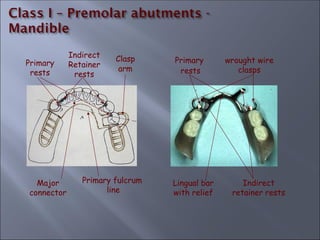
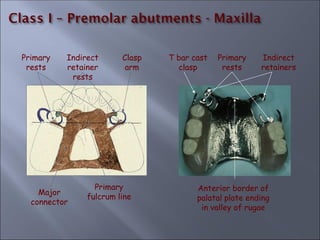
 Premolar abutments
 mandible
 maxilla
 The component of an RPD that assists the
direct retainers (clasps) in preventing
displacement of a distal extension base by
functioning through lever action on the
opposite side of the fulcrum line when the
denture base rotates away from the tissues
around the fulcrum line.
Primary fulcrum
line
Primary
rests
Indirect
Retainer
rests
Clasp
arm
Major
connector
Primary
rests
wrought wire
clasps
Indirect
retainer rests
Lingual bar
with relief
Primary
fulcrum line
Major
connector
Primary
rests
Indirect
retainer
rests
Clasp
arm
T bar cast
clasp
Primary
rests
Indirect
retainers
Anterior border of
palatal plate ending
in valley of rugae
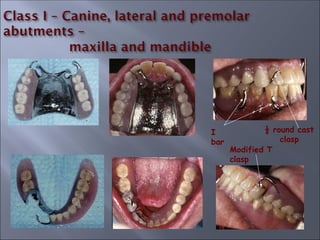
I
bar
½ round cast
clasp
Modified T
clasp
Class II RPD
Design
Considerations
Class II
Class II:
• Mandibular
• Maxillary
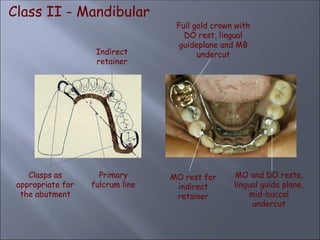
Class II - Mandibular
Indirect
retainer
Primary
fulcrum line
Clasps as
appropriate for
the abutment
MO and DO rests,
lingual guide plane,
mid-buccal
undercut
MO rest for
indirect
retainer
Full gold crown with
DO rest, lingual
guideplane and MB
undercut
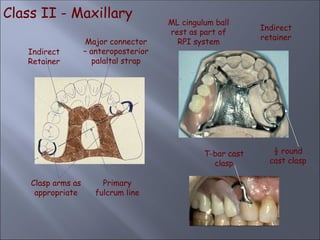
Class II - Maxillary
Indirect
Retainer
Clasp arms as
appropriate
Primary
fulcrum line
Major connector
– anteroposterior
palaltal strap
ML cingulum ball
rest as part of
RPI system
Indirect
retainer
½ round
cast clasp
T-bar cast
clasp
Class III RPD
Design
Considerations
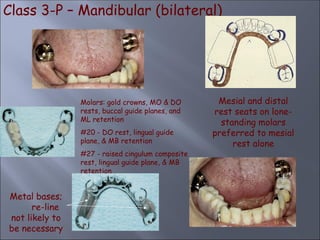
Class 3-P – Mandibular (bilateral)
Mesial and distal
rest seats on lone-
standing molars
preferred to mesial
rest alone
Molars: gold crowns, MO & DO
rests, buccal guide planes, and
ML retention
#20 - DO rest, lingual guide
plane, & MB retention
#27 - raised cingulum composite
rest, lingual guide plane, & MB
retention
Metal bases;
re-line
not likely to
be necessary
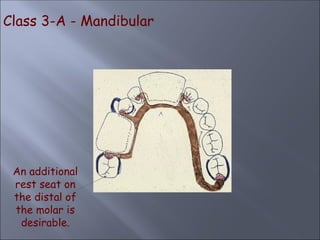
Class 3-A - Mandibular
An additional
rest seat on
the distal of
the molar is
desirable.
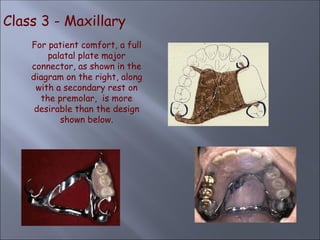
Class 3 - Maxillary
For patient comfort, a full
palatal plate major
connector, as shown in the
diagram on the right, along
with a secondary rest on
the premolar, is more
desirable than the design
shown below.
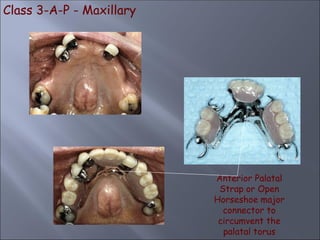
Class 3-A-P - Maxillary
Anterior Palatal
Strap or Open
Horseshoe major
connector to
circumvent the
palatal torus
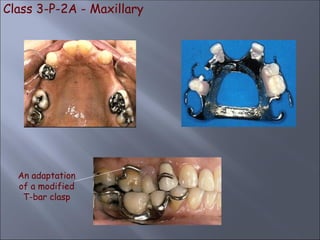
Class 3-P-2A - Maxillary
An adaptation
of a modified
T-bar clasp
Class IV RPD
Design
Considerations
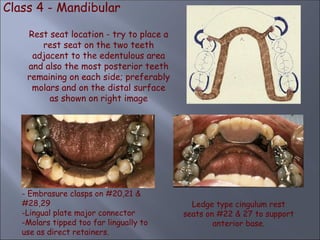
Class 4 - Mandibular
Rest seat location - try to place a
rest seat on the two teeth
adjacent to the edentulous area
and also the most posterior teeth
remaining on each side; preferably
molars and on the distal surface
as shown on right image
- Embrasure clasps on #20,21 &
#28,29
-Lingual plate major connector
-Molars tipped too far lingually to
use as direct retainers.
Ledge type cingulum rest
seats on #22 & 27 to support
anterior base.
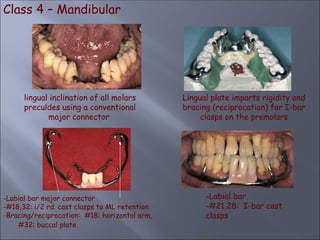
Class 4 – Mandibular
lingual inclination of all molars
preculdes using a conventional
major connector
Lingual plate imparts rigidity and
bracing (reciprocation) for I-bar
clasps on the premolars
-Labial bar major connector
-#18,32: i/2 rd. cast clasps to ML retention
-Bracing/reciprocation: #18: horizontal arm,
#32: buccal plate
-Labial bar
-#21,28: I-bar cast
clasps
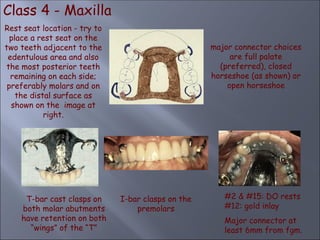
Class 4 - Maxilla
Rest seat location - try to
place a rest seat on the
two teeth adjacent to the
edentulous area and also
the most posterior teeth
remaining on each side;
preferably molars and on
the distal surface as
shown on the image at
right.
major connector choices
are full palate
(preferred), closed
horseshoe (as shown) or
open horseshoe
T-bar cast clasps on
both molar abutments
have retention on both
“wings” of the “T”
#2 & #15: DO rests
#12: gold inlay
Major connector at
least 6mm from fgm.
I-bar clasps on the
premolars
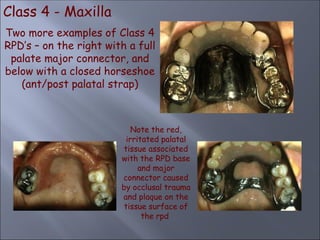
Class 4 - Maxilla
Note the red,
irritated palatal
tissue associated
with the RPD base
and major
connector caused
by occlusal trauma
and plaque on the
tissue surface of
the rpd
Two more examples of Class 4
RPD’s – on the right with a full
palate major connector, and
below with a closed horseshoe
(ant/post palatal strap)
QUESTIONS ???????

RPD_design_considerations and fabrication part 2ppt.ppt

  • 2.
    1. Manner inwhich each is supported 2. Method of impression registration and jaw record 3. Need for indirect retention 4. Use of denture base material
  • 3.
    1. How thepartial denture is supported 2. Connection of tooth and tissue support units- major and minor connector 3. How the RPD is to be retained- clasps 4. Connection of retention units to the support units- direct and indirect retainer to connectors 5. Outline and join the edentulous area to the already established design components
  • 4.
    1. All RPDmust be supported by oral structure 2. Must be retained against reasonable dislodging forces
  • 5.
  • 6.
     Premolar abutments mandible  maxilla
  • 7.
     The componentof an RPD that assists the direct retainers (clasps) in preventing displacement of a distal extension base by functioning through lever action on the opposite side of the fulcrum line when the denture base rotates away from the tissues around the fulcrum line.
  • 8.
  • 9.
    Primary fulcrum line Major connector Primary rests Indirect retainer rests Clasp arm T barcast clasp Primary rests Indirect retainers Anterior border of palatal plate ending in valley of rugae
  • 10.
  • 11.
  • 12.
    Class II Class II: •Mandibular • Maxillary
  • 13.
    Class II -Mandibular Indirect retainer Primary fulcrum line Clasps as appropriate for the abutment MO and DO rests, lingual guide plane, mid-buccal undercut MO rest for indirect retainer Full gold crown with DO rest, lingual guideplane and MB undercut
  • 14.
    Class II -Maxillary Indirect Retainer Clasp arms as appropriate Primary fulcrum line Major connector – anteroposterior palaltal strap ML cingulum ball rest as part of RPI system Indirect retainer ½ round cast clasp T-bar cast clasp
  • 15.
  • 16.
    Class 3-P –Mandibular (bilateral) Mesial and distal rest seats on lone- standing molars preferred to mesial rest alone Molars: gold crowns, MO & DO rests, buccal guide planes, and ML retention #20 - DO rest, lingual guide plane, & MB retention #27 - raised cingulum composite rest, lingual guide plane, & MB retention Metal bases; re-line not likely to be necessary
  • 17.
    Class 3-A -Mandibular An additional rest seat on the distal of the molar is desirable.
  • 18.
    Class 3 -Maxillary For patient comfort, a full palatal plate major connector, as shown in the diagram on the right, along with a secondary rest on the premolar, is more desirable than the design shown below.
  • 19.
    Class 3-A-P -Maxillary Anterior Palatal Strap or Open Horseshoe major connector to circumvent the palatal torus
  • 20.
    Class 3-P-2A -Maxillary An adaptation of a modified T-bar clasp
  • 21.
  • 22.
    Class 4 -Mandibular Rest seat location - try to place a rest seat on the two teeth adjacent to the edentulous area and also the most posterior teeth remaining on each side; preferably molars and on the distal surface as shown on right image - Embrasure clasps on #20,21 & #28,29 -Lingual plate major connector -Molars tipped too far lingually to use as direct retainers. Ledge type cingulum rest seats on #22 & 27 to support anterior base.
  • 23.
    Class 4 –Mandibular lingual inclination of all molars preculdes using a conventional major connector Lingual plate imparts rigidity and bracing (reciprocation) for I-bar clasps on the premolars -Labial bar major connector -#18,32: i/2 rd. cast clasps to ML retention -Bracing/reciprocation: #18: horizontal arm, #32: buccal plate -Labial bar -#21,28: I-bar cast clasps
  • 24.
    Class 4 -Maxilla Rest seat location - try to place a rest seat on the two teeth adjacent to the edentulous area and also the most posterior teeth remaining on each side; preferably molars and on the distal surface as shown on the image at right. major connector choices are full palate (preferred), closed horseshoe (as shown) or open horseshoe T-bar cast clasps on both molar abutments have retention on both “wings” of the “T” #2 & #15: DO rests #12: gold inlay Major connector at least 6mm from fgm. I-bar clasps on the premolars
  • 25.
    Class 4 -Maxilla Note the red, irritated palatal tissue associated with the RPD base and major connector caused by occlusal trauma and plaque on the tissue surface of the rpd Two more examples of Class 4 RPD’s – on the right with a full palate major connector, and below with a closed horseshoe (ant/post palatal strap)
  • 26.