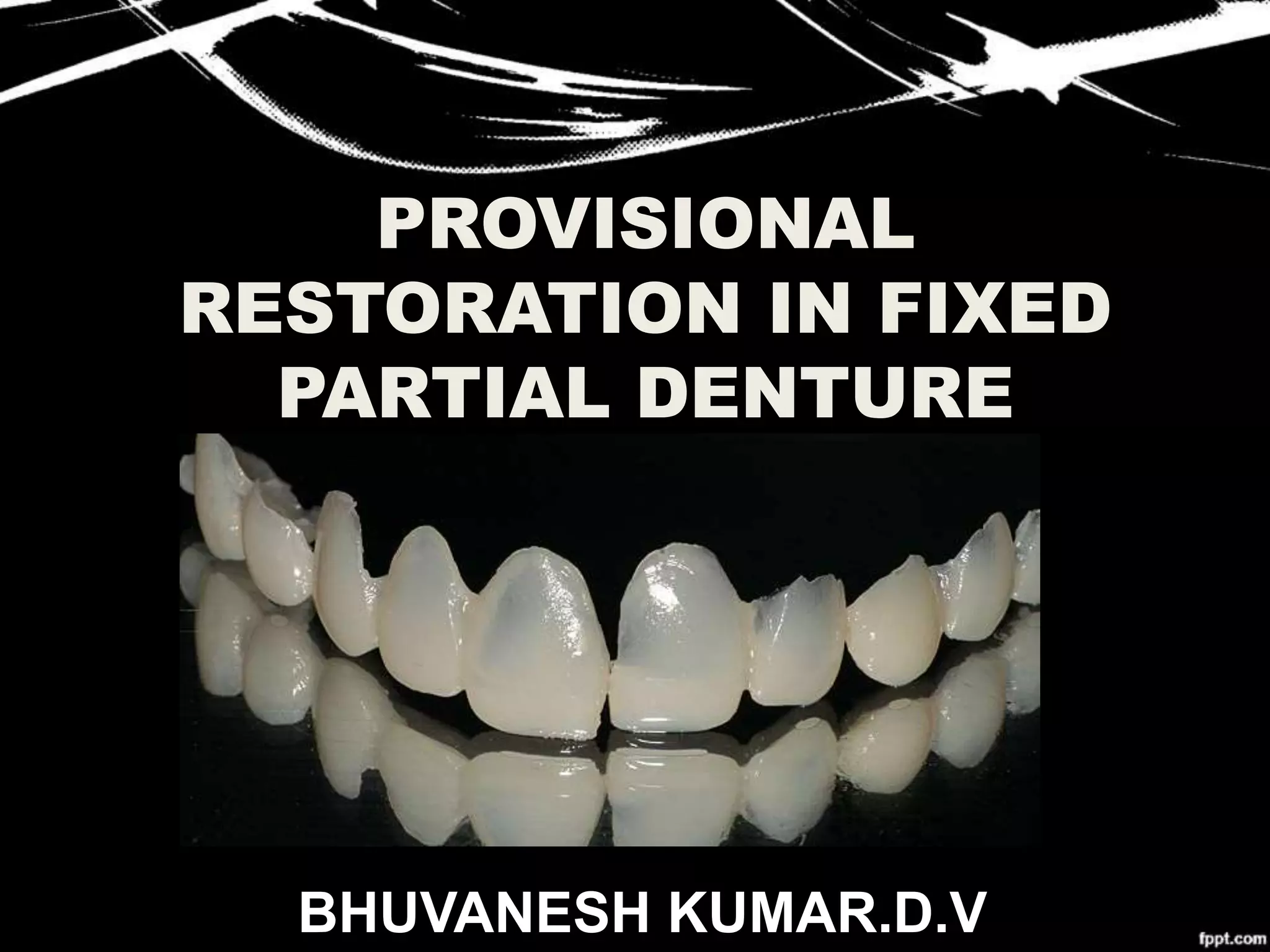
PROVISIONAL
RESTORATION IN FIXED
PARTIAL DENTURE
BHUVANESH KUMAR.D.V
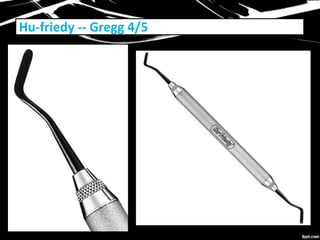
Hu-friedy -- Gregg 4/5
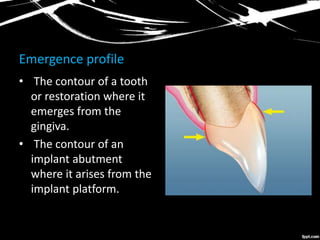
Emergence profile
• The contour of a tooth
or restoration where it
emerges from the
gingiva.
• The contour of an
implant abutment
where it arises from the
implant platform.
DOUBLE CORD TECHNIQUE
• Making an impression for single or multiple
abutments
• The finish line is located sufficiently below the
gingival margin
• Reduce the collapse of the gingival tissue
Gingival Displacement for Impression Making in Fixed Prosthodontics Contemporary
Principles, Materials, and Techniques Nadim Z. Baba, DMD, MSDa, *, Charles J. Goodacre,
DDS, MSDb , Rami Jekki, DDSb , John Won, DDS, MSb
Contents
Synonyms
Definitions
Requirements for fixed provisional restorations
Provisional luting materials
Types of provisional restorations
Various techniques of fabrication:
 Direct fabrication techniques
 Putty index technique /shell-fabricated provisional
restoration
 Indirect method (alginate impression technique)
 Template method
 Technique used in the fabrication of provisionals
using light cured resin.
 Using prefabricated crowns
Provisional treatment for all ceramic veneer
restorations
Removal of provisional restoration
Recementation of provisional restoration
Review of literature
Summary
References
SYNONYMS
• Provisional restoration,
• Treatment restoration (Temporization),
• Interim prosthesis,
• Provisional prosthesis.
The word provisional means established for the
time being pending a permanent arrangement
Temporary restoration
Unfortunately temporary often conveys the
notion that, requirements are unimportant.
Experience reveals that time and effort spent
fulfilling the requisites of provisional
restoration are well invested.
Definition
• A fixed or removable prosthesis
designed to enhance esthetics,
stabilization and function for a limited
period of time after which it is to be
replaced by definitive prosthesis.(GPT-8)
Rationale for Provisional trt:
(Fredrick and Krug)
1. Protect pulpal tissue and sedate prepared abutments
2. Protect teeth from dental caries
3. Provide comfort and function
4. Evaluate parallelism of abutments
5. Provide method for immediately replacing missing
teeth
6. Prevent migration of abutments
7. Improve esthetics
J Prosthet Dent 2003;90:474-97
8. Evaluate and reinforce the patient’s oral home
care
9. Provide a matrix for the retention of
periodontal surgical dressings
11. Stabilize mobile teeth during periodontal
therapy and evaluation.
12.Provide anchorage for orthodontic brackets
during tooth movement
J Prosthet Dent 2003;90:474-97
13. Aid in developing and evaluating an
occlusal scheme before definitive
treatment
14. Allow evaluation of vertical dimension,
phonetics, and masticatory function
15. Assist in determining the prognosis of
questionable abutments during
prosthodontic treatment planning
J Prosthet Dent 2003;90:474-97
A PROVISIONAL MATERIAL SHOULD SATISFY
FOLLOWING CRITERIA
• Convenient handling: adequate working time, easy
moldability, rapid setting time.
• Bicompatibility: nontoxic, nonallergic,
nonexothermic
• Dimensional stability during solidification .
• Ease of contouring and polishing.
• Adequate strength and abrasion resistance.
• Good appearance ,color controllable, colour stable.
• Good patient acceptance, non irritating, odorless.
• Ease of adding to or repairing .
• Chemical compatibility with provisional luting
agents i.e., should establish Mechanical bond for
retention of the prosthesis rather than a chemical
bond
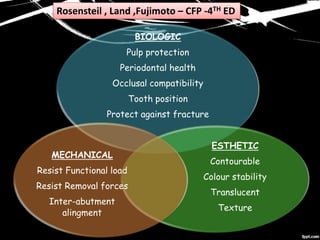
BIOLOGIC
Pulp protection
Periodontal health
Occlusal compatibility
Tooth position
Protect against fracture
ESTHETIC
Contourable
Colour stability
Translucent
Texture
MECHANICAL
Resist Functional load
Resist Removal forces
Inter-abutment
alingment
Rosensteil , Land ,Fujimoto – CFP -4TH ED
• REQUIREMENTS FOR FIXED PROVISIONAL
RESTORATIONS:
1. Biologic
- Protect pulp
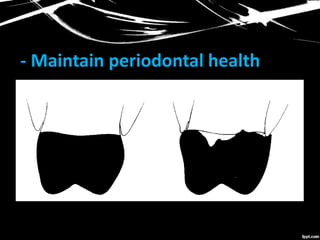
- Maintain periodontal health
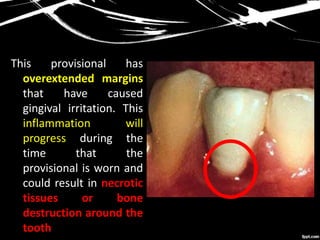
This provisional has
overextended margins
that have caused
gingival irritation. This
inflammation will
progress during the
time that the
provisional is worn and
could result in necrotic
tissues or bone
destruction around the
tooth
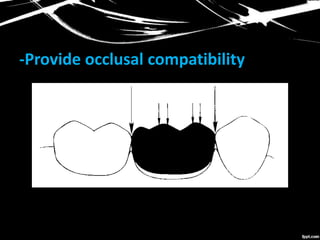
-Provide occlusal compatibility
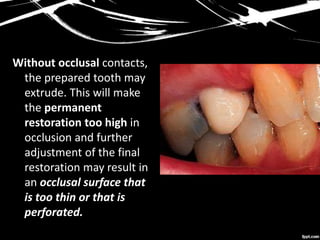
Without occlusal contacts,
the prepared tooth may
extrude. This will make
the permanent
restoration too high in
occlusion and further
adjustment of the final
restoration may result in
an occlusal surface that
is too thin or that is
perforated.
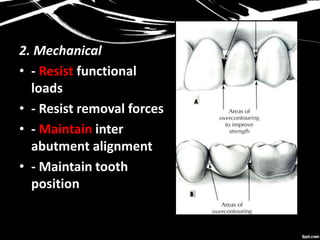
2. Mechanical
• - Resist functional
loads
• - Resist removal forces
• - Maintain inter
abutment alignment
• - Maintain tooth
position
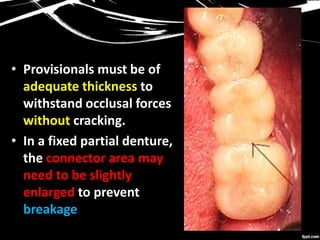
• Provisionals must be of
adequate thickness to
withstand occlusal forces
without cracking.
• In a fixed partial denture,
the connector area may
need to be slightly
enlarged to prevent
breakage
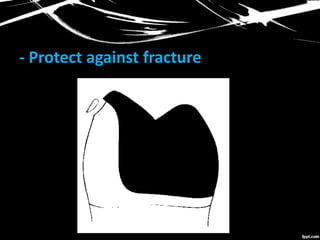
- Protect against fracture
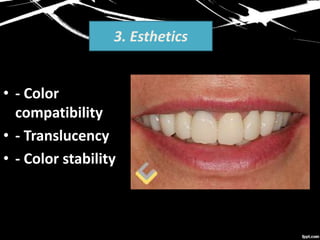
3. Esthetics
• - Color
compatibility
• - Translucency
• - Color stability
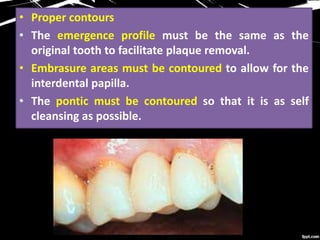
• Proper contours
• The emergence profile must be the same as the
original tooth to facilitate plaque removal.
• Embrasure areas must be contoured to allow for the
interdental papilla.
• The pontic must be contoured so that it is as self
cleansing as possible.
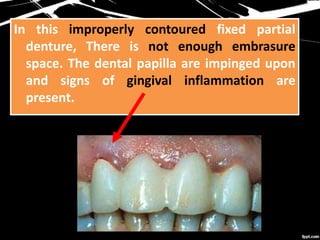
In this improperly contoured fixed partial
denture, There is not enough embrasure
space. The dental papilla are impinged upon
and signs of gingival inflammation are
present.
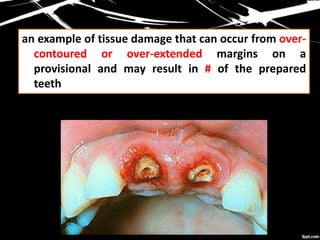
an example of tissue damage that can occur from over-
contoured or over-extended margins on a
provisional and may result in # of the prepared
teeth
Provisional luting materials
• Provisional luting agents should possess :
-good mechanical properties,
-low solubility,
-tooth adhesion to resist bacterial and
molecular penetration.
• The most important function of these
materials is to provide an adequate seal
between the provisional restoration and
prepared tooth. This is necessary to prevent
marginal leakage and pulpal irritation.
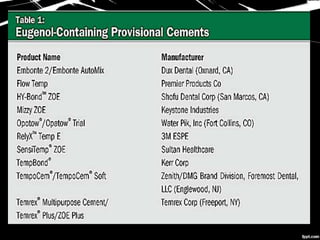
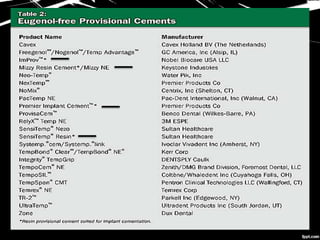
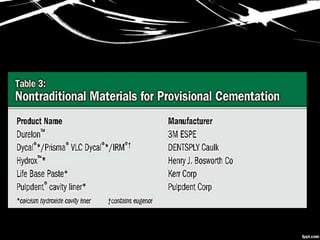
• There are a variety of luting materials used
for interim purposes. The most common
include
(1) calcium hydroxide
(2) zinc-oxide eugenol
(3) non-eugenol materials.
• The retentive requirements for provisional
luting materials are that they be:
strong enough to retain a provisional
restoration during the course of treatment but,
allow easy restoration removal when required.
• This paradoxical necessity for good retentive
and sealing quality and easy restoration
retrieval may lead to a compromise in material
behavior, particularly regarding mechanical
properties.
Baldissara et al recommended that interim
restorations be frequently evaluated
and used for only short periods of time.
Literature reports advise that if
provisional treatment is required over a
protracted time period, it is best to
remove and replace the provisional
luting agent on a regular basis.
Some of the most commonly used cements
with provisional prostheses are those
containing zinc-oxide and eugenol. They
provide:
 sedative effects that reduce dentin
hypersensitivity
 possess antibacterial properties.
Unfortunately, free radical production
necessary for polymerization of methacrylate
materials can be significantly hampered by
the presence of eugenol found in eugenol
based provisional luting materials.
• Eugenol interferes with the acrylic resin
polymerization and hardening process .
• Therefore Eugenol-free provisional
luting materials are commercially
available and have gained popularity
due to the absence of resin-softening
characteristics .
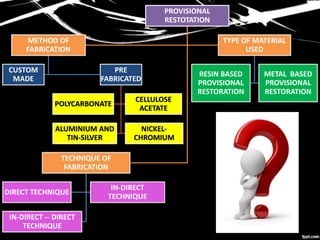
Types of Provisional
restorations
PROVISIONAL
RESTOTATION
METHOD OF
FABRICATION
CUSTOM
MADE
PRE
FABRICATED
POLYCARBONATE
CELLULOSE
ACETATE
ALUMINIUM AND
TIN-SILVER
NICKEL-
CHROMIUM
TYPE OF MATERIAL
USED
RESIN BASED
PROVISIONAL
RESTORATION
METAL BASED
PROVISIONAL
RESTORATION
TECHNIQUE OF
FABRICATION
DIRECT TECHNIQUE
IN-DIRECT
TECHNIQUE
IN-DIRECT -- DIRECT
TECHNIQUE
• 1 Custom temporaries –
- those that are made with a
matrix derived from the original
tooth or a modified diagnostic cast.
 Direct: these are constructed with a
matrix lined with provisional material that
is placed directly on the prepared tooth
 Indirect: these are constructed by placing
the filled matrix over a model of the
prepared tooth, thus the provisional is
constructed out of the patient's mouth.
 Indirect-Direct: These are made by forming
a temporary in an indirect manner and
then relining this directly in the patients
mouth.
This method is useful when
constructing temporary bridges because
most of the work can be done in the
laboratory.
• 2- Prefabricated temporaries
- these are preformed
crowns that can be purchased and
may be modified to fit a prepared
tooth. In most cases these require
relining with an acrylic material.
Direct fabrication.
For urgent situations, in the absence of any
matrix or opportunity to create a matrix, a
provisional restoration can be fabricated by
adapting a block of freshly mixed acrylic resin
directly to a tooth.
After the acrylic resin block has polymerized, the
tooth contours can be carved with acrylic
resin burs of choice and the restorative
margins perfected intraorally.
techniques encompass virtually all of the
literature on direct provisional restorations:
(1) use of a pre manufactured provisional sheIl
(2) use of an impression material, or pressure or
vacuum formed translucent matrix and
(3) use of a custom, prefabricated acrylic resin
shell.
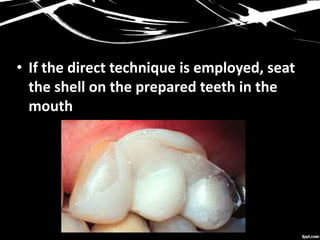
• If the direct technique is employed, seat
the shell on the prepared teeth in the
mouth
Direct provisional restorations made particularly of
PMMA and, to a lesser degree, polyethyl methac-
rylate (PEMA) must be cooled if the material is
allowed to polymerize completely on a tooth.
Polymethyl methacrylate can increase pulpal
temperatures as much as 7°C. Cooling the material
during polymerization by its removal at initial
polymerization and allowing complete
polymerization to be completed while it is off the
tooth, cooling with air-water spray, periodic
removal, and flushing with water will limit
temperature increase to less than 4°C, minimizing
the exothermic risk .
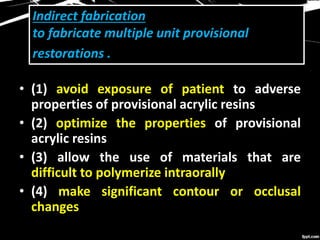
Indirect fabrication
to fabricate multiple unit provisional
restorations .
• (1) avoid exposure of patient to adverse
properties of provisional acrylic resins
• (2) optimize the properties of provisional
acrylic resins
• (3) allow the use of materials that are
difficult to polymerize intraorally
• (4) make significant contour or occlusal
changes
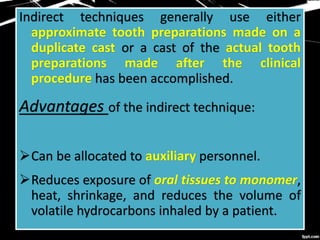
Indirect techniques generally use either
approximate tooth preparations made on a
duplicate cast or a cast of the actual tooth
preparations made after the clinical
procedure has been accomplished.
Advantages of the indirect technique:
Can be allocated to auxiliary personnel.
Reduces exposure of oral tissues to monomer,
heat, shrinkage, and reduces the volume of
volatile hydrocarbons inhaled by a patient.
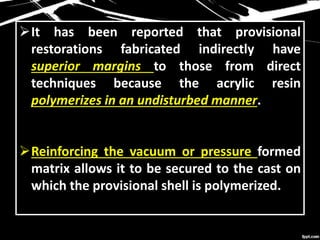
It has been reported that provisional
restorations fabricated indirectly have
superior margins to those from direct
techniques because the acrylic resin
polymerizes in an undisturbed manner.
Reinforcing the vacuum or pressure formed
matrix allows it to be secured to the cast on
which the provisional shell is polymerized.
Indirect method (Alginate impression
technique)
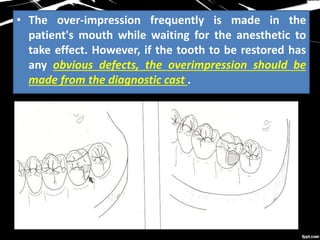
• The over-impression frequently is made in the
patient's mouth while waiting for the anesthetic to
take effect. However, if the tooth to be restored has
any obvious defects, the overimpression should be
made from the diagnostic cast .
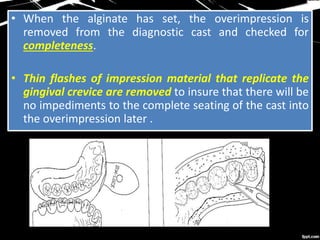
• When the alginate has set, the overimpression is
removed from the diagnostic cast and checked for
completeness.
• Thin flashes of impression material that replicate the
gingival crevice are removed to insure that there will be
no impediments to the complete seating of the cast into
the overimpression later .
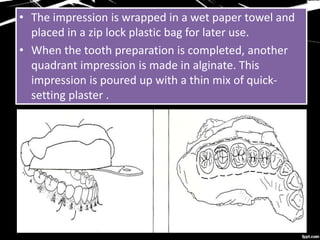
• The impression is wrapped in a wet paper towel and
placed in a zip lock plastic bag for later use.
• When the tooth preparation is completed, another
quadrant impression is made in alginate. This
impression is poured up with a thin mix of quick-
setting plaster .
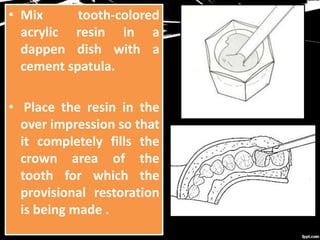
• Mix tooth-colored
acrylic resin in a
dappen dish with a
cement spatula.
• Place the resin in the
over impression so that
it completely fills the
crown area of the
tooth for which the
provisional restoration
is being made .
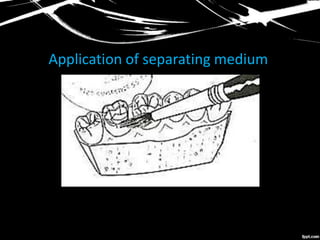
Application of separating medium
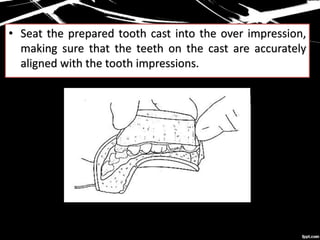
• Seat the prepared tooth cast into the over impression,
making sure that the teeth on the cast are accurately
aligned with the tooth impressions.
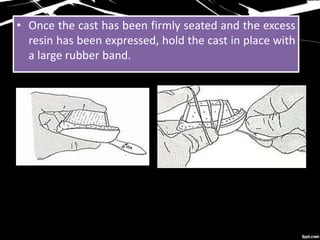
• Once the cast has been firmly seated and the excess
resin has been expressed, hold the cast in place with
a large rubber band.
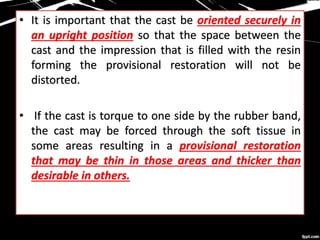
• It is important that the cast be oriented securely in
an upright position so that the space between the
cast and the impression that is filled with the resin
forming the provisional restoration will not be
distorted.
• If the cast is torque to one side by the rubber band,
the cast may be forced through the soft tissue in
some areas resulting in a provisional restoration
that may be thin in those areas and thicker than
desirable in others.
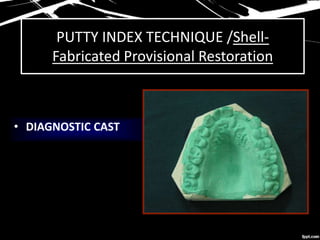
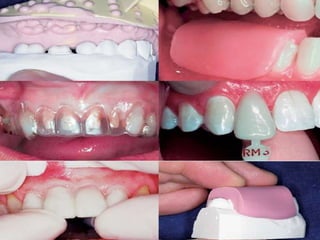
PUTTY INDEX TECHNIQUE /Shell-
Fabricated Provisional Restoration
• DIAGNOSTIC CAST
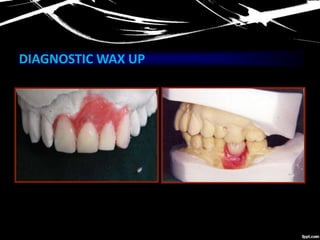
DIAGNOSTIC WAX UP
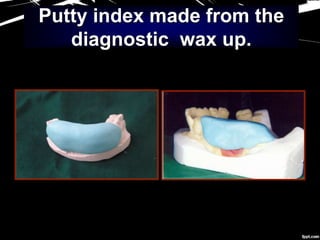
Putty index made from the
diagnostic wax up.
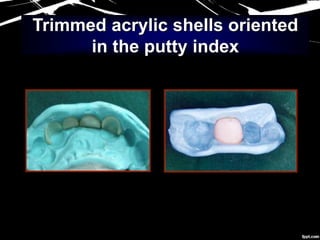
Trimmed acrylic shells oriented
in the putty index
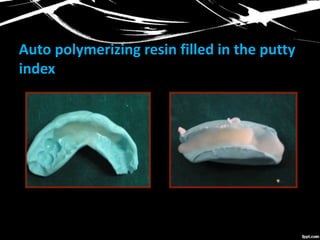
Auto polymerizing resin filled in the putty
index
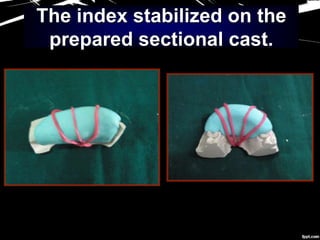
The index stabilized on the
prepared sectional cast.
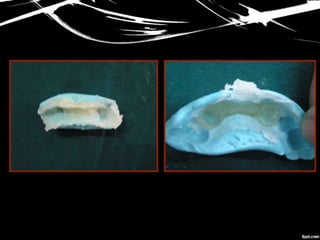
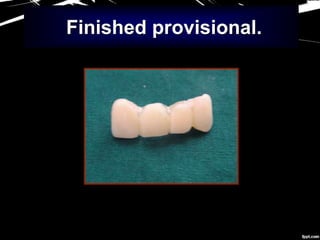
Finished provisional.
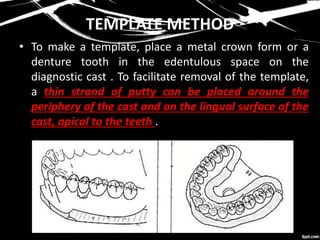
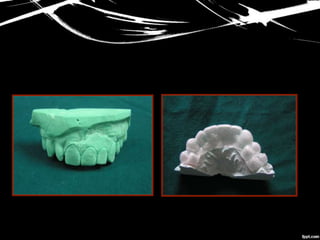
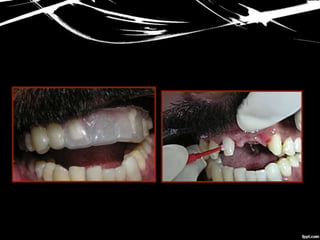
TEMPLATE METHOD
• To make a template, place a metal crown form or a
denture tooth in the edentulous space on the
diagnostic cast . To facilitate removal of the template,
a thin strand of putty can be placed around the
periphery of the cast and on the lingual surface of the
cast, apical to the teeth .
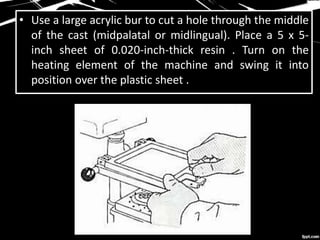
• Use a large acrylic bur to cut a hole through the middle
of the cast (midpalatal or midlingual). Place a 5 x 5-
inch sheet of 0.020-inch-thick resin . Turn on the
heating element of the machine and swing it into
position over the plastic sheet .
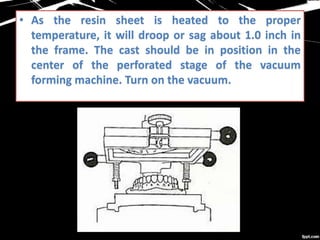
• As the resin sheet is heated to the proper
temperature, it will droop or sag about 1.0 inch in
the frame. The cast should be in position in the
center of the perforated stage of the vacuum
forming machine. Turn on the vacuum.
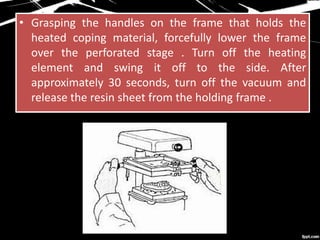
• Grasping the handles on the frame that holds the
heated coping material, forcefully lower the frame
over the perforated stage . Turn off the heating
element and swing it off to the side. After
approximately 30 seconds, turn off the vacuum and
release the resin sheet from the holding frame .
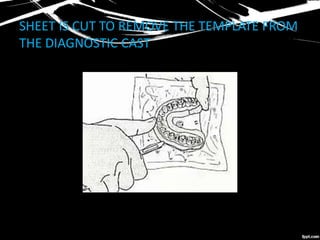
SHEET IS CUT TO REMOVE THE TEMPLATE FROM
THE DIAGNOSTIC CAST
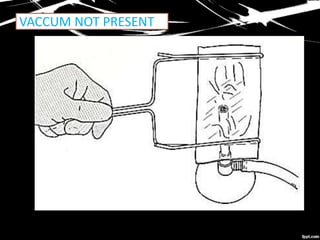
VACCUM NOT PRESENT
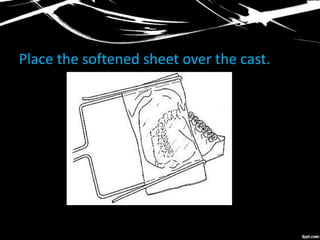
Place the softened sheet over the cast.
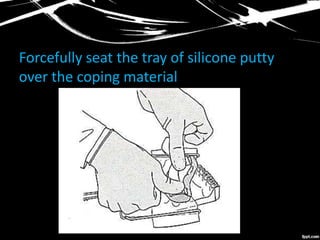
Forcefully seat the tray of silicone putty
over the coping material
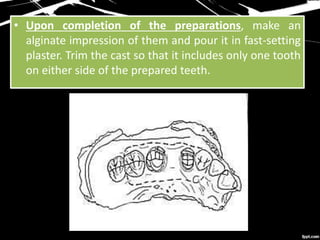
• Upon completion of the preparations, make an
alginate impression of them and pour it in fast-setting
plaster. Trim the cast so that it includes only one tooth
on either side of the prepared teeth.
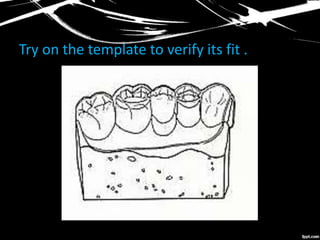
Try on the template to verify its fit .
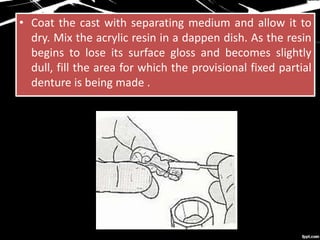
• Coat the cast with separating medium and allow it to
dry. Mix the acrylic resin in a dappen dish. As the resin
begins to lose its surface gloss and becomes slightly
dull, fill the area for which the provisional fixed partial
denture is being made .
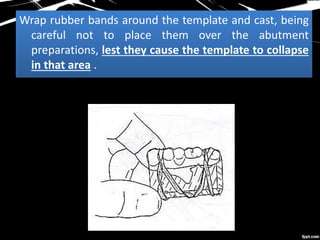
Wrap rubber bands around the template and cast, being
careful not to place them over the abutment
preparations, lest they cause the template to collapse
in that area .
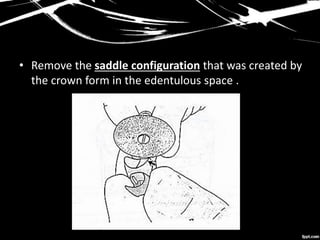
• Remove the saddle configuration that was created by
the crown form in the edentulous space .
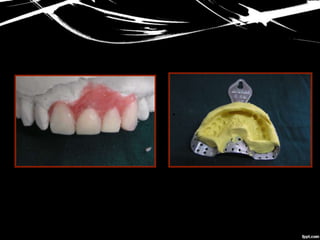
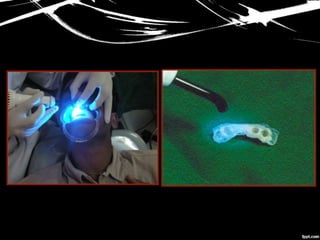
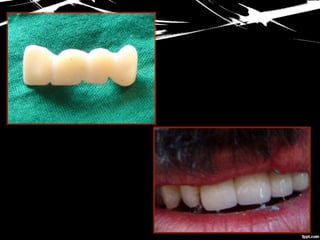
• Technique used in the fabrication of provisionals
using light cured resin.
.
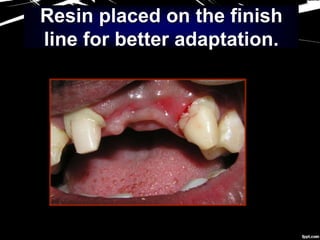
Resin placed on the finish
line for better adaptation.
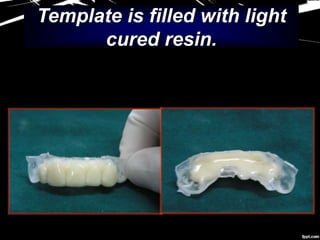
Template is filled with light
cured resin.
PREFABRICATED CROWNS
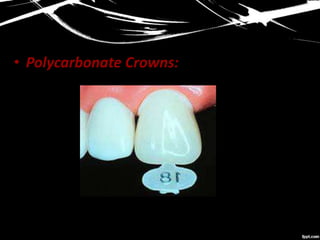
• Polycarbonate Crowns:
• These are available in incisors, canines and
bicuspids. There is a range of sizes for each
tooth form. It should be relined with acrylic in
order to provide a good internal fit.
• After lining with acrylic, they may be trimmed
to provide a good marginal adaptation and
further adjusted into proper occlusion.
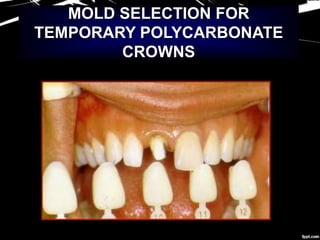
MOLD SELECTION FOR
TEMPORARY POLYCARBONATE
CROWNS
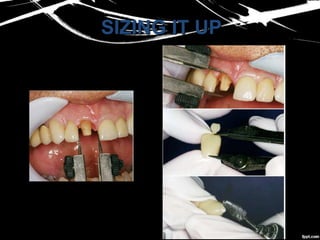
SIZING IT UP
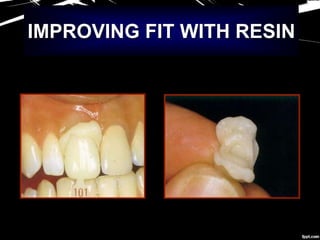
IMPROVING FIT WITH RESIN
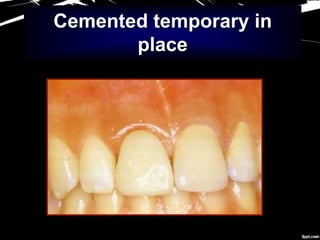
Cemented temporary in
place
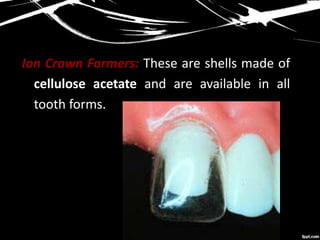
Ion Crown Formers: These are shells made of
cellulose acetate and are available in all
tooth forms.
These shells come in various sizes for each
tooth form and are lined with acrylic resin.
After the acrylic resin has polymerized, the
cellulose shell is peeled away from the crown.
This usually necessitates the further addition of
acrylic in the areas of the proximal contacts.
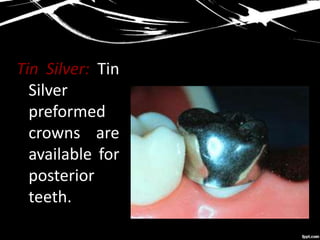
Tin Silver: Tin
Silver
preformed
crowns are
available for
posterior
teeth.
This alloy is very soft and the margin of the
crown can be flexed prior to seating.
This produces a close marginal fit after the shell is
trimmed with a bur. These should also be lined
with acrylic resin to provide good internal
adaptation and retention of the temporary.
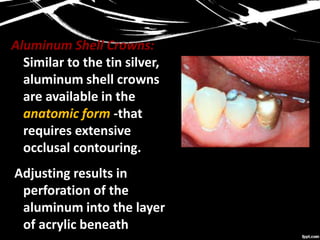
Aluminum Shell Crowns:
Similar to the tin silver,
aluminum shell crowns
are available in the
anatomic form -that
requires extensive
occlusal contouring.
Adjusting results in
perforation of the
aluminum into the layer
of acrylic beneath
Provisional treatment for all ceramic
veneer restorations
Provisional veneers are indicated when:
esthetics and intelligible speech are important;
dentin is exposed;
proximal contacts are broken;
maxillary teeth are inverted lingually and the
veneer surface affects occlusion;
the preparation margin invades the gingival sulcus;
the final veneer is dependent on patient approval of
form, color, contour, and position.
Provisional restorations allow patients to have a
trial period for making notes about esthetics
so that their desires can be taken into
account with the definitive veneer.
Preparations for porcelain veneers may not
have mechanical retentive features and thus
one concern regarding a provisional
restoration is tooth attachment while avoiding
irreversible contamination or alteration of the
luting surface of a prepared tooth.
Elledge advocated placing 2 small dimples
on opposing surfaces of the preparation
to provide mechanical retention for the
provisional veneer that is luted with a
cement of the clinician's choice.
Elledge DA, Hart JK, Schorr BL. A
provisional restoration technique for
laminate veneer preparations. J
Prosthet Dent 1989;62:139-42
One method that avoids excess cement while
sealing the margin area is the "peripheral
seal technique" that uses a 3-second etch of
the preparation periphery and then bonding a
provisional restoration primarily at the etched
periphery.
Similarly, a colored luting resin may facilitate
removal of excess resin and reduce
contamination of a tooth surface.
A variety of methods for fabrication of veneer
provisional restorations have been reported
and are not unlike the methods advocated
for conventional provisional restorations
including,
a removable hand formed visible light-
polymerized material provisional,
polycarbonate provisional crowns,
acrylic resin shells,
splinting together adjacent provisional
veneers.
Methods for improving or customizing colors
also include coloring provisional luting
cements and coloring a provisional
restoration with porcelain stains and visible
light-polymerized acrylic resin.
Custom color guides for provisional
restorations have also been recommended.
REMOVAL OF PROVISIONAL RESTORATION
 The provisional is removed when the patient returns
for the definitive restoration or for continued
preparation.
 Risk of damage to the prepared tooth can be
minimized if removal forces are directed parallel to
the long axis of the preparation.
 The Backhans or hemostatic forceps are effective.
 Slight buccolingual rocking motion will help break
the cement seal.
Sometimes it is helpful to loop dental
floss under the connector at each
end of the FPD, providing a more
even force distribution for removal.
LITERATURE REVIEW
In an in vitro study of surface contamination
associated with provisional bonding,
 a surface treatment left
the cleanest tooth structure
a non eugenol provisional cement left: significant
but removable residue;
a dual polymerizing resin cement left tenacious
residue that could only be removed with a bur .
Mojon P et al,A comparison of methods for
removing provisional cement, Int J
Prosthodont 5:78, 1992
A study was done on the Colour stability of
provisional materials. This study evaluated the in
vitro discoloration of seven resins over a 9 week
period. Resin specimens were prepared and placed
in the facial flange of maxillary complete dentures
and the lingual flange of a mandibular complete
dentures.
Patients were given tooth brushes and tooth paste
and told not to use any chemical agents for cleaning
the dentures. Observations were made at 1, 5 and 9
weeks,
Jack Koumi Jian et al 'Colour stability of
provisional materials in view jpd 1998
• All materials tested were acceptable from the
standpoint of colour stability for short term
(5 weeks or less) provisional restorations.
• Therefore, the dentist using provisional
restorations for a short period of time may
consider other properties of the materials,
such as resistance of fracture, marginal
accuracy, rate of fabrication and cost.
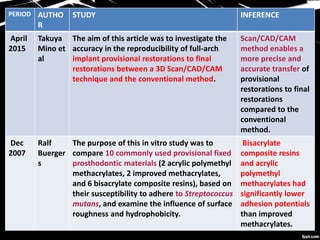
PERIOD AUTHO
R
STUDY INFERENCE
April
2015
Takuya
Mino et
al
The aim of this article was to investigate the
accuracy in the reproducibility of full-arch
implant provisional restorations to final
restorations between a 3D Scan/CAD/CAM
technique and the conventional method.
Scan/CAD/CAM
method enables a
more precise and
accurate transfer of
provisional
restorations to final
restorations
compared to the
conventional
method.
Dec
2007
Ralf
Buerger
s
The purpose of this in vitro study was to
compare 10 commonly used provisional fixed
prosthodontic materials (2 acrylic polymethyl
methacrylates, 2 improved methacrylates,
and 6 bisacrylate composite resins), based on
their susceptibility to adhere to Streptococcus
mutans, and examine the influence of surface
roughness and hydrophobicity.
Bisacrylate
composite resins
and acrylic
polymethyl
methacrylates had
significantly lower
adhesion potentials
than improved
methacrylates.
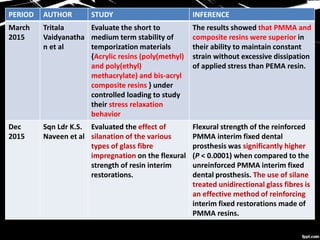
PERIOD AUTHOR STUDY INFERENCE
March
2015
Tritala
Vaidyanatha
n et al
Evaluate the short to
medium term stability of
temporization materials
{Acrylic resins (poly(methyl)
and poly(ethyl)
methacrylate) and bis-acryl
composite resins } under
controlled loading to study
their stress relaxation
behavior
The results showed that PMMA and
composite resins were superior in
their ability to maintain constant
strain without excessive dissipation
of applied stress than PEMA resin.
Dec
2015
Sqn Ldr K.S.
Naveen et al
Evaluated the effect of
silanation of the various
types of glass fibre
impregnation on the flexural
strength of resin interim
restorations.
Flexural strength of the reinforced
PMMA interim fixed dental
prosthesis was significantly higher
(P < 0.0001) when compared to the
unreinforced PMMA interim fixed
dental prosthesis. The use of silane
treated unidirectional glass fibres is
an effective method of reinforcing
interim fixed restorations made of
PMMA resins.
• USING THE LAMINAR IMPRESSION TECHNIQUE FOR
PROVISIONAL RESTORATIONS
• DOUGLAS E. McMASTER, D.D.S.
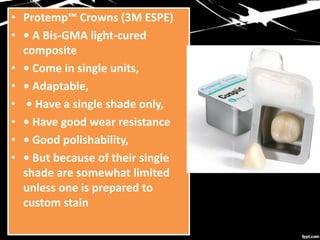
• Protemp™ Crowns (3M ESPE)
• • A Bis-GMA light-cured
composite
• • Come in single units,
• • Adaptable,
• • Have a single shade only,
• • Have good wear resistance
• • Good polishability,
• • But because of their single
shade are somewhat limited
unless one is prepared to
custom stain
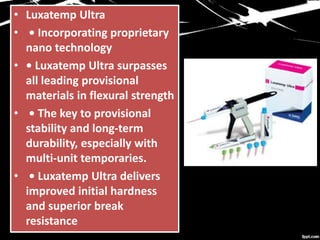
• Luxatemp Ultra
• • Incorporating proprietary
nano technology
• • Luxatemp Ultra surpasses
all leading provisional
materials in flexural strength
• • The key to provisional
stability and long-term
durability, especially with
multi-unit temporaries.
• • Luxatemp Ultra delivers
improved initial hardness
and superior break
resistance
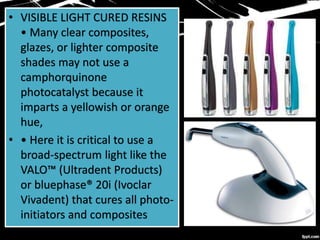
• VISIBLE LIGHT CURED RESINS
• Many clear composites,
glazes, or lighter composite
shades may not use a
camphorquinone
photocatalyst because it
imparts a yellowish or orange
hue,
• • Here it is critical to use a
broad-spectrum light like the
VALO™ (Ultradent Products)
or bluephase® 20i (Ivoclar
Vivadent) that cures all photo-
initiators and composites
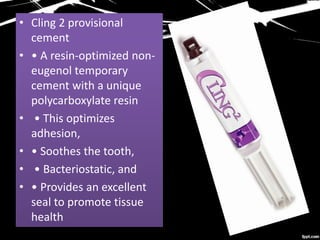
• Cling 2 provisional
cement
• • A resin-optimized non-
eugenol temporary
cement with a unique
polycarboxylate resin
• • This optimizes
adhesion,
• • Soothes the tooth,
• • Bacteriostatic, and
• • Provides an excellent
seal to promote tissue
health
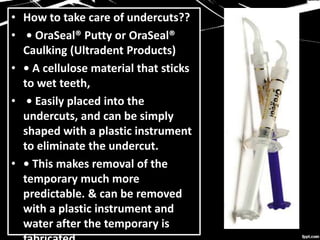
• How to take care of undercuts??
• • OraSeal® Putty or OraSeal®
Caulking (Ultradent Products)
• • A cellulose material that sticks
to wet teeth,
• • Easily placed into the
undercuts, and can be simply
shaped with a plastic instrument
to eliminate the undercut.
• • This makes removal of the
temporary much more
predictable. & can be removed
with a plastic instrument and
water after the temporary is
SUMMARY
• Although provisional restorations are usually
intended for short term use and then discarded,
they can be made to provide pleasing esthetics,
adequate support, and good protection for teeth
while maintaining periodontal health.
• They may be fabricated in the dental office or in
laboratory from any of several commercially
available materials and by a number of practical
methods.
• The success of fixed prosthodontics often depends
on the care with which the provisional is designed
and fabricated.
Thank u

Provisional restoration in fixed partial denture

  • 1.
    PROVISIONAL RESTORATION IN FIXED PARTIALDENTURE BHUVANESH KUMAR.D.V
  • 2.
  • 3.
    Emergence profile • Thecontour of a tooth or restoration where it emerges from the gingiva. • The contour of an implant abutment where it arises from the implant platform.
  • 4.
    DOUBLE CORD TECHNIQUE •Making an impression for single or multiple abutments • The finish line is located sufficiently below the gingival margin • Reduce the collapse of the gingival tissue Gingival Displacement for Impression Making in Fixed Prosthodontics Contemporary Principles, Materials, and Techniques Nadim Z. Baba, DMD, MSDa, *, Charles J. Goodacre, DDS, MSDb , Rami Jekki, DDSb , John Won, DDS, MSb
  • 5.
    Contents Synonyms Definitions Requirements for fixedprovisional restorations Provisional luting materials Types of provisional restorations Various techniques of fabrication:  Direct fabrication techniques  Putty index technique /shell-fabricated provisional restoration  Indirect method (alginate impression technique)
  • 6.
     Template method Technique used in the fabrication of provisionals using light cured resin.  Using prefabricated crowns Provisional treatment for all ceramic veneer restorations Removal of provisional restoration Recementation of provisional restoration Review of literature Summary References
  • 7.
    SYNONYMS • Provisional restoration, •Treatment restoration (Temporization), • Interim prosthesis, • Provisional prosthesis. The word provisional means established for the time being pending a permanent arrangement
  • 8.
    Temporary restoration Unfortunately temporaryoften conveys the notion that, requirements are unimportant. Experience reveals that time and effort spent fulfilling the requisites of provisional restoration are well invested.
  • 9.
    Definition • A fixedor removable prosthesis designed to enhance esthetics, stabilization and function for a limited period of time after which it is to be replaced by definitive prosthesis.(GPT-8)
  • 10.
    Rationale for Provisionaltrt: (Fredrick and Krug) 1. Protect pulpal tissue and sedate prepared abutments 2. Protect teeth from dental caries 3. Provide comfort and function 4. Evaluate parallelism of abutments 5. Provide method for immediately replacing missing teeth 6. Prevent migration of abutments 7. Improve esthetics J Prosthet Dent 2003;90:474-97
  • 11.
    8. Evaluate andreinforce the patient’s oral home care 9. Provide a matrix for the retention of periodontal surgical dressings 11. Stabilize mobile teeth during periodontal therapy and evaluation. 12.Provide anchorage for orthodontic brackets during tooth movement J Prosthet Dent 2003;90:474-97
  • 12.
    13. Aid indeveloping and evaluating an occlusal scheme before definitive treatment 14. Allow evaluation of vertical dimension, phonetics, and masticatory function 15. Assist in determining the prognosis of questionable abutments during prosthodontic treatment planning J Prosthet Dent 2003;90:474-97
  • 13.
    A PROVISIONAL MATERIALSHOULD SATISFY FOLLOWING CRITERIA • Convenient handling: adequate working time, easy moldability, rapid setting time. • Bicompatibility: nontoxic, nonallergic, nonexothermic • Dimensional stability during solidification .
  • 14.
    • Ease ofcontouring and polishing. • Adequate strength and abrasion resistance. • Good appearance ,color controllable, colour stable. • Good patient acceptance, non irritating, odorless. • Ease of adding to or repairing . • Chemical compatibility with provisional luting agents i.e., should establish Mechanical bond for retention of the prosthesis rather than a chemical bond
  • 15.
    BIOLOGIC Pulp protection Periodontal health Occlusalcompatibility Tooth position Protect against fracture ESTHETIC Contourable Colour stability Translucent Texture MECHANICAL Resist Functional load Resist Removal forces Inter-abutment alingment Rosensteil , Land ,Fujimoto – CFP -4TH ED
  • 16.
    • REQUIREMENTS FORFIXED PROVISIONAL RESTORATIONS: 1. Biologic - Protect pulp
  • 17.
  • 18.
    This provisional has overextendedmargins that have caused gingival irritation. This inflammation will progress during the time that the provisional is worn and could result in necrotic tissues or bone destruction around the tooth
  • 19.
  • 20.
    Without occlusal contacts, theprepared tooth may extrude. This will make the permanent restoration too high in occlusion and further adjustment of the final restoration may result in an occlusal surface that is too thin or that is perforated.
  • 21.
    2. Mechanical • -Resist functional loads • - Resist removal forces • - Maintain inter abutment alignment • - Maintain tooth position
  • 22.
    • Provisionals mustbe of adequate thickness to withstand occlusal forces without cracking. • In a fixed partial denture, the connector area may need to be slightly enlarged to prevent breakage
  • 23.
  • 24.
    3. Esthetics • -Color compatibility • - Translucency • - Color stability
  • 25.
    • Proper contours •The emergence profile must be the same as the original tooth to facilitate plaque removal. • Embrasure areas must be contoured to allow for the interdental papilla. • The pontic must be contoured so that it is as self cleansing as possible.
  • 26.
    In this improperlycontoured fixed partial denture, There is not enough embrasure space. The dental papilla are impinged upon and signs of gingival inflammation are present.
  • 27.
    an example oftissue damage that can occur from over- contoured or over-extended margins on a provisional and may result in # of the prepared teeth
  • 28.
    Provisional luting materials •Provisional luting agents should possess : -good mechanical properties, -low solubility, -tooth adhesion to resist bacterial and molecular penetration. • The most important function of these materials is to provide an adequate seal between the provisional restoration and prepared tooth. This is necessary to prevent marginal leakage and pulpal irritation.
  • 29.
    • There area variety of luting materials used for interim purposes. The most common include (1) calcium hydroxide (2) zinc-oxide eugenol (3) non-eugenol materials.
  • 33.
    • The retentiverequirements for provisional luting materials are that they be: strong enough to retain a provisional restoration during the course of treatment but, allow easy restoration removal when required. • This paradoxical necessity for good retentive and sealing quality and easy restoration retrieval may lead to a compromise in material behavior, particularly regarding mechanical properties.
  • 34.
    Baldissara et alrecommended that interim restorations be frequently evaluated and used for only short periods of time. Literature reports advise that if provisional treatment is required over a protracted time period, it is best to remove and replace the provisional luting agent on a regular basis.
  • 35.
    Some of themost commonly used cements with provisional prostheses are those containing zinc-oxide and eugenol. They provide:  sedative effects that reduce dentin hypersensitivity  possess antibacterial properties. Unfortunately, free radical production necessary for polymerization of methacrylate materials can be significantly hampered by the presence of eugenol found in eugenol based provisional luting materials.
  • 36.
    • Eugenol interfereswith the acrylic resin polymerization and hardening process . • Therefore Eugenol-free provisional luting materials are commercially available and have gained popularity due to the absence of resin-softening characteristics .
  • 37.
  • 39.
    PROVISIONAL RESTOTATION METHOD OF FABRICATION CUSTOM MADE PRE FABRICATED POLYCARBONATE CELLULOSE ACETATE ALUMINIUM AND TIN-SILVER NICKEL- CHROMIUM TYPEOF MATERIAL USED RESIN BASED PROVISIONAL RESTORATION METAL BASED PROVISIONAL RESTORATION TECHNIQUE OF FABRICATION DIRECT TECHNIQUE IN-DIRECT TECHNIQUE IN-DIRECT -- DIRECT TECHNIQUE
  • 40.
    • 1 Customtemporaries – - those that are made with a matrix derived from the original tooth or a modified diagnostic cast.
  • 41.
     Direct: theseare constructed with a matrix lined with provisional material that is placed directly on the prepared tooth  Indirect: these are constructed by placing the filled matrix over a model of the prepared tooth, thus the provisional is constructed out of the patient's mouth.
  • 42.
     Indirect-Direct: Theseare made by forming a temporary in an indirect manner and then relining this directly in the patients mouth. This method is useful when constructing temporary bridges because most of the work can be done in the laboratory.
  • 43.
    • 2- Prefabricatedtemporaries - these are preformed crowns that can be purchased and may be modified to fit a prepared tooth. In most cases these require relining with an acrylic material.
  • 44.
    Direct fabrication. For urgentsituations, in the absence of any matrix or opportunity to create a matrix, a provisional restoration can be fabricated by adapting a block of freshly mixed acrylic resin directly to a tooth. After the acrylic resin block has polymerized, the tooth contours can be carved with acrylic resin burs of choice and the restorative margins perfected intraorally.
  • 45.
    techniques encompass virtuallyall of the literature on direct provisional restorations: (1) use of a pre manufactured provisional sheIl (2) use of an impression material, or pressure or vacuum formed translucent matrix and (3) use of a custom, prefabricated acrylic resin shell.
  • 46.
    • If thedirect technique is employed, seat the shell on the prepared teeth in the mouth
  • 47.
    Direct provisional restorationsmade particularly of PMMA and, to a lesser degree, polyethyl methac- rylate (PEMA) must be cooled if the material is allowed to polymerize completely on a tooth. Polymethyl methacrylate can increase pulpal temperatures as much as 7°C. Cooling the material during polymerization by its removal at initial polymerization and allowing complete polymerization to be completed while it is off the tooth, cooling with air-water spray, periodic removal, and flushing with water will limit temperature increase to less than 4°C, minimizing the exothermic risk .
  • 48.
    Indirect fabrication to fabricatemultiple unit provisional restorations . • (1) avoid exposure of patient to adverse properties of provisional acrylic resins • (2) optimize the properties of provisional acrylic resins • (3) allow the use of materials that are difficult to polymerize intraorally • (4) make significant contour or occlusal changes
  • 49.
    Indirect techniques generallyuse either approximate tooth preparations made on a duplicate cast or a cast of the actual tooth preparations made after the clinical procedure has been accomplished. Advantages of the indirect technique: Can be allocated to auxiliary personnel. Reduces exposure of oral tissues to monomer, heat, shrinkage, and reduces the volume of volatile hydrocarbons inhaled by a patient.
  • 50.
    It has beenreported that provisional restorations fabricated indirectly have superior margins to those from direct techniques because the acrylic resin polymerizes in an undisturbed manner. Reinforcing the vacuum or pressure formed matrix allows it to be secured to the cast on which the provisional shell is polymerized.
  • 51.
    Indirect method (Alginateimpression technique)
  • 52.
    • The over-impressionfrequently is made in the patient's mouth while waiting for the anesthetic to take effect. However, if the tooth to be restored has any obvious defects, the overimpression should be made from the diagnostic cast .
  • 53.
    • When thealginate has set, the overimpression is removed from the diagnostic cast and checked for completeness. • Thin flashes of impression material that replicate the gingival crevice are removed to insure that there will be no impediments to the complete seating of the cast into the overimpression later .
  • 54.
    • The impressionis wrapped in a wet paper towel and placed in a zip lock plastic bag for later use. • When the tooth preparation is completed, another quadrant impression is made in alginate. This impression is poured up with a thin mix of quick- setting plaster .
  • 55.
    • Mix tooth-colored acrylicresin in a dappen dish with a cement spatula. • Place the resin in the over impression so that it completely fills the crown area of the tooth for which the provisional restoration is being made .
  • 56.
  • 57.
    • Seat theprepared tooth cast into the over impression, making sure that the teeth on the cast are accurately aligned with the tooth impressions.
  • 58.
    • Once thecast has been firmly seated and the excess resin has been expressed, hold the cast in place with a large rubber band.
  • 59.
    • It isimportant that the cast be oriented securely in an upright position so that the space between the cast and the impression that is filled with the resin forming the provisional restoration will not be distorted. • If the cast is torque to one side by the rubber band, the cast may be forced through the soft tissue in some areas resulting in a provisional restoration that may be thin in those areas and thicker than desirable in others.
  • 61.
    PUTTY INDEX TECHNIQUE/Shell- Fabricated Provisional Restoration • DIAGNOSTIC CAST
  • 62.
  • 63.
    Putty index madefrom the diagnostic wax up.
  • 64.
    Trimmed acrylic shellsoriented in the putty index
  • 65.
    Auto polymerizing resinfilled in the putty index
  • 66.
    The index stabilizedon the prepared sectional cast.
  • 68.
  • 69.
    TEMPLATE METHOD • Tomake a template, place a metal crown form or a denture tooth in the edentulous space on the diagnostic cast . To facilitate removal of the template, a thin strand of putty can be placed around the periphery of the cast and on the lingual surface of the cast, apical to the teeth .
  • 70.
    • Use alarge acrylic bur to cut a hole through the middle of the cast (midpalatal or midlingual). Place a 5 x 5- inch sheet of 0.020-inch-thick resin . Turn on the heating element of the machine and swing it into position over the plastic sheet .
  • 71.
    • As theresin sheet is heated to the proper temperature, it will droop or sag about 1.0 inch in the frame. The cast should be in position in the center of the perforated stage of the vacuum forming machine. Turn on the vacuum.
  • 72.
    • Grasping thehandles on the frame that holds the heated coping material, forcefully lower the frame over the perforated stage . Turn off the heating element and swing it off to the side. After approximately 30 seconds, turn off the vacuum and release the resin sheet from the holding frame .
  • 73.
    SHEET IS CUTTO REMOVE THE TEMPLATE FROM THE DIAGNOSTIC CAST
  • 74.
  • 75.
    Place the softenedsheet over the cast.
  • 76.
    Forcefully seat thetray of silicone putty over the coping material
  • 77.
    • Upon completionof the preparations, make an alginate impression of them and pour it in fast-setting plaster. Trim the cast so that it includes only one tooth on either side of the prepared teeth.
  • 78.
    Try on thetemplate to verify its fit .
  • 79.
    • Coat thecast with separating medium and allow it to dry. Mix the acrylic resin in a dappen dish. As the resin begins to lose its surface gloss and becomes slightly dull, fill the area for which the provisional fixed partial denture is being made .
  • 80.
    Wrap rubber bandsaround the template and cast, being careful not to place them over the abutment preparations, lest they cause the template to collapse in that area .
  • 81.
    • Remove thesaddle configuration that was created by the crown form in the edentulous space .
  • 82.
    • Technique usedin the fabrication of provisionals using light cured resin.
  • 83.
  • 86.
    Resin placed onthe finish line for better adaptation.
  • 87.
    Template is filledwith light cured resin.
  • 90.
  • 91.
  • 92.
    • These areavailable in incisors, canines and bicuspids. There is a range of sizes for each tooth form. It should be relined with acrylic in order to provide a good internal fit. • After lining with acrylic, they may be trimmed to provide a good marginal adaptation and further adjusted into proper occlusion.
  • 93.
    MOLD SELECTION FOR TEMPORARYPOLYCARBONATE CROWNS
  • 94.
  • 95.
  • 96.
  • 97.
    Ion Crown Formers:These are shells made of cellulose acetate and are available in all tooth forms.
  • 98.
    These shells comein various sizes for each tooth form and are lined with acrylic resin. After the acrylic resin has polymerized, the cellulose shell is peeled away from the crown. This usually necessitates the further addition of acrylic in the areas of the proximal contacts.
  • 99.
    Tin Silver: Tin Silver preformed crownsare available for posterior teeth.
  • 100.
    This alloy isvery soft and the margin of the crown can be flexed prior to seating. This produces a close marginal fit after the shell is trimmed with a bur. These should also be lined with acrylic resin to provide good internal adaptation and retention of the temporary.
  • 101.
    Aluminum Shell Crowns: Similarto the tin silver, aluminum shell crowns are available in the anatomic form -that requires extensive occlusal contouring. Adjusting results in perforation of the aluminum into the layer of acrylic beneath
  • 102.
    Provisional treatment forall ceramic veneer restorations
  • 103.
    Provisional veneers areindicated when: esthetics and intelligible speech are important; dentin is exposed; proximal contacts are broken; maxillary teeth are inverted lingually and the veneer surface affects occlusion; the preparation margin invades the gingival sulcus; the final veneer is dependent on patient approval of form, color, contour, and position.
  • 104.
    Provisional restorations allowpatients to have a trial period for making notes about esthetics so that their desires can be taken into account with the definitive veneer. Preparations for porcelain veneers may not have mechanical retentive features and thus one concern regarding a provisional restoration is tooth attachment while avoiding irreversible contamination or alteration of the luting surface of a prepared tooth.
  • 105.
    Elledge advocated placing2 small dimples on opposing surfaces of the preparation to provide mechanical retention for the provisional veneer that is luted with a cement of the clinician's choice. Elledge DA, Hart JK, Schorr BL. A provisional restoration technique for laminate veneer preparations. J Prosthet Dent 1989;62:139-42
  • 106.
    One method thatavoids excess cement while sealing the margin area is the "peripheral seal technique" that uses a 3-second etch of the preparation periphery and then bonding a provisional restoration primarily at the etched periphery. Similarly, a colored luting resin may facilitate removal of excess resin and reduce contamination of a tooth surface.
  • 107.
    A variety ofmethods for fabrication of veneer provisional restorations have been reported and are not unlike the methods advocated for conventional provisional restorations including, a removable hand formed visible light- polymerized material provisional, polycarbonate provisional crowns, acrylic resin shells, splinting together adjacent provisional veneers.
  • 108.
    Methods for improvingor customizing colors also include coloring provisional luting cements and coloring a provisional restoration with porcelain stains and visible light-polymerized acrylic resin. Custom color guides for provisional restorations have also been recommended.
  • 109.
  • 110.
     The provisionalis removed when the patient returns for the definitive restoration or for continued preparation.  Risk of damage to the prepared tooth can be minimized if removal forces are directed parallel to the long axis of the preparation.  The Backhans or hemostatic forceps are effective.  Slight buccolingual rocking motion will help break the cement seal.
  • 111.
    Sometimes it ishelpful to loop dental floss under the connector at each end of the FPD, providing a more even force distribution for removal.
  • 112.
  • 113.
    In an invitro study of surface contamination associated with provisional bonding,  a surface treatment left the cleanest tooth structure a non eugenol provisional cement left: significant but removable residue; a dual polymerizing resin cement left tenacious residue that could only be removed with a bur . Mojon P et al,A comparison of methods for removing provisional cement, Int J Prosthodont 5:78, 1992
  • 114.
    A study wasdone on the Colour stability of provisional materials. This study evaluated the in vitro discoloration of seven resins over a 9 week period. Resin specimens were prepared and placed in the facial flange of maxillary complete dentures and the lingual flange of a mandibular complete dentures. Patients were given tooth brushes and tooth paste and told not to use any chemical agents for cleaning the dentures. Observations were made at 1, 5 and 9 weeks, Jack Koumi Jian et al 'Colour stability of provisional materials in view jpd 1998
  • 115.
    • All materialstested were acceptable from the standpoint of colour stability for short term (5 weeks or less) provisional restorations. • Therefore, the dentist using provisional restorations for a short period of time may consider other properties of the materials, such as resistance of fracture, marginal accuracy, rate of fabrication and cost.
  • 116.
    PERIOD AUTHO R STUDY INFERENCE April 2015 Takuya Minoet al The aim of this article was to investigate the accuracy in the reproducibility of full-arch implant provisional restorations to final restorations between a 3D Scan/CAD/CAM technique and the conventional method. Scan/CAD/CAM method enables a more precise and accurate transfer of provisional restorations to final restorations compared to the conventional method. Dec 2007 Ralf Buerger s The purpose of this in vitro study was to compare 10 commonly used provisional fixed prosthodontic materials (2 acrylic polymethyl methacrylates, 2 improved methacrylates, and 6 bisacrylate composite resins), based on their susceptibility to adhere to Streptococcus mutans, and examine the influence of surface roughness and hydrophobicity. Bisacrylate composite resins and acrylic polymethyl methacrylates had significantly lower adhesion potentials than improved methacrylates.
  • 117.
    PERIOD AUTHOR STUDYINFERENCE March 2015 Tritala Vaidyanatha n et al Evaluate the short to medium term stability of temporization materials {Acrylic resins (poly(methyl) and poly(ethyl) methacrylate) and bis-acryl composite resins } under controlled loading to study their stress relaxation behavior The results showed that PMMA and composite resins were superior in their ability to maintain constant strain without excessive dissipation of applied stress than PEMA resin. Dec 2015 Sqn Ldr K.S. Naveen et al Evaluated the effect of silanation of the various types of glass fibre impregnation on the flexural strength of resin interim restorations. Flexural strength of the reinforced PMMA interim fixed dental prosthesis was significantly higher (P < 0.0001) when compared to the unreinforced PMMA interim fixed dental prosthesis. The use of silane treated unidirectional glass fibres is an effective method of reinforcing interim fixed restorations made of PMMA resins.
  • 118.
    • USING THELAMINAR IMPRESSION TECHNIQUE FOR PROVISIONAL RESTORATIONS • DOUGLAS E. McMASTER, D.D.S.
  • 119.
    • Protemp™ Crowns(3M ESPE) • • A Bis-GMA light-cured composite • • Come in single units, • • Adaptable, • • Have a single shade only, • • Have good wear resistance • • Good polishability, • • But because of their single shade are somewhat limited unless one is prepared to custom stain
  • 120.
    • Luxatemp Ultra •• Incorporating proprietary nano technology • • Luxatemp Ultra surpasses all leading provisional materials in flexural strength • • The key to provisional stability and long-term durability, especially with multi-unit temporaries. • • Luxatemp Ultra delivers improved initial hardness and superior break resistance
  • 121.
    • VISIBLE LIGHTCURED RESINS • Many clear composites, glazes, or lighter composite shades may not use a camphorquinone photocatalyst because it imparts a yellowish or orange hue, • • Here it is critical to use a broad-spectrum light like the VALO™ (Ultradent Products) or bluephase® 20i (Ivoclar Vivadent) that cures all photo- initiators and composites
  • 122.
    • Cling 2provisional cement • • A resin-optimized non- eugenol temporary cement with a unique polycarboxylate resin • • This optimizes adhesion, • • Soothes the tooth, • • Bacteriostatic, and • • Provides an excellent seal to promote tissue health
  • 123.
    • How totake care of undercuts?? • • OraSeal® Putty or OraSeal® Caulking (Ultradent Products) • • A cellulose material that sticks to wet teeth, • • Easily placed into the undercuts, and can be simply shaped with a plastic instrument to eliminate the undercut. • • This makes removal of the temporary much more predictable. & can be removed with a plastic instrument and water after the temporary is
  • 124.
    SUMMARY • Although provisionalrestorations are usually intended for short term use and then discarded, they can be made to provide pleasing esthetics, adequate support, and good protection for teeth while maintaining periodontal health. • They may be fabricated in the dental office or in laboratory from any of several commercially available materials and by a number of practical methods. • The success of fixed prosthodontics often depends on the care with which the provisional is designed and fabricated.
  • 125.