Support for the Distal Extension
Denture Base
Distal Extension Removable Partial
Denture
• The distal extension removable partial
denture does not have the advantage of total
tooth support because one or more bases are
extensions covering the residual ridge distal
to the last abutment. Therefore is dependent
on the residual ridge for a portion of its
support.
• The distal extension removable partial
denture must depend on the residual ridge for
some support, stability, and retension.
• Indirect retension, to prevent the denture
from lifting away from the residual ridge,
should also be incorporated in the design.
Factors Influencing Support of a Distal Extension
Base
Support from the residual ridge becomes more important
as the distance from the last abutment increase and will
depend on the following several factors:
1. Contour and quality of the residual ridge.
2. Extend of residual ridge coverage by the denture base.
3. Type and accuracy of the impression registration.
4. Accuracy of the fit of the denture base.
5. Design of the removable partial denture framework.
6. Total occlusal load applied.
Contour and Quality of the Residual Ridge
• The ideal residual ridge to support a denture base
would consist of cortical bone that covers
relatively dense cancellous bone, with a broad
rounded crest with high vertical slopes, and is
covered by firm, dense, fibrous connective tissue.
• Such a residual ridge would optimally support
vertical and horizontal stresses placed on it by
denture bases.
• Easily displaceable tissue will not adequately
suport a denture base, and tissues that are
interposed between a sharp, bony residual
ridge and a denture base will not remain in a
healthy state.
• Crest of the bony mandibular residual ridge is
most often cancellous therefore cannot be a
primary stress bearing area.
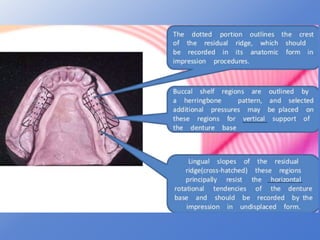
• Buccal shelf area seems to be better suited for
the primary stress bearing area.
• Slopes of residual ridges …… primary stress
bearing region for resistance of horizontal and
off-vertical forces.
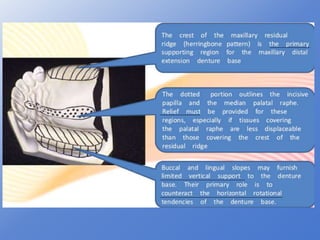
• Immediate crest of the bone of the maxillary
residual ridge may consist primarily of
cancellous bone.
• The crestal area of the residual ridge will
become the primary stress bearing area to
vertically directed forces.
• Some resistance may be obtained by the
immediate buccal and lingual slopes of the
ridge.
• Palatal tissues between the medial palatal
raphe and the lingual slope of the posterior
edentulous ridge are readily displaced and
cannot be considered as primary stress
bearing areas.
Extent of Residual Ridge Coverage by
Denture Base
• The broader the residual ridge coverage the
greater is the distribution of the load …..
((the greater is the distribution of the load,
which results in less load per unit area)).
• “ maximum coverage of the denture-bearing
areas with large, wide denture bases is of
utmost importance in withstanding both
vertical and horizontal stresses” kaires
.
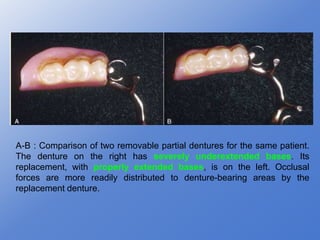
A-B : Comparison of two removable partial dentures for the same patient.
The denture on the right has severely underextended bases. Its
replacement, with properly extended bases, is on the left. Occlusal
forces are more readily distributed to denture-bearing areas by the
replacement denture.
Types and Accuracy of Impression
Registration
Residual Ridge
Anatomical Form
• surface contour when it not supporting an
occlusal load .
Functional Form
• When the ridge is supporting a functional
load.
Accuracy of the Fit of the Denture
Base
• Support of the distal extension base is
enhanced by intimacy of contact of the tissue
surface of the base and the tissues that cover
the residual ridge.
• The tissue surface must optimally represent a
true negative of the basal seat regions.
Design of the Removable Partial
Denture Framework
• Some rotation movement of the distal extension
base at the distal abutment is inevitable under
functional loading.
• The greatest movement takes place at the most
posterior extent of the denture base.
Retromolar pad of the mandibular residual ridge.
Tuberosity region of the maxillary residual ridge.
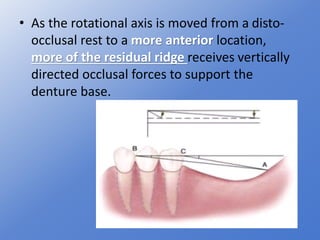
• As the rotational axis is moved from a disto-
occlusal rest to a more anterior location,
more of the residual ridge receives vertically
directed occlusal forces to support the
denture base.
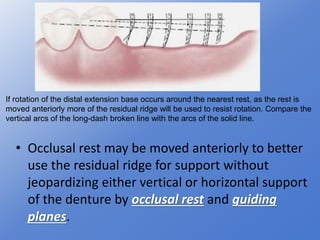
• Occlusal rest may be moved anteriorly to better
use the residual ridge for support without
jeopardizing either vertical or horizontal support
of the denture by occlusal rest and guiding
planes.
If rotation of the distal extension base occurs around the nearest rest, as the rest is
moved anteriorly more of the residual ridge will be used to resist rotation. Compare the
vertical arcs of the long-dash broken line with the arcs of the solid line.
Total Occlusal Load Applied
• Patients with distal extension removable partial dentures
generally oriented the food bolus over natural teeth rather
than prosthetic teeth.
• More stable nature of the natural dentition, the
proprioceptive feedback it provides for chewing, and the
possible nocioceptive feedback from the supporting
mucosa.
• This has an effect on the direction and magnitude of the
occlusal load to the removable partial denture, and thus on
the load transferred to the abutments.
• The number of artificial teeth, the width of their occlusal
surfaces, and their occlusal efficiency influence the total
occlusal load applied to the removable partial denture.
Impressions
Anatomic Form Impression
• One stage impression using an elastic
impression material that does not represent
the functional relationship between various
supporting structures of the partially
edentulous mouth.
• Only represent hard and soft tissues at rest.
• A partial denture fabricated from a one stage
impression, places more of the masticatory
load on the abutment teeth and that part of
the bone that underlies the distal end of the
extension base.
• Effects:
Traumatic load to the underlying bone
Bone loss and loosening of abutment tooth.
Selective Tissue Placement
Impression Method
• The goal is to maximize soft tissue support
while using the teeth to their supportive
advantage, the framework fitted to the teeth
while soft tissue support is registered provides
a means of coordinating both.
• A secondary impression for the distal
extension mandibular removable partial
denture is made in individual trays attached to
the denture framework.
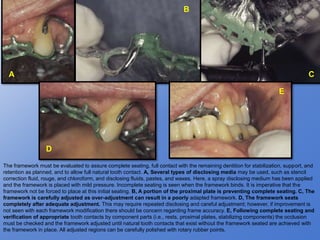
The framework must be evaluated to assure complete seating, full contact with the remaining dentition for stabilization, support, and
retention as planned, and to allow full natural tooth contact. A, Several types of disclosing media may be used, such as stencil
correction fluid, rouge, and chloroform, and disclosing fluids, pastes, and waxes. Here, a spray disclosing medium has been applied
and the framework is placed with mild pressure. Incomplete seating is seen when the framework binds. It is imperative that the
framework not be forced to place at this initial seating. B, A portion of the proximal plate is preventing complete seating. C, The
framework is carefully adjusted as over-adjustment can result in a poorly adapted framework. D, The framework seats
completely after adequate adjustment. This may require repeated disclosing and careful adjustment; however, if improvement is
not seen with each framework modification there should be concern regarding frame accuracy. E, Following complete seating and
verification of appropriate tooth contacts by component parts (i.e., rests, proximal plates, stabilizing components) the occlusion
must be checked and the framework adjusted until natural tooth contacts that exist without the framework seated are achieved with
the framework in place. All adjusted regions can be carefully polished with rotary rubber points.
A
B
C
D
E
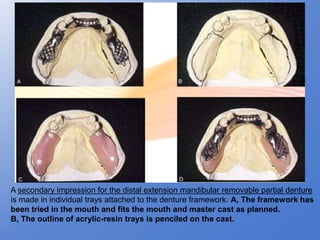
A secondary impression for the distal extension mandibular removable partial denture
is made in individual trays attached to the denture framework. A, The framework has
been tried in the mouth and fits the mouth and master cast as planned.
B, The outline of acrylic-resin trays is penciled on the cast.
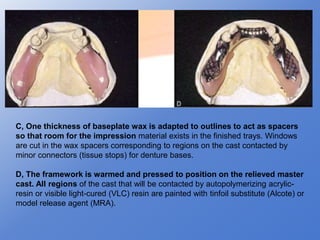
C, One thickness of baseplate wax is adapted to outlines to act as spacers
so that room for the impression material exists in the finished trays. Windows
are cut in the wax spacers corresponding to regions on the cast contacted by
minor connectors (tissue stops) for denture bases.
D, The framework is warmed and pressed to position on the relieved master
cast. All regions of the cast that will be contacted by autopolymerizing acrylic-
resin or visible light-cured (VLC) resin are painted with tinfoil substitute (Alcote) or
model release agent (MRA).
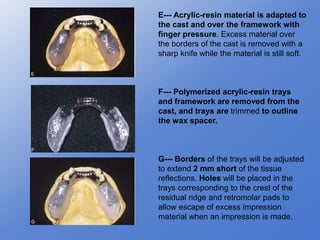
E--- Acrylic-resin material is adapted to
the cast and over the framework with
finger pressure. Excess material over
the borders of the cast is removed with a
sharp knife while the material is still soft.
F--- Polymerized acrylic-resin trays
and framework are removed from the
cast, and trays are trimmed to outline
the wax spacer.
G--- Borders of the trays will be adjusted
to extend 2 mm short of the tissue
reflections. Holes will be placed in the
trays corresponding to the crest of the
residual ridge and retromolar pads to
allow escape of excess impression
material when an impression is made.
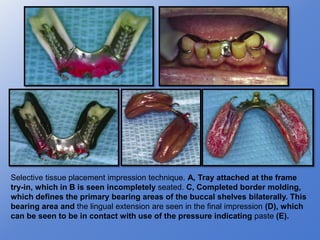
Selective tissue placement impression technique. A, Tray attached at the frame
try-in, which in B is seen incompletely seated. C, Completed border molding,
which defines the primary bearing areas of the buccal shelves bilaterally. This
bearing area and the lingual extension are seen in the final impression (D), which
can be seen to be in contact with use of the pressure indicating paste (E).
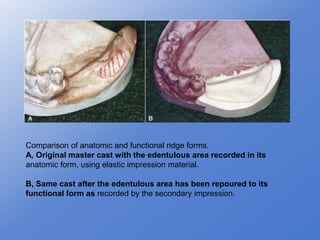
Comparison of anatomic and functional ridge forms.
A, Original master cast with the edentulous area recorded in its
anatomic form, using elastic impression material.
B, Same cast after the edentulous area has been repoured to its
functional form as recorded by the secondary impression.
Altered Cast Method
• The altered cast method of impression making is
most commonly used for the mandibular distal
extension partially edentulous arch (Kennedy
Class I and Class II arch form).
• A common clinical finding in these situations is
greater variation in tissue mobility and tissue
distortion or displaceability, which requires
some selective tissue placement to obtain the
desired support from these tissues.
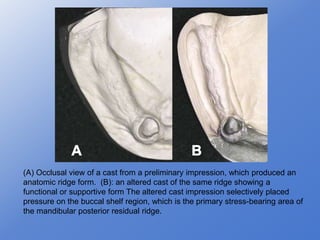
(A) Occlusal view of a cast from a preliminary impression, which produced an
anatomic ridge form. (B): an altered cast of the same ridge showing a
functional or supportive form The altered cast impression selectively placed
pressure on the buccal shelf region, which is the primary stress-bearing area of
the mandibular posterior residual ridge.
Thank You

support for distal extension bases.ppt

  • 1.
    Support for theDistal Extension Denture Base
  • 2.
    Distal Extension RemovablePartial Denture • The distal extension removable partial denture does not have the advantage of total tooth support because one or more bases are extensions covering the residual ridge distal to the last abutment. Therefore is dependent on the residual ridge for a portion of its support.
  • 3.
    • The distalextension removable partial denture must depend on the residual ridge for some support, stability, and retension. • Indirect retension, to prevent the denture from lifting away from the residual ridge, should also be incorporated in the design.
  • 4.
    Factors Influencing Supportof a Distal Extension Base Support from the residual ridge becomes more important as the distance from the last abutment increase and will depend on the following several factors: 1. Contour and quality of the residual ridge. 2. Extend of residual ridge coverage by the denture base. 3. Type and accuracy of the impression registration. 4. Accuracy of the fit of the denture base. 5. Design of the removable partial denture framework. 6. Total occlusal load applied.
  • 5.
    Contour and Qualityof the Residual Ridge • The ideal residual ridge to support a denture base would consist of cortical bone that covers relatively dense cancellous bone, with a broad rounded crest with high vertical slopes, and is covered by firm, dense, fibrous connective tissue. • Such a residual ridge would optimally support vertical and horizontal stresses placed on it by denture bases.

  • 6.
    • Easily displaceabletissue will not adequately suport a denture base, and tissues that are interposed between a sharp, bony residual ridge and a denture base will not remain in a healthy state. • Crest of the bony mandibular residual ridge is most often cancellous therefore cannot be a primary stress bearing area. • Buccal shelf area seems to be better suited for the primary stress bearing area.
  • 7.
    • Slopes ofresidual ridges …… primary stress bearing region for resistance of horizontal and off-vertical forces.
  • 9.
    • Immediate crestof the bone of the maxillary residual ridge may consist primarily of cancellous bone. • The crestal area of the residual ridge will become the primary stress bearing area to vertically directed forces. • Some resistance may be obtained by the immediate buccal and lingual slopes of the ridge.
  • 10.
    • Palatal tissuesbetween the medial palatal raphe and the lingual slope of the posterior edentulous ridge are readily displaced and cannot be considered as primary stress bearing areas.
  • 12.
    Extent of ResidualRidge Coverage by Denture Base • The broader the residual ridge coverage the greater is the distribution of the load ….. ((the greater is the distribution of the load, which results in less load per unit area)). • “ maximum coverage of the denture-bearing areas with large, wide denture bases is of utmost importance in withstanding both vertical and horizontal stresses” kaires .
  • 13.
    A-B : Comparisonof two removable partial dentures for the same patient. The denture on the right has severely underextended bases. Its replacement, with properly extended bases, is on the left. Occlusal forces are more readily distributed to denture-bearing areas by the replacement denture.
  • 14.
    Types and Accuracyof Impression Registration Residual Ridge Anatomical Form • surface contour when it not supporting an occlusal load . Functional Form • When the ridge is supporting a functional load.
  • 15.
    Accuracy of theFit of the Denture Base • Support of the distal extension base is enhanced by intimacy of contact of the tissue surface of the base and the tissues that cover the residual ridge. • The tissue surface must optimally represent a true negative of the basal seat regions.
  • 16.
    Design of theRemovable Partial Denture Framework • Some rotation movement of the distal extension base at the distal abutment is inevitable under functional loading. • The greatest movement takes place at the most posterior extent of the denture base. Retromolar pad of the mandibular residual ridge. Tuberosity region of the maxillary residual ridge.
  • 17.
    • As therotational axis is moved from a disto- occlusal rest to a more anterior location, more of the residual ridge receives vertically directed occlusal forces to support the denture base.
  • 18.
    • Occlusal restmay be moved anteriorly to better use the residual ridge for support without jeopardizing either vertical or horizontal support of the denture by occlusal rest and guiding planes. If rotation of the distal extension base occurs around the nearest rest, as the rest is moved anteriorly more of the residual ridge will be used to resist rotation. Compare the vertical arcs of the long-dash broken line with the arcs of the solid line.
  • 19.
    Total Occlusal LoadApplied • Patients with distal extension removable partial dentures generally oriented the food bolus over natural teeth rather than prosthetic teeth. • More stable nature of the natural dentition, the proprioceptive feedback it provides for chewing, and the possible nocioceptive feedback from the supporting mucosa. • This has an effect on the direction and magnitude of the occlusal load to the removable partial denture, and thus on the load transferred to the abutments. • The number of artificial teeth, the width of their occlusal surfaces, and their occlusal efficiency influence the total occlusal load applied to the removable partial denture.
  • 20.
    Impressions Anatomic Form Impression •One stage impression using an elastic impression material that does not represent the functional relationship between various supporting structures of the partially edentulous mouth. • Only represent hard and soft tissues at rest.
  • 21.
    • A partialdenture fabricated from a one stage impression, places more of the masticatory load on the abutment teeth and that part of the bone that underlies the distal end of the extension base. • Effects: Traumatic load to the underlying bone Bone loss and loosening of abutment tooth.
  • 22.
    Selective Tissue Placement ImpressionMethod • The goal is to maximize soft tissue support while using the teeth to their supportive advantage, the framework fitted to the teeth while soft tissue support is registered provides a means of coordinating both. • A secondary impression for the distal extension mandibular removable partial denture is made in individual trays attached to the denture framework.
  • 23.
    The framework mustbe evaluated to assure complete seating, full contact with the remaining dentition for stabilization, support, and retention as planned, and to allow full natural tooth contact. A, Several types of disclosing media may be used, such as stencil correction fluid, rouge, and chloroform, and disclosing fluids, pastes, and waxes. Here, a spray disclosing medium has been applied and the framework is placed with mild pressure. Incomplete seating is seen when the framework binds. It is imperative that the framework not be forced to place at this initial seating. B, A portion of the proximal plate is preventing complete seating. C, The framework is carefully adjusted as over-adjustment can result in a poorly adapted framework. D, The framework seats completely after adequate adjustment. This may require repeated disclosing and careful adjustment; however, if improvement is not seen with each framework modification there should be concern regarding frame accuracy. E, Following complete seating and verification of appropriate tooth contacts by component parts (i.e., rests, proximal plates, stabilizing components) the occlusion must be checked and the framework adjusted until natural tooth contacts that exist without the framework seated are achieved with the framework in place. All adjusted regions can be carefully polished with rotary rubber points. A B C D E
  • 24.
    A secondary impressionfor the distal extension mandibular removable partial denture is made in individual trays attached to the denture framework. A, The framework has been tried in the mouth and fits the mouth and master cast as planned. B, The outline of acrylic-resin trays is penciled on the cast.
  • 25.
    C, One thicknessof baseplate wax is adapted to outlines to act as spacers so that room for the impression material exists in the finished trays. Windows are cut in the wax spacers corresponding to regions on the cast contacted by minor connectors (tissue stops) for denture bases. D, The framework is warmed and pressed to position on the relieved master cast. All regions of the cast that will be contacted by autopolymerizing acrylic- resin or visible light-cured (VLC) resin are painted with tinfoil substitute (Alcote) or model release agent (MRA).
  • 26.
    E--- Acrylic-resin materialis adapted to the cast and over the framework with finger pressure. Excess material over the borders of the cast is removed with a sharp knife while the material is still soft. F--- Polymerized acrylic-resin trays and framework are removed from the cast, and trays are trimmed to outline the wax spacer. G--- Borders of the trays will be adjusted to extend 2 mm short of the tissue reflections. Holes will be placed in the trays corresponding to the crest of the residual ridge and retromolar pads to allow escape of excess impression material when an impression is made.
  • 27.
    Selective tissue placementimpression technique. A, Tray attached at the frame try-in, which in B is seen incompletely seated. C, Completed border molding, which defines the primary bearing areas of the buccal shelves bilaterally. This bearing area and the lingual extension are seen in the final impression (D), which can be seen to be in contact with use of the pressure indicating paste (E).
  • 28.
    Comparison of anatomicand functional ridge forms. A, Original master cast with the edentulous area recorded in its anatomic form, using elastic impression material. B, Same cast after the edentulous area has been repoured to its functional form as recorded by the secondary impression.
  • 29.
    Altered Cast Method •The altered cast method of impression making is most commonly used for the mandibular distal extension partially edentulous arch (Kennedy Class I and Class II arch form). • A common clinical finding in these situations is greater variation in tissue mobility and tissue distortion or displaceability, which requires some selective tissue placement to obtain the desired support from these tissues.
  • 30.
    (A) Occlusal viewof a cast from a preliminary impression, which produced an anatomic ridge form. (B): an altered cast of the same ridge showing a functional or supportive form The altered cast impression selectively placed pressure on the buccal shelf region, which is the primary stress-bearing area of the mandibular posterior residual ridge.
  • 31.