Presented by:
Dr. Jehan Dordi
1st Yr. MDS
RPI & RPA SYSTEM
1
CONTENTS
2
• Introduction
• Entirely tooth supported prosthesis
• Combined tooth tissue supported prosthesis
• Problems associated with distal extension prosthesis
• Support and force distribution
• Lever and inclined plane actions
• Forces acting
• Controlling stress by design consideration
3
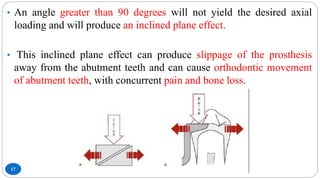
• RPI system-components of RPI system
• Design concept
• Design variation
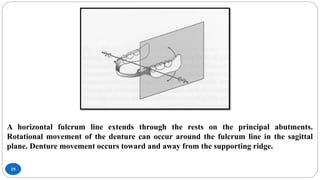
• Advantage
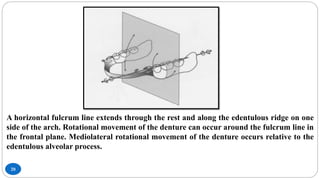
• Contraindications
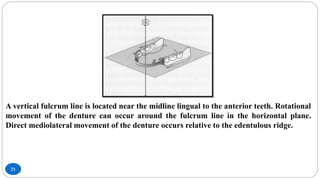
• Limitations
• RPA System
• Advantages of RPA over the RPI clasp assemblies
• Review of Literature
• Conclusion
• References
INTRODUCTION
4
5
• The strategy of selecting component parts for a partial denture is to
help control movement of the prosthesis under functional load is a
method to be considered for partial denture design.
• Requirements for movement control are functions of whether the
prosthesis will be tooth supported or tooth tissue supported.
• Support may be derived from the remaining teeth, the hard and soft
tissues of the residual ridge, or both.
• Under function, healthy teeth may be displaced as much as 0.2 mm.
6
• In contrast, soft tissues overlying residual bone generally may be
displaced 0.4-4mm, and has an average resilience of 1.3 mm.
• Mucosa confers a freedom of movement to the saddle approximately
13 fold higher than that allowed by the dental organ in its alveolus.
• This double system of support, where the distal-extension RPD
adapts, causes the occurrence of inadequate stress around abutment
teeth.
• As a result, there may be a significant difference in the support
provided by the teeth and the tissues of the residual ridge.
Entirely Tooth Supported Prosthesis
7
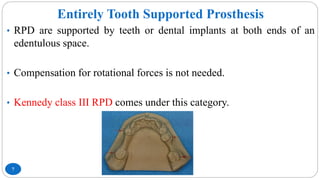
• RPD are supported by teeth or dental implants at both ends of an
edentulous space.
• Compensation for rotational forces is not needed.
• Kennedy class III RPD comes under this category.
Combined Tooth Tissue Supported Prosthesis
8
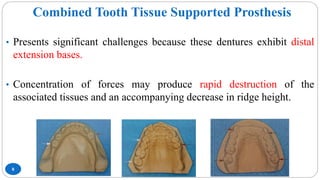
• Presents significant challenges because these dentures exhibit distal
extension bases.
• Concentration of forces may produce rapid destruction of the
associated tissues and an accompanying decrease in ridge height.
PROBLEMS ASSOCIATED WITH DISTAL
EXTENSION BASE REMOVABLE PARTIAL
DENTURES
9
10
Support and Force Distribution
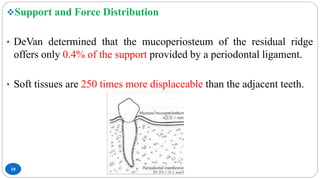
• DeVan determined that the mucoperiosteum of the residual ridge
offers only 0.4% of the support provided by a periodontal ligament.
• Soft tissues are 250 times more displaceable than the adjacent teeth.
11
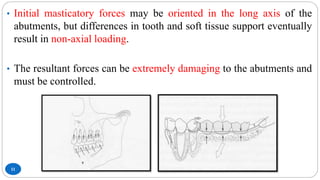
• Initial masticatory forces may be oriented in the long axis of the
abutments, but differences in tooth and soft tissue support eventually
result in non-axial loading.
• The resultant forces can be extremely damaging to the abutments and
must be controlled.
LEVER AND INCLINED PLANE ACTIONS
12
13
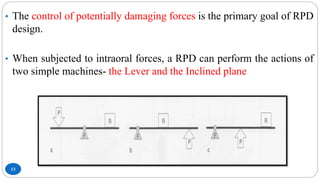
• The control of potentially damaging forces is the primary goal of RPD
design.
• When subjected to intraoral forces, a RPD can perform the actions of
two simple machines- the Lever and the Inclined plane
14
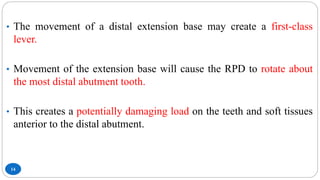
• The movement of a distal extension base may create a first-class
lever.
• Movement of the extension base will cause the RPD to rotate about
the most distal abutment tooth.
• This creates a potentially damaging load on the teeth and soft tissues
anterior to the distal abutment.
15
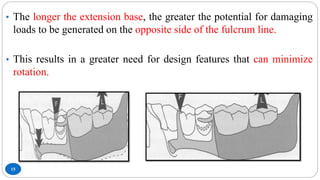
• The longer the extension base, the greater the potential for damaging
loads to be generated on the opposite side of the fulcrum line.
• This results in a greater need for design features that can minimize
rotation.
16
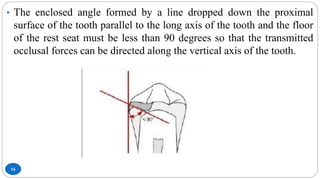
• The enclosed angle formed by a line dropped down the proximal
surface of the tooth parallel to the long axis of the tooth and the floor
of the rest seat must be less than 90 degrees so that the transmitted
occlusal forces can be directed along the vertical axis of the tooth.
17
• An angle greater than 90 degrees will not yield the desired axial
loading and will produce an inclined plane effect.
• This inclined plane effect can produce slippage of the prosthesis
away from the abutment teeth and can cause orthodontic movement
of abutment teeth, with concurrent pain and bone loss.
FORCES ACTING ON RPD
18
19
A horizontal fulcrum line extends through the rests on the principal abutments.
Rotational movement of the denture can occur around the fulcrum line in the sagittal
plane. Denture movement occurs toward and away from the supporting ridge.
20
A horizontal fulcrum line extends through the rest and along the edentulous ridge on one
side of the arch. Rotational movement of the denture can occur around the fulcrum line in
the frontal plane. Mediolateral rotational movement of the denture occurs relative to the
edentulous alveolar process.
21
A vertical fulcrum line is located near the midline lingual to the anterior teeth. Rotational
movement of the denture can occur around the fulcrum line in the horizontal plane.
Direct mediolateral movement of the denture occurs relative to the edentulous ridge.
22
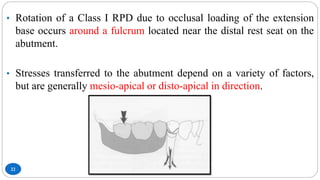
• Rotation of a Class I RPD due to occlusal loading of the extension
base occurs around a fulcrum located near the distal rest seat on the
abutment.
• Stresses transferred to the abutment depend on a variety of factors,
but are generally mesio-apical or disto-apical in direction.
CONTROLLING STRESS BY
DESIGN CONSIDERATION
23
24
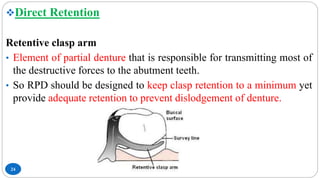
Direct Retention
Retentive clasp arm
• Element of partial denture that is responsible for transmitting most of
the destructive forces to the abutment teeth.
• So RPD should be designed to keep clasp retention to a minimum yet
provide adequate retention to prevent dislodgement of denture.
25
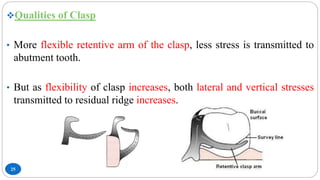
Qualities of Clasp
• More flexible retentive arm of the clasp, less stress is transmitted to
abutment tooth.
• But as flexibility of clasp increases, both lateral and vertical stresses
transmitted to residual ridge increases.
26
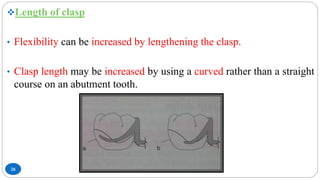
Length of clasp
• Flexibility can be increased by lengthening the clasp.
• Clasp length may be increased by using a curved rather than a straight
course on an abutment tooth.
27
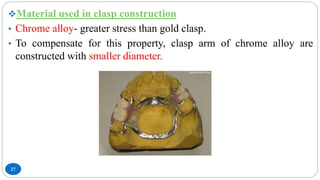
Material used in clasp construction
• Chrome alloy- greater stress than gold clasp.
• To compensate for this property, clasp arm of chrome alloy are
constructed with smaller diameter.
28
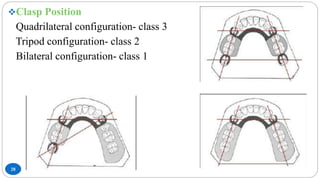
Clasp Position
Quadrilateral configuration- class 3
Tripod configuration- class 2
Bilateral configuration- class 1
29
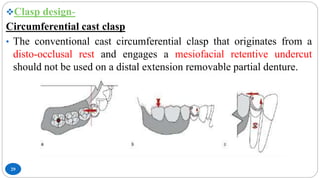
Clasp design-
Circumferential cast clasp
• The conventional cast circumferential clasp that originates from a
disto-occlusal rest and engages a mesiofacial retentive undercut
should not be used on a distal extension removable partial denture.
30
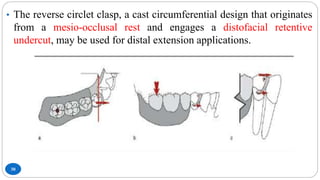
• The reverse circlet clasp, a cast circumferential design that originates
from a mesio-occlusal rest and engages a distofacial retentive
undercut, may be used for distal extension applications.
31
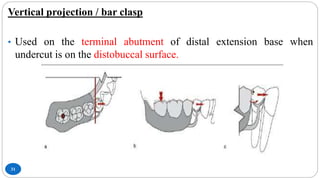
Vertical projection / bar clasp
• Used on the terminal abutment of distal extension base when
undercut is on the distobuccal surface.
32
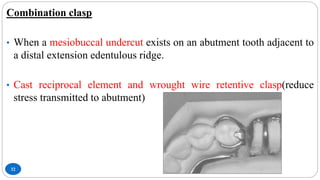
Combination clasp
• When a mesiobuccal undercut exists on an abutment tooth adjacent to
a distal extension edentulous ridge.
• Cast reciprocal element and wrought wire retentive clasp(reduce
stress transmitted to abutment)
33
Frictional control
• A RPD should be designed so that guiding planes are present on as
many teeth as possible.
• Guiding planes are prepared surfaces that are parallel to each other
and parallel to the path the denture takes as it is inserted and
withdrawn from the mouth.
• The frictional contact of the prosthesis against these parallel surfaces
can contribute significantly to the retention of the removable partial
denture.
34
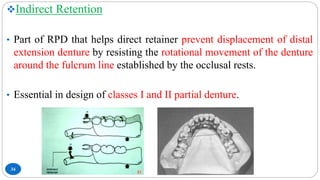
Indirect Retention
• Part of RPD that helps direct retainer prevent displacement of distal
extension denture by resisting the rotational movement of the denture
around the fulcrum line established by the occlusal rests.
• Essential in design of classes I and II partial denture.
35
Rests
• Directs forces to long axis of the tooth.
• Floor of the rest seat < 90° - helps it to grasp the tooth and prevent
its migration.
• Occlusal rest – gently rounded.
• Rest must be free to move within the rest seat- permits release of
stresses that will be transmitted to abutment.
• More teeth that bear rest seat, less will be stress placed on each tooth.
RPI SYSTEM
36
37
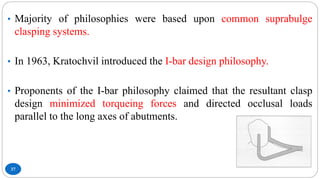
• Majority of philosophies were based upon common suprabulge
clasping systems.
• In 1963, Kratochvil introduced the I-bar design philosophy.
• Proponents of the I-bar philosophy claimed that the resultant clasp
design minimized torqueing forces and directed occlusal loads
parallel to the long axes of abutments.
38
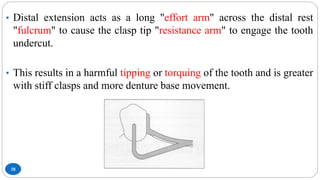
• Distal extension acts as a long "effort arm" across the distal rest
"fulcrum" to cause the clasp tip "resistance arm" to engage the tooth
undercut.
• This results in a harmful tipping or torquing of the tooth and is greater
with stiff clasps and more denture base movement.
39
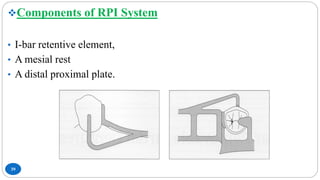
Components of RPI System
• I-bar retentive element,
• A mesial rest
• A distal proximal plate.
40
Design Concepts
REST-
• Rest provide vertical support against occlusal forces and control the
vertical relationship between the prosthesis and the supporting
structures.
• Rests must possess excellent adaptation to the corresponding
abutments and must possess sufficient bulk to withstand applied
loads.
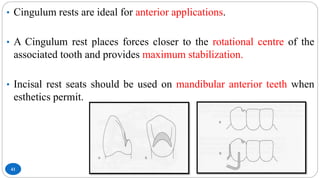
41
• Cingulum rests are ideal for anterior applications.
• A Cingulum rest places forces closer to the rotational centre of the
associated tooth and provides maximum stabilization.
• Incisal rest seats should be used on mandibular anterior teeth when
esthetics permit.
42
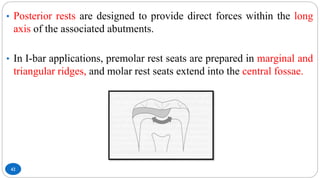
• Posterior rests are designed to provide direct forces within the long
axis of the associated abutments.
• In I-bar applications, premolar rest seats are prepared in marginal and
triangular ridges, and molar rest seats extend into the central fossae.
43
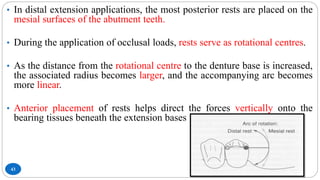
• In distal extension applications, the most posterior rests are placed on the
mesial surfaces of the abutment teeth.
• During the application of occlusal loads, rests serve as rotational centres.
• As the distance from the rotational centre to the denture base is increased,
the associated radius becomes larger, and the accompanying arc becomes
more linear.
• Anterior placement of rests helps direct the forces vertically onto the
bearing tissues beneath the extension bases
44
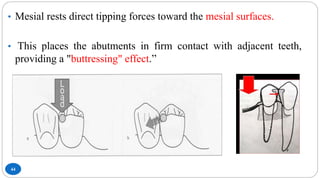
• Mesial rests direct tipping forces toward the mesial surfaces.
• This places the abutments in firm contact with adjacent teeth,
providing a "buttressing" effect.”
45
PROXIMAL PLATES
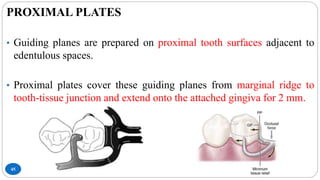
• Guiding planes are prepared on proximal tooth surfaces adjacent to
edentulous spaces.
• Proximal plates cover these guiding planes from marginal ridge to
tooth-tissue junction and extend onto the attached gingiva for 2 mm.
46
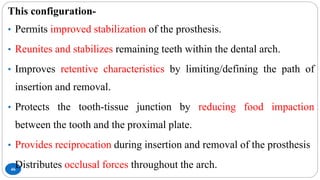
This configuration-
• Permits improved stabilization of the prosthesis.
• Reunites and stabilizes remaining teeth within the dental arch.
• Improves retentive characteristics by limiting/defining the path of
insertion and removal.
• Protects the tooth-tissue junction by reducing food impaction
between the tooth and the proximal plate.
• Provides reciprocation during insertion and removal of the prosthesis
• Distributes occlusal forces throughout the arch.
47
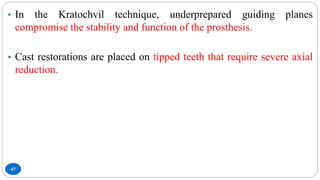
• In the Kratochvil technique, underprepared guiding planes
compromise the stability and function of the prosthesis.
• Cast restorations are placed on tipped teeth that require severe axial
reduction.
48
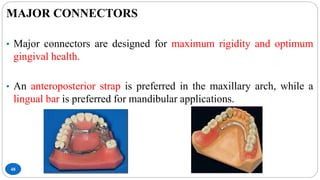
MAJOR CONNECTORS
• Major connectors are designed for maximum rigidity and optimum
gingival health.
• An anteroposterior strap is preferred in the maxillary arch, while a
lingual bar is preferred for mandibular applications.
49
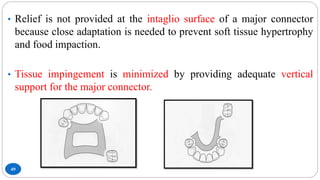
• Relief is not provided at the intaglio surface of a major connector
because close adaptation is needed to prevent soft tissue hypertrophy
and food impaction.
• Tissue impingement is minimized by providing adequate vertical
support for the major connector.
50
MINOR CONNECTORS
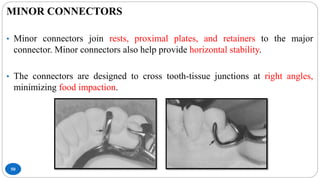
• Minor connectors join rests, proximal plates, and retainers to the major
connector. Minor connectors also help provide horizontal stability.
• The connectors are designed to cross tooth-tissue junctions at right angles,
minimizing food impaction.
51
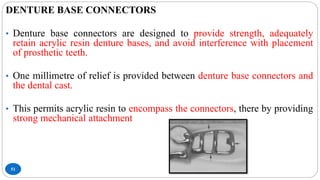
DENTURE BASE CONNECTORS
• Denture base connectors are designed to provide strength, adequately
retain acrylic resin denture bases, and avoid interference with placement
of prosthetic teeth.
• One millimetre of relief is provided between denture base connectors and
the dental cast.
• This permits acrylic resin to encompass the connectors, there by providing
strong mechanical attachment
52
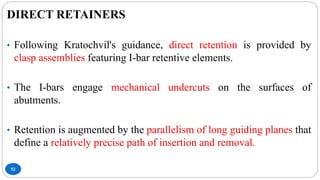
DIRECT RETAINERS
• Following Kratochvil's guidance, direct retention is provided by
clasp assemblies featuring I-bar retentive elements.
• The I-bars engage mechanical undercuts on the surfaces of
abutments.
• Retention is augmented by the parallelism of long guiding planes that
define a relatively precise path of insertion and removal.
53
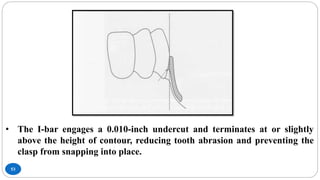
• The I-bar engages a 0.010-inch undercut and terminates at or slightly
above the height of contour, reducing tooth abrasion and preventing the
clasp from snapping into place.
54
• Each I-bar is designed to minimize the coverage of teeth and soft
tissues, thereby promoting tissue health.
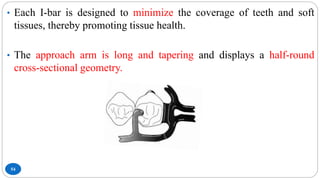
• The approach arm is long and tapering and displays a half-round
cross-sectional geometry.
55
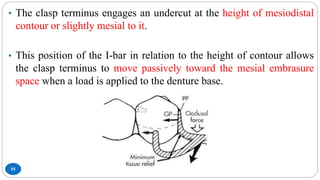
• The clasp terminus engages an undercut at the height of mesiodistal
contour or slightly mesial to it.
• This position of the I-bar in relation to the height of contour allows
the clasp terminus to move passively toward the mesial embrasure
space when a load is applied to the denture base.
56
The following important advantages are gained with the I-bar
configuration:
• Food accumulation is minimized because tooth contours are not
significantly altered.
• The clasp terminus disengages from the tooth when an occlusal load
is applied to the adjacent distal extension base.
• Because the approach arm does not contact the abutment, lateral
forces are minimized.
57
The following are of consequence only if the design concept is not
properly executed:
• Less horizontal stability than other types of clasp assemblies
• Less retention
58
INDIRECT RETAINERS
• Indirect retention is provided by rests placed on secondary abutments
located as far as from the axis of rotation and the extension base.
• Indirect retainers have been shown to be very effective in
redistributing occlusal forces throughout the entire dentoalveolar
structure.
59
• One of the more convenient indirect retention sites is the mesial fossa
of a mandibular first premolar because the tooth form accommodates
the rest and because there is usually no opposing occlusion.
• Similarly, in the maxillary arch, the cingulum rest seat on a canine is
a popular indirect retainer site.
60
Design Variations
Krol’s Modification Design-
• Krol developed a design modification requiring less tooth alteration
in 1974.
• Krol's stated emphasis is “stress control with minimal hard and soft
tissue coverage”.
61
• Krol cites inflammation in the presence of stress as the key to vertical
bone loss around abutment teeth.
• His concept is intended to minimize plaque accumulations that may
endanger the health of the teeth and their vesting structures.
• Krol's clasp assembly includes the three elements of Kratochvil's
system: mesial rest, proximal plate, and I-bar.
62
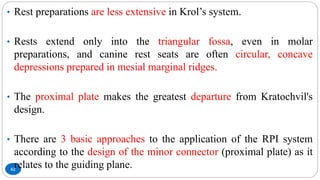
• Rest preparations are less extensive in Krol’s system.
• Rests extend only into the triangular fossa, even in molar
preparations, and canine rest seats are often circular, concave
depressions prepared in mesial marginal ridges.
• The proximal plate makes the greatest departure from Kratochvil's
design.
• There are 3 basic approaches to the application of the RPI system
according to the design of the minor connector (proximal plate) as it
relates to the guiding plane.
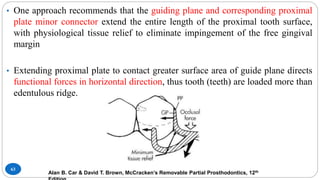
63
• One approach recommends that the guiding plane and corresponding proximal
plate minor connector extend the entire length of the proximal tooth surface,
with physiological tissue relief to eliminate impingement of the free gingival
margin
• Extending proximal plate to contact greater surface area of guide plane directs
functional forces in horizontal direction, thus tooth (teeth) are loaded more than
edentulous ridge.
Alan B. Car & David T. Brown, McCracken’s Removable Partial Prosthodontics, 12th
64
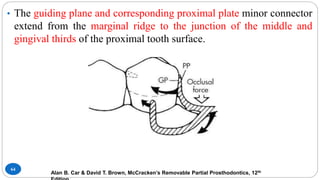
• The guiding plane and corresponding proximal plate minor connector
extend from the marginal ridge to the junction of the middle and
gingival thirds of the proximal tooth surface.
Alan B. Car & David T. Brown, McCracken’s Removable Partial Prosthodontics, 12th
65
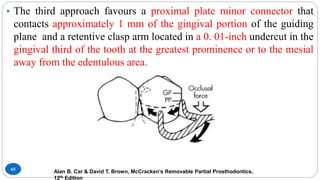
• The third approach favours a proximal plate minor connector that
contacts approximately 1 mm of the gingival portion of the guiding
plane and a retentive clasp arm located in a 0. 01-inch undercut in the
gingival third of the tooth at the greatest prominence or to the mesial
away from the edentulous area.
Alan B. Car & David T. Brown, McCracken’s Removable Partial Prosthodontics,
12th Edition
66
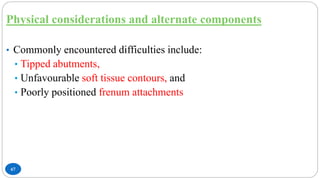
• Relief is provided at the tooth-tissue junction to allow the proximal
plate to disengage when loaded.
• The stated purpose for reducing the proximal plate is to improve
gingival health by opening embrasure spaces as much as possible.
• An anticipated problem is impaction of food into the space above the
proximal plate.
67
Physical considerations and alternate components
• Commonly encountered difficulties include:
• Tipped abutments,
• Unfavourable soft tissue contours, and
• Poorly positioned frenum attachments
68
Tipping of abutments-
• May complicate retention and clasping.
• Buccolingual tipping frequently creates excessive undercuts or
eliminates undercuts entirely.
When tipping creates an excessive undercut, the solutions include:
• Enameloplasty to reduce the undercut or
• The placement of a cast restoration to provide improved abutment
contours.
69
When tipping results in an inadequate undercut, the solutions are:
• Preparation of an undercut via enameloplasty.
• Use of an existing undercut on the opposite surface.
• Severe tipping is most effectively controlled with cast restorations.
• Endodontic therapy should be considered if adequate preparation of
the guiding plane risks pulpal exposure.
• If the tooth in question is not critical to the function of the RPD , it is
better to design the framework to avoid the tipped tooth, especially if
adequate retention can be obtained from other retentive elements.
70
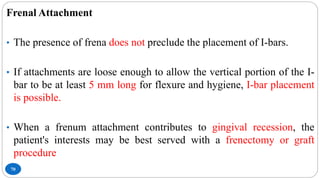
Frenal Attachment
• The presence of frena does not preclude the placement of I-bars.
• If attachments are loose enough to allow the vertical portion of the I-
bar to be at least 5 mm long for flexure and hygiene, I-bar placement
is possible.
• When a frenum attachment contributes to gingival recession, the
patient's interests may be best served with a frenectomy or graft
procedure
71
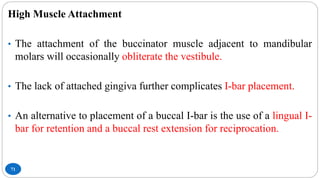
High Muscle Attachment
• The attachment of the buccinator muscle adjacent to mandibular
molars will occasionally obliterate the vestibule.
• The lack of attached gingiva further complicates I-bar placement.
• An alternative to placement of a buccal I-bar is the use of a lingual I-
bar for retention and a buccal rest extension for reciprocation.
72
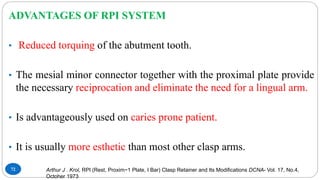
ADVANTAGES OF RPI SYSTEM
• Reduced torquing of the abutment tooth.
• The mesial minor connector together with the proximal plate provide
the necessary reciprocation and eliminate the need for a lingual arm.
• Is advantageously used on caries prone patient.
• It is usually more esthetic than most other clasp arms.
Arthur J . Krol, RPI (Rest, Proxim~1 Plate, I Bar) Clasp Retainer and Its Modifications DCNA- Vol. 17, No.4,

Octoher 1973
73
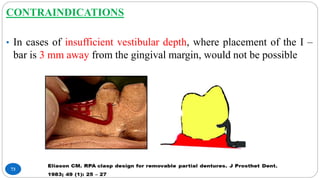
CONTRAINDICATIONS
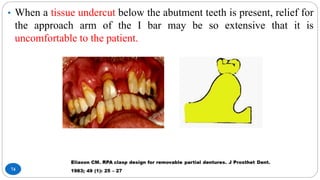
• In cases of insufficient vestibular depth, where placement of the I –
bar is 3 mm away from the gingival margin, would not be possible
74
• When a tissue undercut below the abutment teeth is present, relief for
the approach arm of the I bar may be so extensive that it is
uncomfortable to the patient.
75
LIMITATIONS
• Sometimes due to length of the approach arm of the retentive I-bar,
the flexibility of the retentive arm results in a compromised
retention.
• In addition, on recall examination clasp arms are sometimes found to
be distorted and permanently sprung away from the tooth.
76
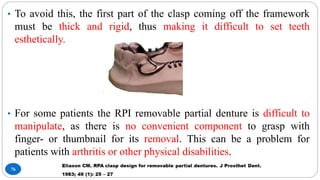
• To avoid this, the first part of the clasp coming off the framework
must be thick and rigid, thus making it difficult to set teeth
esthetically.
• For some patients the RPI removable partial denture is difficult to
manipulate, as there is no convenient component to grasp with
finger- or thumbnail for its removal. This can be a problem for
patients with arthritis or other physical disabilities.
77
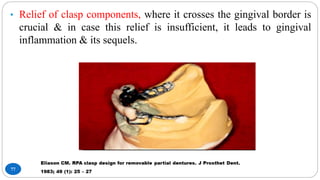
• Relief of clasp components, where it crosses the gingival border is
crucial & in case this relief is insufficient, it leads to gingival
inflammation & its sequels.
RPA SYSTEM
78
79
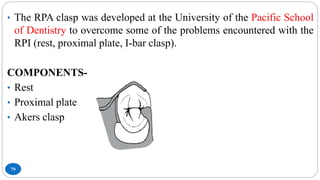
• The RPA clasp was developed at the University of the Pacific School
of Dentistry to overcome some of the problems encountered with the
RPI (rest, proximal plate, I-bar clasp).
COMPONENTS-
• Rest
• Proximal plate
• Akers clasp
80
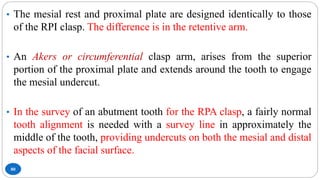
• The mesial rest and proximal plate are designed identically to those
of the RPI clasp. The difference is in the retentive arm.
• An Akers or circumferential clasp arm, arises from the superior
portion of the proximal plate and extends around the tooth to engage
the mesial undercut.
• In the survey of an abutment tooth for the RPA clasp, a fairly normal
tooth alignment is needed with a survey line in approximately the
middle of the tooth, providing undercuts on both the mesial and distal
aspects of the facial surface.
81
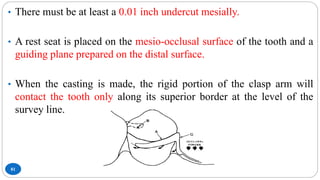
• There must be at least a 0.01 inch undercut mesially.
• A rest seat is placed on the mesio-occlusal surface of the tooth and a
guiding plane prepared on the distal surface.
• When the casting is made, the rigid portion of the clasp arm will
contact the tooth only along its superior border at the level of the
survey line.
82
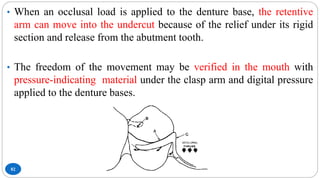
• When an occlusal load is applied to the denture base, the retentive
arm can move into the undercut because of the relief under its rigid
section and release from the abutment tooth.
• The freedom of the movement may be verified in the mouth with
pressure-indicating material under the clasp arm and digital pressure
applied to the denture bases.
83
ADVANTAGES OF RPA OVER THE RPI CLASPASSEMBLIES
• It gives essentially the same kind of tooth release that the RPI clasp
provides.
• In addition, the circumferential-type retentive arm is easier to grasp
for removal of the prosthesis.
• The clasp is simple thus can be easily and consistently fabricated by
dental laboratories.
• But most important, the circumferential retentive arm avoids the
tissue problems around abutment teeth.
REVIEW OF LITERATURE
84
85
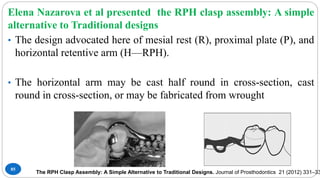
Elena Nazarova et al presented the RPH clasp assembly: A simple
alternative to Traditional designs
• The design advocated here of mesial rest (R), proximal plate (P), and
horizontal retentive arm (H—RPH).
• The horizontal arm may be cast half round in cross-section, cast
round in cross-section, or may be fabricated from wrought
The RPH Clasp Assembly: A Simple Alternative to Traditional Designs. Journal of Prosthodontics 21 (2012) 331–33
86
• Because the horizontal retentive arm touches the abutment tooth only
at its retentive tip, it is by definition an infrabulge type of retentive
arm.
• The horizontal retentive arm originates from the retentive meshwork
of the framework and travels horizontally, parallel to the plane of
occlusion into the retentive undercut of the abutment tooth in a
position at or mesial to the height of contour of the abutment tooth.
The RPH Clasp Assembly: A Simple Alternative to Traditional Designs. Journal of Prosthodontics 21 (2012) 331–33
87
ADVANTAGES-
• Many of the advantages of the bar-type retentive arm allowing for
the use of a cast retentive arm and retaining the potential stress-
breaking concept of the RPI design.
• The horizontal retentive arm may be used in situations where there
are severe soft tissue undercuts, high-frenal attachments, and
shallow vestibular depth.
• It may be used in situations where the survey line on the abutment
tooth is more occlusally placed than is desirable.
• More aesthetic retentive component than the bar-type retentive arm
in situations with a high smile line with soft tissue exposure.
• Easy to adjust
88
DISADVANTAGES
• In situations of narrow mesiodistal abutment tooth width, the short
length of the horizontal arm may be insufficient to allow flexibility
to function well during insertion and removal.
• Another disadvantage of the horizontal retentive arm is that the
blocked-out space may act as a food trap, as is the case with all
infrabulge retainers
89
Marcio Magno Costa et al did a study to determine photoelastic
Study of the Support Structures of Distal-Extension Removable
Partial Dentures
• Three photoelastic models were made simulating a Kennedy Class II
inferior arch. Fifteen dentures with long saddles, five of each design,
were adjusted to the photoelastic patterns and submitted first to
uniformly distributed load, and then to a load localized on the last
artificial tooth.
• The quantitative and qualitative analyses of stress intensity were done
manually and by photography, respectively
Photoelastic Study of the Support Structures of Distal-Extension Removable Partial Dentures.Journal of Prosthodontics
90
The results of this study lead to the following conclusions:
• The distribution of tensions in the photoelastic models was influenced
by the type of retainer, the length of the saddle, and by the form of
load application.
• In relation to the retainer, a more equal distribution of forces between
the support structures was seen in the RPI retainer, followed by the T-
bar and by the circumferential retainers.
• As for the saddle length, a more equal distribution of forces between
the support structures was observed on the long saddles
• When considering the type of load, the best distribution of tensions
occurred when the load was uniformly distributed.
91
Hosman did a study on the influence of clasp design of distal
extension removable partial dentures on the Periodontium of the
abutment teeth
• Twenty-five patients wore three different removable partial dentures
for 19 weeks each.
• The first removable partial denture placed a tilting force on the
abutment teeth
• The second was stress-releasing
• The third collected the least amount of plaque
The Influence of Clasp Design of Distal Extension Removable Partial Dentures on the Periodontium of the Abutment Teeth. Int i Prosthodon
92
• Plaque accumulation, the condition of the periodontium, migration
of the abutment teeth, deformation of the clasp arms, retention of the
prosthesis, and patient preferences were assessed.
The results demonstrated that
• The partial denture retentive design did not affect plaque formation.
• The prosthesis designed to place a tilting force on the abutment teeth
appeared to cause the least mobility and migration of the abutments
and had the greatest acceptance by the patients
The Influence of Clasp Design of Distal Extension Removable Partial Dentures on the Periodontium of the Abutment Teeth. Int i Prosthodo
1990:3:256-265
93
Y. Sato et al did finite element analysis on preferable I-bar clasp
shape.
• This study aimed to investigate, by Finite Element Analysis (FEA),
the dimensions and stress of I-bar clasps having the same stiffness,
and to estimate a mechanically preferable clasp design.
• Three-dimensional FEA models of I-bar clasps were created with
vertical and horizontal straight sections connected by a curved
section characterized by six parameters.
Finite element analysis on preferable I-bar clasp shape. Journal of Oral Rehabilitation 2001 28; 413-417
94
• Stress was calculated with a concentrated load of 5 N applied 2 mm
from the tip of the clasp in the buccal direction.
• The results suggest that such a shape might be the preferable I-bar
clasp shape as biomechanical viewpoint. These criteria will
contribute to the longevity of I-bar clasps
Finite element analysis on preferable I-bar clasp shape. Journal of Oral Rehabilitation 2001 28; 413-417
CONCLUSSION
95
96
• The two most commonly cited causes for abutment loss in distal
extention removable prosthesis were overloading and periodontal
disease.
• Consequently, the practitioner must design distal extension
prostheses that distribute forces evenly without overloading the teeth
or soft tissues.
• As a result, numerous philosophies for the treatment of Kennedy
Class I and Class II arches have been introduced.
97
• Direct retainers for distal extension removable partial dentures
should be chosen after careful evaluation of each individual situation
and consideration of the merits and contraindications of each clasp
design.
• Once the retainer is chosen, meticulous adherence to proper
designing principles will ensure a successful distal extension
removable partial denture.
REFERENCES
98
• Rodney D. Phoenix, David R. Cagna, Charls F. Defreest. Stewart’s Clinical
Removable Partial Prosthodontics. 4th edition.
• Alan b. Carr and David T. Brown. McCracken’s Removable Partial
Prosthodontics. 12th Edition.
• Robert W. Loney, Removable Partial Denture Manual. 2008
• Eliason CM. RPA clasp design for removable partial dentures. J Prosthet Dent.
1983; 49 (1): 25 – 27
• Elena Nazarova & Thomas D. Taylor. The RPH Clasp Assembly: A Simple
Alternative to Traditional Designs. Journal of Prosthodontics 21 (2012) 331–333.
• Marcio Magno Costa, Marco Antonio Moreira Rodrigues da Silva, Sonia
Aparecida Goulart Oliveira, Vanderlei Luiz Gomes, Polliane Morais Carvalho, &
Barbara Lima Lucas. Photoelastic Study of the Support Structures of Distal-
Extension Removable Partial Dentures. Journal of Prosthodontics 18 (2009) 589–
595.
99
• Dr H,I.M, Hosman et al. The Influence of Clasp Design of Distal Extension
Removable Partial Dentures on the Periodontium of the Abutment Teeth. Int i
Prosthodont 1990:3:256-265
• I. Aviv, Z. Ben and H. S. Cardash. An analysis of rotational movement of
asymmetrical distal-extension removable partial dentures. Jpd february 1989
volume 61 number 2
• Y. Sato, k. Tsuga, y. Abe, s. Asahara & y. Akagawa. Finite element analysis on
preferable i-bar clasp shape. Journal of oral rehabilitation 2001 28; 413-417
100

RPI & RPA system

  • 1.
    Presented by: Dr. JehanDordi 1st Yr. MDS RPI & RPA SYSTEM 1
  • 2.
    CONTENTS 2 • Introduction • Entirelytooth supported prosthesis • Combined tooth tissue supported prosthesis • Problems associated with distal extension prosthesis • Support and force distribution • Lever and inclined plane actions • Forces acting • Controlling stress by design consideration
  • 3.
    3 • RPI system-componentsof RPI system • Design concept • Design variation • Advantage • Contraindications • Limitations • RPA System • Advantages of RPA over the RPI clasp assemblies • Review of Literature • Conclusion • References
  • 4.
  • 5.
    5 • The strategyof selecting component parts for a partial denture is to help control movement of the prosthesis under functional load is a method to be considered for partial denture design. • Requirements for movement control are functions of whether the prosthesis will be tooth supported or tooth tissue supported. • Support may be derived from the remaining teeth, the hard and soft tissues of the residual ridge, or both. • Under function, healthy teeth may be displaced as much as 0.2 mm.
  • 6.
    6 • In contrast,soft tissues overlying residual bone generally may be displaced 0.4-4mm, and has an average resilience of 1.3 mm. • Mucosa confers a freedom of movement to the saddle approximately 13 fold higher than that allowed by the dental organ in its alveolus. • This double system of support, where the distal-extension RPD adapts, causes the occurrence of inadequate stress around abutment teeth. • As a result, there may be a significant difference in the support provided by the teeth and the tissues of the residual ridge.
  • 7.
    Entirely Tooth SupportedProsthesis 7 • RPD are supported by teeth or dental implants at both ends of an edentulous space. • Compensation for rotational forces is not needed. • Kennedy class III RPD comes under this category.
  • 8.
    Combined Tooth TissueSupported Prosthesis 8 • Presents significant challenges because these dentures exhibit distal extension bases. • Concentration of forces may produce rapid destruction of the associated tissues and an accompanying decrease in ridge height.
  • 9.
    PROBLEMS ASSOCIATED WITHDISTAL EXTENSION BASE REMOVABLE PARTIAL DENTURES 9
  • 10.
    10 Support and ForceDistribution • DeVan determined that the mucoperiosteum of the residual ridge offers only 0.4% of the support provided by a periodontal ligament. • Soft tissues are 250 times more displaceable than the adjacent teeth.
  • 11.
    11 • Initial masticatoryforces may be oriented in the long axis of the abutments, but differences in tooth and soft tissue support eventually result in non-axial loading. • The resultant forces can be extremely damaging to the abutments and must be controlled.
  • 12.
    LEVER AND INCLINEDPLANE ACTIONS 12
  • 13.
    13 • The controlof potentially damaging forces is the primary goal of RPD design. • When subjected to intraoral forces, a RPD can perform the actions of two simple machines- the Lever and the Inclined plane
  • 14.
    14 • The movementof a distal extension base may create a first-class lever. • Movement of the extension base will cause the RPD to rotate about the most distal abutment tooth. • This creates a potentially damaging load on the teeth and soft tissues anterior to the distal abutment.
  • 15.
    15 • The longerthe extension base, the greater the potential for damaging loads to be generated on the opposite side of the fulcrum line. • This results in a greater need for design features that can minimize rotation.
  • 16.
    16 • The enclosedangle formed by a line dropped down the proximal surface of the tooth parallel to the long axis of the tooth and the floor of the rest seat must be less than 90 degrees so that the transmitted occlusal forces can be directed along the vertical axis of the tooth.
  • 17.
    17 • An anglegreater than 90 degrees will not yield the desired axial loading and will produce an inclined plane effect. • This inclined plane effect can produce slippage of the prosthesis away from the abutment teeth and can cause orthodontic movement of abutment teeth, with concurrent pain and bone loss.
  • 18.
  • 19.
    19 A horizontal fulcrumline extends through the rests on the principal abutments. Rotational movement of the denture can occur around the fulcrum line in the sagittal plane. Denture movement occurs toward and away from the supporting ridge.
  • 20.
    20 A horizontal fulcrumline extends through the rest and along the edentulous ridge on one side of the arch. Rotational movement of the denture can occur around the fulcrum line in the frontal plane. Mediolateral rotational movement of the denture occurs relative to the edentulous alveolar process.
  • 21.
    21 A vertical fulcrumline is located near the midline lingual to the anterior teeth. Rotational movement of the denture can occur around the fulcrum line in the horizontal plane. Direct mediolateral movement of the denture occurs relative to the edentulous ridge.
  • 22.
    22 • Rotation ofa Class I RPD due to occlusal loading of the extension base occurs around a fulcrum located near the distal rest seat on the abutment. • Stresses transferred to the abutment depend on a variety of factors, but are generally mesio-apical or disto-apical in direction.
  • 23.
  • 24.
    24 Direct Retention Retentive clasparm • Element of partial denture that is responsible for transmitting most of the destructive forces to the abutment teeth. • So RPD should be designed to keep clasp retention to a minimum yet provide adequate retention to prevent dislodgement of denture.
  • 25.
    25 Qualities of Clasp •More flexible retentive arm of the clasp, less stress is transmitted to abutment tooth. • But as flexibility of clasp increases, both lateral and vertical stresses transmitted to residual ridge increases.
  • 26.
    26 Length of clasp •Flexibility can be increased by lengthening the clasp. • Clasp length may be increased by using a curved rather than a straight course on an abutment tooth.
  • 27.
    27 Material used inclasp construction • Chrome alloy- greater stress than gold clasp. • To compensate for this property, clasp arm of chrome alloy are constructed with smaller diameter.
  • 28.
    28 Clasp Position Quadrilateral configuration-class 3 Tripod configuration- class 2 Bilateral configuration- class 1
  • 29.
    29 Clasp design- Circumferential castclasp • The conventional cast circumferential clasp that originates from a disto-occlusal rest and engages a mesiofacial retentive undercut should not be used on a distal extension removable partial denture.
  • 30.
    30 • The reversecirclet clasp, a cast circumferential design that originates from a mesio-occlusal rest and engages a distofacial retentive undercut, may be used for distal extension applications.
  • 31.
    31 Vertical projection /bar clasp • Used on the terminal abutment of distal extension base when undercut is on the distobuccal surface.
  • 32.
    32 Combination clasp • Whena mesiobuccal undercut exists on an abutment tooth adjacent to a distal extension edentulous ridge. • Cast reciprocal element and wrought wire retentive clasp(reduce stress transmitted to abutment)
  • 33.
    33 Frictional control • ARPD should be designed so that guiding planes are present on as many teeth as possible. • Guiding planes are prepared surfaces that are parallel to each other and parallel to the path the denture takes as it is inserted and withdrawn from the mouth. • The frictional contact of the prosthesis against these parallel surfaces can contribute significantly to the retention of the removable partial denture.
  • 34.
    34 Indirect Retention • Partof RPD that helps direct retainer prevent displacement of distal extension denture by resisting the rotational movement of the denture around the fulcrum line established by the occlusal rests. • Essential in design of classes I and II partial denture.
  • 35.
    35 Rests • Directs forcesto long axis of the tooth. • Floor of the rest seat < 90° - helps it to grasp the tooth and prevent its migration. • Occlusal rest – gently rounded. • Rest must be free to move within the rest seat- permits release of stresses that will be transmitted to abutment. • More teeth that bear rest seat, less will be stress placed on each tooth.
  • 36.
  • 37.
    37 • Majority ofphilosophies were based upon common suprabulge clasping systems. • In 1963, Kratochvil introduced the I-bar design philosophy. • Proponents of the I-bar philosophy claimed that the resultant clasp design minimized torqueing forces and directed occlusal loads parallel to the long axes of abutments.
  • 38.
    38 • Distal extensionacts as a long "effort arm" across the distal rest "fulcrum" to cause the clasp tip "resistance arm" to engage the tooth undercut. • This results in a harmful tipping or torquing of the tooth and is greater with stiff clasps and more denture base movement.
  • 39.
    39 Components of RPISystem • I-bar retentive element, • A mesial rest • A distal proximal plate.
  • 40.
    40 Design Concepts REST- • Restprovide vertical support against occlusal forces and control the vertical relationship between the prosthesis and the supporting structures. • Rests must possess excellent adaptation to the corresponding abutments and must possess sufficient bulk to withstand applied loads.
  • 41.
    41 • Cingulum restsare ideal for anterior applications. • A Cingulum rest places forces closer to the rotational centre of the associated tooth and provides maximum stabilization. • Incisal rest seats should be used on mandibular anterior teeth when esthetics permit.
  • 42.
    42 • Posterior restsare designed to provide direct forces within the long axis of the associated abutments. • In I-bar applications, premolar rest seats are prepared in marginal and triangular ridges, and molar rest seats extend into the central fossae.
  • 43.
    43 • In distalextension applications, the most posterior rests are placed on the mesial surfaces of the abutment teeth. • During the application of occlusal loads, rests serve as rotational centres. • As the distance from the rotational centre to the denture base is increased, the associated radius becomes larger, and the accompanying arc becomes more linear. • Anterior placement of rests helps direct the forces vertically onto the bearing tissues beneath the extension bases
  • 44.
    44 • Mesial restsdirect tipping forces toward the mesial surfaces. • This places the abutments in firm contact with adjacent teeth, providing a "buttressing" effect.”
  • 45.
    45 PROXIMAL PLATES • Guidingplanes are prepared on proximal tooth surfaces adjacent to edentulous spaces. • Proximal plates cover these guiding planes from marginal ridge to tooth-tissue junction and extend onto the attached gingiva for 2 mm.
  • 46.
    46 This configuration- • Permitsimproved stabilization of the prosthesis. • Reunites and stabilizes remaining teeth within the dental arch. • Improves retentive characteristics by limiting/defining the path of insertion and removal. • Protects the tooth-tissue junction by reducing food impaction between the tooth and the proximal plate. • Provides reciprocation during insertion and removal of the prosthesis • Distributes occlusal forces throughout the arch.
  • 47.
    47 • In theKratochvil technique, underprepared guiding planes compromise the stability and function of the prosthesis. • Cast restorations are placed on tipped teeth that require severe axial reduction.
  • 48.
    48 MAJOR CONNECTORS • Majorconnectors are designed for maximum rigidity and optimum gingival health. • An anteroposterior strap is preferred in the maxillary arch, while a lingual bar is preferred for mandibular applications.
  • 49.
    49 • Relief isnot provided at the intaglio surface of a major connector because close adaptation is needed to prevent soft tissue hypertrophy and food impaction. • Tissue impingement is minimized by providing adequate vertical support for the major connector.
  • 50.
    50 MINOR CONNECTORS • Minorconnectors join rests, proximal plates, and retainers to the major connector. Minor connectors also help provide horizontal stability. • The connectors are designed to cross tooth-tissue junctions at right angles, minimizing food impaction.
  • 51.
    51 DENTURE BASE CONNECTORS •Denture base connectors are designed to provide strength, adequately retain acrylic resin denture bases, and avoid interference with placement of prosthetic teeth. • One millimetre of relief is provided between denture base connectors and the dental cast. • This permits acrylic resin to encompass the connectors, there by providing strong mechanical attachment
  • 52.
    52 DIRECT RETAINERS • FollowingKratochvil's guidance, direct retention is provided by clasp assemblies featuring I-bar retentive elements. • The I-bars engage mechanical undercuts on the surfaces of abutments. • Retention is augmented by the parallelism of long guiding planes that define a relatively precise path of insertion and removal.
  • 53.
    53 • The I-barengages a 0.010-inch undercut and terminates at or slightly above the height of contour, reducing tooth abrasion and preventing the clasp from snapping into place.
  • 54.
    54 • Each I-baris designed to minimize the coverage of teeth and soft tissues, thereby promoting tissue health. • The approach arm is long and tapering and displays a half-round cross-sectional geometry.
  • 55.
    55 • The claspterminus engages an undercut at the height of mesiodistal contour or slightly mesial to it. • This position of the I-bar in relation to the height of contour allows the clasp terminus to move passively toward the mesial embrasure space when a load is applied to the denture base.
  • 56.
    56 The following importantadvantages are gained with the I-bar configuration: • Food accumulation is minimized because tooth contours are not significantly altered. • The clasp terminus disengages from the tooth when an occlusal load is applied to the adjacent distal extension base. • Because the approach arm does not contact the abutment, lateral forces are minimized.
  • 57.
    57 The following areof consequence only if the design concept is not properly executed: • Less horizontal stability than other types of clasp assemblies • Less retention
  • 58.
    58 INDIRECT RETAINERS • Indirectretention is provided by rests placed on secondary abutments located as far as from the axis of rotation and the extension base. • Indirect retainers have been shown to be very effective in redistributing occlusal forces throughout the entire dentoalveolar structure.
  • 59.
    59 • One ofthe more convenient indirect retention sites is the mesial fossa of a mandibular first premolar because the tooth form accommodates the rest and because there is usually no opposing occlusion. • Similarly, in the maxillary arch, the cingulum rest seat on a canine is a popular indirect retainer site.
  • 60.
    60 Design Variations Krol’s ModificationDesign- • Krol developed a design modification requiring less tooth alteration in 1974. • Krol's stated emphasis is “stress control with minimal hard and soft tissue coverage”.
  • 61.
    61 • Krol citesinflammation in the presence of stress as the key to vertical bone loss around abutment teeth. • His concept is intended to minimize plaque accumulations that may endanger the health of the teeth and their vesting structures. • Krol's clasp assembly includes the three elements of Kratochvil's system: mesial rest, proximal plate, and I-bar.
  • 62.
    62 • Rest preparationsare less extensive in Krol’s system. • Rests extend only into the triangular fossa, even in molar preparations, and canine rest seats are often circular, concave depressions prepared in mesial marginal ridges. • The proximal plate makes the greatest departure from Kratochvil's design. • There are 3 basic approaches to the application of the RPI system according to the design of the minor connector (proximal plate) as it relates to the guiding plane.
  • 63.
    63 • One approachrecommends that the guiding plane and corresponding proximal plate minor connector extend the entire length of the proximal tooth surface, with physiological tissue relief to eliminate impingement of the free gingival margin • Extending proximal plate to contact greater surface area of guide plane directs functional forces in horizontal direction, thus tooth (teeth) are loaded more than edentulous ridge. Alan B. Car & David T. Brown, McCracken’s Removable Partial Prosthodontics, 12th
  • 64.
    64 • The guidingplane and corresponding proximal plate minor connector extend from the marginal ridge to the junction of the middle and gingival thirds of the proximal tooth surface. Alan B. Car & David T. Brown, McCracken’s Removable Partial Prosthodontics, 12th
  • 65.
    65 • The thirdapproach favours a proximal plate minor connector that contacts approximately 1 mm of the gingival portion of the guiding plane and a retentive clasp arm located in a 0. 01-inch undercut in the gingival third of the tooth at the greatest prominence or to the mesial away from the edentulous area. Alan B. Car & David T. Brown, McCracken’s Removable Partial Prosthodontics, 12th Edition
  • 66.
    66 • Relief isprovided at the tooth-tissue junction to allow the proximal plate to disengage when loaded. • The stated purpose for reducing the proximal plate is to improve gingival health by opening embrasure spaces as much as possible. • An anticipated problem is impaction of food into the space above the proximal plate.
  • 67.
    67 Physical considerations andalternate components • Commonly encountered difficulties include: • Tipped abutments, • Unfavourable soft tissue contours, and • Poorly positioned frenum attachments
  • 68.
    68 Tipping of abutments- •May complicate retention and clasping. • Buccolingual tipping frequently creates excessive undercuts or eliminates undercuts entirely. When tipping creates an excessive undercut, the solutions include: • Enameloplasty to reduce the undercut or • The placement of a cast restoration to provide improved abutment contours.
  • 69.
    69 When tipping resultsin an inadequate undercut, the solutions are: • Preparation of an undercut via enameloplasty. • Use of an existing undercut on the opposite surface. • Severe tipping is most effectively controlled with cast restorations. • Endodontic therapy should be considered if adequate preparation of the guiding plane risks pulpal exposure. • If the tooth in question is not critical to the function of the RPD , it is better to design the framework to avoid the tipped tooth, especially if adequate retention can be obtained from other retentive elements.
  • 70.
    70 Frenal Attachment • Thepresence of frena does not preclude the placement of I-bars. • If attachments are loose enough to allow the vertical portion of the I- bar to be at least 5 mm long for flexure and hygiene, I-bar placement is possible. • When a frenum attachment contributes to gingival recession, the patient's interests may be best served with a frenectomy or graft procedure
  • 71.
    71 High Muscle Attachment •The attachment of the buccinator muscle adjacent to mandibular molars will occasionally obliterate the vestibule. • The lack of attached gingiva further complicates I-bar placement. • An alternative to placement of a buccal I-bar is the use of a lingual I- bar for retention and a buccal rest extension for reciprocation.
  • 72.
    72 ADVANTAGES OF RPISYSTEM • Reduced torquing of the abutment tooth. • The mesial minor connector together with the proximal plate provide the necessary reciprocation and eliminate the need for a lingual arm. • Is advantageously used on caries prone patient. • It is usually more esthetic than most other clasp arms. Arthur J . Krol, RPI (Rest, Proxim~1 Plate, I Bar) Clasp Retainer and Its Modifications DCNA- Vol. 17, No.4, Octoher 1973
  • 73.
    73 CONTRAINDICATIONS • In casesof insufficient vestibular depth, where placement of the I – bar is 3 mm away from the gingival margin, would not be possible
  • 74.
    74 • When atissue undercut below the abutment teeth is present, relief for the approach arm of the I bar may be so extensive that it is uncomfortable to the patient.
  • 75.
    75 LIMITATIONS • Sometimes dueto length of the approach arm of the retentive I-bar, the flexibility of the retentive arm results in a compromised retention. • In addition, on recall examination clasp arms are sometimes found to be distorted and permanently sprung away from the tooth.
  • 76.
    76 • To avoidthis, the first part of the clasp coming off the framework must be thick and rigid, thus making it difficult to set teeth esthetically. • For some patients the RPI removable partial denture is difficult to manipulate, as there is no convenient component to grasp with finger- or thumbnail for its removal. This can be a problem for patients with arthritis or other physical disabilities.
  • 77.
    77 • Relief ofclasp components, where it crosses the gingival border is crucial & in case this relief is insufficient, it leads to gingival inflammation & its sequels.
  • 78.
  • 79.
    79 • The RPAclasp was developed at the University of the Pacific School of Dentistry to overcome some of the problems encountered with the RPI (rest, proximal plate, I-bar clasp). COMPONENTS- • Rest • Proximal plate • Akers clasp
  • 80.
    80 • The mesialrest and proximal plate are designed identically to those of the RPI clasp. The difference is in the retentive arm. • An Akers or circumferential clasp arm, arises from the superior portion of the proximal plate and extends around the tooth to engage the mesial undercut. • In the survey of an abutment tooth for the RPA clasp, a fairly normal tooth alignment is needed with a survey line in approximately the middle of the tooth, providing undercuts on both the mesial and distal aspects of the facial surface.
  • 81.
    81 • There mustbe at least a 0.01 inch undercut mesially. • A rest seat is placed on the mesio-occlusal surface of the tooth and a guiding plane prepared on the distal surface. • When the casting is made, the rigid portion of the clasp arm will contact the tooth only along its superior border at the level of the survey line.
  • 82.
    82 • When anocclusal load is applied to the denture base, the retentive arm can move into the undercut because of the relief under its rigid section and release from the abutment tooth. • The freedom of the movement may be verified in the mouth with pressure-indicating material under the clasp arm and digital pressure applied to the denture bases.
  • 83.
    83 ADVANTAGES OF RPAOVER THE RPI CLASPASSEMBLIES • It gives essentially the same kind of tooth release that the RPI clasp provides. • In addition, the circumferential-type retentive arm is easier to grasp for removal of the prosthesis. • The clasp is simple thus can be easily and consistently fabricated by dental laboratories. • But most important, the circumferential retentive arm avoids the tissue problems around abutment teeth.
  • 84.
  • 85.
    85 Elena Nazarova etal presented the RPH clasp assembly: A simple alternative to Traditional designs • The design advocated here of mesial rest (R), proximal plate (P), and horizontal retentive arm (H—RPH). • The horizontal arm may be cast half round in cross-section, cast round in cross-section, or may be fabricated from wrought The RPH Clasp Assembly: A Simple Alternative to Traditional Designs. Journal of Prosthodontics 21 (2012) 331–33
  • 86.
    86 • Because thehorizontal retentive arm touches the abutment tooth only at its retentive tip, it is by definition an infrabulge type of retentive arm. • The horizontal retentive arm originates from the retentive meshwork of the framework and travels horizontally, parallel to the plane of occlusion into the retentive undercut of the abutment tooth in a position at or mesial to the height of contour of the abutment tooth. The RPH Clasp Assembly: A Simple Alternative to Traditional Designs. Journal of Prosthodontics 21 (2012) 331–33
  • 87.
    87 ADVANTAGES- • Many ofthe advantages of the bar-type retentive arm allowing for the use of a cast retentive arm and retaining the potential stress- breaking concept of the RPI design. • The horizontal retentive arm may be used in situations where there are severe soft tissue undercuts, high-frenal attachments, and shallow vestibular depth. • It may be used in situations where the survey line on the abutment tooth is more occlusally placed than is desirable. • More aesthetic retentive component than the bar-type retentive arm in situations with a high smile line with soft tissue exposure. • Easy to adjust
  • 88.
    88 DISADVANTAGES • In situationsof narrow mesiodistal abutment tooth width, the short length of the horizontal arm may be insufficient to allow flexibility to function well during insertion and removal. • Another disadvantage of the horizontal retentive arm is that the blocked-out space may act as a food trap, as is the case with all infrabulge retainers
  • 89.
    89 Marcio Magno Costaet al did a study to determine photoelastic Study of the Support Structures of Distal-Extension Removable Partial Dentures • Three photoelastic models were made simulating a Kennedy Class II inferior arch. Fifteen dentures with long saddles, five of each design, were adjusted to the photoelastic patterns and submitted first to uniformly distributed load, and then to a load localized on the last artificial tooth. • The quantitative and qualitative analyses of stress intensity were done manually and by photography, respectively Photoelastic Study of the Support Structures of Distal-Extension Removable Partial Dentures.Journal of Prosthodontics
  • 90.
    90 The results ofthis study lead to the following conclusions: • The distribution of tensions in the photoelastic models was influenced by the type of retainer, the length of the saddle, and by the form of load application. • In relation to the retainer, a more equal distribution of forces between the support structures was seen in the RPI retainer, followed by the T- bar and by the circumferential retainers. • As for the saddle length, a more equal distribution of forces between the support structures was observed on the long saddles • When considering the type of load, the best distribution of tensions occurred when the load was uniformly distributed.
  • 91.
    91 Hosman did astudy on the influence of clasp design of distal extension removable partial dentures on the Periodontium of the abutment teeth • Twenty-five patients wore three different removable partial dentures for 19 weeks each. • The first removable partial denture placed a tilting force on the abutment teeth • The second was stress-releasing • The third collected the least amount of plaque The Influence of Clasp Design of Distal Extension Removable Partial Dentures on the Periodontium of the Abutment Teeth. Int i Prosthodon
  • 92.
    92 • Plaque accumulation,the condition of the periodontium, migration of the abutment teeth, deformation of the clasp arms, retention of the prosthesis, and patient preferences were assessed. The results demonstrated that • The partial denture retentive design did not affect plaque formation. • The prosthesis designed to place a tilting force on the abutment teeth appeared to cause the least mobility and migration of the abutments and had the greatest acceptance by the patients The Influence of Clasp Design of Distal Extension Removable Partial Dentures on the Periodontium of the Abutment Teeth. Int i Prosthodo 1990:3:256-265
  • 93.
    93 Y. Sato etal did finite element analysis on preferable I-bar clasp shape. • This study aimed to investigate, by Finite Element Analysis (FEA), the dimensions and stress of I-bar clasps having the same stiffness, and to estimate a mechanically preferable clasp design. • Three-dimensional FEA models of I-bar clasps were created with vertical and horizontal straight sections connected by a curved section characterized by six parameters. Finite element analysis on preferable I-bar clasp shape. Journal of Oral Rehabilitation 2001 28; 413-417
  • 94.
    94 • Stress wascalculated with a concentrated load of 5 N applied 2 mm from the tip of the clasp in the buccal direction. • The results suggest that such a shape might be the preferable I-bar clasp shape as biomechanical viewpoint. These criteria will contribute to the longevity of I-bar clasps Finite element analysis on preferable I-bar clasp shape. Journal of Oral Rehabilitation 2001 28; 413-417
  • 95.
  • 96.
    96 • The twomost commonly cited causes for abutment loss in distal extention removable prosthesis were overloading and periodontal disease. • Consequently, the practitioner must design distal extension prostheses that distribute forces evenly without overloading the teeth or soft tissues. • As a result, numerous philosophies for the treatment of Kennedy Class I and Class II arches have been introduced.
  • 97.
    97 • Direct retainersfor distal extension removable partial dentures should be chosen after careful evaluation of each individual situation and consideration of the merits and contraindications of each clasp design. • Once the retainer is chosen, meticulous adherence to proper designing principles will ensure a successful distal extension removable partial denture.
  • 98.
    REFERENCES 98 • Rodney D.Phoenix, David R. Cagna, Charls F. Defreest. Stewart’s Clinical Removable Partial Prosthodontics. 4th edition. • Alan b. Carr and David T. Brown. McCracken’s Removable Partial Prosthodontics. 12th Edition. • Robert W. Loney, Removable Partial Denture Manual. 2008 • Eliason CM. RPA clasp design for removable partial dentures. J Prosthet Dent. 1983; 49 (1): 25 – 27 • Elena Nazarova & Thomas D. Taylor. The RPH Clasp Assembly: A Simple Alternative to Traditional Designs. Journal of Prosthodontics 21 (2012) 331–333. • Marcio Magno Costa, Marco Antonio Moreira Rodrigues da Silva, Sonia Aparecida Goulart Oliveira, Vanderlei Luiz Gomes, Polliane Morais Carvalho, & Barbara Lima Lucas. Photoelastic Study of the Support Structures of Distal- Extension Removable Partial Dentures. Journal of Prosthodontics 18 (2009) 589– 595.
  • 99.
    99 • Dr H,I.M,Hosman et al. The Influence of Clasp Design of Distal Extension Removable Partial Dentures on the Periodontium of the Abutment Teeth. Int i Prosthodont 1990:3:256-265 • I. Aviv, Z. Ben and H. S. Cardash. An analysis of rotational movement of asymmetrical distal-extension removable partial dentures. Jpd february 1989 volume 61 number 2 • Y. Sato, k. Tsuga, y. Abe, s. Asahara & y. Akagawa. Finite element analysis on preferable i-bar clasp shape. Journal of oral rehabilitation 2001 28; 413-417
  • 100.

Editor's Notes

  • #7 Teeth are connected to the surrounding bone via thin periodontal ligaments. It is important to understand this difference when designing removable partial prostheses
  • #12 Fibers of the periodontal ligament are arranged to absorb axial forces. Unfortunately, these fibers do not offer similar protection when teeth are subjected to non-axial tipping or rotational forces. Therefore, these forces must be controlled through optimal tissue health, maximum coverage of soft tissues, proper use of direct retainers, and placement of all components in there most advantageous position
  • #14 1st order liver action: In cantilever type of Removable Partial Denture where There is Distal Extension. If there is bone Resorption of the residual alveolar ridge under the distal extension, it will result in an effort leading to first order lever movement along the fulcrum line 2nd order: Seen as indirect retention in RPD 3rd order liver action: Usually seen in the tooth supported RPD. Upon consuming sticky food, the food exerts pulling effort on the prosthetic teeth while the natural teeth and retainers exert counteracting forces from both sides.
  • #18 An angle greater than 90 degrees transmits destructive horizontal force and creates an inclined plane effect. (b) The latter phenomenon may result in migration of the affected abutment.
  • #27 Doubling the length of clasp will increase flexibility by five fold
  • #29 Quadrilateral clasping requires direct retainers to be placed at both ends of the edentulous spaces in a Class III, Modification 1, partially edentulous arch. This design provides optimal retention and stability for the removable partial denture. For the Class II, Modification 1, partially edentulous arch, tripodal clasping is ideal. Direct retainers should be designed to engage abutments adjacent to both edentulous spaces. For a Class I partially edentulous arch, bilateral clasping is indicated. Although this design does not permit optimal control of harmful forces, it is the best design for existing conditions.
  • #30 Use of a cast circumferential clasp arm to engage a mesiofacial undercut in a Class I partially edentulous arch should be avoided. (b) Occlusal loading of the extension base results in prosthesis rotation around the distal rest. (c) The proximal two thirds of the clasp arm moves anteriorly while the terminal one third of the clasp engages the abutment moving superiorly. Stress imparted to the abutment results in a tipping force that can be extremely destructive.
  • #31 The reverse circlet clasp arm direct retainer engages a distofacial undercut in a Class I partially edentulous arch. (b) Occlusal loading of the extension base results in prosthesis rotation around a mesial rest seat. (c) As an occlusal load is applied to the denture base, the terminal one third of the clasp arm engages the abutment’s mesiodistal height of contour. This imparts a mesially directed force on the abutment that is well tolerated if sound proximal contact with an adjacent natural tooth is present.
  • #32 The vertical projection T-clasp engages a distofacial undercut in a Class I partially edentulous arch. (b) Occlusal loading of the extension base results in prosthesis rotation around a distal rest seat. (c) As the denture base is displaced toward the supporting tissues, the clasp terminus moves apically and mesially. This transmits a relatively small, mesially directed force to the abutment. This force is well tolerated because of contact with the adjacent natural tooth.
  • #40 that extends to the tooth-tissue junction. Each component must function properly to ensure success of the I-bar system.
  • #42 Cingulum rest seats can be prepared directly in the enamel of bulky canines and maxillary central incisors or they may be included in cast restorations
  • #43 Each rest should display a gently rounded bearing surface that allows ball-and-socket movement around the axis of rotation
  • #48 Despite the advantages offered by long guiding planes, many practitioners are hesitant to make the required tooth reductions
  • #49 A maxillary major connector should be positioned 6 mm away from tooth-tissue junctions. A mandibular major connector should be placed on unattached mucosa or at least 3 mm away from the gingival margins.
  • #65 Both approaches recommend that the retaining clasp arm be located in the gingival third of the buccal or labial surface of the abutment in a 0. 01-inch undercut. This decrease in amount of surface area contact of proximal plate on guiding plane more evenly distributes functional force between tooth and edentulous ridge.
  • #66 Lack of sustained. contact between proximal plate and guiding plane distributes more functional force to edentulous ridge.
  • #67 When a functional load is applied to the extension base, the proximal plate disengages from the guiding plane, and the i-bar moves toward the mesial embrasure.
  • #94 Thickness of the clasp tip, width of the clasp tip, radius of the curvature, horizontal distance between the base and the vertical axis, vertical dimension between the tip and the horizontal axis, and taper