Nuclear Energy
Mass Defect
1
Introduction
• Nuclear power stations tap into the energy stored
inside an atom’s nucleus.
• Huge amounts of energy can be released.
• But where does it come from and how can we get at
it?
Learning Outcomes:
• At the end of this lesson you will be able to:
1. Explain Mass Defect
2. Calculate the energy stored by an atomic nucleus
2
Missing mass – Mass Defect
• A helium nucleus is made up of 2 protons and 2
neutrons.
• When the mass of two protons + mass of 2 neutrons
is compared with mass of helium nucleus – something
very odd is seen.
• The mass of the nucleus is less than the total mass of
the individual particles that it contains
• True for all nuclei containing more than one nucleon.
• Missing mass is known as mass difference or mass
defect.
• Masses involved are very small – measured in atomic
mass units u, where:
• 1u = 1.6605 x 10⁻²⁷
kg
3
Mass defect
Mass
(atomic mass unit)
Proton 1.00728 u
Neutron 1.00867 u
Helium nucleus 4.00151 u
Table 1:
Atomic mass
units.
Example 1.
Using the data in table 1, calculate the mass defect for a
helium nucleus in atomic mass units and in kilograms.
Mass of 2p + 2n = (2 x 1.00728 u) + (2 x 1.00867 u)
= 4.03190 u
Mass defect = 4.03190 u – 4.00151 u = 0.03039 u
Mass defect in kg = 0.03039 x 1.6605 x 10-27
kg
= 5.046 x 10⁻²⁹
kg
4
Mass defect
• A mass of 5.046 x 10⁻²⁷
kg may not sound a lot – but on
atomic scale it is significant.
• The mass defect is about 3% of the mass of a proton
(or 55 electrons)
• It is important to measure nuclear masses precisely –
masses are quoted to 6 significant figures.
Mass and energy equivalence
• Splitting the nucleus into individual nucleons results in
increase of total mass.
• Where does this extra mass come from?
• Splitting the nucleus is very difficult – nucleons held
together by a very strong but short-range nuclear
forces.
• Overcoming these forces requires energy
5
Mass defect
• What happens to this energy?
• Energy disappears into the system and mass is
created!
• Goes against the conventional conservation laws.
6
Albert Einstein
It was Albert Einstein who
suggested that mass and energy
are equivalent.
He linked mass and energy in his
famous equation: E = m . c 2
E is the energy equivalent in joules
of a mass m in kilograms, c is the
velocity of light (3.00 x 10⁸
m s-1
)
7
Example 2:
Calculate the energy equivalent of the mass defect
calculated in Example 1.
E = m c2
= 5.046 x 10-29
kg x (3.00 x 108
m s-1
)2
= 4.54 x 10⁻¹²
J (3 s.f.)
This is the energy needed to separate the helium nucleus
into individual protons and neutrons.
42He + 4.54 x 10⁻¹²
J → 2p + 2n
energy
In any system, the total amount of mass and energy is
conserved.
Energy equivalent of 1 u
• Einstein’s equation uses mass in kg and energy in J.
• In nuclear physics we are more likely to be working in
atomic mass units (u) and electron-volts (eV)
• Need to work out energy equivalent (in eV) of 1 u:
• Using Einstein’s equation with a precise value for the
velocity of light:
• E = m c2
= 1.6605 x 10-27
kg x (2.9979 x 108
m s-1
)2
= 1.4924 x 10⁻¹⁰
J
• But 1 eV = 1.6022 x 10⁻¹⁹
J
• Hence E = 1.4924 x 10⁻¹⁰
J / 1.6022 x 10-19
= 9.315 x 10⁸
eV = 931.5 x 10⁶
eV
• 1 u = 931.5 MeV
8
9
Example 3:
A carbon nucleus has a mass of 11.9967 u
How much energy, in MeV, would ne needed to split it
into its 6 protons and 6 neutrons?
(mp = 1.00728 u, mn = 1.00867 u)
Mass of 6p + 6 n = (6 x 1.00728 u) + (6 x 1.00867 u)
= 12.0957 u
Mass defect = 12.0957 u – 11.9967 u = 0.0990 u
Energy equivalent = 0.0990 x 931.5 MeV
= 92.2 MeV needed to separate the 12 nucleons.
Question:
Calculate the mass defect in u and kg for the following
nuclei:
(a)Lithium (7
3Li), nuclear mass = 7.014353 u
(b)Silicon (28
14Si), nuclear mass = 27.96924 u
Binding energy
• Energy needed to separate a nucleus into individual
nucleons is its binding energy.
• Also the energy equivalent of the mass defect –
found from E = m c2
• Binding energy indicates the stability of the nucleus.
• Total binding energy is linked to the size of the
nucleus.
• The more nucleons there are, the greater the energy
needed to separate them all out.
• More useful comparison is the binding energy per
nucleon.
• Average energy needed to remove each nucleon from
the nucleus.
10
11
Example 4:
Use the figures calculated in example 3 to find the
binding energy per nucleon for a carbon-12 nucleus.
Carbon-12 contains 12 nucleons (6p + 6n)
Total binding energy for carbon-12 = 92.2 MeV
Binding energy per nucleon = 92.2 MeV / 12
= 7.68 MeV
Question
For each of the two nuclei in question on slide 9, calculate:
(a)Total binding energy in eV
(b)The binding energy per nucleon in eV
Binding energy
12
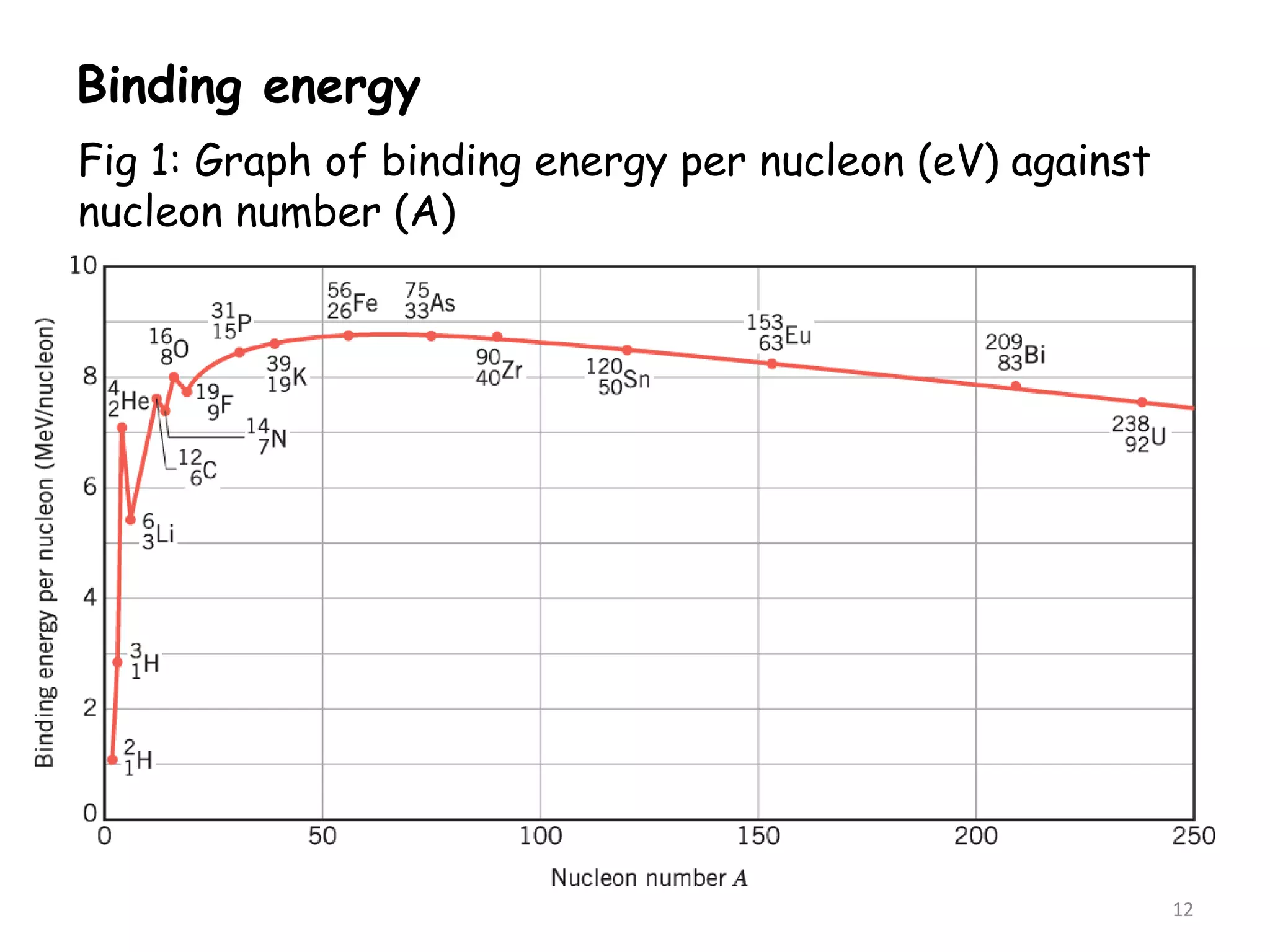
Fig 1: Graph of binding energy per nucleon (eV) against
nucleon number (A)
Binding energy
• Notice that binding energy per nucleon is typically
around 8 MeV
• The most stable nucleus has the highest binding
energy per nucleon.
• This is 8.79 MeV for 56
26Fe
Radioactive Decay and Binding Energy
• Unstable nucleus emits radiation and becomes more
stable.
• Daughter nucleus always has a higher binding energy
per nucleon than the parent.
• Energy is given out when a nucleus decays
• Where does it come from?
13
Radioactive Decay and Binding Energy
• Total mass of products is less than mass of parent
nucleus.
• Mass difference is released as energy – look at the
following examples:
Example 5: α-decay
• Thorium-228 decays by α-emission:
228
90Th → 224
88Ra + 4
2α
• Mass of thorium-228 nucleus = 227.97929 u
• Mass of radium-224 nucleus + α-particle
= 223.97189 u + 4.00151 u = 227.97240 u
Mass difference = 227.97929 u – 227.97340 u
= 0.00589 u = 5.49 MeV (as 1 u = 931.5 MeV)
14
Radioactive Decay and Binding Energy
• The surplus energy appears mostly as K.E. of the α-
particle.
• Radium nucleus also recoils slightly (momentum is
conserved).
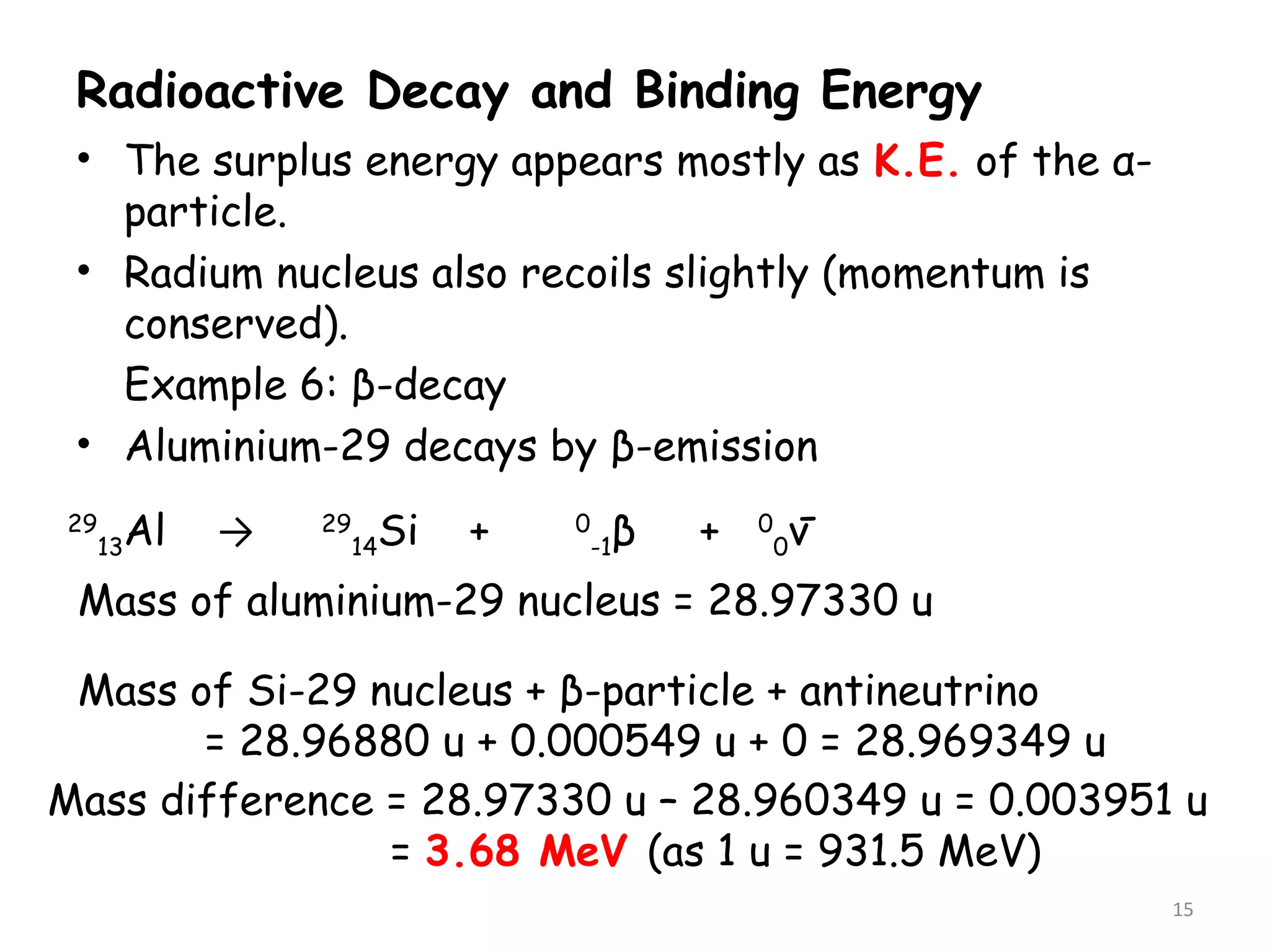
Example 6: β-decay
• Aluminium-29 decays by β-emission
15
29
13Al → 29
14Si + 0
-1β + 0
0ν-
Mass of Si-29 nucleus + β-particle + antineutrino
= 28.96880 u + 0.000549 u + 0 = 28.969349 u
Mass of aluminium-29 nucleus = 28.97330 u
Mass difference = 28.97330 u – 28.960349 u = 0.003951 u
= 3.68 MeV (as 1 u = 931.5 MeV)
Radioactive Decay and Binding Energy
• Some of this energy is carried away by a γ-ray.
• Rest becomes KE of the decay products.
Transmutation and energy
• Transmutation is conversion of one element to
another
• Radioactive decay is a spontaneous transmutation
with a release of energy.
• Some elements can be made by firing very fast
moving charged particles at a stable nucleus –
artificial transmutation. (energy must be supplied)
• First achieved by Rutherford, Marsden and Chadwick
in 1919.
16
Transmutation and energy
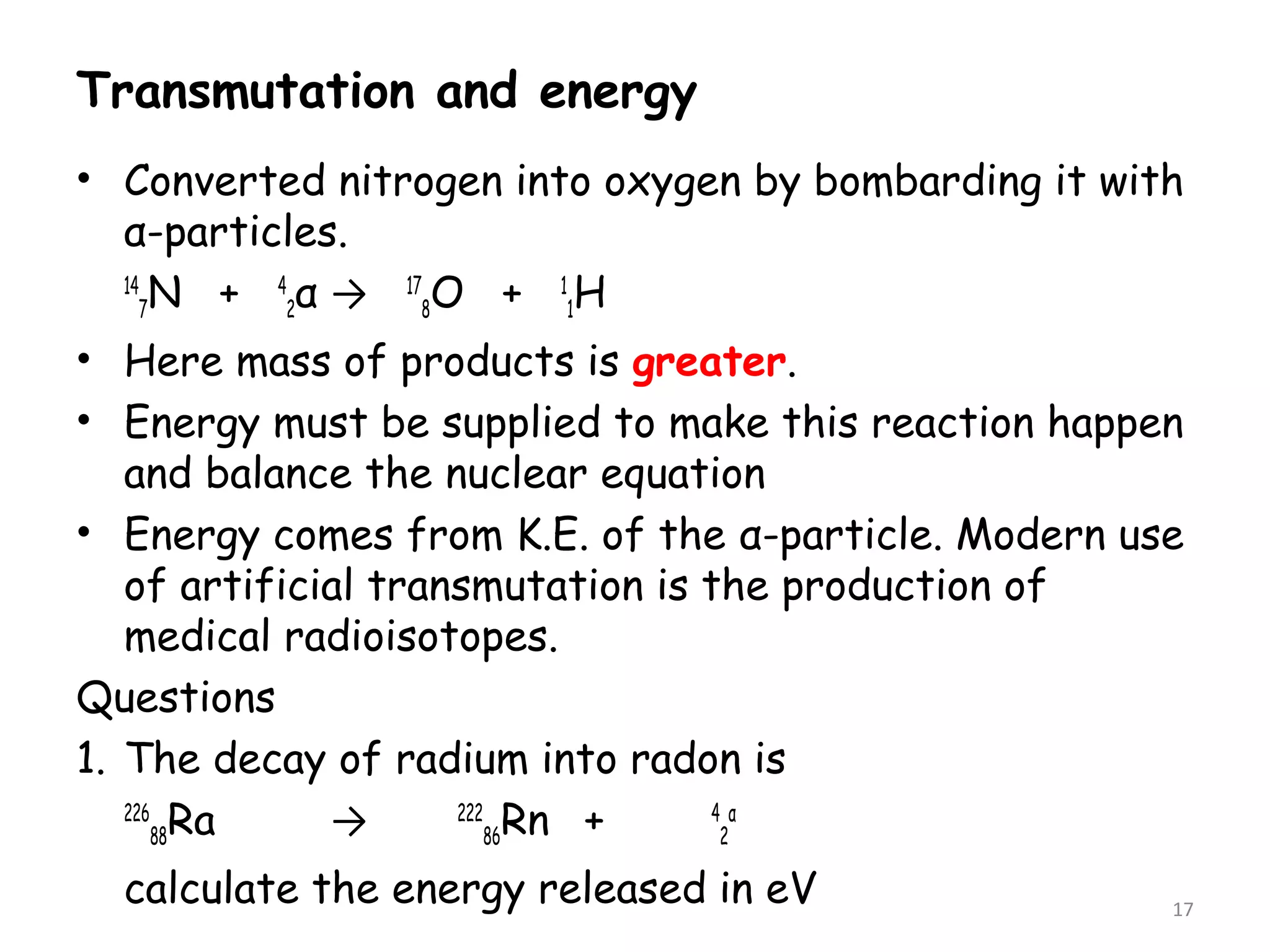
• Converted nitrogen into oxygen by bombarding it with
α-particles.
14
7N + 4
2α → 17
8O + 1
1H
• Here mass of products is greater.
• Energy must be supplied to make this reaction happen
and balance the nuclear equation
• Energy comes from K.E. of the α-particle. Modern use
of artificial transmutation is the production of
medical radioisotopes.
Questions
1. The decay of radium into radon is
226
88Ra → 222
86Rn + 4
2
α
calculate the energy released in eV 17
Questions
18
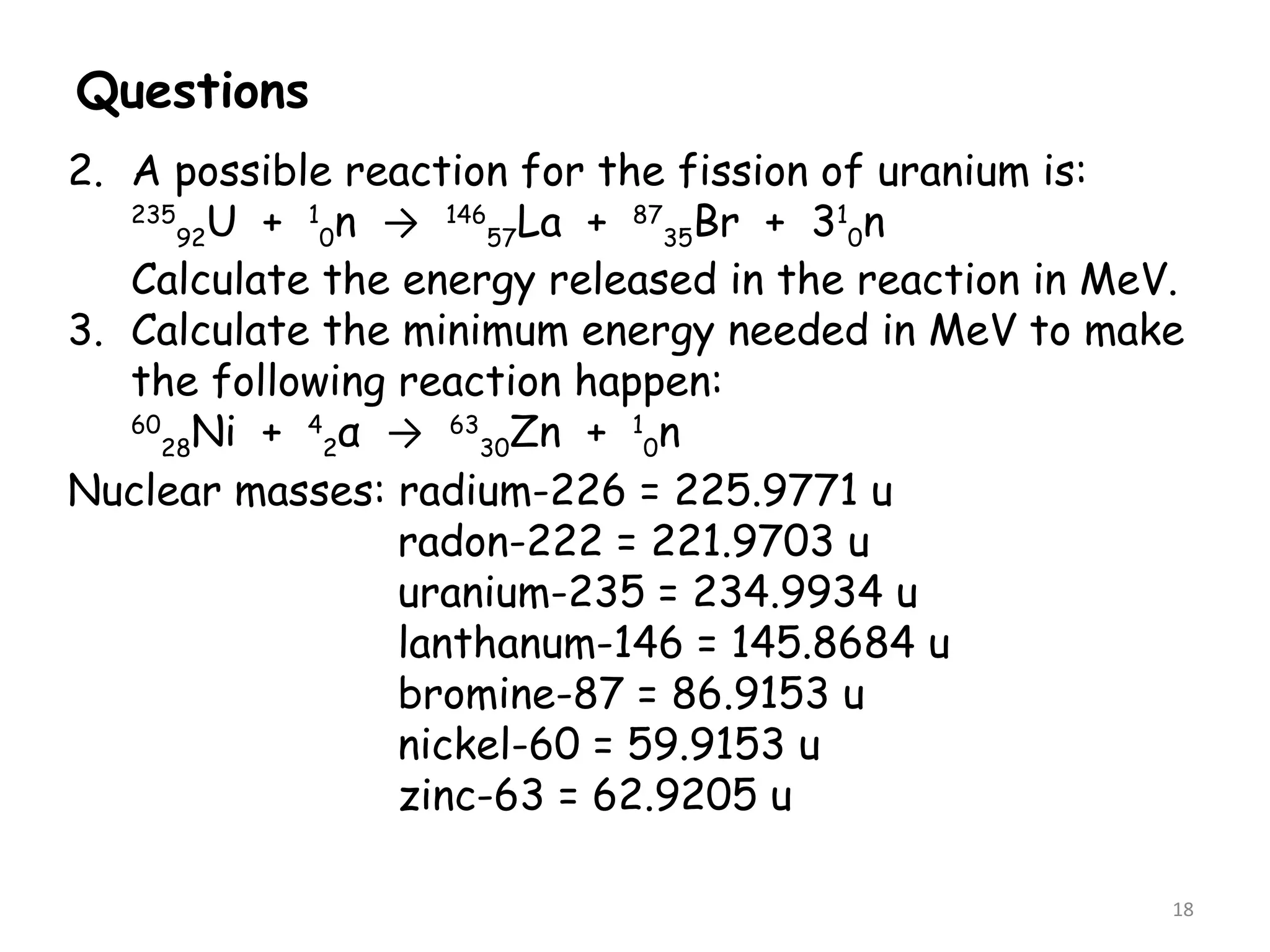
2. A possible reaction for the fission of uranium is:
235
92U + 1
0n → 146
57La + 87
35Br + 31
0n
Calculate the energy released in the reaction in MeV.
3. Calculate the minimum energy needed in MeV to make
the following reaction happen:
60
28Ni + 4
2α → 63
30Zn + 1
0n
Nuclear masses: radium-226 = 225.9771 u
radon-222 = 221.9703 u
uranium-235 = 234.9934 u
lanthanum-146 = 145.8684 u
bromine-87 = 86.9153 u
nickel-60 = 59.9153 u
zinc-63 = 62.9205 u

6 nuclear energy

  • 1.
  • 2.
    Introduction • Nuclear powerstations tap into the energy stored inside an atom’s nucleus. • Huge amounts of energy can be released. • But where does it come from and how can we get at it? Learning Outcomes: • At the end of this lesson you will be able to: 1. Explain Mass Defect 2. Calculate the energy stored by an atomic nucleus 2
  • 3.
    Missing mass –Mass Defect • A helium nucleus is made up of 2 protons and 2 neutrons. • When the mass of two protons + mass of 2 neutrons is compared with mass of helium nucleus – something very odd is seen. • The mass of the nucleus is less than the total mass of the individual particles that it contains • True for all nuclei containing more than one nucleon. • Missing mass is known as mass difference or mass defect. • Masses involved are very small – measured in atomic mass units u, where: • 1u = 1.6605 x 10⁻²⁷ kg 3
  • 4.
    Mass defect Mass (atomic massunit) Proton 1.00728 u Neutron 1.00867 u Helium nucleus 4.00151 u Table 1: Atomic mass units. Example 1. Using the data in table 1, calculate the mass defect for a helium nucleus in atomic mass units and in kilograms. Mass of 2p + 2n = (2 x 1.00728 u) + (2 x 1.00867 u) = 4.03190 u Mass defect = 4.03190 u – 4.00151 u = 0.03039 u Mass defect in kg = 0.03039 x 1.6605 x 10-27 kg = 5.046 x 10⁻²⁹ kg 4
  • 5.
    Mass defect • Amass of 5.046 x 10⁻²⁷ kg may not sound a lot – but on atomic scale it is significant. • The mass defect is about 3% of the mass of a proton (or 55 electrons) • It is important to measure nuclear masses precisely – masses are quoted to 6 significant figures. Mass and energy equivalence • Splitting the nucleus into individual nucleons results in increase of total mass. • Where does this extra mass come from? • Splitting the nucleus is very difficult – nucleons held together by a very strong but short-range nuclear forces. • Overcoming these forces requires energy 5
  • 6.
    Mass defect • Whathappens to this energy? • Energy disappears into the system and mass is created! • Goes against the conventional conservation laws. 6 Albert Einstein It was Albert Einstein who suggested that mass and energy are equivalent. He linked mass and energy in his famous equation: E = m . c 2 E is the energy equivalent in joules of a mass m in kilograms, c is the velocity of light (3.00 x 10⁸ m s-1 )
  • 7.
    7 Example 2: Calculate theenergy equivalent of the mass defect calculated in Example 1. E = m c2 = 5.046 x 10-29 kg x (3.00 x 108 m s-1 )2 = 4.54 x 10⁻¹² J (3 s.f.) This is the energy needed to separate the helium nucleus into individual protons and neutrons. 42He + 4.54 x 10⁻¹² J → 2p + 2n energy In any system, the total amount of mass and energy is conserved.
  • 8.
    Energy equivalent of1 u • Einstein’s equation uses mass in kg and energy in J. • In nuclear physics we are more likely to be working in atomic mass units (u) and electron-volts (eV) • Need to work out energy equivalent (in eV) of 1 u: • Using Einstein’s equation with a precise value for the velocity of light: • E = m c2 = 1.6605 x 10-27 kg x (2.9979 x 108 m s-1 )2 = 1.4924 x 10⁻¹⁰ J • But 1 eV = 1.6022 x 10⁻¹⁹ J • Hence E = 1.4924 x 10⁻¹⁰ J / 1.6022 x 10-19 = 9.315 x 10⁸ eV = 931.5 x 10⁶ eV • 1 u = 931.5 MeV 8
  • 9.
    9 Example 3: A carbonnucleus has a mass of 11.9967 u How much energy, in MeV, would ne needed to split it into its 6 protons and 6 neutrons? (mp = 1.00728 u, mn = 1.00867 u) Mass of 6p + 6 n = (6 x 1.00728 u) + (6 x 1.00867 u) = 12.0957 u Mass defect = 12.0957 u – 11.9967 u = 0.0990 u Energy equivalent = 0.0990 x 931.5 MeV = 92.2 MeV needed to separate the 12 nucleons. Question: Calculate the mass defect in u and kg for the following nuclei: (a)Lithium (7 3Li), nuclear mass = 7.014353 u (b)Silicon (28 14Si), nuclear mass = 27.96924 u
  • 10.
    Binding energy • Energyneeded to separate a nucleus into individual nucleons is its binding energy. • Also the energy equivalent of the mass defect – found from E = m c2 • Binding energy indicates the stability of the nucleus. • Total binding energy is linked to the size of the nucleus. • The more nucleons there are, the greater the energy needed to separate them all out. • More useful comparison is the binding energy per nucleon. • Average energy needed to remove each nucleon from the nucleus. 10
  • 11.
    11 Example 4: Use thefigures calculated in example 3 to find the binding energy per nucleon for a carbon-12 nucleus. Carbon-12 contains 12 nucleons (6p + 6n) Total binding energy for carbon-12 = 92.2 MeV Binding energy per nucleon = 92.2 MeV / 12 = 7.68 MeV Question For each of the two nuclei in question on slide 9, calculate: (a)Total binding energy in eV (b)The binding energy per nucleon in eV
  • 12.
    Binding energy 12 Fig 1:Graph of binding energy per nucleon (eV) against nucleon number (A)
  • 13.
    Binding energy • Noticethat binding energy per nucleon is typically around 8 MeV • The most stable nucleus has the highest binding energy per nucleon. • This is 8.79 MeV for 56 26Fe Radioactive Decay and Binding Energy • Unstable nucleus emits radiation and becomes more stable. • Daughter nucleus always has a higher binding energy per nucleon than the parent. • Energy is given out when a nucleus decays • Where does it come from? 13
  • 14.
    Radioactive Decay andBinding Energy • Total mass of products is less than mass of parent nucleus. • Mass difference is released as energy – look at the following examples: Example 5: α-decay • Thorium-228 decays by α-emission: 228 90Th → 224 88Ra + 4 2α • Mass of thorium-228 nucleus = 227.97929 u • Mass of radium-224 nucleus + α-particle = 223.97189 u + 4.00151 u = 227.97240 u Mass difference = 227.97929 u – 227.97340 u = 0.00589 u = 5.49 MeV (as 1 u = 931.5 MeV) 14
  • 15.
    Radioactive Decay andBinding Energy • The surplus energy appears mostly as K.E. of the α- particle. • Radium nucleus also recoils slightly (momentum is conserved). Example 6: β-decay • Aluminium-29 decays by β-emission 15 29 13Al → 29 14Si + 0 -1β + 0 0ν- Mass of Si-29 nucleus + β-particle + antineutrino = 28.96880 u + 0.000549 u + 0 = 28.969349 u Mass of aluminium-29 nucleus = 28.97330 u Mass difference = 28.97330 u – 28.960349 u = 0.003951 u = 3.68 MeV (as 1 u = 931.5 MeV)
  • 16.
    Radioactive Decay andBinding Energy • Some of this energy is carried away by a γ-ray. • Rest becomes KE of the decay products. Transmutation and energy • Transmutation is conversion of one element to another • Radioactive decay is a spontaneous transmutation with a release of energy. • Some elements can be made by firing very fast moving charged particles at a stable nucleus – artificial transmutation. (energy must be supplied) • First achieved by Rutherford, Marsden and Chadwick in 1919. 16
  • 17.
    Transmutation and energy •Converted nitrogen into oxygen by bombarding it with α-particles. 14 7N + 4 2α → 17 8O + 1 1H • Here mass of products is greater. • Energy must be supplied to make this reaction happen and balance the nuclear equation • Energy comes from K.E. of the α-particle. Modern use of artificial transmutation is the production of medical radioisotopes. Questions 1. The decay of radium into radon is 226 88Ra → 222 86Rn + 4 2 α calculate the energy released in eV 17
  • 18.
    Questions 18 2. A possiblereaction for the fission of uranium is: 235 92U + 1 0n → 146 57La + 87 35Br + 31 0n Calculate the energy released in the reaction in MeV. 3. Calculate the minimum energy needed in MeV to make the following reaction happen: 60 28Ni + 4 2α → 63 30Zn + 1 0n Nuclear masses: radium-226 = 225.9771 u radon-222 = 221.9703 u uranium-235 = 234.9934 u lanthanum-146 = 145.8684 u bromine-87 = 86.9153 u nickel-60 = 59.9153 u zinc-63 = 62.9205 u