


Wilhelm Conrad Röentgen
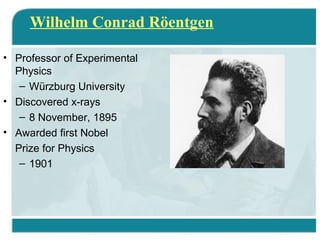
• Professor of Experimental
Physics
– Würzburg University
• Discovered x-rays
– 8 November, 1895
• Awarded first Nobel
Prize for Physics
– 1901
History of x-ray:
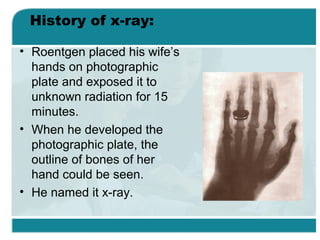
• Roentgen placed his wife’s
hands on photographic
plate and exposed it to
unknown radiation for 15
minutes.
• When he developed the
photographic plate, the
outline of bones of her
hand could be seen.
• He named it x-ray.
Nature of the atom:

• Simple substances are called elements. There are 105
elements.
• The atom is the smallest particle of an element that has
the characteristic properties of that element.
• It consists of nucleus surrounded by orbital electrons.
• The nucleus is composed of protons and neutrons and
they are called nucleons.
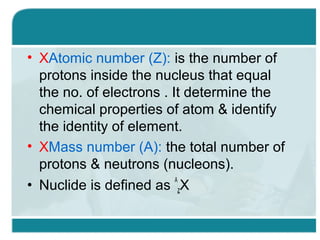
• XAtomic number (Z): is the number of
protons inside the nucleus that equal
the no. of electrons . It determine the
chemical properties of atom & identify
the identity of element.
• XMass number (A): the total number of
protons & neutrons (nucleons).
A
• Nuclide is defined as zX
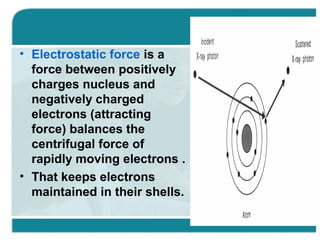
• Electrostatic force is a
force between positively
charges nucleus and
negatively charged
electrons (attracting
force) balances the
centrifugal force of
rapidly moving electrons .
• That keeps electrons
maintained in their shells.
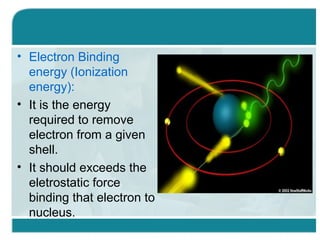
• Electron Binding
energy (Ionization
energy):
• It is the energy
required to remove
electron from a given
shell.
• It should exceeds the
eletrostatic force
binding that electron to
nucleus.
Atom (cont.)

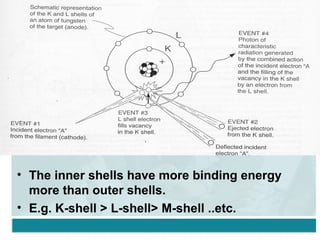
• The inner shells have more binding energy
more than outer shells.
• E.g. K-shell > L-shell> M-shell ..etc.
Ionization:
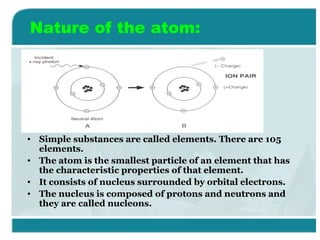
• Atom is ordinary neutral as the
number of electrons equal the number
of protons.
• If atom loses an electron, it becomes a
positive ion and free electron is a
negative ion.
• This process of forming an ion pair is
termed Ionization.
Ionization (cont.)
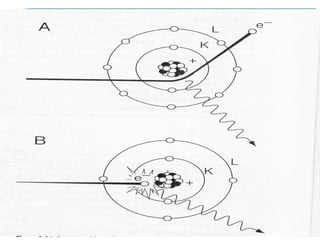
• XIonization of inner shell electrons
(K, L) require high energy to be
ejected from their orbit (X-ray,
Gamma rays or high energy particles)
.
• Ionization of electrons on outer shells
require low energy particles (ultraviolet)
Nature of radiation:
• X1- Corpuscular or particulate
radiation:
• A minute particles which have mass &
charge traveling at straight line with high
speeds.
• A- Alpha Particles: composed of Helium
nuclei (2P+2N) without orbital electrons.
• Because of their double charge & heavy
mass they loss their energy very quickly
and have shallow tissue penetration .
Nature of radiation (cont.)
• B- β- Particles:
• They are emitted from nuclei of radioactive
atoms & possess 1 unit of negative charge.
• They are more penetrating than α-particles.
• C- Cathode Rays (electrons):
• Streams of electrons passing from the hot
filament of cathode to anode target in x-ray
tube.
Nature of radiation (cont.)
• The capacity of particulate radiation to
ionize atoms depends on its ;
• Mass, velocity and charge.
• The rate of loss of energy from a
particle as it moves along its track
through matter (tissue) is called Linear
Energy Transfer (LET).
• The slower heavy particles have higher
LET.
Nature of radiation (cont.)

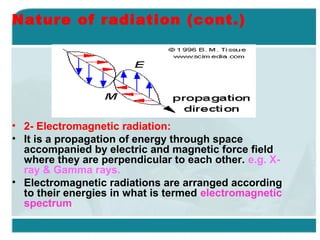
• 2- Electromagnetic radiation:
• It is a propagation of energy through space
accompanied by electric and magnetic force field
where they are perpendicular to each other. e.g. Xray & Gamma rays.
• Electromagnetic radiations are arranged according
to their energies in what is termed electromagnetic
spectrum.
Nature of radiation (cont.)

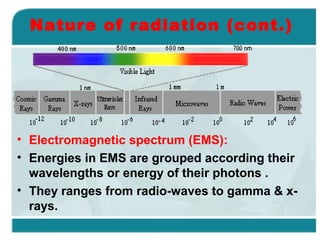
• Electromagnetic spectrum (EMS):
• Energies in EMS are grouped according their
wavelengths or energy of their photons .
• They ranges from radio-waves to gamma & xrays.
Nature of radiation (cont.)













EM radiation regard as both a particle & wave.
Particle concept:
Discrete bundle of energy → Photons
( Quanta).
Photons have no mass or weight travel in straight line & carrying EM
energy.
Wave concept:
EM radiation → Waves characterized by;
1- Velocity →speed of wave (speed of light 3×10⁸ m/s).
2- Wavelength (λ) → distance between the crest of one wave & the
crest of the next.
3- frequency (F): refers to the number of wavelengths that pass a
given point in a certain amount of time.
C= λ√ (lambda × nu)
C= velocity of light, λ= wavelength in meters, √= frequency in hertz
(cycle per second).
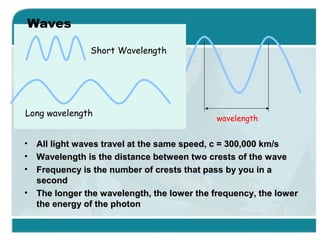
Waves
Short Wavelength

Long wavelength
•
•
•
•

wavelength

All light waves travel at the same speed, c = 300,000 km/s
Wavelength is the distance between two crests of the wave
Frequency is the number of crests that pass by you in a
second
The longer the wavelength, the lower the frequency, the lower
the energy of the photon
What are x-rays?
• XA weightless bundles of energy
(photons) without an electrical charge that
travel in waves with a specific frequency at
the speed of light. X-ray photons interact
with the materials they penetrate and
cause ionization.
Properties of x-ray
X1- x-ray are invisible and weightless.
2- They travel in straight line.
3- They travel at the speed of light.
4- They have a wide range of wavelengths.
5- They can not be focused to a point; over
distance the beam diverges like beam of
light.
Properties of x-ray (cont.)
6- due to their short wavelengths , they penetrate
materials that absorb or reflect visible light.
7- They are absorbed by matter; that depends on
atomic structure of matter and wave-length of xray.
8- They cause certain substances to fluoresce ; to
emit radiation of long wavelength (visible or
ultraviolet rays).
9- they produce biologic changes in living cells.
10- they can ionize gases and materials they
penetrate.
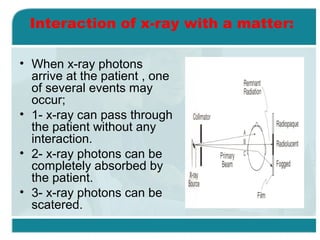
Interaction of x-ray with a matter:
• When x-ray photons
arrive at the patient , one
of several events may
occur;
• 1- x-ray can pass through
the patient without any
interaction.
• 2- x-ray photons can be
completely absorbed by
the patient.
• 3- x-ray photons can be
scatered.
Interaction of x-ray with a matter(cont.):

• At the atomic level 4 interactions could be
occur when x-ray photons interact with
matter;
• 1- No interaction.
• 2- Absorption or photoelectric effect.
• 3- Compton scatter.
• 4- Coherent scatter.
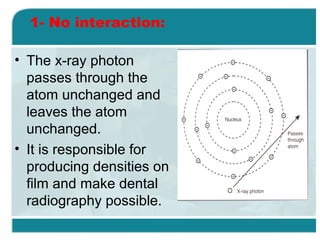
1- No interaction:
• The x-ray photon
passes through the
atom unchanged and
leaves the atom
unchanged.
• It is responsible for
producing densities on
film and make dental
radiography possible.
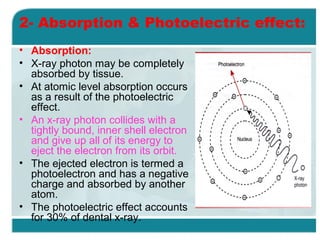
2- Absorption & Photoelectric effect:
• Absorption:
• X-ray photon may be completely
absorbed by tissue.
• At atomic level absorption occurs
as a result of the photoelectric
effect.
• An x-ray photon collides with a
tightly bound, inner shell electron
and give up all of its energy to
eject the electron from its orbit.
• The ejected electron is termed a
photoelectron and has a negative
charge and absorbed by another
atom.
• The photoelectric effect accounts
for 30% of dental x-ray.
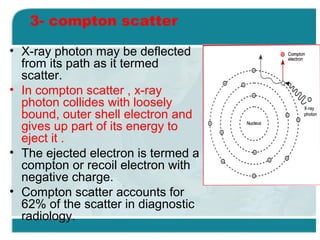
3- compton scatter
• X-ray photon may be deflected
from its path as it termed
scatter.
• In compton scatter , x-ray
photon collides with loosely
bound, outer shell electron and
gives up part of its energy to
eject it .
• The ejected electron is termed a
compton or recoil electron with
negative charge.
• Compton scatter accounts for
62% of the scatter in diagnostic
radiology.
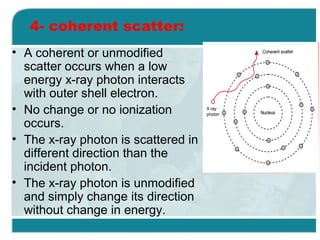
4- coherent scatter:
• A coherent or unmodified
scatter occurs when a low
energy x-ray photon interacts
with outer shell electron.
• No change or no ionization
occurs.
• The x-ray photon is scattered in
different direction than the
incident photon.
• The x-ray photon is unmodified
and simply change its direction
without change in energy.
X ray physics part I

X ray physics part I

  • 2.
    Wilhelm Conrad Röentgen •Professor of Experimental Physics – Würzburg University • Discovered x-rays – 8 November, 1895 • Awarded first Nobel Prize for Physics – 1901
  • 3.
    History of x-ray: •Roentgen placed his wife’s hands on photographic plate and exposed it to unknown radiation for 15 minutes. • When he developed the photographic plate, the outline of bones of her hand could be seen. • He named it x-ray.
  • 4.
    Nature of theatom: • Simple substances are called elements. There are 105 elements. • The atom is the smallest particle of an element that has the characteristic properties of that element. • It consists of nucleus surrounded by orbital electrons. • The nucleus is composed of protons and neutrons and they are called nucleons.
  • 5.
    • XAtomic number(Z): is the number of protons inside the nucleus that equal the no. of electrons . It determine the chemical properties of atom & identify the identity of element. • XMass number (A): the total number of protons & neutrons (nucleons). A • Nuclide is defined as zX
  • 6.
    • Electrostatic forceis a force between positively charges nucleus and negatively charged electrons (attracting force) balances the centrifugal force of rapidly moving electrons . • That keeps electrons maintained in their shells.
  • 7.
    • Electron Binding energy(Ionization energy): • It is the energy required to remove electron from a given shell. • It should exceeds the eletrostatic force binding that electron to nucleus.
  • 8.
    Atom (cont.) • Theinner shells have more binding energy more than outer shells. • E.g. K-shell > L-shell> M-shell ..etc.
  • 9.
    Ionization: • Atom isordinary neutral as the number of electrons equal the number of protons. • If atom loses an electron, it becomes a positive ion and free electron is a negative ion. • This process of forming an ion pair is termed Ionization.
  • 10.
    Ionization (cont.) • XIonizationof inner shell electrons (K, L) require high energy to be ejected from their orbit (X-ray, Gamma rays or high energy particles) . • Ionization of electrons on outer shells require low energy particles (ultraviolet)
  • 12.
    Nature of radiation: •X1- Corpuscular or particulate radiation: • A minute particles which have mass & charge traveling at straight line with high speeds. • A- Alpha Particles: composed of Helium nuclei (2P+2N) without orbital electrons. • Because of their double charge & heavy mass they loss their energy very quickly and have shallow tissue penetration .
  • 13.
    Nature of radiation(cont.) • B- β- Particles: • They are emitted from nuclei of radioactive atoms & possess 1 unit of negative charge. • They are more penetrating than α-particles. • C- Cathode Rays (electrons): • Streams of electrons passing from the hot filament of cathode to anode target in x-ray tube.
  • 14.
    Nature of radiation(cont.) • The capacity of particulate radiation to ionize atoms depends on its ; • Mass, velocity and charge. • The rate of loss of energy from a particle as it moves along its track through matter (tissue) is called Linear Energy Transfer (LET). • The slower heavy particles have higher LET.
  • 15.
    Nature of radiation(cont.) • 2- Electromagnetic radiation: • It is a propagation of energy through space accompanied by electric and magnetic force field where they are perpendicular to each other. e.g. Xray & Gamma rays. • Electromagnetic radiations are arranged according to their energies in what is termed electromagnetic spectrum.
  • 16.
    Nature of radiation(cont.) • Electromagnetic spectrum (EMS): • Energies in EMS are grouped according their wavelengths or energy of their photons . • They ranges from radio-waves to gamma & xrays.
  • 17.
    Nature of radiation(cont.)             EM radiation regard as both a particle & wave. Particle concept: Discrete bundle of energy → Photons ( Quanta). Photons have no mass or weight travel in straight line & carrying EM energy. Wave concept: EM radiation → Waves characterized by; 1- Velocity →speed of wave (speed of light 3×10⁸ m/s). 2- Wavelength (λ) → distance between the crest of one wave & the crest of the next. 3- frequency (F): refers to the number of wavelengths that pass a given point in a certain amount of time. C= λ√ (lambda × nu) C= velocity of light, λ= wavelength in meters, √= frequency in hertz (cycle per second).
  • 18.
    Waves Short Wavelength Long wavelength • • • • wavelength Alllight waves travel at the same speed, c = 300,000 km/s Wavelength is the distance between two crests of the wave Frequency is the number of crests that pass by you in a second The longer the wavelength, the lower the frequency, the lower the energy of the photon
  • 19.
    What are x-rays? •XA weightless bundles of energy (photons) without an electrical charge that travel in waves with a specific frequency at the speed of light. X-ray photons interact with the materials they penetrate and cause ionization.
  • 20.
    Properties of x-ray X1-x-ray are invisible and weightless. 2- They travel in straight line. 3- They travel at the speed of light. 4- They have a wide range of wavelengths. 5- They can not be focused to a point; over distance the beam diverges like beam of light.
  • 21.
    Properties of x-ray(cont.) 6- due to their short wavelengths , they penetrate materials that absorb or reflect visible light. 7- They are absorbed by matter; that depends on atomic structure of matter and wave-length of xray. 8- They cause certain substances to fluoresce ; to emit radiation of long wavelength (visible or ultraviolet rays). 9- they produce biologic changes in living cells. 10- they can ionize gases and materials they penetrate.
  • 22.
    Interaction of x-raywith a matter: • When x-ray photons arrive at the patient , one of several events may occur; • 1- x-ray can pass through the patient without any interaction. • 2- x-ray photons can be completely absorbed by the patient. • 3- x-ray photons can be scatered.
  • 23.
    Interaction of x-raywith a matter(cont.): • At the atomic level 4 interactions could be occur when x-ray photons interact with matter; • 1- No interaction. • 2- Absorption or photoelectric effect. • 3- Compton scatter. • 4- Coherent scatter.
  • 24.
    1- No interaction: •The x-ray photon passes through the atom unchanged and leaves the atom unchanged. • It is responsible for producing densities on film and make dental radiography possible.
  • 25.
    2- Absorption &Photoelectric effect: • Absorption: • X-ray photon may be completely absorbed by tissue. • At atomic level absorption occurs as a result of the photoelectric effect. • An x-ray photon collides with a tightly bound, inner shell electron and give up all of its energy to eject the electron from its orbit. • The ejected electron is termed a photoelectron and has a negative charge and absorbed by another atom. • The photoelectric effect accounts for 30% of dental x-ray.
  • 26.
    3- compton scatter •X-ray photon may be deflected from its path as it termed scatter. • In compton scatter , x-ray photon collides with loosely bound, outer shell electron and gives up part of its energy to eject it . • The ejected electron is termed a compton or recoil electron with negative charge. • Compton scatter accounts for 62% of the scatter in diagnostic radiology.
  • 27.
    4- coherent scatter: •A coherent or unmodified scatter occurs when a low energy x-ray photon interacts with outer shell electron. • No change or no ionization occurs. • The x-ray photon is scattered in different direction than the incident photon. • The x-ray photon is unmodified and simply change its direction without change in energy.

Editor's Notes