Total internal reflection occurs when a light ray traveling through a higher refractive index material reaches the boundary with a lower refractive index material at an angle greater than or equal to the critical angle. At this critical angle, the refracted ray travels parallel to the surface. Total internal reflection is used in optical fibers to transmit light along the fiber by repeated reflections off the inner fiber surface. Optical fibers have advantages over metal cables for data transmission as they can carry vastly more data and the signals are less susceptible to noise and tapping.
Introduction
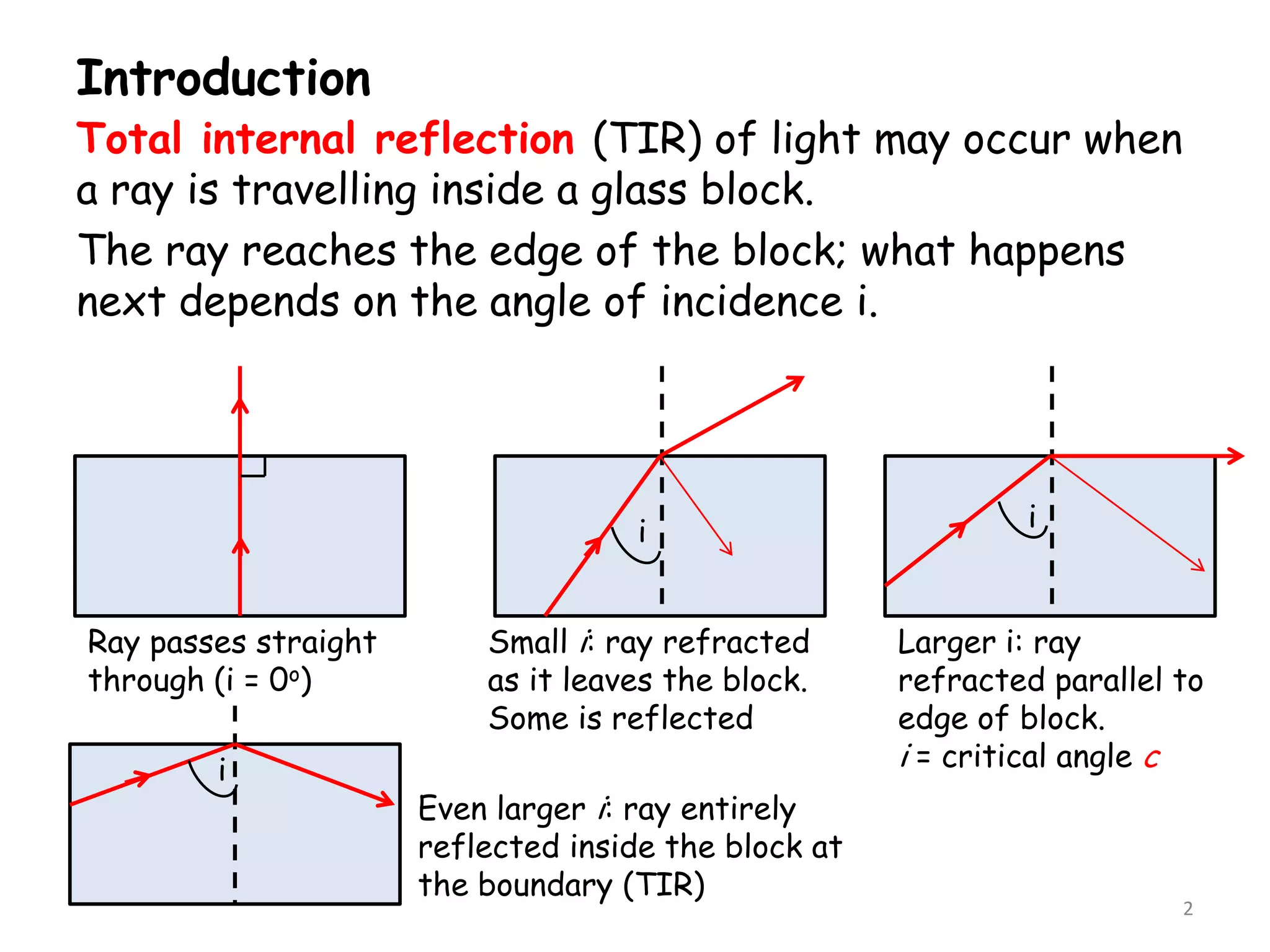
Total internal reflection(TIR) of light may occur when
a ray is travelling inside a glass block.
The ray reaches the edge of the block; what happens
next depends on the angle of incidence i.
Ray passes straight
through (i = 0o)
i i
Small i: ray refracted
as it leaves the block.
Some is reflected
Larger i: ray
refracted parallel to
edge of block.
i = critical angle ci
Even larger i: ray entirely
reflected inside the block at
the boundary (TIR)
2
3.
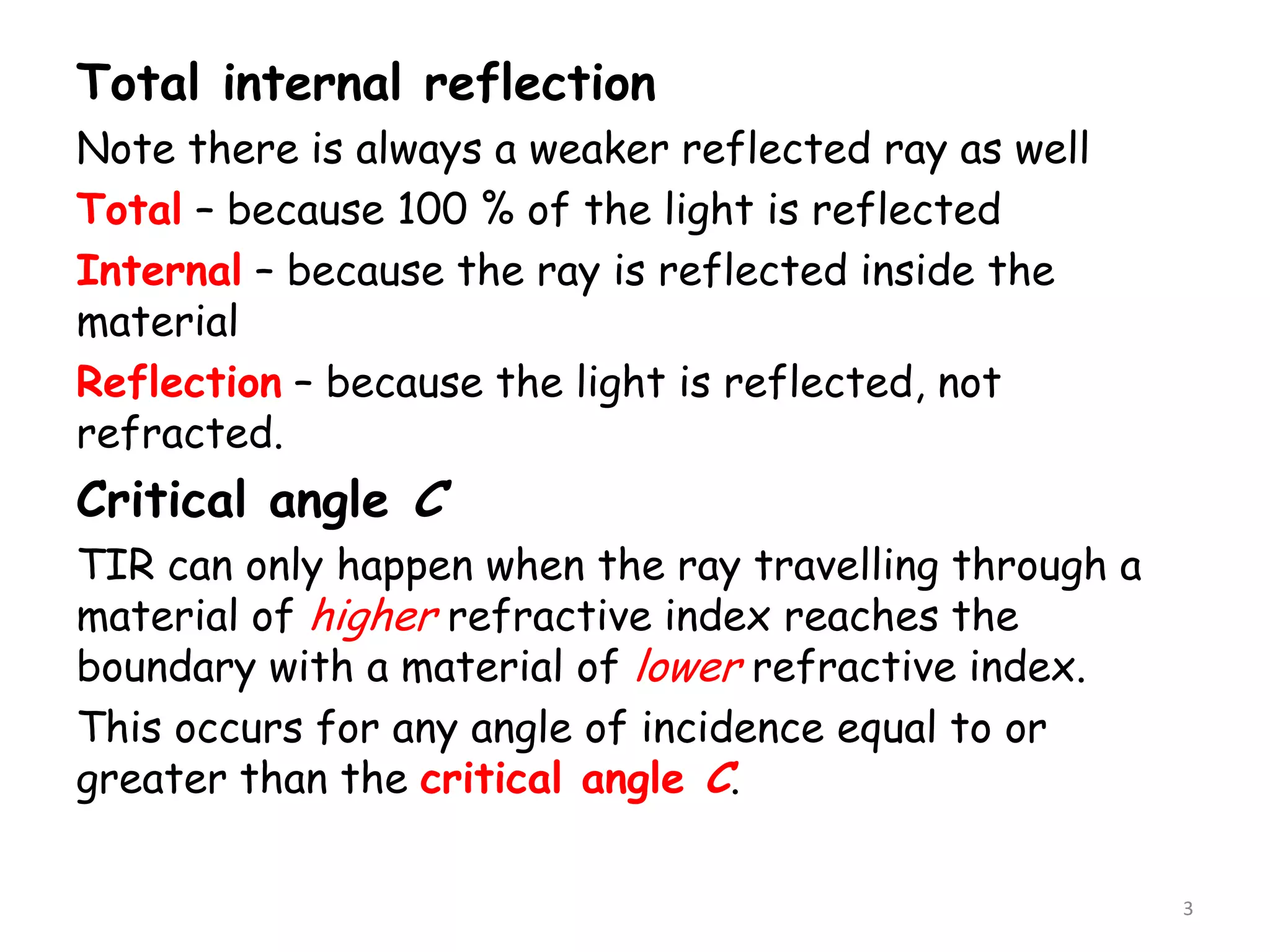
Total internal reflection
Notethere is always a weaker reflected ray as well
Total – because 100 % of the light is reflected
Internal – because the ray is reflected inside the
material
Reflection – because the light is reflected, not
refracted.
Critical angle C
TIR can only happen when the ray travelling through a
material of higher refractive index reaches the
boundary with a material of lower refractive index.
This occurs for any angle of incidence equal to or
greater than the critical angle C.
3
4.
4
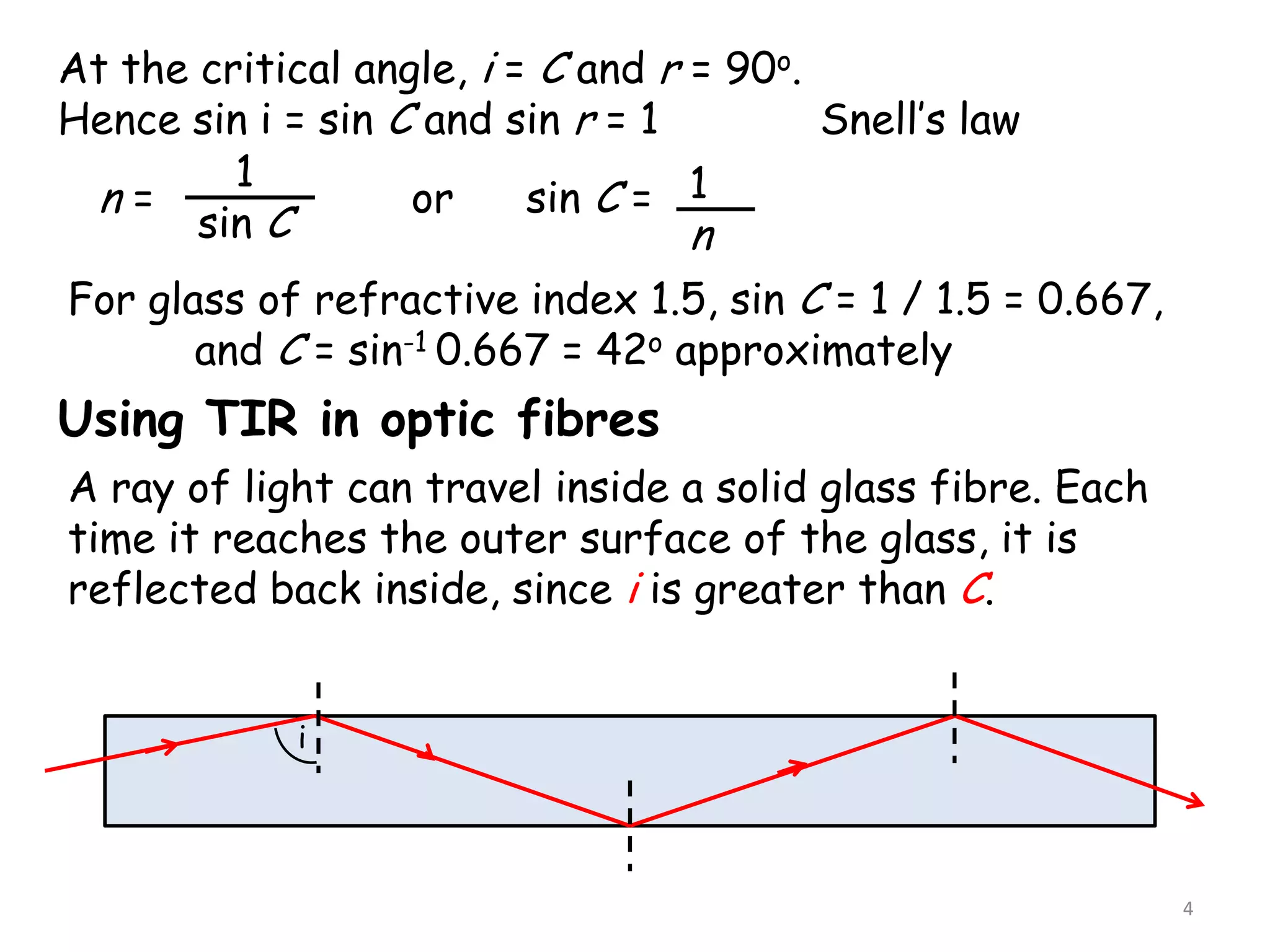
At the criticalangle, i = C and r = 90o.
Hence sin i = sin C and sin r = 1 Snell’s law
n =
1
sin C
or sin C = 1
n
For glass of refractive index 1.5, sin C = 1 / 1.5 = 0.667,
and C = sin-1 0.667 = 42o approximately
Using TIR in optic fibres
A ray of light can travel inside a solid glass fibre. Each
time it reaches the outer surface of the glass, it is
reflected back inside, since i is greater than C.
i
5.
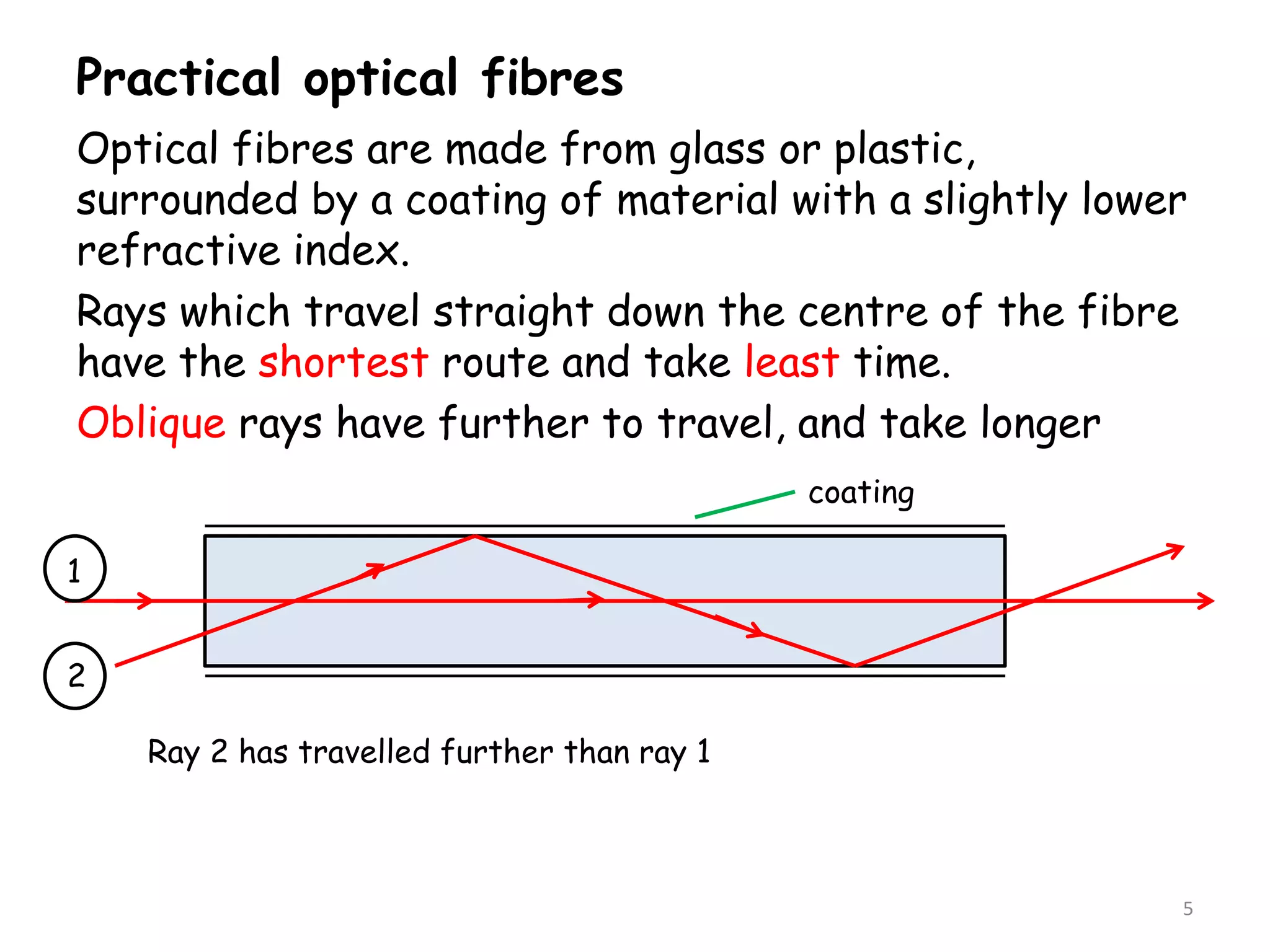
Practical optical fibres
Opticalfibres are made from glass or plastic,
surrounded by a coating of material with a slightly lower
refractive index.
Rays which travel straight down the centre of the fibre
have the shortest route and take least time.
Oblique rays have further to travel, and take longer
5
1
coating
2
Ray 2 has travelled further than ray 1
6.
Transmitting data
Optical fibrescarry data in digital form. A ray of light
from a laser is modulated (switched on and off) at high
frequency to encode the data.
Rather like Morse code.
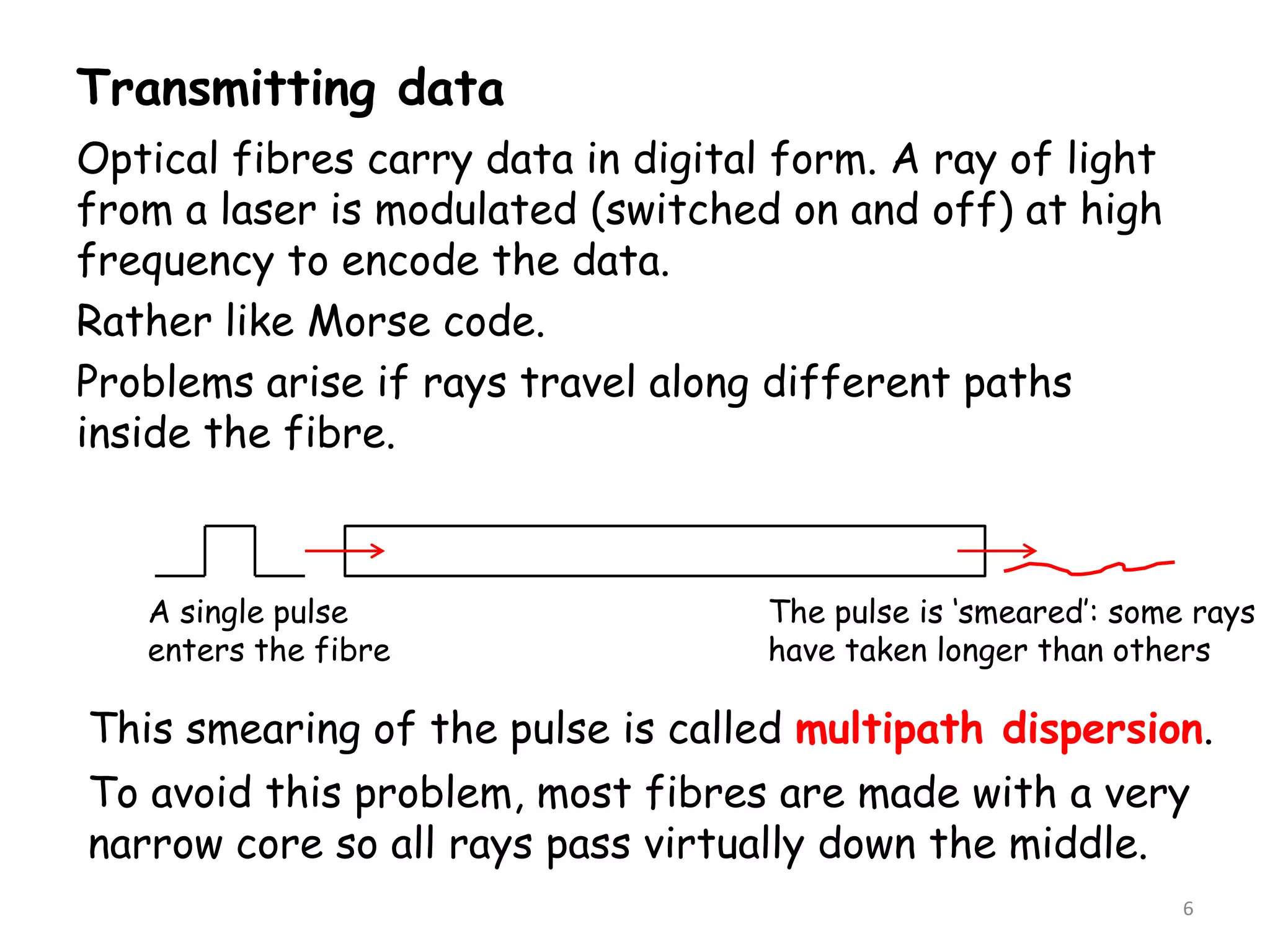
Problems arise if rays travel along different paths
inside the fibre.
6
A single pulse
enters the fibre
The pulse is ‘smeared’: some rays
have taken longer than others
This smearing of the pulse is called multipath dispersion.
To avoid this problem, most fibres are made with a very
narrow core so all rays pass virtually down the middle.
7.
Advantages of opticfibres
Optic fibres have made possible the Internet. They are
used for:
Telecommunication networks (carrying telephone
messages)
Cable television
Links between computers (for high speed data
transfers).
Digital signals are less susceptible to noise than
analogue signals.
Because of the high frequency of light, optic fibres can
carry vastly more data than a current in a cable of
comparable size.
They are very difficult to bug
7
8.
8
Because the lightis only weakly absorbed, signals can
travel many kilometres before they become so weak that
they need to be re-generated.
Questions
1. Calculate the critical angle for glass of refractive
index 1.6
2. Calculate the critical angle at the interface between
glass (n = 1.6) and water (n = 1.33)
3. Explain why the central core of an optic fibre must be
coated with a material of low refractive index.
4. Different wavelengths of light travel at different
speeds through glass. Explain why white light could not
be used for long-distance information transfer. Why is
laser light more suitable?