16 Young’s slits experiment
1
Introduction
Light shows interference.
To produce two rays, light is shone through a pair of
parallel slits.
Where the light falls on a screen beyond the slits, light
and dark interference ‘fringes’ are seen.
Single slit acts as a
narrow source of light,
shining on the double slit.
Alternatively a laser can
be shone directly on the
double slit.
2
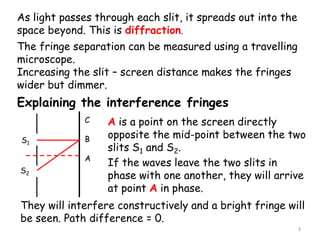
As light passes through each slit, it spreads out into the
space beyond. This is diffraction.
The fringe separation can be measured using a travelling
microscope.
Increasing the slit – screen distance makes the fringes
wider but dimmer.
Explaining the interference fringes
S1
S2
C
B
A
A is a point on the screen directly
opposite the mid-point between the two
slits S1 and S2.
If the waves leave the two slits in
phase with one another, they will arrive
at point A in phase.
They will interfere constructively and a bright fringe will
be seen. Path difference = 0.
3
B is the centre of the first dark fringe. Waves from S1
have a shorter distance to travel than light from S2.
The two waves arrive out of phase and interfere
destructively.
Path difference = S1B – S2B = λ / 2
C is the centre of the next bright fringe.
The two waves arrive in phase, but one has travelled
further than the other.
Path difference = λ
Therefore:
A bright fringe is seen where two waves arrive in
phase; path difference = nλ
A dark fringe is seen where they arrive out of phase;
path difference = (n + ½)λ
In-between positions have in-between path differences
which give rise to intermediate brightnesses. 4
Measuring the wavelength of light
The Young’s slits experiment provides a method for
determining λ, which is related to the screen distance
D, slit separation a and fringe width x by:
λ = a.x / D
It may be easier to remember the formula as:
λ.D = a.x
The largest quantity (D) multiplied by the smallest (λ)
equals the other two multiplied together.
Note that for white light, this can only give an average
value of λ since many wavelengths are present.
Laser light is monochromatic (a single wavelength) so
the fringes are cleaner and a more accurate value of λ
can be found.
5
Worked example
Laser light of wavelength 648 nm falls on a pair of slits
separated by 1.5 mm. what will be the separation of the
interference fringes seen on a screen 4.5 m away from
the slits?
Solution:
Step 1 write down what you know and what you want to
know:
λ = 648 nm, a = 1.5 mm, D = 4.5 m, x = ?
Step 2 rearrange the equation, substitute values and
solve:
6
x =
λ.D
a
=
648 x 10-9 m x 4.5 m
1.5 x 10⁻³ m
= 1.9 x 10⁻³ m
So the fringe width seen on the screen will be 1.9 mm.
Questions
1. Give the symbol and approximate size for each of
the following in the Young’s slits experiment: slit-
screen distance; slit separation; fringe separation;
wavelength of light.
2. What can you say about the path difference between
two waves which show destructive interference?
3. If the slit separation a is doubled, how will the
fringe width x be changed?
4. White light is directed onto a pair of slits separated
by 1.0 mm. interference fringes are observed on a
screen at a distance of 1.8 m. five fringes have a
width of 5.0 mm. estimate the wavelength of the
light. Why is your answer an estimate?
7

6 young’s slits experiment

  • 1.
    16 Young’s slitsexperiment 1
  • 2.
    Introduction Light shows interference. Toproduce two rays, light is shone through a pair of parallel slits. Where the light falls on a screen beyond the slits, light and dark interference ‘fringes’ are seen. Single slit acts as a narrow source of light, shining on the double slit. Alternatively a laser can be shone directly on the double slit. 2
  • 3.
    As light passesthrough each slit, it spreads out into the space beyond. This is diffraction. The fringe separation can be measured using a travelling microscope. Increasing the slit – screen distance makes the fringes wider but dimmer. Explaining the interference fringes S1 S2 C B A A is a point on the screen directly opposite the mid-point between the two slits S1 and S2. If the waves leave the two slits in phase with one another, they will arrive at point A in phase. They will interfere constructively and a bright fringe will be seen. Path difference = 0. 3
  • 4.
    B is thecentre of the first dark fringe. Waves from S1 have a shorter distance to travel than light from S2. The two waves arrive out of phase and interfere destructively. Path difference = S1B – S2B = λ / 2 C is the centre of the next bright fringe. The two waves arrive in phase, but one has travelled further than the other. Path difference = λ Therefore: A bright fringe is seen where two waves arrive in phase; path difference = nλ A dark fringe is seen where they arrive out of phase; path difference = (n + ½)λ In-between positions have in-between path differences which give rise to intermediate brightnesses. 4
  • 5.
    Measuring the wavelengthof light The Young’s slits experiment provides a method for determining λ, which is related to the screen distance D, slit separation a and fringe width x by: λ = a.x / D It may be easier to remember the formula as: λ.D = a.x The largest quantity (D) multiplied by the smallest (λ) equals the other two multiplied together. Note that for white light, this can only give an average value of λ since many wavelengths are present. Laser light is monochromatic (a single wavelength) so the fringes are cleaner and a more accurate value of λ can be found. 5
  • 6.
    Worked example Laser lightof wavelength 648 nm falls on a pair of slits separated by 1.5 mm. what will be the separation of the interference fringes seen on a screen 4.5 m away from the slits? Solution: Step 1 write down what you know and what you want to know: λ = 648 nm, a = 1.5 mm, D = 4.5 m, x = ? Step 2 rearrange the equation, substitute values and solve: 6 x = λ.D a = 648 x 10-9 m x 4.5 m 1.5 x 10⁻³ m = 1.9 x 10⁻³ m So the fringe width seen on the screen will be 1.9 mm.
  • 7.
    Questions 1. Give thesymbol and approximate size for each of the following in the Young’s slits experiment: slit- screen distance; slit separation; fringe separation; wavelength of light. 2. What can you say about the path difference between two waves which show destructive interference? 3. If the slit separation a is doubled, how will the fringe width x be changed? 4. White light is directed onto a pair of slits separated by 1.0 mm. interference fringes are observed on a screen at a distance of 1.8 m. five fringes have a width of 5.0 mm. estimate the wavelength of the light. Why is your answer an estimate? 7