‫الرحمن‬ ‫ا‬ ‫بسم‬‫الرحمن‬ ‫ا‬ ‫بسم‬
‫الرحيم‬‫الرحيم‬
COMBINEDCOMBINED
IMMUNODEFICIENCYIMMUNODEFICIENCY
Dr Tai Al Akawy
Pediatrician and Neonatologist
Alexandria University Children’s Hospital
ImmunodeficiencyImmunodeficiency
disordersdisorders
 DefinitionDefinition
Immunodeficiency- an abnormality of theImmunodeficiency- an abnormality of the
immune system that renders a personimmune system that renders a person
susceptible to diseases that is preventedsusceptible to diseases that is prevented
by a normal functioning immune systemby a normal functioning immune system
ClassificationClassification
 Primary or congenital immunodeficienciesPrimary or congenital immunodeficiencies
 Present at birthPresent at birth
 Result from genetic abnormalities in one or moreResult from genetic abnormalities in one or more
components of the immune systemcomponents of the immune system
 Secondary or acquired immunodeficienciesSecondary or acquired immunodeficiencies
 Later in lifeLater in life
 Result from infections, malnutrition, or drugsResult from infections, malnutrition, or drugs
Classified asClassified as
SECONDARY
IMMUNODEFECIENCY
.DRUGS
.INFECTIONS
HUMORAL
IMMUNITY
CELL MEDIATED
IMMUNITY
PHAGOCYTOSIS
APR-2015-CSBRP
Four Major Host DefenseFour Major Host Defense
DeficienciesDeficiencies
2.2. T-cell or combinedT-cell or combined
immunodeficienciesimmunodeficiencies
3.3. Phagocyte disordersPhagocyte disorders
4.4. Complement disordersComplement disorders
1.1. B-cell (humoral) immunodeficienciesB-cell (humoral) immunodeficiencies
Primary immunodeficienciesPrimary immunodeficiencies
APR-2015-CSBRP
CombinedCombined
ImmunodeficienciesImmunodeficiencies
are immunodeficiency disorders thatare immunodeficiency disorders that
involve multiple components ofinvolve multiple components of
the immune system, includingthe immune system, including
both humoral immunity and cell-both humoral immunity and cell-
mediated immunitymediated immunity
Functional Classification T cells/combined IdFunctional Classification T cells/combined Id..
SCIDSCID ((bubble boy diseasebubble boy disease))
 a genetic disease that results when one ofa genetic disease that results when one of
the thirteen genes involved in a molecularthe thirteen genes involved in a molecular
mechanism known asmechanism known as somatic re-somatic re-
combinationcombination is mutated.is mutated.
 Somatic recombination is responsible forSomatic recombination is responsible for
giving rise togiving rise to variable B and T cellvariable B and T cell
receptorsreceptors
It's classified to many typesIt's classified to many types
according to the mutated gene.according to the mutated gene.
 Congenital immunodeficiencies that affect bothCongenital immunodeficiencies that affect both
humoral and cell-mediated immunityhumoral and cell-mediated immunity
 characterized by deficiencies of bothcharacterized by deficiencies of both B and TB and T
cells or only of T cellscells or only of T cells;;
 in the latter cases, the defect in humoralin the latter cases, the defect in humoral
immunity isimmunity is due to the absence of T cell helpdue to the absence of T cell help..
 Children with SCID usually have infectionsChildren with SCID usually have infections
during the first year of life.during the first year of life.
Severe Combined ImmunodeficiencySevere Combined Immunodeficiency
Syndromes (SCID)Syndromes (SCID)
IntroductionIntroduction
 Severe combinedSevere combined
immunodeficiencyimmunodeficiency
(SCID) is a group of(SCID) is a group of
fatal disorder thatfatal disorder that
results in little or noresults in little or no
immune response. Theimmune response. The
disease is also calleddisease is also called
‘bubble boy’ disease.‘bubble boy’ disease.
Bubble Boy DiseaseBubble Boy Disease
 SCID is often called “bubble boy disease”.SCID is often called “bubble boy disease”.
 SCID became widely known during the 1970′s and 80′s,SCID became widely known during the 1970′s and 80′s,
when the world learned ofwhen the world learned of David VetterDavid Vetter, a boy with X-, a boy with X-
linked SCID, who lived for 12 years in a plastic, germ-linked SCID, who lived for 12 years in a plastic, germ-
free bubble.free bubble.
TYPES
TYPESTYPES
1.1. X-LINKED SEVERE COMBINEDX-LINKED SEVERE COMBINED
IMMUNODEFICIENCYIMMUNODEFICIENCY
2.2. ADENOSINE DEAMINASE DEFICIENCYADENOSINE DEAMINASE DEFICIENCY
3.3. PURINE NUCLEOSIDE PHOSPHORYLASEPURINE NUCLEOSIDE PHOSPHORYLASE
DEFICIENCYDEFICIENCY
4.4. RETICULAR DYSGENESISRETICULAR DYSGENESIS
5.5. OMENN SYNDROMEOMENN SYNDROME
6.6. BARE LYMPHOCYTE SYNDROMEBARE LYMPHOCYTE SYNDROME
7.7. JANUS KINASE-3 (JAK3)JANUS KINASE-3 (JAK3)
8.8. ARTEMIS/DCLRE1CARTEMIS/DCLRE1C
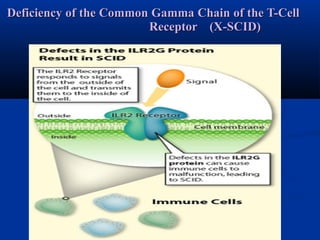
X-Linked SCID: Common CytokineX-Linked SCID: Common Cytokine
Receptor Gamma Chain (gc) DeficiencyReceptor Gamma Chain (gc) Deficiency
 Most common form of SCID (40%)Most common form of SCID (40%)
 Responsible gene:Responsible gene: γγcc– the common subunit of– the common subunit of
receptors forreceptors for IL-2, IL-4, IL-7, IL-9, and IL-15IL-2, IL-4, IL-7, IL-9, and IL-15
 Very low T cells and NK cellsVery low T cells and NK cells with low to normalwith low to normal
numbers of B cellsnumbers of B cells
X-SCIDX-SCID
 This type of SCID is caused by a mutationThis type of SCID is caused by a mutation
occurring in theoccurring in the xq13.1 locusxq13.1 locus of the X-of the X-
chromosome.chromosome.
Deficiency of the Common Gamma Chain of the T-CellDeficiency of the Common Gamma Chain of the T-Cell
Receptor (X-SCID)Receptor (X-SCID)
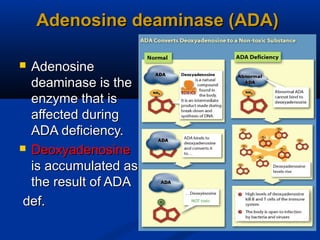
Adenosine deaminase (ADA)Adenosine deaminase (ADA)
 AdenosineAdenosine
deaminase is thedeaminase is the
enzyme that isenzyme that is
affected duringaffected during
ADA deficiency.ADA deficiency.
 DeoxyadenosineDeoxyadenosine
is accumulated asis accumulated as
the result of ADAthe result of ADA
def.def.
Adenosine Deaminase DeficiencyAdenosine Deaminase Deficiency
Babies with this type of SCID haveBabies with this type of SCID have the lowestthe lowest
total lymphocyte counts of alltotal lymphocyte counts of all, and, and T, B andT, B and
NK-lymphocyte counts are all very lowNK-lymphocyte counts are all very low..
This form of SCID is inherited asThis form of SCID is inherited as anan
autosomal recessiveautosomal recessive trait.trait.
Lack of the ADA enzyme also leads toLack of the ADA enzyme also leads to neurologicalneurological
problemsproblems such assuch as
-cognitive impairment-cognitive impairment
-hearing and visual impairment-hearing and visual impairment
-low muscle tone and movement disorders.-low muscle tone and movement disorders.
The neurological problems areThe neurological problems are notnot fully curable byfully curable by
bone marrow transplantationbone marrow transplantation
Gene was identified in 1992Gene was identified in 1992
Purine nucleoside phosphorylasePurine nucleoside phosphorylase
(PNP) deficiency(PNP) deficiency
 PNP is a key enzyme in the purinePNP is a key enzyme in the purine
salvage pathwaysalvage pathway
 PNP deficiency is a combinedPNP deficiency is a combined
immunodeficiency caused by mutations inimmunodeficiency caused by mutations in
the enzyme PNPthe enzyme PNP
 and subsequentand subsequent accumulation of purineaccumulation of purine
metabolitesmetabolites such as deoxyguanosinesuch as deoxyguanosine
Purine nucleoside phosphorylasePurine nucleoside phosphorylase
(PNP) deficiency(PNP) deficiency
 Patients typically present withPatients typically present with recurrentrecurrent
infectionsinfections,, autoimmunityautoimmunity andand ataxiaataxia..
 Presentation may be delayed beyond 1–2Presentation may be delayed beyond 1–2
years of lifeyears of life
 An autosomal recessiveAn autosomal recessive traittrait
 PNP deficiency isPNP deficiency is a rarea rare disease with andisease with an
estimated frequency of 4% amongestimated frequency of 4% among
patients with SCIDpatients with SCID
Severe Combined ImmunodeficiencySevere Combined Immunodeficiency
 Presentation usually< 6 mo agePresentation usually< 6 mo age
 Opportunistis infections and recurrentOpportunistis infections and recurrent
pyogenic infections, chronicpyogenic infections, chronic
diarrhea , FTT, eczemadiarrhea , FTT, eczema
 Male: female 4:1 (most commonMale: female 4:1 (most common
form is X-linked)form is X-linked)
 Often fatal befor 1 year of age if untreatedOften fatal befor 1 year of age if untreated
Other Forms of severe combinedOther Forms of severe combined
ImmunodeficiencyImmunodeficiency
Deficiency of the Alpha Chain of the IL-7 ReceptorDeficiency of the Alpha Chain of the IL-7 Receptor
This form of SCID is due to mutations in a gene thatThis form of SCID is due to mutations in a gene that
encodes the alpha chain of the IL-7 receptor (IL-7Rα).encodes the alpha chain of the IL-7 receptor (IL-7Rα).
 Infants with this typeInfants with this type have B- cells and NK-cellshave B- cells and NK-cells, but, but no T-no T-
cells.cells.
However, the B-cells do not work because of the lack of T-However, the B-cells do not work because of the lack of T-
cells.cells.
 IL-7Rα deficiency isIL-7Rα deficiency is the third most commonthe third most common cause of SCIDcause of SCID
accounting for 11% of SCID cases.accounting for 11% of SCID cases.
It is inheritedIt is inherited as an autosomal recessive traitas an autosomal recessive trait..
Deficiency of Janus Kinase 3Deficiency of Janus Kinase 3
 It is a defect in the cytokine receptors and their signalingIt is a defect in the cytokine receptors and their signaling..
Janus kinase 3, a tyrosine kinase that belongs to the Janus family.Janus kinase 3, a tyrosine kinase that belongs to the Janus family.
 JAK3 functions inJAK3 functions in signal transductionsignal transduction and interacts with members ofand interacts with members of
the STAT family.the STAT family.
This enzyme isThis enzyme is necessary for function γcnecessary for function γc..
 Thus, when T, B and NK-lymphocyte counts are done,Thus, when T, B and NK-lymphocyte counts are done,
they arethey are T-, B+, NK-T-, B+, NK-..
Since this form of SCID is inherited asSince this form of SCID is inherited as an autosomal recessivean autosomal recessive traittrait
both boys and girls can be affected.both boys and girls can be affected.
 T- , B-, NK+T- , B-, NK+
 10% of SCID genes identified in 198910% of SCID genes identified in 1989
 RAG1 and RAG2 form a hetero-dimer thatRAG1 and RAG2 form a hetero-dimer that
is required tois required to initiate VDJ recombinationinitiate VDJ recombination inin
order to generateorder to generate diverse repertoires of Tdiverse repertoires of T
and B cell receptorsand B cell receptors capable ofcapable of
recognizing a wide range of pathogenrecognizing a wide range of pathogen
epitopesepitopes
RAG1 and RAG2 Deficiency- ARRAG1 and RAG2 Deficiency- AR
SCIDS DefectSCIDS Defect
RAG1 and RAG2 Deficiency- ARRAG1 and RAG2 Deficiency- AR
 Moderate lymphopenia (mean ALC 1000)Moderate lymphopenia (mean ALC 1000)
 Amino acid substitutions can causeAmino acid substitutions can cause
Omenn SyndromeOmenn Syndrome ((SCID with hyper-SCID with hyper-
eosinophiliaeosinophilia))
 Omenn syndrome is the type results whenOmenn syndrome is the type results when
RAG coding gene is mutatedRAG coding gene is mutated
Omenn syndromeOmenn syndrome
 poorly functional Th2 cells producepoorly functional Th2 cells produce
elevated levels of IL-4 and IL-5 whichelevated levels of IL-4 and IL-5 which
 lead tolead to hypereosinophiliahypereosinophilia and despite theand despite the
absence of B cells, increased serumabsence of B cells, increased serum
levels oflevels of IgEIgE..
Omenn syndromeOmenn syndrome
 also characterized byalso characterized by lymphadenopathylymphadenopathy
andand hepatosplenomegalyhepatosplenomegaly which arewhich are
problems unusual in other types of SCID.problems unusual in other types of SCID.
 Patients also suffer from alopecia and anPatients also suffer from alopecia and an
exudative erythrodermiaexudative erythrodermia that is associatedthat is associated
with episodes ofwith episodes of Staphylococcus aureusStaphylococcus aureus
sepsis.sepsis.
Bare-lymphocyte syndromeBare-lymphocyte syndrome
Condition caused by mutations in certain genes of theCondition caused by mutations in certain genes of the
major histocompatibility complex.major histocompatibility complex.
Without these molecules, the patient’s lymphocytesWithout these molecules, the patient’s lymphocytes
cannot participate in cellular interactions with T helper cellscannot participate in cellular interactions with T helper cells..
This includes defective interaction between a 5’ promoterThis includes defective interaction between a 5’ promoter
sequence of the gene forsequence of the gene for the class II MHC moleculethe class II MHC molecule and aand a
DNA-binding protein necessary for gene transcriptionDNA-binding protein necessary for gene transcription..
Bare-lymphocyte syndromeBare-lymphocyte syndrome
 TAP complex, the peptide transporterTAP complex, the peptide transporter
associated with antigen presentationassociated with antigen presentation
causing (causing (TAP deficiency syndromeTAP deficiency syndrome))..
 Bare lymphocyte syndrome (BLS) isBare lymphocyte syndrome (BLS) is
characterized by a severe down-regulationcharacterized by a severe down-regulation
of HLA class I and/or class II moleculesof HLA class I and/or class II molecules
 In type 1 BLS the defect is confined toIn type 1 BLS the defect is confined to
HLA class I molecules,HLA class I molecules,
 while in type 2 BLS HLA class II moleculeswhile in type 2 BLS HLA class II molecules
are down-regulated .are down-regulated .
 Characterization of 22 patients with type 1Characterization of 22 patients with type 1
BLS over the last 22 years has revealedBLS over the last 22 years has revealed
the existence of several clinically andthe existence of several clinically and
immunologically distinct disease subsets.immunologically distinct disease subsets.
Reticular dysgenesis
•Is a rare genetic disorder of the bone marrow resulting in
complete absence of granulocytes and decreased number or
abnormal lymphocytes.
• Production of red blood cells (erythrocytes) and megakaryocytes
(platelet precursors) is not affected.
•There is also poor development of the secondary lymphoid organ.
•The cause of reticular dysgenesis is the inability of granulocyte
precursors to form granules secondary to mitochondrial adenylate
kinase 2 mutation
Common Features of Severe CombinedCommon Features of Severe Combined
Immunodeficiency (SCID)Immunodeficiency (SCID)
 Failure to thriveFailure to thrive
 Onset of infections in the neonatalOnset of infections in the neonatal
periodperiod
 Opportunistic infectionsOpportunistic infections
 Chronic or recurrent thrushChronic or recurrent thrush
 Chronic rashesChronic rashes
 Chronic or recurrent diarrheaChronic or recurrent diarrhea
 Paucity of lymphoid tissuePaucity of lymphoid tissue
Clinical Presentation of SevereClinical Presentation of Severe
Combined Immune DeficiencyCombined Immune Deficiency
 Children with SCID may develop infections caused byChildren with SCID may develop infections caused by organisms ororganisms or
vaccines.vaccines.
 Among the most dangerous is an organism calledAmong the most dangerous is an organism called PneumocystisPneumocystis
jirovecijiroveci, which can cause a rapidly fatal pneumonia (PCP) if not, which can cause a rapidly fatal pneumonia (PCP) if not
diagnosed and treated promptly.diagnosed and treated promptly.
 Another dangerous organism is the chicken pox virus (Another dangerous organism is the chicken pox virus (varicellavaricella).).
 In the patient with SCID, chicken pox can be fatal because it doesIn the patient with SCID, chicken pox can be fatal because it does
not resolve and can progress to cause infection in the lungs, livernot resolve and can progress to cause infection in the lungs, liver
and brain.and brain.
 Cytomegalovirus (Cytomegalovirus (CMVCMV), may cause fatal pneumonia in patients), may cause fatal pneumonia in patients
with SCIDwith SCID
• Other dangerous viruses for patients with SCID are the cold sore
virus (Herpes simplex), adenovirus, para influenza 3, Epstein-Barr
virus (EBV, the infectious mononucleosis virus), polioviruses,
measles virus (rubella) and rotavirus.
• Fungal infections in patients with SCID may be very difficult to treats
such as oral thrush.
• Candida pneumonia, abscesses, esophageal infection or even
meningitis may develop in patients with SCID.
• Persistent diarrhea, resulting in growth failure or malabsorption, is a
common problem in children with SCID.
• Patients with SCID may also have a rash that is mistakenly
diagnosed as eczema, but is actually caused by a reaction of the
mother’s T-cells (that entered the SCID baby’s circulation before
birth) against the baby’s tissues. This reaction is called graft-versus-
host disease (GVHD).
combinedcombined
ImmunodeficiencyImmunodeficiency
 Results from a mutation on chromosome 11Results from a mutation on chromosome 11
 Condition consists ofCondition consists of worsening ataxiaworsening ataxia (lack of(lack of
coordination) andcoordination) and telangiectasiatelangiectasia (dilated capillaries(dilated capillaries
and arterioles) on the skin and conjunctiva.and arterioles) on the skin and conjunctiva.
 Children have reduced levels ofChildren have reduced levels of IgA, IgE, and IgGIgA, IgE, and IgG,,
andand decreased ratiodecreased ratio of CD4of CD4++
helper T cells to CD8helper T cells to CD8++
cells.cells.
 Children are prone to recurrent upper and lowerChildren are prone to recurrent upper and lower
respiratory infections andrespiratory infections and an increased risk ofan increased risk of
malignancy.malignancy.
 Death from lymphoma is commonDeath from lymphoma is common
Ataxia Telangiectasia
TELANGIECTASIS
Wiskott-Aldrich SyndromeWiskott-Aldrich Syndrome
 X-linkedX-linked, combined immune deficiency, combined immune deficiency
 Thrombocytopenia, eczema and recurrent infectionsThrombocytopenia, eczema and recurrent infections
 Sinopulmonary, herpes group viruses andSinopulmonary, herpes group viruses and
occasionally Pneumocystisoccasionally Pneumocystis
 Few, small plateletsFew, small platelets;; elevated IgEelevated IgE,, reduced IgMreduced IgM
 Defect in cytoskeletal organization by WASp (wiskottDefect in cytoskeletal organization by WASp (wiskott
Aldrich Syndrome protein)Aldrich Syndrome protein)
 Wiskott-Aldrich SyndromeWiskott-Aldrich Syndrome
 Patient has decreased IgM and elevated levels of IgAPatient has decreased IgM and elevated levels of IgA
and IgE.and IgE.
 T-cell dysfunction is initially mild thenT-cell dysfunction is initially mild then
progressively worsens making child susceptible toprogressively worsens making child susceptible to
Hodgkin’s disease and lymphomaHodgkin’s disease and lymphoma
 They are also susceptible to infections (includingThey are also susceptible to infections (including
septicemia and meningitis) caused bysepticemia and meningitis) caused by encapsulatedencapsulated
microorganismsmicroorganisms
 Signs and symptomsSigns and symptoms::
 eczemaeczema
 chronic infectionschronic infections
 low platelet countslow platelet counts
X-linked lymphoproliferative disorderX-linked lymphoproliferative disorder
(XLP or Duncan Disease)(XLP or Duncan Disease)
 1 in 100,00001 in 100,0000
 Age of onsetAge of onset: 2.5 yrs old, older reported: 2.5 yrs old, older reported
 Unique predisposition to uncontrolled infection withUnique predisposition to uncontrolled infection with
Epstein Barr virusEpstein Barr virus
 EBV inducesEBV induces
- fatal/severe infectious mononucleosisfatal/severe infectious mononucleosis
- Secondary agammaglobulinemiaSecondary agammaglobulinemia
- LymphomaLymphoma
- Bone marrow failureBone marrow failure
 Defect in SAP-Defect in SAP- interferesinterferes withwith NKNK andand CD8+ CTLCD8+ CTL
functionfunction
-- Classified as aClassified as a phagocytic disorderphagocytic disorder, but most likely, but most likely
representsrepresents an abnormality of T cellan abnormality of T cell functionfunction (dysregulated(dysregulated
cytokine & Igcytokine & IgEE production)production)
-- Candida infections and infections due to pneumocystis,Candida infections and infections due to pneumocystis,
cryptocoocuscryptocoocus
-- Recurrent pyogenic infections with massively elevated IgRecurrent pyogenic infections with massively elevated IgEE
levelslevels
-- Recurrent sinopulmonary infections,Recurrent sinopulmonary infections, pneumatoceles,pneumatoceles,
severe atopic dermatitissevere atopic dermatitis
-- S.aureusS.aureus most common pathogenmost common pathogen
Hyper-IgE syndrome (JobHyper-IgE syndrome (Job
syndrome)syndrome)
LABORATORY EVALUATION OFLABORATORY EVALUATION OF
IMMUNODEFICIENCY DISORDERSIMMUNODEFICIENCY DISORDERS
 Routine investigationsRoutine investigations::
 Total and differential leucocyte countsTotal and differential leucocyte counts
 Absolute lymphocyte countAbsolute lymphocyte count
Normal result rules out T- cell defectNormal result rules out T- cell defect
 Platelet count and morphologyPlatelet count and morphology
Normal result rules out WASNormal result rules out WAS
Screening testsScreening tests
DiagnosisDiagnosis
TreatmentTreatment
 Bone marrow transplantBone marrow transplant, which, which
provides a new immune system to theprovides a new immune system to the
patient.patient.
 Gene therapyGene therapy treatment of SCID hastreatment of SCID has
also been successful in clinical trials,also been successful in clinical trials,
but not without complications.but not without complications.
 Enzyme replacementEnzyme replacement therapy.therapy.
Treatment for SCIDTreatment for SCID
 Preventing infectionsPreventing infections
 Live Virus Vaccines And Non-IrradiatedLive Virus Vaccines And Non-Irradiated
Blood Are Dangerous.Blood Are Dangerous.
 Enzyme therapy for ADA deficiency SCIDEnzyme therapy for ADA deficiency SCID
The standard treatment for ADA deficiency SCID isThe standard treatment for ADA deficiency SCID is
treatment with a form of the ADA enzyme calledtreatment with a form of the ADA enzyme called PEG-PEG-
ADAADA..
Treatment with PEG-ADA is effective in about 90% ofTreatment with PEG-ADA is effective in about 90% of
children. However, despite PEG-ADA therapy, somechildren. However, despite PEG-ADA therapy, some
children continue to requirechildren continue to require IVIG treatmentsIVIG treatments..
Stem cell transplantationStem cell transplantation
 The most common treatmentThe most common treatment forfor SCIDSCID
isis STEM CELL TRANSPLANTATIONSTEM CELL TRANSPLANTATION, which has, which has
been successful using either a matched relatedbeen successful using either a matched related
or unrelated donor, or a half matched donor, whoor unrelated donor, or a half matched donor, who
would be either parent.would be either parent.
 HLA-matched bone marrow or cord bloodHLA-matched bone marrow or cord blood
transplantation fromtransplantation from unrelated donorsunrelated donors hashas
also been used successfully to treat SCID,also been used successfully to treat SCID,
andand
the immune reconstitution after these typesthe immune reconstitution after these types
of transplants is often better than when aof transplants is often better than when a
half-matched parent is a donorhalf-matched parent is a donor
Gene therapyGene therapy
 Gene therapy has been attempted as an alternativeGene therapy has been attempted as an alternative
to the bone marrow transplant.to the bone marrow transplant.
 Transduction of the missing gene to hematopoieticTransduction of the missing gene to hematopoietic
stem cellsstem cells using viral vectors is being tested in ADAusing viral vectors is being tested in ADA
SCID and X-linked SCID.SCID and X-linked SCID.
 In 1990, four-year-oldIn 1990, four-year-old Ashanthi DeSilvaAshanthi DeSilva became thebecame the
first patient to undergo successful gene therapy.first patient to undergo successful gene therapy.
Gene therapyGene therapy
TREATMENT FOR SCIDTREATMENT FOR SCID
APR-2015-CSBRP
APR-2015-CSBRP
APR-2015-CSBRP
Characteristic T- cell defect B- cell defect Granulocyte defect Complement defect
Age of onset of
infection
Early; 2-6 months After 5-7 months Early onset at birth Any age
Specific pathogens Mycobacteria,
Viruses, Fungus like
Candida and
parasites
Pyogenic bacteria
mainly Streptococci,
Staphylococci
Hemophilus
enteroviruses
Bacteria;
Staphylococcus
Pseudomonas
Klebsiella
Bacteria
Systemic effects Failure to thrive,
Extensive
mucocutaneous
Candidiasis
Recurrent
sinopulmonary
infections
Malabsorption
Enteroviral
encephalitis
Skin abscesses,
impetigo, cellulitis
Recurrent
sinopulmonary
infections
Meningitis
Special features GVHD, Post
vaccination
disseminated BCG
or Varicella
Hypocalcemic tetany
in infancy
Autoimmunity
Lymphoma
Thymoma
Post vaccination
paralytic polio
Prolonged
attachment of
umbilical cord
Poor wound healing
Autoimmune
diseases
Key PointsKey Points
 High index of suspicionHigh index of suspicion
 Thorough history and complete physicalThorough history and complete physical
examination is a mustexamination is a must
 Begin with screening testsBegin with screening tests andand
approperiate additional testing as requiredapproperiate additional testing as required
 Teach patients how toTeach patients how to avoid infectionsavoid infections andand
do required preventive measuresdo required preventive measures
 Early diagnosis and prompt treatmentEarly diagnosis and prompt treatment
could be life savingcould be life saving
ReferencesReferences
 Buckley R (2004) Molecular defects in human severe combinedBuckley R (2004) Molecular defects in human severe combined
immunodeficiency and approaches to immuneimmunodeficiency and approaches to immune reconstitution. Annu Revreconstitution. Annu Rev
Immunol 22:625–655Immunol 22:625–655
 Buckley RH (1994) Breakthroughs in the understanding and therapy ofBuckley RH (1994) Breakthroughs in the understanding and therapy of
primary immunodeficiency. Pediatr Clin North Am 41:665–690primary immunodeficiency. Pediatr Clin North Am 41:665–690
 Buckley RH (2000) Primary immunodeficiency diseases due to defects inBuckley RH (2000) Primary immunodeficiency diseases due to defects in
lymphocytes. N Engl J Med1313:343-4231.lymphocytes. N Engl J Med1313:343-4231.
 Buckley RH (2004) Molecular defects in human severe combinedBuckley RH (2004) Molecular defects in human severe combined
immunodeficiency and approaches to immuneimmunodeficiency and approaches to immune reconstitution. Annu Revreconstitution. Annu Rev
Immunol 22:625–655.Immunol 22:625–655.
 Buckley RH, Schiff RI, Schiff SE, Markert ML, WilliamsBuckley RH, Schiff RI, Schiff SE, Markert ML, Williams LW, Harville TO,LW, Harville TO,
Roberts JL, Puck JM (1997)Human severe combined immunodeficiencyRoberts JL, Puck JM (1997)Human severe combined immunodeficiency
(SCID):genetic, phenotypic and functional diversity in 108 infants. J Pediatr(SCID):genetic, phenotypic and functional diversity in 108 infants. J Pediatr
130:378–387130:378–387
 Buettner R, Mora LB, Jove R (2002) Activated STAT signalingBuettner R, Mora LB, Jove R (2002) Activated STAT signaling in humanin human
tumors provides novel molecular targets for therapeutic intervention. Clintumors provides novel molecular targets for therapeutic intervention. Clin
Cancer Res 8:945–954Cancer Res 8:945–954
ReferencesReferences
 Carson DA, Carrera CJ (1990) Immunodeficiency secondaryCarson DA, Carrera CJ (1990) Immunodeficiency secondary to adenosineto adenosine
deaminase deficiency and purine nucleoside phosphorylation deficiency.deaminase deficiency and purine nucleoside phosphorylation deficiency.
Semin Hematol 27:260-269Semin Hematol 27:260-269
 Cavazzana-Calvo M, Fischer A (2007) Gene therapy forCavazzana-Calvo M, Fischer A (2007) Gene therapy for severe combinedsevere combined
immunodeficiency: are we there yet? J Clin Invest 117:1456–1465immunodeficiency: are we there yet? J Clin Invest 117:1456–1465
 Cerundolo V, de la Salle H (2006) Description of HLA class I- and CD8-Cerundolo V, de la Salle H (2006) Description of HLA class I- and CD8-
deficient patients: Insights into the function of cytotoxic T lymphocytes anddeficient patients: Insights into the function of cytotoxic T lymphocytes and
NK cells in host defense. Semin Immunol 18:330–336NK cells in host defense. Semin Immunol 18:330–336
 Classen CF, Schulz AS, Sigl-Kraetzig M, Hoffmann GF,Simmonds HA,Classen CF, Schulz AS, Sigl-Kraetzig M, Hoffmann GF,Simmonds HA,
Fairbanks L, Debatin KM, Friedrich W(2001) Successful HLA-identical boneFairbanks L, Debatin KM, Friedrich W(2001) Successful HLA-identical bone
marrow transplantation in a patient with PNP deficiency using busulfan andmarrow transplantation in a patient with PNP deficiency using busulfan and
fludarabine for conditioning. Bone Marrow Transplant 28:93-96fludarabine for conditioning. Bone Marrow Transplant 28:93-96
ReferencesReferences
 Corneo B, Moshous D, Gungor T, Wulffraat N, Philippet P, Le Deist FL,Corneo B, Moshous D, Gungor T, Wulffraat N, Philippet P, Le Deist FL,
Fischer A, de Villartay JP (2001) Identical mutations in RAG1 or RAG2Fischer A, de Villartay JP (2001) Identical mutations in RAG1 or RAG2
genes leading to defective V(D)J recombinase activity can cause either T-B-genes leading to defective V(D)J recombinase activity can cause either T-B-
severe combined immune deficiency or Omenn syndrome. Blood 97:2772–severe combined immune deficiency or Omenn syndrome. Blood 97:2772–
27762776
 de Vries E, de Bruin-Versteeg S, Comans-Bitter WM, de Groot R, Hop WC,de Vries E, de Bruin-Versteeg S, Comans-Bitter WM, de Groot R, Hop WC,
Boerma GJ, Lotgering FK, vanBoerma GJ, Lotgering FK, van Dongen JJ (2000) Longitudinal survey ofDongen JJ (2000) Longitudinal survey of
lymphocyte subpopulations in the first year of life. Pediatr Res47:528-537lymphocyte subpopulations in the first year of life. Pediatr Res47:528-537
 Fruhwirth M, Clodi K, Heitger A, Neu N (2001) Lymphocyte diversity in a 9-Fruhwirth M, Clodi K, Heitger A, Neu N (2001) Lymphocyte diversity in a 9-
year-old boy with idiopathic CD4+ T cell lymphocytopenia. Int Arch Allergyyear-old boy with idiopathic CD4+ T cell lymphocytopenia. Int Arch Allergy
Immunol 125:80-85Immunol 125:80-85
 Ishii J, Takeshita T, Kimura Y, Tada K, Kondo M, Nakamura M, Sugamura KIshii J, Takeshita T, Kimura Y, Tada K, Kondo M, Nakamura M, Sugamura K
(1994) Expression of the interleukin-2 (IL-2) receptor gamma chain on(1994) Expression of the interleukin-2 (IL-2) receptor gamma chain on
various populations in human peripheral blood. Int Immunol 6:1273–1277various populations in human peripheral blood. Int Immunol 6:1273–1277
Thank youThank you

Combined immunodeficiency

  • 1.
    ‫الرحمن‬ ‫ا‬ ‫بسم‬‫الرحمن‬‫ا‬ ‫بسم‬ ‫الرحيم‬‫الرحيم‬ COMBINEDCOMBINED IMMUNODEFICIENCYIMMUNODEFICIENCY Dr Tai Al Akawy Pediatrician and Neonatologist Alexandria University Children’s Hospital
  • 2.
    ImmunodeficiencyImmunodeficiency disordersdisorders  DefinitionDefinition Immunodeficiency- anabnormality of theImmunodeficiency- an abnormality of the immune system that renders a personimmune system that renders a person susceptible to diseases that is preventedsusceptible to diseases that is prevented by a normal functioning immune systemby a normal functioning immune system
  • 3.
    ClassificationClassification  Primary orcongenital immunodeficienciesPrimary or congenital immunodeficiencies  Present at birthPresent at birth  Result from genetic abnormalities in one or moreResult from genetic abnormalities in one or more components of the immune systemcomponents of the immune system  Secondary or acquired immunodeficienciesSecondary or acquired immunodeficiencies  Later in lifeLater in life  Result from infections, malnutrition, or drugsResult from infections, malnutrition, or drugs
  • 4.
  • 5.
  • 6.
  • 8.
    Four Major HostDefenseFour Major Host Defense DeficienciesDeficiencies 2.2. T-cell or combinedT-cell or combined immunodeficienciesimmunodeficiencies 3.3. Phagocyte disordersPhagocyte disorders 4.4. Complement disordersComplement disorders 1.1. B-cell (humoral) immunodeficienciesB-cell (humoral) immunodeficiencies
  • 9.
  • 10.
    CombinedCombined ImmunodeficienciesImmunodeficiencies are immunodeficiency disordersthatare immunodeficiency disorders that involve multiple components ofinvolve multiple components of the immune system, includingthe immune system, including both humoral immunity and cell-both humoral immunity and cell- mediated immunitymediated immunity
  • 11.
    Functional Classification Tcells/combined IdFunctional Classification T cells/combined Id..
  • 12.
    SCIDSCID ((bubble boydiseasebubble boy disease))  a genetic disease that results when one ofa genetic disease that results when one of the thirteen genes involved in a molecularthe thirteen genes involved in a molecular mechanism known asmechanism known as somatic re-somatic re- combinationcombination is mutated.is mutated.  Somatic recombination is responsible forSomatic recombination is responsible for giving rise togiving rise to variable B and T cellvariable B and T cell receptorsreceptors
  • 13.
    It's classified tomany typesIt's classified to many types according to the mutated gene.according to the mutated gene.
  • 15.
     Congenital immunodeficienciesthat affect bothCongenital immunodeficiencies that affect both humoral and cell-mediated immunityhumoral and cell-mediated immunity  characterized by deficiencies of bothcharacterized by deficiencies of both B and TB and T cells or only of T cellscells or only of T cells;;  in the latter cases, the defect in humoralin the latter cases, the defect in humoral immunity isimmunity is due to the absence of T cell helpdue to the absence of T cell help..  Children with SCID usually have infectionsChildren with SCID usually have infections during the first year of life.during the first year of life. Severe Combined ImmunodeficiencySevere Combined Immunodeficiency Syndromes (SCID)Syndromes (SCID)
  • 16.
    IntroductionIntroduction  Severe combinedSeverecombined immunodeficiencyimmunodeficiency (SCID) is a group of(SCID) is a group of fatal disorder thatfatal disorder that results in little or noresults in little or no immune response. Theimmune response. The disease is also calleddisease is also called ‘bubble boy’ disease.‘bubble boy’ disease.
  • 17.
    Bubble Boy DiseaseBubbleBoy Disease  SCID is often called “bubble boy disease”.SCID is often called “bubble boy disease”.  SCID became widely known during the 1970′s and 80′s,SCID became widely known during the 1970′s and 80′s, when the world learned ofwhen the world learned of David VetterDavid Vetter, a boy with X-, a boy with X- linked SCID, who lived for 12 years in a plastic, germ-linked SCID, who lived for 12 years in a plastic, germ- free bubble.free bubble.
  • 19.
  • 20.
    TYPESTYPES 1.1. X-LINKED SEVERECOMBINEDX-LINKED SEVERE COMBINED IMMUNODEFICIENCYIMMUNODEFICIENCY 2.2. ADENOSINE DEAMINASE DEFICIENCYADENOSINE DEAMINASE DEFICIENCY 3.3. PURINE NUCLEOSIDE PHOSPHORYLASEPURINE NUCLEOSIDE PHOSPHORYLASE DEFICIENCYDEFICIENCY 4.4. RETICULAR DYSGENESISRETICULAR DYSGENESIS 5.5. OMENN SYNDROMEOMENN SYNDROME 6.6. BARE LYMPHOCYTE SYNDROMEBARE LYMPHOCYTE SYNDROME 7.7. JANUS KINASE-3 (JAK3)JANUS KINASE-3 (JAK3) 8.8. ARTEMIS/DCLRE1CARTEMIS/DCLRE1C
  • 21.
    X-Linked SCID: CommonCytokineX-Linked SCID: Common Cytokine Receptor Gamma Chain (gc) DeficiencyReceptor Gamma Chain (gc) Deficiency  Most common form of SCID (40%)Most common form of SCID (40%)  Responsible gene:Responsible gene: γγcc– the common subunit of– the common subunit of receptors forreceptors for IL-2, IL-4, IL-7, IL-9, and IL-15IL-2, IL-4, IL-7, IL-9, and IL-15  Very low T cells and NK cellsVery low T cells and NK cells with low to normalwith low to normal numbers of B cellsnumbers of B cells
  • 23.
    X-SCIDX-SCID  This typeof SCID is caused by a mutationThis type of SCID is caused by a mutation occurring in theoccurring in the xq13.1 locusxq13.1 locus of the X-of the X- chromosome.chromosome.
  • 24.
    Deficiency of theCommon Gamma Chain of the T-CellDeficiency of the Common Gamma Chain of the T-Cell Receptor (X-SCID)Receptor (X-SCID)
  • 25.
    Adenosine deaminase (ADA)Adenosinedeaminase (ADA)  AdenosineAdenosine deaminase is thedeaminase is the enzyme that isenzyme that is affected duringaffected during ADA deficiency.ADA deficiency.  DeoxyadenosineDeoxyadenosine is accumulated asis accumulated as the result of ADAthe result of ADA def.def.
  • 26.
    Adenosine Deaminase DeficiencyAdenosineDeaminase Deficiency Babies with this type of SCID haveBabies with this type of SCID have the lowestthe lowest total lymphocyte counts of alltotal lymphocyte counts of all, and, and T, B andT, B and NK-lymphocyte counts are all very lowNK-lymphocyte counts are all very low.. This form of SCID is inherited asThis form of SCID is inherited as anan autosomal recessiveautosomal recessive trait.trait.
  • 27.
    Lack of theADA enzyme also leads toLack of the ADA enzyme also leads to neurologicalneurological problemsproblems such assuch as -cognitive impairment-cognitive impairment -hearing and visual impairment-hearing and visual impairment -low muscle tone and movement disorders.-low muscle tone and movement disorders. The neurological problems areThe neurological problems are notnot fully curable byfully curable by bone marrow transplantationbone marrow transplantation Gene was identified in 1992Gene was identified in 1992
  • 28.
    Purine nucleoside phosphorylasePurinenucleoside phosphorylase (PNP) deficiency(PNP) deficiency  PNP is a key enzyme in the purinePNP is a key enzyme in the purine salvage pathwaysalvage pathway  PNP deficiency is a combinedPNP deficiency is a combined immunodeficiency caused by mutations inimmunodeficiency caused by mutations in the enzyme PNPthe enzyme PNP  and subsequentand subsequent accumulation of purineaccumulation of purine metabolitesmetabolites such as deoxyguanosinesuch as deoxyguanosine
  • 29.
    Purine nucleoside phosphorylasePurinenucleoside phosphorylase (PNP) deficiency(PNP) deficiency  Patients typically present withPatients typically present with recurrentrecurrent infectionsinfections,, autoimmunityautoimmunity andand ataxiaataxia..  Presentation may be delayed beyond 1–2Presentation may be delayed beyond 1–2 years of lifeyears of life  An autosomal recessiveAn autosomal recessive traittrait  PNP deficiency isPNP deficiency is a rarea rare disease with andisease with an estimated frequency of 4% amongestimated frequency of 4% among patients with SCIDpatients with SCID
  • 30.
    Severe Combined ImmunodeficiencySevereCombined Immunodeficiency  Presentation usually< 6 mo agePresentation usually< 6 mo age  Opportunistis infections and recurrentOpportunistis infections and recurrent pyogenic infections, chronicpyogenic infections, chronic diarrhea , FTT, eczemadiarrhea , FTT, eczema  Male: female 4:1 (most commonMale: female 4:1 (most common form is X-linked)form is X-linked)  Often fatal befor 1 year of age if untreatedOften fatal befor 1 year of age if untreated
  • 31.
    Other Forms ofsevere combinedOther Forms of severe combined ImmunodeficiencyImmunodeficiency
  • 32.
    Deficiency of theAlpha Chain of the IL-7 ReceptorDeficiency of the Alpha Chain of the IL-7 Receptor This form of SCID is due to mutations in a gene thatThis form of SCID is due to mutations in a gene that encodes the alpha chain of the IL-7 receptor (IL-7Rα).encodes the alpha chain of the IL-7 receptor (IL-7Rα).  Infants with this typeInfants with this type have B- cells and NK-cellshave B- cells and NK-cells, but, but no T-no T- cells.cells. However, the B-cells do not work because of the lack of T-However, the B-cells do not work because of the lack of T- cells.cells.  IL-7Rα deficiency isIL-7Rα deficiency is the third most commonthe third most common cause of SCIDcause of SCID accounting for 11% of SCID cases.accounting for 11% of SCID cases. It is inheritedIt is inherited as an autosomal recessive traitas an autosomal recessive trait..
  • 33.
    Deficiency of JanusKinase 3Deficiency of Janus Kinase 3  It is a defect in the cytokine receptors and their signalingIt is a defect in the cytokine receptors and their signaling.. Janus kinase 3, a tyrosine kinase that belongs to the Janus family.Janus kinase 3, a tyrosine kinase that belongs to the Janus family.  JAK3 functions inJAK3 functions in signal transductionsignal transduction and interacts with members ofand interacts with members of the STAT family.the STAT family. This enzyme isThis enzyme is necessary for function γcnecessary for function γc..  Thus, when T, B and NK-lymphocyte counts are done,Thus, when T, B and NK-lymphocyte counts are done, they arethey are T-, B+, NK-T-, B+, NK-.. Since this form of SCID is inherited asSince this form of SCID is inherited as an autosomal recessivean autosomal recessive traittrait both boys and girls can be affected.both boys and girls can be affected.
  • 35.
     T- ,B-, NK+T- , B-, NK+  10% of SCID genes identified in 198910% of SCID genes identified in 1989  RAG1 and RAG2 form a hetero-dimer thatRAG1 and RAG2 form a hetero-dimer that is required tois required to initiate VDJ recombinationinitiate VDJ recombination inin order to generateorder to generate diverse repertoires of Tdiverse repertoires of T and B cell receptorsand B cell receptors capable ofcapable of recognizing a wide range of pathogenrecognizing a wide range of pathogen epitopesepitopes RAG1 and RAG2 Deficiency- ARRAG1 and RAG2 Deficiency- AR
  • 36.
  • 37.
    RAG1 and RAG2Deficiency- ARRAG1 and RAG2 Deficiency- AR  Moderate lymphopenia (mean ALC 1000)Moderate lymphopenia (mean ALC 1000)  Amino acid substitutions can causeAmino acid substitutions can cause Omenn SyndromeOmenn Syndrome ((SCID with hyper-SCID with hyper- eosinophiliaeosinophilia))  Omenn syndrome is the type results whenOmenn syndrome is the type results when RAG coding gene is mutatedRAG coding gene is mutated
  • 38.
    Omenn syndromeOmenn syndrome poorly functional Th2 cells producepoorly functional Th2 cells produce elevated levels of IL-4 and IL-5 whichelevated levels of IL-4 and IL-5 which  lead tolead to hypereosinophiliahypereosinophilia and despite theand despite the absence of B cells, increased serumabsence of B cells, increased serum levels oflevels of IgEIgE..
  • 39.
    Omenn syndromeOmenn syndrome also characterized byalso characterized by lymphadenopathylymphadenopathy andand hepatosplenomegalyhepatosplenomegaly which arewhich are problems unusual in other types of SCID.problems unusual in other types of SCID.  Patients also suffer from alopecia and anPatients also suffer from alopecia and an exudative erythrodermiaexudative erythrodermia that is associatedthat is associated with episodes ofwith episodes of Staphylococcus aureusStaphylococcus aureus sepsis.sepsis.
  • 40.
    Bare-lymphocyte syndromeBare-lymphocyte syndrome Conditioncaused by mutations in certain genes of theCondition caused by mutations in certain genes of the major histocompatibility complex.major histocompatibility complex. Without these molecules, the patient’s lymphocytesWithout these molecules, the patient’s lymphocytes cannot participate in cellular interactions with T helper cellscannot participate in cellular interactions with T helper cells.. This includes defective interaction between a 5’ promoterThis includes defective interaction between a 5’ promoter sequence of the gene forsequence of the gene for the class II MHC moleculethe class II MHC molecule and aand a DNA-binding protein necessary for gene transcriptionDNA-binding protein necessary for gene transcription..
  • 41.
    Bare-lymphocyte syndromeBare-lymphocyte syndrome TAP complex, the peptide transporterTAP complex, the peptide transporter associated with antigen presentationassociated with antigen presentation causing (causing (TAP deficiency syndromeTAP deficiency syndrome))..  Bare lymphocyte syndrome (BLS) isBare lymphocyte syndrome (BLS) is characterized by a severe down-regulationcharacterized by a severe down-regulation of HLA class I and/or class II moleculesof HLA class I and/or class II molecules
  • 42.
     In type1 BLS the defect is confined toIn type 1 BLS the defect is confined to HLA class I molecules,HLA class I molecules,  while in type 2 BLS HLA class II moleculeswhile in type 2 BLS HLA class II molecules are down-regulated .are down-regulated .  Characterization of 22 patients with type 1Characterization of 22 patients with type 1 BLS over the last 22 years has revealedBLS over the last 22 years has revealed the existence of several clinically andthe existence of several clinically and immunologically distinct disease subsets.immunologically distinct disease subsets.
  • 44.
    Reticular dysgenesis •Is arare genetic disorder of the bone marrow resulting in complete absence of granulocytes and decreased number or abnormal lymphocytes. • Production of red blood cells (erythrocytes) and megakaryocytes (platelet precursors) is not affected. •There is also poor development of the secondary lymphoid organ. •The cause of reticular dysgenesis is the inability of granulocyte precursors to form granules secondary to mitochondrial adenylate kinase 2 mutation
  • 46.
    Common Features ofSevere CombinedCommon Features of Severe Combined Immunodeficiency (SCID)Immunodeficiency (SCID)  Failure to thriveFailure to thrive  Onset of infections in the neonatalOnset of infections in the neonatal periodperiod  Opportunistic infectionsOpportunistic infections  Chronic or recurrent thrushChronic or recurrent thrush  Chronic rashesChronic rashes  Chronic or recurrent diarrheaChronic or recurrent diarrhea  Paucity of lymphoid tissuePaucity of lymphoid tissue
  • 47.
    Clinical Presentation ofSevereClinical Presentation of Severe Combined Immune DeficiencyCombined Immune Deficiency  Children with SCID may develop infections caused byChildren with SCID may develop infections caused by organisms ororganisms or vaccines.vaccines.  Among the most dangerous is an organism calledAmong the most dangerous is an organism called PneumocystisPneumocystis jirovecijiroveci, which can cause a rapidly fatal pneumonia (PCP) if not, which can cause a rapidly fatal pneumonia (PCP) if not diagnosed and treated promptly.diagnosed and treated promptly.  Another dangerous organism is the chicken pox virus (Another dangerous organism is the chicken pox virus (varicellavaricella).).  In the patient with SCID, chicken pox can be fatal because it doesIn the patient with SCID, chicken pox can be fatal because it does not resolve and can progress to cause infection in the lungs, livernot resolve and can progress to cause infection in the lungs, liver and brain.and brain.  Cytomegalovirus (Cytomegalovirus (CMVCMV), may cause fatal pneumonia in patients), may cause fatal pneumonia in patients with SCIDwith SCID
  • 49.
    • Other dangerousviruses for patients with SCID are the cold sore virus (Herpes simplex), adenovirus, para influenza 3, Epstein-Barr virus (EBV, the infectious mononucleosis virus), polioviruses, measles virus (rubella) and rotavirus. • Fungal infections in patients with SCID may be very difficult to treats such as oral thrush. • Candida pneumonia, abscesses, esophageal infection or even meningitis may develop in patients with SCID. • Persistent diarrhea, resulting in growth failure or malabsorption, is a common problem in children with SCID. • Patients with SCID may also have a rash that is mistakenly diagnosed as eczema, but is actually caused by a reaction of the mother’s T-cells (that entered the SCID baby’s circulation before birth) against the baby’s tissues. This reaction is called graft-versus- host disease (GVHD).
  • 51.
  • 52.
     Results froma mutation on chromosome 11Results from a mutation on chromosome 11  Condition consists ofCondition consists of worsening ataxiaworsening ataxia (lack of(lack of coordination) andcoordination) and telangiectasiatelangiectasia (dilated capillaries(dilated capillaries and arterioles) on the skin and conjunctiva.and arterioles) on the skin and conjunctiva.  Children have reduced levels ofChildren have reduced levels of IgA, IgE, and IgGIgA, IgE, and IgG,, andand decreased ratiodecreased ratio of CD4of CD4++ helper T cells to CD8helper T cells to CD8++ cells.cells.  Children are prone to recurrent upper and lowerChildren are prone to recurrent upper and lower respiratory infections andrespiratory infections and an increased risk ofan increased risk of malignancy.malignancy.  Death from lymphoma is commonDeath from lymphoma is common Ataxia Telangiectasia
  • 53.
  • 54.
    Wiskott-Aldrich SyndromeWiskott-Aldrich Syndrome X-linkedX-linked, combined immune deficiency, combined immune deficiency  Thrombocytopenia, eczema and recurrent infectionsThrombocytopenia, eczema and recurrent infections  Sinopulmonary, herpes group viruses andSinopulmonary, herpes group viruses and occasionally Pneumocystisoccasionally Pneumocystis  Few, small plateletsFew, small platelets;; elevated IgEelevated IgE,, reduced IgMreduced IgM  Defect in cytoskeletal organization by WASp (wiskottDefect in cytoskeletal organization by WASp (wiskott Aldrich Syndrome protein)Aldrich Syndrome protein)
  • 55.
     Wiskott-Aldrich SyndromeWiskott-AldrichSyndrome  Patient has decreased IgM and elevated levels of IgAPatient has decreased IgM and elevated levels of IgA and IgE.and IgE.  T-cell dysfunction is initially mild thenT-cell dysfunction is initially mild then progressively worsens making child susceptible toprogressively worsens making child susceptible to Hodgkin’s disease and lymphomaHodgkin’s disease and lymphoma  They are also susceptible to infections (includingThey are also susceptible to infections (including septicemia and meningitis) caused bysepticemia and meningitis) caused by encapsulatedencapsulated microorganismsmicroorganisms  Signs and symptomsSigns and symptoms::  eczemaeczema  chronic infectionschronic infections  low platelet countslow platelet counts
  • 56.
    X-linked lymphoproliferative disorderX-linkedlymphoproliferative disorder (XLP or Duncan Disease)(XLP or Duncan Disease)  1 in 100,00001 in 100,0000  Age of onsetAge of onset: 2.5 yrs old, older reported: 2.5 yrs old, older reported  Unique predisposition to uncontrolled infection withUnique predisposition to uncontrolled infection with Epstein Barr virusEpstein Barr virus  EBV inducesEBV induces - fatal/severe infectious mononucleosisfatal/severe infectious mononucleosis - Secondary agammaglobulinemiaSecondary agammaglobulinemia - LymphomaLymphoma - Bone marrow failureBone marrow failure  Defect in SAP-Defect in SAP- interferesinterferes withwith NKNK andand CD8+ CTLCD8+ CTL functionfunction
  • 57.
    -- Classified asaClassified as a phagocytic disorderphagocytic disorder, but most likely, but most likely representsrepresents an abnormality of T cellan abnormality of T cell functionfunction (dysregulated(dysregulated cytokine & Igcytokine & IgEE production)production) -- Candida infections and infections due to pneumocystis,Candida infections and infections due to pneumocystis, cryptocoocuscryptocoocus -- Recurrent pyogenic infections with massively elevated IgRecurrent pyogenic infections with massively elevated IgEE levelslevels -- Recurrent sinopulmonary infections,Recurrent sinopulmonary infections, pneumatoceles,pneumatoceles, severe atopic dermatitissevere atopic dermatitis -- S.aureusS.aureus most common pathogenmost common pathogen Hyper-IgE syndrome (JobHyper-IgE syndrome (Job syndrome)syndrome)
  • 58.
    LABORATORY EVALUATION OFLABORATORYEVALUATION OF IMMUNODEFICIENCY DISORDERSIMMUNODEFICIENCY DISORDERS  Routine investigationsRoutine investigations::  Total and differential leucocyte countsTotal and differential leucocyte counts  Absolute lymphocyte countAbsolute lymphocyte count Normal result rules out T- cell defectNormal result rules out T- cell defect  Platelet count and morphologyPlatelet count and morphology Normal result rules out WASNormal result rules out WAS
  • 59.
  • 60.
  • 62.
    TreatmentTreatment  Bone marrowtransplantBone marrow transplant, which, which provides a new immune system to theprovides a new immune system to the patient.patient.  Gene therapyGene therapy treatment of SCID hastreatment of SCID has also been successful in clinical trials,also been successful in clinical trials, but not without complications.but not without complications.  Enzyme replacementEnzyme replacement therapy.therapy.
  • 63.
    Treatment for SCIDTreatmentfor SCID  Preventing infectionsPreventing infections  Live Virus Vaccines And Non-IrradiatedLive Virus Vaccines And Non-Irradiated Blood Are Dangerous.Blood Are Dangerous.  Enzyme therapy for ADA deficiency SCIDEnzyme therapy for ADA deficiency SCID The standard treatment for ADA deficiency SCID isThe standard treatment for ADA deficiency SCID is treatment with a form of the ADA enzyme calledtreatment with a form of the ADA enzyme called PEG-PEG- ADAADA.. Treatment with PEG-ADA is effective in about 90% ofTreatment with PEG-ADA is effective in about 90% of children. However, despite PEG-ADA therapy, somechildren. However, despite PEG-ADA therapy, some children continue to requirechildren continue to require IVIG treatmentsIVIG treatments..
  • 64.
    Stem cell transplantationStemcell transplantation  The most common treatmentThe most common treatment forfor SCIDSCID isis STEM CELL TRANSPLANTATIONSTEM CELL TRANSPLANTATION, which has, which has been successful using either a matched relatedbeen successful using either a matched related or unrelated donor, or a half matched donor, whoor unrelated donor, or a half matched donor, who would be either parent.would be either parent.
  • 65.
     HLA-matched bonemarrow or cord bloodHLA-matched bone marrow or cord blood transplantation fromtransplantation from unrelated donorsunrelated donors hashas also been used successfully to treat SCID,also been used successfully to treat SCID, andand the immune reconstitution after these typesthe immune reconstitution after these types of transplants is often better than when aof transplants is often better than when a half-matched parent is a donorhalf-matched parent is a donor
  • 66.
    Gene therapyGene therapy Gene therapy has been attempted as an alternativeGene therapy has been attempted as an alternative to the bone marrow transplant.to the bone marrow transplant.  Transduction of the missing gene to hematopoieticTransduction of the missing gene to hematopoietic stem cellsstem cells using viral vectors is being tested in ADAusing viral vectors is being tested in ADA SCID and X-linked SCID.SCID and X-linked SCID.  In 1990, four-year-oldIn 1990, four-year-old Ashanthi DeSilvaAshanthi DeSilva became thebecame the first patient to undergo successful gene therapy.first patient to undergo successful gene therapy.
  • 67.
  • 68.
  • 69.
  • 70.
  • 71.
  • 72.
    Characteristic T- celldefect B- cell defect Granulocyte defect Complement defect Age of onset of infection Early; 2-6 months After 5-7 months Early onset at birth Any age Specific pathogens Mycobacteria, Viruses, Fungus like Candida and parasites Pyogenic bacteria mainly Streptococci, Staphylococci Hemophilus enteroviruses Bacteria; Staphylococcus Pseudomonas Klebsiella Bacteria Systemic effects Failure to thrive, Extensive mucocutaneous Candidiasis Recurrent sinopulmonary infections Malabsorption Enteroviral encephalitis Skin abscesses, impetigo, cellulitis Recurrent sinopulmonary infections Meningitis Special features GVHD, Post vaccination disseminated BCG or Varicella Hypocalcemic tetany in infancy Autoimmunity Lymphoma Thymoma Post vaccination paralytic polio Prolonged attachment of umbilical cord Poor wound healing Autoimmune diseases
  • 73.
    Key PointsKey Points High index of suspicionHigh index of suspicion  Thorough history and complete physicalThorough history and complete physical examination is a mustexamination is a must  Begin with screening testsBegin with screening tests andand approperiate additional testing as requiredapproperiate additional testing as required  Teach patients how toTeach patients how to avoid infectionsavoid infections andand do required preventive measuresdo required preventive measures  Early diagnosis and prompt treatmentEarly diagnosis and prompt treatment could be life savingcould be life saving
  • 74.
    ReferencesReferences  Buckley R(2004) Molecular defects in human severe combinedBuckley R (2004) Molecular defects in human severe combined immunodeficiency and approaches to immuneimmunodeficiency and approaches to immune reconstitution. Annu Revreconstitution. Annu Rev Immunol 22:625–655Immunol 22:625–655  Buckley RH (1994) Breakthroughs in the understanding and therapy ofBuckley RH (1994) Breakthroughs in the understanding and therapy of primary immunodeficiency. Pediatr Clin North Am 41:665–690primary immunodeficiency. Pediatr Clin North Am 41:665–690  Buckley RH (2000) Primary immunodeficiency diseases due to defects inBuckley RH (2000) Primary immunodeficiency diseases due to defects in lymphocytes. N Engl J Med1313:343-4231.lymphocytes. N Engl J Med1313:343-4231.  Buckley RH (2004) Molecular defects in human severe combinedBuckley RH (2004) Molecular defects in human severe combined immunodeficiency and approaches to immuneimmunodeficiency and approaches to immune reconstitution. Annu Revreconstitution. Annu Rev Immunol 22:625–655.Immunol 22:625–655.  Buckley RH, Schiff RI, Schiff SE, Markert ML, WilliamsBuckley RH, Schiff RI, Schiff SE, Markert ML, Williams LW, Harville TO,LW, Harville TO, Roberts JL, Puck JM (1997)Human severe combined immunodeficiencyRoberts JL, Puck JM (1997)Human severe combined immunodeficiency (SCID):genetic, phenotypic and functional diversity in 108 infants. J Pediatr(SCID):genetic, phenotypic and functional diversity in 108 infants. J Pediatr 130:378–387130:378–387  Buettner R, Mora LB, Jove R (2002) Activated STAT signalingBuettner R, Mora LB, Jove R (2002) Activated STAT signaling in humanin human tumors provides novel molecular targets for therapeutic intervention. Clintumors provides novel molecular targets for therapeutic intervention. Clin Cancer Res 8:945–954Cancer Res 8:945–954
  • 75.
    ReferencesReferences  Carson DA,Carrera CJ (1990) Immunodeficiency secondaryCarson DA, Carrera CJ (1990) Immunodeficiency secondary to adenosineto adenosine deaminase deficiency and purine nucleoside phosphorylation deficiency.deaminase deficiency and purine nucleoside phosphorylation deficiency. Semin Hematol 27:260-269Semin Hematol 27:260-269  Cavazzana-Calvo M, Fischer A (2007) Gene therapy forCavazzana-Calvo M, Fischer A (2007) Gene therapy for severe combinedsevere combined immunodeficiency: are we there yet? J Clin Invest 117:1456–1465immunodeficiency: are we there yet? J Clin Invest 117:1456–1465  Cerundolo V, de la Salle H (2006) Description of HLA class I- and CD8-Cerundolo V, de la Salle H (2006) Description of HLA class I- and CD8- deficient patients: Insights into the function of cytotoxic T lymphocytes anddeficient patients: Insights into the function of cytotoxic T lymphocytes and NK cells in host defense. Semin Immunol 18:330–336NK cells in host defense. Semin Immunol 18:330–336  Classen CF, Schulz AS, Sigl-Kraetzig M, Hoffmann GF,Simmonds HA,Classen CF, Schulz AS, Sigl-Kraetzig M, Hoffmann GF,Simmonds HA, Fairbanks L, Debatin KM, Friedrich W(2001) Successful HLA-identical boneFairbanks L, Debatin KM, Friedrich W(2001) Successful HLA-identical bone marrow transplantation in a patient with PNP deficiency using busulfan andmarrow transplantation in a patient with PNP deficiency using busulfan and fludarabine for conditioning. Bone Marrow Transplant 28:93-96fludarabine for conditioning. Bone Marrow Transplant 28:93-96
  • 76.
    ReferencesReferences  Corneo B,Moshous D, Gungor T, Wulffraat N, Philippet P, Le Deist FL,Corneo B, Moshous D, Gungor T, Wulffraat N, Philippet P, Le Deist FL, Fischer A, de Villartay JP (2001) Identical mutations in RAG1 or RAG2Fischer A, de Villartay JP (2001) Identical mutations in RAG1 or RAG2 genes leading to defective V(D)J recombinase activity can cause either T-B-genes leading to defective V(D)J recombinase activity can cause either T-B- severe combined immune deficiency or Omenn syndrome. Blood 97:2772–severe combined immune deficiency or Omenn syndrome. Blood 97:2772– 27762776  de Vries E, de Bruin-Versteeg S, Comans-Bitter WM, de Groot R, Hop WC,de Vries E, de Bruin-Versteeg S, Comans-Bitter WM, de Groot R, Hop WC, Boerma GJ, Lotgering FK, vanBoerma GJ, Lotgering FK, van Dongen JJ (2000) Longitudinal survey ofDongen JJ (2000) Longitudinal survey of lymphocyte subpopulations in the first year of life. Pediatr Res47:528-537lymphocyte subpopulations in the first year of life. Pediatr Res47:528-537  Fruhwirth M, Clodi K, Heitger A, Neu N (2001) Lymphocyte diversity in a 9-Fruhwirth M, Clodi K, Heitger A, Neu N (2001) Lymphocyte diversity in a 9- year-old boy with idiopathic CD4+ T cell lymphocytopenia. Int Arch Allergyyear-old boy with idiopathic CD4+ T cell lymphocytopenia. Int Arch Allergy Immunol 125:80-85Immunol 125:80-85  Ishii J, Takeshita T, Kimura Y, Tada K, Kondo M, Nakamura M, Sugamura KIshii J, Takeshita T, Kimura Y, Tada K, Kondo M, Nakamura M, Sugamura K (1994) Expression of the interleukin-2 (IL-2) receptor gamma chain on(1994) Expression of the interleukin-2 (IL-2) receptor gamma chain on various populations in human peripheral blood. Int Immunol 6:1273–1277various populations in human peripheral blood. Int Immunol 6:1273–1277
  • 77.

Editor's Notes

  • #62 Cd11, 18---LAD
  • #70 TAP deficiency syndrome: (TAP complex, the peptide transporter complex associated with antigen presentation. TAP --- transporter associated with antigen presentation. Bare lymphocyte syndrome (BLS) is characterized by a severe down-regulation of HLA class I and/or class II molecules. In type 1 BLS the defect is confined to HLA class I molecules, while in type 2 BLS HLA class II molecules are down-regulated [1]. Characterization of 22 patients with type 1 BLS over the last 22 years has revealed the existence of several clinically and immunologically distinct disease subsets. HLA CLASS I ASSEMBLY AND THE ROLE OF THE TAP COMPLEX: HLA class I molecules are highly polymorphic transmembrane glycoproteins expressed to variable levels on the surface of all nucleated cells in the body. HLA class I molecules have the dual role of presenting intracellular antigenic peptides to cytotoxic T lymphocytes (CTL), and modulating the activity of cells bearing HLA class I binding receptors, such as natural killer (NK) cells and γδ T cells [21–24] (Fig. 1). Failure to express HLA class I molecules on the surface of malignant or virus-infected cells sensitizes them for lysis by NK and γδ T cells [25]. Furthermore, presentation of self-peptides via HLA class I molecules is critical for the selection of cytotoxic T cells in the thymus .