HCV
Ahmed Elsherbini
Outline:
• Introduction.
• Life cycle and Spaces.
• Expected.
• Evidence based Literature and Text books.
• Which immune responses are believed to be protective..?
• Vaccine.
• Abbreviation.
• References.
2
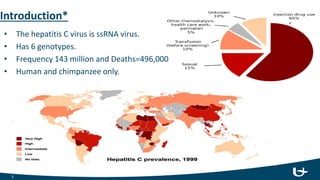
Introduction*
• The hepatitis C virus is ssRNA virus.
• Has 6 genotypes.
• Frequency 143 million and Deaths=496,000
• Human and chimpanzee only.
3
4
• consists of a core of (RNA),
surrounded by protective shell
of protein encased in a lipid
envelope of cellular origin.
• Two envelope Glycoprotien E1
and E2, are embedded in the
lipid envelop.
Introduction (cont.)
Structure:
Introduction(cont.)
Pathology
15% of cases develop
acute. But, rarely
does have liver failure .The
infection resolves
spontaneously more
frequently in young and
females.
85% of cases develop a
chronic infection .they
experience minimal
symptoms during the
initial stage but, after
several years they may
have cirrhosis or HCC.
5
Spaces and life cycle
The virus replicates mainly in the hepatocytes cytoplasm (ER) of liver but, may
also replicate in peripheral blood mononuclear cells.
6
Expected immunity.
Innate immunity:
• Liver Macrophage ,DCs and NK cells as they are enriched in liver may play a role…
• Interferons as the main cytokines.
Adaptive immunity:
• CD 4 TH1 > TH2
• CD 8 cytotoxic (CMI) may be the main effector agent against HCV..
• Antibodies may have a role as virus present in blood and ADCC..
7
Evidence based Literature and
Text book
Innate
Immunity
Adaptive
immunity
How could
HCV evade.!
8
Evidence based literature and text book (cont.)
General scheme of 8 steps…! *
9
Evidence based –Innate immunity (cont.)
Step number (1)
The first line of immunity against
HCV relies on cell-intrinsic innate
immunity within hepatocyte cells .
10
PRR PAMP
1-RIG-I ,pkr-1
(Cytosolic PRR)
dsRNA
from the Internal ribosome entry side.
from accumulation after HCV infection
from dying cells later.
2-TLR 3 dsRNA
3-TLR 7,8* ssRNA
Evidence based-Innate Immunity (cont.)
11
Evidence based innate
immunity (cont.)
Viral RNA sensing by
RIGs -> MAVS-->
IRF3,7ISG .
INF β,γ.
Similar, occurs by
viral RNA sensing by
TLR3TRIFISG..
INF β,γ .
12
13
Evidence based-Innate
immunity (cont.)
Hepatic DC , APC
step number (2)
• Liver resident and migratory APCs
uptake apoptotic bodies from
destroyed HCV-infected
hepatocytes and present HCV
derived epitopes to both CD4 and
CD8 T cell in the context of MHC
class II and MHC class I ,
respectively.
Liver
Macrophage
Kupffer cells
Circulating
macrophage
Evidence based Innate Immunity (cont.)
Controversy of DCs…!
function of DCs is controversial…!
1-recently demonstrated that sustained hyperresponsiveness of DCs was associated with
resolution of HCV infection  better priming of HCV-specific T cells.*
2-Another groups Also, have reported that DCs are defective in HCV response to and may
induce proliferation of T reg chronic infection.**
14
Evidence based Innate Immunity (cont.)
KCs and fibrosis…!
• KCs produce profibrogenic factors and yet also represent a major source of matrix
breakdown and turnover -cirrhosis.
• Nitric oxide produced by activated KCs may also promote DNA damage HCC .
• it has recently been postulated that KC-derived IL-6 contributes to HCC development
so, Estrogen inhibition of IL-6 production MAY reduces HCC risk in females.*
15
Evidence based Innate immunity (cont.)
Step number (3) …NK cells
• NK cells are highly enriched in the liver and are expected to play a major role in
controlling hepatotropic infections.
• NK cells from acutely infected individuals and during chronic infection were
biased toward cytotoxicity rather than cytokine production.
• ADCC..!
16
Evidence based Adaptive immunity (cont.)
Step number (4)…CD4
• HCV-specific CD4 and CD8 T cell appear late around 6–8 weeks after primary HCV
infection May be indicative of the capacity of the virus to evade the innate
immune system.
• CD4 helper T cell support responses of CD8T cells and B cell through production
of Th1 and Th2 cytokine respectively.
17
Evidence based Adaptive Immunity (cont.)
Step number (5) …..Neutralizing Antibodies
• Most of these Abs have NO antiviral activity. However, only a small subset is able
to prevent virus binding, entry or post-entry steps of the viral lifecycle.
• ADCC is not fully understood ,also the role of Tfh * cells in this process is still
unknown.
18
Evidence based Adaptive Immunity (cont.)
Step number (6)…CD8
• The main adaptive effector cells involved in HCV clearance.
• CD8 T cells eliminate HCV-infected cells through direct cytotoxic
mechanisms(granules, perforin and granzyme) or non-cytolytic mechanisms
through secretion of the antiviral cytokines IFN g and TNF a.
• But,CD8 needs to persists its action…!
19
Evidence based adaptive (cont.)
Exhausted CD8…!
T17/ Treg Balance
Step number (7)..T17
Early induction of IL-21 producing Th17 cells is
critical to limit exhaustion of CD8 T cells
Step number (8) ..T reg
T reg contributes to exhaustion
and inhibition of CD4 and CD8
through production of the Tim-
3,Gal-9 ,IL-10 and TGF-B
20
HCV Evasion of innate immunity
The Swiss Army knife..!
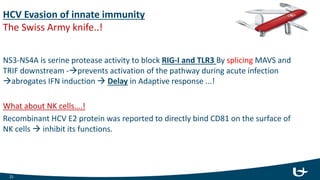
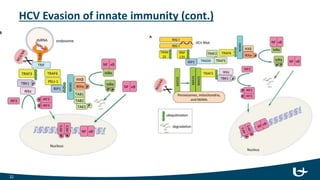
NS3-NS4A is serine protease activity to block RIG-I and TLR3 By splicing MAVS and
TRIF downstream -prevents activation of the pathway during acute infection
abrogates IFN induction  Delay in Adaptive response ...!
What about NK cells….!
Recombinant HCV E2 protein was reported to directly bind CD81 on the surface of
NK cells  inhibit its functions.
21
HCV Evasion of innate immunity (cont.)
22
HCV Evasion from Adaptive
Immunity (cont.)
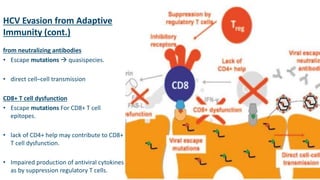
from neutralizing antibodies
• Escape mutations  quasispecies.
• direct cell–cell transmission
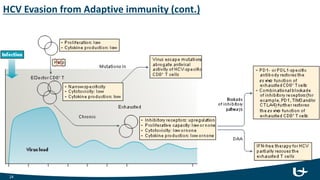
CD8+ T cell dysfunction
• Escape mutations For CD8+ T cell
epitopes.
• lack of CD4+ help may contribute to CD8+
T cell dysfunction.
• Impaired production of antiviral cytokines
as by suppression regulatory T cells.
23
HCV Evasion from Adaptive immunity (cont.)
24
Which immune responses are believed to be protective.!
Studies of depletion..!
• One study of CD4 depletion in chimpanzees ,first they temporarily
controlled viremia then viral titers increased again and These data supports
the concept that HCV-specific CD8 T cells are the main antiviral effector cells
while HCV specific CD4 T cells have important helper functions to prevent
viral escape from the CD8 T cell response..*
• HCV and HIV co-infection..!**
• One study of KC depletion leading to attenuated liver injury…!***
25
Vaccine.
• No approved vaccine of HCV.
• Some trials working to include several components of the adaptive immune
response as successful vaccination strategy because, vaccine-induced CD8+ T
cell responses may fail when sufficient CD4+ T cell help is missing.
• Regarding therapeutic immune strategies, restoration of CD8+ T cell
function may be a promising concept.
• 2013 The revolution of new HCV drugs (sofosbuvir) and preventive
medicine..!
26
Abbreviation.
• HCC : Hepatocellular carcinoma.
• KCs: Kupffer cells.
• TRIF:TIR-domain-containing adapter-inducing interferon-β
• T fh : follicular helper cells
• RIG-1: Retinoic Acid Inducible Gene 1 protein.
• PKR-1: Protein kinase receptor.
• MAVS: mitochondrial antiviral signaling protein.
• TBK-1: Serine/threonine-protein kinase .
• IRF: Interferon regulatory factor.
• ISG : interferon stimulating gene.
27
References.
• Eui-Cheol Shin, Pil Soo Sung & Su-Hyung Park et, Nature Reviews
Immunology 16, 509–523.
• Lynn B. Dustin, Curr Drug Targets. 2017; 18(7): 826–843.
• S. Abdel-Hakeem ,H. Shoukry , Front Immunol. 2014; 5: 274.
• Ralf Bartenschlager,Springer. Berlin, 2013
28

Hcv

  • 1.
  • 2.
    Outline: • Introduction. • Lifecycle and Spaces. • Expected. • Evidence based Literature and Text books. • Which immune responses are believed to be protective..? • Vaccine. • Abbreviation. • References. 2
  • 3.
    Introduction* • The hepatitisC virus is ssRNA virus. • Has 6 genotypes. • Frequency 143 million and Deaths=496,000 • Human and chimpanzee only. 3
  • 4.
    4 • consists ofa core of (RNA), surrounded by protective shell of protein encased in a lipid envelope of cellular origin. • Two envelope Glycoprotien E1 and E2, are embedded in the lipid envelop. Introduction (cont.) Structure:
  • 5.
    Introduction(cont.) Pathology 15% of casesdevelop acute. But, rarely does have liver failure .The infection resolves spontaneously more frequently in young and females. 85% of cases develop a chronic infection .they experience minimal symptoms during the initial stage but, after several years they may have cirrhosis or HCC. 5
  • 6.
    Spaces and lifecycle The virus replicates mainly in the hepatocytes cytoplasm (ER) of liver but, may also replicate in peripheral blood mononuclear cells. 6
  • 7.
    Expected immunity. Innate immunity: •Liver Macrophage ,DCs and NK cells as they are enriched in liver may play a role… • Interferons as the main cytokines. Adaptive immunity: • CD 4 TH1 > TH2 • CD 8 cytotoxic (CMI) may be the main effector agent against HCV.. • Antibodies may have a role as virus present in blood and ADCC.. 7
  • 8.
    Evidence based Literatureand Text book Innate Immunity Adaptive immunity How could HCV evade.! 8
  • 9.
    Evidence based literatureand text book (cont.) General scheme of 8 steps…! * 9
  • 10.
    Evidence based –Innateimmunity (cont.) Step number (1) The first line of immunity against HCV relies on cell-intrinsic innate immunity within hepatocyte cells . 10
  • 11.
    PRR PAMP 1-RIG-I ,pkr-1 (CytosolicPRR) dsRNA from the Internal ribosome entry side. from accumulation after HCV infection from dying cells later. 2-TLR 3 dsRNA 3-TLR 7,8* ssRNA Evidence based-Innate Immunity (cont.) 11
  • 12.
    Evidence based innate immunity(cont.) Viral RNA sensing by RIGs -> MAVS--> IRF3,7ISG . INF β,γ. Similar, occurs by viral RNA sensing by TLR3TRIFISG.. INF β,γ . 12
  • 13.
    13 Evidence based-Innate immunity (cont.) HepaticDC , APC step number (2) • Liver resident and migratory APCs uptake apoptotic bodies from destroyed HCV-infected hepatocytes and present HCV derived epitopes to both CD4 and CD8 T cell in the context of MHC class II and MHC class I , respectively. Liver Macrophage Kupffer cells Circulating macrophage
  • 14.
    Evidence based InnateImmunity (cont.) Controversy of DCs…! function of DCs is controversial…! 1-recently demonstrated that sustained hyperresponsiveness of DCs was associated with resolution of HCV infection  better priming of HCV-specific T cells.* 2-Another groups Also, have reported that DCs are defective in HCV response to and may induce proliferation of T reg chronic infection.** 14
  • 15.
    Evidence based InnateImmunity (cont.) KCs and fibrosis…! • KCs produce profibrogenic factors and yet also represent a major source of matrix breakdown and turnover -cirrhosis. • Nitric oxide produced by activated KCs may also promote DNA damage HCC . • it has recently been postulated that KC-derived IL-6 contributes to HCC development so, Estrogen inhibition of IL-6 production MAY reduces HCC risk in females.* 15
  • 16.
    Evidence based Innateimmunity (cont.) Step number (3) …NK cells • NK cells are highly enriched in the liver and are expected to play a major role in controlling hepatotropic infections. • NK cells from acutely infected individuals and during chronic infection were biased toward cytotoxicity rather than cytokine production. • ADCC..! 16
  • 17.
    Evidence based Adaptiveimmunity (cont.) Step number (4)…CD4 • HCV-specific CD4 and CD8 T cell appear late around 6–8 weeks after primary HCV infection May be indicative of the capacity of the virus to evade the innate immune system. • CD4 helper T cell support responses of CD8T cells and B cell through production of Th1 and Th2 cytokine respectively. 17
  • 18.
    Evidence based AdaptiveImmunity (cont.) Step number (5) …..Neutralizing Antibodies • Most of these Abs have NO antiviral activity. However, only a small subset is able to prevent virus binding, entry or post-entry steps of the viral lifecycle. • ADCC is not fully understood ,also the role of Tfh * cells in this process is still unknown. 18
  • 19.
    Evidence based AdaptiveImmunity (cont.) Step number (6)…CD8 • The main adaptive effector cells involved in HCV clearance. • CD8 T cells eliminate HCV-infected cells through direct cytotoxic mechanisms(granules, perforin and granzyme) or non-cytolytic mechanisms through secretion of the antiviral cytokines IFN g and TNF a. • But,CD8 needs to persists its action…! 19
  • 20.
    Evidence based adaptive(cont.) Exhausted CD8…! T17/ Treg Balance Step number (7)..T17 Early induction of IL-21 producing Th17 cells is critical to limit exhaustion of CD8 T cells Step number (8) ..T reg T reg contributes to exhaustion and inhibition of CD4 and CD8 through production of the Tim- 3,Gal-9 ,IL-10 and TGF-B 20
  • 21.
    HCV Evasion ofinnate immunity The Swiss Army knife..! NS3-NS4A is serine protease activity to block RIG-I and TLR3 By splicing MAVS and TRIF downstream -prevents activation of the pathway during acute infection abrogates IFN induction  Delay in Adaptive response ...! What about NK cells….! Recombinant HCV E2 protein was reported to directly bind CD81 on the surface of NK cells  inhibit its functions. 21
  • 22.
    HCV Evasion ofinnate immunity (cont.) 22
  • 23.
    HCV Evasion fromAdaptive Immunity (cont.) from neutralizing antibodies • Escape mutations  quasispecies. • direct cell–cell transmission CD8+ T cell dysfunction • Escape mutations For CD8+ T cell epitopes. • lack of CD4+ help may contribute to CD8+ T cell dysfunction. • Impaired production of antiviral cytokines as by suppression regulatory T cells. 23
  • 24.
    HCV Evasion fromAdaptive immunity (cont.) 24
  • 25.
    Which immune responsesare believed to be protective.! Studies of depletion..! • One study of CD4 depletion in chimpanzees ,first they temporarily controlled viremia then viral titers increased again and These data supports the concept that HCV-specific CD8 T cells are the main antiviral effector cells while HCV specific CD4 T cells have important helper functions to prevent viral escape from the CD8 T cell response..* • HCV and HIV co-infection..!** • One study of KC depletion leading to attenuated liver injury…!*** 25
  • 26.
    Vaccine. • No approvedvaccine of HCV. • Some trials working to include several components of the adaptive immune response as successful vaccination strategy because, vaccine-induced CD8+ T cell responses may fail when sufficient CD4+ T cell help is missing. • Regarding therapeutic immune strategies, restoration of CD8+ T cell function may be a promising concept. • 2013 The revolution of new HCV drugs (sofosbuvir) and preventive medicine..! 26
  • 27.
    Abbreviation. • HCC :Hepatocellular carcinoma. • KCs: Kupffer cells. • TRIF:TIR-domain-containing adapter-inducing interferon-β • T fh : follicular helper cells • RIG-1: Retinoic Acid Inducible Gene 1 protein. • PKR-1: Protein kinase receptor. • MAVS: mitochondrial antiviral signaling protein. • TBK-1: Serine/threonine-protein kinase . • IRF: Interferon regulatory factor. • ISG : interferon stimulating gene. 27
  • 28.
    References. • Eui-Cheol Shin,Pil Soo Sung & Su-Hyung Park et, Nature Reviews Immunology 16, 509–523. • Lynn B. Dustin, Curr Drug Targets. 2017; 18(7): 826–843. • S. Abdel-Hakeem ,H. Shoukry , Front Immunol. 2014; 5: 274. • Ralf Bartenschlager,Springer. Berlin, 2013 28

Editor's Notes

  • #4 *https://en.wikipedia.org/wiki/Hepatitis_C
  • #6 *Lauer, J Infect Dis. 2013 Mar;207 Suppl 1:S7-S12.
  • #7 Entry into host cells occur through complex interactions between virions and cell-surface molecules for example ( CD81, LDL receptor, ..) The virus replicates on intracellular membranes of The endoplasmic reticulumin particular are deformed into uniquely shaped membrane structures termed 'membranous webs’.
  • #10 *S. Abdel-Hakeem ,H. Shoukry , Front Immunol. 2014; 5: 274.
  • #12 -Activation of these PRRs drives the innate antiviral and proinflammatory responses that : 1- limit virus replication. 2- recruit adaptive immune cells and enhance their effector actions at the site of infection. *Yuwei Zhang, Scientific Reports 6, Article number: 29447 (2016)
  • #13 *Ralf Bartenschlager,Springer. Berlin, 2013
  • #15 *Sandy Pelletiera, et journal of virology,(2013). **Silvia Della Bella, Immunology. 2007 Jun; 121(2): 283–292.
  • #16 Profibrognic factors e.g.( transforming growth factor β and platelet-derived growth factor) . *Prieto J. Hepatol. 2008 Feb;48(2):380-1.
  • #18 Also, tolerogenic nature of the liver environment The time required for viral antigens to reach the draining lymph nodes to be presented by professional APCs.
  • #19 * follicular helper cells (TFH cells): A distinct subset of CD4+ T cells found in B cell follicles of secondary lymphoid organs. ICOS (inducible T cell co‑stimulator)-dependent TFH cells have a crucial role in the selection and survival of B cells that differentiate to plasma cells or memory B cells.
  • #22 Due to the relatively conserved binding region of E2 to the CD8  receptor on the liver cells, this discovery is expected to pave the way to design a HCV vaccine which will stimulate antibody response with neutralizing effects on broad range of virus strains.
  • #23 *Lynn B. Dustin, Curr Drug Targets. 2017; 18(7): 826–843.
  • #24 *Ralf Bartenschlager,Springer. Berlin, 2013. Virus escape mutations :Mutations generating viral protein products that can no longer be recognized by virus-specific antibodies or T cells. Viruses with a high rate of mutation, such as hepatitis C virus (HCV) and HIV, rely on escape mutations as a mechanism of immune evasion
  • #25 *Eui-Cheol Shin, Pil Soo Sung & Su-Hyung Park et, Nature Reviews Immunology 16, 509–523.
  • #26 * Shoukry NH, J Exp Med. 2003 Jun 16;197(12):1645-55. ** Y. Chen, R. Feeney & T. Chung , Nature Reviews Gastroenterology & Hepatology 11, 362–371 (2014). ***Mathis Heydtmann, J. Virol. April 2009 vol. 83 no. 7 2796-2802.
  • #27 *Ralf Bartenschlager,Springer. Berlin, 2013.