Expansion Bus
Buses and Expansion 
Slots 
 Buses evolved around data path and 
speed Local bus (system) and 
expansion bus (ISA) 
 Buses carry electrical power, control 
signals, memory addresses, and data 
 On-board ports, connectors, and riser 
slots
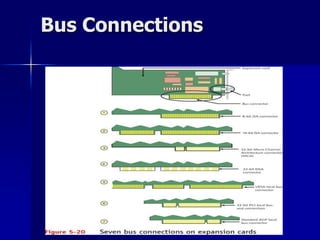
Bus Connections
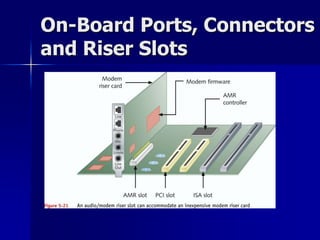
On-Board Ports, Connectors 
and Riser Slots
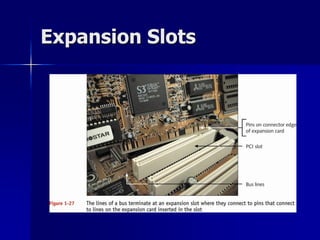
Expansion Slots
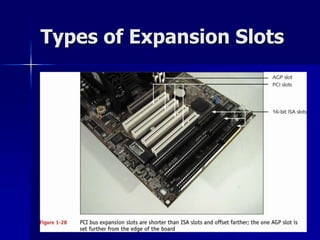
Types of Expansion Slots
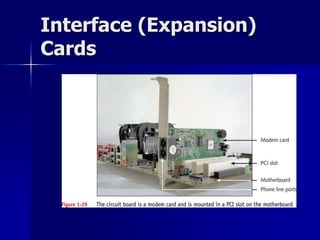
Interface (Expansion) 
Cards
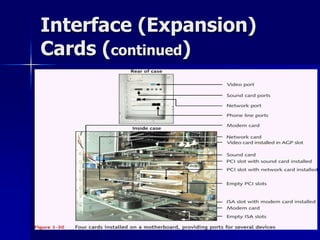
Interface (Expansion) 
Cards (continued)
PC Bus 
 ISA Bus 
– 16 bits wide 
– 7 MHz speed 
– Manual configuration
Modern Expansion Buses 
 IBM’s Micro Channel Architecture 
– MCA 
 Open standard Extended ISA 
– EISA 
 Video Electronics Standards Association’s 
VESA Local Bus 
– VL-Bus 
 Peripheral Component Interconnect 
– PCI
Modern Expansion Buses 
 PCI Bus 
– 32 bits wide 
– 33 MHz speed 
– Self-configuring 
TIP There was a 64-bit version of the original PCI 
standard, but it was quite rare.
AGP 
 A specialized, video only version of PCI 
– Accelerated graphics port (AGP) 
– An AGP slot is a PCI slot, but one with a 
direct connection 
– AGP slots are only for video cards 
 Don’t try to snap a sound card or modem into 
one
PCI-X 
 Available in systems such as the Macintosh G5 
 Is a huge enhancement to current PCI that is also fully 
backward-compatible, in terms of both hardware and software 
 PCI-X is a 64-bit-wide bus 
– Its slots will accept regular PCI cards 
– The real bonus of PCI-X is its much enhanced speed 
 The PCI-X 2.0 standard features four speed grades (measured 
in MHz): 
– PCI-X 66, PCI-X 133, PCI-X 266, and PCI-X 533 
– Obvious candidates for PCI-X are businesses using workstations 
and servers
Mini-PCI 
 Find Mini-PCI in just about every 
laptop 
 Designed to use low power and to lie 
flat 
– Both good features for a laptop expansion 
slot
PCI Express 
 PCI Express (PCIe) is the latest, fastest 
 Still PCI, but it uses a point-to-point serial 
connection instead of PCI’s shared parallel 
communication 
 A PCIe connection uses one wire for sending 
and 
 One for receiving. Each of these pairs of 
wires between a PCIe controller and a 
device is called a lane
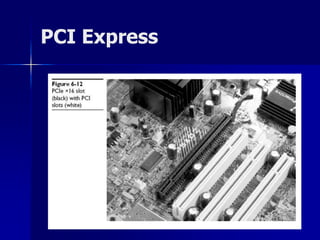
PCI Express
System Resources 
 Expansion cards, need to communicate with the 
CPU 
 Divide communication into four aspects called 
system resources 
 The system resources are 
– I/O address 
 How the CPU sends commands to devices 
– IRQ 
 How devices tell the CPU they need communication 
– DMA 
 How the CPU enables devices to talk directly to RAM 
– Memory 
 How the CPU talks to RAM on devices
System Resources 
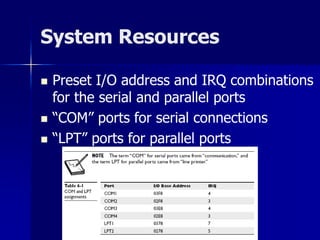
 Preset I/O address and IRQ combinations 
for the serial and parallel ports 
 “COM” ports for serial connections 
 “LPT” ports for parallel ports
Installing Expansion 
Cards 
 Step 1: Knowledge 
 Step 2: Physical Installation 
 Step 3: Device Drivers 
– Getting the Correct Drivers 
– Removing the Old Drivers 
– Installing the New Driver 
 Step 4: Verify
Installing Expansion 
Cards 
 Unsigned Drivers 
– Bad - it simply means that they haven’t 
gone through Microsoft’s exhaustive 
quality assurance certification procedure 
 Driver Rollback 
– Windows XP offers the nifty feature of 
rolling back to previous drivers after an 
installation or driver upgrade
Troubleshooting 
Expansion Cards 
 Properly installed expansion card 
rarely makes trouble 
– An improperly installed card usually 
shows up the moment you first try to get 
that card to do whatever it’s supposed to 
do and it doesn’t do it
Device Manager 
 First diagnostic and troubleshooting tool in Windows 
 Device problems manifest themselves in the Device Manager 
via error icons—a black “!” or a red “X” or a blue “i.” 
– A black “!” on a yellow circle indicates that a device is missing, 
that Windows does not recognize a device, or that there’s a 
device driver problem. A device may still work even while 
producing this error 
– A red “X” indicates a disabled device (Figure 6-37). This usually 
points to a device that’s been manually turned off, or a damaged 
device. A device producing this error will not work 
– A blue “i” on a white field indicates a device on which someone 
has configured the system resources manually. This only occurs 
on non-ACPI systems. This symbol merely provides information 
and does not indicate an error with the device

6 expansion bus

  • 1.
  • 2.
    Buses and Expansion Slots  Buses evolved around data path and speed Local bus (system) and expansion bus (ISA)  Buses carry electrical power, control signals, memory addresses, and data  On-board ports, connectors, and riser slots
  • 3.
  • 4.
  • 5.
  • 6.
  • 7.
  • 8.
  • 9.
    PC Bus ISA Bus – 16 bits wide – 7 MHz speed – Manual configuration
  • 10.
    Modern Expansion Buses  IBM’s Micro Channel Architecture – MCA  Open standard Extended ISA – EISA  Video Electronics Standards Association’s VESA Local Bus – VL-Bus  Peripheral Component Interconnect – PCI
  • 11.
    Modern Expansion Buses  PCI Bus – 32 bits wide – 33 MHz speed – Self-configuring TIP There was a 64-bit version of the original PCI standard, but it was quite rare.
  • 12.
    AGP  Aspecialized, video only version of PCI – Accelerated graphics port (AGP) – An AGP slot is a PCI slot, but one with a direct connection – AGP slots are only for video cards  Don’t try to snap a sound card or modem into one
  • 13.
    PCI-X  Availablein systems such as the Macintosh G5  Is a huge enhancement to current PCI that is also fully backward-compatible, in terms of both hardware and software  PCI-X is a 64-bit-wide bus – Its slots will accept regular PCI cards – The real bonus of PCI-X is its much enhanced speed  The PCI-X 2.0 standard features four speed grades (measured in MHz): – PCI-X 66, PCI-X 133, PCI-X 266, and PCI-X 533 – Obvious candidates for PCI-X are businesses using workstations and servers
  • 14.
    Mini-PCI  FindMini-PCI in just about every laptop  Designed to use low power and to lie flat – Both good features for a laptop expansion slot
  • 15.
    PCI Express PCI Express (PCIe) is the latest, fastest  Still PCI, but it uses a point-to-point serial connection instead of PCI’s shared parallel communication  A PCIe connection uses one wire for sending and  One for receiving. Each of these pairs of wires between a PCIe controller and a device is called a lane
  • 16.
  • 17.
    System Resources Expansion cards, need to communicate with the CPU  Divide communication into four aspects called system resources  The system resources are – I/O address  How the CPU sends commands to devices – IRQ  How devices tell the CPU they need communication – DMA  How the CPU enables devices to talk directly to RAM – Memory  How the CPU talks to RAM on devices
  • 18.
    System Resources Preset I/O address and IRQ combinations for the serial and parallel ports  “COM” ports for serial connections  “LPT” ports for parallel ports
  • 19.
    Installing Expansion Cards  Step 1: Knowledge  Step 2: Physical Installation  Step 3: Device Drivers – Getting the Correct Drivers – Removing the Old Drivers – Installing the New Driver  Step 4: Verify
  • 20.
    Installing Expansion Cards  Unsigned Drivers – Bad - it simply means that they haven’t gone through Microsoft’s exhaustive quality assurance certification procedure  Driver Rollback – Windows XP offers the nifty feature of rolling back to previous drivers after an installation or driver upgrade
  • 21.
    Troubleshooting Expansion Cards  Properly installed expansion card rarely makes trouble – An improperly installed card usually shows up the moment you first try to get that card to do whatever it’s supposed to do and it doesn’t do it
  • 22.
    Device Manager First diagnostic and troubleshooting tool in Windows  Device problems manifest themselves in the Device Manager via error icons—a black “!” or a red “X” or a blue “i.” – A black “!” on a yellow circle indicates that a device is missing, that Windows does not recognize a device, or that there’s a device driver problem. A device may still work even while producing this error – A red “X” indicates a disabled device (Figure 6-37). This usually points to a device that’s been manually turned off, or a damaged device. A device producing this error will not work – A blue “i” on a white field indicates a device on which someone has configured the system resources manually. This only occurs on non-ACPI systems. This symbol merely provides information and does not indicate an error with the device