Group Members
Salman Qaiser M13-464
Faisal Malik M13-403
Moazzam Ijaz M13-444
Nehal Aslam M13-418
Expansion Slots
 Introduction
 Standards
 Construction
 External expansion buses
Intro
The primary purpose of an expansion card is to provide or
expand on features not offered by the motherboard.
Intro
Nearly all personal computers except portables contain
expansion slots for adding
more memory, graphics capabilities, and support for
special devices.
Standards
There are different types of expansion slots, the
commonly known are:
• PCI
• PCI Express
• AGP
Standards
 PCI Slots
The PCI slot is the most common form of internal
expansion for a PC. They take a wide variety of
cards, such as network cards and sound cards.
Standards
 PCI Express Slots
Created in year 2004 PCIe are a lot faster than PCI. PCIe
can hold large video cards which older version couldn’t.
PCI Express type of expansion slot communicates with
the motherboard, and therefore with the
microprocessor, both quickly and efficiently.
Standards
 AGP Slots
Its now obsolete. They were designed to hold video
cards.
Originally it was designed as a successor to PCI type
connection but phased out in favor of PCIe.
Standards
 Other Families
Most other computer lines, including those from Apple
and Atari, offered their own expansion buses. Apple used
a proprietary system with seven 50-pin-slots, later-on
they switched to a PCI Bus. Generally PCI expansion
cards will function on any CPU platform if there is a
software driver for that type.
Construction
 Depending on the form factor of the motherboard
and case, around one to seven expansion cards can
be added to a computer system
Construction
Some commonly know cards
 Sound cards
 Network cards
 TV tuner cards
 Modems
 Video cards
 RAM disks, e.g. i-RAM
 Disk controller cards (for fixed- or removable-media
drives)
Construction
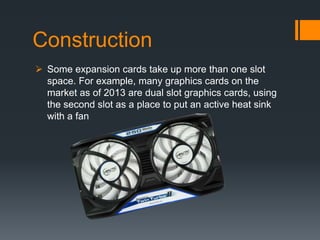
 Some expansion cards take up more than one slot
space. For example, many graphics cards on the
market as of 2013 are dual slot graphics cards, using
the second slot as a place to put an active heat sink
with a fan
External Expansion Buses
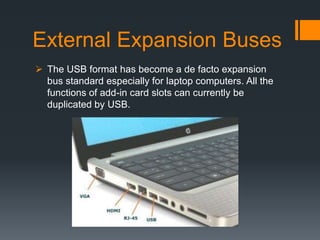
 The USB format has become a de facto expansion
bus standard especially for laptop computers. All the
functions of add-in card slots can currently be
duplicated by USB.
External Expansion Buses
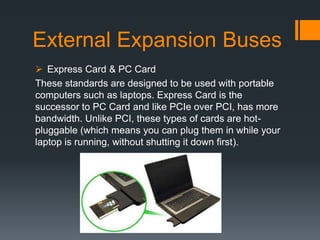
 Express Card & PC Card
These standards are designed to be used with portable
computers such as laptops. Express Card is the
successor to PC Card and like PCIe over PCI, has more
bandwidth. Unlike PCI, these types of cards are hot-
pluggable (which means you can plug them in while your
laptop is running, without shutting it down first).
Thank You
All rights reserved

Expansion slots

  • 1.
    Group Members Salman QaiserM13-464 Faisal Malik M13-403 Moazzam Ijaz M13-444 Nehal Aslam M13-418
  • 3.
    Expansion Slots  Introduction Standards  Construction  External expansion buses
  • 4.
    Intro The primary purposeof an expansion card is to provide or expand on features not offered by the motherboard.
  • 5.
    Intro Nearly all personalcomputers except portables contain expansion slots for adding more memory, graphics capabilities, and support for special devices.
  • 6.
    Standards There are differenttypes of expansion slots, the commonly known are: • PCI • PCI Express • AGP
  • 7.
    Standards  PCI Slots ThePCI slot is the most common form of internal expansion for a PC. They take a wide variety of cards, such as network cards and sound cards.
  • 8.
    Standards  PCI ExpressSlots Created in year 2004 PCIe are a lot faster than PCI. PCIe can hold large video cards which older version couldn’t. PCI Express type of expansion slot communicates with the motherboard, and therefore with the microprocessor, both quickly and efficiently.
  • 9.
    Standards  AGP Slots Itsnow obsolete. They were designed to hold video cards. Originally it was designed as a successor to PCI type connection but phased out in favor of PCIe.
  • 10.
    Standards  Other Families Mostother computer lines, including those from Apple and Atari, offered their own expansion buses. Apple used a proprietary system with seven 50-pin-slots, later-on they switched to a PCI Bus. Generally PCI expansion cards will function on any CPU platform if there is a software driver for that type.
  • 11.
    Construction  Depending onthe form factor of the motherboard and case, around one to seven expansion cards can be added to a computer system
  • 12.
    Construction Some commonly knowcards  Sound cards  Network cards  TV tuner cards  Modems  Video cards  RAM disks, e.g. i-RAM  Disk controller cards (for fixed- or removable-media drives)
  • 13.
    Construction  Some expansioncards take up more than one slot space. For example, many graphics cards on the market as of 2013 are dual slot graphics cards, using the second slot as a place to put an active heat sink with a fan
  • 14.
    External Expansion Buses The USB format has become a de facto expansion bus standard especially for laptop computers. All the functions of add-in card slots can currently be duplicated by USB.
  • 15.
    External Expansion Buses Express Card & PC Card These standards are designed to be used with portable computers such as laptops. Express Card is the successor to PC Card and like PCIe over PCI, has more bandwidth. Unlike PCI, these types of cards are hot- pluggable (which means you can plug them in while your laptop is running, without shutting it down first).
  • 16.