Module 1/unit 2

  By Kenneth Ayebazibwe
256774185458 / 0702555890
    kynaye@gmail.com
objectives
– On completion of this unit, you will be able to;
– Identify and describe the main components of a
 motherboard
   • CPU Sockets and chipsets
   • System clock
   • Memory Slots
   • I/O ports
   • ROM BIOS
   • Disk connectors
   -Identify expansion bus slots and cards
   -Describe the capabilities of PCI, AGP and PCIe bus standards
   -Describe ATX,NLX,BTX and proprietary motherboard form factors
   -Identify the use and connectors for a PC Power Supply Unit(PSU)
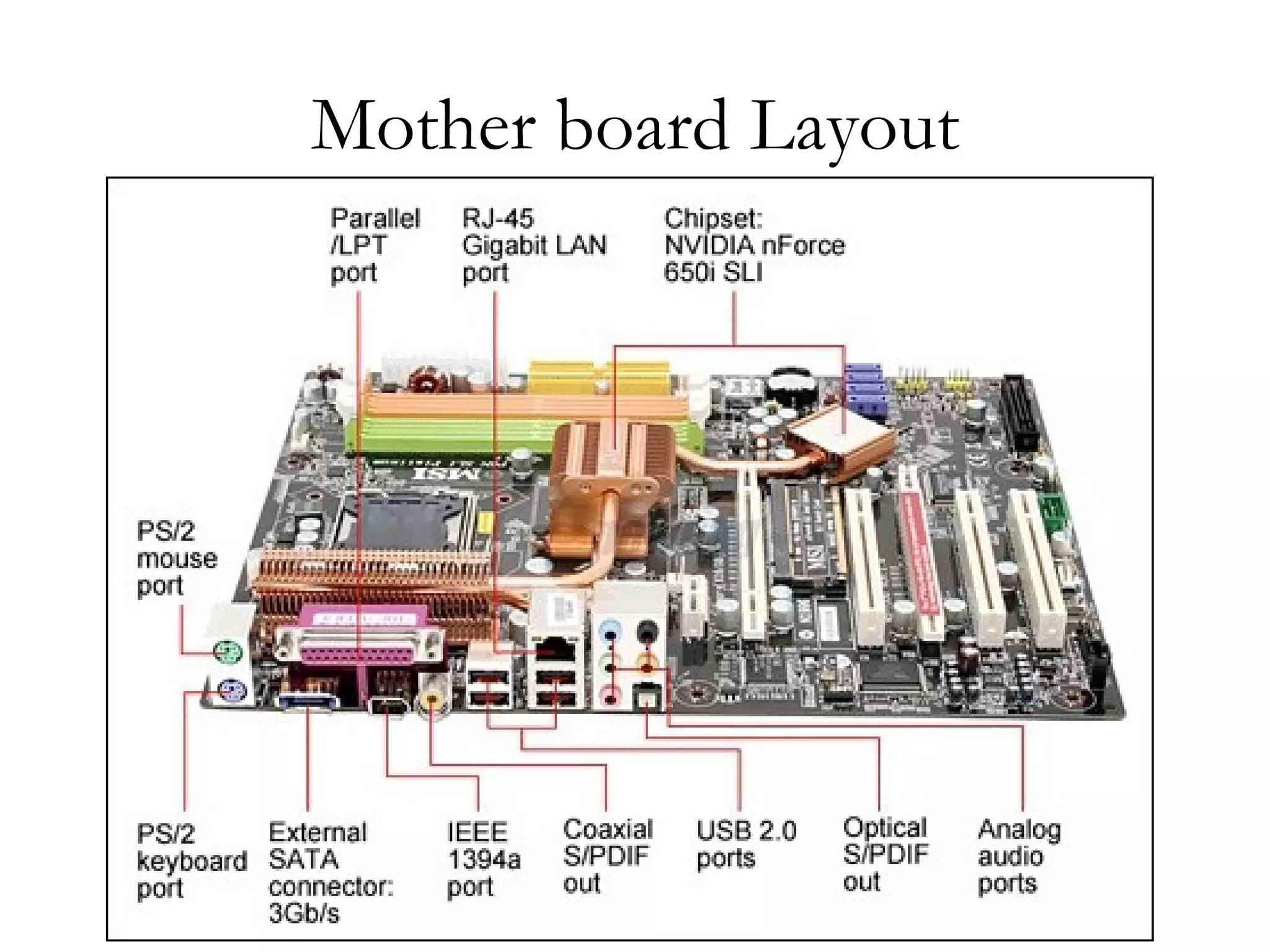
Mother board Layout
Mother board Layout
• In personal computers, a motherboard (sometimes
  alternatively known as the mainboard, system board,
  planar board or, on logic board[) is the central printed
  circuit board in many modern computers and holds many
  of the crucial components of the system, providing
  connectors for other peripherals.
• Motherboard specifically refers to a printed circuit board
  with expansion capability. The term mainboard is applied
  to devices with a single board and no additional
  expansions or capability. In modern terms this would
  include controlling boards in televisions, washing
  machines and other embedded systems.
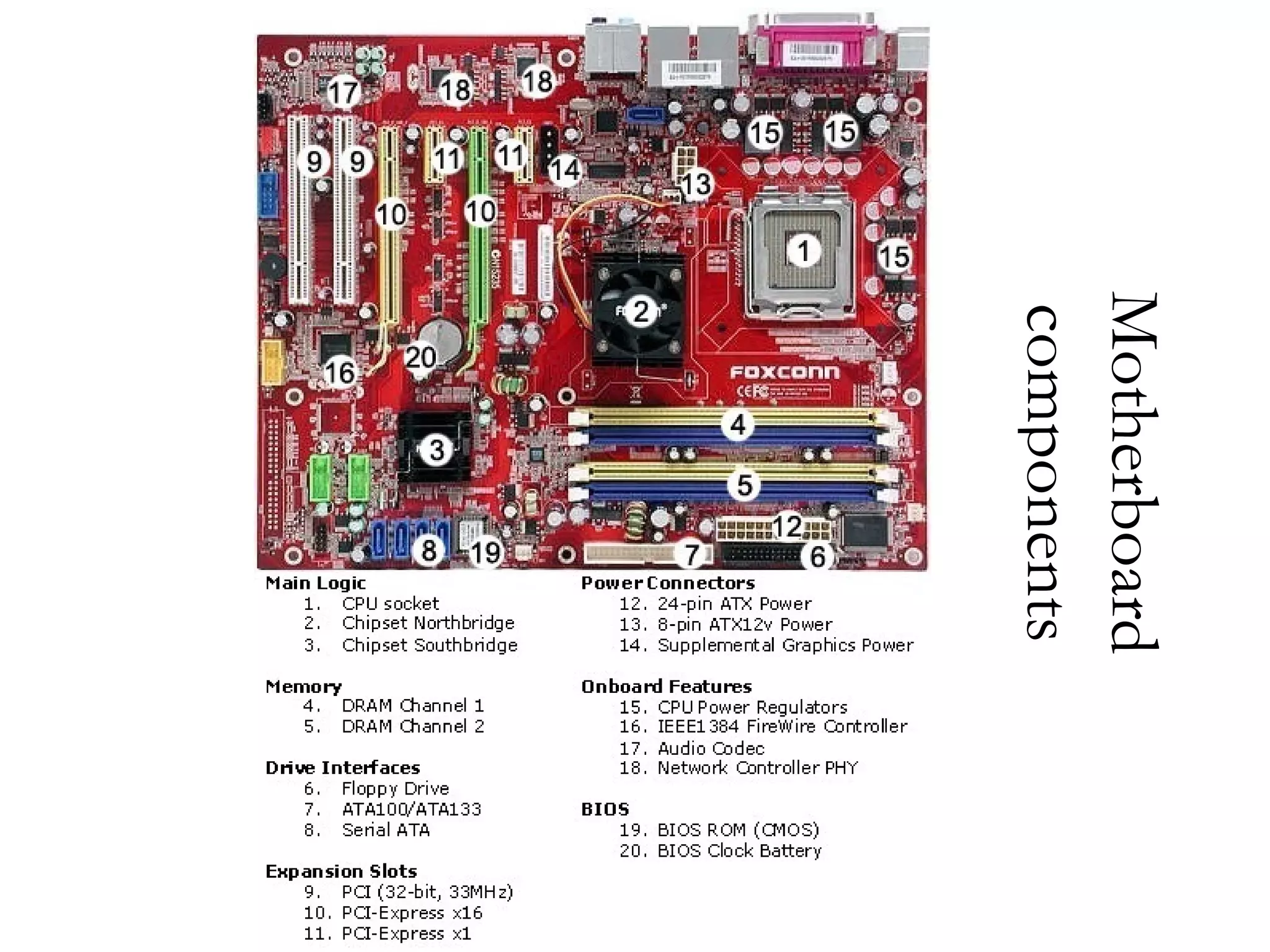
Motherboard
components
System clock
• In computers, sequence is everything. The system
  clock synchronizes the tasks in a computer, like
  loading data before manipulating it, etc. The system
  clock is a circuit that emits a continuous stream of
  precise high and low pulses that are all exactly the
  same length. One clock cycle is the time that passes
  from the start of one high pulse, until the start of
  the next. If several events are supposed to happen
  in one clock cycle, the cycle is subdivided by
  inserting a circuit with a known delay in it, thus
  providing more highs and more lows.
Computer Bus Architecture Types
• Computers comprises of many internal components and
  in order for these components to communicate with each
  other, a ‘bus’ is used for that purpose.
• A bus is a common pathway through which information
  is flows from one component to another. This pathway is
  used for communication and can be established between
  two or more computer components. We are going to
  review computer bus architectures that are used in
  computers.
• The functions of buses can be summarized as below:
Functions Of Buses
• Data sharing - the expansion bus must be able to transfer data
  between the computer and the peripherals connected to it.
• The data is transferred in parallel, which allows the exchange of 1, 2, 4
  or even 8 bytes of data at a time. (A byte is a group of 8 bits). Buses are
  classified depending on how many bits they can move at the same
  time, which means that we have 8-bit, 16-bit or even 32-bit buses.
• Addressing - A bus has address lines, which match those of the
  processor. This allows data to be sent to or from specific memory
  locations.
• Power - A bus supplies power to various peripherals that are
  connected to it.
• Timing - The bus provides a system clock signal to synchronize the
  peripherals attached to it with the rest of the system.
Bus Terminologies

• Computers can be viewed to be having just two types of
  buses:
  System bus:- The bus that connects the CPU to main
  memory on the motherboard. The system bus is also
  called the front-side bus, memory bus, local bus, or host
  bus.
  A number of I/O Buses, (Acronym for input/output),
  connecting various peripheral devices to the CPU -these
  are connected to the system bus via a ‘bridge’
  implemented in the processors chipset. Other names for
  the I/O bus include “expansion bus", "external bus” or
  “host bus”.
EXPANSION BUS TYPES

• These are some of the common expansion bus types that
  have ever been used in computers:

   – ISA - Industry Standard Architecture
   – EISA - Extended Industry Standard Architecture
   – MCA - Micro Channel Architecture
   – VESA - Video Electronics Standards Association
   – PCI - Peripheral Component Interconnect
   – PCMCIA - Personal Computer Memory Card Industry
     Association (Also called PC bus)
   – AGP - Accelerated Graphics Port
   – SCSI - Small Computer Systems Interface.
What exactly is Motherboard Form
                 Factor?
• Motherboards have different form factors. A
  form factor is simply the physical size and layout
  of the motherboard and its components. Several
  form factors and their features are described
  below.
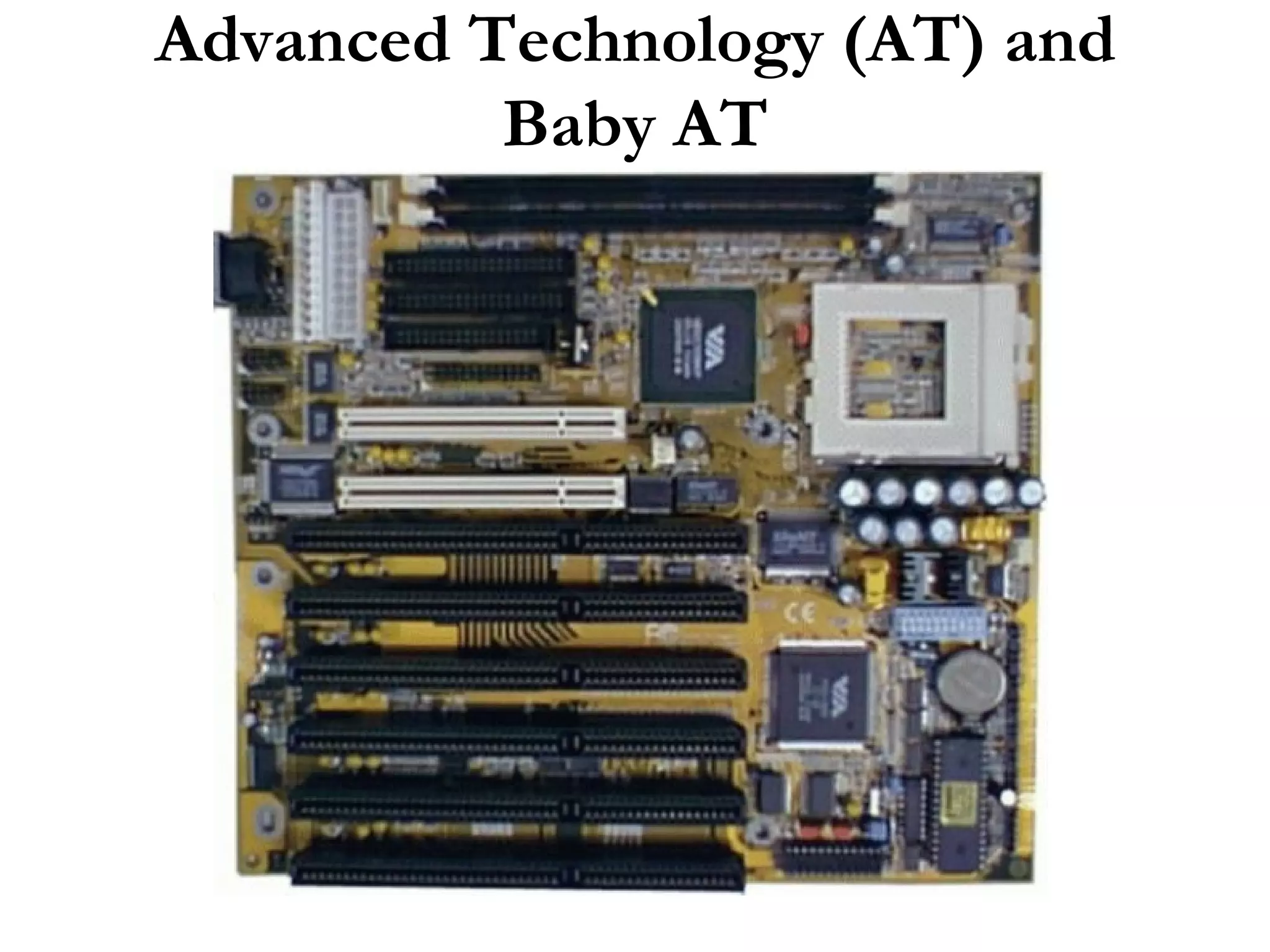
•   Advanced Technology (AT) and Baby AT
•   Advanced Technology (AT) and baby AT form factors were the most popular types of
    motherboards on the market. The main difference between the two is the width of the
    motherboards, themselves. The AT motherboard is 12 inches wide by 13 inches long.
    The baby AT is 9 inches wide by 10 inches long. See Figure 2.1 for the baby AT and
    its components.
•   The AT and baby AT form factors have the processor and memory socket locations
    toward the front of the motherboard. Very long expansion cards were designed to
    extend over them, which made removing the processor difficult. One had to take the
    expansion cards out first to remove the processor or to get to the memory. It is
    important to note that an AT power supply gives an output of 12V and 5V to the
    motherboard. Additional regulators are needed on the motherboard if 3.3V cards
    (peripheral component interface, or PCI) or processors are used.
•   This design was acceptable when clearance and cooling were not issues. With the
    advent of faster Pentium-class processors, which required more cooling and memory
    sockets that extended off the motherboards, a better motherboard design was needed.
Advanced Technology (AT) and
          Baby AT
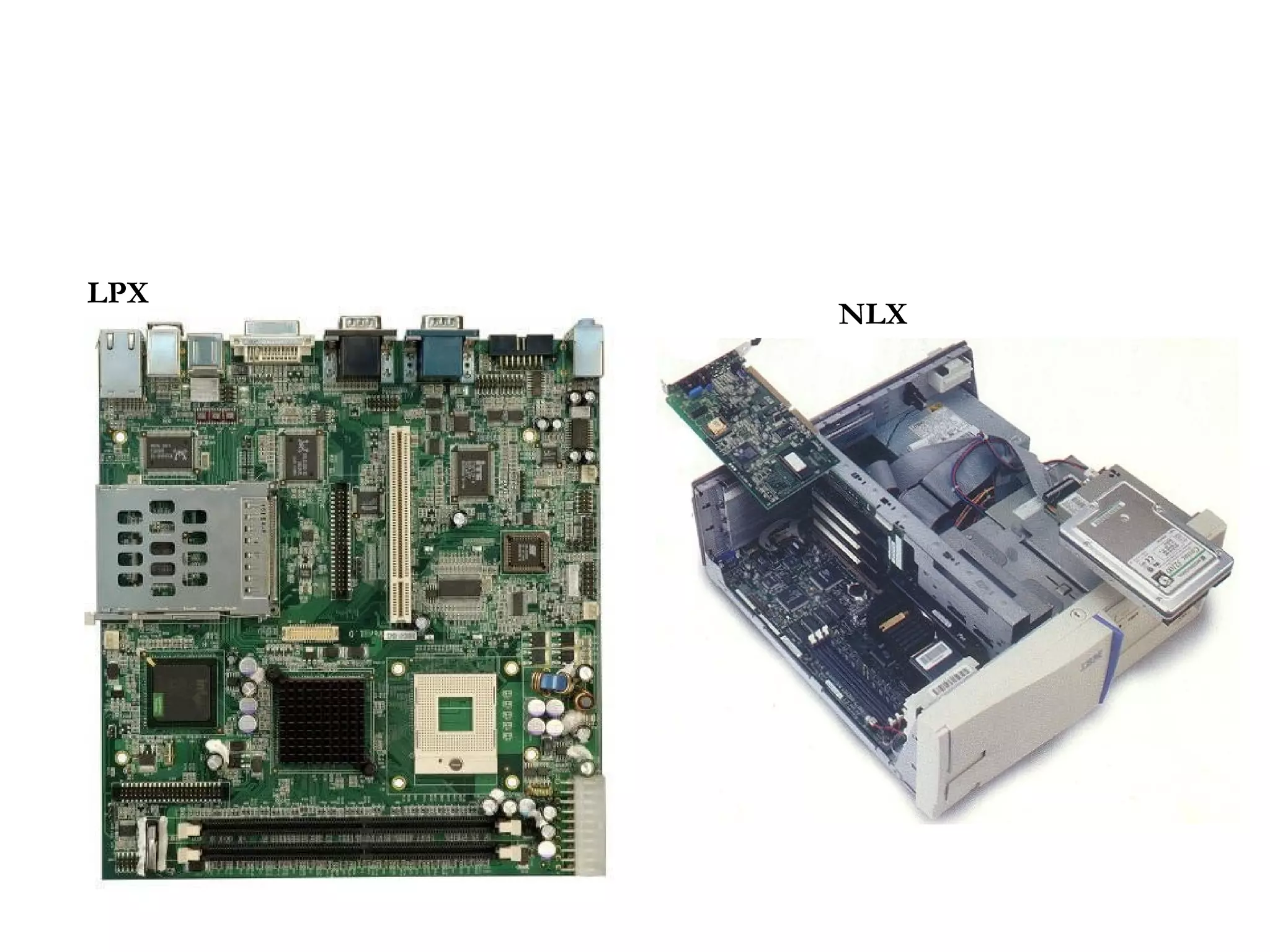
LPX
• Western Digital introduced the Low Profile Extensions (LPX)
  motherboard form factor. This form factor was developed to
  meet the need for a slimmer desktop. This goal was
  accomplished based on the implementation of a riser card that
  extended from the motherboard and allowed expansion cards
  to be installed parallel to the motherboard.
NLX
• As the need for more expansion slots and easier access to
  components increased, the LPX form factor was redesigned
  by Intel and named the NLX (InteLex) form factor. The NLX
  form factor moved the riser card from the center of the
  motherboard to the outside edge.
LPX
      NLX
ATX
• The ATX form factor was developed to solve the
  problems associated with the baby AT form factor
  design. This new design had many advantages that
  affected not only the motherboard, but the system
  unit and power supply, as well. The dimensions of
  the ATX form factor are 12 inches wide by 9.6
  inches long. A mini ATX is typically 11.2 inches
  wide by 8.2 inches long.
Advantages of ATX form factor.
Integrated I/O port connection.
• Baby AT motherboards have cables connecting them to the physical serial
   and parallel ports mounted on the system unit. With the ATX form factor,
   this connection is integrated into the motherboard. The ATX form factor
   uses a 20-pin plastic power supply connector. This is called a keyed
   connector, and it can be plugged into the motherboard in one direction only.
Integrated PS/2 mouse connector.
• ATX motherboards have PS/2 mouse ports integrated into the motherboard.
   Most baby AT motherboards do not have a PS/2 mouse port. Older-style AT
   motherboards required a serial mouse.
Easier access to components.
• The ATX motherboard was designed with functionality and accessibility in
   mind. It provides much easier access to components than the baby AT form
   factor and offers more room in general for additional components.
Improved power supply connection.
• The new ATX form factor incorporated a single 20-pin connector in place of
   the pair of 6-pin connectors used on the baby AT motherboard.
Support for 3.3V.
• The ATX motherboard supports 3.3V power from the ATX power supply.
   This voltage is used by most new processors.
'Soft switch' power support.
• The ATX power supply uses a signal from the motherboard to turn itself off.
   This feature enables you to use the power management utilities offered with
   newer operating systems to shut down a computer, as opposed to physically
   turning it off with the power button.
Better airflow.
• With the ATX form factor, the processor is moved closer to the power
   supply, providing it with better air circulation and cooling. For proper air
   circulation, it is also important to replace any slot covers on the back of a
   computer that may be missing as a result of removed expansion cards.
Motherboard component

• CPU Socket : This section is the place laid a processor even with the
  many small holes that are used to place a pin processor.
• RAM Slots : Places to install the memory module (RAM). For a
  modern motherboard, usually there are 4 slots DDR2 PC 6400 with a
  capacity of up to 8GB and support for dual-channel configuration.
• Power Port : Old type use 20 +4 pin, while new types have been using
  24 +4 pin. Through this port all the power needed by the system
  supplied through the power supply.
• Serial ATA Port : The new type motherboard using this port. Usually
  there are 4 to 8. It is used for hard disk drives where using SATA
  interface. Cable that is used is usually smaller than the IDE cable.
  SATA technology is growing rapidly, at this time is to reach the next
  generation of SATA-2 with data transfer speeds up to 3Gb/s.
•   IDE Port : It is only found in old type of motherboard. That is used to install
    the hard disk drive and optical drives, it has an  large size of the cable width.
•   Chip-set : A chip that regulates the data traffic on the system. There are 2
    types of chip set with a different function with each other. North-bridge chip-
    set is located between the processor and RAM slots. This chip-set works so
    RAM and processor modules can work together (set of traffic data between
    the CPU and RAM). South-brigde chip-set is located on the bottom. Either
    the bottom of the processor or under the slot for graphics cards. Chip-set
    handle this work flow of traffic data from the graphics card, hard disk and
    other motherboard peripherals.
•   AGP / PCI Express Slot : Used to install the graphics card. AGP slot is
    rarely found in the new type, because the resulting bandwidth is not sufficient
    for the needs of graphics at this time. Now, almost all motherboards use the
    PCI Express slot, with a larger bandwidth. In fact, there are motherboards
    that have up to 4 PCI Express slots.
• PCI (Peripheral Component Interconnect) : Is
  the place to put additional cards such as sound card,
  LAN card, TV tuner, and others. It is working at 33
  Mhz frequency.
• BIOS (Basic Input Output System) : Form of
  software that is embedded in the motherboard
  where the energy supplied from the motherboard
  battery. All initial configuration of the hardware
  that is installed can be accessed and changed
  through the BIOS.
Review Questions
       Motherboards
Follow on the Face Book group page

       Thanks for attending!

Module 1 unit 2

  • 1.
    Module 1/unit 2 By Kenneth Ayebazibwe 256774185458 / 0702555890 kynaye@gmail.com
  • 2.
    objectives – On completionof this unit, you will be able to; – Identify and describe the main components of a motherboard • CPU Sockets and chipsets • System clock • Memory Slots • I/O ports • ROM BIOS • Disk connectors -Identify expansion bus slots and cards -Describe the capabilities of PCI, AGP and PCIe bus standards -Describe ATX,NLX,BTX and proprietary motherboard form factors -Identify the use and connectors for a PC Power Supply Unit(PSU)
  • 3.
  • 4.
    Mother board Layout •In personal computers, a motherboard (sometimes alternatively known as the mainboard, system board, planar board or, on logic board[) is the central printed circuit board in many modern computers and holds many of the crucial components of the system, providing connectors for other peripherals. • Motherboard specifically refers to a printed circuit board with expansion capability. The term mainboard is applied to devices with a single board and no additional expansions or capability. In modern terms this would include controlling boards in televisions, washing machines and other embedded systems.
  • 5.
  • 6.
    System clock • Incomputers, sequence is everything. The system clock synchronizes the tasks in a computer, like loading data before manipulating it, etc. The system clock is a circuit that emits a continuous stream of precise high and low pulses that are all exactly the same length. One clock cycle is the time that passes from the start of one high pulse, until the start of the next. If several events are supposed to happen in one clock cycle, the cycle is subdivided by inserting a circuit with a known delay in it, thus providing more highs and more lows.
  • 7.
    Computer Bus ArchitectureTypes • Computers comprises of many internal components and in order for these components to communicate with each other, a ‘bus’ is used for that purpose. • A bus is a common pathway through which information is flows from one component to another. This pathway is used for communication and can be established between two or more computer components. We are going to review computer bus architectures that are used in computers. • The functions of buses can be summarized as below:
  • 8.
    Functions Of Buses •Data sharing - the expansion bus must be able to transfer data between the computer and the peripherals connected to it. • The data is transferred in parallel, which allows the exchange of 1, 2, 4 or even 8 bytes of data at a time. (A byte is a group of 8 bits). Buses are classified depending on how many bits they can move at the same time, which means that we have 8-bit, 16-bit or even 32-bit buses. • Addressing - A bus has address lines, which match those of the processor. This allows data to be sent to or from specific memory locations. • Power - A bus supplies power to various peripherals that are connected to it. • Timing - The bus provides a system clock signal to synchronize the peripherals attached to it with the rest of the system.
  • 9.
    Bus Terminologies • Computerscan be viewed to be having just two types of buses: System bus:- The bus that connects the CPU to main memory on the motherboard. The system bus is also called the front-side bus, memory bus, local bus, or host bus. A number of I/O Buses, (Acronym for input/output), connecting various peripheral devices to the CPU -these are connected to the system bus via a ‘bridge’ implemented in the processors chipset. Other names for the I/O bus include “expansion bus", "external bus” or “host bus”.
  • 10.
    EXPANSION BUS TYPES •These are some of the common expansion bus types that have ever been used in computers: – ISA - Industry Standard Architecture – EISA - Extended Industry Standard Architecture – MCA - Micro Channel Architecture – VESA - Video Electronics Standards Association – PCI - Peripheral Component Interconnect – PCMCIA - Personal Computer Memory Card Industry Association (Also called PC bus) – AGP - Accelerated Graphics Port – SCSI - Small Computer Systems Interface.
  • 11.
    What exactly isMotherboard Form Factor? • Motherboards have different form factors. A form factor is simply the physical size and layout of the motherboard and its components. Several form factors and their features are described below.
  • 12.
    Advanced Technology (AT) and Baby AT • Advanced Technology (AT) and baby AT form factors were the most popular types of motherboards on the market. The main difference between the two is the width of the motherboards, themselves. The AT motherboard is 12 inches wide by 13 inches long. The baby AT is 9 inches wide by 10 inches long. See Figure 2.1 for the baby AT and its components. • The AT and baby AT form factors have the processor and memory socket locations toward the front of the motherboard. Very long expansion cards were designed to extend over them, which made removing the processor difficult. One had to take the expansion cards out first to remove the processor or to get to the memory. It is important to note that an AT power supply gives an output of 12V and 5V to the motherboard. Additional regulators are needed on the motherboard if 3.3V cards (peripheral component interface, or PCI) or processors are used. • This design was acceptable when clearance and cooling were not issues. With the advent of faster Pentium-class processors, which required more cooling and memory sockets that extended off the motherboards, a better motherboard design was needed.
  • 13.
  • 14.
    LPX • Western Digitalintroduced the Low Profile Extensions (LPX) motherboard form factor. This form factor was developed to meet the need for a slimmer desktop. This goal was accomplished based on the implementation of a riser card that extended from the motherboard and allowed expansion cards to be installed parallel to the motherboard. NLX • As the need for more expansion slots and easier access to components increased, the LPX form factor was redesigned by Intel and named the NLX (InteLex) form factor. The NLX form factor moved the riser card from the center of the motherboard to the outside edge.
  • 15.
    LPX NLX
  • 16.
    ATX • The ATXform factor was developed to solve the problems associated with the baby AT form factor design. This new design had many advantages that affected not only the motherboard, but the system unit and power supply, as well. The dimensions of the ATX form factor are 12 inches wide by 9.6 inches long. A mini ATX is typically 11.2 inches wide by 8.2 inches long.
  • 17.
    Advantages of ATXform factor. Integrated I/O port connection. • Baby AT motherboards have cables connecting them to the physical serial and parallel ports mounted on the system unit. With the ATX form factor, this connection is integrated into the motherboard. The ATX form factor uses a 20-pin plastic power supply connector. This is called a keyed connector, and it can be plugged into the motherboard in one direction only. Integrated PS/2 mouse connector. • ATX motherboards have PS/2 mouse ports integrated into the motherboard. Most baby AT motherboards do not have a PS/2 mouse port. Older-style AT motherboards required a serial mouse. Easier access to components. • The ATX motherboard was designed with functionality and accessibility in mind. It provides much easier access to components than the baby AT form factor and offers more room in general for additional components.
  • 18.
    Improved power supplyconnection. • The new ATX form factor incorporated a single 20-pin connector in place of the pair of 6-pin connectors used on the baby AT motherboard. Support for 3.3V. • The ATX motherboard supports 3.3V power from the ATX power supply. This voltage is used by most new processors. 'Soft switch' power support. • The ATX power supply uses a signal from the motherboard to turn itself off. This feature enables you to use the power management utilities offered with newer operating systems to shut down a computer, as opposed to physically turning it off with the power button. Better airflow. • With the ATX form factor, the processor is moved closer to the power supply, providing it with better air circulation and cooling. For proper air circulation, it is also important to replace any slot covers on the back of a computer that may be missing as a result of removed expansion cards.
  • 19.
    Motherboard component • CPUSocket : This section is the place laid a processor even with the many small holes that are used to place a pin processor. • RAM Slots : Places to install the memory module (RAM). For a modern motherboard, usually there are 4 slots DDR2 PC 6400 with a capacity of up to 8GB and support for dual-channel configuration. • Power Port : Old type use 20 +4 pin, while new types have been using 24 +4 pin. Through this port all the power needed by the system supplied through the power supply. • Serial ATA Port : The new type motherboard using this port. Usually there are 4 to 8. It is used for hard disk drives where using SATA interface. Cable that is used is usually smaller than the IDE cable. SATA technology is growing rapidly, at this time is to reach the next generation of SATA-2 with data transfer speeds up to 3Gb/s.
  • 20.
    IDE Port : It is only found in old type of motherboard. That is used to install the hard disk drive and optical drives, it has an  large size of the cable width. • Chip-set : A chip that regulates the data traffic on the system. There are 2 types of chip set with a different function with each other. North-bridge chip- set is located between the processor and RAM slots. This chip-set works so RAM and processor modules can work together (set of traffic data between the CPU and RAM). South-brigde chip-set is located on the bottom. Either the bottom of the processor or under the slot for graphics cards. Chip-set handle this work flow of traffic data from the graphics card, hard disk and other motherboard peripherals. • AGP / PCI Express Slot : Used to install the graphics card. AGP slot is rarely found in the new type, because the resulting bandwidth is not sufficient for the needs of graphics at this time. Now, almost all motherboards use the PCI Express slot, with a larger bandwidth. In fact, there are motherboards that have up to 4 PCI Express slots.
  • 21.
    • PCI (PeripheralComponent Interconnect) : Is the place to put additional cards such as sound card, LAN card, TV tuner, and others. It is working at 33 Mhz frequency. • BIOS (Basic Input Output System) : Form of software that is embedded in the motherboard where the energy supplied from the motherboard battery. All initial configuration of the hardware that is installed can be accessed and changed through the BIOS.
  • 22.
    Review Questions Motherboards Follow on the Face Book group page Thanks for attending!