EXPANSION CARDS AND
SLOTS
EXPANSION CARD
Definition - What does Expansion Card mean?
An expansion card is an electronic card/board that is used to
add extra functionality to a computer. Expansion cards contain
edge connectors that are used to create an electronic link
between motherboard and card, thus enabling these two to
communicate.
Expansion cards are also known as add-on cards or interface
cards.
EXPANSION SLOT
 An expansion slot is a socket on the motherboard that is used to
insert an expansion card (or circuit board), which provides
additional features to a computer such as video, sound,
advanced graphics, Ethernet or memory.
 The expansion card has an edge connector that fits precisely
into the expansion slot as well as a row of contacts that is
designed to establish an electrical connection between the
motherboard and the electronics on the card, which are mostly
integrated circuits. Depending on the form factor of the case
and motherboard, a computer system generally can have
anywhere from one to seven expansion slots. With a backplane
system, up to 19 expansion cards can be installed.
TYPES OF EXPANSION SLOTS
FOLLOWING ARE THE EXPANSION SLOT:-
 Peripheral Component Interconnect(PCI SLOT)
 Industry Standard Architecture(ISA SLOT)
 Accelerated Graphics Port(AGP SLOT)
They differ primarily in how fast they transfer information between the
microprocessor and the expansion board.
PERIPHERAL COMPONENT
INTERCONNECT(PCI)
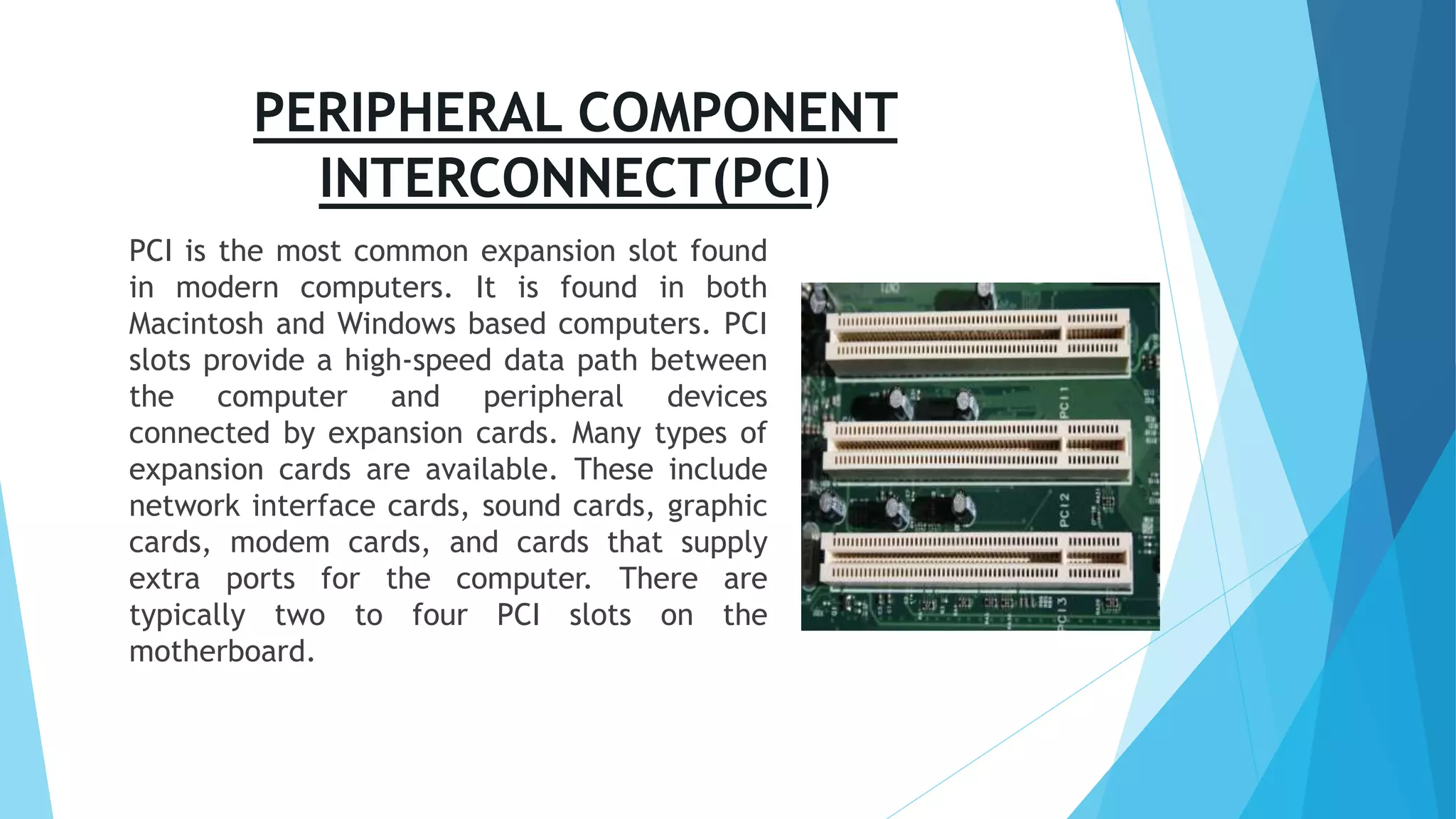
PCI is the most common expansion slot found
in modern computers. It is found in both
Macintosh and Windows based computers. PCI
slots provide a high-speed data path between
the computer and peripheral devices
connected by expansion cards. Many types of
expansion cards are available. These include
network interface cards, sound cards, graphic
cards, modem cards, and cards that supply
extra ports for the computer. There are
typically two to four PCI slots on the
motherboard.
INDUSTRY STANDARD
ARCHITECTURE(ISA)
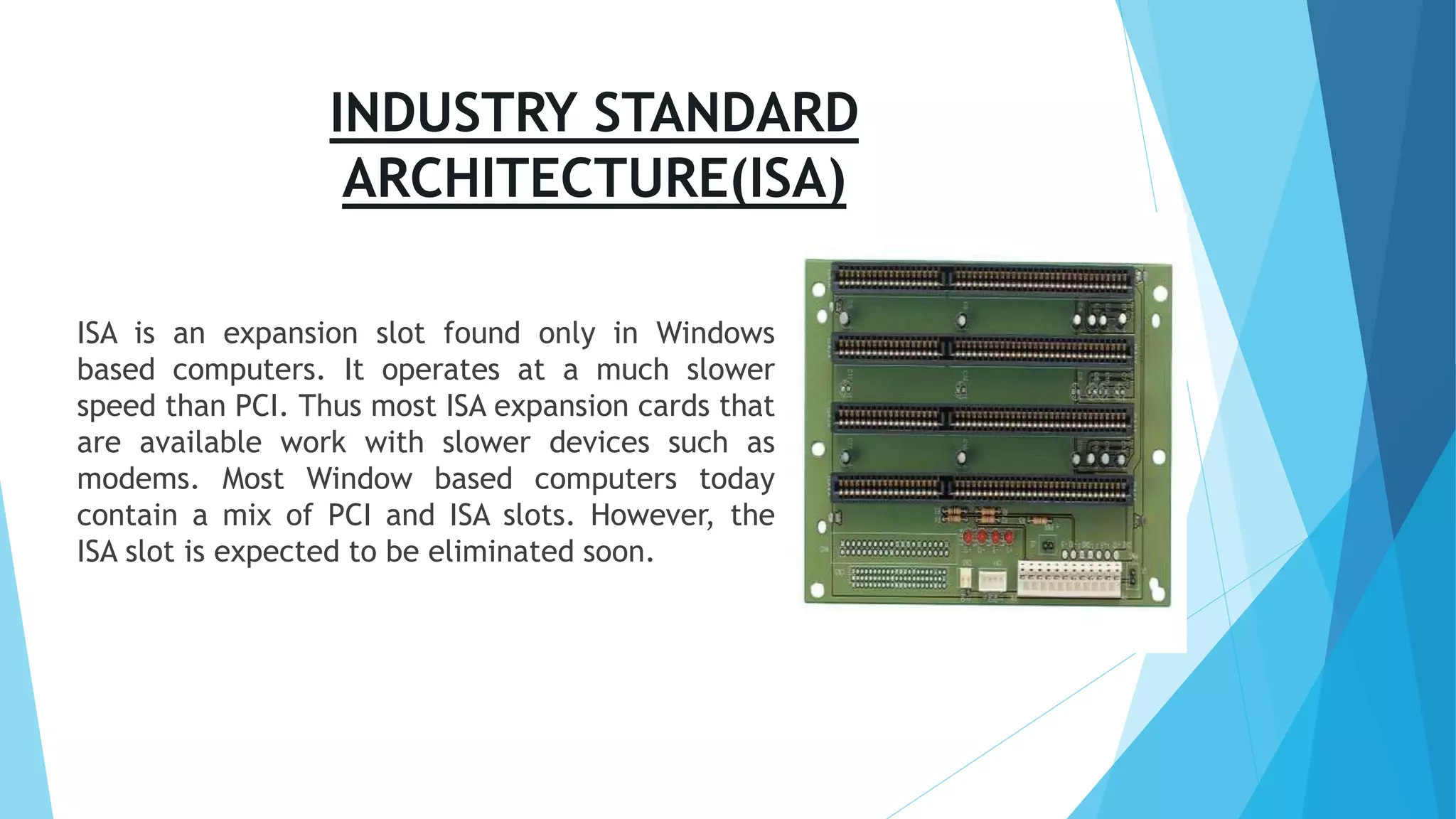
ISA is an expansion slot found only in Windows
based computers. It operates at a much slower
speed than PCI. Thus most ISA expansion cards that
are available work with slower devices such as
modems. Most Window based computers today
contain a mix of PCI and ISA slots. However, the
ISA slot is expected to be eliminated soon.
ACCELERATED GRAPHICS PORT(AGP SLOT)
AGP is a specialized expansion slot
used only for a graphics or video
card. It is found in both Macintosh
and Windows based computers. AGP
operates at a much faster speed than
PCI. Only one AGP slot is provided on
AGP-equipped motherboards. AGP
slots are commonly rated as 1x, 2x or
4x which refers to the transfer rate of
the slot. The transfer rate of the
video/graphics card should match the
transfer rate of the slot.
EXPANSION CARDS
FOLLOWING ARE THE EXPANSION CARDS AVAILABLE IN THE MARKET:-
 SOUND CARD
 VIDEO CARD
 NETWORK CARD
 USB CARD
 FIREWIRE CARD
 STORAGE CARD
 MODEM CARD
 TV TUNER CARD
SOUND CARD
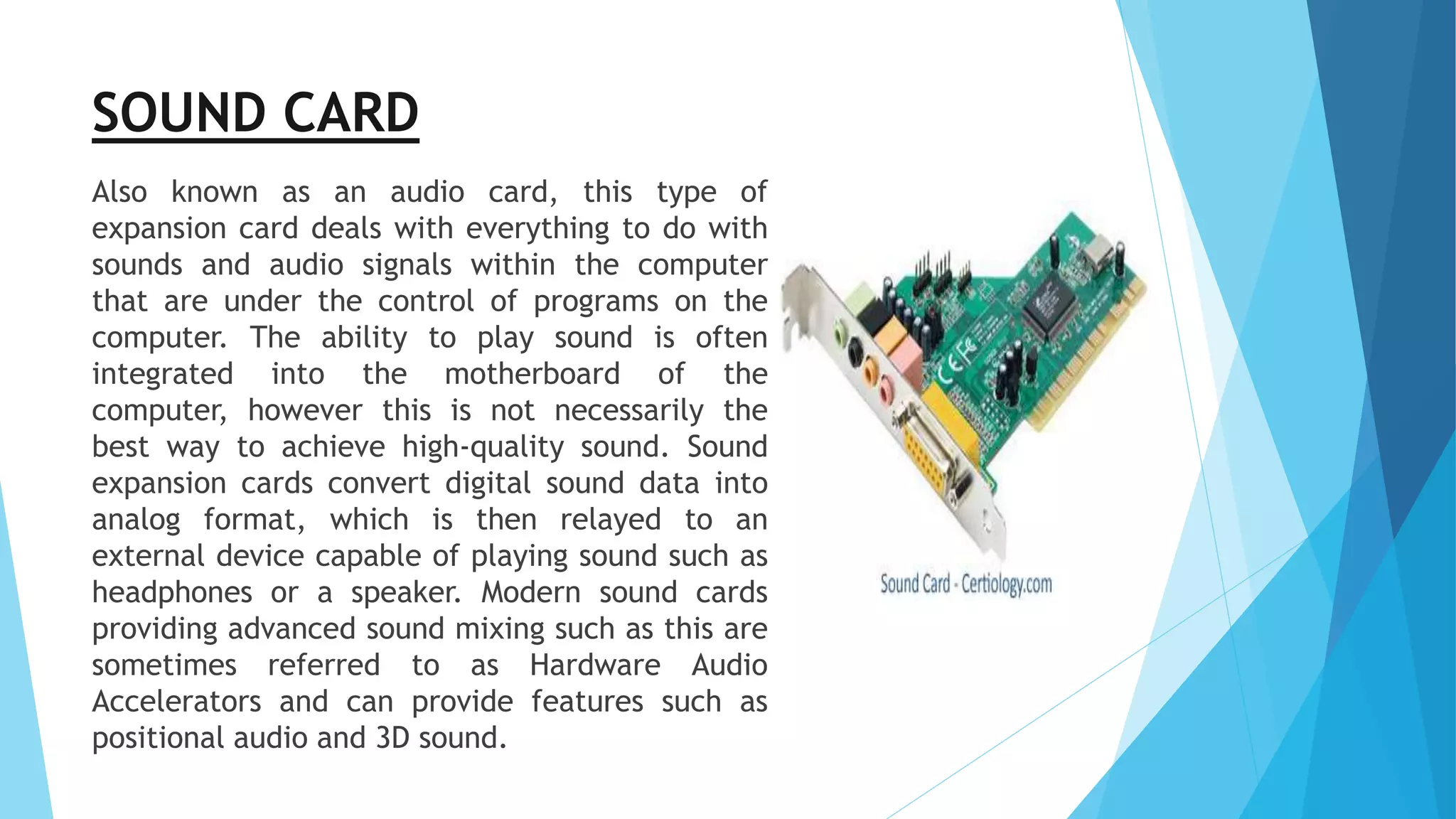
Also known as an audio card, this type of
expansion card deals with everything to do with
sounds and audio signals within the computer
that are under the control of programs on the
computer. The ability to play sound is often
integrated into the motherboard of the
computer, however this is not necessarily the
best way to achieve high-quality sound. Sound
expansion cards convert digital sound data into
analog format, which is then relayed to an
external device capable of playing sound such as
headphones or a speaker. Modern sound cards
providing advanced sound mixing such as this are
sometimes referred to as Hardware Audio
Accelerators and can provide features such as
positional audio and 3D sound.
VIDEO CARD
A video card is more often called a
graphics card or display card, and is
responsible for generating images to a
visual display such as a computer monitor
or laptop screen. Although all
motherboards have some degree of
integrated graphics, a dedicated video
card allows for higher quality graphics and
better speeds. Video cards can offer such
functions as the rendering of high-quality
3D and 2D graphics, the ability to connect
to a TV and the ability to display graphics
across multiple display screens.
NETWORK CARD
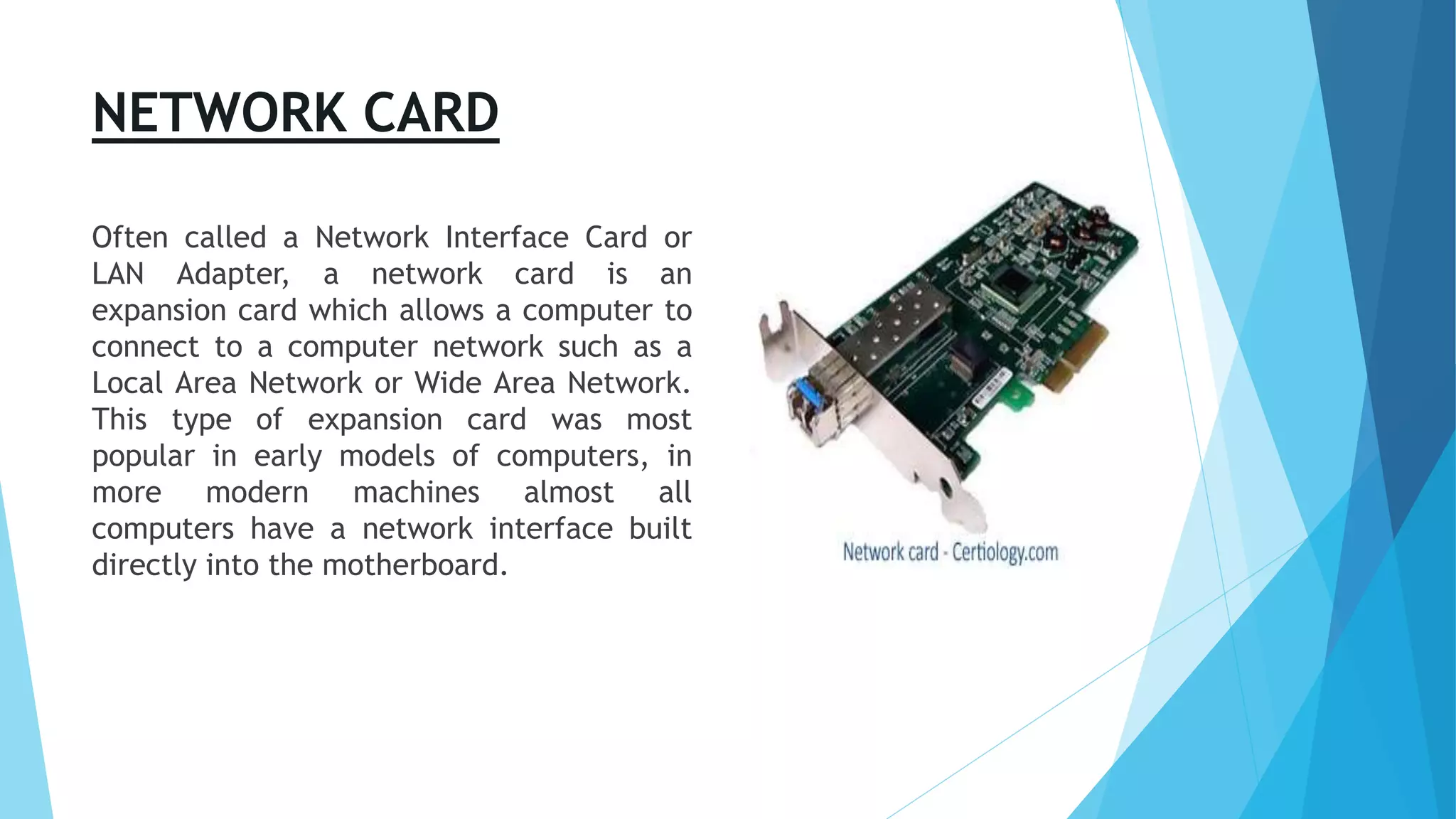
Often called a Network Interface Card or
LAN Adapter, a network card is an
expansion card which allows a computer to
connect to a computer network such as a
Local Area Network or Wide Area Network.
This type of expansion card was most
popular in early models of computers, in
more modern machines almost all
computers have a network interface built
directly into the motherboard.
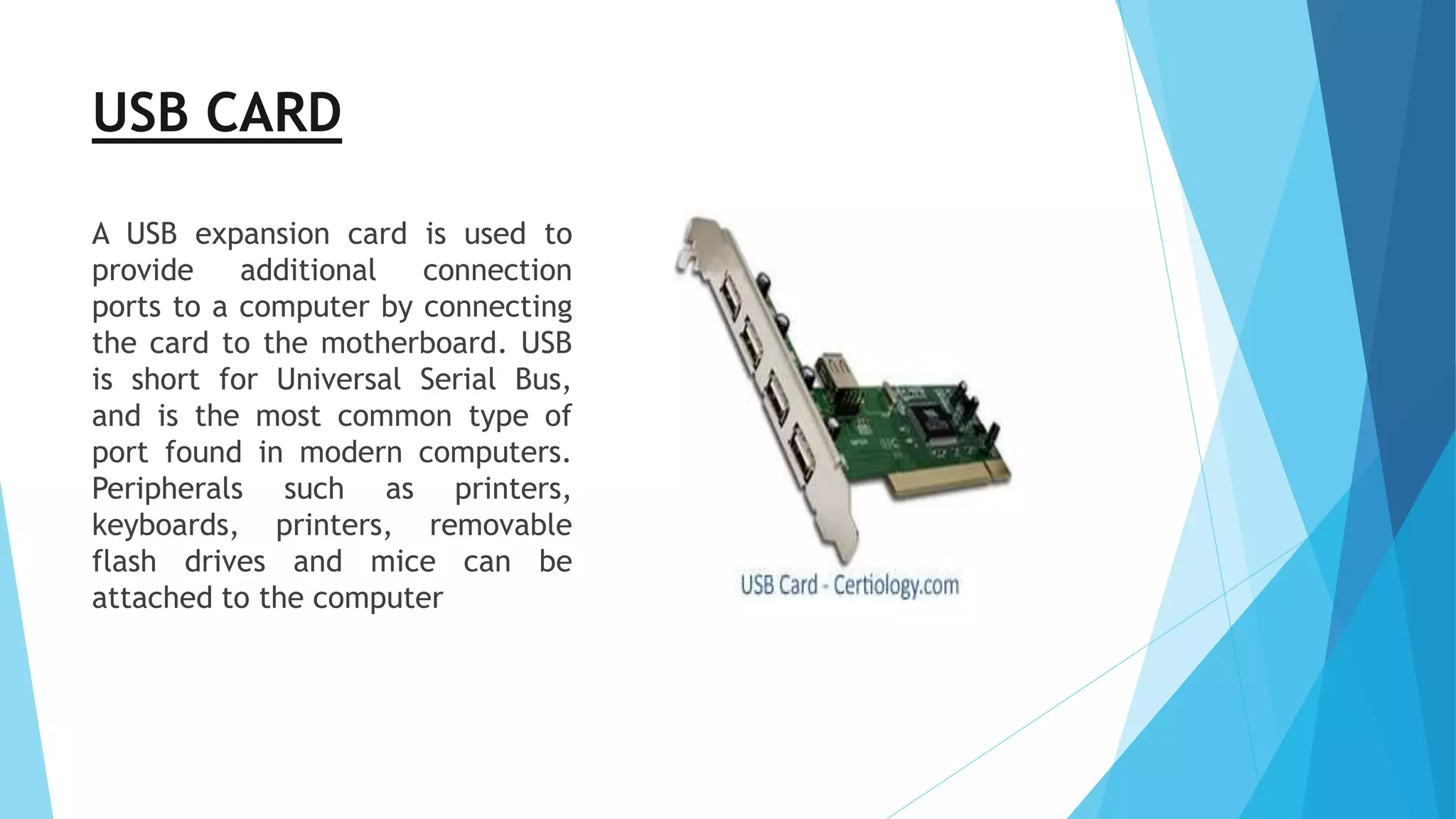
USB CARD
A USB expansion card is used to
provide additional connection
ports to a computer by connecting
the card to the motherboard. USB
is short for Universal Serial Bus,
and is the most common type of
port found in modern computers.
Peripherals such as printers,
keyboards, printers, removable
flash drives and mice can be
attached to the computer
FIREWIRE CARD
A FIREWIRE CARD IS USED TO PROVIDE
COMPUTERS WITH AN IEEE 1394 INTERFACE
CONNECTION, ALSO KNOWN AS A FIREWIRE.
THE TERM WAS COINED BY APPLE IN THE
EARLY 1990S, AND THE PORTS THEMSELVES
HAVE BEEN INCLUDED ON MOST APPLE
COMPUTERS SINCE THE YEAR 2000.
RECENTLY APPLE HAS BEGUN REPLACING
THIS PORT WITH THE THUNDERBOLT
INTERFACE ON ALL MODERN MAC
COMPUTERS. THE PORT ITSELF IS VERY
SIMILAR TO A USB CONNECTION, ALTHOUGH
USB IS MUCH MORE POPULAR ACROSS A
RANGE OF CROSS-PLATFORM DEVICES AND
THE TWO ARE NOT INTERCHANGEABLE
STORAGE CARD
A storage card, often also called a flash
memory card or simply a memory card that is
connected to a computer in order to provide
users with extra space to store their data on.
This can include data such as music, pictures,
text or video and is transferable to other
devices such as digital cameras and mobile
phones. These cards vary in both physical size
and data capacity, and are constantly being
developed and upgraded. Some of the most
common on the market today include the
Secure Digital (SD) Card, the Mini/Micro SD
Card, and the Multi MediaCard (MMC)
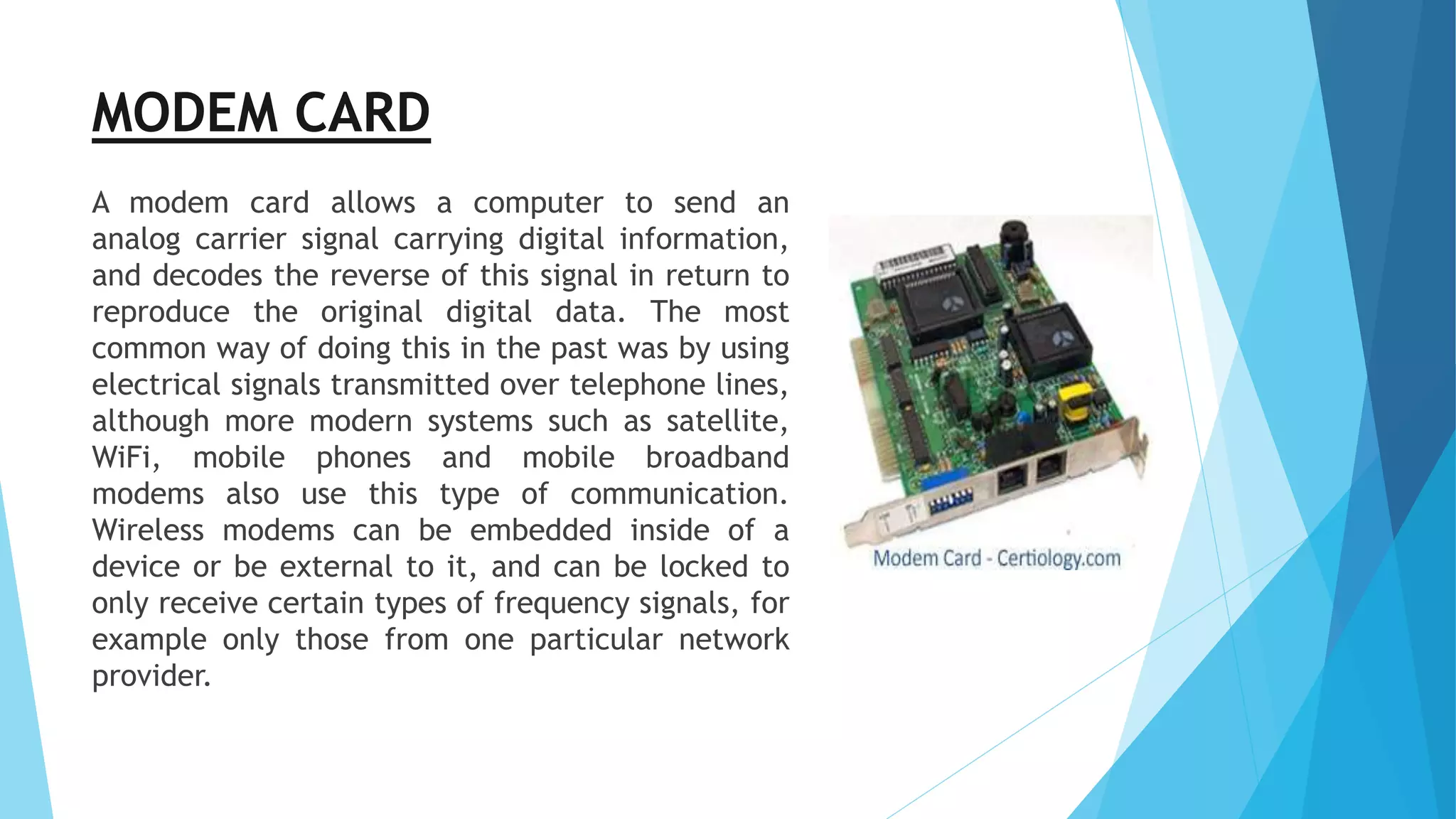
MODEM CARD
A modem card allows a computer to send an
analog carrier signal carrying digital information,
and decodes the reverse of this signal in return to
reproduce the original digital data. The most
common way of doing this in the past was by using
electrical signals transmitted over telephone lines,
although more modern systems such as satellite,
WiFi, mobile phones and mobile broadband
modems also use this type of communication.
Wireless modems can be embedded inside of a
device or be external to it, and can be locked to
only receive certain types of frequency signals, for
example only those from one particular network
provider.
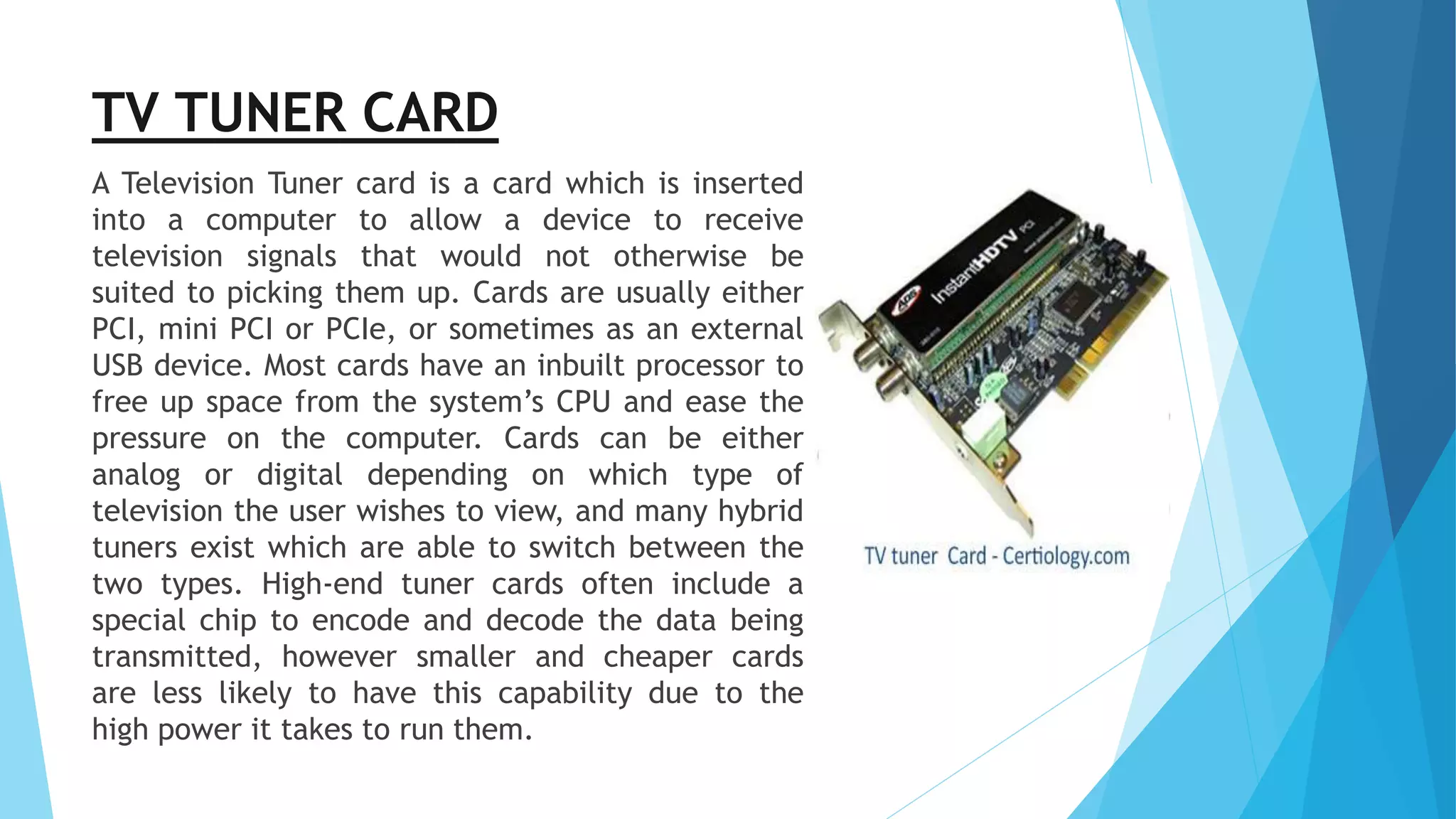
TV TUNER CARD
A Television Tuner card is a card which is inserted
into a computer to allow a device to receive
television signals that would not otherwise be
suited to picking them up. Cards are usually either
PCI, mini PCI or PCIe, or sometimes as an external
USB device. Most cards have an inbuilt processor to
free up space from the system’s CPU and ease the
pressure on the computer. Cards can be either
analog or digital depending on which type of
television the user wishes to view, and many hybrid
tuners exist which are able to switch between the
two types. High-end tuner cards often include a
special chip to encode and decode the data being
transmitted, however smaller and cheaper cards
are less likely to have this capability due to the
high power it takes to run them.
THANK YOU

Expansion cards and slots

  • 1.
  • 2.
    EXPANSION CARD Definition -What does Expansion Card mean? An expansion card is an electronic card/board that is used to add extra functionality to a computer. Expansion cards contain edge connectors that are used to create an electronic link between motherboard and card, thus enabling these two to communicate. Expansion cards are also known as add-on cards or interface cards.
  • 3.
    EXPANSION SLOT  Anexpansion slot is a socket on the motherboard that is used to insert an expansion card (or circuit board), which provides additional features to a computer such as video, sound, advanced graphics, Ethernet or memory.  The expansion card has an edge connector that fits precisely into the expansion slot as well as a row of contacts that is designed to establish an electrical connection between the motherboard and the electronics on the card, which are mostly integrated circuits. Depending on the form factor of the case and motherboard, a computer system generally can have anywhere from one to seven expansion slots. With a backplane system, up to 19 expansion cards can be installed.
  • 4.
    TYPES OF EXPANSIONSLOTS FOLLOWING ARE THE EXPANSION SLOT:-  Peripheral Component Interconnect(PCI SLOT)  Industry Standard Architecture(ISA SLOT)  Accelerated Graphics Port(AGP SLOT) They differ primarily in how fast they transfer information between the microprocessor and the expansion board.
  • 5.
    PERIPHERAL COMPONENT INTERCONNECT(PCI) PCI isthe most common expansion slot found in modern computers. It is found in both Macintosh and Windows based computers. PCI slots provide a high-speed data path between the computer and peripheral devices connected by expansion cards. Many types of expansion cards are available. These include network interface cards, sound cards, graphic cards, modem cards, and cards that supply extra ports for the computer. There are typically two to four PCI slots on the motherboard.
  • 6.
    INDUSTRY STANDARD ARCHITECTURE(ISA) ISA isan expansion slot found only in Windows based computers. It operates at a much slower speed than PCI. Thus most ISA expansion cards that are available work with slower devices such as modems. Most Window based computers today contain a mix of PCI and ISA slots. However, the ISA slot is expected to be eliminated soon.
  • 7.
    ACCELERATED GRAPHICS PORT(AGPSLOT) AGP is a specialized expansion slot used only for a graphics or video card. It is found in both Macintosh and Windows based computers. AGP operates at a much faster speed than PCI. Only one AGP slot is provided on AGP-equipped motherboards. AGP slots are commonly rated as 1x, 2x or 4x which refers to the transfer rate of the slot. The transfer rate of the video/graphics card should match the transfer rate of the slot.
  • 8.
    EXPANSION CARDS FOLLOWING ARETHE EXPANSION CARDS AVAILABLE IN THE MARKET:-  SOUND CARD  VIDEO CARD  NETWORK CARD  USB CARD  FIREWIRE CARD  STORAGE CARD  MODEM CARD  TV TUNER CARD
  • 9.
    SOUND CARD Also knownas an audio card, this type of expansion card deals with everything to do with sounds and audio signals within the computer that are under the control of programs on the computer. The ability to play sound is often integrated into the motherboard of the computer, however this is not necessarily the best way to achieve high-quality sound. Sound expansion cards convert digital sound data into analog format, which is then relayed to an external device capable of playing sound such as headphones or a speaker. Modern sound cards providing advanced sound mixing such as this are sometimes referred to as Hardware Audio Accelerators and can provide features such as positional audio and 3D sound.
  • 10.
    VIDEO CARD A videocard is more often called a graphics card or display card, and is responsible for generating images to a visual display such as a computer monitor or laptop screen. Although all motherboards have some degree of integrated graphics, a dedicated video card allows for higher quality graphics and better speeds. Video cards can offer such functions as the rendering of high-quality 3D and 2D graphics, the ability to connect to a TV and the ability to display graphics across multiple display screens.
  • 11.
    NETWORK CARD Often calleda Network Interface Card or LAN Adapter, a network card is an expansion card which allows a computer to connect to a computer network such as a Local Area Network or Wide Area Network. This type of expansion card was most popular in early models of computers, in more modern machines almost all computers have a network interface built directly into the motherboard.
  • 12.
    USB CARD A USBexpansion card is used to provide additional connection ports to a computer by connecting the card to the motherboard. USB is short for Universal Serial Bus, and is the most common type of port found in modern computers. Peripherals such as printers, keyboards, printers, removable flash drives and mice can be attached to the computer
  • 13.
    FIREWIRE CARD A FIREWIRECARD IS USED TO PROVIDE COMPUTERS WITH AN IEEE 1394 INTERFACE CONNECTION, ALSO KNOWN AS A FIREWIRE. THE TERM WAS COINED BY APPLE IN THE EARLY 1990S, AND THE PORTS THEMSELVES HAVE BEEN INCLUDED ON MOST APPLE COMPUTERS SINCE THE YEAR 2000. RECENTLY APPLE HAS BEGUN REPLACING THIS PORT WITH THE THUNDERBOLT INTERFACE ON ALL MODERN MAC COMPUTERS. THE PORT ITSELF IS VERY SIMILAR TO A USB CONNECTION, ALTHOUGH USB IS MUCH MORE POPULAR ACROSS A RANGE OF CROSS-PLATFORM DEVICES AND THE TWO ARE NOT INTERCHANGEABLE
  • 14.
    STORAGE CARD A storagecard, often also called a flash memory card or simply a memory card that is connected to a computer in order to provide users with extra space to store their data on. This can include data such as music, pictures, text or video and is transferable to other devices such as digital cameras and mobile phones. These cards vary in both physical size and data capacity, and are constantly being developed and upgraded. Some of the most common on the market today include the Secure Digital (SD) Card, the Mini/Micro SD Card, and the Multi MediaCard (MMC)
  • 15.
    MODEM CARD A modemcard allows a computer to send an analog carrier signal carrying digital information, and decodes the reverse of this signal in return to reproduce the original digital data. The most common way of doing this in the past was by using electrical signals transmitted over telephone lines, although more modern systems such as satellite, WiFi, mobile phones and mobile broadband modems also use this type of communication. Wireless modems can be embedded inside of a device or be external to it, and can be locked to only receive certain types of frequency signals, for example only those from one particular network provider.
  • 16.
    TV TUNER CARD ATelevision Tuner card is a card which is inserted into a computer to allow a device to receive television signals that would not otherwise be suited to picking them up. Cards are usually either PCI, mini PCI or PCIe, or sometimes as an external USB device. Most cards have an inbuilt processor to free up space from the system’s CPU and ease the pressure on the computer. Cards can be either analog or digital depending on which type of television the user wishes to view, and many hybrid tuners exist which are able to switch between the two types. High-end tuner cards often include a special chip to encode and decode the data being transmitted, however smaller and cheaper cards are less likely to have this capability due to the high power it takes to run them.
  • 17.