A  STRATEGY FOR PERFORMANCE EXCELLENCE 5s
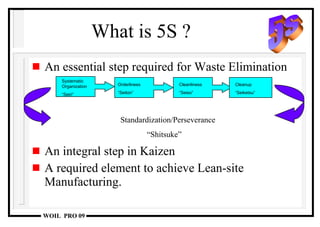
What is 5S ? An essential step required for Waste Elimination An integral step in Kaizen A required element to achieve Lean-site Manufacturing. Systematic Organization “ Seiri” Orderliness “ Seiton” Cleanliness “ Seiso” Cleanup “ Seiketsu” Cleanup “ Seiketsu” Standardization/Perseverance “ Shitsuke” 5s
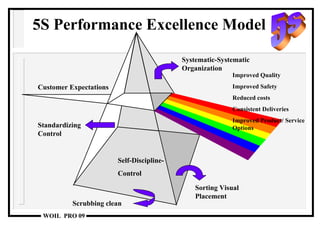
5S Performance Excellence Model Systematic-Systematic Organization Scrubbing clean Self-Discipline- Control Customer Expectations Sorting Visual Placement Standardizing Control Improved Quality Improved Safety Reduced costs Consistent Deliveries Improved Product/ Service Options 5s
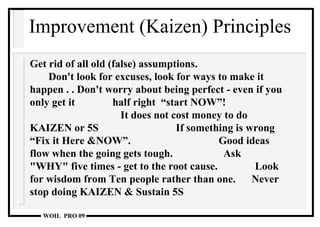
Improvement (Kaizen) Principles Get rid of all old (false) assumptions.  Don't look for excuses, look for ways to make it happen . . Don't worry about being perfect - even if you only get it    half right  “start NOW”!  It does not cost money to do KAIZEN or 5S  If something is wrong  “Fix it Here &NOW”.  Good ideas flow when the going gets tough.  Ask "WHY" five times - get to the root cause.  Look for wisdom from Ten people rather than one.  Never stop doing KAIZEN   & Sustain 5S
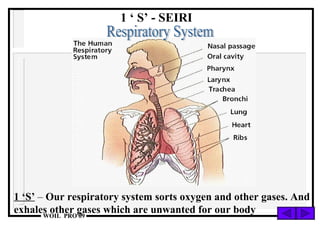
Respiratory System 1 ‘S’  –  Our respiratory system sorts oxygen and other gases. And exhales other gases which are unwanted for our body 1 ‘ S’ - SEIRI
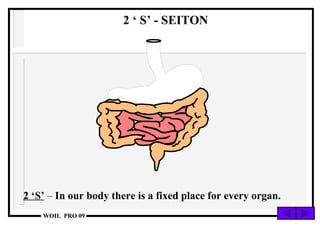
2 ‘S’  –  In our body there is a fixed place for every organ. 2 ‘ S’ - SEITON
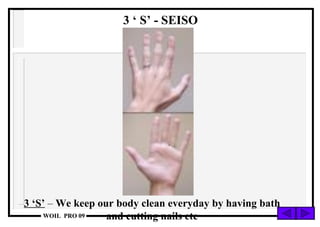
3 ‘ S’ - SEISO 3 ‘S’  –  We keep our body clean everyday by having bath and cutting nails etc
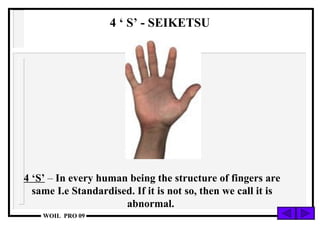
4 ‘S’  –  In every human being the structure of fingers are same I.e Standardised. If it is not so, then we call it is abnormal.  4 ‘ S’ - SEIKETSU
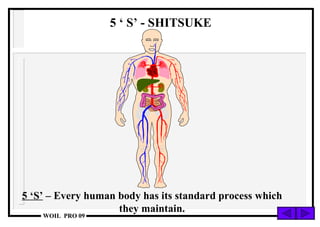
5 ‘S’  – Every human body has its standard process which they maintain. 5 ‘ S’ - SHITSUKE
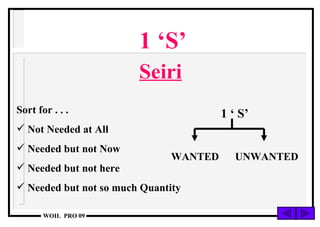
1 ‘S’ Seiri Sort for . . .  Not Needed at All Needed but not Now Needed but not here Needed but not so much Quantity 1 ‘ S’ WANTED UNWANTED
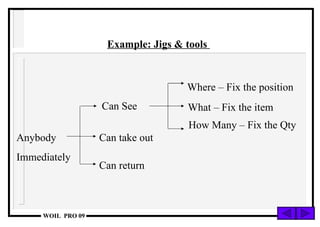
Example: Jigs & tools  Anybody Immediately Can See Can take out Can return Where – Fix the position What – Fix the item How Many – Fix the Qty
Clean Procedure: Decide what to clean Decide who is in charge of each cleaning Decide on cleaning method Prepare cleaning tools and equipment Implement cleaning
WHAT TO DO STANDARDISATION . . . Workstation layout,work area layout Work in progress Sequence of work Material & tools used Machine & their process parameters Quality parameters, methods of measurement & reporting methods 5 W’s and 1 H
ENSURE . . .  Procedure & Work Instruction are correct. Standard are expressed in specific. Visual Aids are used. Train at all levels. Work ethics for effective management. Transparent & Discipline work culture.
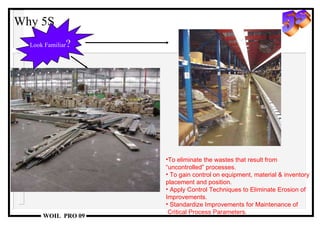
Why 5S To eliminate the wastes that result from “ uncontrolled” processes. To gain control on equipment, material & inventory placement and position. Apply Control Techniques to Eliminate Erosion of Improvements. Standardize Improvements for Maintenance of  Critical Process Parameters. Look Familiar ? 5s
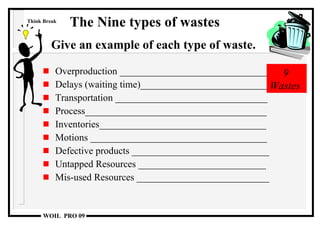
Overproduction Delays (waiting time) Transportation Process Inventories Motions Defective products Untapped Resources Mis-used Resources 9  Wastes The Nine types of wastes.
Overproduction ______________________________ Delays (waiting time)__________________________ Transportation _______________________________ Process_____________________________________ Inventories__________________________________ Motions ____________________________________ Defective products ____________________________ Untapped Resources __________________________ Mis-used Resources ___________________________ 9 Wastes Give an example of each type of waste. The Nine types of wastes Think Break
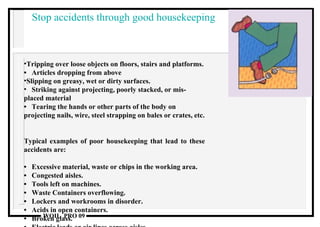
Stop accidents through good housekeeping Tripping over loose objects on floors, stairs and platforms. •  Articles dropping from above Slipping on greasy, wet or dirty surfaces.  Striking against projecting, poorly stacked, or mis- placed material •  Tearing the hands or other parts of the body on projecting nails, wire, steel strapping on bales or crates, etc.  Typical examples of poor housekeeping that lead to these accidents are:  •  Excessive material, waste or chips in the working area.  •  Congested aisles.  •  Tools left on machines.  •  Waste Containers overflowing.  •  Lockers and workrooms in disorder.  •  Acids in open containers. •  Broken glass.  •  Electric leads or air lines across aisles.  •  Dirty light fittings, windows and skylights.
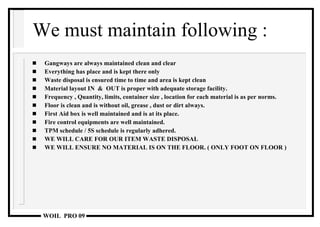
We must maintain following : Gangways are always maintained clean and clear Everything has place and is kept there only Waste disposal is ensured time to time and area is kept clean Material layout IN  &  OUT is proper with adequate storage facility. Frequency , Quantity, limits, container size , location for each material is as per norms. Floor is clean and is without oil, grease , dust or dirt always. First Aid box is well maintained and is at its place. Fire control equipments are well maintained. TPM schedule / 5S schedule is regularly adhered. WE WILL CARE FOR OUR ITEM WASTE DISPOSAL WE WILL ENSURE NO MATERIAL IS ON THE FLOOR. ( ONLY FOOT ON FLOOR )
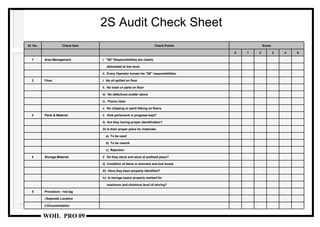
2S Audit Check Sheet               ii.Documentation                 i.Seperate Location                 Procedure - red tag 5             maximum and minimum level of storing?                 iv)  Is storage space properly marked for                 iii)  Have they been properly identified?                 ii)  Condition of items in almirahs and tool boxes                 i)  Do they stock and store at prefixed place? Storage Material 4             c)  Rejection                 b)  To be rework                 a)  To be used                 iii) Is their proper place for materials.                 ii)  Are they having proper identification?                 i)  How parts/work in progress kept? Parts & Material 3             v.  No chipping or paint flaking on floors                 iv.  Floors clean                 iii.  No defectives scatter about                 ii.  No trash or parts on floor                 i.  No oil spilled on floor Floor 2             ii.  Every Operator knows his "5S" responsibilities.                 delineated at line level.                 i.  "5S" Responsibilities are clearly Area Management  1 5 4 3 2 1 0       Score Check Points Check Item Sl. No.
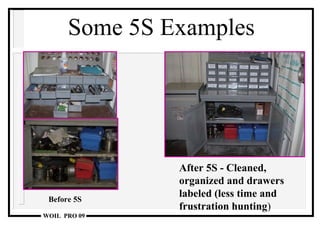
Some 5S Examples Before 5S After 5S - Cleaned, organized and drawers labeled (less time and frustration hunting )
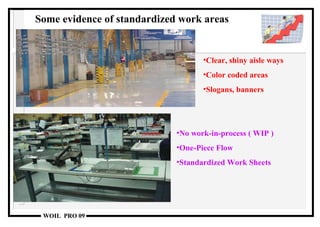
Some evidence of standardized work areas Clear, shiny aisle ways Color coded areas Slogans, banners No work-in-process ( WIP ) One-Piece Flow Standardized Work Sheets
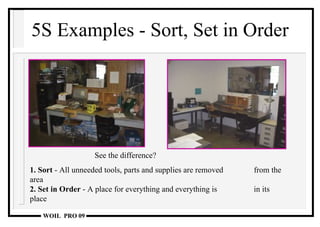
5S Examples - Sort, Set in Order See the difference? 1. Sort  - All unneeded tools, parts and supplies are removed  from the area 2. Set in Order  - A place for everything and everything is  in its place
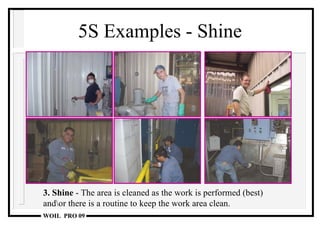
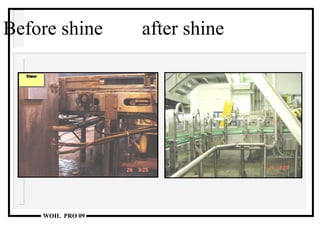
5S Examples - Shine 3. Shine  - The area is cleaned as the work is performed (best) and\or there is a routine to keep the work area clean.
Before shine  after shine
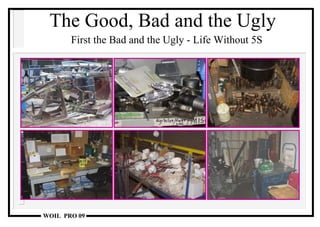
The Good, Bad and the Ugly First the Bad and the Ugly - Life Without 5S
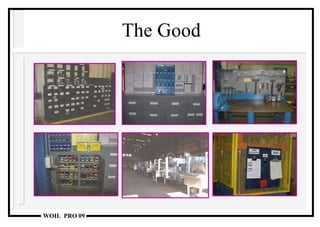
The Good
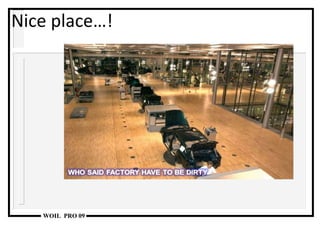
Nice place…! There is no second chance to make the first impression!
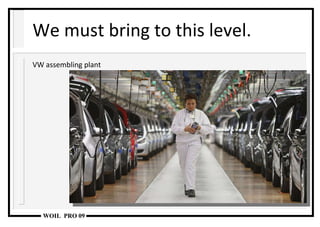
We must bring to this level. VW assembling plant

5s trg manual woil pro

  • 1.
    A STRATEGYFOR PERFORMANCE EXCELLENCE 5s
  • 2.
    What is 5S? An essential step required for Waste Elimination An integral step in Kaizen A required element to achieve Lean-site Manufacturing. Systematic Organization “ Seiri” Orderliness “ Seiton” Cleanliness “ Seiso” Cleanup “ Seiketsu” Cleanup “ Seiketsu” Standardization/Perseverance “ Shitsuke” 5s
  • 3.
    5S Performance ExcellenceModel Systematic-Systematic Organization Scrubbing clean Self-Discipline- Control Customer Expectations Sorting Visual Placement Standardizing Control Improved Quality Improved Safety Reduced costs Consistent Deliveries Improved Product/ Service Options 5s
  • 4.
    Improvement (Kaizen) PrinciplesGet rid of all old (false) assumptions. Don't look for excuses, look for ways to make it happen . . Don't worry about being perfect - even if you only get it half right “start NOW”! It does not cost money to do KAIZEN or 5S If something is wrong “Fix it Here &NOW”. Good ideas flow when the going gets tough. Ask "WHY" five times - get to the root cause. Look for wisdom from Ten people rather than one. Never stop doing KAIZEN & Sustain 5S
  • 5.
    Respiratory System 1‘S’ – Our respiratory system sorts oxygen and other gases. And exhales other gases which are unwanted for our body 1 ‘ S’ - SEIRI
  • 6.
    2 ‘S’ – In our body there is a fixed place for every organ. 2 ‘ S’ - SEITON
  • 7.
    3 ‘ S’- SEISO 3 ‘S’ – We keep our body clean everyday by having bath and cutting nails etc
  • 8.
    4 ‘S’ – In every human being the structure of fingers are same I.e Standardised. If it is not so, then we call it is abnormal. 4 ‘ S’ - SEIKETSU
  • 9.
    5 ‘S’ – Every human body has its standard process which they maintain. 5 ‘ S’ - SHITSUKE
  • 10.
    1 ‘S’ SeiriSort for . . . Not Needed at All Needed but not Now Needed but not here Needed but not so much Quantity 1 ‘ S’ WANTED UNWANTED
  • 11.
    Example: Jigs &tools Anybody Immediately Can See Can take out Can return Where – Fix the position What – Fix the item How Many – Fix the Qty
  • 12.
    Clean Procedure: Decidewhat to clean Decide who is in charge of each cleaning Decide on cleaning method Prepare cleaning tools and equipment Implement cleaning
  • 13.
    WHAT TO DOSTANDARDISATION . . . Workstation layout,work area layout Work in progress Sequence of work Material & tools used Machine & their process parameters Quality parameters, methods of measurement & reporting methods 5 W’s and 1 H
  • 14.
    ENSURE . .. Procedure & Work Instruction are correct. Standard are expressed in specific. Visual Aids are used. Train at all levels. Work ethics for effective management. Transparent & Discipline work culture.
  • 15.
    Why 5S Toeliminate the wastes that result from “ uncontrolled” processes. To gain control on equipment, material & inventory placement and position. Apply Control Techniques to Eliminate Erosion of Improvements. Standardize Improvements for Maintenance of Critical Process Parameters. Look Familiar ? 5s
  • 16.
    Overproduction Delays (waitingtime) Transportation Process Inventories Motions Defective products Untapped Resources Mis-used Resources 9 Wastes The Nine types of wastes.
  • 17.
    Overproduction ______________________________ Delays(waiting time)__________________________ Transportation _______________________________ Process_____________________________________ Inventories__________________________________ Motions ____________________________________ Defective products ____________________________ Untapped Resources __________________________ Mis-used Resources ___________________________ 9 Wastes Give an example of each type of waste. The Nine types of wastes Think Break
  • 18.
    Stop accidents throughgood housekeeping Tripping over loose objects on floors, stairs and platforms. • Articles dropping from above Slipping on greasy, wet or dirty surfaces. Striking against projecting, poorly stacked, or mis- placed material • Tearing the hands or other parts of the body on projecting nails, wire, steel strapping on bales or crates, etc. Typical examples of poor housekeeping that lead to these accidents are: • Excessive material, waste or chips in the working area. • Congested aisles. • Tools left on machines. • Waste Containers overflowing. • Lockers and workrooms in disorder. • Acids in open containers. • Broken glass. • Electric leads or air lines across aisles. • Dirty light fittings, windows and skylights.
  • 19.
    We must maintainfollowing : Gangways are always maintained clean and clear Everything has place and is kept there only Waste disposal is ensured time to time and area is kept clean Material layout IN & OUT is proper with adequate storage facility. Frequency , Quantity, limits, container size , location for each material is as per norms. Floor is clean and is without oil, grease , dust or dirt always. First Aid box is well maintained and is at its place. Fire control equipments are well maintained. TPM schedule / 5S schedule is regularly adhered. WE WILL CARE FOR OUR ITEM WASTE DISPOSAL WE WILL ENSURE NO MATERIAL IS ON THE FLOOR. ( ONLY FOOT ON FLOOR )
  • 20.
    2S Audit CheckSheet               ii.Documentation                 i.Seperate Location                 Procedure - red tag 5             maximum and minimum level of storing?                 iv) Is storage space properly marked for                 iii) Have they been properly identified?                 ii) Condition of items in almirahs and tool boxes                 i) Do they stock and store at prefixed place? Storage Material 4             c) Rejection                 b) To be rework                 a) To be used                 iii) Is their proper place for materials.                 ii) Are they having proper identification?                 i) How parts/work in progress kept? Parts & Material 3             v. No chipping or paint flaking on floors                 iv. Floors clean                 iii. No defectives scatter about                 ii. No trash or parts on floor                 i. No oil spilled on floor Floor 2             ii. Every Operator knows his "5S" responsibilities.                 delineated at line level.                 i. "5S" Responsibilities are clearly Area Management 1 5 4 3 2 1 0       Score Check Points Check Item Sl. No.
  • 21.
    Some 5S ExamplesBefore 5S After 5S - Cleaned, organized and drawers labeled (less time and frustration hunting )
  • 22.
    Some evidence ofstandardized work areas Clear, shiny aisle ways Color coded areas Slogans, banners No work-in-process ( WIP ) One-Piece Flow Standardized Work Sheets
  • 23.
    5S Examples -Sort, Set in Order See the difference? 1. Sort - All unneeded tools, parts and supplies are removed from the area 2. Set in Order - A place for everything and everything is in its place
  • 24.
    5S Examples -Shine 3. Shine - The area is cleaned as the work is performed (best) and\or there is a routine to keep the work area clean.
  • 25.
    Before shine after shine
  • 26.
    The Good, Badand the Ugly First the Bad and the Ugly - Life Without 5S
  • 27.
  • 28.
    Nice place…! Thereis no second chance to make the first impression!
  • 29.
    We must bringto this level. VW assembling plant

Editor's Notes

  • #2 5S is the foundation, the building blocks, for a “Kaizen” approach to incremental improvement. 5S focuses on the elimination of wastes( Muda) in the work environment: to include the office environment as well as the manufacturing environment. In simplest terms , it is the cleaning up of all the wastes so that the work environment produces “what” it wants, at the “time” it is needed in the “correct quantities”.
  • #3 5S was created in the Japanese manufacturing environment and literally stands for 5 Japanese words which begin with S: Seiri, Seiton, Seison, Seiketsu, Shitsuke When translated together mean a cleaning activity at a workplace. Aforementioned, 5S is an integral step towards Kaizen and Lean-site Manufacturing with the primary goal of being able to supply the customer ( internal,external) with the “right product” at the “right time” in the correct quantities.
  • #4 This model shows the inter-relationship of the 5S steps with the customer’s expectations of improved quality,improved safety, reduced nonconformance costs, improved product service options;thus, leading to a satisfied customer. Please note that the base of the pyramid is self-discipline-control. This step is key in maintaining the progress already achieved by the previous 4 S’s. Also please note, that the deliverables are closely related to the deliverables of a Kaizen process.
  • #6 09/17/10
  • #7 09/17/10
  • #8 09/17/10
  • #9 09/17/10
  • #10 09/17/10
  • #11 09/17/10
  • #12 09/17/10
  • #13 09/17/10
  • #14 09/17/10
  • #15 09/17/10
  • #16 The primary focus of 5S is the elimination of wastes in the work environment that result from unorganized, unclean material, tools, machines, desks, inventories, aisles,walkways, storage locations. 5S provides a structured methodical approach towards this goal.
  • #17 The 7 types of wastes are identified. It is important that the group understand these 7 wastes. The primary focus of Kaizen and Lean-site Manufacturing are focused on the elimination of these wastes. 5S in turn focuses on the elimination of many of these wastes ( Delays, Transportation, Inventories, Motions, Defective products).
  • #18 Have each member work by themselves and identify an example of each type of the seven wastes. ( 10 minutes)
  • #23 A standardized work area is a result of applying the first 3 S’s. the result will be a clean, organized work area with evidence of visual color and sign strategies.
  • #26 09/17/10
  • #29 09/17/10
  • #30 09/17/10