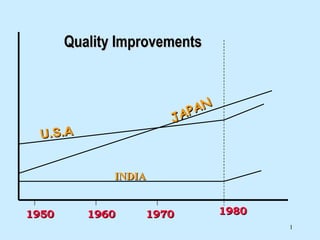
1980 1950 1970 1960 U.S.A JAPAN INDIA Quality Improvements
1. 5S Principles Elimination of waste Every body is involved, Co-operative effort Attack root cause Human being is not infalliable
2. Objectives Improve housekeeping Make every individual responsible for housekeeping Beautify by simple means Productivity improvement by saving time, space etc.
3. 5S’s Seiri   - Sorting Seiton  - Systematic arrangement Seiso  - Cleaning    Inspection while cleaning Seiketsu   - Standardization Shitsuke   - Self Discipline
5S If we do not do 5S, we can’t do any other work efficiently. They are features which are common to all places and are the indicators of  how well an organization is functioning.
SEIRI =  Sorting Meaning Distinguish between necessary and unnecessary    items and eliminate the unnecessary items Activity Establish a criteria for eliminating unwanted items Eliminate unwanted items either by disposing  them or by relocating them. Success Area saved or percentage of space available Indicator
SEIRI =  Sorting Japanese Meaning :  The Japanese meaning of  “ Seiri”  is to straighten and contain. - Get rid of waste and put it in order according to rules OTHER JAPANESE MEANINGS - farmland cultivation, Make an orderly system and straighten
Seiri = Sorting 1. Item is not needed 2. Item is needed however quantity in stock is more than what is needed for consumption in near future 3.  Contingency Parts Critically decide the quantity of contingency  parts to be retained and criteria for such parts What is unnecessary
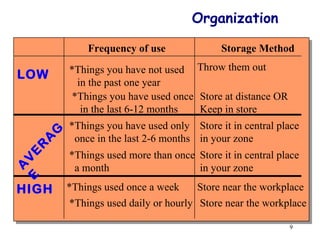
Frequency of use Storage Method *Things you have not used in the past one year Throw them out *Things you have used once in the last 6-12 months Store at distance OR Keep in store LOW *Things you have used only once in the last 2-6 months Store it in central place in your zone *Things used more than once a month Store it in central place in your zone AVERAGE HIGH *Things used once a week Store near the workplace *Things used daily or hourly Store near the workplace Organization
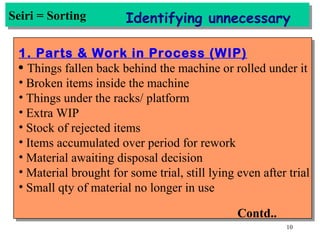
Seiri = Sorting Identifying unnecessary 1. Parts & Work in Process (WIP) Things fallen back behind the machine or rolled under it Broken items inside the machine Things under the racks/ platform Extra WIP Stock of rejected items Items accumulated over period for rework Material awaiting disposal decision Material brought for some trial, still lying even after trial Small qty of material no longer in use Contd..
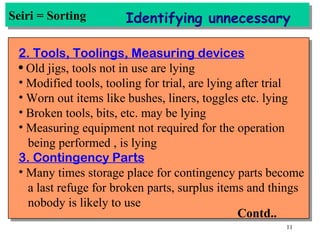
Seiri = Sorting Identifying unnecessary 2. Tools, Toolings, Measuring devices Old jigs, tools not in use are lying Modified tools, tooling for trial, are lying after trial Worn out items like bushes, liners, toggles etc. lying Broken tools, bits, etc. may be lying Measuring equipment not required for the operation being performed , is lying 3. Contingency Parts Many times storage place for contingency parts become a last refuge for broken parts, surplus items and things nobody is likely to use Contd..
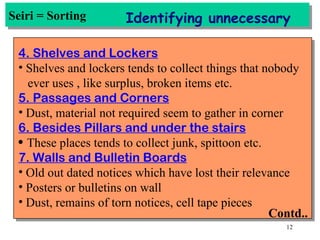
Seiri = Sorting Identifying unnecessary 4. Shelves and Lockers Shelves and lockers tends to collect things that nobody ever uses , like surplus, broken items etc. 5. Passages and Corners Dust, material not required seem to gather in corner 6. Besides Pillars and under the stairs These places tends to collect junk, spittoon etc. 7. Walls and Bulletin Boards Old out dated notices which have lost their relevance Posters or bulletins on wall Dust, remains of torn notices, cell tape pieces Contd..
Seiri = Sorting Identifying unnecessary 8.Floor, Pits, Partitions Defective parts Protection caps, covers Packing material Hardware items , small items Even tools, tooling Items dropped on the floor are never picked 9.Computer Hard Disk Many unwanted, outdated, temporary files pile up
Seiri = Sorting Improvement methods 1. Flow Process Chart (Procedural Analysis) Drawing a process flow chart for the system eg. How to make and use category wise grouping 2. Operational Analysis Preparing the sequence of operations for system eg. How to perform Seiri (sorting) 3. Check List A check sheet is used to decide what sort of main system and sub system are necessary.
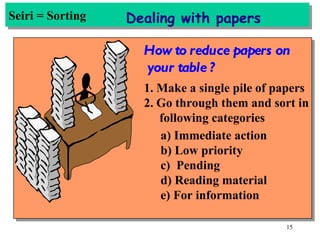
Seiri = Sorting Dealing with papers How to reduce papers on your table ? 1. Make a single pile of papers 2. Go through them and sort in following categories a) Immediate action b) Low priority c)  Pending d) Reading material e) For information
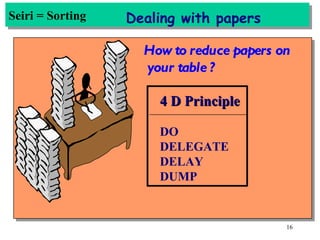
Seiri = Sorting Dealing with papers How to reduce papers on your table ? 4 D Principle DO DELEGATE DELAY DUMP
SEITION =  Systematic Arrangement Meaning To determine type of storage and layout that  will ensure easy accessibility for  everyone   . Activity -  Functional storage  -  Creating place for everything and putting    everything in its place Success -  Time saved in searching  Indicator  -  Time saved in material handling
SEITION =  Systematic Arrangement Japanese Meaning : Dictionary meaning of Seiton is “to be correctly prepared”and “to prepare correctly”. In short these means :  (a) arrange correctly in accordance with the correct method of doing activities and  (b) make thorough preparations so that activities can be done even if they occur abruptly
SEITION =  Systematic Arrangement The main target areas for Seri-Seiton improvement are : Tool-setting and preparation operations, line balancing and process planning, parts supply to assembly line, peak time problems etc. Improvement Methods Kit Method  /  Assembly box method / Outside tool setting  Cassettisation  / Parallel operations / Changes in assignment method
Seiton = Systematic Arrangement How to achieve Systematic Arrangement ? Decide where things belong Decide how things should be put away Obey the Put away rules
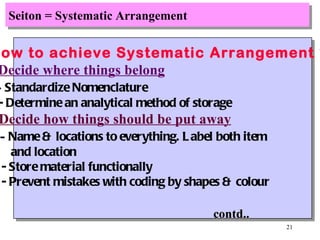
Seiton = Systematic Arrangement How to achieve Systematic Arrangement ? Decide where things belong -  Standardize Nomenclature - Determine an analytical method of storage Decide how things should be put away -  Name & locations to everything. Label both item  and location - Store material functionally - Prevent mistakes with coding by shapes & colour contd..
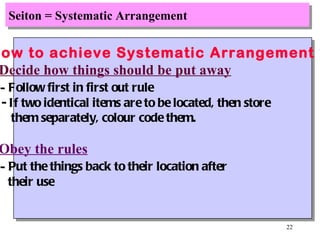
Seiton = Systematic Arrangement How to achieve Systematic Arrangement ? Decide how things should be put away -  Follow first in first out rule - If two identical items are to be located, then store them separately, colour code them. Obey the rules -  Put the things back to their location after their use
Seiton = Systematic Arrangement USE : 1 ) Signboards 2) Colour codes 3) Outline markings 4) Labels
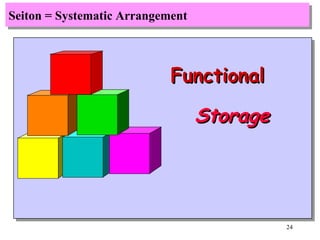
Seiton = Systematic Arrangement Functional Storage
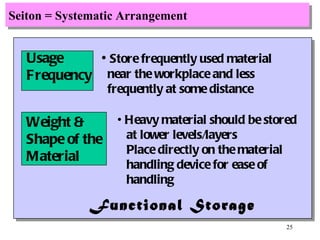
Seiton = Systematic Arrangement Usage Frequency Store frequently used material near the workplace and less  frequently at some distance Weight & Shape of the Material Heavy material should be stored at lower levels/layers  Place directly on the material handling device for ease of  handling Functional Storage
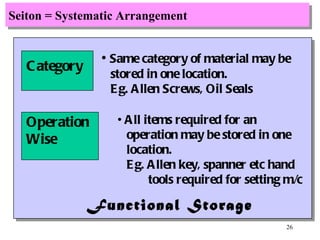
Seiton = Systematic Arrangement Category Same category of material may be  stored in one location.  Eg. Allen Screws, Oil Seals  Operation Wise All items required for an  operation may be stored in one location. Eg. Allen key, spanner etc hand  tools required for setting m/c Functional Storage
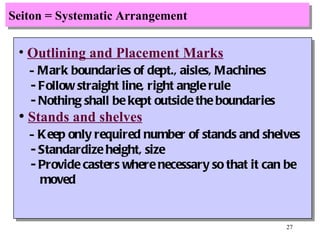
Seiton = Systematic Arrangement Outlining and Placement Marks -  Mark boundaries of dept., aisles, Machines - Follow straight line, right angle rule - Nothing shall be kept outside the boundaries Stands and shelves -  Keep only required number of stands and shelves - Standardize height, size - Provide casters where necessary so that it can be moved
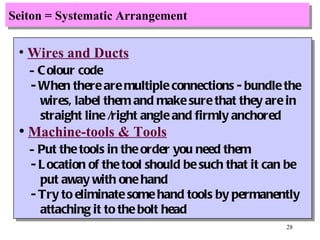
Seiton = Systematic Arrangement Wires and Ducts -  Colour code - When there are multiple connections - bundle the wires, label them and make sure that they are in straight line /right angle and firmly anchored Machine-tools & Tools -  Put the tools in the order you need them - Location of the tool should be such that it can be put away with one hand - Try to eliminate some hand tools by permanently attaching it to the bolt head
Seiton = Systematic Arrangement Blades, Dies, Other important consumables -  Store them in the protected place - Maintain these things regularly by applying rust preventive, oiling etc. WIP- Work In Process -  Designate a place for each component/part - Decide on how much quantity to be stored - Ensure that there is no damage to good part  during transit, they do not get rusty and they are not mislabeled
Seiton = Systematic Arrangement Oils -  Reduce number of oils used (Standardize) - Colour code for oil - Safety aspects - fire prevention, pollution, leak, spillage Instrumentation & Measuring Devices -  Label them, show direction of flow
SEISO =  Cleaning  Meaning Cleaning trash, filth, dust and other foreign  matter. Cleaning as a form of Inspection Activity - Keep workplace spotlessly clean - Inspection while cleaning - Finding minor problems with cleaning inspection Success - Reduction in machine down time Indicator   - Reduction in no. of accidents
SEISO =  Cleaning  Japanese Meaning : Dictionary meaning “to clean up” and “ getting rid of dirt and unclean items”  While cleaning potential defects such as abrasion, damage, loose parts, deformities, leaks temp., vibration, abnormal sound etc. are revealed hence Seiso is Inspection
Seiso = Cleaning Here cleaning means more than just keeping things clean. Cleaning should be viewed as a form of Visual Inspection Preventive measures should be taken to tackle problems of dust, grim, burrs, leakage etc. Root cause of the problem should be identified and it should be eliminated
Seiso = Cleaning Various Minor Defects = Trash = Dirt =Knocking  = Loose parts = Leaks =Scattering =Skips =Curvature =Abrasion =Rust =Scratches =Eccentricity =Lurching =Abnormal =Vibration   Movements =Abnormal  =Heat =Abnormal Sounds   smells =Faded colour =Hisses
Seiso = Cleaning 5 Minutes Every day for cleaning Devote 5 minutes everyday for cleaning your work area Participation of everyone is required Attack hard to clean places regularly
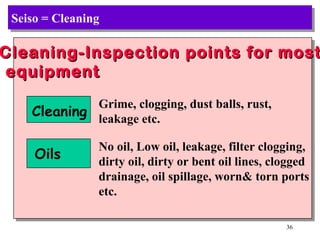
Seiso = Cleaning Cleaning-Inspection points for most equipment   Cleaning Grime, clogging, dust balls, rust,  leakage etc. Oils No oil, Low oil, leakage, filter clogging, dirty oil, dirty or bent oil lines, clogged drainage, oil spillage, worn& torn ports etc.
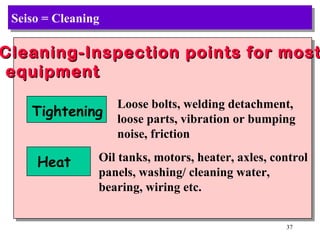
Seiso = Cleaning Cleaning-Inspection points for most equipment   Tightening Loose bolts, welding detachment, loose parts, vibration or bumping noise, friction  Heat Oil tanks, motors, heater, axles, control panels, washing/ cleaning water,  bearing, wiring etc.
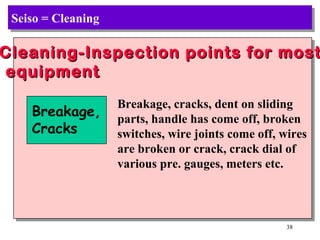
Seiso = Cleaning Cleaning-Inspection points for most equipment   Breakage,  Cracks Breakage, cracks, dent on sliding parts, handle has come off, broken switches, wire joints come off, wires are broken or crack, crack dial of various pre. gauges, meters etc.
Seiso = Cleaning Function wise Cleaning check list of equipment Pneumatics  Hydraulics Compressed Air lines, air valves, connections, meters, filters,  reservoirs etc. Hydraulic oil tank, oil valves,  filters, pumps, hoses, gauges,  cylinders etc.
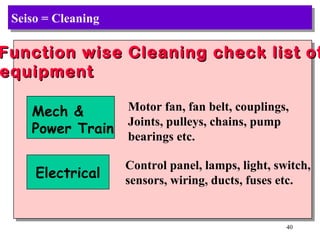
Seiso = Cleaning Function wise Cleaning check list of equipment Mech &  Power Train  Electrical Motor fan, fan belt, couplings, Joints, pulleys, chains, pump  bearings etc. Control panel, lamps, light, switch, sensors, wiring, ducts, fuses etc.
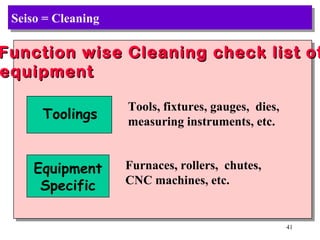
Seiso = Cleaning Function wise Cleaning check list of equipment Toolings Equipment Specific Tools, fixtures, gauges,  dies, measuring instruments, etc. Furnaces, rollers,  chutes,  CNC machines, etc.
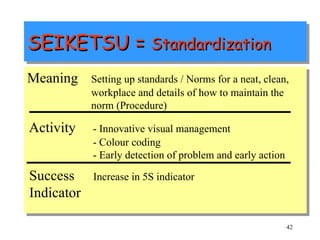
SEIKETSU =  Standardization Meaning Setting up standards / Norms for a neat, clean,  workplace and details of how to maintain the  norm (Procedure) Activity - Innovative visual management - Colour coding - Early detection of problem and early action Success Increase in 5S indicator Indicator
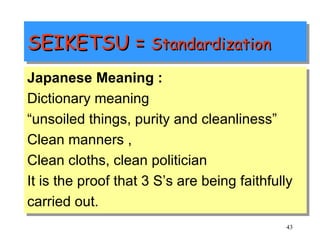
SEIKETSU =  Standardization Japanese Meaning : Dictionary meaning  “ unsoiled things, purity and cleanliness” Clean manners , Clean cloths, clean politician It is the proof that 3 S’s are being faithfully carried out.
SEIKETSU =  Standardization Tools used for analysis : MTTR MTBF OEE
Seiketsu = Standardization Regularizing 5S activities so that abnormalities are revealed Make it easy for everyone to identify the state of normal or abnormal condition For maintaining previous 3S, deploy visual management
Seiketsu = Standardization  It has been estimated by scientific study that 60% of all human activities starts with sight 5S is easy to do once.It is consistency that is difficult. That is why Visual Management is so important, so that everybody will know that there is  some problem. Visual Management
Seiketsu = Standardization  What visual control communicates ? It grabs one or more of our senses in  order to Alert us to an abnormality Help us recover quickly Promote adherence and prevention Enable successful self management
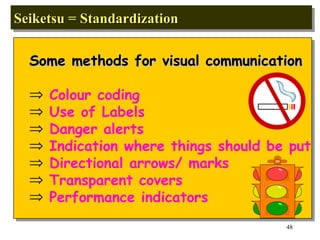
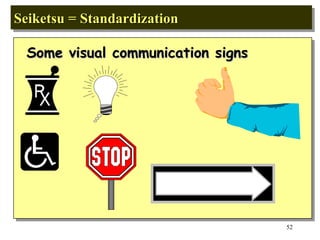
Seiketsu = Standardization  Some methods for visual communication Colour coding Use of Labels Danger alerts Indication where things should be put Directional arrows/ marks Transparent covers Performance indicators
Seiketsu = Standardization  Some methods for visual communication Labels Precision management labels Inspection labels Temperature labels Responsibility labels
Seiketsu = Standardization  Points to remember in making visual c control tools 1. Make them easy to see from distance 2. Put the display on the things  3. Everyone can tell what is right and what is wrong 4. Anybody can follow them and make necessary corrections easily 5. Work place should look brighter & orderly
Seiketsu = Standardization  Some everyday visual management  examples  Traffic signal Zebra crossing In car - Petrol indicator - Speed indicator Direction arrows Electric danger sign  etc.
Seiketsu = Standardization  Some visual communication signs
SHITSUKE =  Self Discipline Meaning Every one sticks to the rule and makes it a habit  Activity - Participation of everyone in developing good habits - Regular audits and aiming for higher level Success   High employee morale Indicator   Involvement of all people
SHITSUKE =  Self Discipline Japanese Meaning : Dictionary meaning is  “ learning of the manners” “ having manners, dressing neatly” OR “ training children for good customs”
SHITSUKE =  Self Discipline Activities : 5S Committee 5S Training 5S Competition / evaluation 5S Month Posters , Literature etc.
Shitsuke = Self Discipline We need everyone to maintain 5S guidelines. To maintain DISCIPLINE, we need to practice and repeat until it becomes a way of life. Discipline is the Core of 5S
Shitsuke = Self Discipline Discipline means making a steady habit of properly maintaining  correct procedure . Time and effort involved in establishing proper arrangement and orderliness will be in vain if  we do not have discipline to maintain it.
Shitsuke = Self Discipline Pledge It shall be my constant effort to maintain my workplace in good order by Assigning a place for everything & keeping everything in its place Sorting out unwanted material periodically & discarding them Keeping my work area neat & clean everyday
Organization Departments into areas Coordinators at department level Coordinator at each area level Training for all Audit each area and make action check list Implement actions Audit and evaluation on continuous basis
Implementation Target TOTAL FACTORY 400 people/month to be trained Every 3 month 25% area will be covered

5s training slides_432

  • 1.
    1980 1950 19701960 U.S.A JAPAN INDIA Quality Improvements
  • 2.
    1. 5S PrinciplesElimination of waste Every body is involved, Co-operative effort Attack root cause Human being is not infalliable
  • 3.
    2. Objectives Improvehousekeeping Make every individual responsible for housekeeping Beautify by simple means Productivity improvement by saving time, space etc.
  • 4.
    3. 5S’s Seiri - Sorting Seiton - Systematic arrangement Seiso - Cleaning Inspection while cleaning Seiketsu - Standardization Shitsuke - Self Discipline
  • 5.
    5S If wedo not do 5S, we can’t do any other work efficiently. They are features which are common to all places and are the indicators of how well an organization is functioning.
  • 6.
    SEIRI = Sorting Meaning Distinguish between necessary and unnecessary items and eliminate the unnecessary items Activity Establish a criteria for eliminating unwanted items Eliminate unwanted items either by disposing them or by relocating them. Success Area saved or percentage of space available Indicator
  • 7.
    SEIRI = Sorting Japanese Meaning : The Japanese meaning of “ Seiri” is to straighten and contain. - Get rid of waste and put it in order according to rules OTHER JAPANESE MEANINGS - farmland cultivation, Make an orderly system and straighten
  • 8.
    Seiri = Sorting1. Item is not needed 2. Item is needed however quantity in stock is more than what is needed for consumption in near future 3. Contingency Parts Critically decide the quantity of contingency parts to be retained and criteria for such parts What is unnecessary
  • 9.
    Frequency of useStorage Method *Things you have not used in the past one year Throw them out *Things you have used once in the last 6-12 months Store at distance OR Keep in store LOW *Things you have used only once in the last 2-6 months Store it in central place in your zone *Things used more than once a month Store it in central place in your zone AVERAGE HIGH *Things used once a week Store near the workplace *Things used daily or hourly Store near the workplace Organization
  • 10.
    Seiri = SortingIdentifying unnecessary 1. Parts & Work in Process (WIP) Things fallen back behind the machine or rolled under it Broken items inside the machine Things under the racks/ platform Extra WIP Stock of rejected items Items accumulated over period for rework Material awaiting disposal decision Material brought for some trial, still lying even after trial Small qty of material no longer in use Contd..
  • 11.
    Seiri = SortingIdentifying unnecessary 2. Tools, Toolings, Measuring devices Old jigs, tools not in use are lying Modified tools, tooling for trial, are lying after trial Worn out items like bushes, liners, toggles etc. lying Broken tools, bits, etc. may be lying Measuring equipment not required for the operation being performed , is lying 3. Contingency Parts Many times storage place for contingency parts become a last refuge for broken parts, surplus items and things nobody is likely to use Contd..
  • 12.
    Seiri = SortingIdentifying unnecessary 4. Shelves and Lockers Shelves and lockers tends to collect things that nobody ever uses , like surplus, broken items etc. 5. Passages and Corners Dust, material not required seem to gather in corner 6. Besides Pillars and under the stairs These places tends to collect junk, spittoon etc. 7. Walls and Bulletin Boards Old out dated notices which have lost their relevance Posters or bulletins on wall Dust, remains of torn notices, cell tape pieces Contd..
  • 13.
    Seiri = SortingIdentifying unnecessary 8.Floor, Pits, Partitions Defective parts Protection caps, covers Packing material Hardware items , small items Even tools, tooling Items dropped on the floor are never picked 9.Computer Hard Disk Many unwanted, outdated, temporary files pile up
  • 14.
    Seiri = SortingImprovement methods 1. Flow Process Chart (Procedural Analysis) Drawing a process flow chart for the system eg. How to make and use category wise grouping 2. Operational Analysis Preparing the sequence of operations for system eg. How to perform Seiri (sorting) 3. Check List A check sheet is used to decide what sort of main system and sub system are necessary.
  • 15.
    Seiri = SortingDealing with papers How to reduce papers on your table ? 1. Make a single pile of papers 2. Go through them and sort in following categories a) Immediate action b) Low priority c) Pending d) Reading material e) For information
  • 16.
    Seiri = SortingDealing with papers How to reduce papers on your table ? 4 D Principle DO DELEGATE DELAY DUMP
  • 17.
    SEITION = Systematic Arrangement Meaning To determine type of storage and layout that will ensure easy accessibility for everyone . Activity - Functional storage - Creating place for everything and putting everything in its place Success - Time saved in searching Indicator - Time saved in material handling
  • 18.
    SEITION = Systematic Arrangement Japanese Meaning : Dictionary meaning of Seiton is “to be correctly prepared”and “to prepare correctly”. In short these means : (a) arrange correctly in accordance with the correct method of doing activities and (b) make thorough preparations so that activities can be done even if they occur abruptly
  • 19.
    SEITION = Systematic Arrangement The main target areas for Seri-Seiton improvement are : Tool-setting and preparation operations, line balancing and process planning, parts supply to assembly line, peak time problems etc. Improvement Methods Kit Method / Assembly box method / Outside tool setting Cassettisation / Parallel operations / Changes in assignment method
  • 20.
    Seiton = SystematicArrangement How to achieve Systematic Arrangement ? Decide where things belong Decide how things should be put away Obey the Put away rules
  • 21.
    Seiton = SystematicArrangement How to achieve Systematic Arrangement ? Decide where things belong - Standardize Nomenclature - Determine an analytical method of storage Decide how things should be put away - Name & locations to everything. Label both item and location - Store material functionally - Prevent mistakes with coding by shapes & colour contd..
  • 22.
    Seiton = SystematicArrangement How to achieve Systematic Arrangement ? Decide how things should be put away - Follow first in first out rule - If two identical items are to be located, then store them separately, colour code them. Obey the rules - Put the things back to their location after their use
  • 23.
    Seiton = SystematicArrangement USE : 1 ) Signboards 2) Colour codes 3) Outline markings 4) Labels
  • 24.
    Seiton = SystematicArrangement Functional Storage
  • 25.
    Seiton = SystematicArrangement Usage Frequency Store frequently used material near the workplace and less frequently at some distance Weight & Shape of the Material Heavy material should be stored at lower levels/layers Place directly on the material handling device for ease of handling Functional Storage
  • 26.
    Seiton = SystematicArrangement Category Same category of material may be stored in one location. Eg. Allen Screws, Oil Seals Operation Wise All items required for an operation may be stored in one location. Eg. Allen key, spanner etc hand tools required for setting m/c Functional Storage
  • 27.
    Seiton = SystematicArrangement Outlining and Placement Marks - Mark boundaries of dept., aisles, Machines - Follow straight line, right angle rule - Nothing shall be kept outside the boundaries Stands and shelves - Keep only required number of stands and shelves - Standardize height, size - Provide casters where necessary so that it can be moved
  • 28.
    Seiton = SystematicArrangement Wires and Ducts - Colour code - When there are multiple connections - bundle the wires, label them and make sure that they are in straight line /right angle and firmly anchored Machine-tools & Tools - Put the tools in the order you need them - Location of the tool should be such that it can be put away with one hand - Try to eliminate some hand tools by permanently attaching it to the bolt head
  • 29.
    Seiton = SystematicArrangement Blades, Dies, Other important consumables - Store them in the protected place - Maintain these things regularly by applying rust preventive, oiling etc. WIP- Work In Process - Designate a place for each component/part - Decide on how much quantity to be stored - Ensure that there is no damage to good part during transit, they do not get rusty and they are not mislabeled
  • 30.
    Seiton = SystematicArrangement Oils - Reduce number of oils used (Standardize) - Colour code for oil - Safety aspects - fire prevention, pollution, leak, spillage Instrumentation & Measuring Devices - Label them, show direction of flow
  • 31.
    SEISO = Cleaning Meaning Cleaning trash, filth, dust and other foreign matter. Cleaning as a form of Inspection Activity - Keep workplace spotlessly clean - Inspection while cleaning - Finding minor problems with cleaning inspection Success - Reduction in machine down time Indicator - Reduction in no. of accidents
  • 32.
    SEISO = Cleaning Japanese Meaning : Dictionary meaning “to clean up” and “ getting rid of dirt and unclean items” While cleaning potential defects such as abrasion, damage, loose parts, deformities, leaks temp., vibration, abnormal sound etc. are revealed hence Seiso is Inspection
  • 33.
    Seiso = CleaningHere cleaning means more than just keeping things clean. Cleaning should be viewed as a form of Visual Inspection Preventive measures should be taken to tackle problems of dust, grim, burrs, leakage etc. Root cause of the problem should be identified and it should be eliminated
  • 34.
    Seiso = CleaningVarious Minor Defects = Trash = Dirt =Knocking = Loose parts = Leaks =Scattering =Skips =Curvature =Abrasion =Rust =Scratches =Eccentricity =Lurching =Abnormal =Vibration Movements =Abnormal =Heat =Abnormal Sounds smells =Faded colour =Hisses
  • 35.
    Seiso = Cleaning5 Minutes Every day for cleaning Devote 5 minutes everyday for cleaning your work area Participation of everyone is required Attack hard to clean places regularly
  • 36.
    Seiso = CleaningCleaning-Inspection points for most equipment Cleaning Grime, clogging, dust balls, rust, leakage etc. Oils No oil, Low oil, leakage, filter clogging, dirty oil, dirty or bent oil lines, clogged drainage, oil spillage, worn& torn ports etc.
  • 37.
    Seiso = CleaningCleaning-Inspection points for most equipment Tightening Loose bolts, welding detachment, loose parts, vibration or bumping noise, friction Heat Oil tanks, motors, heater, axles, control panels, washing/ cleaning water, bearing, wiring etc.
  • 38.
    Seiso = CleaningCleaning-Inspection points for most equipment Breakage, Cracks Breakage, cracks, dent on sliding parts, handle has come off, broken switches, wire joints come off, wires are broken or crack, crack dial of various pre. gauges, meters etc.
  • 39.
    Seiso = CleaningFunction wise Cleaning check list of equipment Pneumatics Hydraulics Compressed Air lines, air valves, connections, meters, filters, reservoirs etc. Hydraulic oil tank, oil valves, filters, pumps, hoses, gauges, cylinders etc.
  • 40.
    Seiso = CleaningFunction wise Cleaning check list of equipment Mech & Power Train Electrical Motor fan, fan belt, couplings, Joints, pulleys, chains, pump bearings etc. Control panel, lamps, light, switch, sensors, wiring, ducts, fuses etc.
  • 41.
    Seiso = CleaningFunction wise Cleaning check list of equipment Toolings Equipment Specific Tools, fixtures, gauges, dies, measuring instruments, etc. Furnaces, rollers, chutes, CNC machines, etc.
  • 42.
    SEIKETSU = Standardization Meaning Setting up standards / Norms for a neat, clean, workplace and details of how to maintain the norm (Procedure) Activity - Innovative visual management - Colour coding - Early detection of problem and early action Success Increase in 5S indicator Indicator
  • 43.
    SEIKETSU = Standardization Japanese Meaning : Dictionary meaning “ unsoiled things, purity and cleanliness” Clean manners , Clean cloths, clean politician It is the proof that 3 S’s are being faithfully carried out.
  • 44.
    SEIKETSU = Standardization Tools used for analysis : MTTR MTBF OEE
  • 45.
    Seiketsu = StandardizationRegularizing 5S activities so that abnormalities are revealed Make it easy for everyone to identify the state of normal or abnormal condition For maintaining previous 3S, deploy visual management
  • 46.
    Seiketsu = Standardization It has been estimated by scientific study that 60% of all human activities starts with sight 5S is easy to do once.It is consistency that is difficult. That is why Visual Management is so important, so that everybody will know that there is some problem. Visual Management
  • 47.
    Seiketsu = Standardization What visual control communicates ? It grabs one or more of our senses in order to Alert us to an abnormality Help us recover quickly Promote adherence and prevention Enable successful self management
  • 48.
    Seiketsu = Standardization Some methods for visual communication Colour coding Use of Labels Danger alerts Indication where things should be put Directional arrows/ marks Transparent covers Performance indicators
  • 49.
    Seiketsu = Standardization Some methods for visual communication Labels Precision management labels Inspection labels Temperature labels Responsibility labels
  • 50.
    Seiketsu = Standardization Points to remember in making visual c control tools 1. Make them easy to see from distance 2. Put the display on the things 3. Everyone can tell what is right and what is wrong 4. Anybody can follow them and make necessary corrections easily 5. Work place should look brighter & orderly
  • 51.
    Seiketsu = Standardization Some everyday visual management examples Traffic signal Zebra crossing In car - Petrol indicator - Speed indicator Direction arrows Electric danger sign etc.
  • 52.
    Seiketsu = Standardization Some visual communication signs
  • 53.
    SHITSUKE = Self Discipline Meaning Every one sticks to the rule and makes it a habit Activity - Participation of everyone in developing good habits - Regular audits and aiming for higher level Success High employee morale Indicator Involvement of all people
  • 54.
    SHITSUKE = Self Discipline Japanese Meaning : Dictionary meaning is “ learning of the manners” “ having manners, dressing neatly” OR “ training children for good customs”
  • 55.
    SHITSUKE = Self Discipline Activities : 5S Committee 5S Training 5S Competition / evaluation 5S Month Posters , Literature etc.
  • 56.
    Shitsuke = SelfDiscipline We need everyone to maintain 5S guidelines. To maintain DISCIPLINE, we need to practice and repeat until it becomes a way of life. Discipline is the Core of 5S
  • 57.
    Shitsuke = SelfDiscipline Discipline means making a steady habit of properly maintaining correct procedure . Time and effort involved in establishing proper arrangement and orderliness will be in vain if we do not have discipline to maintain it.
  • 58.
    Shitsuke = SelfDiscipline Pledge It shall be my constant effort to maintain my workplace in good order by Assigning a place for everything & keeping everything in its place Sorting out unwanted material periodically & discarding them Keeping my work area neat & clean everyday
  • 59.
    Organization Departments intoareas Coordinators at department level Coordinator at each area level Training for all Audit each area and make action check list Implement actions Audit and evaluation on continuous basis
  • 60.
    Implementation Target TOTALFACTORY 400 people/month to be trained Every 3 month 25% area will be covered