5S Training
What is Lean Manufacturing?

   Lean Manufacturing is the continuing process of
    analyzing, then improving, the flow of information
    and materials in order to eliminate waste and
    enhance value to the customer.

   In simpler words:
    Cut out the waste of non-value activities.
    Illustration:
    Like a lean piece of Filet Mignon.
WHY Go “Lean”?
 Uses less of everything compared with mass
  production.
 Less human effort
 Less space
 Less tool investment
 Less inventory
 Less defects
 Reduces costly internal “Wastes”

       Being Wasteful Helps
        the Competition!!
Elements of Lean
   Philosophy of Excellence in becoming a
    World Class Company
   Elimination of Waste
   Synchronization to Customer Demand
   Employee Involvement
   Continuous Improvement
What Is Waste?

 Waste is everything we do that takes
 time, adds cost, and has no value in
 the eyes of the customer.
7 types of Waste (Muda)
1) Overproducing
2) Waiting
3) Moving
4) Downtime
5) Excess Inventory
6) Motion
7) Scrap
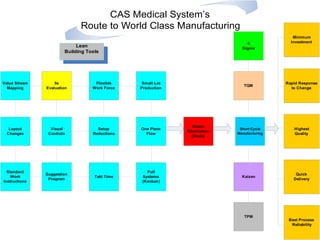
CAS Medical System’s
                             Route to World Class Manufacturing
                                                                                             Minimum
                                                                               6            Investment
                            Lean                                            Sigma
                       Building Tools


Value Stream       5s              Flexible     Small Lot                                 Rapid Response
                                                                             TQM
  Mapping      Evaluation         Work Force   Production                                   to Change


                                                               Waste
   Layout        Visual             Setup      One Piece                   Short Cycle       Highest
                                                            Elimination
  Changes       Controls          Reductions     Flow                     Manufacturing      Quality
                                                              (Muda)


  Standard                                        Pull
               Suggestion                                                                     Quick
    Work                           Takt Time    Systems                     Kaizen
                Program                                                                      Delivery
Instructions                                    (Kanban)


                                                                             TPM
                                                                                           Best Process
                                                                                            Reliability
What is 5s+1
 It’s Housekeeping at the
 highest level that’s measurable
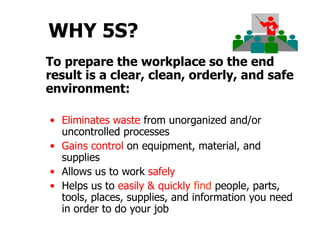
WHY 5S?
To prepare the workplace so the end
result is a clear, clean, orderly, and safe
environment:

• Eliminates waste from unorganized and/or
  uncontrolled processes
• Gains control on equipment, material, and
  supplies
• Allows us to work safely
• Helps us to easily & quickly find people, parts,
  tools, places, supplies, and information you need
  in order to do your job
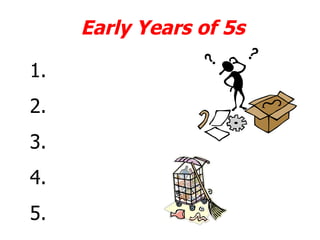
Early Years of 5s

1. Scrounge
2. Steal
3. Stash
4. Scramble
5. Search
Do you know your 5S’s +1?
   S1: Sort      Sort out the clutter. Get rid of items
                            not needed to make your product

   S2: Scrub     Scrub & Shine your work area. Paint if needed. Don’t
                  rely on someone else to clean your mess

   S3: Select    Select locations for materials, supplies & equipment.
                  Anything that takes up real estate needs to have a
                  designated location

   S4: Set       Set locations by using borders, ID labels, shadow boards

   S5: Safety    Prevent Safety hazards caused by clutter, garbage, spills,
                           and disorder. Increase safety through visual
    order.

   +1:Sustain    Sustain the 5’s habit. Conduct management audits
                  and report cards.
SORT - The 1st & Most Important“S”

Purpose of Sort - get rid of the junk
 Sort through items in the area

 Keep what is needed

 Eliminate what is not needed

 Reduce the number of items to the
  quantity required at any given time

         ** Don’t be a Pack-Rat
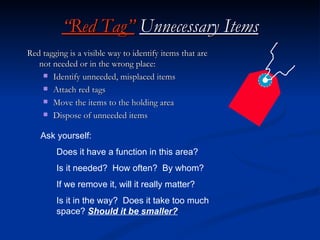
“Red Tag” Unnecessary Items
Red tagging is a visible way to identify items that are
   not needed or in the wrong place:
     Identify unneeded, misplaced items

     Attach red tags

     Move the items to the holding area

     Dispose of unneeded items


    Ask yourself:
        Does it have a function in this area?
        Is it needed? How often? By whom?
        If we remove it, will it really matter?
        Is it in the way? Does it take too much
        space? Should it be smaller?
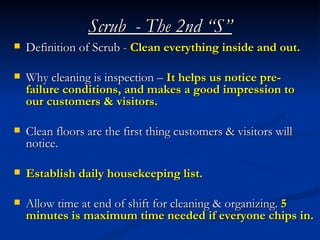
Scrub - The 2nd “S”
   Definition of Scrub - Clean everything inside and out.

   Why cleaning is inspection – It helps us notice pre-
    failure conditions, and makes a good impression to
    our customers & visitors.

   Clean floors are the first thing customers & visitors will
    notice.

   Establish daily housekeeping list.

   Allow time at end of shift for cleaning & organizing. 5
    minutes is maximum time needed if everyone chips in.
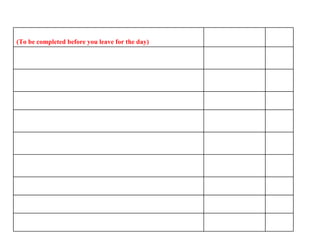
Daily Housekeeping Check List

                                                          Associate   √
(To be completed before you leave for the day)
Floors are clean & free of debris. (check underneath
your work bench)
Clean all bench tops & equipment from dust, oils &
debris
Turn off all equipment, computers, lights

Return all tools, parts, and supplies to designated
locations.
All kanban cards are handed in and properly placed
with the item
Chemicals & cleaning supplies are stored in proper
locations
Dispose all cardboard

Work stations are clutter free and well organized

Nothing is in the aisle ways
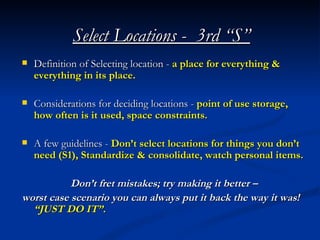
Select Locations - 3rd “S”
   Definition of Selecting location - a place for everything &
    everything in its place.

   Considerations for deciding locations - point of use storage,
    how often is it used, space constraints.

   A few guidelines - Don’t select locations for things you don’t
    need (S1), Standardize & consolidate, watch personal items.

           Don’t fret mistakes; try making it better –
worst case scenario you can always put it back the way it was!
  “JUST DO IT”.
Set Locations - 4th“S”
   Definition of Setting locations- Identifying your selected
    location so everyone knows where it has to go.

   Location Identifiers - signs, labels, colored tape, shadow
    boards, floor borders

   3 actions needed
    1) Put taped border around moveable items.
    2) Put an ID label with each border.
    3) Put an ID label on each item.
Safety - 5th“S”
   Everyone is accountable for having a safe operation and
    work environment. Get involved.

   Improve safety through visual order.

   Safety committee is established for CAS. Help to
    implement committee findings.

   S1 – is your biggest contributor toward a safe
    environment. (Statcorp Pallet story)
Cardinal Rule for 5s
        Implementation

    Follow the 5s Methodology


**Do not do S3 or S4 before doing S1
             (Trident story)
+1 Sustain - The 6th “S”
   Purpose of +1: Is to recognize, reward, and strengthen adherence to the
    first 5S’s. It provides feedback for Continuous Improvement.

   Make 5S’ part of the culture - Empower workers to manage and control
    their area.

   5 Techniques for sustaining the 5s Program
         1) 5s Audit Report Card
         2) Review of report card with employees
         3) Develop daily housekeeping activities
         4) Employee Ownership
         5) Include in annual performance review.

   Reasons for inadequate implementation:
        1. Lack of understanding & training
        2. Not supported by management
        3. Little or no employee involvement
Review of 5’s +1 Audit Report Card
Keys To Success

• Management Driven
• Management Involvement
•Gather baseline information
• Get everyone involved
•Audit your results
•Take action – “Just do it”
• Keep it simple!
Total Employee Involvement


PEOPLE ARE THE KEY!
5’s
        Dept. Photos
             &
Hall of Fame Best Practices
5s Quiz
   1) Can you name the 5s+1 order of methodology?
         Sort
         Scrub
         Select
         Set
         Safety
         Sustain

   2) Of the five 5S’s which is the most important?
         Sort

   3) What are the 5 techniques we will use to Sustain (+1) the 5s program?

         Audit Report Card
         Employee Review of Report Card
         Daily Housekeeping List of Duties
         Employee Ownership
         Performance Reviews
5s Quiz Continued
   4) What do we use for setting locations (S4)?
         Signs
         Labels
         Tape Borders
         Shadow Boards

   5) Why is S2 – Scrub so important to do?
         It helps to notice pre-failure conditions.
         It makes a strong impression to our customers & visitors.

   6) What’s the Cardinal rule for 5’s Implementation?
         Follow the Methodology
         Don’t do S3 & S4 before doing S1
Bonus Quiz Question
What are the 7 types of Muda?
 1) Overproducing
 2) Waiting
 3) Moving
 4) Downtime
 5) Excess Inventory
 6) Motion
 7) Scrap

5 S Training

  • 1.
  • 2.
    What is LeanManufacturing?  Lean Manufacturing is the continuing process of analyzing, then improving, the flow of information and materials in order to eliminate waste and enhance value to the customer.  In simpler words: Cut out the waste of non-value activities. Illustration: Like a lean piece of Filet Mignon.
  • 3.
    WHY Go “Lean”? Uses less of everything compared with mass production.  Less human effort  Less space  Less tool investment  Less inventory  Less defects  Reduces costly internal “Wastes” Being Wasteful Helps the Competition!!
  • 4.
    Elements of Lean  Philosophy of Excellence in becoming a World Class Company  Elimination of Waste  Synchronization to Customer Demand  Employee Involvement  Continuous Improvement
  • 5.
    What Is Waste? Waste is everything we do that takes time, adds cost, and has no value in the eyes of the customer.
  • 6.
    7 types ofWaste (Muda) 1) Overproducing 2) Waiting 3) Moving 4) Downtime 5) Excess Inventory 6) Motion 7) Scrap
  • 7.
    CAS Medical System’s Route to World Class Manufacturing Minimum 6 Investment Lean Sigma Building Tools Value Stream 5s Flexible Small Lot Rapid Response TQM Mapping Evaluation Work Force Production to Change Waste Layout Visual Setup One Piece Short Cycle Highest Elimination Changes Controls Reductions Flow Manufacturing Quality (Muda) Standard Pull Suggestion Quick Work Takt Time Systems Kaizen Program Delivery Instructions (Kanban) TPM Best Process Reliability
  • 8.
    What is 5s+1 It’s Housekeeping at the highest level that’s measurable
  • 9.
    WHY 5S? To preparethe workplace so the end result is a clear, clean, orderly, and safe environment: • Eliminates waste from unorganized and/or uncontrolled processes • Gains control on equipment, material, and supplies • Allows us to work safely • Helps us to easily & quickly find people, parts, tools, places, supplies, and information you need in order to do your job
  • 10.
    Early Years of5s 1. Scrounge 2. Steal 3. Stash 4. Scramble 5. Search
  • 11.
    Do you knowyour 5S’s +1?  S1: Sort Sort out the clutter. Get rid of items not needed to make your product  S2: Scrub Scrub & Shine your work area. Paint if needed. Don’t rely on someone else to clean your mess  S3: Select Select locations for materials, supplies & equipment. Anything that takes up real estate needs to have a designated location  S4: Set Set locations by using borders, ID labels, shadow boards  S5: Safety Prevent Safety hazards caused by clutter, garbage, spills, and disorder. Increase safety through visual order.  +1:Sustain Sustain the 5’s habit. Conduct management audits and report cards.
  • 12.
    SORT - The1st & Most Important“S” Purpose of Sort - get rid of the junk  Sort through items in the area  Keep what is needed  Eliminate what is not needed  Reduce the number of items to the quantity required at any given time ** Don’t be a Pack-Rat
  • 13.
    “Red Tag” UnnecessaryItems Red tagging is a visible way to identify items that are not needed or in the wrong place:  Identify unneeded, misplaced items  Attach red tags  Move the items to the holding area  Dispose of unneeded items Ask yourself: Does it have a function in this area? Is it needed? How often? By whom? If we remove it, will it really matter? Is it in the way? Does it take too much space? Should it be smaller?
  • 14.
    Scrub - The2nd “S”  Definition of Scrub - Clean everything inside and out.  Why cleaning is inspection – It helps us notice pre- failure conditions, and makes a good impression to our customers & visitors.  Clean floors are the first thing customers & visitors will notice.  Establish daily housekeeping list.  Allow time at end of shift for cleaning & organizing. 5 minutes is maximum time needed if everyone chips in.
  • 15.
    Daily Housekeeping CheckList Associate √ (To be completed before you leave for the day) Floors are clean & free of debris. (check underneath your work bench) Clean all bench tops & equipment from dust, oils & debris Turn off all equipment, computers, lights Return all tools, parts, and supplies to designated locations. All kanban cards are handed in and properly placed with the item Chemicals & cleaning supplies are stored in proper locations Dispose all cardboard Work stations are clutter free and well organized Nothing is in the aisle ways
  • 16.
    Select Locations -3rd “S”  Definition of Selecting location - a place for everything & everything in its place.  Considerations for deciding locations - point of use storage, how often is it used, space constraints.  A few guidelines - Don’t select locations for things you don’t need (S1), Standardize & consolidate, watch personal items. Don’t fret mistakes; try making it better – worst case scenario you can always put it back the way it was! “JUST DO IT”.
  • 17.
    Set Locations -4th“S”  Definition of Setting locations- Identifying your selected location so everyone knows where it has to go.  Location Identifiers - signs, labels, colored tape, shadow boards, floor borders  3 actions needed 1) Put taped border around moveable items. 2) Put an ID label with each border. 3) Put an ID label on each item.
  • 18.
    Safety - 5th“S”  Everyone is accountable for having a safe operation and work environment. Get involved.  Improve safety through visual order.  Safety committee is established for CAS. Help to implement committee findings.  S1 – is your biggest contributor toward a safe environment. (Statcorp Pallet story)
  • 19.
    Cardinal Rule for5s Implementation Follow the 5s Methodology **Do not do S3 or S4 before doing S1 (Trident story)
  • 20.
    +1 Sustain -The 6th “S”  Purpose of +1: Is to recognize, reward, and strengthen adherence to the first 5S’s. It provides feedback for Continuous Improvement.  Make 5S’ part of the culture - Empower workers to manage and control their area.  5 Techniques for sustaining the 5s Program 1) 5s Audit Report Card 2) Review of report card with employees 3) Develop daily housekeeping activities 4) Employee Ownership 5) Include in annual performance review.  Reasons for inadequate implementation: 1. Lack of understanding & training 2. Not supported by management 3. Little or no employee involvement
  • 21.
    Review of 5’s+1 Audit Report Card
  • 22.
    Keys To Success •Management Driven • Management Involvement •Gather baseline information • Get everyone involved •Audit your results •Take action – “Just do it” • Keep it simple!
  • 23.
  • 24.
    5’s Dept. Photos & Hall of Fame Best Practices
  • 25.
    5s Quiz  1) Can you name the 5s+1 order of methodology? Sort Scrub Select Set Safety Sustain  2) Of the five 5S’s which is the most important? Sort  3) What are the 5 techniques we will use to Sustain (+1) the 5s program? Audit Report Card Employee Review of Report Card Daily Housekeeping List of Duties Employee Ownership Performance Reviews
  • 26.
    5s Quiz Continued  4) What do we use for setting locations (S4)? Signs Labels Tape Borders Shadow Boards  5) Why is S2 – Scrub so important to do? It helps to notice pre-failure conditions. It makes a strong impression to our customers & visitors.  6) What’s the Cardinal rule for 5’s Implementation? Follow the Methodology Don’t do S3 & S4 before doing S1
  • 27.
    Bonus Quiz Question Whatare the 7 types of Muda?  1) Overproducing  2) Waiting  3) Moving  4) Downtime  5) Excess Inventory  6) Motion  7) Scrap