“Introducing Lean to the Hospital”


 Peter D. Schellinck
 Partner
 SHConseil
 +32 496 386 437
 www.shconseil.fr
 www.schellter.eu
Agenda

   The Crisis of Waste in Healthcare

   Lean Thinking Principles in Healthcare

   Benefits for:
                Patients
                Employees
                Hospitals
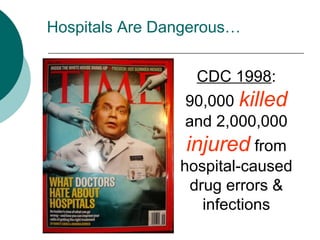
Hospitals Are Dangerous…


                  CDC 1998:
                 90,000 killed
                 and 2,000,000
                 injured from
                hospital-caused
                 drug errors &
                   infections
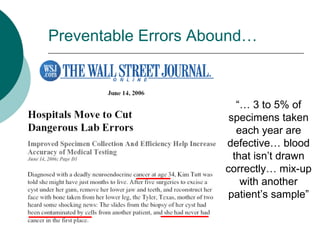
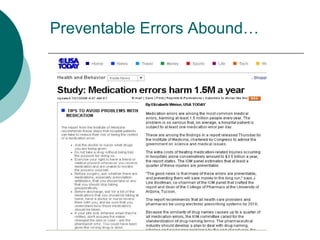
Preventable Errors Abound…


                         “… 3 to 5% of
                       specimens taken
                         each year are
                      defective… blood
                        that isn’t drawn
                      correctly… mix-up
                          with another
                       patient’s sample”
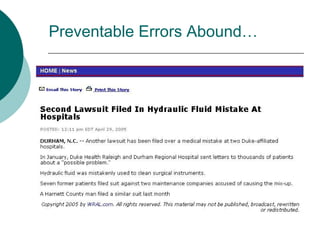
Preventable Errors Abound…
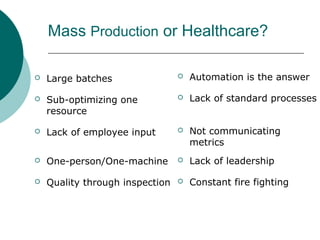
Mass Production or Healthcare?

   Large batches                   Automation is the answer

   Sub-optimizing one              Lack of standard processes
    resource

   Lack of employee input          Not communicating
                                     metrics
   One-person/One-machine          Lack of leadership

   Quality through inspection      Constant fire fighting
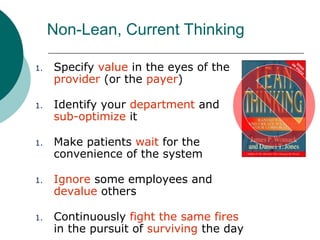
Non-Lean, Current Thinking

1.   Specify value in the eyes of the
     provider (or the payer)

1.   Identify your department and
     sub-optimize it

1.   Make patients wait for the
     convenience of the system

1.   Ignore some employees and
     devalue others

1.   Continuously fight the same fires
     in the pursuit of surviving the day
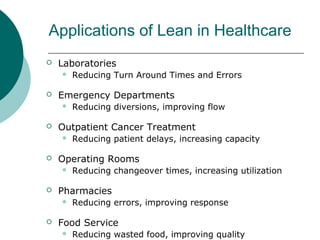
Applications of Lean in Healthcare
   Laboratories
       Reducing Turn Around Times and Errors
   Emergency Departments
       Reducing diversions, improving flow

   Outpatient Cancer Treatment
       Reducing patient delays, increasing capacity

   Operating Rooms
       Reducing changeover times, increasing utilization

   Pharmacies
       Reducing errors, improving response

   Food Service
       Reducing wasted food, improving quality
Why LEAN Works in Healthcare

   LEAN is not a list of tools that applies only
    to factories
   LEAN is a philosophy of management that
    applies to any system
   LEAN rallies people around goals we can all
    agree on:
       Patients and Employees
                                 for
                                       Quality
Not About Cutting Heads

   Shortages of skilled employees
       51% of hospital med techs greater than 45
        years of age, vacancy rate at 11%
       Shortfall of 65,000 nurses expected by 2012


   Do more…
       With the same
       Eventually, with less
Not Only About Cutting Costs

   Hospitals are using lean as a
    Business Strategy
     Improving   quality
     Improving   service
     Improving   employee satisfaction
     Growth   strategies
     “Un-outsourcing”   testing work
Principles of LEAN Thinking

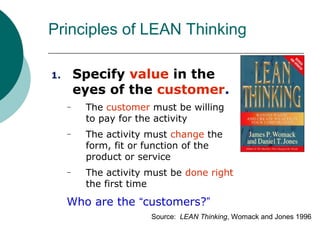
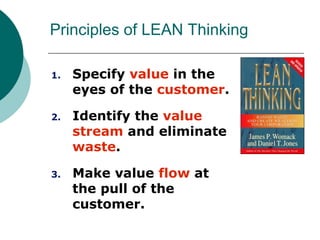
1.       Specify value in the
         eyes of the customer.
     –    The customer must be willing
          to pay for the activity
     –    The activity must change the
          form, fit or function of the
          product or service
     –    The activity must be done right
          the first time
     Who are the “customers?”
                       Source: LEAN Thinking, Womack and Jones 1996
Principles of LEAN Thinking


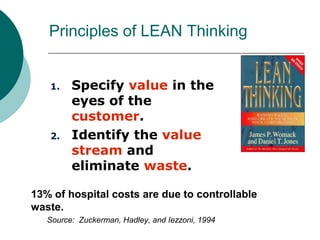
   1.    Specify value in the
         eyes of the
         customer.
   2.    Identify the value
         stream and
         eliminate waste.

13% of hospital costs are due to controllable
waste.
   Source: Zuckerman, Hadley, and Iezzoni, 1994
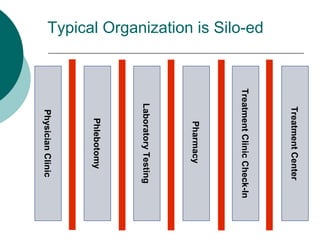
Treatment Center
Typical Organization is Silo-ed


                                  Treatment Clinic Check-In
                                         Pharmacy
                                     Laboratory Testing
                                        Phlebotomy
                                      Physician Clinic
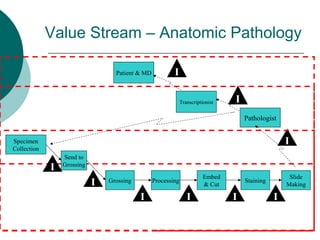
Value Stream – Anatomic Pathology

                                  Patient & MD           I

                                                              Transcriptionist   I
                                                                                     Pathologist


Specimen                                                                                            I
Collection
                 Send to
                 Grossing
             I
                                                                         Embed                       Slide
                            I   Grossing         Processing
                                                                         & Cut
                                                                                     Staining
                                                                                                    Making

                                           I                     I               I              I
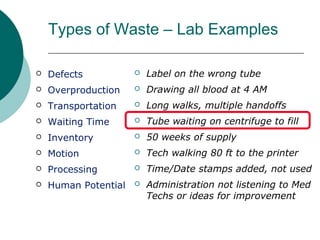
Types of Waste – Lab Examples

   Defects              Label on the wrong tube
   Overproduction       Drawing all blood at 4 AM
   Transportation       Long walks, multiple handoffs
   Waiting Time         Tube waiting on centrifuge to fill
   Inventory            50 weeks of supply
   Motion               Tech walking 80 ft to the printer
   Processing           Time/Date stamps added, not used
   Human Potential      Administration not listening to Med
                          Techs or ideas for improvement
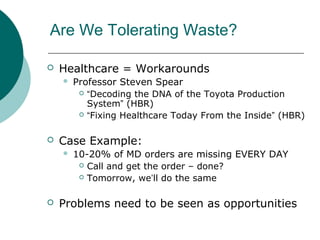
Are We Tolerating Waste?

   Healthcare = Workarounds
       Professor Steven Spear
          “Decoding the DNA of the Toyota Production
           System” (HBR)
          “Fixing Healthcare Today From the Inside” (HBR)


   Case Example:
       10-20% of MD orders are missing EVERY DAY
          Call and get the order – done?

          Tomorrow, we’ll do the same


   Problems need to be seen as opportunities
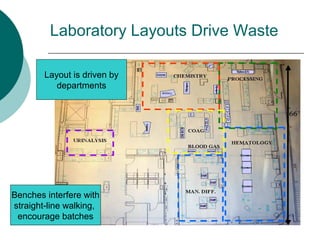
Laboratory Layouts Drive Waste

        Layout is driven by
           departments


Benches interfere with
straight-line walking,
 encourage batches
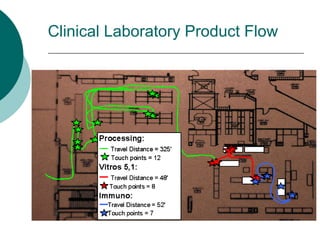
Clinical Laboratory Product Flow
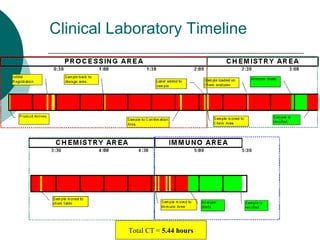
Clinical Laboratory Timeline


           Total CT = 5.44 hours
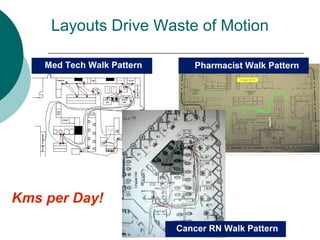
Layouts Drive Waste of Motion

    Med Tech Walk Pattern      Pharmacist Walk Pattern


Kms per Day!

                            Cancer RN Walk Pattern
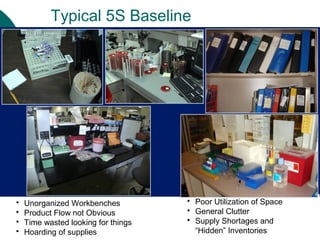
Typical 5S Baseline


   Unorganized Workbenches             Poor Utilization of Space
   Product Flow not Obvious            General Clutter
   Time wasted looking for things      Supply Shortages and
   Hoarding of supplies                 “Hidden” Inventories
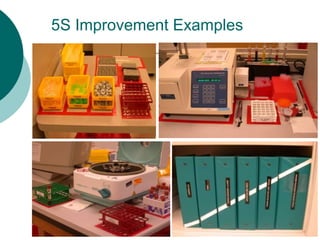
5S Improvement Examples
Principles of LEAN Thinking

1.   Specify value in the
     eyes of the customer.

2.   Identify the value
     stream and eliminate
     waste.

3.   Make value flow at
     the pull of the
     customer.
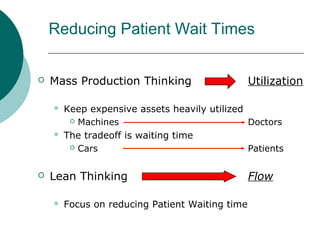
Reducing Patient Wait Times

   Mass Production Thinking                     Utilization

       Keep expensive assets heavily utilized
          Machines                            Doctors
       The tradeoff is waiting time
          Cars                                Patients

   Lean Thinking                                Flow

       Focus on reducing Patient Waiting time
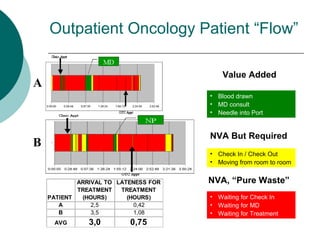
Outpatient Oncology Patient “Flow”

                                          Value Added
A
                                      • Blood drawn
                                      • MD consult
                                      • Needle into Port


                                      NVA But Required
B
                                      • Check In / Check Out
                                      • Moving from room to room


            ARRIVAL TO LATENESS FOR   NVA, “Pure Waste”
            TREATMENT   TREATMENT
    PATIENT  (HOURS)      (HOURS)     • Waiting for Check In
       A        2,5         0,42      • Waiting for MD
       B        3,5         1,08      • Waiting for Treatment
     AVG       3,0        0,75
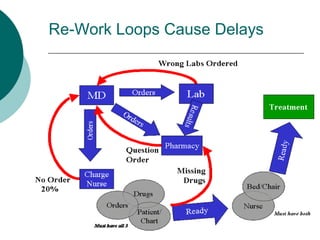
Re-Work Loops Cause Delays
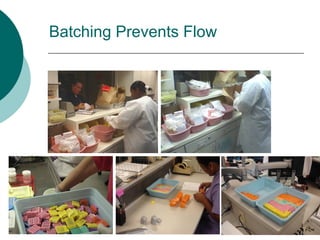
Batching Prevents Flow
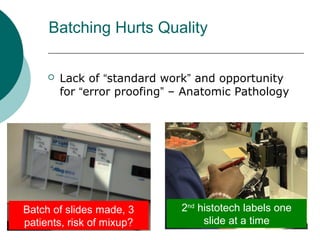
Batching Hurts Quality

        Lack of “standard work” and opportunity
         for “error proofing” – Anatomic Pathology


Batch of slides made, 3       2nd histotech labels one
patients, risk of mixup?           slide at a time
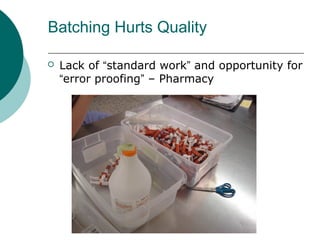
Batching Hurts Quality

   Lack of “standard work” and opportunity for
    “error proofing” – Pharmacy
Flow

   You can’t have flow without some
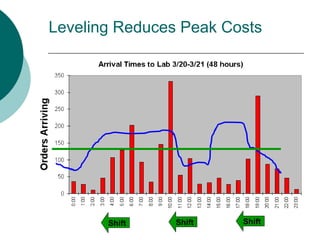
    amount of “leveling” in the system

   “Leveled Production:
     You   won’t be Happy without it”
                From Toyota publication
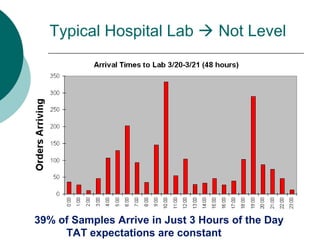
Typical Hospital Lab  Not Level


39% of Samples Arrive in Just 3 Hours of the Day
     TAT expectations are constant
Leveling Reduces Peak Costs


       Shift    Shift   Shift
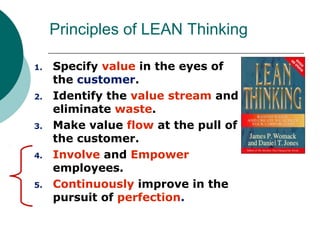
Principles of LEAN Thinking

1.   Specify value in the eyes of
     the customer.
2.   Identify the value stream and
     eliminate waste.
3.   Make value flow at the pull of
     the customer.
4.   Involve and Empower
     employees.
5.   Continuously improve in the
     pursuit of perfection.
Pre-Lean Med Tech Quote:


      “With all of the
        automation,
    I feel like a robot.”
The “Thinking Production System”


“Perhaps the greatest strength of the
Toyota Production System is the way
it develops people.


This is why the T actually stands for
‘Thinking’ as well as for ‘Toyota.’”

                    Teruyuki Minoura, Toyota
What Mistake-Proofing Means to
Healthcare

 The Global Goal: Reduce Medical Errors

   “Human error is inevitable.
   We can never eliminate it.” …..
   We can eliminate problems in the
   system that make it more likely to
   happen.”

  Source: USA Today            Liam Donaldson
  August 24, 2005     WHO World Health Alliance
                             for Patient safety
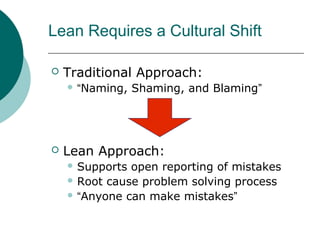
Lean Requires a Cultural Shift

   Traditional Approach:
     “Naming,   Shaming, and Blaming”


   Lean Approach:
     Supports open reporting of mistakes
     Root cause problem solving process
     “Anyone can make mistakes”
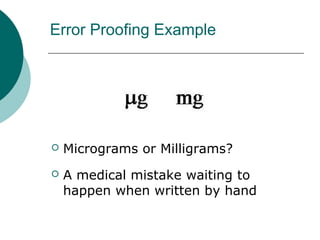
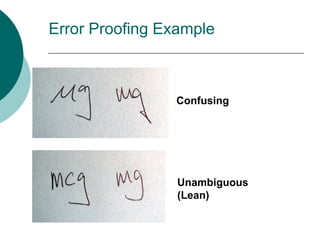
Error Proofing Example


   Micrograms or Milligrams?
   A medical mistake waiting to
    happen when written by hand
Error Proofing Example


                Confusing


                 Unambiguous
                 (Lean)
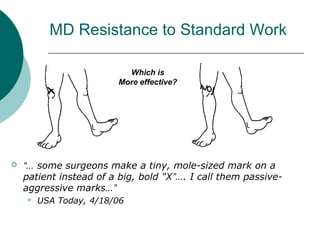
MD Resistance to Standard Work

                          Which is
                        More effective?


   “… some surgeons make a tiny, mole-sized mark on a
    patient instead of a big, bold "X”…. I call them passive-
    aggressive marks…”
       USA Today, 4/18/06
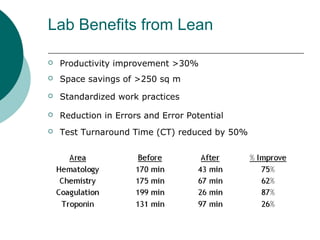
Lab Benefits from Lean

   Productivity improvement >30%
   Space savings of >250 sq m
   Standardized work practices

   Reduction in Errors and Error Potential
   Test Turnaround Time (CT) reduced by 50%
Reflections on Year’s in Healthcare

   Lean is a powerful methodology
   People are people
   Healthcare people have incredible intrinsic
    motivation
   Humility and asking questions is better
    than being a know-it-all
   Coaching the team to “do lean & be lean”
    is the only sustainable route

Lean in Hospitals

  • 1.
    “Introducing Lean tothe Hospital” Peter D. Schellinck Partner SHConseil +32 496 386 437 www.shconseil.fr www.schellter.eu
  • 2.
    Agenda  The Crisis of Waste in Healthcare  Lean Thinking Principles in Healthcare  Benefits for:  Patients  Employees  Hospitals
  • 3.
    Hospitals Are Dangerous… CDC 1998: 90,000 killed and 2,000,000 injured from hospital-caused drug errors & infections
  • 4.
    Preventable Errors Abound… “… 3 to 5% of specimens taken each year are defective… blood that isn’t drawn correctly… mix-up with another patient’s sample”
  • 5.
  • 6.
  • 7.
    Mass Production orHealthcare?  Large batches  Automation is the answer  Sub-optimizing one  Lack of standard processes resource  Lack of employee input  Not communicating metrics  One-person/One-machine  Lack of leadership  Quality through inspection  Constant fire fighting
  • 8.
    Non-Lean, Current Thinking 1. Specify value in the eyes of the provider (or the payer) 1. Identify your department and sub-optimize it 1. Make patients wait for the convenience of the system 1. Ignore some employees and devalue others 1. Continuously fight the same fires in the pursuit of surviving the day
  • 9.
    Applications of Leanin Healthcare  Laboratories  Reducing Turn Around Times and Errors  Emergency Departments  Reducing diversions, improving flow  Outpatient Cancer Treatment  Reducing patient delays, increasing capacity  Operating Rooms  Reducing changeover times, increasing utilization  Pharmacies  Reducing errors, improving response  Food Service  Reducing wasted food, improving quality
  • 10.
    Why LEAN Worksin Healthcare  LEAN is not a list of tools that applies only to factories  LEAN is a philosophy of management that applies to any system  LEAN rallies people around goals we can all agree on:  Patients and Employees for Quality
  • 11.
    Not About CuttingHeads  Shortages of skilled employees  51% of hospital med techs greater than 45 years of age, vacancy rate at 11%  Shortfall of 65,000 nurses expected by 2012  Do more…  With the same  Eventually, with less
  • 12.
    Not Only AboutCutting Costs  Hospitals are using lean as a Business Strategy  Improving quality  Improving service  Improving employee satisfaction  Growth strategies  “Un-outsourcing” testing work
  • 13.
    Principles of LEANThinking 1. Specify value in the eyes of the customer. – The customer must be willing to pay for the activity – The activity must change the form, fit or function of the product or service – The activity must be done right the first time Who are the “customers?” Source: LEAN Thinking, Womack and Jones 1996
  • 14.
    Principles of LEANThinking 1. Specify value in the eyes of the customer. 2. Identify the value stream and eliminate waste. 13% of hospital costs are due to controllable waste. Source: Zuckerman, Hadley, and Iezzoni, 1994
  • 15.
    Treatment Center Typical Organizationis Silo-ed Treatment Clinic Check-In Pharmacy Laboratory Testing Phlebotomy Physician Clinic
  • 16.
    Value Stream –Anatomic Pathology Patient & MD I Transcriptionist I Pathologist Specimen I Collection Send to Grossing I Embed Slide I Grossing Processing & Cut Staining Making I I I I
  • 17.
    Types of Waste– Lab Examples  Defects  Label on the wrong tube  Overproduction  Drawing all blood at 4 AM  Transportation  Long walks, multiple handoffs  Waiting Time  Tube waiting on centrifuge to fill  Inventory  50 weeks of supply  Motion  Tech walking 80 ft to the printer  Processing  Time/Date stamps added, not used  Human Potential  Administration not listening to Med Techs or ideas for improvement
  • 18.
    Are We ToleratingWaste?  Healthcare = Workarounds  Professor Steven Spear  “Decoding the DNA of the Toyota Production System” (HBR)  “Fixing Healthcare Today From the Inside” (HBR)  Case Example:  10-20% of MD orders are missing EVERY DAY  Call and get the order – done?  Tomorrow, we’ll do the same  Problems need to be seen as opportunities
  • 19.
    Laboratory Layouts DriveWaste Layout is driven by departments Benches interfere with straight-line walking, encourage batches
  • 20.
  • 21.
    Clinical Laboratory Timeline Total CT = 5.44 hours
  • 22.
    Layouts Drive Wasteof Motion Med Tech Walk Pattern Pharmacist Walk Pattern Kms per Day! Cancer RN Walk Pattern
  • 23.
    Typical 5S Baseline  Unorganized Workbenches  Poor Utilization of Space  Product Flow not Obvious  General Clutter  Time wasted looking for things  Supply Shortages and  Hoarding of supplies “Hidden” Inventories
  • 24.
  • 25.
    Principles of LEANThinking 1. Specify value in the eyes of the customer. 2. Identify the value stream and eliminate waste. 3. Make value flow at the pull of the customer.
  • 26.
    Reducing Patient WaitTimes  Mass Production Thinking Utilization  Keep expensive assets heavily utilized  Machines Doctors  The tradeoff is waiting time  Cars Patients  Lean Thinking Flow  Focus on reducing Patient Waiting time
  • 27.
    Outpatient Oncology Patient“Flow” Value Added A • Blood drawn • MD consult • Needle into Port NVA But Required B • Check In / Check Out • Moving from room to room ARRIVAL TO LATENESS FOR NVA, “Pure Waste” TREATMENT TREATMENT PATIENT (HOURS) (HOURS) • Waiting for Check In A 2,5 0,42 • Waiting for MD B 3,5 1,08 • Waiting for Treatment AVG 3,0 0,75
  • 28.
  • 29.
  • 30.
    Batching Hurts Quality  Lack of “standard work” and opportunity for “error proofing” – Anatomic Pathology Batch of slides made, 3 2nd histotech labels one patients, risk of mixup? slide at a time
  • 31.
    Batching Hurts Quality  Lack of “standard work” and opportunity for “error proofing” – Pharmacy
  • 32.
    Flow  You can’t have flow without some amount of “leveling” in the system  “Leveled Production:  You won’t be Happy without it”  From Toyota publication
  • 33.
    Typical Hospital Lab Not Level 39% of Samples Arrive in Just 3 Hours of the Day TAT expectations are constant
  • 34.
    Leveling Reduces PeakCosts Shift Shift Shift
  • 35.
    Principles of LEANThinking 1. Specify value in the eyes of the customer. 2. Identify the value stream and eliminate waste. 3. Make value flow at the pull of the customer. 4. Involve and Empower employees. 5. Continuously improve in the pursuit of perfection.
  • 36.
    Pre-Lean Med TechQuote: “With all of the automation, I feel like a robot.”
  • 37.
    The “Thinking ProductionSystem” “Perhaps the greatest strength of the Toyota Production System is the way it develops people. This is why the T actually stands for ‘Thinking’ as well as for ‘Toyota.’”  Teruyuki Minoura, Toyota
  • 38.
    What Mistake-Proofing Meansto Healthcare The Global Goal: Reduce Medical Errors “Human error is inevitable. We can never eliminate it.” ….. We can eliminate problems in the system that make it more likely to happen.” Source: USA Today Liam Donaldson August 24, 2005 WHO World Health Alliance for Patient safety
  • 39.
    Lean Requires aCultural Shift  Traditional Approach:  “Naming, Shaming, and Blaming”  Lean Approach:  Supports open reporting of mistakes  Root cause problem solving process  “Anyone can make mistakes”
  • 40.
    Error Proofing Example  Micrograms or Milligrams?  A medical mistake waiting to happen when written by hand
  • 41.
    Error Proofing Example Confusing Unambiguous (Lean)
  • 42.
    MD Resistance toStandard Work Which is More effective?  “… some surgeons make a tiny, mole-sized mark on a patient instead of a big, bold "X”…. I call them passive- aggressive marks…”  USA Today, 4/18/06
  • 43.
    Lab Benefits fromLean  Productivity improvement >30%  Space savings of >250 sq m  Standardized work practices  Reduction in Errors and Error Potential  Test Turnaround Time (CT) reduced by 50%
  • 44.
    Reflections on Year’sin Healthcare  Lean is a powerful methodology  People are people  Healthcare people have incredible intrinsic motivation  Humility and asking questions is better than being a know-it-all  Coaching the team to “do lean & be lean” is the only sustainable route

Editor's Notes

  • #9 Other important points we must consider: focus on what the customer wants, and the align all our processes to deliver collect best practices and develop standard processes use teams to execute use all of the brains in the company establish flow; eliminate the barriers to flow (causes of waste) rework is not value-added, need quality built into products/processes understand customer demand reward LEAN thinking and LEAN behavior reward problem solving rather than work-arounds make every process visual multi-skill everyone
  • #14 Other important points we must consider: focus on what the customer wants, and the align all our processes to deliver collect best practices and develop standard processes use teams to execute use all of the brains in the company establish flow; eliminate the barriers to flow (causes of waste) rework is not value-added, need quality built into products/processes understand customer demand reward LEAN thinking and LEAN behavior reward problem solving rather than work-arounds make every process visual multi-skill everyone
  • #15 Other important points we must consider: focus on what the customer wants, and the align all our processes to deliver collect best practices and develop standard processes use teams to execute use all of the brains in the company establish flow; eliminate the barriers to flow (causes of waste) rework is not value-added, need quality built into products/processes understand customer demand reward LEAN thinking and LEAN behavior reward problem solving rather than work-arounds make every process visual multi-skill everyone
  • #16 Respect for humanity includes the following concepts (this terminology comes from noted lean author Norman Bodek), including 1) jidoka (separating people from machines and empowering employees to stop production) 2) People working in teams, and 3) people contributing improvement ideas (kaizen)
  • #18 All of the eight types of waste can be found in a laboratory environment. A big challenge in a lean transformation is learning to SEE waste, then having the courage to call it waste, then having the drive to actually reduce the waste.
  • #19 All of the eight types of waste can be found in a laboratory environment. A big challenge in a lean transformation is learning to SEE waste, then having the courage to call it waste, then having the drive to actually reduce the waste.
  • #23 Let ’ s look at a typical non-LEAN lab. If you trace the flow of a product (such as a tube of blood) or the path an operator walks during a shift, the resulting picture is what we call a “ spaghetti diagram. ” This usually results when we organize the lab without thinking about product or operator “ flow ” . “ Flow ” is another key lean word that we ’ ll hear a lot today. When a lab (or a factory) is organized with similar machines grouped together, the resulting workflow ends up looking like this. All the wasted steps and wasted time involved in moving product (and people) such a long distance. Before lean concepts are introduced, is this even seen as a problem? Do we just put up with this as “ the way we ’ ve always done it? ”
  • #26 Other important points we must consider: focus on what the customer wants, and the align all our processes to deliver collect best practices and develop standard processes use teams to execute use all of the brains in the company establish flow; eliminate the barriers to flow (causes of waste) rework is not value-added, need quality built into products/processes understand customer demand reward LEAN thinking and LEAN behavior reward problem solving rather than work-arounds make every process visual multi-skill everyone
  • #27 Ford examples – announcing 30,000 layoffs but CEO Bill Ford says he wants a “ risk taking ” and “ innovative ” culture…. How will people do that if they ’ re afraid? Merck announced “ lean ” is about cutting heads at their factories, including 25% of the staff at their first “ lean ” factory…. I ’ m sure the other factories are sure excited about lean coming to them. It ’ s basic human nature…. Fear does not lead to creativity and risk taking. People will look to protect their own job and keep their heads down. It ’ s takes very rare and outstanding leadership to keep people on board when layoffs are going on.
  • #33 Respect for humanity includes the following concepts (this terminology comes from noted lean author Norman Bodek), including 1) jidoka (separating people from machines and empowering employees to stop production) 2) People working in teams, and 3) people contributing improvement ideas (kaizen) Add in example about Gary Convis and “ servant leadership ” Coach Carter: the best way care for someone is to have high expectations The “ if the operators would learn to read english ” story
  • #36 Other important points we must consider: focus on what the customer wants, and the align all our processes to deliver collect best practices and develop standard processes use teams to execute use all of the brains in the company establish flow; eliminate the barriers to flow (causes of waste) rework is not value-added, need quality built into products/processes understand customer demand reward LEAN thinking and LEAN behavior reward problem solving rather than work-arounds make every process visual multi-skill everyone
  • #38 Toyota continues to allow TPS to evolve and grow LEAN often involves balance – there is a balance between being so flummoxed as to be overwhelmed, versus being flummoxed enough to get create and solve problems “ Fat dumb and happy ” is not a term Toyota would ever want. They want a “ healthy stress ” or “ healthy pressure ” that drives improvement.
  • #39 This is a very Toyota-like philosophy. People WILL make mistakes because they are human. Certain circumstances make it MORE likely to make errors. Management has a responsibility to help improve the system so it ’ s harder to make mistakes. Deming, who deeply influenced Toyota, liked to say 94% of errors were management ’ s responsibility (meaning the system).