5S Training:
Improving your workplace improves you
By – AJAY & SHUBHAM
2
5S BASIC TRAINING
What is 5S and why do we want to do
it?
3
Little to 5S
 5S is short for:
Sort
Set in Order (Straight)
Shine
Standardize
Sustain
 5S represents 5 disciplines for maintaining a visual
workplace (visual controls and information systems).
 These are foundational to Kaizen (continuous improvement)
and a operations strategy based "Lean operations" (waste
removing) concepts.
 5S is one of the activities that will help ensure our
company’s survival with soothing work environment.
4
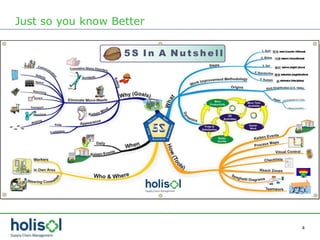
Just so you know Better
5
For Better meaning of 5 -> S
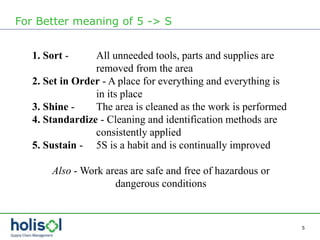
1. Sort - All unneeded tools, parts and supplies are
removed from the area
2. Set in Order - A place for everything and everything is
in its place
3. Shine - The area is cleaned as the work is performed
4. Standardize - Cleaning and identification methods are
consistently applied
5. Sustain - 5S is a habit and is continually improved
Also - Work areas are safe and free of hazardous or
dangerous conditions
6
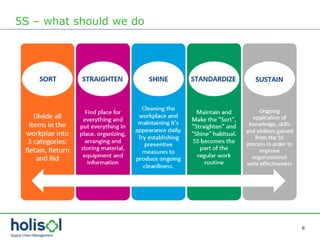
5S – what should we do
7
5S – SORT - (Retain or remove)
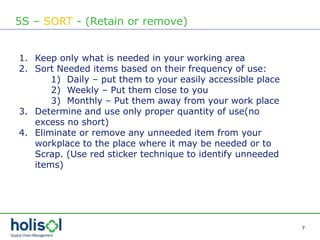
1. Keep only what is needed in your working area
2. Sort Needed items based on their frequency of use:
1) Daily – put them to your easily accessible place
2) Weekly – Put them close to you
3) Monthly – Put them away from your work place
3. Determine and use only proper quantity of use(no
excess no short)
4. Eliminate or remove any unneeded item from your
workplace to the place where it may be needed or to
Scrap. (Use red sticker technique to identify unneeded
items)
8
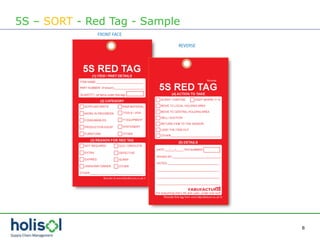
5S – SORT - Red Tag - Sample
9
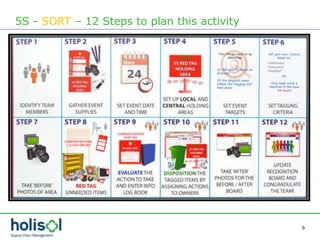
5S - SORT – 12 Steps to plan this activity
10
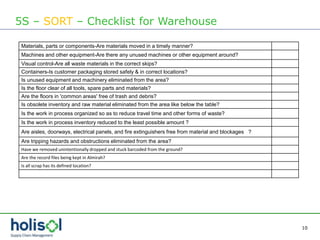
5S – SORT – Checklist for Warehouse
Materials, parts or components-Are materials moved in a timely manner?
Machines and other equipment-Are there any unused machines or other equipment around?
Visual control-Are all waste materials in the correct skips?
Containers-Is customer packaging stored safely & in correct locations?
Is unused equipment and machinery eliminated from the area?
Is the floor clear of all tools, spare parts and materials?
Are the floors in 'common areas' free of trash and debris?
Is obsolete inventory and raw material eliminated from the area like below the table?
Is the work in process organized so as to reduce travel time and other forms of waste?
Is the work in process inventory reduced to the least possible amount ?
Are aisles, doorways, electrical panels, and fire extinguishers free from material and blockages ?
Are tripping hazards and obstructions eliminated from the area?
Have we removed unintentionally dropped and stuck barcoded from the ground?
Are the record files being kept in Almirah?
Is all scrap has its defined location?
11
5S – STRAIGHTEN – Everything in place
1. “STOP”, Proceed only if SORT has been accomplished
2. A place should be assigned for everything and everything
should be placed to its assigned place after use.
3. Even if someone is not familiar with the are, should be
able to find something required
4. Every place of use should be properly labelled
12
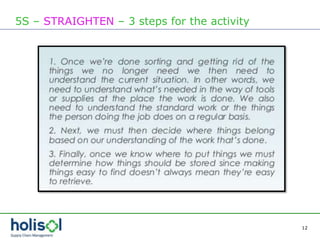
5S – STRAIGHTEN – 3 steps for the activity
13
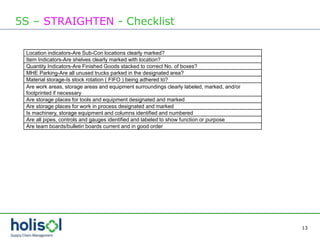
5S – STRAIGHTEN - Checklist
Location indicators-Are Sub-Con locations clearly marked?
Item Indicators-Are shelves clearly marked with location?
Quantity Indicators-Are Finished Goods stacked to correct No. of boxes?
MHE Parking-Are all unused trucks parked in the designated area?
Material storage-Is stock rotation ( FIFO ) being adhered to?
Are work areas, storage areas and equipment surroundings clearly labeled, marked, and/or
footprinted if necessary
Are storage places for tools and equipment designated and marked
Are storage places for work in process designated and marked
Is machinery, storage equipment and columns identified and numbered
Are all pipes, controls and gauges identified and labeled to show function or purpose
Are team boards/bulletin boards current and in good order
14
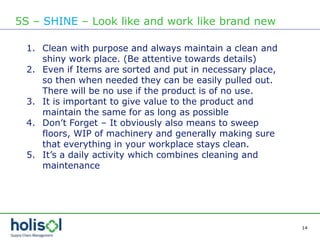
5S – SHINE – Look like and work like brand new
1. Clean with purpose and always maintain a clean and
shiny work place. (Be attentive towards details)
2. Even if Items are sorted and put in necessary place,
so then when needed they can be easily pulled out.
There will be no use if the product is of no use.
3. It is important to give value to the product and
maintain the same for as long as possible
4. Don’t Forget – It obviously also means to sweep
floors, WIP of machinery and generally making sure
that everything in your workplace stays clean.
5. It’s a daily activity which combines cleaning and
maintenance
15
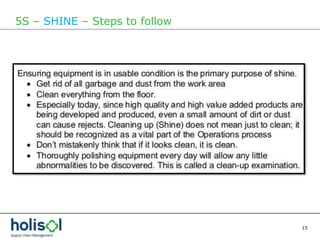
5S – SHINE – Steps to follow
16
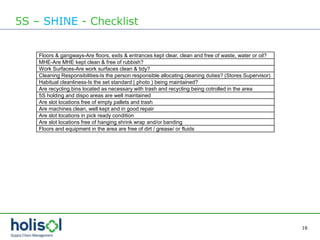
5S – SHINE - Checklist
Floors & gangways-Are floors, exits & entrances kept clear, clean and free of waste, water or oil?
MHE-Are MHE kept clean & free of rubbish?
Work Surfaces-Are work surfaces clean & tidy?
Cleaning Responsibilities-Is the person responsible allocating cleaning duties? (Stores Supervisor)
Habitual cleanliness-Is the set standard ( photo ) being maintained?
Are recycling bins located as necessary with trash and recycling being cotrolled in the area
5S holding and dispo areas are well maintained
Are slot locations free of empty pallets and trash
Are machines clean, well kept and in good repair
Are slot locations in pick ready condition
Are slot locations free of hanging shrink wrap and/or banding
Floors and equipment in the area are free of dirt / grease/ or fluids
17
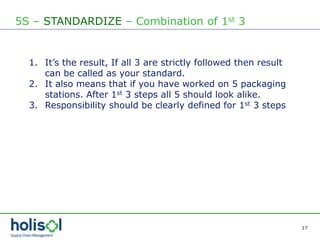
5S – STANDARDIZE – Combination of 1st 3
1. It’s the result, If all 3 are strictly followed then result
can be called as your standard.
2. It also means that if you have worked on 5 packaging
stations. After 1st 3 steps all 5 should look alike.
3. Responsibility should be clearly defined for 1st 3 steps
18
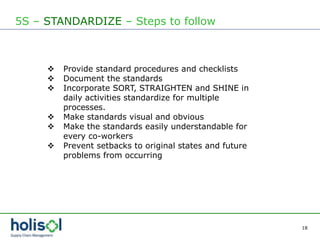
5S – STANDARDIZE – Steps to follow
 Provide standard procedures and checklists
 Document the standards
 Incorporate SORT, STRAIGHTEN and SHINE in
daily activities standardize for multiple
processes.
 Make standards visual and obvious
 Make the standards easily understandable for
every co-workers
 Prevent setbacks to original states and future
problems from occurring
19
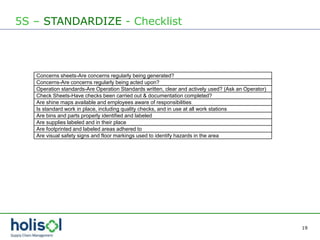
5S – STANDARDIZE - Checklist
Concerns sheets-Are concerns regularly being generated?
Concerns-Are concerns regularly being acted upon?
Operation standards-Are Operation Standards written, clear and actively used? (Ask an Operator)
Check Sheets-Have checks been carried out & documentation completed?
Are shine maps available and employees aware of responsibilities
Is standard work in place, including quality checks, and in use at all work stations
Are bins and parts properly identified and labeled
Are supplies labeled and in their place
Are footprinted and labeled areas adhered to
Are visual safety signs and floor markings used to identify hazards in the area
20
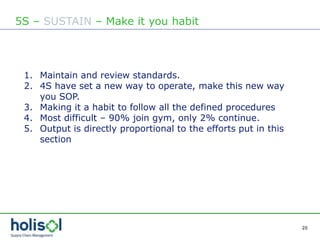
5S – SUSTAIN – Make it you habit
1. Maintain and review standards.
2. 4S have set a new way to operate, make this new way
you SOP.
3. Making it a habit to follow all the defined procedures
4. Most difficult – 90% join gym, only 2% continue.
5. Output is directly proportional to the efforts put in this
section
21
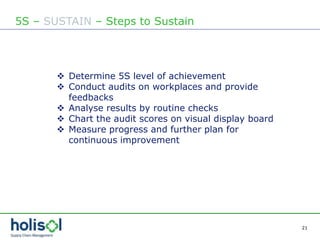
5S – SUSTAIN – Steps to Sustain
 Determine 5S level of achievement
 Conduct audits on workplaces and provide
feedbacks
 Analyse results by routine checks
 Chart the audit scores on visual display board
 Measure progress and further plan for
continuous improvement
22
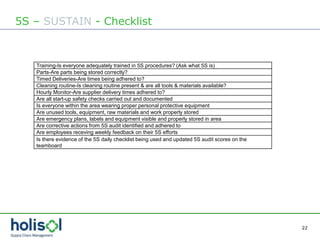
5S – SUSTAIN - Checklist
Training-Is everyone adequately trained in 5S procedures? (Ask what 5S is)
Parts-Are parts being stored correctly?
Timed Deliveries-Are times being adhered to?
Cleaning routine-Is cleaning routine present & are all tools & materials available?
Hourly Monitor-Are supplier delivery times adhered to?
Are all start-up safety checks carried out and documented
Is everyone within the area wearing proper personal protective equipment
Are unused tools, equipment, raw materials and work properly stored
Are emergency plans, labels and equipment visible and properly stored in area
Are corrective actions from 5S audit identified and adhered to
Are employees receving weekly feedback on their 5S efforts
Is there evidence of the 5S daily checklist being used and updated 5S audit scores on the
teamboard
23
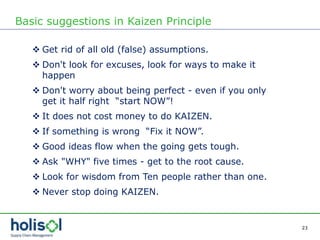
Basic suggestions in Kaizen Principle
 Get rid of all old (false) assumptions.
 Don't look for excuses, look for ways to make it
happen
 Don't worry about being perfect - even if you only
get it half right “start NOW”!
 It does not cost money to do KAIZEN.
 If something is wrong “Fix it NOW”.
 Good ideas flow when the going gets tough.
 Ask "WHY" five times - get to the root cause.
 Look for wisdom from Ten people rather than one.
 Never stop doing KAIZEN.
24
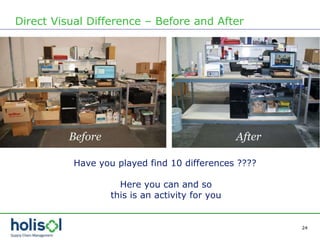
Direct Visual Difference – Before and After
Have you played find 10 differences ????
Here you can and so
this is an activity for you
25
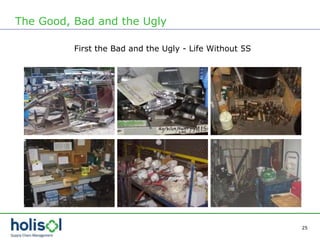
The Good, Bad and the Ugly
First the Bad and the Ugly - Life Without 5S
26
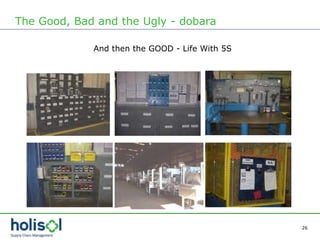
The Good, Bad and the Ugly - dobara
And then the GOOD - Life With 5S
27
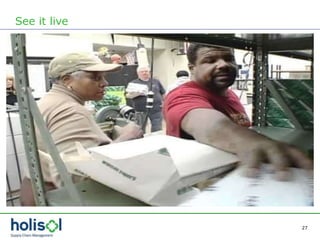
See it live
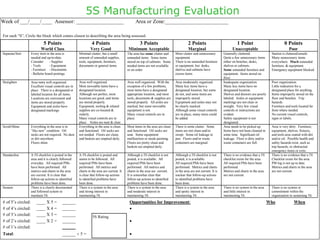
Week of ___/____/____ Assessor: __________________ Area or Zone:________________________
For each “S”, Circle the block which comes closest to describing the area being assessed.
5 Points
World Class
4 Points
Very Good
3 Points
Minimum Acceptable
2 Points
Marginal
1 Point
Unacceptable
0 Points
Poor
Separate/Sort Every item in the area is
needed and up-to-date.
Consider: - Supplies
- Tools - Equipment
- Furniture - Documents
- Bulletin board postings
Minimal clutter, but a small
amount of unneeded supplies,
tools, equipment, furniture,
documents or general items.
The area has some clutter and
unneeded items. Some items
stored on top of cabinets. Some
needed items are not available
or on order.
More clutter and unnecessary
equipment.
There is no unneeded furniture
or equipment, but desks,
shelves and cabinets have
excess items.
Generally cluttered.
Quite a few unnecessary items
either on benches, desks,
shelves or cabinets.
Some unneeded furniture and
equipment. Items stored on
floor.
Station is cluttered/unsafe.
Many unnecessary items
everywhere. Much unneeded
furniture, & equipment.
Emergency equipment blocked.
Straighten Area very well organized.
Excellent visual controls are in
place. There is a designated or
labeled location for all items.
Locations are convenient and
items are stored properly.
Equipment and aisles have
designated markings
Area well organized.
Most moveable items have a
designated location.
Although not perfect, most
locations are good, and items
are stored properly.
Equipment, tooling & related
supplies are co-located &
orderly.
Many visual controls are in
place. Aisles are neat & clear.
Area well organized. With the
exception of a few problems,
most items have a designated
appropriate location, and most
tools, documents & supplies are
stored properly. All aisles are
marked, but some moveable
equipment is not.
Many visual controls are in
place.
Area moderately organized.
Many key items have a
designated location, but some
do not, and some items are
improperly stored.
Equipment and aisles may not
be clearly marked.
Although some visual controls
are in place, many more could
be added.
Inadequate organization.
Many key items have no
designated location.
Shelves and drawers are poorly
labeled. Aisles or equipment
markings are not clear or
straight. Very few visual
controls or instructions are
evident.
Safety equipment is not
designated.
Poor organization.
Little indication for a
designated place for anything.
Items improperly stored on the
floor and benches. Trip
hazards.
Furniture and tools located far
from where needed.
No current visual controls,
signs or labels.
Scrub/Shine Everything in the area is in
“like new” condition. Oil
socks are not required. No dust
or dirt anywhere.
Floors shine.
Everything in the area is clean
and functional. Oil socks are
not needed. Floors are clean,
and baskets are emptied daily.
Most items in the area are clean
and functional. Oil socks are
neat. Some equipment
malfunction or needs painting.
Floors are pretty clean and
baskets are emptied daily.
There is some clutter. Some
items are not clean and/or
swept. Some oil leakage in
pan. Floors and/or waste
containers are marginal.
Area needs to be picked up.
Items have not been cleaned in
some time. Significant oil
leakage. Floor is dirty and/or
waste containers are full.
Area is very dirty. Furniture,
equipment, shelves, fixtures,
and tools area coated with dirt
and/or oil. Possible health and
safety hazards exist, such as
trip hazards, or obstructed
emergency items or exits.
Standardize A 5S checklist is posted in the
area and it is clearly followed
everyday. All required PMs
have been performed. All
metrics and charts in the area
are current. It is clear that
follow-up actions to identified
problems have been done.
A 5S checklist is posted and
seems to be followed. All
required PMs have been
performed. All metrics and
charts in the area are current. It
is clear that follow-up actions
to identified problems have
been done.
Although a 5S checklist is not
posted, it is available. All
required PMs have been
performed. All metrics and
charts in the area are current.
It is somewhat clear that
follow-up actions to identified
problems have been done.
Although a 5S checklist is not
posted, it is available.
All required PMs have been
performed. Metrics and charts
in the area are not current. It is
unclear that follow-up actions
to identified problems have
been done.
There is no evidence that a 5S
checklist exists for the area.
All required PMs have been
performed.
Metrics and charts in the area
are not current.
There is no evidence that a 5S
Checklist exists for the area.
PM log is not up to date.
Metrics and charts in the area
are not current.
Sustain There is a clearly documented
and followed system to
maintain 5S.
There is a system in the area
and strong interest in
maintaining 5S.
There is a system in the area
and moderate interest in
maintaining 5S.
There is a system in the area
and spotty interest in
maintaining 5S.
There is no system in the area
and little interest in
maintaining 5S.
There is no system or
commitment within the
organization to sustaining 5S.
# of 5’s circled: ____ X 5 = ______ Opportunities for Improvement: Who When
# of 4’s circled: ____ X 4 = ______ 
# of 3’s circled: ____ X 3 = ______
# of 2’s circled: ____ X 2 = ______ 
# of 1’s circled: ______
Total: ______  5 = 
5S Rating
5S Manufacturing Evaluation
29
What you get with 5S – Straight Advantages
1. NEAT & CLEAN WORKPLACE
2. PRODUCT DIVERSIFICATION
3. SMOOTH WORKING
4. NO OBSTRUCTION
5. SAFETY INCREASES
6. PRODUCTIVITY IMPROVES
7. QUALITY IMPROVES
7. WASTAGE DECREASE
8. MACHINE MAINTENANCE
9. VISUAL CONTROL SYSTEM
10. EMPLOYEES MOTIVATED
11. WORKSTATIONS BECOME SPACIOUS
12. IN THE END REDUCED COST
30
Activity
1. Take the PPT
2. Read -> Read again
3. Plan your schedule to perform each activity under everyone’s
supervision
4. Convert this PPT to your warehouse Report
5. Replace the before and after images in the PPT with your
warehouses images
6. Right down what extra inputs were put apart from the steps
mentioned – Others will follow and you will be rewarded
7. Show us the change you saw apart from obvious
8. Start form Monday
9. Make the reporting a weekly report
31

5S implementation workshop

  • 1.
    5S Training: Improving yourworkplace improves you By – AJAY & SHUBHAM
  • 2.
    2 5S BASIC TRAINING Whatis 5S and why do we want to do it?
  • 3.
    3 Little to 5S 5S is short for: Sort Set in Order (Straight) Shine Standardize Sustain  5S represents 5 disciplines for maintaining a visual workplace (visual controls and information systems).  These are foundational to Kaizen (continuous improvement) and a operations strategy based "Lean operations" (waste removing) concepts.  5S is one of the activities that will help ensure our company’s survival with soothing work environment.
  • 4.
    4 Just so youknow Better
  • 5.
    5 For Better meaningof 5 -> S 1. Sort - All unneeded tools, parts and supplies are removed from the area 2. Set in Order - A place for everything and everything is in its place 3. Shine - The area is cleaned as the work is performed 4. Standardize - Cleaning and identification methods are consistently applied 5. Sustain - 5S is a habit and is continually improved Also - Work areas are safe and free of hazardous or dangerous conditions
  • 6.
    6 5S – whatshould we do
  • 7.
    7 5S – SORT- (Retain or remove) 1. Keep only what is needed in your working area 2. Sort Needed items based on their frequency of use: 1) Daily – put them to your easily accessible place 2) Weekly – Put them close to you 3) Monthly – Put them away from your work place 3. Determine and use only proper quantity of use(no excess no short) 4. Eliminate or remove any unneeded item from your workplace to the place where it may be needed or to Scrap. (Use red sticker technique to identify unneeded items)
  • 8.
    8 5S – SORT- Red Tag - Sample
  • 9.
    9 5S - SORT– 12 Steps to plan this activity
  • 10.
    10 5S – SORT– Checklist for Warehouse Materials, parts or components-Are materials moved in a timely manner? Machines and other equipment-Are there any unused machines or other equipment around? Visual control-Are all waste materials in the correct skips? Containers-Is customer packaging stored safely & in correct locations? Is unused equipment and machinery eliminated from the area? Is the floor clear of all tools, spare parts and materials? Are the floors in 'common areas' free of trash and debris? Is obsolete inventory and raw material eliminated from the area like below the table? Is the work in process organized so as to reduce travel time and other forms of waste? Is the work in process inventory reduced to the least possible amount ? Are aisles, doorways, electrical panels, and fire extinguishers free from material and blockages ? Are tripping hazards and obstructions eliminated from the area? Have we removed unintentionally dropped and stuck barcoded from the ground? Are the record files being kept in Almirah? Is all scrap has its defined location?
  • 11.
    11 5S – STRAIGHTEN– Everything in place 1. “STOP”, Proceed only if SORT has been accomplished 2. A place should be assigned for everything and everything should be placed to its assigned place after use. 3. Even if someone is not familiar with the are, should be able to find something required 4. Every place of use should be properly labelled
  • 12.
    12 5S – STRAIGHTEN– 3 steps for the activity
  • 13.
    13 5S – STRAIGHTEN- Checklist Location indicators-Are Sub-Con locations clearly marked? Item Indicators-Are shelves clearly marked with location? Quantity Indicators-Are Finished Goods stacked to correct No. of boxes? MHE Parking-Are all unused trucks parked in the designated area? Material storage-Is stock rotation ( FIFO ) being adhered to? Are work areas, storage areas and equipment surroundings clearly labeled, marked, and/or footprinted if necessary Are storage places for tools and equipment designated and marked Are storage places for work in process designated and marked Is machinery, storage equipment and columns identified and numbered Are all pipes, controls and gauges identified and labeled to show function or purpose Are team boards/bulletin boards current and in good order
  • 14.
    14 5S – SHINE– Look like and work like brand new 1. Clean with purpose and always maintain a clean and shiny work place. (Be attentive towards details) 2. Even if Items are sorted and put in necessary place, so then when needed they can be easily pulled out. There will be no use if the product is of no use. 3. It is important to give value to the product and maintain the same for as long as possible 4. Don’t Forget – It obviously also means to sweep floors, WIP of machinery and generally making sure that everything in your workplace stays clean. 5. It’s a daily activity which combines cleaning and maintenance
  • 15.
    15 5S – SHINE– Steps to follow
  • 16.
    16 5S – SHINE- Checklist Floors & gangways-Are floors, exits & entrances kept clear, clean and free of waste, water or oil? MHE-Are MHE kept clean & free of rubbish? Work Surfaces-Are work surfaces clean & tidy? Cleaning Responsibilities-Is the person responsible allocating cleaning duties? (Stores Supervisor) Habitual cleanliness-Is the set standard ( photo ) being maintained? Are recycling bins located as necessary with trash and recycling being cotrolled in the area 5S holding and dispo areas are well maintained Are slot locations free of empty pallets and trash Are machines clean, well kept and in good repair Are slot locations in pick ready condition Are slot locations free of hanging shrink wrap and/or banding Floors and equipment in the area are free of dirt / grease/ or fluids
  • 17.
    17 5S – STANDARDIZE– Combination of 1st 3 1. It’s the result, If all 3 are strictly followed then result can be called as your standard. 2. It also means that if you have worked on 5 packaging stations. After 1st 3 steps all 5 should look alike. 3. Responsibility should be clearly defined for 1st 3 steps
  • 18.
    18 5S – STANDARDIZE– Steps to follow  Provide standard procedures and checklists  Document the standards  Incorporate SORT, STRAIGHTEN and SHINE in daily activities standardize for multiple processes.  Make standards visual and obvious  Make the standards easily understandable for every co-workers  Prevent setbacks to original states and future problems from occurring
  • 19.
    19 5S – STANDARDIZE- Checklist Concerns sheets-Are concerns regularly being generated? Concerns-Are concerns regularly being acted upon? Operation standards-Are Operation Standards written, clear and actively used? (Ask an Operator) Check Sheets-Have checks been carried out & documentation completed? Are shine maps available and employees aware of responsibilities Is standard work in place, including quality checks, and in use at all work stations Are bins and parts properly identified and labeled Are supplies labeled and in their place Are footprinted and labeled areas adhered to Are visual safety signs and floor markings used to identify hazards in the area
  • 20.
    20 5S – SUSTAIN– Make it you habit 1. Maintain and review standards. 2. 4S have set a new way to operate, make this new way you SOP. 3. Making it a habit to follow all the defined procedures 4. Most difficult – 90% join gym, only 2% continue. 5. Output is directly proportional to the efforts put in this section
  • 21.
    21 5S – SUSTAIN– Steps to Sustain  Determine 5S level of achievement  Conduct audits on workplaces and provide feedbacks  Analyse results by routine checks  Chart the audit scores on visual display board  Measure progress and further plan for continuous improvement
  • 22.
    22 5S – SUSTAIN- Checklist Training-Is everyone adequately trained in 5S procedures? (Ask what 5S is) Parts-Are parts being stored correctly? Timed Deliveries-Are times being adhered to? Cleaning routine-Is cleaning routine present & are all tools & materials available? Hourly Monitor-Are supplier delivery times adhered to? Are all start-up safety checks carried out and documented Is everyone within the area wearing proper personal protective equipment Are unused tools, equipment, raw materials and work properly stored Are emergency plans, labels and equipment visible and properly stored in area Are corrective actions from 5S audit identified and adhered to Are employees receving weekly feedback on their 5S efforts Is there evidence of the 5S daily checklist being used and updated 5S audit scores on the teamboard
  • 23.
    23 Basic suggestions inKaizen Principle  Get rid of all old (false) assumptions.  Don't look for excuses, look for ways to make it happen  Don't worry about being perfect - even if you only get it half right “start NOW”!  It does not cost money to do KAIZEN.  If something is wrong “Fix it NOW”.  Good ideas flow when the going gets tough.  Ask "WHY" five times - get to the root cause.  Look for wisdom from Ten people rather than one.  Never stop doing KAIZEN.
  • 24.
    24 Direct Visual Difference– Before and After Have you played find 10 differences ???? Here you can and so this is an activity for you
  • 25.
    25 The Good, Badand the Ugly First the Bad and the Ugly - Life Without 5S
  • 26.
    26 The Good, Badand the Ugly - dobara And then the GOOD - Life With 5S
  • 27.
  • 28.
    Week of ___/____/____Assessor: __________________ Area or Zone:________________________ For each “S”, Circle the block which comes closest to describing the area being assessed. 5 Points World Class 4 Points Very Good 3 Points Minimum Acceptable 2 Points Marginal 1 Point Unacceptable 0 Points Poor Separate/Sort Every item in the area is needed and up-to-date. Consider: - Supplies - Tools - Equipment - Furniture - Documents - Bulletin board postings Minimal clutter, but a small amount of unneeded supplies, tools, equipment, furniture, documents or general items. The area has some clutter and unneeded items. Some items stored on top of cabinets. Some needed items are not available or on order. More clutter and unnecessary equipment. There is no unneeded furniture or equipment, but desks, shelves and cabinets have excess items. Generally cluttered. Quite a few unnecessary items either on benches, desks, shelves or cabinets. Some unneeded furniture and equipment. Items stored on floor. Station is cluttered/unsafe. Many unnecessary items everywhere. Much unneeded furniture, & equipment. Emergency equipment blocked. Straighten Area very well organized. Excellent visual controls are in place. There is a designated or labeled location for all items. Locations are convenient and items are stored properly. Equipment and aisles have designated markings Area well organized. Most moveable items have a designated location. Although not perfect, most locations are good, and items are stored properly. Equipment, tooling & related supplies are co-located & orderly. Many visual controls are in place. Aisles are neat & clear. Area well organized. With the exception of a few problems, most items have a designated appropriate location, and most tools, documents & supplies are stored properly. All aisles are marked, but some moveable equipment is not. Many visual controls are in place. Area moderately organized. Many key items have a designated location, but some do not, and some items are improperly stored. Equipment and aisles may not be clearly marked. Although some visual controls are in place, many more could be added. Inadequate organization. Many key items have no designated location. Shelves and drawers are poorly labeled. Aisles or equipment markings are not clear or straight. Very few visual controls or instructions are evident. Safety equipment is not designated. Poor organization. Little indication for a designated place for anything. Items improperly stored on the floor and benches. Trip hazards. Furniture and tools located far from where needed. No current visual controls, signs or labels. Scrub/Shine Everything in the area is in “like new” condition. Oil socks are not required. No dust or dirt anywhere. Floors shine. Everything in the area is clean and functional. Oil socks are not needed. Floors are clean, and baskets are emptied daily. Most items in the area are clean and functional. Oil socks are neat. Some equipment malfunction or needs painting. Floors are pretty clean and baskets are emptied daily. There is some clutter. Some items are not clean and/or swept. Some oil leakage in pan. Floors and/or waste containers are marginal. Area needs to be picked up. Items have not been cleaned in some time. Significant oil leakage. Floor is dirty and/or waste containers are full. Area is very dirty. Furniture, equipment, shelves, fixtures, and tools area coated with dirt and/or oil. Possible health and safety hazards exist, such as trip hazards, or obstructed emergency items or exits. Standardize A 5S checklist is posted in the area and it is clearly followed everyday. All required PMs have been performed. All metrics and charts in the area are current. It is clear that follow-up actions to identified problems have been done. A 5S checklist is posted and seems to be followed. All required PMs have been performed. All metrics and charts in the area are current. It is clear that follow-up actions to identified problems have been done. Although a 5S checklist is not posted, it is available. All required PMs have been performed. All metrics and charts in the area are current. It is somewhat clear that follow-up actions to identified problems have been done. Although a 5S checklist is not posted, it is available. All required PMs have been performed. Metrics and charts in the area are not current. It is unclear that follow-up actions to identified problems have been done. There is no evidence that a 5S checklist exists for the area. All required PMs have been performed. Metrics and charts in the area are not current. There is no evidence that a 5S Checklist exists for the area. PM log is not up to date. Metrics and charts in the area are not current. Sustain There is a clearly documented and followed system to maintain 5S. There is a system in the area and strong interest in maintaining 5S. There is a system in the area and moderate interest in maintaining 5S. There is a system in the area and spotty interest in maintaining 5S. There is no system in the area and little interest in maintaining 5S. There is no system or commitment within the organization to sustaining 5S. # of 5’s circled: ____ X 5 = ______ Opportunities for Improvement: Who When # of 4’s circled: ____ X 4 = ______  # of 3’s circled: ____ X 3 = ______ # of 2’s circled: ____ X 2 = ______  # of 1’s circled: ______ Total: ______  5 =  5S Rating 5S Manufacturing Evaluation
  • 29.
    29 What you getwith 5S – Straight Advantages 1. NEAT & CLEAN WORKPLACE 2. PRODUCT DIVERSIFICATION 3. SMOOTH WORKING 4. NO OBSTRUCTION 5. SAFETY INCREASES 6. PRODUCTIVITY IMPROVES 7. QUALITY IMPROVES 7. WASTAGE DECREASE 8. MACHINE MAINTENANCE 9. VISUAL CONTROL SYSTEM 10. EMPLOYEES MOTIVATED 11. WORKSTATIONS BECOME SPACIOUS 12. IN THE END REDUCED COST
  • 30.
    30 Activity 1. Take thePPT 2. Read -> Read again 3. Plan your schedule to perform each activity under everyone’s supervision 4. Convert this PPT to your warehouse Report 5. Replace the before and after images in the PPT with your warehouses images 6. Right down what extra inputs were put apart from the steps mentioned – Others will follow and you will be rewarded 7. Show us the change you saw apart from obvious 8. Start form Monday 9. Make the reporting a weekly report
  • 31.