‘5S’
METHOD OF WORK PLACE
ORGANIZATION AND VISUAL
CONTROLS
Popularized by Hiroyuki Hirano (1990).
The origin is rooted in the works of two
American pioneers Frederick W. Taylor
and Henry Ford – Studied by Japanese
managers.
‘5S’ – Each ‘S’ means.,
• SEIRI – Sort - Clearing
• SEITON – Set - Organizing
• SEISO – Shine – Cleaning
• SEIKETSU –Standardizing
• SHITSUKE – Sustain – Self
Discipline and Training
COMMON MIND SETS…
• Its an additional burden. Too busy to do
5S activities.
• Why clean it? It will get dirty again
• We cannot change the existing setup.
• More work pressure – No time for these
things
COMMON MIND SETS…
• Expensive – Why to waste money?
• We are comfortable – Why to change?
• It will take time.
But the winning
companies says…
• Work efficiency enhanced due to
organized work place
• Achieve remarkable cost reduction in
production process and improved
productivity by 20%
But the winning
companies says…
• Promotes safe, healthy and beautiful
work environment
• From the bottom of the list we become
the number two profit maker
• Waste elimination, Cycle time reduction,
Space generation, Inventory reduction
and improved work ethics
But the winning
companies says…
• World class companies do
not succeed, it’s people
who do
So,
What’s good in it?
‘5S’
• SEIRI – Sort - Clearing
• SEITON – Set - Organizing
• SEISO – Shine – Cleaning
• SEIKETSU –Standardizing
• SHITSUKE – Sustain – Self
Discipline and Training
1S – SORT - Clearing
“…only what is needed, in the
amounts necessary,
as they are required…”
Eliminate unwanted
items from your work
area
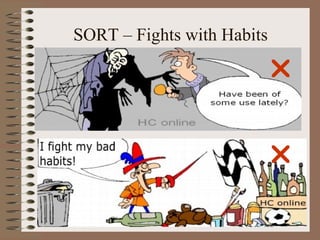
SORT – Fights with Habits


SORT – Fights with Habits
• It is difficult and confusing to decide which
would be wanted in future.
• People tend to keep extras or duplicates “just in
case a need comes in future”
• People do not realize the importance of space,
believing in unlimited space availability.
JUST-IN-CASE JUST-IN-TIME
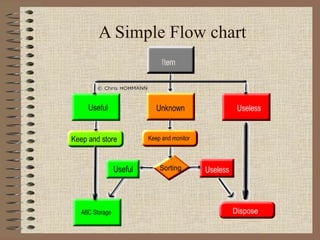
A Simple Flow chart
What is unwanted?
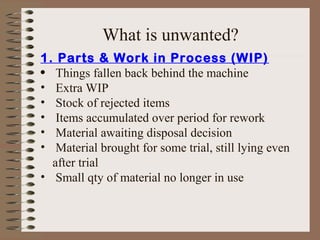
1. Parts & Work in Process (WIP)
• Things fallen back behind the machine
• Extra WIP
• Stock of rejected items
• Items accumulated over period for rework
• Material awaiting disposal decision
• Material brought for some trial, still lying even
after trial
• Small qty of material no longer in use
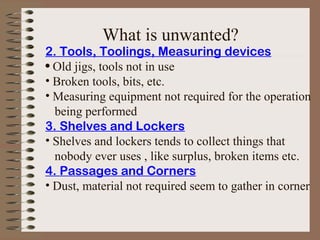
2. Tools, Toolings, Measuring devices
• Old jigs, tools not in use
• Broken tools, bits, etc.
• Measuring equipment not required for the operation
being performed
3. Shelves and Lockers
• Shelves and lockers tends to collect things that
nobody ever uses , like surplus, broken items etc.
4. Passages and Corners
• Dust, material not required seem to gather in corner
What is unwanted?
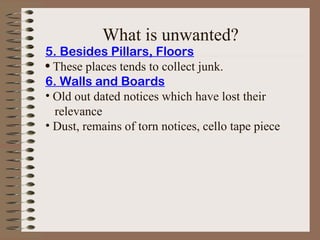
5. Besides Pillars, Floors
• These places tends to collect junk.
6. Walls and Boards
• Old out dated notices which have lost their
relevance
• Dust, remains of torn notices, cello tape piece
What is unwanted?
What is unknown?
• Simple –
• Unable to decide whether it is useful or
not.
• Good material – Not useful to you. May be
of use to somebody else.
SEIRI =SEIRI = SortingSorting
Activity Establish a criteria for eliminating unwanted items
Eliminate unwanted items either by disposing
them or by relocating them.
Meaning Distinguish between necessary and
unnecessary items and eliminate the
unnecessary items
Success Area saved or percentage of space available
Indicator
INTERACTIVE BIT
Give me three examples
of areas that could benefit
from sorting
SEITON – SET -
ORGANIZING
• “A place for everything and
everything in its place”
• Identify and allocate a place for
all the materials needed for your
work.
• Decide where things belong.
• Decide how things should put
away
• Obey the put away rules
SEITON – SET -
ORGANIZING
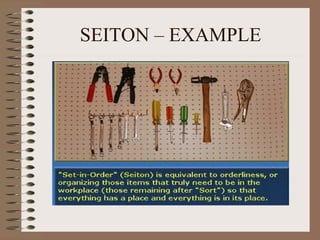
SEITON – EXAMPLE
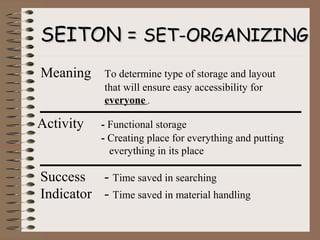
SEITON =SEITON = SET-ORGANIZINGSET-ORGANIZING
Activity - Functional storage
- Creating place for everything and putting
everything in its place
Meaning To determine type of storage and layout
that will ensure easy accessibility for
everyone .
Success - Time saved in searching
Indicator - Time saved in material handling
INTERACTIVE BIT
Discuss two areas where production
is frustrating
• Do the tools keep going missing, or do
you have to wait for them to become
available.
• Do operators zig-zag around the area
and/or get in each others way
• Do we have Mix Ups?
•
SEISO – SHINE - CLEANING
• Here cleaning means more than
just keeping things clean – Its for
your safe.
• At least 5 minutes everyday for
cleaning
SEISO-SHINE-CLEANINGSEISO-SHINE-CLEANING
Activity - Keep workplace spotlessly clean
- Inspection while cleaning
- Finding minor problems with cleaning inspection
Meaning Cleaning trash, filth, dust and other foreign
matter. Cleaning as a form of Inspection.
Success - Reduction in machine down time
Indicator - Reduction in no. of accidents
INTERACTIVE BIT
What areas of the factory
are the dirtiest and/or are
depressing to work in?
SEIKETSU -
STANDARDIZING
• Regularising 5S activities by putting
systems in place – Everyone does things
the same way
• Make it easy for everyone to identify the
state of normal or abnormal condition.
• For maintaining previous 3S, use visual
management
5S IS EASY TO DO ONCE –
CONSISTENCY IS DIFFICULT
SEIKETSU - STANDARDIZINGSEIKETSU - STANDARDIZING
Activity - Innovative visual management
- Colour coding
- Early detection of problem and early action
Meaning Setting up standards / Norms for a neat,
clean,workplace and details of how
to maintain the norm (Procedure)
Success Increase in 5S indicator
Indicator
• Make ‘5S’ is a HABIT
• Without this, the time involved
in all the other S will be in
vain.
SHITSUKE – SUSTAIN – SELF
DISCIPLINE & TRAINING
• We need Everyone to maintain
5S guidelines.
• To maintain discipline, we
need to practice and repeat
until it becomes way of life.
• Discipline is the core of 5S
SHITSUKE – SUSTAIN – SELF
DISCIPLINE & TRAINING
SHITSUKE – SUSTAIN –
SELF DISCIPLINE &
TRAINING
• Commitment +
Everyone’s Involvement =
Success to 5S
SHITSUKE-SUSTAINSHITSUKE-SUSTAIN
Activity - Participation of everyone in developing good
habits
- Regular audits and aiming for higher level
Meaning Every one sticks to the rule and makes it a
habit
Success High employee morale
Indicator Involvement of all people
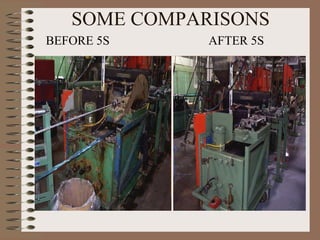
SOME COMPARISONS
BEFORE 5S AFTER 5S
The rules…
• Remove fixed ideas.
• Think of ways to make it possible.
• No excuses needed.
• Go for the simple solution, not the perfect one.
• Correct mistakes right away.
• Repeat ‘Why’ 5 times.
• Ask ideas from many people.
• There is no end to improvement.
BENEFITS
 Reduced set-up times
 Reduced cycle times
 Reduce searching time
 Increased floor space
 Lower safety incident/accident rate
 Less wasted labor
 Better equipment reliability
 Higher Quality
 Lower cost
 Reliable Delivery
Roles and Responsibility
• Leaders must set the tone and lead by
example.
• We should commit to the initiative,
Provide time to the workforce to develop
and implement 5S changes.
• Any implementation should have a drive.
• Conduct short, focussed and frequent
communication sessions.
• Select areas that needs 5S – as pilot areas
• Share the successes
It’s a start….

5 s training

  • 1.
    ‘5S’ METHOD OF WORKPLACE ORGANIZATION AND VISUAL CONTROLS Popularized by Hiroyuki Hirano (1990). The origin is rooted in the works of two American pioneers Frederick W. Taylor and Henry Ford – Studied by Japanese managers.
  • 2.
    ‘5S’ – Each‘S’ means., • SEIRI – Sort - Clearing • SEITON – Set - Organizing • SEISO – Shine – Cleaning • SEIKETSU –Standardizing • SHITSUKE – Sustain – Self Discipline and Training
  • 3.
    COMMON MIND SETS… •Its an additional burden. Too busy to do 5S activities. • Why clean it? It will get dirty again • We cannot change the existing setup. • More work pressure – No time for these things
  • 4.
    COMMON MIND SETS… •Expensive – Why to waste money? • We are comfortable – Why to change? • It will take time.
  • 5.
    But the winning companiessays… • Work efficiency enhanced due to organized work place • Achieve remarkable cost reduction in production process and improved productivity by 20%
  • 6.
    But the winning companiessays… • Promotes safe, healthy and beautiful work environment • From the bottom of the list we become the number two profit maker • Waste elimination, Cycle time reduction, Space generation, Inventory reduction and improved work ethics
  • 7.
    But the winning companiessays… • World class companies do not succeed, it’s people who do
  • 8.
  • 9.
    ‘5S’ • SEIRI –Sort - Clearing • SEITON – Set - Organizing • SEISO – Shine – Cleaning • SEIKETSU –Standardizing • SHITSUKE – Sustain – Self Discipline and Training
  • 10.
    1S – SORT- Clearing “…only what is needed, in the amounts necessary, as they are required…” Eliminate unwanted items from your work area
  • 11.
    SORT – Fightswith Habits  
  • 12.
    SORT – Fightswith Habits • It is difficult and confusing to decide which would be wanted in future. • People tend to keep extras or duplicates “just in case a need comes in future” • People do not realize the importance of space, believing in unlimited space availability. JUST-IN-CASE JUST-IN-TIME
  • 13.
  • 14.
    What is unwanted? 1.Parts & Work in Process (WIP) • Things fallen back behind the machine • Extra WIP • Stock of rejected items • Items accumulated over period for rework • Material awaiting disposal decision • Material brought for some trial, still lying even after trial • Small qty of material no longer in use
  • 15.
    2. Tools, Toolings,Measuring devices • Old jigs, tools not in use • Broken tools, bits, etc. • Measuring equipment not required for the operation being performed 3. Shelves and Lockers • Shelves and lockers tends to collect things that nobody ever uses , like surplus, broken items etc. 4. Passages and Corners • Dust, material not required seem to gather in corner What is unwanted?
  • 16.
    5. Besides Pillars,Floors • These places tends to collect junk. 6. Walls and Boards • Old out dated notices which have lost their relevance • Dust, remains of torn notices, cello tape piece What is unwanted?
  • 17.
    What is unknown? •Simple – • Unable to decide whether it is useful or not. • Good material – Not useful to you. May be of use to somebody else.
  • 18.
    SEIRI =SEIRI =SortingSorting Activity Establish a criteria for eliminating unwanted items Eliminate unwanted items either by disposing them or by relocating them. Meaning Distinguish between necessary and unnecessary items and eliminate the unnecessary items Success Area saved or percentage of space available Indicator
  • 19.
    INTERACTIVE BIT Give methree examples of areas that could benefit from sorting
  • 20.
    SEITON – SET- ORGANIZING • “A place for everything and everything in its place” • Identify and allocate a place for all the materials needed for your work.
  • 21.
    • Decide wherethings belong. • Decide how things should put away • Obey the put away rules SEITON – SET - ORGANIZING
  • 22.
  • 23.
    SEITON =SEITON =SET-ORGANIZINGSET-ORGANIZING Activity - Functional storage - Creating place for everything and putting everything in its place Meaning To determine type of storage and layout that will ensure easy accessibility for everyone . Success - Time saved in searching Indicator - Time saved in material handling
  • 24.
    INTERACTIVE BIT Discuss twoareas where production is frustrating • Do the tools keep going missing, or do you have to wait for them to become available. • Do operators zig-zag around the area and/or get in each others way • Do we have Mix Ups? •
  • 25.
    SEISO – SHINE- CLEANING • Here cleaning means more than just keeping things clean – Its for your safe. • At least 5 minutes everyday for cleaning
  • 26.
    SEISO-SHINE-CLEANINGSEISO-SHINE-CLEANING Activity - Keepworkplace spotlessly clean - Inspection while cleaning - Finding minor problems with cleaning inspection Meaning Cleaning trash, filth, dust and other foreign matter. Cleaning as a form of Inspection. Success - Reduction in machine down time Indicator - Reduction in no. of accidents
  • 27.
    INTERACTIVE BIT What areasof the factory are the dirtiest and/or are depressing to work in?
  • 28.
    SEIKETSU - STANDARDIZING • Regularising5S activities by putting systems in place – Everyone does things the same way • Make it easy for everyone to identify the state of normal or abnormal condition. • For maintaining previous 3S, use visual management 5S IS EASY TO DO ONCE – CONSISTENCY IS DIFFICULT
  • 29.
    SEIKETSU - STANDARDIZINGSEIKETSU- STANDARDIZING Activity - Innovative visual management - Colour coding - Early detection of problem and early action Meaning Setting up standards / Norms for a neat, clean,workplace and details of how to maintain the norm (Procedure) Success Increase in 5S indicator Indicator
  • 30.
    • Make ‘5S’is a HABIT • Without this, the time involved in all the other S will be in vain. SHITSUKE – SUSTAIN – SELF DISCIPLINE & TRAINING
  • 31.
    • We needEveryone to maintain 5S guidelines. • To maintain discipline, we need to practice and repeat until it becomes way of life. • Discipline is the core of 5S SHITSUKE – SUSTAIN – SELF DISCIPLINE & TRAINING
  • 32.
    SHITSUKE – SUSTAIN– SELF DISCIPLINE & TRAINING • Commitment + Everyone’s Involvement = Success to 5S
  • 33.
    SHITSUKE-SUSTAINSHITSUKE-SUSTAIN Activity - Participationof everyone in developing good habits - Regular audits and aiming for higher level Meaning Every one sticks to the rule and makes it a habit Success High employee morale Indicator Involvement of all people
  • 34.
  • 35.
    The rules… • Removefixed ideas. • Think of ways to make it possible. • No excuses needed. • Go for the simple solution, not the perfect one. • Correct mistakes right away. • Repeat ‘Why’ 5 times. • Ask ideas from many people. • There is no end to improvement.
  • 36.
    BENEFITS  Reduced set-uptimes  Reduced cycle times  Reduce searching time  Increased floor space  Lower safety incident/accident rate  Less wasted labor  Better equipment reliability  Higher Quality  Lower cost  Reliable Delivery
  • 37.
    Roles and Responsibility •Leaders must set the tone and lead by example. • We should commit to the initiative, Provide time to the workforce to develop and implement 5S changes. • Any implementation should have a drive. • Conduct short, focussed and frequent communication sessions. • Select areas that needs 5S – as pilot areas • Share the successes
  • 38.