WELCOME
TRAINING
on
Workplace Management - 1S
Vijay Khonde
Lean Manufacturing Consultant
5S
The Workplace Management
What Are 5S?
• Seiri : Sorting (Needed, Not Needed)
• Seiton : Systematic Arrangement
(Place for Everything & Everything in
its Place)
• Seiso : Cleaning & Inspection while
Cleaning (Shine)
• Seiketsu : Standardization (Adhering to
the laid down procedures
consistently)
• Shitsuke : Self Discipline (Maintain)
3
5S- Objectives
1. Improve Housekeeping
2. Individual Ownership
3. Beautify by Simple Means
4. Productivity Improvement by
saving time, space etc.
5. Provide foundation for
continuous improvements
4
5S - Principles
1. Elimination of Waste
2. Team Work
3. Attack Root Cause
4. Sustain the movement
5. Human being is not Infallible
5
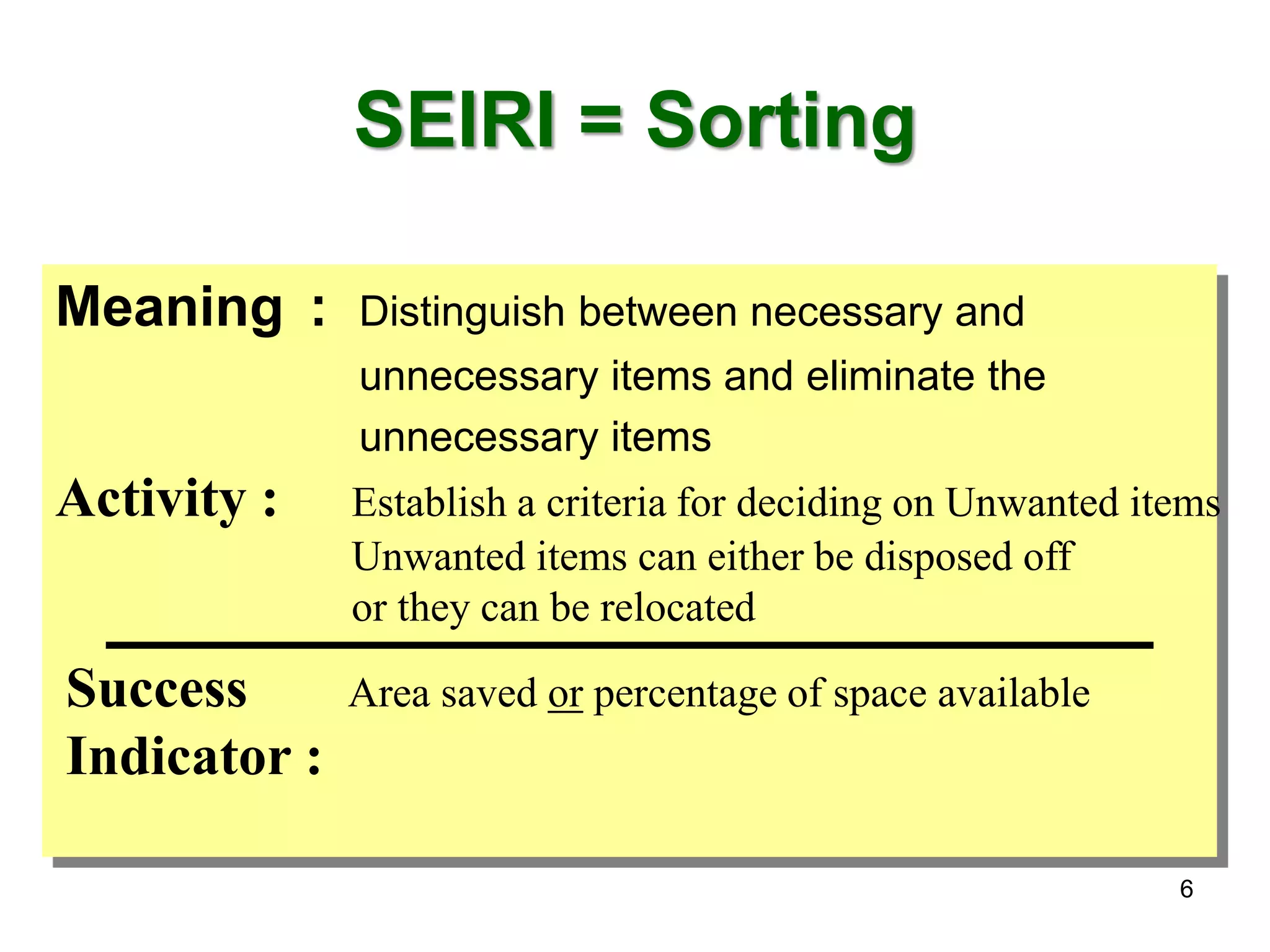
Meaning : Distinguish between necessary and
unnecessary items and eliminate the
unnecessary items
Activity : Establish a criteria for deciding on Unwanted items
Unwanted items can either be disposed off
or they can be relocated
Success Area saved or percentage of space available
Indicator :
6
SEIRI = Sorting
• Item is not needed
• Item is needed however quantity in stock
is more than what is needed for
consumption in the near future
Seiri = Sorting
What is unnecessary
7
Seiri = Sorting
Frequency of use Storage Method
*Things you have not used
in the past one year
Throw them out
*Things you have used once
in the last 6-12 months
Store at distance OR
Keep in store
LOW
*Things you have used only
once in the last 2-6 months
Store it in central place
in your zone
*Things used more than once
a month
Store it in central place
in your zone
HIGH *Things used once a week Store near the workplace
*Things used daily or hourly Store near the workplace
Organization
8
Seiri = Sorting Identifying Unnecessary
1. Parts & Work in Process (WIP)
• Stock of rejected items
• Items accumulated over period for rework
• Material awaiting disposal decision
• Material brought for trial, still lying even after trial
Contd..
9
Seiri = Sorting Identifying unnecessary
2. Tools, Toolings
• Toolings brought for trial, Currently not in use
• Worn out bushes, liners, toggles etc. Lying unattended
• Broken tools, bits indisposed
3. Shelves and Lockers
• Shelves and lockers tends to collect things that nobody
ever uses , like surplus, broken items etc.
Contd..
10
Seiri = Sorting Identifying unnecessary
4. Walls and Bulletin Boards
• Old out-dated notices which have lost their relevance
• Posters or bulletins on wall
• Remains of torn notices, Cell tape pieces
5. Computer Hard Disk
Many unwanted, outdated, temporary files pile up
Contd..
11
Seiri = Sorting Dealing with papers
How to reduce papers on
your table ?
1. Make a single pile of papers
2. Go through them and sort in
following categories
a) Immediate action
b) Low priority
c) Pending
d) Reading material
12
FPP – Fixed Point Photography
(Before & After)
• Fix the views of every zone ( 1 to 3 views)
• Capture picture (photo) from the same
point every time
• Get suggestions from zonal members &
Improve the zones continuously
• Capture pictures (photos) every month
• Arrange the photos in chronological order
• Arrange competition
13
XYZ Industries - Surrounding Area
Status in Jan.2012
100 Sq. M Area
made free
from removing
unwanted
material
Status in Feb.2012
05.02.2012
20.01.2012
One Cutting m/c shifted in this area
which was previously infront of Office
Status in March 2012
Arranged Two
Welding m/c in
this area
Status in May 2012
28.05.2012
WPP – Worst Point Pictures
(Before & After)
• Unsafe conditions
– Excess / insufficient light
– Open / loose electrical joints
– Hanging wires, improper parts, accessories
– No guards for M/cs, Moving parts, Elect. panels
• Mixed material
• Obsolete items / tools / dies / gauges / docs
• Wet floor
• Out of reach points for cleaning
15
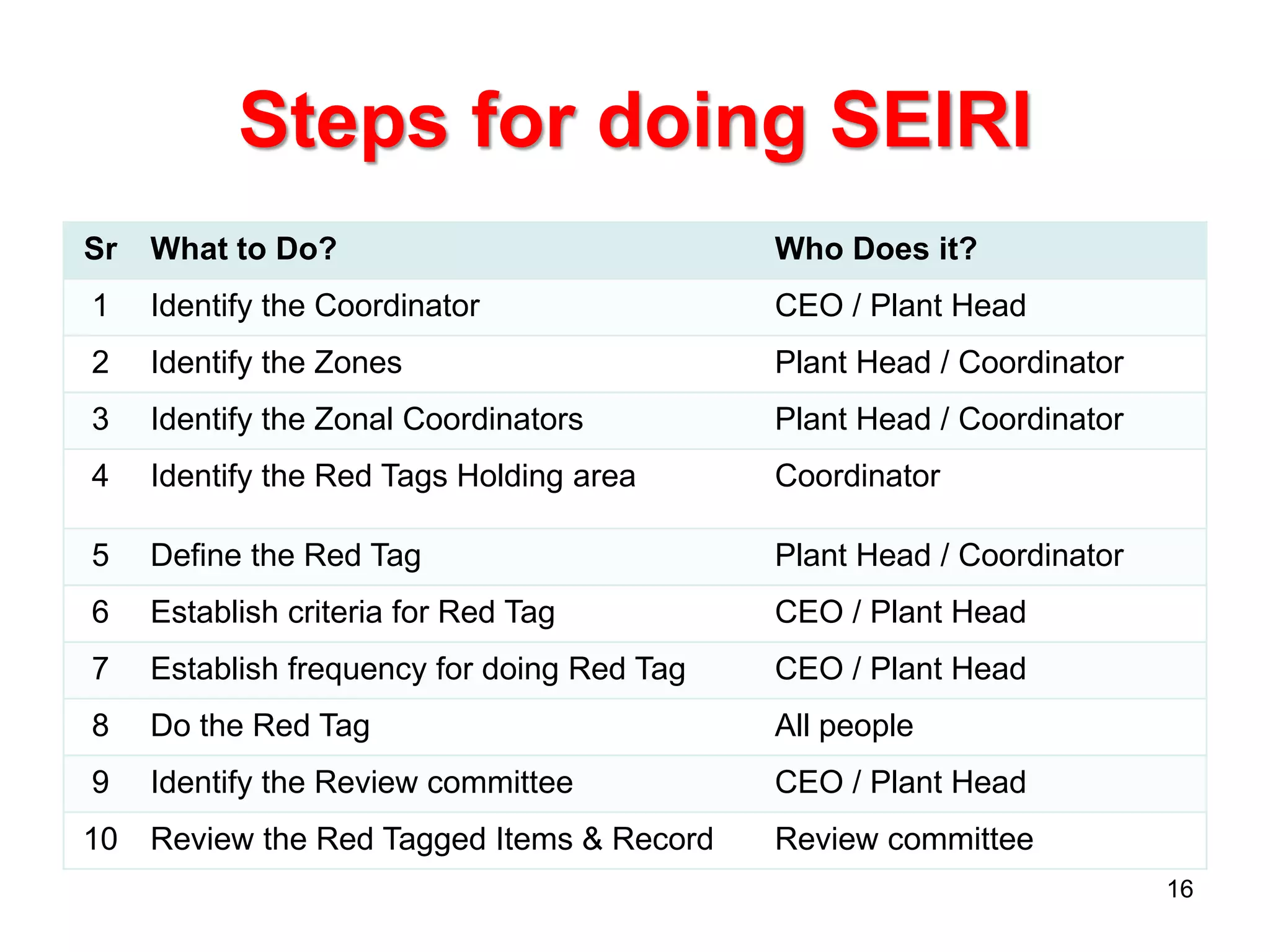
Steps for doing SEIRI
Sr What to Do? Who Does it?
1 Identify the Coordinator CEO / Plant Head
2 Identify the Zones Plant Head / Coordinator
3 Identify the Zonal Coordinators Plant Head / Coordinator
4 Identify the Red Tags Holding area Coordinator
5 Define the Red Tag Plant Head / Coordinator
6 Establish criteria for Red Tag CEO / Plant Head
7 Establish frequency for doing Red Tag CEO / Plant Head
8 Do the Red Tag All people
9 Identify the Review committee CEO / Plant Head
10 Review the Red Tagged Items & Record Review committee
16
Red Tag
• It can be a paper tag with the following
information
• What is the item?
• How much Qty?
• Why is it removed out (damaged, excess etc.
• What is the approx. value?
• Section from where the item is removed?
“Establish the frequency of doing the Red Tag”
17
18
Criteria for Red Tag
• Every person asks to all the items around
his / her workplace
• Is this item needed?
• If it is needed, is it needed in this Qty?
• If it is needed, is it needed very
frequently?
If the answer is “NO” : Remove it from
the Workplace
19
Red Tag Targets
Red Tag
Targets
Types of
Items
Physical
Areas
RM, BO, WIP,
Assly. parts, SFG,
FG
Floors, gangways,
shelves,
warehouses
20
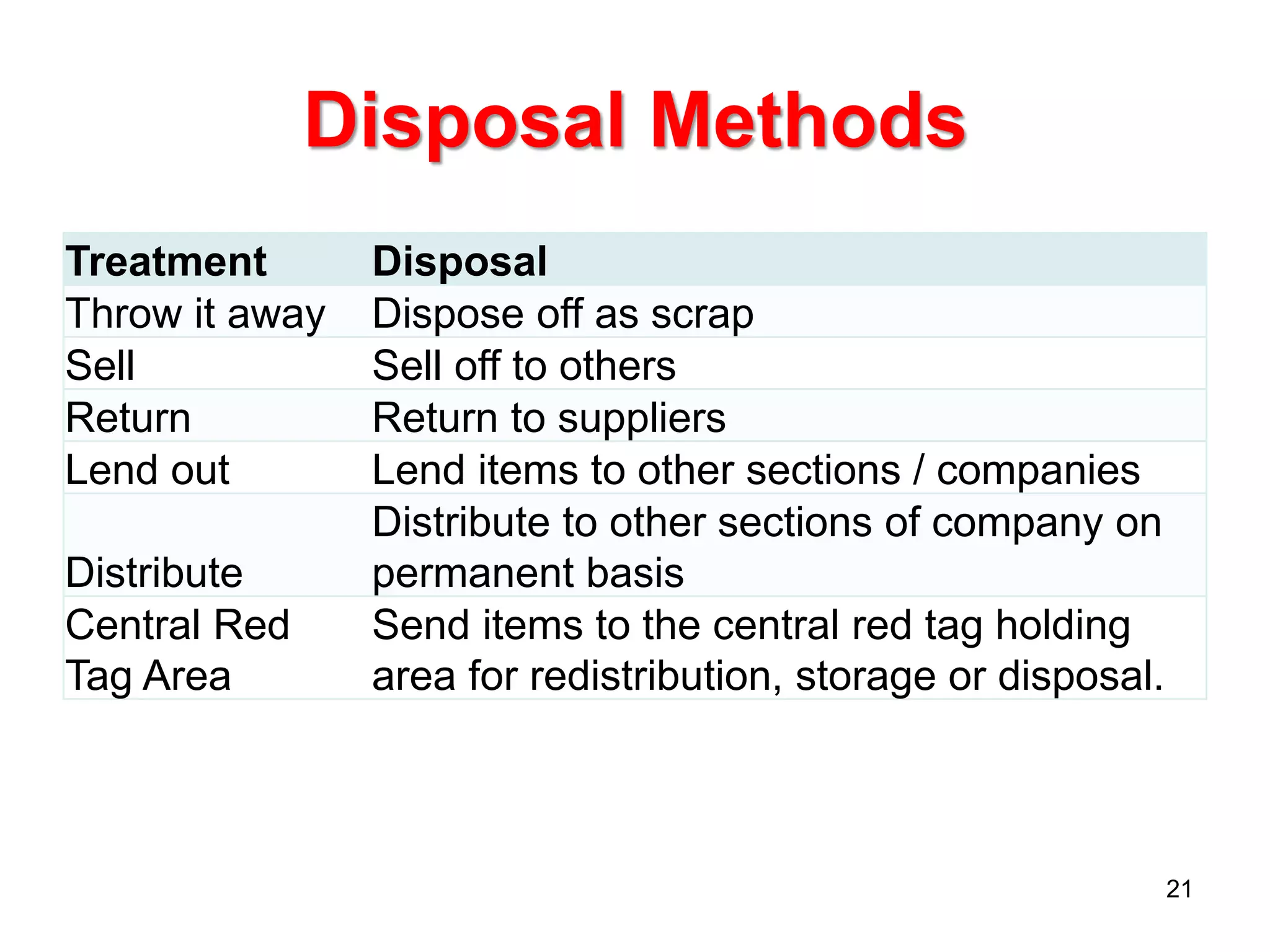
Disposal Methods
Treatment Disposal
Throw it away Dispose off as scrap
Sell Sell off to others
Return Return to suppliers
Lend out Lend items to other sections / companies
Distribute
Distribute to other sections of company on
permanent basis
Central Red
Tag Area
Send items to the central red tag holding
area for redistribution, storage or disposal.
21
Practice : 1 S
• Identify 5 S Coordinator, Zones, Zonal
Coordinators & Review Committee.
• Display area of zones, photographs of Zonal
coordinator and his team members at
appropriate place in the zone itself.
• Seek help of the Consultant
• Identify Red Tag holding area, define Red Tag,
establish criteria for Red tag & frequency.
• Do the Red Tag as planned, review & record.
• Show it to the Consultant & get assessed.
22
5M
4.5M
4M
1.3M
Toilet
2.4M
OFFICE
PRESS
12M
9
M
12M
9
M
9
M
8.5M
6
M
5M
3
M
2.5M
QA
SPOT WELDING
&
RECEIVING
6M
9
M
9
M
PACKING
W/C
W/C
W/C
21.5M
8
M
17.5M
Main
Gate
CO2 WELDING
Red Tagging Campaign
Zo
ne
No.
Zone Name
Red Tag
Found
Total
Pending
Tags
Red Tag
Found
Total
Pending
Tags
Red Tag
Found
Total
Pending
Tags
Red Tag
Found
Total
Pendin
g Tags
01 Office 16 00 04 00 05 02 4 0
02 Press 13 02 06 01 06 04 4 0
03 Co2 Welding 14 03 05 00 05 04 3 0
04 Spot Welding 12 01 03 00 04 03 4 0
05
Packing &
Disp.
14 04 03 02 03 03 3 0
06
Surrounding
Area
09 00 03 01 03 02 02 0
Total 78 10 24 04 26 18 20 0
16
13 14
12
14
9
4
6 5
3 3 3
5 6 5 4 3 3
4 4 3 4 3 2
Zone 01 Zone 02 Zone 03 Zone 04 Zone 05 Zone 06
1st 2nd 3rd 4th
Red Tagging Campaign
Zone
No.
Zone Name Red Tag Found
Red Tag
Cleared
Red Tag pending
(16 Mar 2012)
Total Pending
Tags
(Cumulative)
01 Office 3 3 00 0+2 =2
02 Press 3 3 00 0+7=7
03 Co2 Welding 3 2 01 1+7=8
04 Spot Welding 2 2 00 0+4=4
05 Packing & Disp. 5 3 02 2+9=11
06 Surrounding Area 2 1 01 1+3=4
Total 18 00 36
Meaning : To determine type of storage and layout
that will ensure easy accessibility for
everyone .
Activity : - Functional storage
- Creating place for everything and putting
everything in its place
Success Time saved in searching
Indicator : Time saved in material handling
27
SEITON : Systematic Arrangement
SEITON
• Seiton means arranging needed items so
that they are easy to use and label them
so that anyone can find.
• It helps eliminate following waste in the
workplace
– Motion waste
– Searching waste
– Waste of human energy
– Waste of excess inventory
– Waste of defective parts
– Waste of unsafe condition
28
The Good, Bad and the Ugly
First the Bad and the Ugly - Life Without 5S
Some 5S Examples
Before 5S
After 5S - Cleaned, organized and
drawers labeled (less time and
frustration hunting)
5S Examples - Sort, Set in
Order
See the difference!
1. Sort - All unneeded tools, parts and supplies are removed from the
area
2. Set in Order - A place for everything and everything is in its place
Steps to do SEITON
• Step A : Decide Appropriate Location
– Principles of storing Jigs, tools, dies
– Principles of motion economy
– 5 S Map to decide location
• Step B : Identify Location
– Signboard Strategy
– Painting Strategy
– Colour coding Strategy
– Outlining Strategy
32
How to achieve Systematic Arrangement
?
• Decide where the thing belongs
• Decide how the things should be kept
• Maintain the discipline of keeping things
at the right place
33
SEITON : Systematic Arrangement
USE :
1 ) Signboards
2) Colour Codes
3) Outline Markings
4) Labels
34
SEITON : Systematic Arrangement
Signboards
Colour Codes
Outlining
Example of Outlining
Labels
Labels
Usage
Frequency
• Store frequently used material
near the workplace and less
frequently at some distance
Weight &
Shape of the
Material
• Heavy material should be stored
at lower levels/layers
• Place directly on the material
handling device for ease of
handling
42
Seiton = Systematic Arrangement
Category
• Same category of material may
be stored in one location
e.g. Allen Screws, Oil Seals
Operation
Wise
• All items required for an
operation may be stored in one
location.
e.g. Allen key, Spanner etc. hand
tools required for setting m/c
43
The 2 S - Summary
A place for everything and
everything in its place, clean and
ready to use
• Arrange workplace for safety and efficiency
– Identify key equipment and supplies
– Determine location for each item
– Outline locations and zones
– Develop shadow boards, label items
– Document layout, equipment, supplies
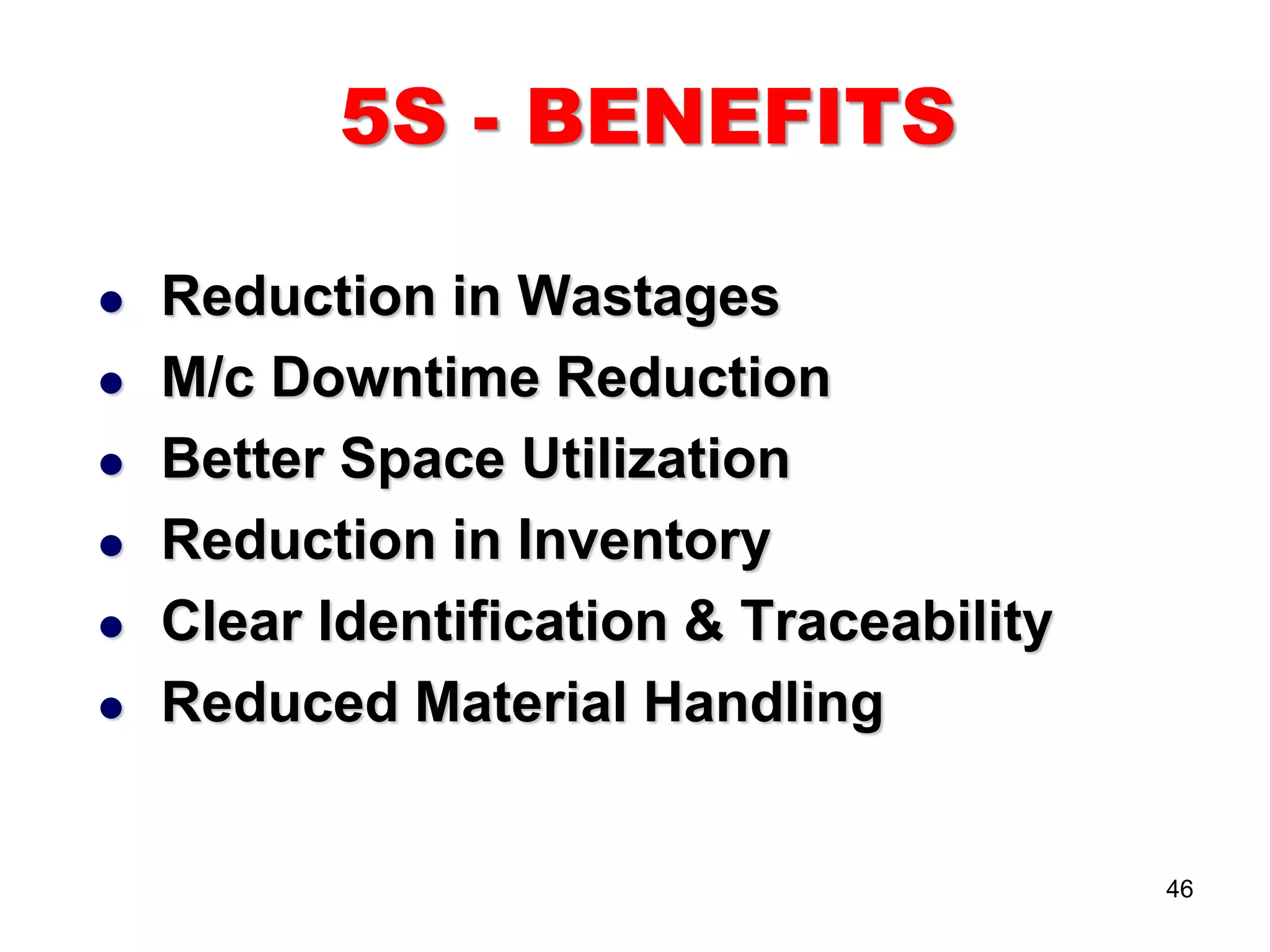
5S - BENEFITS
 Reduction in Wastages
 M/c Downtime Reduction
 Better Space Utilization
 Reduction in Inventory
 Clear Identification & Traceability
 Reduced Material Handling
46

1S 2S.pdf

  • 1.
    WELCOME TRAINING on Workplace Management -1S Vijay Khonde Lean Manufacturing Consultant
  • 2.
  • 3.
    What Are 5S? •Seiri : Sorting (Needed, Not Needed) • Seiton : Systematic Arrangement (Place for Everything & Everything in its Place) • Seiso : Cleaning & Inspection while Cleaning (Shine) • Seiketsu : Standardization (Adhering to the laid down procedures consistently) • Shitsuke : Self Discipline (Maintain) 3
  • 4.
    5S- Objectives 1. ImproveHousekeeping 2. Individual Ownership 3. Beautify by Simple Means 4. Productivity Improvement by saving time, space etc. 5. Provide foundation for continuous improvements 4
  • 5.
    5S - Principles 1.Elimination of Waste 2. Team Work 3. Attack Root Cause 4. Sustain the movement 5. Human being is not Infallible 5
  • 6.
    Meaning : Distinguishbetween necessary and unnecessary items and eliminate the unnecessary items Activity : Establish a criteria for deciding on Unwanted items Unwanted items can either be disposed off or they can be relocated Success Area saved or percentage of space available Indicator : 6 SEIRI = Sorting
  • 7.
    • Item isnot needed • Item is needed however quantity in stock is more than what is needed for consumption in the near future Seiri = Sorting What is unnecessary 7
  • 8.
    Seiri = Sorting Frequencyof use Storage Method *Things you have not used in the past one year Throw them out *Things you have used once in the last 6-12 months Store at distance OR Keep in store LOW *Things you have used only once in the last 2-6 months Store it in central place in your zone *Things used more than once a month Store it in central place in your zone HIGH *Things used once a week Store near the workplace *Things used daily or hourly Store near the workplace Organization 8
  • 9.
    Seiri = SortingIdentifying Unnecessary 1. Parts & Work in Process (WIP) • Stock of rejected items • Items accumulated over period for rework • Material awaiting disposal decision • Material brought for trial, still lying even after trial Contd.. 9
  • 10.
    Seiri = SortingIdentifying unnecessary 2. Tools, Toolings • Toolings brought for trial, Currently not in use • Worn out bushes, liners, toggles etc. Lying unattended • Broken tools, bits indisposed 3. Shelves and Lockers • Shelves and lockers tends to collect things that nobody ever uses , like surplus, broken items etc. Contd.. 10
  • 11.
    Seiri = SortingIdentifying unnecessary 4. Walls and Bulletin Boards • Old out-dated notices which have lost their relevance • Posters or bulletins on wall • Remains of torn notices, Cell tape pieces 5. Computer Hard Disk Many unwanted, outdated, temporary files pile up Contd.. 11
  • 12.
    Seiri = SortingDealing with papers How to reduce papers on your table ? 1. Make a single pile of papers 2. Go through them and sort in following categories a) Immediate action b) Low priority c) Pending d) Reading material 12
  • 13.
    FPP – FixedPoint Photography (Before & After) • Fix the views of every zone ( 1 to 3 views) • Capture picture (photo) from the same point every time • Get suggestions from zonal members & Improve the zones continuously • Capture pictures (photos) every month • Arrange the photos in chronological order • Arrange competition 13
  • 14.
    XYZ Industries -Surrounding Area Status in Jan.2012 100 Sq. M Area made free from removing unwanted material Status in Feb.2012 05.02.2012 20.01.2012 One Cutting m/c shifted in this area which was previously infront of Office Status in March 2012 Arranged Two Welding m/c in this area Status in May 2012 28.05.2012
  • 15.
    WPP – WorstPoint Pictures (Before & After) • Unsafe conditions – Excess / insufficient light – Open / loose electrical joints – Hanging wires, improper parts, accessories – No guards for M/cs, Moving parts, Elect. panels • Mixed material • Obsolete items / tools / dies / gauges / docs • Wet floor • Out of reach points for cleaning 15
  • 16.
    Steps for doingSEIRI Sr What to Do? Who Does it? 1 Identify the Coordinator CEO / Plant Head 2 Identify the Zones Plant Head / Coordinator 3 Identify the Zonal Coordinators Plant Head / Coordinator 4 Identify the Red Tags Holding area Coordinator 5 Define the Red Tag Plant Head / Coordinator 6 Establish criteria for Red Tag CEO / Plant Head 7 Establish frequency for doing Red Tag CEO / Plant Head 8 Do the Red Tag All people 9 Identify the Review committee CEO / Plant Head 10 Review the Red Tagged Items & Record Review committee 16
  • 17.
    Red Tag • Itcan be a paper tag with the following information • What is the item? • How much Qty? • Why is it removed out (damaged, excess etc. • What is the approx. value? • Section from where the item is removed? “Establish the frequency of doing the Red Tag” 17
  • 18.
  • 19.
    Criteria for RedTag • Every person asks to all the items around his / her workplace • Is this item needed? • If it is needed, is it needed in this Qty? • If it is needed, is it needed very frequently? If the answer is “NO” : Remove it from the Workplace 19
  • 20.
    Red Tag Targets RedTag Targets Types of Items Physical Areas RM, BO, WIP, Assly. parts, SFG, FG Floors, gangways, shelves, warehouses 20
  • 21.
    Disposal Methods Treatment Disposal Throwit away Dispose off as scrap Sell Sell off to others Return Return to suppliers Lend out Lend items to other sections / companies Distribute Distribute to other sections of company on permanent basis Central Red Tag Area Send items to the central red tag holding area for redistribution, storage or disposal. 21
  • 22.
    Practice : 1S • Identify 5 S Coordinator, Zones, Zonal Coordinators & Review Committee. • Display area of zones, photographs of Zonal coordinator and his team members at appropriate place in the zone itself. • Seek help of the Consultant • Identify Red Tag holding area, define Red Tag, establish criteria for Red tag & frequency. • Do the Red Tag as planned, review & record. • Show it to the Consultant & get assessed. 22
  • 24.
  • 25.
    Red Tagging Campaign Zo ne No. ZoneName Red Tag Found Total Pending Tags Red Tag Found Total Pending Tags Red Tag Found Total Pending Tags Red Tag Found Total Pendin g Tags 01 Office 16 00 04 00 05 02 4 0 02 Press 13 02 06 01 06 04 4 0 03 Co2 Welding 14 03 05 00 05 04 3 0 04 Spot Welding 12 01 03 00 04 03 4 0 05 Packing & Disp. 14 04 03 02 03 03 3 0 06 Surrounding Area 09 00 03 01 03 02 02 0 Total 78 10 24 04 26 18 20 0 16 13 14 12 14 9 4 6 5 3 3 3 5 6 5 4 3 3 4 4 3 4 3 2 Zone 01 Zone 02 Zone 03 Zone 04 Zone 05 Zone 06 1st 2nd 3rd 4th
  • 26.
    Red Tagging Campaign Zone No. ZoneName Red Tag Found Red Tag Cleared Red Tag pending (16 Mar 2012) Total Pending Tags (Cumulative) 01 Office 3 3 00 0+2 =2 02 Press 3 3 00 0+7=7 03 Co2 Welding 3 2 01 1+7=8 04 Spot Welding 2 2 00 0+4=4 05 Packing & Disp. 5 3 02 2+9=11 06 Surrounding Area 2 1 01 1+3=4 Total 18 00 36
  • 27.
    Meaning : Todetermine type of storage and layout that will ensure easy accessibility for everyone . Activity : - Functional storage - Creating place for everything and putting everything in its place Success Time saved in searching Indicator : Time saved in material handling 27 SEITON : Systematic Arrangement
  • 28.
    SEITON • Seiton meansarranging needed items so that they are easy to use and label them so that anyone can find. • It helps eliminate following waste in the workplace – Motion waste – Searching waste – Waste of human energy – Waste of excess inventory – Waste of defective parts – Waste of unsafe condition 28
  • 29.
    The Good, Badand the Ugly First the Bad and the Ugly - Life Without 5S
  • 30.
    Some 5S Examples Before5S After 5S - Cleaned, organized and drawers labeled (less time and frustration hunting)
  • 31.
    5S Examples -Sort, Set in Order See the difference! 1. Sort - All unneeded tools, parts and supplies are removed from the area 2. Set in Order - A place for everything and everything is in its place
  • 32.
    Steps to doSEITON • Step A : Decide Appropriate Location – Principles of storing Jigs, tools, dies – Principles of motion economy – 5 S Map to decide location • Step B : Identify Location – Signboard Strategy – Painting Strategy – Colour coding Strategy – Outlining Strategy 32
  • 33.
    How to achieveSystematic Arrangement ? • Decide where the thing belongs • Decide how the things should be kept • Maintain the discipline of keeping things at the right place 33 SEITON : Systematic Arrangement
  • 34.
    USE : 1 )Signboards 2) Colour Codes 3) Outline Markings 4) Labels 34 SEITON : Systematic Arrangement
  • 35.
  • 36.
  • 37.
  • 38.
  • 39.
  • 40.
  • 41.
  • 42.
    Usage Frequency • Store frequentlyused material near the workplace and less frequently at some distance Weight & Shape of the Material • Heavy material should be stored at lower levels/layers • Place directly on the material handling device for ease of handling 42 Seiton = Systematic Arrangement
  • 43.
    Seiton = SystematicArrangement Category • Same category of material may be stored in one location e.g. Allen Screws, Oil Seals Operation Wise • All items required for an operation may be stored in one location. e.g. Allen key, Spanner etc. hand tools required for setting m/c 43
  • 44.
    The 2 S- Summary A place for everything and everything in its place, clean and ready to use • Arrange workplace for safety and efficiency – Identify key equipment and supplies – Determine location for each item – Outline locations and zones – Develop shadow boards, label items – Document layout, equipment, supplies
  • 46.
    5S - BENEFITS Reduction in Wastages  M/c Downtime Reduction  Better Space Utilization  Reduction in Inventory  Clear Identification & Traceability  Reduced Material Handling 46