Presented By- Krishna Heda Value Stream Mapping
VSM is Used in Helping to Identify the 8 Types of Waste Over Production Inventory Transportation Waiting Motion Over Processing Correction Not Utilizing Human Resources
To be successful, a  Total System Strategy  must be employed.  The Total System Strategy is facilitated by committed leadership, knowledge, an effective planning process and a bias towards action.  Total System Strategy Flow Flow Operational Availability Workplace Organization Material Movement Employee  Environment  & Involvement Quality Flow Manufacturing (MSD) Waste Elimination Leadership Planning  Knowledge  Action  Flow Flow
Objectives Provide an Introduction to Value Stream Mapping Complete a Current State Value Stream Map Complete a Future State Value Stream Map with proposed Implementation Plan
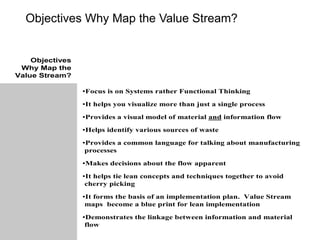
Objectives Why Map the Value Stream?
Introduction to Value Stream Mapping Data Collection Map Current State Activity:  Map Current State Review Current State Map Design Future State - Purpose Map Future State Consider Key Questions Summary Activity:  Design Future State Agenda Session 1 Session 2
Introduction to Value Stream Mapping Data Collection Map Current State Activity:  Map Current State Agenda - Session 1
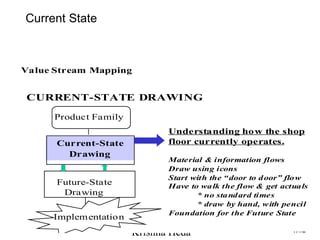
Current State
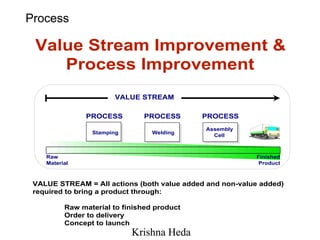
Process
Introduction to Value Stream Mapping A  Value Stream  includes all elements (both value and non-value added) that occur to a given product from its inception as a raw material through delivery to the customer. Definition of Value Stream
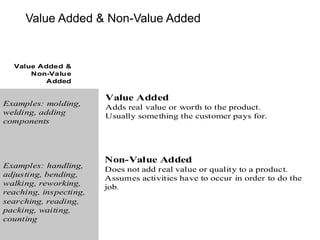
Value Added & Non-Value Added
Waste
Provide a means of visualizing product and information flow for the value stream  Facilitate the identification and elimination of waste and the sources of waste  Support the prioritization of continuous improvement activities at the plant and value stream levels Provide the basis for site plan development Objectives of Value Stream Mapping Eliminate  Waste Introduction to Value Stream Mapping
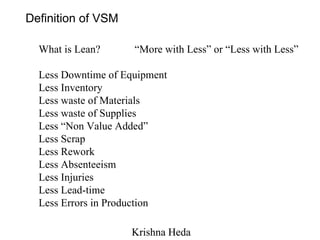
Definition of VSM What is Lean? “More with Less” or “Less with Less” Less Downtime of Equipment Less Inventory Less waste of Materials Less waste of Supplies Less “Non Value Added” Less Scrap Less Rework Less Absenteeism Less Injuries Less Lead-time Less Errors in Production
Indications of Opportunities EMPLOYEE SYMPTOMS *  Frustration *  Low Morale *  Absenteeism *  Negativism *  “It’s Not My Job” EXTERNAL INDICATORS *  Warranty Costs *  Negative Publicity *  Pricing Inflexibility *  Market Share Drop
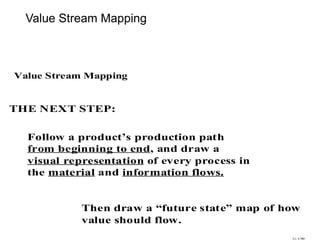
Value Stream Mapping
Attribute Data to Collect Data Collection How Operations are scheduled Shipping/Receiving schedules Pack sizes at each process Demand rates by process (Takt Time) Working hours and breaks Inventory Points (location & size) Work-in-process inventory Overtime per week Process cycle times Number of product variations at each step  Batch (lot) sizes Changeover times Changeover  frequencies Scrap Rework Downtime
It is not necessary that attribute data be precise.  It is necessary that the information at least be directionally correct.  Knowing that uptime is 82.7% vs. 82% is normally not necessary.  An assumption of 80%, however, when reality is 65% can be detrimental in that it may substantially misdirect the future state development and the prioritization of improvement activities. Data Collection
Identify Opportunities for Improvement ? Data Collection
 Introduction to Value Value Stream Mapping  Data Collection Map Current State Activity:  Map Current State Agenda - Session 1
Map Current State The Steps Select a Product Family Form a Team Understand Customer Demand Map the Process Flow Map the Material Flow Map the Information Flow Calculate Total Product Cycle Time Detail Off-Line Activities Step 1: Step 2: Step 3: Step 4: Step 5: Step 6: Step 7: Step 8:
Tools Introduction to Value Stream Mapping Scrap Manufacturing  Process Kaizen  Lightning  Burst Outside Source/ Customer Data Box Inventory I o  o o Truck Shipment Finished Goods to Customer Push Arrow Supermarket Buffer or Safety Stock Manual  Information Flow Electronic Information Flow Production Kanban Withdrawal Kanban Signal Kanban Kanban Post
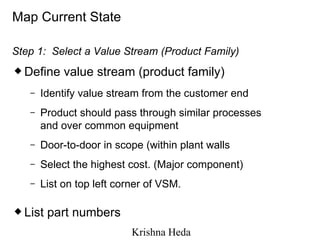
Define value stream (product family) Identify value stream from the customer end Product should pass through similar processes and over common equipment Door-to-door in scope (within plant walls Select the highest cost. (Major component) List on top left corner of VSM. List part numbers Map Current State Step 1:  Select a Value Stream (Product Family)
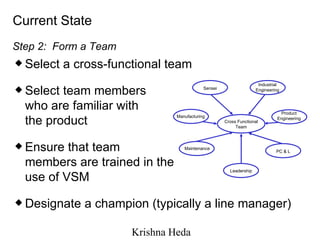
Select a cross-functional team Select team members  who are familiar with the product Ensure that team members are trained in the use of VSM Designate a champion (typically a line manager) Current State Step 2:  Form a Team  Cross Functional Team Manufacturing PC & L Maintenance Leadership Product Engineering Industrial Engineering Sensei
Plan for Every Part Industrial Engineering budgeted volumes Production Control  (monthly/weekly forecasts) Production history (day-to-day, month-to-month variation) Sales (product changes, new business etc.)  Map Current State Step 3:  Understand Customer Demand Customer Demand/month: Part A = Part B = Part C = # of shifts =
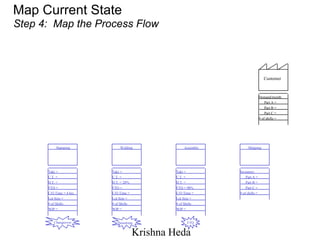
Customer Map Current State Step 4:  Map the Process Flow Demand/month: Part A = Part B = Part C = # of shifts = Inventory Part A = Part B = Part C = # of shifts = Shipping Assembly Welding Stamping Takt = C.T. = D.T. = FTQ = 90% C/O Time = Lot Size = # of Shifts WIP = Takt = C.T. = D.T. = 20% FTQ = C/O Time = Lot Size = # of Shifts WIP = Takt = C.T. = D.T. =  FTQ = C/O Time = 4 hrs. Lot Size = # of Shifts WIP = Changeover Downtime FTQ
Map Current State Step 6:  Map the Information Flow Customer Demand/month: Part A = 705 pcs. Part B = 600 pcs. Part C = 1650 pcs. # of shifts = Inventory Part A = 750 pcs Part B = 600 pcs Part C = 1650 pcs # of shifts = Shipping Assembly Welding Stamping Takt = C.T. = D.T. = FTQ = 90% C/O Time = Lot Size = # of Shifts WIP = 550 pcs. Takt = C.T. = D.T. = 20% FTQ = C/O Time = Lot Size = # of Shifts WIP = 60 pcs. Takt = C.T. = D.T. =  FTQ = C/O Time = 4 hrs. Lot Size = # of Shifts WIP = 25 pcs. Changeover Downtime FTQ I I I I 2 x/ day 2 x/ week Supplier 1,200 pcs 1,500 pcs 800 pcs 500 pcs PC & L Weekly Build Schedule Daily Ship Schedule 6 week rolling forecast 6 week rolling forecast Weekly Order Weekly Order
Map Current State Step 7:  Calculate Total Product Cycle Time Customer Demand/month: Part A = 705 pcs. Part B = 600 pcs. Part C = 1650 pcs. # of shifts = Inventory Part A = 750 pcs Part B = 600 pcs Part C = 1650 pcs # of shifts = Shipping Assembly Welding Stamping Takt = C.T. = D.T. = FTQ = 90% C/O Time = Lot Size = # of Shifts WIP = 550 pcs. Takt = C.T. = D.T. = 20% FTQ = C/O Time = Lot Size = # of Shifts WIP = 60 pcs. Takt = C.T. = D.T. =  FTQ = C/O Time = 4 hrs. Lot Size = # of Shifts WIP = 25 pcs. Changeover Downtime FTQ I I I I 2 x/ day 2 x/ week Supplier 1,200 pcs 1,500 pcs 800 pcs 500 pcs PC & L Weekly Build Schedule Daily Ship Schedule 6 week rolling forecast 6 week rolling forecast Weekly Order Weekly Order .27 days .17 days .4 days .5 days 1.0 days .18 days .02 days .008 days TPc/t = 2.5 days
Current State
Step 8:  Detail Off-Line Activities Map Current State Show on the map using general icons  Detail out on another sheet using either reference VSM and/or process flow-charting I Dies Die Room Receiving Die Room Shipping (Remove from Schedule Board) Die Bench I Dies 2 shifts 12 shifts Schedule Board (Forecast) Fork Truck Press Room
 Introduction to Value Value Stream Mapping  Data Collection  Map Current State Activity:  Map Current State Agenda - Session 1
Activity:  Map the Current State Complete By Task Approximate Total Time: Complete  draft  of current state value stream map. Review draft and identify open issues. Resolve open issues.  Complete  current state value stream map. Session 2   Review current state value stream map.
 Introduction to Value Stream Mapping  Data Collection  Map Current State  Activity:  Map Current State Review Current State Map Design Future State - Purpose Map Future State Consider Key Questions Summary Activity:  Design Future State Agenda Session 1 Session 2
 Review Current State Map Design Future State - Purpose Map Future State Consider Key Questions Summary Activity:  Design Future State Agenda - Session 2
Define how the plant will operate in the future Serve as the blueprint for implementation Design Future State - Purpose Purpose
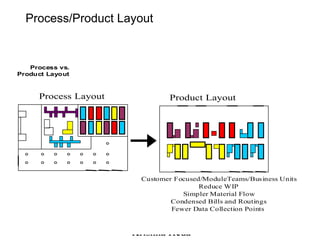
Process/Product Layout
How to Think
Efficiency
 Review Current State Map  Design Future State - Purpose Map Future State Consider Key Questions Summary Activity:  Design Future State Agenda - Session 2
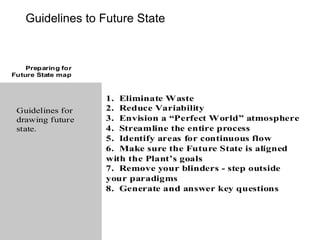
Guidelines to Future State
Achieving The Future State
Pacemaker Loop
Identify the Pacemaker
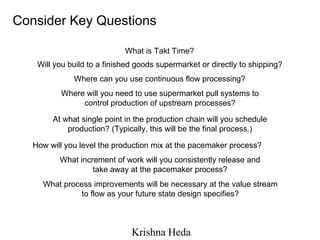
Where will you need to use supermarket pull systems to control production of upstream processes? What is Takt Time? Will you build to a finished goods supermarket or directly to shipping? Where can you use continuous flow processing? At what single point in the production chain will you schedule production? (Typically, this will be the final process.) How will you level the production mix at the pacemaker process? What increment of work will you consistently release and take away at the pacemaker process? What process improvements will be necessary at the value stream to flow as your future state design specifies? Consider Key Questions
Develop A Plan
Future State
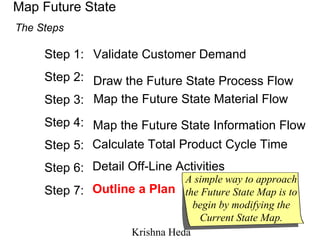
Map Future State Step 1: Step 2: Step 3: Step 4: Step 5: Step 6: Step 7: The Steps Validate Customer Demand Draw the Future State Process Flow Map the Future State Material Flow Map the Future State Information Flow Calculate Total Product Cycle Time Detail Off-Line Activities Outline a Plan A simple way to approach the Future State Map is to begin by modifying the Current State Map.
Map Future State Customer demand should be validated to ensure accuracy and that consideration has been given for future business.  Step 1:  Validate Customer Demand X pcs / month Std Pack Qty # Shifts Customer
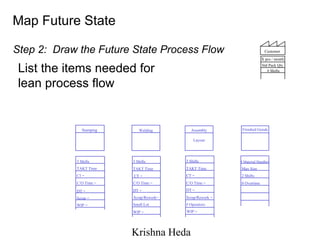
Map Future State Finished Goods Assembly Layout Welding Stamping X pcs / month Std Pack Qty # Shifts C/O Time = CT = TAKT Time 3 Shifts DT = Scrap = 0 Overtime 2 Shifts Max Size # Material Handlers C/O Time = CT = TAKT Time 3 Shifts DT = Scrap/Rework = C/O Time = CT = TAKT Time 3 Shifts DT = Scrap/Rework= Small Lot # Operators WIP = WIP = WIP = Customer Step 2:  Draw the Future State Process Flow List the items needed for  lean process flow
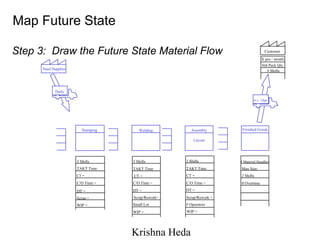
Map Future State Finished Goods Assembly Layout Welding 6 x / Day Daily Stamping X pcs / month Std Pack Qty # Shifts C/O Time = CT = TAKT Time 3 Shifts DT = Scrap = 0 Overtime 2 Shifts Max Size # Material Handlers C/O Time = CT = TAKT Time 3 Shifts DT = Scrap/Rework = C/O Time = CT = TAKT Time 3 Shifts DT = Scrap/Rework= Small Lot # Operators WIP = WIP = WIP = Customer Steel Supplier Step 3:  Draw the Future State Material Flow
Map Future State Rolling 6 wk Forecast Finished Goods Assembly Layout Welding 6 x / Day PC & L 6-wk forecast Daily Level Box DA1 DA2 DA3 Stamping X pcs / month Std Pack Qty # Shifts Weekly Order C/O Time = CT = TAKT Time 3 Shifts DT = Scrap = 0 Overtime 2 Shifts Max Size # Material Handlers C/O Time = CT = TAKT Time 3 Shifts DT = Scrap/Rework = C/O Time = CT = TAKT Time 3 Shifts DT = Scrap/Rework= Small Lot # Operators WIP = WIP = WIP = Customer Step 4:  Draw the Future State Informational Flow Steel Supplier
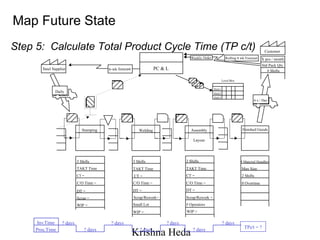
Step 5:  Calculate Total Product Cycle Time (TP c/t) Map Future State Rolling 6 wk Forecast Finished Goods Assembly Layout Welding 6 x / Day PC & L 6-wk forecast Daily Level Box DA1 DA2 DA3 Stamping X pcs / month Std Pack Qty # Shifts Weekly Order C/O Time = CT = TAKT Time 3 Shifts DT = Scrap = 0 Overtime 2 Shifts Max Size # Material Handlers C/O Time = CT = TAKT Time 3 Shifts DT = Scrap/Rework = C/O Time = CT = TAKT Time 3 Shifts DT = Scrap/Rework= Small Lot # Operators WIP = WIP = WIP = Inv .Time Proc .Time TPc /t = ? ? days ? days ? days ? days ? days ? days ? days Customer Steel Supplier
Step 6:  Detail Off-Line Activities Map Future State Consideration should be given at this stage for the improvement of off-line activities. In many cases, these changes will be necessary to sustain improvements in flow.
Original Condition Step7:  Outline a Plan Map Future State Future Condition Inj: Molding 2 Sender Ass’y 2 MSS Ass’y Plants 7 Stamping 10 Tank Ass’y 4 Perform to TAKT & Pitch. Produce to Order Load Leveling and Pull Zone Maintenance & Fast Response Labels Level ABABA. . . Staging by Truck card by card (Pitch = 14 Units) 1ST 2ND 3RD 4TH 1ST 2ND 3RD 4TH Establish TAKT & Flow in Tank Ass'y Stamping Changeover Reduction Reduce Stamping Buffer Move Ass'y to Plant 10 Establish TAKT & Flow in Sender Ass'y Pull To Sender Ass'y Training 1999 2000 Activity Inj: Molding 2 Sender Ass’y 2 MSS Tank Ass’y Stamping Fuel Pump Ass’y I I I I I I Ass’y Plants 2 12 10 4 Cycle-Time Driven. Batches. Change Over Change Over No Flow Attendance No Flow Uptime Item Current Target Total  product cycle time Parts / Person Hour Delivery Performance Inventory (days) Overtime Uptime METRICS
Linkage to Improvement Workplace Organization 5S Deploy Visual Controls Layout Waste free - Eliminate waste thru Continuous Improvement Deploy and maintain appropriate Kanbans Uninterrupted flow Error Free Processing Insignificant Changeover
 Review Current State Map  Design Future State - Purpose  Map Future State Consider Key Questions Summary Activity:  Design Future State Agenda - Session 2
Data is analyzed to  determine  waste (inhibitors to flow). Plans are developed to reduce or eliminate  waste.  What process improvement are necessary for the  value stream to flow as your future state design specifies? This step is key to any successful value stream improvement activities. Consider Key Questions This is the step where we can most impact the bottom line.
Eliminate Waste Consider Key Questions Flow Manufacturing 1 Piece Flow,  Employee Involvement Empowered, Continuous Imp.  Workplace Organization Std. Work, 5S, EH&S Quality RRCA,  Process Certification Roadmap Operational SMED, TPM, MP  Material Movement FIFO, Pull System
 Review Current State Map  Design Future State - Purpose  Map Future State  Consider Key Questions Summary Activity:  Design Future State Agenda - Session 2
Summary Getting Started Be Wise… Observe…it is necessary to physically observe the value stream.  This provides the greatest opportunity to identify and eliminate waste. Be Persistent... Value stream mapping is an iterative process. Todays future state is tomorrows current state.  This is what continuous improvement is all about.
Is the Time NOW
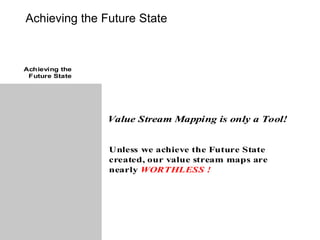
Achieving the Future State
Activity:  Design Future State Task Using the current state map for your selected value stream, design your future state. Outline a plan. Review future state design and plan. Approximate Total Time:
Activity:  Map the Future State Complete By Task Approximate Total Time: Complete  draft  of future state value stream map. Review draft and identify open issues. Resolve open issues.  Complete  future state value stream map. Complete “Action Plan.” Follow-up 90 days for 75% completion

Value stream mapping - Future State

  • 1.
    Presented By- KrishnaHeda Value Stream Mapping
  • 2.
    VSM is Usedin Helping to Identify the 8 Types of Waste Over Production Inventory Transportation Waiting Motion Over Processing Correction Not Utilizing Human Resources
  • 3.
    To be successful,a Total System Strategy must be employed. The Total System Strategy is facilitated by committed leadership, knowledge, an effective planning process and a bias towards action. Total System Strategy Flow Flow Operational Availability Workplace Organization Material Movement Employee Environment & Involvement Quality Flow Manufacturing (MSD) Waste Elimination Leadership Planning Knowledge Action Flow Flow
  • 4.
    Objectives Provide anIntroduction to Value Stream Mapping Complete a Current State Value Stream Map Complete a Future State Value Stream Map with proposed Implementation Plan
  • 5.
    Objectives Why Mapthe Value Stream?
  • 6.
    Introduction to ValueStream Mapping Data Collection Map Current State Activity: Map Current State Review Current State Map Design Future State - Purpose Map Future State Consider Key Questions Summary Activity: Design Future State Agenda Session 1 Session 2
  • 7.
    Introduction to ValueStream Mapping Data Collection Map Current State Activity: Map Current State Agenda - Session 1
  • 8.
  • 9.
  • 10.
    Introduction to ValueStream Mapping A Value Stream includes all elements (both value and non-value added) that occur to a given product from its inception as a raw material through delivery to the customer. Definition of Value Stream
  • 11.
    Value Added &Non-Value Added
  • 12.
  • 13.
    Provide a meansof visualizing product and information flow for the value stream Facilitate the identification and elimination of waste and the sources of waste Support the prioritization of continuous improvement activities at the plant and value stream levels Provide the basis for site plan development Objectives of Value Stream Mapping Eliminate Waste Introduction to Value Stream Mapping
  • 14.
    Definition of VSMWhat is Lean? “More with Less” or “Less with Less” Less Downtime of Equipment Less Inventory Less waste of Materials Less waste of Supplies Less “Non Value Added” Less Scrap Less Rework Less Absenteeism Less Injuries Less Lead-time Less Errors in Production
  • 15.
    Indications of OpportunitiesEMPLOYEE SYMPTOMS * Frustration * Low Morale * Absenteeism * Negativism * “It’s Not My Job” EXTERNAL INDICATORS * Warranty Costs * Negative Publicity * Pricing Inflexibility * Market Share Drop
  • 16.
  • 17.
    Attribute Data toCollect Data Collection How Operations are scheduled Shipping/Receiving schedules Pack sizes at each process Demand rates by process (Takt Time) Working hours and breaks Inventory Points (location & size) Work-in-process inventory Overtime per week Process cycle times Number of product variations at each step Batch (lot) sizes Changeover times Changeover frequencies Scrap Rework Downtime
  • 18.
    It is notnecessary that attribute data be precise. It is necessary that the information at least be directionally correct. Knowing that uptime is 82.7% vs. 82% is normally not necessary. An assumption of 80%, however, when reality is 65% can be detrimental in that it may substantially misdirect the future state development and the prioritization of improvement activities. Data Collection
  • 19.
    Identify Opportunities forImprovement ? Data Collection
  • 20.
     Introduction toValue Value Stream Mapping  Data Collection Map Current State Activity: Map Current State Agenda - Session 1
  • 21.
    Map Current StateThe Steps Select a Product Family Form a Team Understand Customer Demand Map the Process Flow Map the Material Flow Map the Information Flow Calculate Total Product Cycle Time Detail Off-Line Activities Step 1: Step 2: Step 3: Step 4: Step 5: Step 6: Step 7: Step 8:
  • 22.
    Tools Introduction toValue Stream Mapping Scrap Manufacturing Process Kaizen Lightning Burst Outside Source/ Customer Data Box Inventory I o o o Truck Shipment Finished Goods to Customer Push Arrow Supermarket Buffer or Safety Stock Manual Information Flow Electronic Information Flow Production Kanban Withdrawal Kanban Signal Kanban Kanban Post
  • 23.
    Define value stream(product family) Identify value stream from the customer end Product should pass through similar processes and over common equipment Door-to-door in scope (within plant walls Select the highest cost. (Major component) List on top left corner of VSM. List part numbers Map Current State Step 1: Select a Value Stream (Product Family)
  • 24.
    Select a cross-functionalteam Select team members who are familiar with the product Ensure that team members are trained in the use of VSM Designate a champion (typically a line manager) Current State Step 2: Form a Team Cross Functional Team Manufacturing PC & L Maintenance Leadership Product Engineering Industrial Engineering Sensei
  • 25.
    Plan for EveryPart Industrial Engineering budgeted volumes Production Control (monthly/weekly forecasts) Production history (day-to-day, month-to-month variation) Sales (product changes, new business etc.) Map Current State Step 3: Understand Customer Demand Customer Demand/month: Part A = Part B = Part C = # of shifts =
  • 26.
    Customer Map CurrentState Step 4: Map the Process Flow Demand/month: Part A = Part B = Part C = # of shifts = Inventory Part A = Part B = Part C = # of shifts = Shipping Assembly Welding Stamping Takt = C.T. = D.T. = FTQ = 90% C/O Time = Lot Size = # of Shifts WIP = Takt = C.T. = D.T. = 20% FTQ = C/O Time = Lot Size = # of Shifts WIP = Takt = C.T. = D.T. = FTQ = C/O Time = 4 hrs. Lot Size = # of Shifts WIP = Changeover Downtime FTQ
  • 27.
    Map Current StateStep 6: Map the Information Flow Customer Demand/month: Part A = 705 pcs. Part B = 600 pcs. Part C = 1650 pcs. # of shifts = Inventory Part A = 750 pcs Part B = 600 pcs Part C = 1650 pcs # of shifts = Shipping Assembly Welding Stamping Takt = C.T. = D.T. = FTQ = 90% C/O Time = Lot Size = # of Shifts WIP = 550 pcs. Takt = C.T. = D.T. = 20% FTQ = C/O Time = Lot Size = # of Shifts WIP = 60 pcs. Takt = C.T. = D.T. = FTQ = C/O Time = 4 hrs. Lot Size = # of Shifts WIP = 25 pcs. Changeover Downtime FTQ I I I I 2 x/ day 2 x/ week Supplier 1,200 pcs 1,500 pcs 800 pcs 500 pcs PC & L Weekly Build Schedule Daily Ship Schedule 6 week rolling forecast 6 week rolling forecast Weekly Order Weekly Order
  • 28.
    Map Current StateStep 7: Calculate Total Product Cycle Time Customer Demand/month: Part A = 705 pcs. Part B = 600 pcs. Part C = 1650 pcs. # of shifts = Inventory Part A = 750 pcs Part B = 600 pcs Part C = 1650 pcs # of shifts = Shipping Assembly Welding Stamping Takt = C.T. = D.T. = FTQ = 90% C/O Time = Lot Size = # of Shifts WIP = 550 pcs. Takt = C.T. = D.T. = 20% FTQ = C/O Time = Lot Size = # of Shifts WIP = 60 pcs. Takt = C.T. = D.T. = FTQ = C/O Time = 4 hrs. Lot Size = # of Shifts WIP = 25 pcs. Changeover Downtime FTQ I I I I 2 x/ day 2 x/ week Supplier 1,200 pcs 1,500 pcs 800 pcs 500 pcs PC & L Weekly Build Schedule Daily Ship Schedule 6 week rolling forecast 6 week rolling forecast Weekly Order Weekly Order .27 days .17 days .4 days .5 days 1.0 days .18 days .02 days .008 days TPc/t = 2.5 days
  • 29.
  • 30.
    Step 8: Detail Off-Line Activities Map Current State Show on the map using general icons Detail out on another sheet using either reference VSM and/or process flow-charting I Dies Die Room Receiving Die Room Shipping (Remove from Schedule Board) Die Bench I Dies 2 shifts 12 shifts Schedule Board (Forecast) Fork Truck Press Room
  • 31.
     Introduction toValue Value Stream Mapping  Data Collection  Map Current State Activity: Map Current State Agenda - Session 1
  • 32.
    Activity: Mapthe Current State Complete By Task Approximate Total Time: Complete draft of current state value stream map. Review draft and identify open issues. Resolve open issues. Complete current state value stream map. Session 2 Review current state value stream map.
  • 33.
     Introduction toValue Stream Mapping  Data Collection  Map Current State  Activity: Map Current State Review Current State Map Design Future State - Purpose Map Future State Consider Key Questions Summary Activity: Design Future State Agenda Session 1 Session 2
  • 34.
     Review CurrentState Map Design Future State - Purpose Map Future State Consider Key Questions Summary Activity: Design Future State Agenda - Session 2
  • 35.
    Define how theplant will operate in the future Serve as the blueprint for implementation Design Future State - Purpose Purpose
  • 36.
  • 37.
  • 38.
  • 39.
     Review CurrentState Map  Design Future State - Purpose Map Future State Consider Key Questions Summary Activity: Design Future State Agenda - Session 2
  • 40.
  • 41.
  • 42.
  • 43.
  • 44.
    Where will youneed to use supermarket pull systems to control production of upstream processes? What is Takt Time? Will you build to a finished goods supermarket or directly to shipping? Where can you use continuous flow processing? At what single point in the production chain will you schedule production? (Typically, this will be the final process.) How will you level the production mix at the pacemaker process? What increment of work will you consistently release and take away at the pacemaker process? What process improvements will be necessary at the value stream to flow as your future state design specifies? Consider Key Questions
  • 45.
  • 46.
  • 47.
    Map Future StateStep 1: Step 2: Step 3: Step 4: Step 5: Step 6: Step 7: The Steps Validate Customer Demand Draw the Future State Process Flow Map the Future State Material Flow Map the Future State Information Flow Calculate Total Product Cycle Time Detail Off-Line Activities Outline a Plan A simple way to approach the Future State Map is to begin by modifying the Current State Map.
  • 48.
    Map Future StateCustomer demand should be validated to ensure accuracy and that consideration has been given for future business. Step 1: Validate Customer Demand X pcs / month Std Pack Qty # Shifts Customer
  • 49.
    Map Future StateFinished Goods Assembly Layout Welding Stamping X pcs / month Std Pack Qty # Shifts C/O Time = CT = TAKT Time 3 Shifts DT = Scrap = 0 Overtime 2 Shifts Max Size # Material Handlers C/O Time = CT = TAKT Time 3 Shifts DT = Scrap/Rework = C/O Time = CT = TAKT Time 3 Shifts DT = Scrap/Rework= Small Lot # Operators WIP = WIP = WIP = Customer Step 2: Draw the Future State Process Flow List the items needed for lean process flow
  • 50.
    Map Future StateFinished Goods Assembly Layout Welding 6 x / Day Daily Stamping X pcs / month Std Pack Qty # Shifts C/O Time = CT = TAKT Time 3 Shifts DT = Scrap = 0 Overtime 2 Shifts Max Size # Material Handlers C/O Time = CT = TAKT Time 3 Shifts DT = Scrap/Rework = C/O Time = CT = TAKT Time 3 Shifts DT = Scrap/Rework= Small Lot # Operators WIP = WIP = WIP = Customer Steel Supplier Step 3: Draw the Future State Material Flow
  • 51.
    Map Future StateRolling 6 wk Forecast Finished Goods Assembly Layout Welding 6 x / Day PC & L 6-wk forecast Daily Level Box DA1 DA2 DA3 Stamping X pcs / month Std Pack Qty # Shifts Weekly Order C/O Time = CT = TAKT Time 3 Shifts DT = Scrap = 0 Overtime 2 Shifts Max Size # Material Handlers C/O Time = CT = TAKT Time 3 Shifts DT = Scrap/Rework = C/O Time = CT = TAKT Time 3 Shifts DT = Scrap/Rework= Small Lot # Operators WIP = WIP = WIP = Customer Step 4: Draw the Future State Informational Flow Steel Supplier
  • 52.
    Step 5: Calculate Total Product Cycle Time (TP c/t) Map Future State Rolling 6 wk Forecast Finished Goods Assembly Layout Welding 6 x / Day PC & L 6-wk forecast Daily Level Box DA1 DA2 DA3 Stamping X pcs / month Std Pack Qty # Shifts Weekly Order C/O Time = CT = TAKT Time 3 Shifts DT = Scrap = 0 Overtime 2 Shifts Max Size # Material Handlers C/O Time = CT = TAKT Time 3 Shifts DT = Scrap/Rework = C/O Time = CT = TAKT Time 3 Shifts DT = Scrap/Rework= Small Lot # Operators WIP = WIP = WIP = Inv .Time Proc .Time TPc /t = ? ? days ? days ? days ? days ? days ? days ? days Customer Steel Supplier
  • 53.
    Step 6: Detail Off-Line Activities Map Future State Consideration should be given at this stage for the improvement of off-line activities. In many cases, these changes will be necessary to sustain improvements in flow.
  • 54.
    Original Condition Step7: Outline a Plan Map Future State Future Condition Inj: Molding 2 Sender Ass’y 2 MSS Ass’y Plants 7 Stamping 10 Tank Ass’y 4 Perform to TAKT & Pitch. Produce to Order Load Leveling and Pull Zone Maintenance & Fast Response Labels Level ABABA. . . Staging by Truck card by card (Pitch = 14 Units) 1ST 2ND 3RD 4TH 1ST 2ND 3RD 4TH Establish TAKT & Flow in Tank Ass'y Stamping Changeover Reduction Reduce Stamping Buffer Move Ass'y to Plant 10 Establish TAKT & Flow in Sender Ass'y Pull To Sender Ass'y Training 1999 2000 Activity Inj: Molding 2 Sender Ass’y 2 MSS Tank Ass’y Stamping Fuel Pump Ass’y I I I I I I Ass’y Plants 2 12 10 4 Cycle-Time Driven. Batches. Change Over Change Over No Flow Attendance No Flow Uptime Item Current Target Total product cycle time Parts / Person Hour Delivery Performance Inventory (days) Overtime Uptime METRICS
  • 55.
    Linkage to ImprovementWorkplace Organization 5S Deploy Visual Controls Layout Waste free - Eliminate waste thru Continuous Improvement Deploy and maintain appropriate Kanbans Uninterrupted flow Error Free Processing Insignificant Changeover
  • 56.
     Review CurrentState Map  Design Future State - Purpose  Map Future State Consider Key Questions Summary Activity: Design Future State Agenda - Session 2
  • 57.
    Data is analyzedto determine waste (inhibitors to flow). Plans are developed to reduce or eliminate waste. What process improvement are necessary for the value stream to flow as your future state design specifies? This step is key to any successful value stream improvement activities. Consider Key Questions This is the step where we can most impact the bottom line.
  • 58.
    Eliminate Waste ConsiderKey Questions Flow Manufacturing 1 Piece Flow, Employee Involvement Empowered, Continuous Imp. Workplace Organization Std. Work, 5S, EH&S Quality RRCA, Process Certification Roadmap Operational SMED, TPM, MP Material Movement FIFO, Pull System
  • 59.
     Review CurrentState Map  Design Future State - Purpose  Map Future State  Consider Key Questions Summary Activity: Design Future State Agenda - Session 2
  • 60.
    Summary Getting StartedBe Wise… Observe…it is necessary to physically observe the value stream. This provides the greatest opportunity to identify and eliminate waste. Be Persistent... Value stream mapping is an iterative process. Todays future state is tomorrows current state. This is what continuous improvement is all about.
  • 61.
  • 62.
  • 63.
    Activity: DesignFuture State Task Using the current state map for your selected value stream, design your future state. Outline a plan. Review future state design and plan. Approximate Total Time:
  • 64.
    Activity: Mapthe Future State Complete By Task Approximate Total Time: Complete draft of future state value stream map. Review draft and identify open issues. Resolve open issues. Complete future state value stream map. Complete “Action Plan.” Follow-up 90 days for 75% completion

Editor's Notes

  • #2 1999 Delphi Automotive Systems DMS Overview - Instructor Manual - Version 1.0 Page Arial 12 Sub-bullet Next Sub-bullet Last Sub-bullet
  • #3 1999 Delphi Automotive Systems DMS Overview - Instructor Manual - Version 1.0 Page Arial 12 Sub-bullet Next Sub-bullet Last Sub-bullet
  • #4 1999 Delphi Automotive Systems DMS Overview - Instructor Manual - Version 1.0 Page Explain that DMS is a Total System Strategy and that committed leadership, knowledge, effective planning and action are essential. Emphasize the importance of Action. Explain that DMS is structured in six interdependent elements and reference these elements on the graphic. Explain that two key elements of DMS are: Flow-based manufacturing. Waste identification and elimination. Transition to the next slide by stating: Let’s briefly discuss Waste Identification. Key Point
  • #5 1999 Delphi Automotive Systems DMS Overview - Instructor Manual - Version 1.0 Page
  • #6 1999 Delphi Automotive Systems DMS Overview - Instructor Manual - Version 1.0 Page Activity: Design Future State Goal: To Complete a Future State Map and an Implementation Plan.
  • #7 1999 Delphi Automotive Systems DMS Overview - Instructor Manual - Version 1.0 Page
  • #8 1999 Delphi Automotive Systems DMS Overview - Instructor Manual - Version 1.0 Page
  • #9 1999 Delphi Automotive Systems DMS Overview - Instructor Manual - Version 1.0 Page Activity: Design Future State Goal: To Complete a Future State Map and an Implementation Plan.
  • #10 1999 Delphi Automotive Systems DMS Overview - Instructor Manual - Version 1.0 Page Activity: Design Future State Goal: To Complete a Future State Map and an Implementation Plan.
  • #11 1999 Delphi Automotive Systems DMS Overview - Instructor Manual - Version 1.0 Page
  • #12 1999 Delphi Automotive Systems DMS Overview - Instructor Manual - Version 1.0 Page Activity: Design Future State Goal: To Complete a Future State Map and an Implementation Plan.
  • #13 1999 Delphi Automotive Systems DMS Overview - Instructor Manual - Version 1.0 Page Activity: Design Future State Goal: To Complete a Future State Map and an Implementation Plan.
  • #14 1999 Delphi Automotive Systems DMS Overview - Instructor Manual - Version 1.0 Page
  • #15 1999 Delphi Automotive Systems DMS Overview - Instructor Manual - Version 1.0 Page Activity: Design Future State Goal: To Complete a Future State Map and an Implementation Plan.
  • #16 1999 Delphi Automotive Systems DMS Overview - Instructor Manual - Version 1.0 Page Activity: Design Future State Goal: To Complete a Future State Map and an Implementation Plan.
  • #17 1999 Delphi Automotive Systems DMS Overview - Instructor Manual - Version 1.0 Page Activity: Design Future State Goal: To Complete a Future State Map and an Implementation Plan.
  • #18 1999 Delphi Automotive Systems DMS Overview - Instructor Manual - Version 1.0 Page
  • #19 1999 Delphi Automotive Systems DMS Overview - Instructor Manual - Version 1.0 Page
  • #20 1999 Delphi Automotive Systems DMS Overview - Instructor Manual - Version 1.0 Page
  • #21 1999 Delphi Automotive Systems DMS Overview - Instructor Manual - Version 1.0 Page
  • #22 1999 Delphi Automotive Systems DMS Overview - Instructor Manual - Version 1.0 Page
  • #23 1999 Delphi Automotive Systems DMS Overview - Instructor Manual - Version 1.0 Page
  • #24 1999 Delphi Automotive Systems DMS Overview - Instructor Manual - Version 1.0 Page 2
  • #25 1999 Delphi Automotive Systems DMS Overview - Instructor Manual - Version 1.0 Page 3
  • #26 1999 Delphi Automotive Systems DMS Overview - Instructor Manual - Version 1.0 Page 4 Instructors Notes: Sources of information
  • #27 1999 Delphi Automotive Systems DMS Overview - Instructor Manual - Version 1.0 Page 5
  • #28 1999 Delphi Automotive Systems DMS Overview - Instructor Manual - Version 1.0 Page
  • #29 1999 Delphi Automotive Systems DMS Overview - Instructor Manual - Version 1.0 Page 7
  • #30 1999 Delphi Automotive Systems DMS Overview - Instructor Manual - Version 1.0 Page Activity: Design Future State Goal: To Complete a Future State Map and an Implementation Plan.
  • #31 1999 Delphi Automotive Systems DMS Overview - Instructor Manual - Version 1.0 Page State: This is an optional step.
  • #32 1999 Delphi Automotive Systems DMS Overview - Instructor Manual - Version 1.0 Page
  • #33 1999 Delphi Automotive Systems DMS Overview - Instructor Manual - Version 1.0 Page Activity : Map the Current State Goal: Prepare for Session 2. Prior to starting Session 2, get a copy of the Current State Map. If possible, make a transparency of the Current State Map and use the transparency for review. The first topic for Session 2 is the Review of the Current State Map. Use the overhead machine for the review then switch to the automated presentation. The presentation assumes you have completed the overview and will show Review Current State Map as a completed topic.
  • #34 1999 Delphi Automotive Systems DMS Overview - Instructor Manual - Version 1.0 Page
  • #35 1999 Delphi Automotive Systems DMS Overview - Instructor Manual - Version 1.0 Page
  • #36 1999 Delphi Automotive Systems DMS Overview - Instructor Manual - Version 1.0 Page
  • #37 1999 Delphi Automotive Systems DMS Overview - Instructor Manual - Version 1.0 Page Activity: Design Future State Goal: To Complete a Future State Map and an Implementation Plan.
  • #38 1999 Delphi Automotive Systems DMS Overview - Instructor Manual - Version 1.0 Page Activity: Design Future State Goal: To Complete a Future State Map and an Implementation Plan.
  • #39 1999 Delphi Automotive Systems DMS Overview - Instructor Manual - Version 1.0 Page Activity: Design Future State Goal: To Complete a Future State Map and an Implementation Plan.
  • #40 1999 Delphi Automotive Systems DMS Overview - Instructor Manual - Version 1.0 Page
  • #41 1999 Delphi Automotive Systems DMS Overview - Instructor Manual - Version 1.0 Page Activity: Design Future State Goal: To Complete a Future State Map and an Implementation Plan.
  • #42 1999 Delphi Automotive Systems DMS Overview - Instructor Manual - Version 1.0 Page Activity: Design Future State Goal: To Complete a Future State Map and an Implementation Plan.
  • #43 1999 Delphi Automotive Systems DMS Overview - Instructor Manual - Version 1.0 Page Activity: Design Future State Goal: To Complete a Future State Map and an Implementation Plan.
  • #44 1999 Delphi Automotive Systems DMS Overview - Instructor Manual - Version 1.0 Page Activity: Design Future State Goal: To Complete a Future State Map and an Implementation Plan.
  • #45 1999 Delphi Automotive Systems DMS Overview - Instructor Manual - Version 1.0 Page
  • #46 1999 Delphi Automotive Systems DMS Overview - Instructor Manual - Version 1.0 Page Activity: Design Future State Goal: To Complete a Future State Map and an Implementation Plan.
  • #47 1999 Delphi Automotive Systems DMS Overview - Instructor Manual - Version 1.0 Page Activity: Design Future State Goal: To Complete a Future State Map and an Implementation Plan.
  • #48 1999 Delphi Automotive Systems DMS Overview - Instructor Manual - Version 1.0 Page
  • #49 1999 Delphi Automotive Systems DMS Overview - Instructor Manual - Version 1.0 Page
  • #50 1999 Delphi Automotive Systems DMS Overview - Instructor Manual - Version 1.0 Page
  • #51 1999 Delphi Automotive Systems DMS Overview - Instructor Manual - Version 1.0 Page
  • #52 1999 Delphi Automotive Systems DMS Overview - Instructor Manual - Version 1.0 Page
  • #53 1999 Delphi Automotive Systems DMS Overview - Instructor Manual - Version 1.0 Page
  • #54 1999 Delphi Automotive Systems DMS Overview - Instructor Manual - Version 1.0 Page
  • #55 1999 Delphi Automotive Systems DMS Overview - Instructor Manual - Version 1.0 Page
  • #56 1999 Delphi Automotive Systems DMS Overview - Instructor Manual - Version 1.0 Page Activity: Design Future State Goal: To Complete a Future State Map and an Implementation Plan.
  • #57 1999 Delphi Automotive Systems DMS Overview - Instructor Manual - Version 1.0 Page
  • #58 1999 Delphi Automotive Systems DMS Overview - Instructor Manual - Version 1.0 Page
  • #59 1999 Delphi Automotive Systems DMS Overview - Instructor Manual - Version 1.0 Page
  • #60 1999 Delphi Automotive Systems DMS Overview - Instructor Manual - Version 1.0 Page
  • #61 1999 Delphi Automotive Systems DMS Overview - Instructor Manual - Version 1.0 Page
  • #62 1999 Delphi Automotive Systems DMS Overview - Instructor Manual - Version 1.0 Page
  • #63 1999 Delphi Automotive Systems DMS Overview - Instructor Manual - Version 1.0 Page Activity: Design Future State Goal: To Complete a Future State Map and an Implementation Plan.
  • #64 1999 Delphi Automotive Systems DMS Overview - Instructor Manual - Version 1.0 Page Activity: Design Future State Goal: To Complete a Future State Map and an Implementation Plan.
  • #65 1999 Delphi Automotive Systems DMS Overview - Instructor Manual - Version 1.0 Page Activity : Map the Current State Goal: Prepare for Session 2. Prior to starting Session 2, get a copy of the Current State Map. If possible, make a transparency of the Current State Map and use the transparency for review. The first topic for Session 2 is the Review of the Current State Map. Use the overhead machine for the review then switch to the automated presentation. The presentation assumes you have completed the overview and will show Review Current State Map as a completed topic.