Clive
Sury
‘5S’
HOW TO
IMPLEMENT
What is 5S?
Benefits
Implementation
Sustainment
Examples
‘5S’ –AGENDA
 5S is the foundation of Japanese Kaizen (Continuous
Improvement) methodology
 Each ‘S’ is a different Japanese word and represents an
element of how to improve the workplace effectiveness
 5S is a continuous system for maintaining and improving the
workplace
 5S has significant impact on the cultural mindset of the team
WHAT IS ‘5S’?
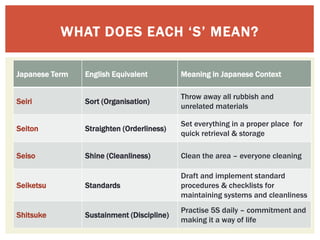
Japanese Term English Equivalent Meaning in Japanese Context
Seiri Sort (Organisation)
Throw away all rubbish and
unrelated materials
Seiton Straighten (Orderliness)
Set everything in a proper place for
quick retrieval & storage
Seiso Shine (Cleanliness) Clean the area – everyone cleaning
Seiketsu Standards
Draft and implement standard
procedures & checklists for
maintaining systems and cleanliness
Shitsuke Sustainment (Discipline)
Practise 5S daily – commitment and
making it a way of life
WHAT DOES EACH ‘S’ MEAN?
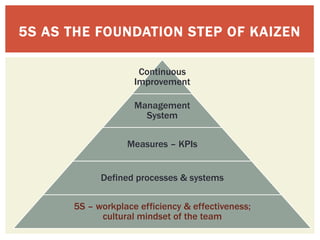
Continuous
Improvement
Management
System
Measures – KPIs
Defined processes & systems
5S – workplace efficiency & effectiveness;
cultural mindset of the team
5S AS THE FOUNDATION STEP OF KAIZEN
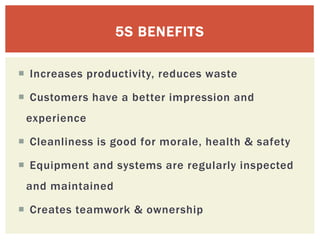
 Increases productivity, reduces waste
 Customers have a better impression and
experience
 Cleanliness is good for morale, health & safety
 Equipment and systems are regularly inspected
and maintained
 Creates teamwork & ownership
5S BENEFITS
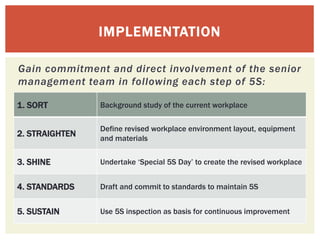
Gain commitment and direct involvement of the senior
management team in following each step of 5S:
IMPLEMENTATION
1. SORT Background study of the current workplace
2. STRAIGHTEN
Define revised workplace environment layout, equipment
and materials
3. SHINE Undertake ‘Special 5S Day’ to create the revised workplace
4. STANDARDS Draft and commit to standards to maintain 5S
5. SUSTAIN Use 5S inspection as basis for continuous improvement
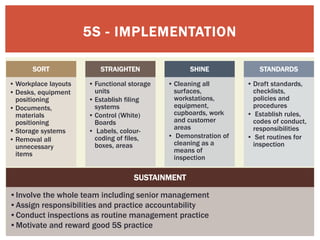
5S - IMPLEMENTATION
SORT
• Workplace layouts
• Desks, equipment
positioning
• Documents,
materials
positioning
• Storage systems
• Removal all
unnecessary
items
STRAIGHTEN
• Functional storage
units
• Establish filing
systems
• Control (White)
Boards
• Labels, colour-
coding of files,
boxes, areas
SHINE
• Cleaning all
surfaces,
workstations,
equipment,
cupboards, work
and customer
areas
• Demonstration of
cleaning as a
means of
inspection
STANDARDS
• Draft standards,
checklists,
policies and
procedures
• Establish rules,
codes of conduct,
responsibilities
• Set routines for
inspection
SUSTAINMENT
•Involve the whole team including senior management
•Assign responsibilities and practice accountability
•Conduct inspections as routine management practice
•Motivate and reward good 5S practice
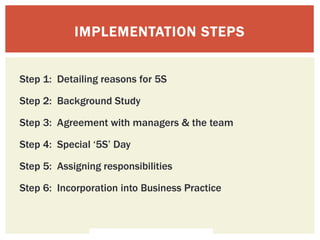
IMPLEMENTATION STEPS
Step 1: Detailing reasons for 5S
Step 2: Background Study
Step 3: Agreement with managers & the team
Step 4: Special ‘5S’ Day
Step 5: Assigning responsibilities
Step 6: Incorporation into Business Practice
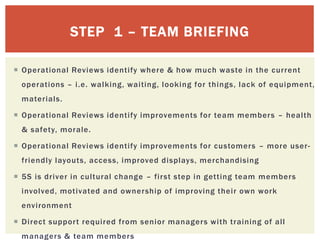
STEP 1 – TEAM BRIEFING
 Operational Reviews identify where & how much waste in the current
operations – i.e. walking, waiting, looking for things, lack of equipment,
materials.
 Operational Reviews identify improvements for team members – health
& safety, morale.
 Operational Reviews identify improvements for customers – more user-
friendly layouts, access, improved displays, merchandising
 5S is driver in cultural change – first step in getting team members
involved, motivated and ownership of improving their own work
environment
 Direct support required from senior managers with training of all
managers & team members
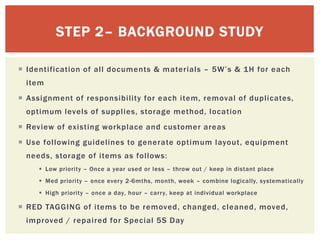
 Identification of all documents & materials – 5W’s & 1H for each
item
 Assignment of responsibility for each item, removal of duplicates,
optimum levels of supplies, storage method, location
 Review of existing workplace and customer areas
 Use following guidelines to generate optimum layout, equipment
needs, storage of items as follows:
 Low priority – Once a year used or less – throw out / keep in distant place
 Med priority – once every 2-6mths, month, week – combine logically, systematically
 High priority – once a day, hour – carry, keep at individual workplace
 RED TAGGING of items to be removed, changed, cleaned, moved,
improved / repaired for Special 5S Day
STEP 2– BACKGROUND STUDY
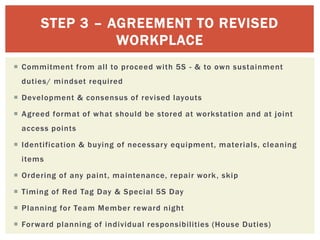
STEP 3 – AGREEMENT TO REVISED
WORKPLACE
 Commitment from all to proceed with 5S - & to own sustainment
duties/ mindset required
 Development & consensus of revised layouts
 Agreed format of what should be stored at workstation and at joint
access points
 Identification & buying of necessary equipment, materials, cleaning
items
 Ordering of any paint, maintenance, repair work, skip
 Timing of Red Tag Day & Special 5S Day
 Planning for Team Member reward night
 Forward planning of individual responsibilities (House Duties)
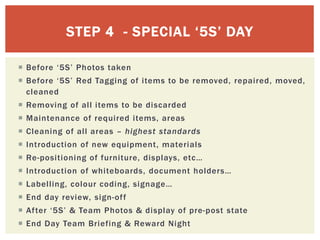
STEP 4 - SPECIAL ‘5S’ DAY
 Before ‘5S’ Photos taken
 Before ‘5S’ Red Tagging of items to be removed, repaired, moved,
cleaned
 Removing of all items to be discarded
 Maintenance of required items, areas
 Cleaning of all areas – highest standards
 Introduction of new equipment, materials
 Re-positioning of furniture, displays, etc…
 Introduction of whiteboards, document holders…
 Labelling, colour coding, signage…
 End day review, sign-off
 After ‘5S’ & Team Photos & display of pre-post state
 End Day Team Briefing & Reward Night
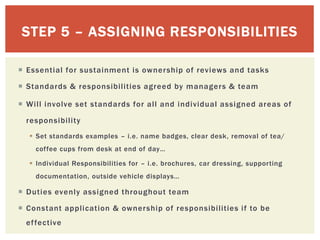
STEP 5 – ASSIGNING RESPONSIBILITIES
 Essential for sustainment is ownership of reviews and tasks
 Standards & responsibilities agreed by managers & team
 Will involve set standards for all and individual assigned areas of
responsibility
 Set standards examples – i.e. name badges, clear desk, removal of tea/
coffee cups from desk at end of day…
 Individual Responsibilities for – i.e. brochures, car dressing, supporting
documentation, outside vehicle displays…
 Duties evenly assigned throughout team
 Constant application & ownership of responsibilities if to be
effective
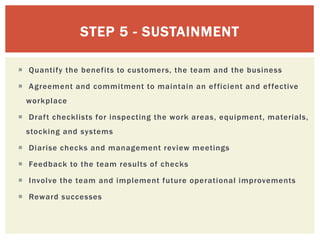
 Quantify the benefits to customers, the team and the business
 Agreement and commitment to maintain an efficient and effective
workplace
 Draft checklists for inspecting the work areas, equipment, materials,
stocking and systems
 Diarise checks and management review meetings
 Feedback to the team results of checks
 Involve the team and implement future operational improvements
 Reward successes
STEP 5 - SUSTAINMENT
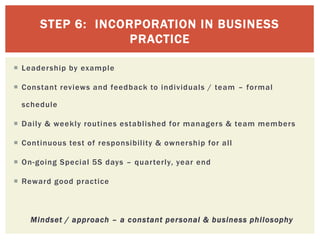
STEP 6: INCORPORATION IN BUSINESS
PRACTICE
 Leadership by example
 Constant reviews and feedback to individuals / team – formal
schedule
 Daily & weekly routines established for managers & team members
 Continuous test of responsibility & ownership for all
 On-going Special 5S days – quarterly, year end
 Reward good practice
Mindset / approach – a constant personal & business philosophy
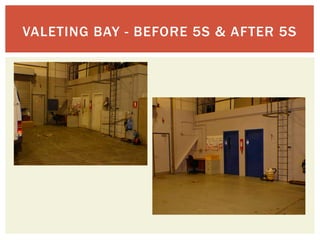
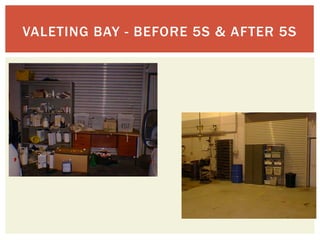
VALETING BAY - BEFORE 5S & AFTER 5S
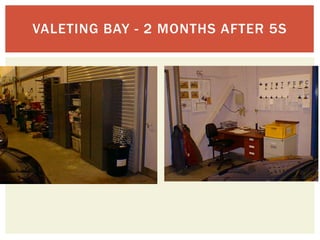
VALETING BAY - 2 MONTHS AFTER 5S
20
SALES SHOWROOM -
BEFORE & AFTER 5S

5 S ~ implementation presentation

  • 1.
  • 2.
  • 3.
     5S isthe foundation of Japanese Kaizen (Continuous Improvement) methodology  Each ‘S’ is a different Japanese word and represents an element of how to improve the workplace effectiveness  5S is a continuous system for maintaining and improving the workplace  5S has significant impact on the cultural mindset of the team WHAT IS ‘5S’?
  • 4.
    Japanese Term EnglishEquivalent Meaning in Japanese Context Seiri Sort (Organisation) Throw away all rubbish and unrelated materials Seiton Straighten (Orderliness) Set everything in a proper place for quick retrieval & storage Seiso Shine (Cleanliness) Clean the area – everyone cleaning Seiketsu Standards Draft and implement standard procedures & checklists for maintaining systems and cleanliness Shitsuke Sustainment (Discipline) Practise 5S daily – commitment and making it a way of life WHAT DOES EACH ‘S’ MEAN?
  • 5.
    Continuous Improvement Management System Measures – KPIs Definedprocesses & systems 5S – workplace efficiency & effectiveness; cultural mindset of the team 5S AS THE FOUNDATION STEP OF KAIZEN
  • 6.
     Increases productivity,reduces waste  Customers have a better impression and experience  Cleanliness is good for morale, health & safety  Equipment and systems are regularly inspected and maintained  Creates teamwork & ownership 5S BENEFITS
  • 7.
    Gain commitment anddirect involvement of the senior management team in following each step of 5S: IMPLEMENTATION 1. SORT Background study of the current workplace 2. STRAIGHTEN Define revised workplace environment layout, equipment and materials 3. SHINE Undertake ‘Special 5S Day’ to create the revised workplace 4. STANDARDS Draft and commit to standards to maintain 5S 5. SUSTAIN Use 5S inspection as basis for continuous improvement
  • 8.
    5S - IMPLEMENTATION SORT •Workplace layouts • Desks, equipment positioning • Documents, materials positioning • Storage systems • Removal all unnecessary items STRAIGHTEN • Functional storage units • Establish filing systems • Control (White) Boards • Labels, colour- coding of files, boxes, areas SHINE • Cleaning all surfaces, workstations, equipment, cupboards, work and customer areas • Demonstration of cleaning as a means of inspection STANDARDS • Draft standards, checklists, policies and procedures • Establish rules, codes of conduct, responsibilities • Set routines for inspection SUSTAINMENT •Involve the whole team including senior management •Assign responsibilities and practice accountability •Conduct inspections as routine management practice •Motivate and reward good 5S practice
  • 9.
    IMPLEMENTATION STEPS Step 1:Detailing reasons for 5S Step 2: Background Study Step 3: Agreement with managers & the team Step 4: Special ‘5S’ Day Step 5: Assigning responsibilities Step 6: Incorporation into Business Practice
  • 10.
    STEP 1 –TEAM BRIEFING  Operational Reviews identify where & how much waste in the current operations – i.e. walking, waiting, looking for things, lack of equipment, materials.  Operational Reviews identify improvements for team members – health & safety, morale.  Operational Reviews identify improvements for customers – more user- friendly layouts, access, improved displays, merchandising  5S is driver in cultural change – first step in getting team members involved, motivated and ownership of improving their own work environment  Direct support required from senior managers with training of all managers & team members
  • 11.
     Identification ofall documents & materials – 5W’s & 1H for each item  Assignment of responsibility for each item, removal of duplicates, optimum levels of supplies, storage method, location  Review of existing workplace and customer areas  Use following guidelines to generate optimum layout, equipment needs, storage of items as follows:  Low priority – Once a year used or less – throw out / keep in distant place  Med priority – once every 2-6mths, month, week – combine logically, systematically  High priority – once a day, hour – carry, keep at individual workplace  RED TAGGING of items to be removed, changed, cleaned, moved, improved / repaired for Special 5S Day STEP 2– BACKGROUND STUDY
  • 12.
    STEP 3 –AGREEMENT TO REVISED WORKPLACE  Commitment from all to proceed with 5S - & to own sustainment duties/ mindset required  Development & consensus of revised layouts  Agreed format of what should be stored at workstation and at joint access points  Identification & buying of necessary equipment, materials, cleaning items  Ordering of any paint, maintenance, repair work, skip  Timing of Red Tag Day & Special 5S Day  Planning for Team Member reward night  Forward planning of individual responsibilities (House Duties)
  • 13.
    STEP 4 -SPECIAL ‘5S’ DAY  Before ‘5S’ Photos taken  Before ‘5S’ Red Tagging of items to be removed, repaired, moved, cleaned  Removing of all items to be discarded  Maintenance of required items, areas  Cleaning of all areas – highest standards  Introduction of new equipment, materials  Re-positioning of furniture, displays, etc…  Introduction of whiteboards, document holders…  Labelling, colour coding, signage…  End day review, sign-off  After ‘5S’ & Team Photos & display of pre-post state  End Day Team Briefing & Reward Night
  • 14.
    STEP 5 –ASSIGNING RESPONSIBILITIES  Essential for sustainment is ownership of reviews and tasks  Standards & responsibilities agreed by managers & team  Will involve set standards for all and individual assigned areas of responsibility  Set standards examples – i.e. name badges, clear desk, removal of tea/ coffee cups from desk at end of day…  Individual Responsibilities for – i.e. brochures, car dressing, supporting documentation, outside vehicle displays…  Duties evenly assigned throughout team  Constant application & ownership of responsibilities if to be effective
  • 15.
     Quantify thebenefits to customers, the team and the business  Agreement and commitment to maintain an efficient and effective workplace  Draft checklists for inspecting the work areas, equipment, materials, stocking and systems  Diarise checks and management review meetings  Feedback to the team results of checks  Involve the team and implement future operational improvements  Reward successes STEP 5 - SUSTAINMENT
  • 16.
    STEP 6: INCORPORATIONIN BUSINESS PRACTICE  Leadership by example  Constant reviews and feedback to individuals / team – formal schedule  Daily & weekly routines established for managers & team members  Continuous test of responsibility & ownership for all  On-going Special 5S days – quarterly, year end  Reward good practice Mindset / approach – a constant personal & business philosophy
  • 17.
    VALETING BAY -BEFORE 5S & AFTER 5S
  • 18.
    VALETING BAY -BEFORE 5S & AFTER 5S
  • 19.
    VALETING BAY -2 MONTHS AFTER 5S
  • 20.