Basics of Human
Resource Management
Human Resource Management
Managerial function that tries to
match an organization’s needs
to the skills and abilities of its
employees.
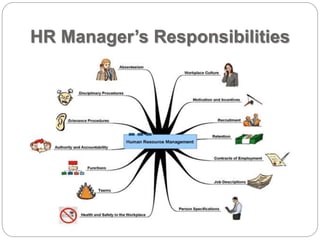
HR Manager’s Responsibilities
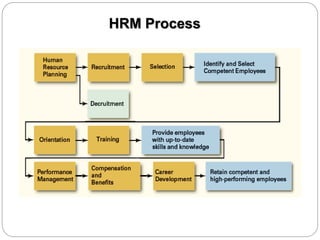
HRM Process
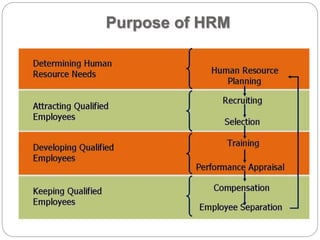
Purpose of HRM
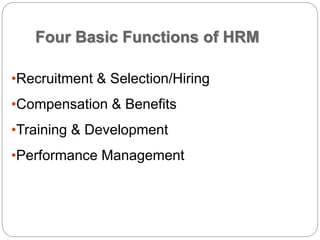
Four Basic Functions of HRM
•Recruitment & Selection/Hiring
•Compensation & Benefits
•Training & Development
•Performance Management
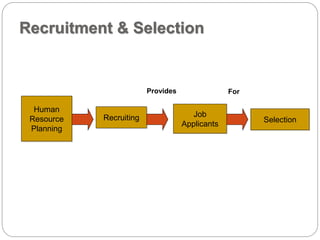
Recruitment & Selection
Human
Resource
Planning
Recruiting Job
Applicants
Selection
Provides For
Identifying Job Need
Why does the organisation need new staff?
 A process of job analysis is needed
to identify the need for new staff
 It could be that there is no need and staff
could just be organised better
Analysing the Job
What will the job involve?
 Skills analysis – what competences
will be needed for the job?
 Specifying the job – what’s needed
to be done?
 Describing the job – main activities, training
provided, terms, location described.
 Specifying the person – qualifications,
experience, skills needed
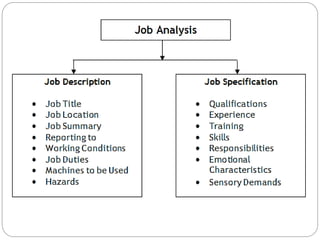
Job Analysis - JA
 JA is a systematic investigation of the tasks,
duties and responsibilities necessary to do a job.
 This stage is where the key documents involved
in recruitment and selection are created:
 The job description – JD
 The person specification - JS
 These documents are crucial for working out if
you have the ‘right’ candidate.
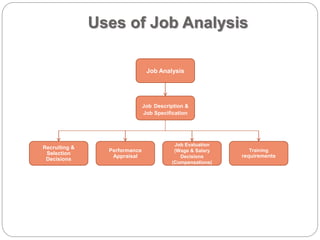
Uses of Job Analysis
Job Analysis
Training
requirements
Job Evaluation
(Wage & Salary
Decisions
(Compensations)
Performance
Appraisal
Recruiting &
Selection
Decisions
Job Description &
Job Specification
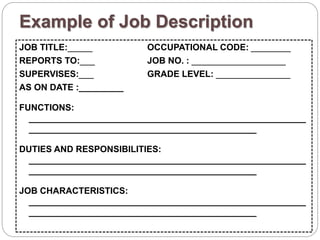
Example of Job Description
JOB TITLE:_____ OCCUPATIONAL CODE: ________
REPORTS TO:___ JOB NO. : ___________________
SUPERVISES:___ GRADE LEVEL: _______________
AS ON DATE :_________
FUNCTIONS:
________________________________________________________
______________________________________________
DUTIES AND RESPONSIBILITIES:
________________________________________________________
______________________________________________
JOB CHARACTERISTICS:
________________________________________________________
______________________________________________
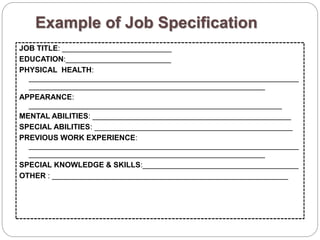
Example of Job Specification
JOB TITLE: __________________________
EDUCATION:_________________________
PHYSICAL HEALTH:
________________________________________________________________
________________________________________________________
APPEARANCE:
____________________________________________________________
MENTAL ABILITIES: _______________________________________________
SPECIAL ABILITIES: _______________________________________________
PREVIOUS WORK EXPERIENCE:
________________________________________________________________
________________________________________________________
SPECIAL KNOWLEDGE & SKILLS:_____________________________________
OTHER : ________________________________________________________
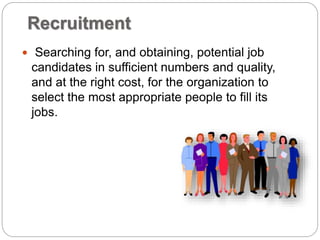
Recruitment
 Searching for, and obtaining, potential job
candidates in sufficient numbers and quality,
and at the right cost, for the organization to
select the most appropriate people to fill its
jobs.
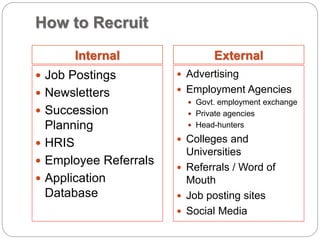
How to Recruit
Internal External
 Job Postings
 Newsletters
 Succession
Planning
 HRIS
 Employee Referrals
 Application
Database
 Advertising
 Employment Agencies
 Govt. employment exchange
 Private agencies
 Head-hunters
 Colleges and
Universities
 Referrals / Word of
Mouth
 Job posting sites
 Social Media
SELECTION / HIRING
Selection is the process of gathering information
for the purposes of evaluating and deciding who
should be hired, under legal guidelines, for the
short and long term interests of the individual
and the organization.
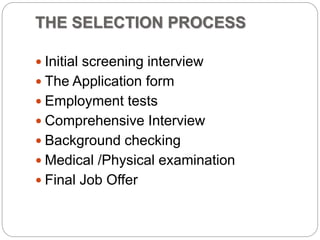
THE SELECTION PROCESS
 Initial screening interview
 The Application form
 Employment tests
 Comprehensive Interview
 Background checking
 Medical /Physical examination
 Final Job Offer
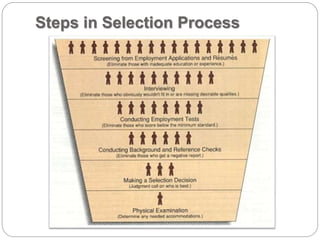
Steps in Selection Process
Selection Tools
 Employment Tests
 Interviews
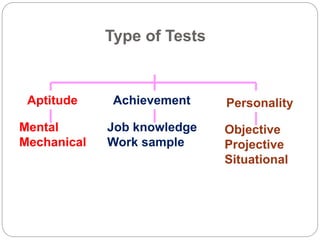
Type of Tests
Mental
Mechanical
Job knowledge
Work sample
Objective
Projective
Situational
Aptitude Achievement Personality
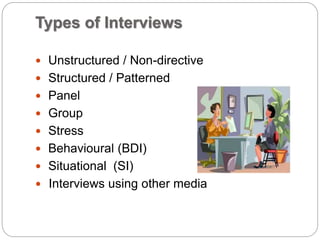
Types of Interviews
 Unstructured / Non-directive
 Structured / Patterned
 Panel
 Group
 Stress
 Behavioural (BDI)
 Situational (SI)
 Interviews using other media
Employee Orientation
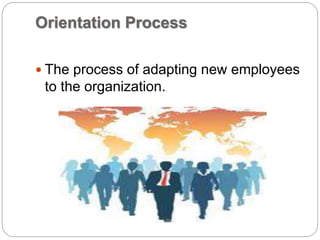
Orientation Process
 The process of adapting new employees
to the organization.
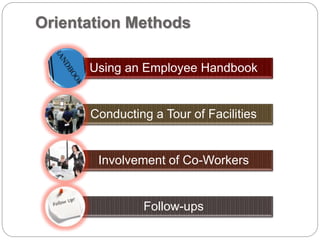
Orientation Methods
Using an Employee Handbook
Conducting a Tour of Facilities
Involvement of Co-Workers
Follow-ups
Training & Development
 Is a function of human resource
management concerned with
organizational activity aimed at bettering
the performance of individuals & groups
in organizational settings.
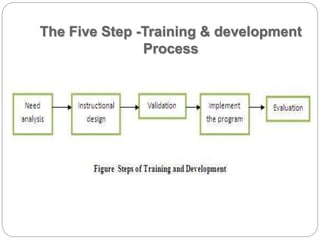
The Five Step -Training & development
Process
Training Methods
 On-the-job Training
 Apprenticeship Training
 Simulated Training
 Classroom Training
 Distance Learning
 Computer Based Training
 Case Based Method
 Business Games
 Role Plays
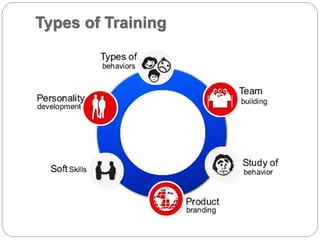
Types of Training
Performance Management
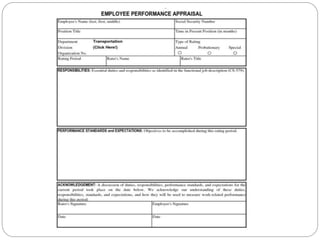
Performance Appraisal
 Evaluating an employee’s current and/or
past performance relative to his or her
performance standards.
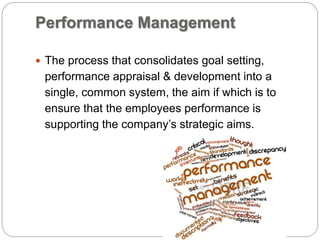
Performance Management
 The process that consolidates goal setting,
performance appraisal & development into a
single, common system, the aim if which is to
ensure that the employees performance is
supporting the company’s strategic aims.
Performance Management, Not
Performance Appraisal
 Performance appraisal can be defined as the formal
assessment and rating of individuals by their
managers at usually an annual review meeting.
 It should be distinguished from performance
management, which is a much wider, more
comprehensive and more natural process of
management that aims to clarify mutual expectations
and emphasizes the support role of managers, who
are expected to act as coaches rather than judges
and focuses on the future.
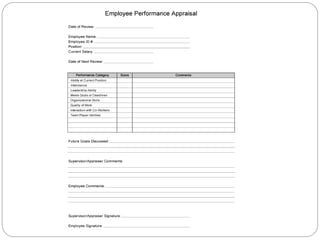
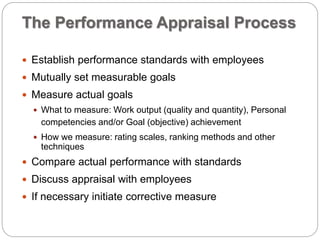
The Performance Appraisal Process
 Establish performance standards with employees
 Mutually set measurable goals
 Measure actual goals
 What to measure: Work output (quality and quantity), Personal
competencies and/or Goal (objective) achievement
 How we measure: rating scales, ranking methods and other
techniques
 Compare actual performance with standards
 Discuss appraisal with employees
 If necessary initiate corrective measure
Uses of Performance Appraisals
 Human Resource Planning
 Recruitment and Selection
 Training and Development
 Career Planning and Development
 Compensations Programs
 Internal Employee Relations
 Assessment of Employee Potentials
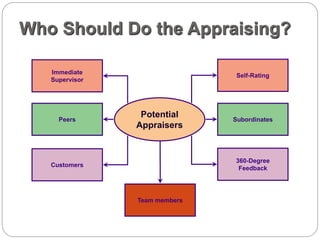
Who Should Do the Appraising?
Self-Rating
Subordinates
360-Degree
Feedback
Potential
Appraisers
Immediate
Supervisor
Peers
Customers
Team members
Appraisal Period
 Annual
 Six months / Bi-annual
 Appraisal can be done once or twice a
year but feedback should be continuous
and intermittent!
Performance Appraisal Methods
1. Rating Scales
2. Critical Incidents
3. Essay
4. Work Standards
5. Ranking
6. 360 degrees
7. MBO
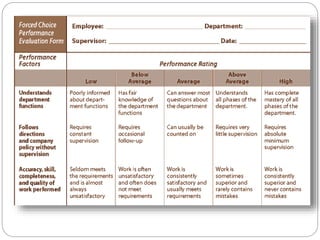
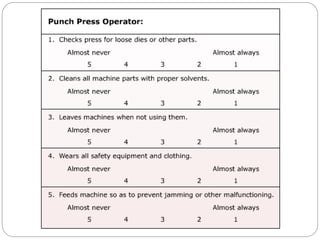
1. Rating Scales
 Rates according to defined factors
 Job factors and personal factors
 Judgments are recorded on a scale
 Many employees are evaluated quickly
2. Critical Incidents
 Written records of highly favorable and
unfavorable work actions
 Appraisal more likely to cover entire
evaluation period
 Does not focus on last few weeks or
months
3. Essay
 Brief narrative describing performance
 Tends to focus on extreme behavior
 Depends heavily on evaluator's writing
ability
 Comparing essay evaluations might be
difficult
4. Work Standards
 Compares performance to predetermined
standard
 Standards - normal output of average worker
operating at normal pace
 Time study and work sampling used
 Workers need to know how standards were
set
5. Ranking
 All employees from group ranked in
order of overall performance
 Paired comparison is a variation
 Comparison is based on single criterion,
such as overall performance
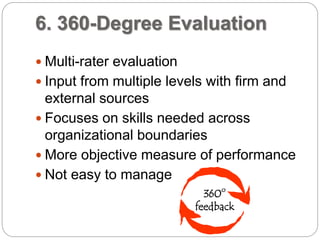
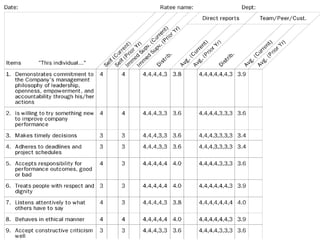
6. 360-Degree Evaluation
 Multi-rater evaluation
 Input from multiple levels with firm and
external sources
 Focuses on skills needed across
organizational boundaries
 More objective measure of performance
 Not easy to manage
360o
feedback
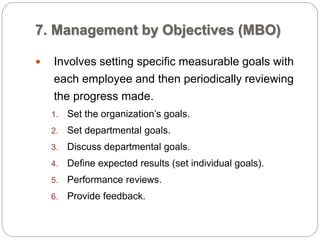
7. Management by Objectives (MBO)
 Involves setting specific measurable goals with
each employee and then periodically reviewing
the progress made.
1. Set the organization’s goals.
2. Set departmental goals.
3. Discuss departmental goals.
4. Define expected results (set individual goals).
5. Performance reviews.
6. Provide feedback.
Problems in Performance Appraisals
 Lack of objectivity
 Bias
 Leniency/Strictness
 Central Tendency
 Recent Behavior Bias
 Personal Bias (stereotyping)
 Manipulating the evaluation
Reward System
Total Reward
 Total Reward includes all types of
reward – non-financial as well as
financial, indirect as well as direct,
intrinsic as well as extrinsic.
 These embrace everything that people
value in the employment relationship
and are developed and implemented as
an integrated and coherent whole.
Total Rewards
 All of the tools available to the employer that
may be used to attract, motivate and retain
employees. Total rewards include everything the
employee perceives to be of value resulting
from the employment relationship.
 There are five elements of total rewards:
1. Compensation
2. Benefits
3. Work-Life
4. Performance and Recognition
5. Development and Career Opportunities
Basics f HRM

Basics f HRM

  • 1.
  • 2.
    Human Resource Management Managerialfunction that tries to match an organization’s needs to the skills and abilities of its employees.
  • 3.
  • 4.
  • 5.
  • 6.
    Four Basic Functionsof HRM •Recruitment & Selection/Hiring •Compensation & Benefits •Training & Development •Performance Management
  • 7.
  • 8.
  • 9.
    Identifying Job Need Whydoes the organisation need new staff?  A process of job analysis is needed to identify the need for new staff  It could be that there is no need and staff could just be organised better
  • 10.
    Analysing the Job Whatwill the job involve?  Skills analysis – what competences will be needed for the job?  Specifying the job – what’s needed to be done?  Describing the job – main activities, training provided, terms, location described.  Specifying the person – qualifications, experience, skills needed
  • 11.
    Job Analysis -JA  JA is a systematic investigation of the tasks, duties and responsibilities necessary to do a job.  This stage is where the key documents involved in recruitment and selection are created:  The job description – JD  The person specification - JS  These documents are crucial for working out if you have the ‘right’ candidate.
  • 12.
    Uses of JobAnalysis Job Analysis Training requirements Job Evaluation (Wage & Salary Decisions (Compensations) Performance Appraisal Recruiting & Selection Decisions Job Description & Job Specification
  • 14.
    Example of JobDescription JOB TITLE:_____ OCCUPATIONAL CODE: ________ REPORTS TO:___ JOB NO. : ___________________ SUPERVISES:___ GRADE LEVEL: _______________ AS ON DATE :_________ FUNCTIONS: ________________________________________________________ ______________________________________________ DUTIES AND RESPONSIBILITIES: ________________________________________________________ ______________________________________________ JOB CHARACTERISTICS: ________________________________________________________ ______________________________________________
  • 15.
    Example of JobSpecification JOB TITLE: __________________________ EDUCATION:_________________________ PHYSICAL HEALTH: ________________________________________________________________ ________________________________________________________ APPEARANCE: ____________________________________________________________ MENTAL ABILITIES: _______________________________________________ SPECIAL ABILITIES: _______________________________________________ PREVIOUS WORK EXPERIENCE: ________________________________________________________________ ________________________________________________________ SPECIAL KNOWLEDGE & SKILLS:_____________________________________ OTHER : ________________________________________________________
  • 16.
    Recruitment  Searching for,and obtaining, potential job candidates in sufficient numbers and quality, and at the right cost, for the organization to select the most appropriate people to fill its jobs.
  • 17.
    How to Recruit InternalExternal  Job Postings  Newsletters  Succession Planning  HRIS  Employee Referrals  Application Database  Advertising  Employment Agencies  Govt. employment exchange  Private agencies  Head-hunters  Colleges and Universities  Referrals / Word of Mouth  Job posting sites  Social Media
  • 18.
    SELECTION / HIRING Selectionis the process of gathering information for the purposes of evaluating and deciding who should be hired, under legal guidelines, for the short and long term interests of the individual and the organization.
  • 19.
    THE SELECTION PROCESS Initial screening interview  The Application form  Employment tests  Comprehensive Interview  Background checking  Medical /Physical examination  Final Job Offer
  • 20.
  • 21.
    Selection Tools  EmploymentTests  Interviews
  • 22.
    Type of Tests Mental Mechanical Jobknowledge Work sample Objective Projective Situational Aptitude Achievement Personality
  • 23.
    Types of Interviews Unstructured / Non-directive  Structured / Patterned  Panel  Group  Stress  Behavioural (BDI)  Situational (SI)  Interviews using other media
  • 24.
  • 25.
    Orientation Process  Theprocess of adapting new employees to the organization.
  • 26.
    Orientation Methods Using anEmployee Handbook Conducting a Tour of Facilities Involvement of Co-Workers Follow-ups
  • 27.
  • 28.
    Training & Development Is a function of human resource management concerned with organizational activity aimed at bettering the performance of individuals & groups in organizational settings.
  • 29.
    The Five Step-Training & development Process
  • 30.
    Training Methods  On-the-jobTraining  Apprenticeship Training  Simulated Training  Classroom Training  Distance Learning  Computer Based Training  Case Based Method  Business Games  Role Plays
  • 31.
  • 32.
  • 33.
    Performance Appraisal  Evaluatingan employee’s current and/or past performance relative to his or her performance standards.
  • 34.
    Performance Management  Theprocess that consolidates goal setting, performance appraisal & development into a single, common system, the aim if which is to ensure that the employees performance is supporting the company’s strategic aims.
  • 35.
    Performance Management, Not PerformanceAppraisal  Performance appraisal can be defined as the formal assessment and rating of individuals by their managers at usually an annual review meeting.  It should be distinguished from performance management, which is a much wider, more comprehensive and more natural process of management that aims to clarify mutual expectations and emphasizes the support role of managers, who are expected to act as coaches rather than judges and focuses on the future.
  • 36.
    The Performance AppraisalProcess  Establish performance standards with employees  Mutually set measurable goals  Measure actual goals  What to measure: Work output (quality and quantity), Personal competencies and/or Goal (objective) achievement  How we measure: rating scales, ranking methods and other techniques  Compare actual performance with standards  Discuss appraisal with employees  If necessary initiate corrective measure
  • 37.
    Uses of PerformanceAppraisals  Human Resource Planning  Recruitment and Selection  Training and Development  Career Planning and Development  Compensations Programs  Internal Employee Relations  Assessment of Employee Potentials
  • 38.
    Who Should Dothe Appraising? Self-Rating Subordinates 360-Degree Feedback Potential Appraisers Immediate Supervisor Peers Customers Team members
  • 39.
    Appraisal Period  Annual Six months / Bi-annual  Appraisal can be done once or twice a year but feedback should be continuous and intermittent!
  • 40.
    Performance Appraisal Methods 1.Rating Scales 2. Critical Incidents 3. Essay 4. Work Standards 5. Ranking 6. 360 degrees 7. MBO
  • 41.
    1. Rating Scales Rates according to defined factors  Job factors and personal factors  Judgments are recorded on a scale  Many employees are evaluated quickly
  • 44.
    2. Critical Incidents Written records of highly favorable and unfavorable work actions  Appraisal more likely to cover entire evaluation period  Does not focus on last few weeks or months
  • 45.
    3. Essay  Briefnarrative describing performance  Tends to focus on extreme behavior  Depends heavily on evaluator's writing ability  Comparing essay evaluations might be difficult
  • 47.
    4. Work Standards Compares performance to predetermined standard  Standards - normal output of average worker operating at normal pace  Time study and work sampling used  Workers need to know how standards were set
  • 48.
    5. Ranking  Allemployees from group ranked in order of overall performance  Paired comparison is a variation  Comparison is based on single criterion, such as overall performance
  • 49.
    6. 360-Degree Evaluation Multi-rater evaluation  Input from multiple levels with firm and external sources  Focuses on skills needed across organizational boundaries  More objective measure of performance  Not easy to manage 360o feedback
  • 51.
    7. Management byObjectives (MBO)  Involves setting specific measurable goals with each employee and then periodically reviewing the progress made. 1. Set the organization’s goals. 2. Set departmental goals. 3. Discuss departmental goals. 4. Define expected results (set individual goals). 5. Performance reviews. 6. Provide feedback.
  • 53.
    Problems in PerformanceAppraisals  Lack of objectivity  Bias  Leniency/Strictness  Central Tendency  Recent Behavior Bias  Personal Bias (stereotyping)  Manipulating the evaluation
  • 54.
  • 55.
    Total Reward  TotalReward includes all types of reward – non-financial as well as financial, indirect as well as direct, intrinsic as well as extrinsic.  These embrace everything that people value in the employment relationship and are developed and implemented as an integrated and coherent whole.
  • 56.
    Total Rewards  Allof the tools available to the employer that may be used to attract, motivate and retain employees. Total rewards include everything the employee perceives to be of value resulting from the employment relationship.  There are five elements of total rewards: 1. Compensation 2. Benefits 3. Work-Life 4. Performance and Recognition 5. Development and Career Opportunities