5S – Workplace Organisation
www.optimumfx.com
Intent of session
• To explain the stages involved in implementing
5S
• To understand how you and your teams can
benefit from using this method
• To help identify opportunities where this can help
you
What Is 5S?
• 5S is a method for creating and maintaining an
organised, clean and high performing workplace
• The basis for improvement programmes
• Five stages, translated from the Japanese:
Seiri Sort
Seiton Set in Order
Seiso Sweep
Seiketsu Standardise
Shitsuke Sustain
Why Use 5S?
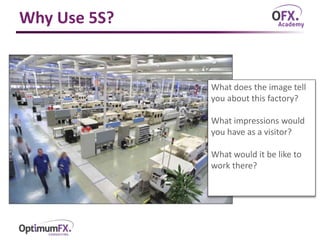
What does the image tell
you about this factory?
What impressions would
you have as a visitor?
What would it be like to
work there?
Why Use 5S?
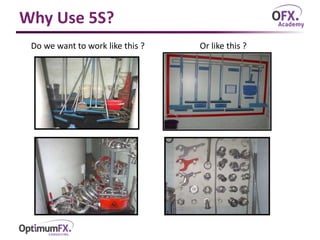
Do we want to work like this ? Or like this ?
Why Use 5S?
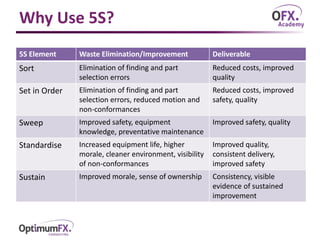
5S Element Waste Elimination/Improvement Deliverable
Sort Elimination of finding and part
selection errors
Reduced costs, improved
quality
Set in Order Elimination of finding and part
selection errors, reduced motion and
non-conformances
Reduced costs, improved
safety, quality
Sweep Improved safety, equipment
knowledge, preventative maintenance
Improved safety, quality
Standardise Increased equipment life, higher
morale, cleaner environment, visibility
of non-conformances
Improved quality,
consistent delivery,
improved safety
Sustain Improved morale, sense of ownership Consistency, visible
evidence of sustained
improvement
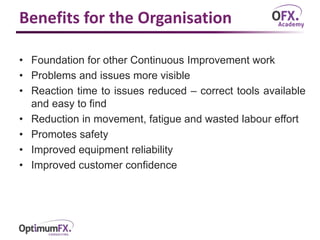
Benefits for the Organisation
• Foundation for other Continuous Improvement work
• Problems and issues more visible
• Reaction time to issues reduced – correct tools available
and easy to find
• Reduction in movement, fatigue and wasted labour effort
• Promotes safety
• Improved equipment reliability
• Improved customer confidence
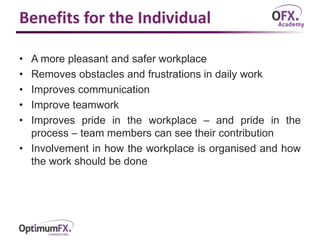
Benefits for the Individual
• A more pleasant and safer workplace
• Removes obstacles and frustrations in daily work
• Improves communication
• Improve teamwork
• Improves pride in the workplace – and pride in the
process – team members can see their contribution
• Involvement in how the workplace is organised and how
the work should be done
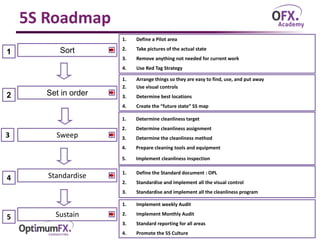
5S Roadmap
Sort
1. Define a Pilot area
2. Take pictures of the actual state
3. Remove anything not needed for current work
4. Use Red Tag Strategy
1
Set in order
1. Arrange things so they are easy to find, use, and put away
2. Use visual controls
3. Determine best locations
4. Create the “future state” 5S map
2
Sweep
1. Determine cleanliness target
2. Determine cleanliness assignment
3. Determine the cleanliness method
4. Prepare cleaning tools and equipment
5. Implement cleanliness inspection
3
Standardise 1. Define the Standard document : OPL
2. Standardise and implement all the visual control
3. Standardise and implement all the cleanliness program
4
Sustain
1. Implement weekly Audit
2. Implement Monthly Audit
3. Standard reporting for all areas
4. Promote the 5S Culture
5
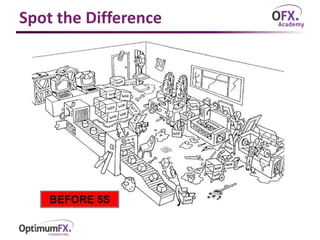
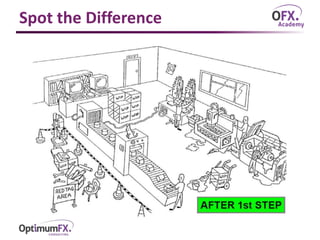
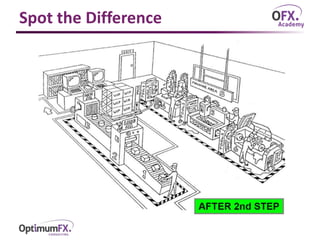
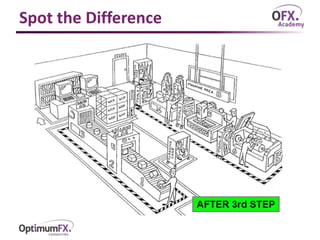
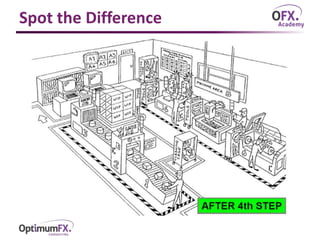
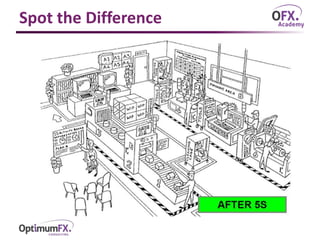
Spot the Difference
Spot the Difference
Spot the Difference
Spot the Difference
Spot the Difference
Spot the Difference
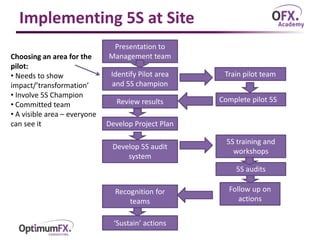
Implementing 5S at Site
Presentation to
Management team
Identify Pilot area
and 5S champion
Review results
Train pilot team
Complete pilot 5S
Develop Project Plan
5S training and
workshops
Develop 5S audit
system
5S audits
Follow up on
actions
Recognition for
teams
Choosing an area for the
pilot:
• Needs to show
impact/’transformation’
• Involve 5S Champion
• Committed team
• A visible area – everyone
can see it
‘Sustain’ actions

5S Overview

  • 1.
    5S – WorkplaceOrganisation www.optimumfx.com
  • 2.
    Intent of session •To explain the stages involved in implementing 5S • To understand how you and your teams can benefit from using this method • To help identify opportunities where this can help you
  • 3.
    What Is 5S? •5S is a method for creating and maintaining an organised, clean and high performing workplace • The basis for improvement programmes • Five stages, translated from the Japanese: Seiri Sort Seiton Set in Order Seiso Sweep Seiketsu Standardise Shitsuke Sustain
  • 4.
    Why Use 5S? Whatdoes the image tell you about this factory? What impressions would you have as a visitor? What would it be like to work there?
  • 5.
    Why Use 5S? Dowe want to work like this ? Or like this ?
  • 6.
    Why Use 5S? 5SElement Waste Elimination/Improvement Deliverable Sort Elimination of finding and part selection errors Reduced costs, improved quality Set in Order Elimination of finding and part selection errors, reduced motion and non-conformances Reduced costs, improved safety, quality Sweep Improved safety, equipment knowledge, preventative maintenance Improved safety, quality Standardise Increased equipment life, higher morale, cleaner environment, visibility of non-conformances Improved quality, consistent delivery, improved safety Sustain Improved morale, sense of ownership Consistency, visible evidence of sustained improvement
  • 7.
    Benefits for theOrganisation • Foundation for other Continuous Improvement work • Problems and issues more visible • Reaction time to issues reduced – correct tools available and easy to find • Reduction in movement, fatigue and wasted labour effort • Promotes safety • Improved equipment reliability • Improved customer confidence
  • 8.
    Benefits for theIndividual • A more pleasant and safer workplace • Removes obstacles and frustrations in daily work • Improves communication • Improve teamwork • Improves pride in the workplace – and pride in the process – team members can see their contribution • Involvement in how the workplace is organised and how the work should be done
  • 9.
    5S Roadmap Sort 1. Definea Pilot area 2. Take pictures of the actual state 3. Remove anything not needed for current work 4. Use Red Tag Strategy 1 Set in order 1. Arrange things so they are easy to find, use, and put away 2. Use visual controls 3. Determine best locations 4. Create the “future state” 5S map 2 Sweep 1. Determine cleanliness target 2. Determine cleanliness assignment 3. Determine the cleanliness method 4. Prepare cleaning tools and equipment 5. Implement cleanliness inspection 3 Standardise 1. Define the Standard document : OPL 2. Standardise and implement all the visual control 3. Standardise and implement all the cleanliness program 4 Sustain 1. Implement weekly Audit 2. Implement Monthly Audit 3. Standard reporting for all areas 4. Promote the 5S Culture 5
  • 10.
  • 11.
  • 12.
  • 13.
  • 14.
  • 15.
  • 16.
    Implementing 5S atSite Presentation to Management team Identify Pilot area and 5S champion Review results Train pilot team Complete pilot 5S Develop Project Plan 5S training and workshops Develop 5S audit system 5S audits Follow up on actions Recognition for teams Choosing an area for the pilot: • Needs to show impact/’transformation’ • Involve 5S Champion • Committed team • A visible area – everyone can see it ‘Sustain’ actions

Editor's Notes

  • #7 Use other slide to wrap up importance of 5S