6S Implementation
,,,,we evaluate Energy
Why Implement 6S?
 Customers’ needs constantly change.
 Companies compete to meet these needs.
 To survive, we must stay competitive.
 This means improving products and services and lowering
costs.
 The 6S system is a good starting point for all improvement
programs.
,,,,we evaluate Energy
Typical Resistances to 6S
1. Implementing Sort and Set in Order will not boost output.
2. Why concern ourselves with triviality?
3. My filing system is a mess – but I know my way around it!
,,,,we evaluate Energy
Typical Resistances to 6S
4. 6S’s and related improvements are just for the factory.
5. We’re too busy to spend time on Sort and Set in Order.
6. We don’t need the 6S’s – We’re making money, so just let
us do our work!
,,,,we evaluate Energy
What is 6S?
A process for creating and maintaining an organized,
clean, and high performance work place, which serves as
a foundation for continuous improvement activities
,,,,we evaluate Energy
What Is 5 S
• 5 Japanese Words
 Seiri - Sort (Housekeeping)
 Seiton - Set in Order (Workplace Organization)
 Seiso - Shine (Cleanup)
 Seiketsu - Standardize (Keep Cleanliness)
 Shitsuke - Sustain (Discipline)
,,,,we evaluate Energy
Elements of a 6S Program
1. Safety – Throughout the entire process safety is number 1.
2. Sort - Clearly distinguishing between what is
necessary and what is unnecessary and disposing
of the unnecessary.
3. Set in Order - Organizing the necessary items so that
they can be used and returned easily.
4. Shine - Cleaning floors, equipment, and furniture in
all areas of the workplace.
5. Standardize - Maintaining and improving the standards of
the first three S’s.
6. Sustain - Achieving the discipline or habit of properly
maintaining the correct 6S procedure.
,,,,we evaluate Energy
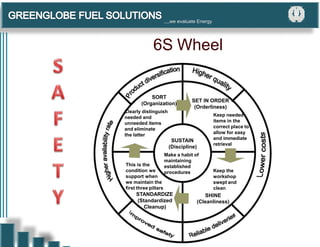
allow for easy
and immediate
retrieval
and eliminate
the latter
This is the
condition we
support when
we maintain the
first three pillars
Keep the
workshop
swept and
clean
SHINE
(Cleanliness)
SORT
(Organization)
Clearly distinguish
needed and
unneeded items
SET IN ORDER
(Orderliness)
Keep needed
items in the
correct place to
STANDARDIZE
(Standardized
Cleanup)
SUSTAIN
(Discipline)
Make a habit of
maintaining
established
procedures
6S Wheel
,,,,we evaluate Energy
Benefits of 6S
 Individuals: A safer work environment, more pleasant
workplace, more satisfying jobs, and a process that makes
sense.
 Company: Higher quality, lower costs, greater customer
satisfaction.
,,,,we evaluate Energy
Implementing 6S
 Role of Management:
 Educating, creating teams, scheduling time,
providing resources, encouragement, and
recognition.
 Role of Associate:
 Encouraging coworkers, participating, implementing,
contributing ideas, and promoting 6S efforts.
,,,,we evaluate Energy
Sort
 Discourage people from being
defensive.
 Be fair - all areas get tagged.
 Remove any unneeded items
from the area.
 Allow for personal / decorative items
per established policies.
 Leave only the bare essentials!
 When in doubt, throw it out!
Before
After
,,,,we evaluate Energy
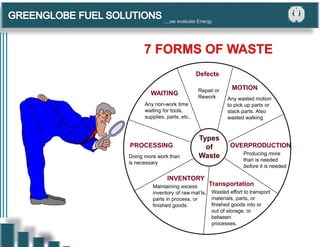
Types
of
Waste
Defects
Repair or
Rework
MOTION
Any wasted motion
to pick up parts or
stack parts. Also
wasted walking
PROCESSING
Doing more work than
is necessary
WAITING
Any non-work time
waiting for tools,
supplies, parts, etc..
Transportation
Wasted effort to transport
materials, parts, or
finished goods into or
out of storage, or
between
processes.
INVENTORY
Maintaining excess
inventory of raw mat’ls,
parts in process, or
finished goods.
OVERPRODUCTION
Producing more
than is needed
before it is needed
,,,,we evaluate Energy
Lean = Eliminating the Wastes
Typically 95% of Total Lead Time
is Non-Value Added!!!
RUN
TIME
Order Processing, Transport, Storage, Waiting, Rework,
Machine Setup, Inspection, Machine Breakdowns, etc…
Total Lead Time
,,,,we evaluate Energy
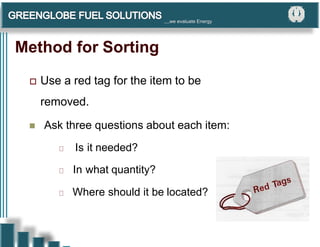
Method for Sorting
 Use a red tag for the item to be
removed.
 Ask three questions about each item:
Is it needed?
In what quantity?
Where should it be located?
,,,,we evaluate Energy
RED TAG
Category 1.Equipment 7. Quassi products
2.Jigs and tools 8. Finished products
3.Measuring instruments 9. Quassi material
4.Materials 10. Office products
5.Parts 11. Paper, pens, etc.
6.In-process inventory
Item name
Manufacturing
No.
Quantity Units Value INR
Reason 1. Not needed 6. Other
2.Defective
3.Not need soon
4.Scrap material
5.Use known
Disposal by: Department/Division/Section
Disposal method: 1.Discard
2.Return
3.Move to red-tag storage site
4.Move to separate storage site 5
Other
Disposal
complete
(initials)
Today's date: Posting date:Disposal date:
Red-tag file number
,,,,we evaluate Energy
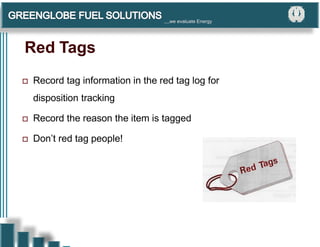
Red Tags
 Record tag information in the red tag log for
disposition tracking
 Record the reason the item is tagged
 Don’t red tag people!
,,,,we evaluate Energy
Red Tag Holding Areas
 An area set aside to store red-tagged items that need to
be evaluated.
 Two kinds:
 Central red-tag holding area
 Local red-tag holding area
,,,,we evaluate Energy
Steps in Red-Tagging
 Step 1: Launch the red-tag project.
 Step 2: Identify the red-tag targets.
 Step 3: Set red-tag criteria.
 Step 4: Make red tags.
 Step 5: Attach the red tags.
 Step 6: Evaluate the red-tagged items.
 Step 7: Document the results of red-tagging.
,,,,we evaluate Energy
Set in Order
 A place for everything and everything in its place.
 Arrange things so they are easy to find, use, and put
away.
 Work place organization is apparent through use of
lines, labels, color-coding, shadow boards,
photographs, etc.
,,,,we evaluate Energy
Elements of Set in Order
 Set in order and standardization
 Visual controls
 Principles of deciding locations
,,,,we evaluate Energy
Set in Order and Standardization
 Standardization means doing things in a consistent way.
 Set in Order is the core of standardization.
,,,,we evaluate Energy
Visual Controls
Devices or methods which show, at a glance, how work
should be done and/or where items should be placed.
,,,,we evaluate Energy
Principles of Deciding Locations
 Get rid of waste by storing jigs, tools, and dies.
 Get rid of unnecessary motion: “motion improvement.”
 Get rid of whole operations: “radical improvement.”
,,,,we evaluate Energy
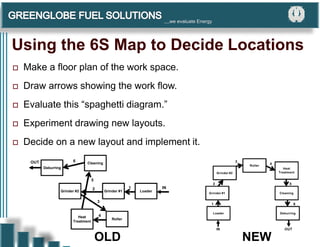
Using the 6S Map to Decide Locations
 Make a floor plan of the work space.
 Draw arrows showing the work flow.
 Evaluate this “spaghetti diagram.”
 Experiment drawing new layouts.
 Decide on a new layout and implement it.
Grinder #2
Heat
Treatment
Roller
Loader
Grinder #1
Cleaning
IN
OUT
1
6
2
5
3
4
Deburring
IN OUT
Deburring
Grinder #2
Heat
Treatment
Roller
Loader
Grinder #1 Cleaning
1 6
2 5
3
4
OLD NEW
,,,,we evaluate Energy
Strategies for Identifying Locations
 Signboard Strategy
 Painting Strategy
 “After” 6S map
 Color-coding strategy
 Outlining Strategy
,,,,we evaluate Energy
Shine
 Clean EVERYTHING!
 Inspect and repair while you clean.
 Scan the work place.
,,,,we evaluate Energy
Planning a Shine Campaign
 Step 1: Decide shine targets.
 Step 2: Decide shine assignments.
 Step 3: Decide shine methods.
 Step 4: Prepare shine tools.
 Step 5: Implement shine activities.
,,,,we evaluate Energy
Shine Means Inspection
 When you clean an area, you also do some inspection of
machinery, equipment, and working conditions.
 Including inspection with shine procedures turns
“cleaning” into “cleaning/inspection.”
,,,,we evaluate Energy
Steps in Cleaning/Inspection
 Step 1: Decide cleaning/inspection targets.
 Step 2: Assign cleaning/inspection jobs.
 Step 3: Determine cleaning/inspection methods.
 Step 4: Implement cleaning/inspection.
 Step 5: Correct equipment problems.
,,,,we evaluate Energy
New Tools and Techniques
 6S Schedule
 Five-Minute Shine
 Cleaning/Inspection Checklist
 Checklist of Needed Maintenance Activities.
,,,,we evaluate Energy
Standardize
 Maintain Sort, Set in Order, and Shine.
 Standardize methods to ensure the improvements
become a way of life.
 Create or revise check sheets and operator instructions.
 Scan the work place.
,,,,we evaluate Energy
Tools and Techniques
 6S Job Cycle Charts
 Visual 6S
 The Five-Minute 6S
 6S Checklist for Factories
,,,,we evaluate Energy
Taking It to the Next Level: Prevention
 Preventive Sort Procedures
 Preventive Set in Order Procedures
 Preventive Shine Procedures
,,,,we evaluate Energy
Other New Tools and Techniques
 5 Whys and 1 How Approach (5W1H)
 Suspension
 Incorporation
 Use Elimination
 Preventative Shine
,,,,we evaluate Energy
Sustain
 Renewal and improvement.
 Build on earlier accomplishments.
 Make a habit of using correct procedures.
 Without discipline, improvements cannot be sustained.
For example:
 Audits
 Work place scans
 Team reviews and reports
 Recognition
,,,,we evaluate Energy
Creating Conditions for Sustain
 Awareness
 Time
 Structure
 Support
 Rewards and Recognition
 Satisfaction and Excitement
,,,,we evaluate Energy
Tools and Techniques to Sustain
 Slogans
 Posters
 Photo Exhibits and Storyboards
 Newsletters
 Pocket Manuals
 Department Tours
 6S Months
,,,,we evaluate Energy
Points to Remember
 Establish guidelines and develop the discipline to
maintain them.
 If you always do what you’ve always done, you’ll always get
what you’ve always got.
 If nothing is done, nothing will improve.
 Develop habits that won’t be forgotten.
,,,,we evaluate Energy
No, it’s
GREENHOUSE
Is this
Heaven?
6S’s
6. Safety
Thank You
,,,,we evaluate Energy

6S Training.pptx

  • 1.
  • 2.
    Why Implement 6S? Customers’ needs constantly change.  Companies compete to meet these needs.  To survive, we must stay competitive.  This means improving products and services and lowering costs.  The 6S system is a good starting point for all improvement programs. ,,,,we evaluate Energy
  • 3.
    Typical Resistances to6S 1. Implementing Sort and Set in Order will not boost output. 2. Why concern ourselves with triviality? 3. My filing system is a mess – but I know my way around it! ,,,,we evaluate Energy
  • 4.
    Typical Resistances to6S 4. 6S’s and related improvements are just for the factory. 5. We’re too busy to spend time on Sort and Set in Order. 6. We don’t need the 6S’s – We’re making money, so just let us do our work! ,,,,we evaluate Energy
  • 5.
    What is 6S? Aprocess for creating and maintaining an organized, clean, and high performance work place, which serves as a foundation for continuous improvement activities ,,,,we evaluate Energy
  • 6.
    What Is 5S • 5 Japanese Words  Seiri - Sort (Housekeeping)  Seiton - Set in Order (Workplace Organization)  Seiso - Shine (Cleanup)  Seiketsu - Standardize (Keep Cleanliness)  Shitsuke - Sustain (Discipline) ,,,,we evaluate Energy
  • 7.
    Elements of a6S Program 1. Safety – Throughout the entire process safety is number 1. 2. Sort - Clearly distinguishing between what is necessary and what is unnecessary and disposing of the unnecessary. 3. Set in Order - Organizing the necessary items so that they can be used and returned easily. 4. Shine - Cleaning floors, equipment, and furniture in all areas of the workplace. 5. Standardize - Maintaining and improving the standards of the first three S’s. 6. Sustain - Achieving the discipline or habit of properly maintaining the correct 6S procedure. ,,,,we evaluate Energy
  • 8.
    allow for easy andimmediate retrieval and eliminate the latter This is the condition we support when we maintain the first three pillars Keep the workshop swept and clean SHINE (Cleanliness) SORT (Organization) Clearly distinguish needed and unneeded items SET IN ORDER (Orderliness) Keep needed items in the correct place to STANDARDIZE (Standardized Cleanup) SUSTAIN (Discipline) Make a habit of maintaining established procedures 6S Wheel ,,,,we evaluate Energy
  • 9.
    Benefits of 6S Individuals: A safer work environment, more pleasant workplace, more satisfying jobs, and a process that makes sense.  Company: Higher quality, lower costs, greater customer satisfaction. ,,,,we evaluate Energy
  • 10.
    Implementing 6S  Roleof Management:  Educating, creating teams, scheduling time, providing resources, encouragement, and recognition.  Role of Associate:  Encouraging coworkers, participating, implementing, contributing ideas, and promoting 6S efforts. ,,,,we evaluate Energy
  • 11.
    Sort  Discourage peoplefrom being defensive.  Be fair - all areas get tagged.  Remove any unneeded items from the area.  Allow for personal / decorative items per established policies.  Leave only the bare essentials!  When in doubt, throw it out! Before After ,,,,we evaluate Energy
  • 12.
    Types of Waste Defects Repair or Rework MOTION Any wastedmotion to pick up parts or stack parts. Also wasted walking PROCESSING Doing more work than is necessary WAITING Any non-work time waiting for tools, supplies, parts, etc.. Transportation Wasted effort to transport materials, parts, or finished goods into or out of storage, or between processes. INVENTORY Maintaining excess inventory of raw mat’ls, parts in process, or finished goods. OVERPRODUCTION Producing more than is needed before it is needed ,,,,we evaluate Energy
  • 13.
    Lean = Eliminatingthe Wastes Typically 95% of Total Lead Time is Non-Value Added!!! RUN TIME Order Processing, Transport, Storage, Waiting, Rework, Machine Setup, Inspection, Machine Breakdowns, etc… Total Lead Time ,,,,we evaluate Energy
  • 14.
    Method for Sorting Use a red tag for the item to be removed.  Ask three questions about each item: Is it needed? In what quantity? Where should it be located? ,,,,we evaluate Energy
  • 15.
    RED TAG Category 1.Equipment7. Quassi products 2.Jigs and tools 8. Finished products 3.Measuring instruments 9. Quassi material 4.Materials 10. Office products 5.Parts 11. Paper, pens, etc. 6.In-process inventory Item name Manufacturing No. Quantity Units Value INR Reason 1. Not needed 6. Other 2.Defective 3.Not need soon 4.Scrap material 5.Use known Disposal by: Department/Division/Section Disposal method: 1.Discard 2.Return 3.Move to red-tag storage site 4.Move to separate storage site 5 Other Disposal complete (initials) Today's date: Posting date:Disposal date: Red-tag file number ,,,,we evaluate Energy
  • 16.
    Red Tags  Recordtag information in the red tag log for disposition tracking  Record the reason the item is tagged  Don’t red tag people! ,,,,we evaluate Energy
  • 17.
    Red Tag HoldingAreas  An area set aside to store red-tagged items that need to be evaluated.  Two kinds:  Central red-tag holding area  Local red-tag holding area ,,,,we evaluate Energy
  • 18.
    Steps in Red-Tagging Step 1: Launch the red-tag project.  Step 2: Identify the red-tag targets.  Step 3: Set red-tag criteria.  Step 4: Make red tags.  Step 5: Attach the red tags.  Step 6: Evaluate the red-tagged items.  Step 7: Document the results of red-tagging. ,,,,we evaluate Energy
  • 19.
    Set in Order A place for everything and everything in its place.  Arrange things so they are easy to find, use, and put away.  Work place organization is apparent through use of lines, labels, color-coding, shadow boards, photographs, etc. ,,,,we evaluate Energy
  • 20.
    Elements of Setin Order  Set in order and standardization  Visual controls  Principles of deciding locations ,,,,we evaluate Energy
  • 21.
    Set in Orderand Standardization  Standardization means doing things in a consistent way.  Set in Order is the core of standardization. ,,,,we evaluate Energy
  • 22.
    Visual Controls Devices ormethods which show, at a glance, how work should be done and/or where items should be placed. ,,,,we evaluate Energy
  • 23.
    Principles of DecidingLocations  Get rid of waste by storing jigs, tools, and dies.  Get rid of unnecessary motion: “motion improvement.”  Get rid of whole operations: “radical improvement.” ,,,,we evaluate Energy
  • 24.
    Using the 6SMap to Decide Locations  Make a floor plan of the work space.  Draw arrows showing the work flow.  Evaluate this “spaghetti diagram.”  Experiment drawing new layouts.  Decide on a new layout and implement it. Grinder #2 Heat Treatment Roller Loader Grinder #1 Cleaning IN OUT 1 6 2 5 3 4 Deburring IN OUT Deburring Grinder #2 Heat Treatment Roller Loader Grinder #1 Cleaning 1 6 2 5 3 4 OLD NEW ,,,,we evaluate Energy
  • 25.
    Strategies for IdentifyingLocations  Signboard Strategy  Painting Strategy  “After” 6S map  Color-coding strategy  Outlining Strategy ,,,,we evaluate Energy
  • 26.
    Shine  Clean EVERYTHING! Inspect and repair while you clean.  Scan the work place. ,,,,we evaluate Energy
  • 27.
    Planning a ShineCampaign  Step 1: Decide shine targets.  Step 2: Decide shine assignments.  Step 3: Decide shine methods.  Step 4: Prepare shine tools.  Step 5: Implement shine activities. ,,,,we evaluate Energy
  • 28.
    Shine Means Inspection When you clean an area, you also do some inspection of machinery, equipment, and working conditions.  Including inspection with shine procedures turns “cleaning” into “cleaning/inspection.” ,,,,we evaluate Energy
  • 29.
    Steps in Cleaning/Inspection Step 1: Decide cleaning/inspection targets.  Step 2: Assign cleaning/inspection jobs.  Step 3: Determine cleaning/inspection methods.  Step 4: Implement cleaning/inspection.  Step 5: Correct equipment problems. ,,,,we evaluate Energy
  • 30.
    New Tools andTechniques  6S Schedule  Five-Minute Shine  Cleaning/Inspection Checklist  Checklist of Needed Maintenance Activities. ,,,,we evaluate Energy
  • 31.
    Standardize  Maintain Sort,Set in Order, and Shine.  Standardize methods to ensure the improvements become a way of life.  Create or revise check sheets and operator instructions.  Scan the work place. ,,,,we evaluate Energy
  • 32.
    Tools and Techniques 6S Job Cycle Charts  Visual 6S  The Five-Minute 6S  6S Checklist for Factories ,,,,we evaluate Energy
  • 33.
    Taking It tothe Next Level: Prevention  Preventive Sort Procedures  Preventive Set in Order Procedures  Preventive Shine Procedures ,,,,we evaluate Energy
  • 34.
    Other New Toolsand Techniques  5 Whys and 1 How Approach (5W1H)  Suspension  Incorporation  Use Elimination  Preventative Shine ,,,,we evaluate Energy
  • 35.
    Sustain  Renewal andimprovement.  Build on earlier accomplishments.  Make a habit of using correct procedures.  Without discipline, improvements cannot be sustained. For example:  Audits  Work place scans  Team reviews and reports  Recognition ,,,,we evaluate Energy
  • 36.
    Creating Conditions forSustain  Awareness  Time  Structure  Support  Rewards and Recognition  Satisfaction and Excitement ,,,,we evaluate Energy
  • 37.
    Tools and Techniquesto Sustain  Slogans  Posters  Photo Exhibits and Storyboards  Newsletters  Pocket Manuals  Department Tours  6S Months ,,,,we evaluate Energy
  • 38.
    Points to Remember Establish guidelines and develop the discipline to maintain them.  If you always do what you’ve always done, you’ll always get what you’ve always got.  If nothing is done, nothing will improve.  Develop habits that won’t be forgotten. ,,,,we evaluate Energy
  • 39.
  • 40.