What is 5S?
5S is a system for organizing spaces so work can be performed efficiently,
effectively, and safely. This system focuses on putting everything where it
belongs and keeping the workplace clean, which makes it easier for
people to do their jobs without wasting time or risking injury.
The word “5S(five S)” was generalized in
1980’s in manufacturing sector in Japan, as
Toyota Production System (TPS) became
famous in the sector and “5S activities” were
set as one of the bases of TPS
•The 5S method originated in Japan and
was first introduced in the 1990s
Taiichi Ohno was a Japanese industrial
engineer and businessman. He considered
to be a father of 5s.
5S in Japanese/English Term
What 5S can do?
Increased employee satisfaction
Improved customer
satisfaction
Identify wastes and reduce
the wastes
Reduced costs
Improve productivities
Improve safety
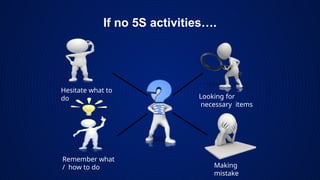
If no 5S activities….
Looking for
necessary items
Remember what
/ how to do
Hesitate what to
do
Making
mistake
If no 5S activities….
Looking for
necessary items
Remember what
/ how to do
Hesitate what to
do
Making
mistake
The 5S Conceptual
Framework
5S: Sort-Set-Shine-Standardize-Sustain
S1
sort
S2
SET
S3
SHINE
S4:
STAND
ARDIZ
E
S5
SUSTAIN
5s
5S: Sort-Set-Shine-Standardize-Sustain
S1
sort
S2
SET IN
ORDER
S3
SHINE
S4:
STANDARDIZE
S5
SUSTAIN
5s
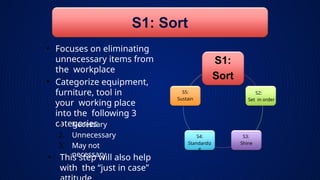
S1: Sort
• Focuses on eliminating
unnecessary items from
the workplace
• Categorize equipment,
furniture, tool in
your working place
into the following 3
categories
1. Necessary
2. Unnecessary
3. May not
necessary
• This step will also help
with the “just in case”
S1:
Sort
S2:
Set in order
S3:
Shine
S4:
Standardiz
e
S5:
Sustain
Equipment,
materials
tools etc. in your
work place
Items often use are in this category
Need it
May need it
Not need it
Equipment, material, tools files, furniture etc. can be
categorized based on the frequency of use!
Items not used in current work
process are in this category
Items only used occasionally
are in this category
S1: Sorting activities
Equipment,
materials
tools etc. in your
work place
Items often use are in this category
Need it
May need it
Not need it
Equipment, material, tools files, furniture etc. can be
categorized based on the frequency of use!
Items not used in current work
process are in this category
Items only used occasionally
are in this category
S1: Sorting activities
Examples of “Sorting”
• Place “Red tag” for categorization of items
to identify unnecessary items
• Move unnecessary items( broken tools,
obsolete jigs and fixtures, scrap and excess
raw material etc.) to central stored area
• Free up valuable floor space (Space
utilization)
• Finding abnormality of equipment and tools
(Out of order, missing parts etc.)
2
6
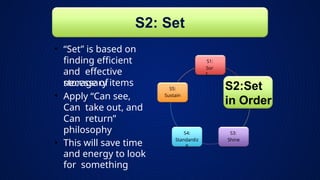
S2: Set
• “Set” is based on
finding efficient
and effective
storage of
necessary items
• Apply “Can see,
Can take out, and
Can return”
philosophy
• This will save time
and energy to look
for something
S1:
Sor
t
S2:Set
in Order
S3:
Shine
S4:
Standardiz
e
S5:
Sustain
S2: Setting activities
Have consensus among
co-workers on where and
how to organize necessary
items
Arrange them properly based on
“Can see, Can take-out, Can
return” Philosophy
Think not only “beatification. Need to
consider workflow and arrange items
Use 5S tools for proper
Organization of items
such as
• Labeling
• Color coding
• Numbering
• Zoning
etc.
• Needed items
• Items often use
(with current
work process)
Example of “Set in order”
activities
• Labeling , numbering, zoning for
clear identification of storage
areas to keep necessary items
• Set necessary items matching
with workflow to minimize
unnecessary movement and
transportation time
29
Before
5S
ADMINISTRATION
BASELINE
PHOTOGRAPHS
JULY
2023
MID.
YEAR
PROCESS
After
5S
AUGUST
2023
30
S3: Shine
• Cleaning up one’s
workplace daily so
that there is no
dust on floors,
machines or
equipment.
• It will create
ownership and
build pride in the
workers
S1:
Sort
S2:
Set
S3:
Shine
S4:
Standardize
S5:
Sustain
31
Back to
S3: Shining activities
• Clean floor, windows and walls.
• Clean and Maintain office automation
machines, medical equipment and
tools, office furniture
• Develop and follow regular
cleaning and Maintenance
schedule
Example of “Shining” activities
33
• Daily sweeping and mopping of
floor, bathroom, corridor etc.
• Regular cleaning and maintenance
of equipment and tools
• Periodical check for changes in
equipment and the service area such
as: leaks, vibration, misalignment,
breakage etc.
3
4
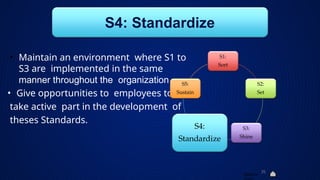
S4: Standardize
• Maintain an environment where S1 to
S3 are implemented in the same
manner throughout the organization
• Give opportunities to employees to
take active part in the development of
theses Standards.
S1:
Sort
S2:
Set
S3:
Shine
S4:
Standardize
S5:
Sustain
35
Back to
Example of “Standardize”
activities
• Work instructions, Standard
Operating Procedures (SOPs)
• Checklist development and regular
usage for SOPs
• Mechanism and format development
for ordering supplies, reporting etc
• Color coding for waste segregation
• Standardized common symbols
37
3
8
S5 : Sustain
• Maintain S1-S4
through
discipline,
commitment
and
empowerme
nt
• It focuses on
defining a
new mindset
and a
standard in
workplace
S1:
Sort
S2:
Set
S3:
Shine
S4:
Standardize
S5:
Sustain
39
Back to
Example of “Sustain” activities
• Regular progress reporting
• Refresher training
• Periodical evaluation of 5S activities
with proper advices for continuation
and further improvements
• Appreciation, recognition and
awarding on good 5S activities
• Reminder using 5S corner, new
letters, good practice sheet etc.
41
VIDEO PRESENTATION
QUIZ
ASSIGNMENT
Info Graphic of Input / Output and
storage Device
Print and cut and paste in Oslo paper.
With name and description

5s procedure_MODULE QUARTER first semes

  • 1.
    What is 5S? 5Sis a system for organizing spaces so work can be performed efficiently, effectively, and safely. This system focuses on putting everything where it belongs and keeping the workplace clean, which makes it easier for people to do their jobs without wasting time or risking injury.
  • 2.
    The word “5S(fiveS)” was generalized in 1980’s in manufacturing sector in Japan, as Toyota Production System (TPS) became famous in the sector and “5S activities” were set as one of the bases of TPS •The 5S method originated in Japan and was first introduced in the 1990s Taiichi Ohno was a Japanese industrial engineer and businessman. He considered to be a father of 5s.
  • 3.
  • 4.
  • 5.
  • 6.
  • 7.
    Identify wastes andreduce the wastes
  • 8.
  • 9.
  • 10.
  • 11.
    If no 5Sactivities…. Looking for necessary items Remember what / how to do Hesitate what to do Making mistake
  • 12.
    If no 5Sactivities…. Looking for necessary items Remember what / how to do Hesitate what to do Making mistake
  • 13.
  • 14.
  • 15.
  • 16.
    S1: Sort • Focuseson eliminating unnecessary items from the workplace • Categorize equipment, furniture, tool in your working place into the following 3 categories 1. Necessary 2. Unnecessary 3. May not necessary • This step will also help with the “just in case” S1: Sort S2: Set in order S3: Shine S4: Standardiz e S5: Sustain
  • 17.
    Equipment, materials tools etc. inyour work place Items often use are in this category Need it May need it Not need it Equipment, material, tools files, furniture etc. can be categorized based on the frequency of use! Items not used in current work process are in this category Items only used occasionally are in this category S1: Sorting activities
  • 18.
    Equipment, materials tools etc. inyour work place Items often use are in this category Need it May need it Not need it Equipment, material, tools files, furniture etc. can be categorized based on the frequency of use! Items not used in current work process are in this category Items only used occasionally are in this category S1: Sorting activities
  • 19.
    Examples of “Sorting” •Place “Red tag” for categorization of items to identify unnecessary items • Move unnecessary items( broken tools, obsolete jigs and fixtures, scrap and excess raw material etc.) to central stored area • Free up valuable floor space (Space utilization) • Finding abnormality of equipment and tools (Out of order, missing parts etc.)
  • 20.
  • 21.
    S2: Set • “Set”is based on finding efficient and effective storage of necessary items • Apply “Can see, Can take out, and Can return” philosophy • This will save time and energy to look for something S1: Sor t S2:Set in Order S3: Shine S4: Standardiz e S5: Sustain
  • 22.
    S2: Setting activities Haveconsensus among co-workers on where and how to organize necessary items Arrange them properly based on “Can see, Can take-out, Can return” Philosophy Think not only “beatification. Need to consider workflow and arrange items Use 5S tools for proper Organization of items such as • Labeling • Color coding • Numbering • Zoning etc. • Needed items • Items often use (with current work process)
  • 23.
    Example of “Setin order” activities • Labeling , numbering, zoning for clear identification of storage areas to keep necessary items • Set necessary items matching with workflow to minimize unnecessary movement and transportation time 29
  • 24.
  • 25.
    S3: Shine • Cleaningup one’s workplace daily so that there is no dust on floors, machines or equipment. • It will create ownership and build pride in the workers S1: Sort S2: Set S3: Shine S4: Standardize S5: Sustain 31 Back to
  • 26.
    S3: Shining activities •Clean floor, windows and walls. • Clean and Maintain office automation machines, medical equipment and tools, office furniture • Develop and follow regular cleaning and Maintenance schedule
  • 27.
    Example of “Shining”activities 33 • Daily sweeping and mopping of floor, bathroom, corridor etc. • Regular cleaning and maintenance of equipment and tools • Periodical check for changes in equipment and the service area such as: leaks, vibration, misalignment, breakage etc.
  • 28.
  • 29.
    S4: Standardize • Maintainan environment where S1 to S3 are implemented in the same manner throughout the organization • Give opportunities to employees to take active part in the development of theses Standards. S1: Sort S2: Set S3: Shine S4: Standardize S5: Sustain 35 Back to
  • 30.
    Example of “Standardize” activities •Work instructions, Standard Operating Procedures (SOPs) • Checklist development and regular usage for SOPs • Mechanism and format development for ordering supplies, reporting etc • Color coding for waste segregation • Standardized common symbols 37
  • 31.
  • 32.
    S5 : Sustain •Maintain S1-S4 through discipline, commitment and empowerme nt • It focuses on defining a new mindset and a standard in workplace S1: Sort S2: Set S3: Shine S4: Standardize S5: Sustain 39 Back to
  • 33.
    Example of “Sustain”activities • Regular progress reporting • Refresher training • Periodical evaluation of 5S activities with proper advices for continuation and further improvements • Appreciation, recognition and awarding on good 5S activities • Reminder using 5S corner, new letters, good practice sheet etc. 41
  • 35.
  • 37.
  • 38.
    ASSIGNMENT Info Graphic ofInput / Output and storage Device Print and cut and paste in Oslo paper. With name and description