4G Mobile TechnologiesAn IEEE Comsoc Indonesia Chapter Lecture
@kuncoro
Mobile Communications
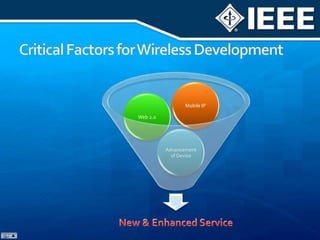
Critical Factors for Wireless Development
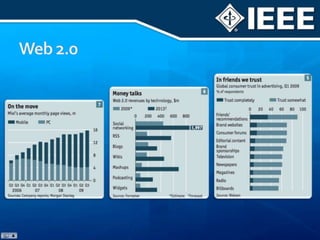
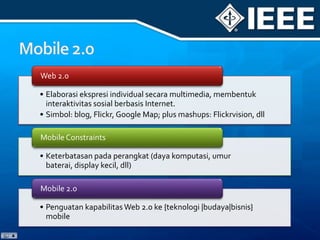
Web 2.0
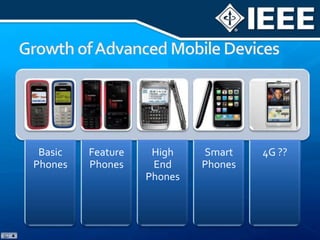
Growth of Advanced Mobile Devices
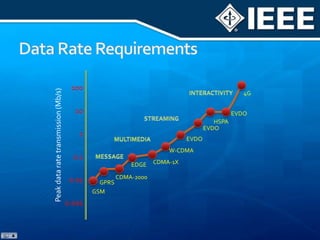
Data Rate Requirements100INTERACTIVITY4G10EVDOSTREAMINGHSPAEVDO1EVDOMULTIMEDIAPeak data rate transmission (Mb/s)W-CDMA0.1MESSAGECDMA-1XEDGECDMA-20000.01GPRSGSM0.001
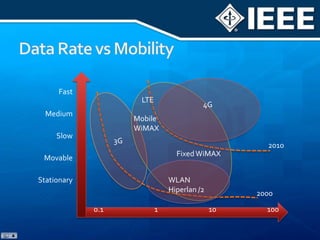
Data Rate vs MobilityFastLTE4GMediumMobileWiMAXSlow3G2010Fixed WiMAXMovableWLANHiperlan /2Stationary20000.1110100
4G Mobile Technology
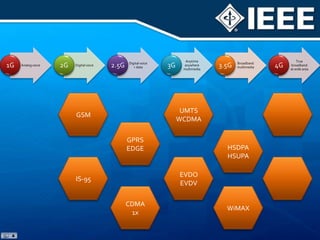
GSMUMTS WCDMAGPRSEDGEHSDPAHSUPAEVDO EVDVIS-95CDMA1xWiMAX
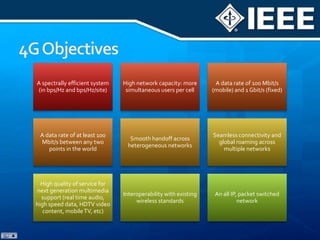
4G Objectives
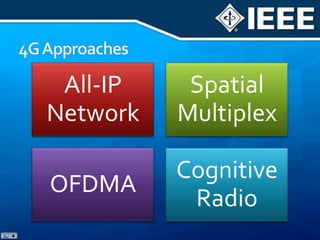
4G Approaches
All-IP Network
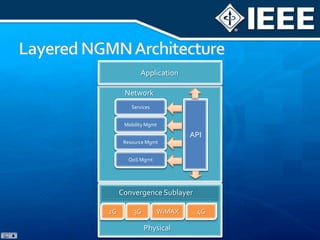
ApplicationNetworkAPIServicesMobility MgmtResource MgmtQoS MgmtConvergence Sublayer2G3GWiMAX4GPhysicalLayered NGMN Architecture
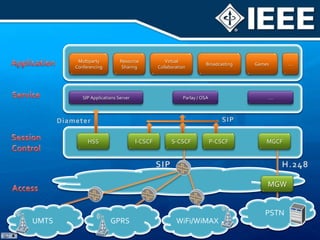
Multiparty ConferencingResource SharingVirtual CollaborationBroadcastingGames….ApplicationServiceSIP Applications ServerParlay / OSA….SIPDiameterSessionControlI-CSCFP-CSCFHSSS-CSCFMGCFSIPH.248MGWAccessPSTNWiFi/WiMAXGPRSUMTS
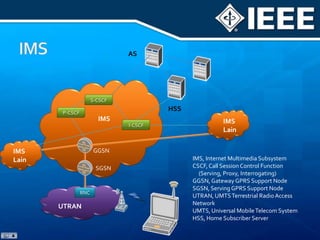
ASS-CSCFHSSP-CSCFIMSIMSLainI-CSCFGGSNIMSLainIMS, Internet Multimedia SubsystemCSCF, Call Session Control Function     (Serving, Proxy, Interrogating)GGSN, Gateway GPRS Support NodeSGSN, Serving GPRS Support NodeUTRAN, UMTS Terrestrial Radio Access NetworkUMTS, Universal Mobile Telecom SystemHSS, Home Subscriber ServerSGSNRNCUTRANIMS
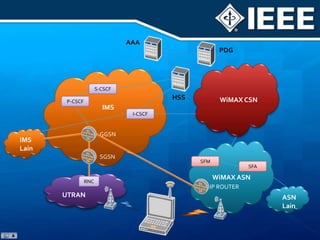
AAAPDGS-CSCFHSSWiMAX CSNP-CSCFIMSI-CSCFGGSNIMSLainSGSNSFMSFAWiMAX ASNRNCIP ROUTERUTRANASNLain
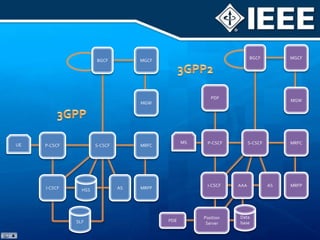
BGCFMGCFBGCFMGCF3GPP2PDFMGWMGW3GPPS-CSCFMRFCP-CSCFS-CSCFMRFCP-CSCFMSUEASMRFPI-CSCFAAAASMRFPHSSI-CSCFData baseSLFPosition ServerPDE
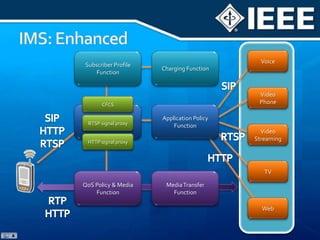
IMS: EnhancedVoiceCharging FunctionSubscriber Profile FunctionSIPVideo PhoneCFCSSignalling FunctionApplication Policy FunctionSIPHTTPRTSPRTSP signal proxyVideo StreamingRTSPHTTP signal proxyHTTPTVQoS Policy & Media FunctionMedia Transfer FunctionRTPHTTPWeb
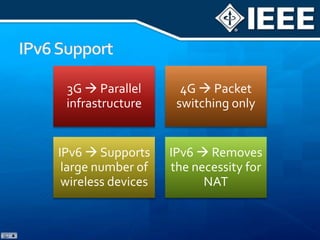
IPv6 Support
Cognitive Radio
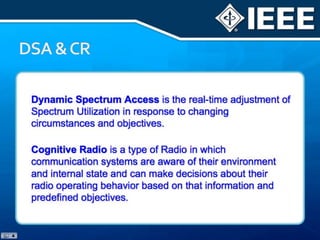
Cognitive radio (CR), also related to software-defined radio (SDR), is a type of Radio in which communication systems are aware of their environment and internal state and can make decisions about their radio operating behavior based on that information and predefined objectives.Cognitive Radio
DSA & CR
IEEE 1900 is a suite to support cognitive radio (CR), dynamic spectrum access (DSA), and coexistence.Previous standards s.a. WiFi (802.11), Zigbee (802.15.4), and WiMAX (802.16) have included certain level of CR.CR will be related to dynamic spectrum access (DSA), which is the real-time adjustment of Spectrum Utilization in response to changing circumstances and objectives.The most interesting aspect is coexistence: resource selection to determine the type of wireless/mobile access.IEEE 1900
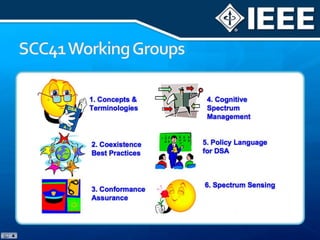
SCC41 Working Groups
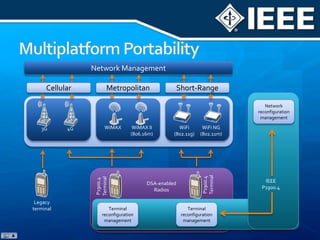
Network ManagementMetropolitanShort-RangeCellularNetwork reconfiguration managementWiMAXWiMAX II(806.16m)WiFi(802.11g)WiFi NG(802.11m)3G4GDSA-enabledRadiosIEEEP1900.4P1900.4TerminalP1900.4TerminalLegacyterminalTerminal reconfiguration managementTerminal reconfiguration managementMultiplatform Portability
Access Scheme
New access schemes like Orthogonal FDMA (OFDMA), Single Carrier FDMA (SC-FDMA), Interleaved FDMA and Multi-carrier CDMA (MC-CDMA) are gaining more importance for the next generation systems.WiMAX: OFDMALTE: OFDMA (downlink), IFDMA (uplink) The other important advantage of the above is that they require less complexity for equalization at the receiver. This is an added advantage especially in the MIMO environments since the spatial multiplexing transmission of MIMO systems inherently requires high complexity equalization at the receiver.In addition to improvements in these multiplexing systems, improved modulation techniques are being used. Whereas earlier standards largely used PSK, more efficient systems such as 64QAM are being proposed for use with the LTEAccess Scheme
Orthogonal frequency-division multiplexingFDM in which sub-channels overlap without interferingOFDMSingle Carrier Transmission(WCDMA etc)5 MHzSubcarriersOrthogonal FrequencyDivision Multiplexinge.g. 5 MHz
Adaptable to severe channel conditions without complex equalization.Robust against narrow-band co-channel interference.Robust against intersymbol interference (ISI) and fading caused by multipath propagation.High spectral efficiency.Efficient implementation using FFTLow sensitivity to time synchronization errors.Facilitates Single Frequency Networks (SFNs), i.e. transmitter macrodiversity.OFDM Advantages
TDMA/FDMA operation = OFDMAFrequency sub-channels are composed of multiple, non-adjacent carriers OFDMA: Combining TDMA and FDMA
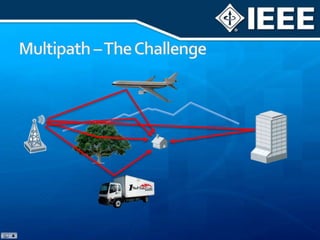
Multipath – The Challenge
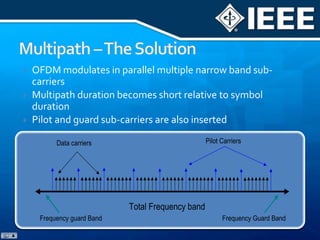
OFDM modulates in parallel multiple narrow band sub-carriersMultipath duration becomes short relative to symbol durationPilot and guard sub-carriers are also insertedMultipath – The Solution
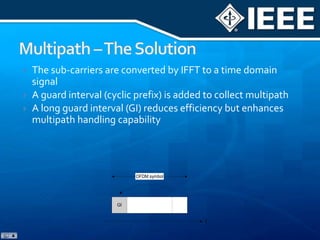
The sub-carriers are converted by IFFT to a time domain signalA guard interval (cyclic prefix) is added to collect multipathA long guard interval (GI) reduces efficiency but enhances multipath handling capabilityMultipath – The Solution
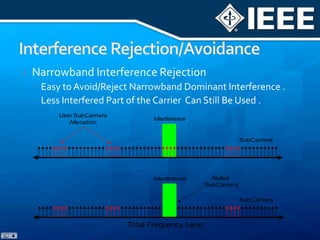
Narrowband Interference RejectionEasy to Avoid/Reject Narrowband Dominant Interference .Less Interfered Part of the Carrier  Can Still Be Used .Interference Rejection/Avoidance
Using shaping on the signal peaksLimiting the PAPR to a constant value by vector reductionPAPR Reduction
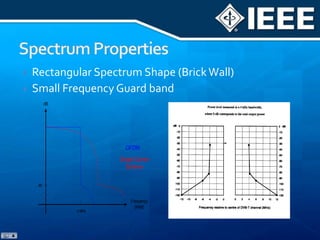
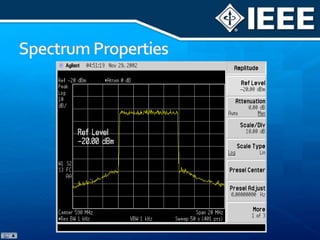
Rectangular Spectrum Shape (Brick Wall)Small Frequency Guard bandSpectrum Properties
Spectrum Properties
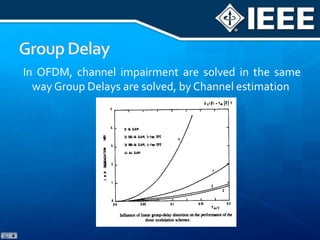
In OFDM, channel impairment are solved in the same way Group Delays are solved, by Channel estimationGroup Delay
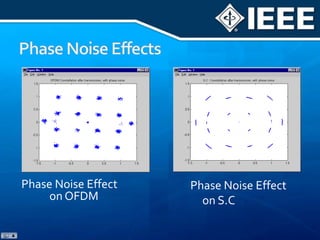
Phase Noise EffectsPhase Noise Effect on S.CPhase Noise Effect on OFDM
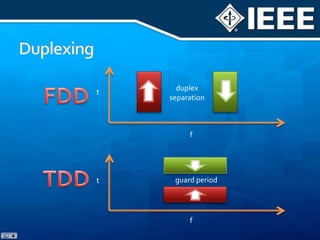
DuplexingFDDduplexseparationtfTDDguard periodtf
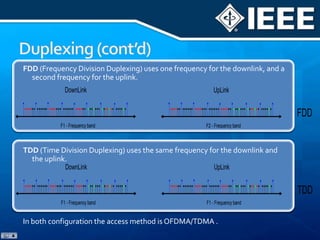
FDD (Frequency Division Duplexing) uses one frequency for the downlink, and a second frequency for the uplink.TDD (Time Division Duplexing) uses the same frequency for the downlink and the uplink.In both configuration the access method is OFDMA/TDMA .Duplexing (cont’d)
Spatial Multiplexing
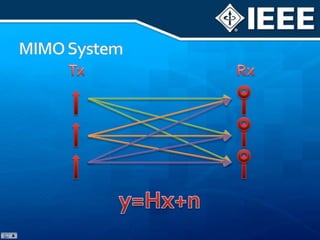
Multiple antenna technologies are emerging to achieve high rate, high reliability, and long range communications.Spatial multiplexing gained importance for its bandwidth conservation and power efficiency. It involves deploying multiple antennas at the transmitter and at the receiver. Independent streams can then be transmitted simultaneously from all the antennas. This increases the data rate into multiple folds with the number equal to minimum of the number of transmit and receive antennas. This is called MIMO (as a branch of intelligent antenna).Spatial Multiplexing
MIMO SystemTxRxy=Hx+n
MIMI Schemes
MIMO Techniques Comparison
MIMO Capabilities
Adaptive MIMO
Space Time CodingA space–time code (STC) is a method employed to improve the reliability of data transmission in wireless communication systems using multiple transmit antennas. STCs rely on transmitting multiple, redundant copies of a data stream to the receiver in the hope that at least some of them may survive the physical path between transmission and reception in a good enough state to allow reliable decoding.
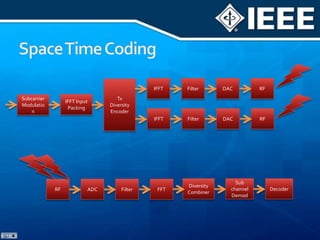
Space Time CodingIFFTFilterDACRFTx Diversity EncoderIFFT Input PackingSubcarrier ModulationIFFTFilterDACRFDiversity CombinerSub channel DemodDecoderRFADCFilterFFT
Schedules & Candidates
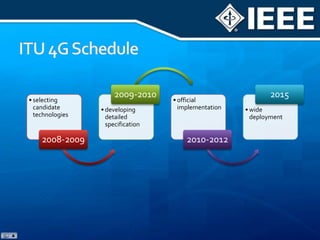
ITU 4G Schedule
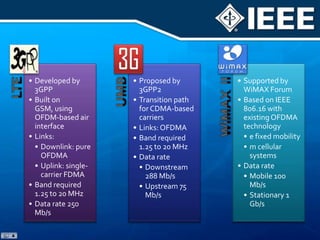
LTE & WiMAX II Terminologies
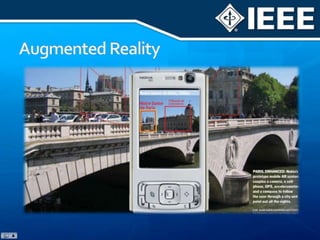
Context-AwareMobile Applications
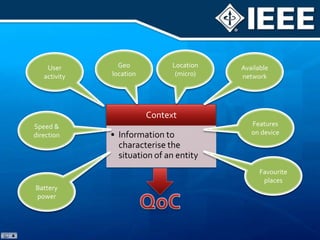
Location (micro)Geo locationAvailable networkUser activityFeatures on deviceSpeed & directionFavourite placesBattery powerQoC
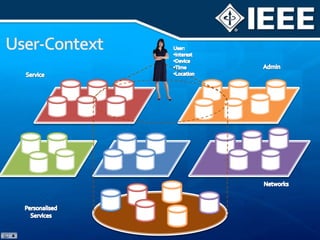
User-ContextUser:Interest
Device

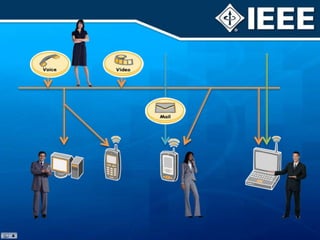
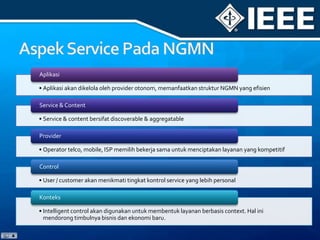
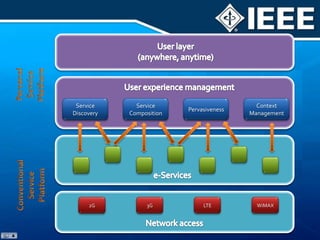
4G Mobile Network & Applications