4G - An Ultimate Mobile Solution By: Aman Jain, 1BJ05EC003. 3/18/2009 Department of Electronics and Communication, SBMJCE
Overview Wireless Future - Evolution -> 3G  4G Mobile Technology Motivation for 4G Research Before 3G Has Not Been Deployed? Objectives Approaches What is needed to Build 4G Networks of Future? THE CREW: CURRENT R&D Wireless Future -> Issues and Threats  Developments/ Industry Initiatives Applications 3/18/2009 Department of Electronics and Communication, SBMJCE
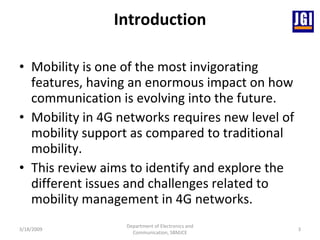
Introduction Mobility is one of the most invigorating features, having an enormous impact on how communication is evolving into the future.  Mobility in 4G networks requires new level of mobility support as compared to traditional mobility.  This review aims to identify and explore the different issues and challenges related to mobility management in 4G networks. 3/18/2009 Department of Electronics and Communication, SBMJCE
3/18/2009 Department of Electronics and Communication, SBMJCE
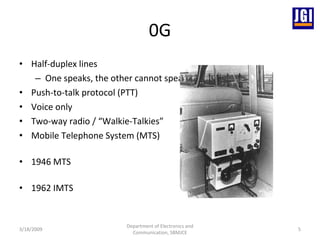
0G Half-duplex lines One speaks, the other cannot speak. Push-to-talk protocol (PTT) Voice only Two-way radio / “Walkie-Talkies” Mobile Telephone System (MTS) 1946 MTS 1962 IMTS 3/18/2009 Department of Electronics and Communication, SBMJCE
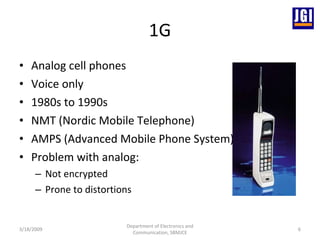
1G Analog cell phones Voice only 1980s to 1990s NMT (Nordic Mobile Telephone) AMPS (Advanced Mobile Phone System) Problem with analog: Not encrypted Prone to distortions  3/18/2009 Department of Electronics and Communication, SBMJCE
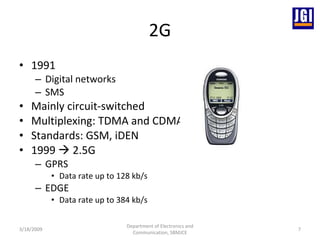
2G 1991 Digital networks SMS Mainly circuit-switched Multiplexing: TDMA and CDMA Standards: GSM, iDEN 1999    2.5G GPRS Data rate up to 128 kb/s EDGE Data rate up to 384 kb/s 3/18/2009 Department of Electronics and Communication, SBMJCE
3G Combines with IP based services Video-conferencing Music downloading? Transfer of data: Emails Documents CDMA2000, UMTS, W-CDMA Problem: Different places, different air interfaces Cost of deploying Internet, e-mail, fax, e-commerce, music, video clips, and videoconferencing UMTS-  UNIVERSAL MOBILE  TELECOMMUNICATION SYSTEM 3/18/2009 Department of Electronics and Communication, SBMJCE
4G Expected in 2010 M obile multimedia,  A nytime anywhere,  G lobal support,  I ntegrated wireless solution,  C ustomized personal service WiMAX 3/18/2009 Department of Electronics and Communication, SBMJCE
Wireless Future - Evolution -> 3G (3rd generation of mobile networks)  The Third Generation of mobile communications systems will soon be implemented.  Following on the heals of analog and digital technology, the Third Generation will be digital mobile multimedia offering broadband mobile communications with voice, video, graphics, audio and other information.  In fact, in countries such as    Japan, South Korea and Singapore 3G networks are already deployed and being used.  3/18/2009 Department of Electronics and Communication, SBMJCE
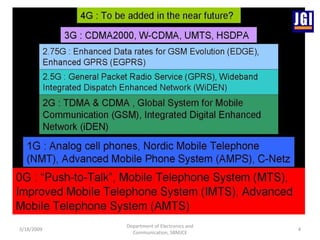
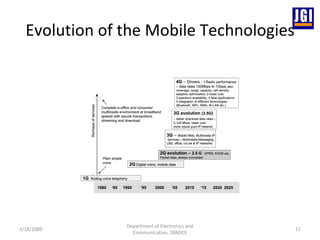
Evolution of the Mobile Technologies 3/18/2009 Department of Electronics and Communication, SBMJCE
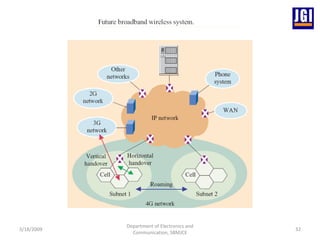
What is 4G anyway? 4G refers to the next generation of wireless technology that promises higher data rates and expanded multimedia services.  The 4G is defined as a completely new fully IP-based integrated system of systems and network of networks achieved after convergence of wired and wireless networks as well as computers, consumer electronics, and communication technology and several other convergences that will be capable to provide 100 Mbps and 1 Gbps, respectively in outdoor and indoor environments, with end-to-end QoS and high security, offering any kind of services at any time as per user requirements, anywhere with seamless interoperability, always on, affordable cost, one billing and fully  personalized .  3/18/2009 Department of Electronics and Communication, SBMJCE
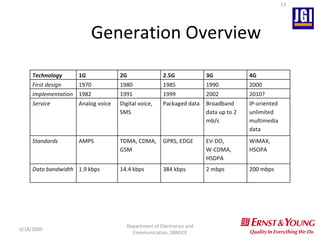
3/18/2009 Department of Electronics and Communication, SBMJCE Generation Overview Technology 1G 2G 2.5G 3G 4G First design 1970 1980 1985 1990 2000 Implementation 1982 1991 1999 2002 2010? Service Analog voice Digital voice, SMS Packaged data Broadband data up to 2 mb/s IP-oriented unlimited multimedia data Standards AMPS TDMA, CDMA, GSM GPRS, EDGE EV-DO,  W-CDMA, HSDPA WiMAX, HSOPA Data bandwidth 1.9 kbps 14.4 kbps 384 kbps 2 mbps 200 mbps
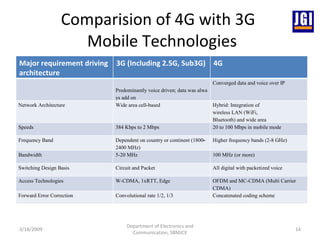
Comparision of 4G with 3G   Mobile Technologies 3/18/2009 Department of Electronics and Communication, SBMJCE Major requirement driving architecture   3G (Including 2.5G, Sub3G)  4G     Predominantly voice driven; data was always add on   Converged data and voice over IP  Network Architecture   Wide area cell-based   Hybrid: Integration of wireless LAN (WiFi, Bluetooth) and wide area  Speeds  384 Kbps to 2 Mbps   20 to 100 Mbps in mobile mode   Frequency Band   Dependent on country or continent (1800 ‐ 2400 MHz)   Higher frequency bands (2-8 GHz)   Bandwidth   5-20 MHz   100 MHz (or more)   Switching Design Basis   Circuit and Packet   All digital with packetized voice   Access Technologies   W-CDMA, 1xRTT, Edge   OFDM and MC-CDMA (Multi Carrier CDMA)   Forward Error Correction   Convolutional rate 1/2, 1/3   Concatenated coding scheme 
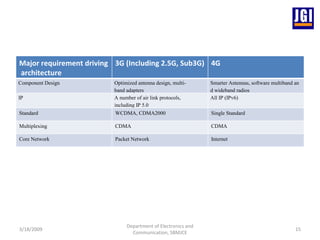
3/18/2009 Department of Electronics and Communication, SBMJCE Major requirement driving architecture   3G (Including 2.5G, Sub3G)  4G  Component Design   Optimized antenna design, multi-band adapters   Smarter Antennas, software multiband and wideband radios   IP    A number of air link protocols, including IP 5.0    All IP (IPv6)   Standard  WCDMA, CDMA2000 Single Standard Multiplexing CDMA CDMA Core Network Packet Network Internet
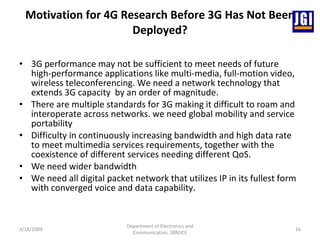
Motivation for 4G Research Before 3G Has Not Been Deployed? 3G performance may not be sufficient to meet needs of future high-performance applications like multi-media, full-motion video, wireless teleconferencing. We need a network technology that extends 3G capacity  by an order of magnitude.   There are multiple standards for 3G making it difficult to roam and interoperate across networks. we need global mobility and service portability  Difficulty in continuously increasing bandwidth and high data rate to meet multimedia services requirements, together with the coexistence of different services needing different QoS. We need wider bandwidth  We need all digital packet network that utilizes IP in its fullest form with converged voice and data capability.  3/18/2009 Department of Electronics and Communication, SBMJCE
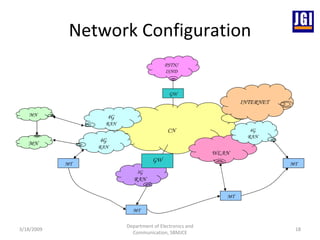
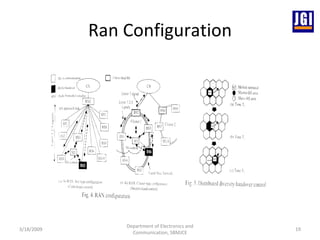
SYSTEM ARCHITECTURE Network configuration  RAN configuration 3/18/2009 Department of Electronics and Communication, SBMJCE
Network Configuration 3/18/2009 Department of Electronics and Communication, SBMJCE MN MN PSTN/ ISND GW 3G RAN MT GW MT MT MT CN INTERNET WLAN 4G RAN 4G RAN 4G RAN
Ran Configuration 3/18/2009 Department of Electronics and Communication, SBMJCE
Objectives The 4G working group has defined the following as objectives of the 4G wireless communication standard: A  spectrally efficient  system (in bits/s/Hz and bits/s/Hz/site) High network capacity: more simultaneous users per cell A nominal data rate of 100 Mbit/s while the client physically moves at high speeds relative to the station, and 1 Gbit/s while client and station are in relatively fixed positions as defined by the  ITU-R A data rate of at least 100 Mbit/s between any two points in the world Smooth  handoff  across heterogeneous networks Seamless connectivity and global  roaming  across multiple networks Interoperability with existing wireless standards and An all IP, packet switched network In summary, the 4G system should dynamically share and utilise network resources to meet the minimal requirements of all the 4G enabled users. 3/18/2009 Department of Electronics and Communication, SBMJCE
Approaches Consideration points Coverage, radio environment, spectrum, services, business models and deployment types, users 3/18/2009 Department of Electronics and Communication, SBMJCE
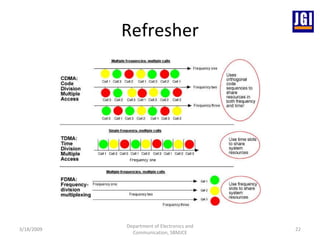
Refresher 3/18/2009 Department of Electronics and Communication, SBMJCE
Principal Technologies Baseband techniques [9]   OFDM : To exploit the frequency selective channel property MIMO : To attain ultra high spectral efficiency Turbo principle : To minimize the required SNR at the reception side Adaptive radio interface Modulation , spatial processing including multi-antenna and multi-user MIMO 3/18/2009 Department of Electronics and Communication, SBMJCE
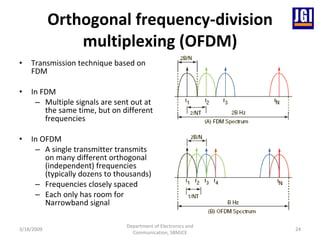
Orthogonal frequency-division multiplexing (OFDM) Transmission technique based on FDM  In FDM Multiple signals are sent out at the same time, but on different frequencies In OFDM A single transmitter transmits on many different orthogonal (independent) frequencies (typically dozens to thousands) Frequencies closely spaced  Each only has room for Narrowband signal 3/18/2009 Department of Electronics and Communication, SBMJCE
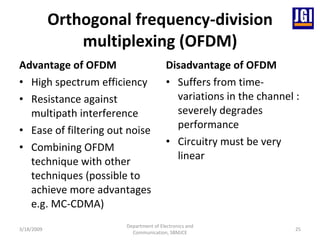
Orthogonal frequency-division multiplexing (OFDM) Advantage of OFDM High spectrum efficiency Resistance against multipath interference  Ease of filtering out noise  Combining OFDM technique with other techniques (possible to achieve more advantages e.g. MC-CDMA) Disadvantage of OFDM Suffers from time-variations in the channel : severely degrades performance Circuitry must be very linear 3/18/2009 Department of Electronics and Communication, SBMJCE
Components - Access schemes Recently, new access schemes like Orthogonal FDMA (OFDMA), Single Carrier FDMA (SC-FDMA), Interleaved FDMA and Multi-carrier code division multiple access (MC-CDMA) are gaining more importance for the next generation systems.  WiMax is using OFDMA in the downlink and in the uplink. For the next generation UMTS, OFDMA is being considered for the downlink. By contrast, IFDMA is being considered for the uplink since OFDMA contributes more to the PAPR related issues and results in nonlinear operation of amplifiers.  IFDMA provides less power fluctuation and thus avoids amplifier issues.  3/18/2009 Department of Electronics and Communication, SBMJCE
Components – IPV6 By the time that 4G is deployed, the process of IPv4 address exhaustion is expected to be in its final stages. Therefore, in the context of 4G, IPv6 support is essential in order to support a large number of wireless-enabled devices.  By increasing the number of IP addresses, IPv6 removes the need for Network Address Translation (NAT), a method of sharing a limited number of addresses among a larger group of devices. In the context of 4G, IPv6 also enables a number of applications with better multicast, security, and route optimization capabilities.  3/18/2009 Department of Electronics and Communication, SBMJCE
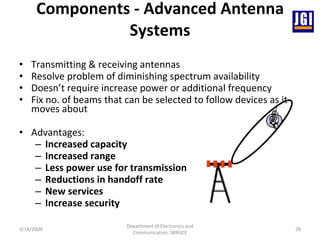
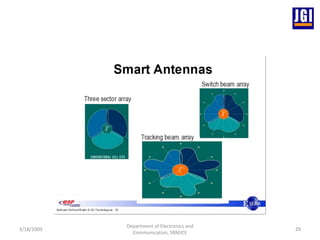
Components - Advanced Antenna Systems Transmitting & receiving antennas  Resolve problem of diminishing spectrum availability  Doesn’t require increase power or additional frequency  Fix no. of beams that can be selected to follow devices as it moves about  Advantages: Increased capacity   Increased range   Less power use for transmission  Reductions in handoff rate New services Increase security   3/18/2009 Department of Electronics and Communication, SBMJCE
3/18/2009 Department of Electronics and Communication, SBMJCE
Components – Software-Defined Radio (SDR) SDR is one form of open wireless architecture (OWA). Since 4G is a collection of wireless standards, the final form of a 4G device will constitute various standards. This can be efficiently realized using SDR technology, which is categorized to the area of the radio convergence. 3/18/2009 Department of Electronics and Communication, SBMJCE
What is needed to Build 4G Networks of Future? Lower Price Points Only Slightly Higher than Alternatives   More Coordination Among Spectrum Regulators Around the World More Academic Research Standardization of wireless networks A Voice-independent Business Justification Thinking Integration Across Different Network Topologies Non-disruptive Implementation 3/18/2009 Department of Electronics and Communication, SBMJCE
3/18/2009 Department of Electronics and Communication, SBMJCE
THE CREW: CURRENT R&D Alcatel, Ericsson, Motorola, Nokia, and Siemens founded the Wireless World Research Forum (WWRF) in early 2001 (www.wireless-world-research.org).  That forum's objective is to formulate visions on strategic future research directions for the wireless field.  The timeframe for these reflections is in the range of 7 to 12 years from now. The main deliverables of the WWRF are white papers on emerging-technology topics and its seminal Book of Visions. 3/18/2009 Department of Electronics and Communication, SBMJCE
Wireless Future -> Issues and Threats  Wireless Spam Security Lack of Standards 3/18/2009 Department of Electronics and Communication, SBMJCE
Developments/ Industry Initiatives The Japanese company NTT DoCoMo has been testing a 4G communication system prototype with 4x4 MIMO called VSF-OFCDM at 100 Mbit/s while moving, and 1 Gbit/s while stationary.  Digiweb, an Irish fixed and wireless broadband company, has announced that they have received a mobile communications license from the Irish Telecoms regulator, ComReg.  Sprint plans to launch 4G services in trial markets by the end of 2007 with plans to deploy a network that reaches as many as 100 million people in 2008 and has also announced WiMax service called Xohm. Tested in Chicago, this speed was clocked at 100 Mbit/s. WWRF (Wireless World Research Forum)- consisting of Alcatel, Ericsson, Nokia and Siemens have started a research forum for 4G  3/18/2009 Department of Electronics and Communication, SBMJCE
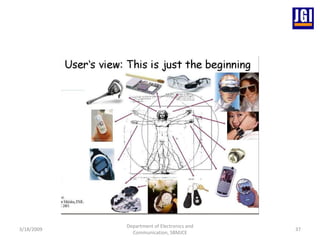
Applications •  E-commerce •  Business/Work •  Private Life •  Vehicular •  Public Place •  Entertainment •  Education   3/18/2009 Department of Electronics and Communication, SBMJCE
3/18/2009 Department of Electronics and Communication, SBMJCE
References Mobility Management Challenges and Issues in 4G Heterogeneous Networks Sadia Hussain, Zara Hamid and Naveed S. Khattak  Department of Computer Sciences,MCS, NUST, Pakistan 4G Wireless Systems in Virtex-II by James A. Watson -- Manager, Applications Engineering, Xilinx, Inc. (7/1/01 -- Issue 40) jim.watson@xilinx.com Y Raivio, “4G - Hype or Reality”. In  IEE 3G Mobile Communication Technologies , Conference Publication, Mar.2001, No 477, pp. 346-350.   Janny Hu,Willie W. Lu ,“Open Wireless Architecture - The Core to 4G Mobile Communications”. In  Proceedings of ICCT,  2003. Juuso Pesola, Sami Pönkänen,”Location-aided Handover in Heterogeneous Wireless Networks”. In  Wireless Personal Communications  ,Volume 30 , Issue 2-4 , September 2004 Jawad Ibrahim (December 2002).  "4G Features"  (PDF).  Bechtel  Telecommunications Technical Journal . Retrieved on 2007-03-26 .   3/18/2009 Department of Electronics and Communication, SBMJCE
http://www.wirelessnewsfactor.com/perl/story/6186.html http://www.charmed.com/html/press/articles/47.html http://209.249.142.27/nnpm/owa/NRpublicreports.usageweekly   www.google.com www.wikipedia.com www.slideshare.net www.4g.in www.4G.co.uk www.futuregeneration-research.com Electronics for u 3/18/2009 Department of Electronics and Communication, SBMJCE
THANK YOU 3/18/2009 Department of Electronics and Communication, SBMJCE

4 G mobile technology

  • 1.
    4G - AnUltimate Mobile Solution By: Aman Jain, 1BJ05EC003. 3/18/2009 Department of Electronics and Communication, SBMJCE
  • 2.
    Overview Wireless Future- Evolution -> 3G 4G Mobile Technology Motivation for 4G Research Before 3G Has Not Been Deployed? Objectives Approaches What is needed to Build 4G Networks of Future? THE CREW: CURRENT R&D Wireless Future -> Issues and Threats Developments/ Industry Initiatives Applications 3/18/2009 Department of Electronics and Communication, SBMJCE
  • 3.
    Introduction Mobility isone of the most invigorating features, having an enormous impact on how communication is evolving into the future. Mobility in 4G networks requires new level of mobility support as compared to traditional mobility. This review aims to identify and explore the different issues and challenges related to mobility management in 4G networks. 3/18/2009 Department of Electronics and Communication, SBMJCE
  • 4.
    3/18/2009 Department ofElectronics and Communication, SBMJCE
  • 5.
    0G Half-duplex linesOne speaks, the other cannot speak. Push-to-talk protocol (PTT) Voice only Two-way radio / “Walkie-Talkies” Mobile Telephone System (MTS) 1946 MTS 1962 IMTS 3/18/2009 Department of Electronics and Communication, SBMJCE
  • 6.
    1G Analog cellphones Voice only 1980s to 1990s NMT (Nordic Mobile Telephone) AMPS (Advanced Mobile Phone System) Problem with analog: Not encrypted Prone to distortions 3/18/2009 Department of Electronics and Communication, SBMJCE
  • 7.
    2G 1991 Digitalnetworks SMS Mainly circuit-switched Multiplexing: TDMA and CDMA Standards: GSM, iDEN 1999  2.5G GPRS Data rate up to 128 kb/s EDGE Data rate up to 384 kb/s 3/18/2009 Department of Electronics and Communication, SBMJCE
  • 8.
    3G Combines withIP based services Video-conferencing Music downloading? Transfer of data: Emails Documents CDMA2000, UMTS, W-CDMA Problem: Different places, different air interfaces Cost of deploying Internet, e-mail, fax, e-commerce, music, video clips, and videoconferencing UMTS- UNIVERSAL MOBILE TELECOMMUNICATION SYSTEM 3/18/2009 Department of Electronics and Communication, SBMJCE
  • 9.
    4G Expected in2010 M obile multimedia, A nytime anywhere, G lobal support, I ntegrated wireless solution, C ustomized personal service WiMAX 3/18/2009 Department of Electronics and Communication, SBMJCE
  • 10.
    Wireless Future -Evolution -> 3G (3rd generation of mobile networks) The Third Generation of mobile communications systems will soon be implemented. Following on the heals of analog and digital technology, the Third Generation will be digital mobile multimedia offering broadband mobile communications with voice, video, graphics, audio and other information. In fact, in countries such as    Japan, South Korea and Singapore 3G networks are already deployed and being used. 3/18/2009 Department of Electronics and Communication, SBMJCE
  • 11.
    Evolution of theMobile Technologies 3/18/2009 Department of Electronics and Communication, SBMJCE
  • 12.
    What is 4Ganyway? 4G refers to the next generation of wireless technology that promises higher data rates and expanded multimedia services.  The 4G is defined as a completely new fully IP-based integrated system of systems and network of networks achieved after convergence of wired and wireless networks as well as computers, consumer electronics, and communication technology and several other convergences that will be capable to provide 100 Mbps and 1 Gbps, respectively in outdoor and indoor environments, with end-to-end QoS and high security, offering any kind of services at any time as per user requirements, anywhere with seamless interoperability, always on, affordable cost, one billing and fully personalized . 3/18/2009 Department of Electronics and Communication, SBMJCE
  • 13.
    3/18/2009 Department ofElectronics and Communication, SBMJCE Generation Overview Technology 1G 2G 2.5G 3G 4G First design 1970 1980 1985 1990 2000 Implementation 1982 1991 1999 2002 2010? Service Analog voice Digital voice, SMS Packaged data Broadband data up to 2 mb/s IP-oriented unlimited multimedia data Standards AMPS TDMA, CDMA, GSM GPRS, EDGE EV-DO, W-CDMA, HSDPA WiMAX, HSOPA Data bandwidth 1.9 kbps 14.4 kbps 384 kbps 2 mbps 200 mbps
  • 14.
    Comparision of 4Gwith 3G Mobile Technologies 3/18/2009 Department of Electronics and Communication, SBMJCE Major requirement driving architecture  3G (Including 2.5G, Sub3G) 4G   Predominantly voice driven; data was always add on  Converged data and voice over IP Network Architecture  Wide area cell-based  Hybrid: Integration of wireless LAN (WiFi, Bluetooth) and wide area Speeds 384 Kbps to 2 Mbps  20 to 100 Mbps in mobile mode  Frequency Band  Dependent on country or continent (1800 ‐ 2400 MHz)  Higher frequency bands (2-8 GHz)  Bandwidth  5-20 MHz  100 MHz (or more)  Switching Design Basis  Circuit and Packet  All digital with packetized voice  Access Technologies  W-CDMA, 1xRTT, Edge  OFDM and MC-CDMA (Multi Carrier CDMA)  Forward Error Correction  Convolutional rate 1/2, 1/3  Concatenated coding scheme 
  • 15.
    3/18/2009 Department ofElectronics and Communication, SBMJCE Major requirement driving architecture  3G (Including 2.5G, Sub3G) 4G Component Design  Optimized antenna design, multi-band adapters  Smarter Antennas, software multiband and wideband radios  IP   A number of air link protocols, including IP 5.0   All IP (IPv6)  Standard WCDMA, CDMA2000 Single Standard Multiplexing CDMA CDMA Core Network Packet Network Internet
  • 16.
    Motivation for 4GResearch Before 3G Has Not Been Deployed? 3G performance may not be sufficient to meet needs of future high-performance applications like multi-media, full-motion video, wireless teleconferencing. We need a network technology that extends 3G capacity  by an order of magnitude.  There are multiple standards for 3G making it difficult to roam and interoperate across networks. we need global mobility and service portability Difficulty in continuously increasing bandwidth and high data rate to meet multimedia services requirements, together with the coexistence of different services needing different QoS. We need wider bandwidth We need all digital packet network that utilizes IP in its fullest form with converged voice and data capability. 3/18/2009 Department of Electronics and Communication, SBMJCE
  • 17.
    SYSTEM ARCHITECTURE Networkconfiguration RAN configuration 3/18/2009 Department of Electronics and Communication, SBMJCE
  • 18.
    Network Configuration 3/18/2009Department of Electronics and Communication, SBMJCE MN MN PSTN/ ISND GW 3G RAN MT GW MT MT MT CN INTERNET WLAN 4G RAN 4G RAN 4G RAN
  • 19.
    Ran Configuration 3/18/2009Department of Electronics and Communication, SBMJCE
  • 20.
    Objectives The 4Gworking group has defined the following as objectives of the 4G wireless communication standard: A spectrally efficient system (in bits/s/Hz and bits/s/Hz/site) High network capacity: more simultaneous users per cell A nominal data rate of 100 Mbit/s while the client physically moves at high speeds relative to the station, and 1 Gbit/s while client and station are in relatively fixed positions as defined by the ITU-R A data rate of at least 100 Mbit/s between any two points in the world Smooth handoff across heterogeneous networks Seamless connectivity and global roaming across multiple networks Interoperability with existing wireless standards and An all IP, packet switched network In summary, the 4G system should dynamically share and utilise network resources to meet the minimal requirements of all the 4G enabled users. 3/18/2009 Department of Electronics and Communication, SBMJCE
  • 21.
    Approaches Consideration pointsCoverage, radio environment, spectrum, services, business models and deployment types, users 3/18/2009 Department of Electronics and Communication, SBMJCE
  • 22.
    Refresher 3/18/2009 Departmentof Electronics and Communication, SBMJCE
  • 23.
    Principal Technologies Basebandtechniques [9] OFDM : To exploit the frequency selective channel property MIMO : To attain ultra high spectral efficiency Turbo principle : To minimize the required SNR at the reception side Adaptive radio interface Modulation , spatial processing including multi-antenna and multi-user MIMO 3/18/2009 Department of Electronics and Communication, SBMJCE
  • 24.
    Orthogonal frequency-division multiplexing(OFDM) Transmission technique based on FDM In FDM Multiple signals are sent out at the same time, but on different frequencies In OFDM A single transmitter transmits on many different orthogonal (independent) frequencies (typically dozens to thousands) Frequencies closely spaced Each only has room for Narrowband signal 3/18/2009 Department of Electronics and Communication, SBMJCE
  • 25.
    Orthogonal frequency-division multiplexing(OFDM) Advantage of OFDM High spectrum efficiency Resistance against multipath interference Ease of filtering out noise Combining OFDM technique with other techniques (possible to achieve more advantages e.g. MC-CDMA) Disadvantage of OFDM Suffers from time-variations in the channel : severely degrades performance Circuitry must be very linear 3/18/2009 Department of Electronics and Communication, SBMJCE
  • 26.
    Components - Accessschemes Recently, new access schemes like Orthogonal FDMA (OFDMA), Single Carrier FDMA (SC-FDMA), Interleaved FDMA and Multi-carrier code division multiple access (MC-CDMA) are gaining more importance for the next generation systems. WiMax is using OFDMA in the downlink and in the uplink. For the next generation UMTS, OFDMA is being considered for the downlink. By contrast, IFDMA is being considered for the uplink since OFDMA contributes more to the PAPR related issues and results in nonlinear operation of amplifiers. IFDMA provides less power fluctuation and thus avoids amplifier issues. 3/18/2009 Department of Electronics and Communication, SBMJCE
  • 27.
    Components – IPV6By the time that 4G is deployed, the process of IPv4 address exhaustion is expected to be in its final stages. Therefore, in the context of 4G, IPv6 support is essential in order to support a large number of wireless-enabled devices. By increasing the number of IP addresses, IPv6 removes the need for Network Address Translation (NAT), a method of sharing a limited number of addresses among a larger group of devices. In the context of 4G, IPv6 also enables a number of applications with better multicast, security, and route optimization capabilities. 3/18/2009 Department of Electronics and Communication, SBMJCE
  • 28.
    Components - AdvancedAntenna Systems Transmitting & receiving antennas Resolve problem of diminishing spectrum availability Doesn’t require increase power or additional frequency Fix no. of beams that can be selected to follow devices as it moves about Advantages: Increased capacity Increased range Less power use for transmission Reductions in handoff rate New services Increase security 3/18/2009 Department of Electronics and Communication, SBMJCE
  • 29.
    3/18/2009 Department ofElectronics and Communication, SBMJCE
  • 30.
    Components – Software-DefinedRadio (SDR) SDR is one form of open wireless architecture (OWA). Since 4G is a collection of wireless standards, the final form of a 4G device will constitute various standards. This can be efficiently realized using SDR technology, which is categorized to the area of the radio convergence. 3/18/2009 Department of Electronics and Communication, SBMJCE
  • 31.
    What is neededto Build 4G Networks of Future? Lower Price Points Only Slightly Higher than Alternatives More Coordination Among Spectrum Regulators Around the World More Academic Research Standardization of wireless networks A Voice-independent Business Justification Thinking Integration Across Different Network Topologies Non-disruptive Implementation 3/18/2009 Department of Electronics and Communication, SBMJCE
  • 32.
    3/18/2009 Department ofElectronics and Communication, SBMJCE
  • 33.
    THE CREW: CURRENTR&D Alcatel, Ericsson, Motorola, Nokia, and Siemens founded the Wireless World Research Forum (WWRF) in early 2001 (www.wireless-world-research.org). That forum's objective is to formulate visions on strategic future research directions for the wireless field. The timeframe for these reflections is in the range of 7 to 12 years from now. The main deliverables of the WWRF are white papers on emerging-technology topics and its seminal Book of Visions. 3/18/2009 Department of Electronics and Communication, SBMJCE
  • 34.
    Wireless Future -> Issuesand Threats Wireless Spam Security Lack of Standards 3/18/2009 Department of Electronics and Communication, SBMJCE
  • 35.
    Developments/ Industry InitiativesThe Japanese company NTT DoCoMo has been testing a 4G communication system prototype with 4x4 MIMO called VSF-OFCDM at 100 Mbit/s while moving, and 1 Gbit/s while stationary. Digiweb, an Irish fixed and wireless broadband company, has announced that they have received a mobile communications license from the Irish Telecoms regulator, ComReg. Sprint plans to launch 4G services in trial markets by the end of 2007 with plans to deploy a network that reaches as many as 100 million people in 2008 and has also announced WiMax service called Xohm. Tested in Chicago, this speed was clocked at 100 Mbit/s. WWRF (Wireless World Research Forum)- consisting of Alcatel, Ericsson, Nokia and Siemens have started a research forum for 4G 3/18/2009 Department of Electronics and Communication, SBMJCE
  • 36.
    Applications • E-commerce • Business/Work • Private Life • Vehicular • Public Place • Entertainment • Education   3/18/2009 Department of Electronics and Communication, SBMJCE
  • 37.
    3/18/2009 Department ofElectronics and Communication, SBMJCE
  • 38.
    References Mobility ManagementChallenges and Issues in 4G Heterogeneous Networks Sadia Hussain, Zara Hamid and Naveed S. Khattak Department of Computer Sciences,MCS, NUST, Pakistan 4G Wireless Systems in Virtex-II by James A. Watson -- Manager, Applications Engineering, Xilinx, Inc. (7/1/01 -- Issue 40) jim.watson@xilinx.com Y Raivio, “4G - Hype or Reality”. In IEE 3G Mobile Communication Technologies , Conference Publication, Mar.2001, No 477, pp. 346-350.   Janny Hu,Willie W. Lu ,“Open Wireless Architecture - The Core to 4G Mobile Communications”. In Proceedings of ICCT, 2003. Juuso Pesola, Sami Pönkänen,”Location-aided Handover in Heterogeneous Wireless Networks”. In Wireless Personal Communications ,Volume 30 , Issue 2-4 , September 2004 Jawad Ibrahim (December 2002). "4G Features" (PDF). Bechtel Telecommunications Technical Journal . Retrieved on 2007-03-26 .   3/18/2009 Department of Electronics and Communication, SBMJCE
  • 39.
    http://www.wirelessnewsfactor.com/perl/story/6186.html http://www.charmed.com/html/press/articles/47.html http://209.249.142.27/nnpm/owa/NRpublicreports.usageweekly  www.google.com www.wikipedia.com www.slideshare.net www.4g.in www.4G.co.uk www.futuregeneration-research.com Electronics for u 3/18/2009 Department of Electronics and Communication, SBMJCE
  • 40.
    THANK YOU 3/18/2009Department of Electronics and Communication, SBMJCE