
IEEE Indonesia SectionChair Keynote Speech
National Electrical Engineering Seminar (NEST)
Universitas Indonesia
Jakarta 12 September 2013
Mission statement
• IEEE's core purpose is to foster
technological innovation and excellence for
the benefit of humanity.
Vision statement
• IEEE will be essential to the global
technical community and to technical
professionals everywhere, and be
universally recognized for the contributions
of technology and of technical
professionals in improving global
conditions.
IEEE is the world's largest professional association dedicated to
advancing technological innovation and excellence for the
benefit of humanity. IEEE and its members inspire a global
community through IEEE's highly cited publications,
conferences, technology standards, and professional and
educational activities.
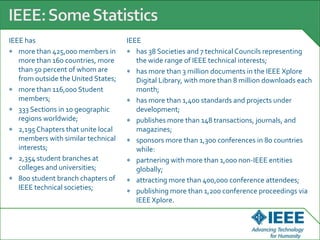
IEEE has
more than 425,000 members in
more than 160 countries, more
than 50 percent of whom are
from outside the United States;
more than 116,000 Student
members;
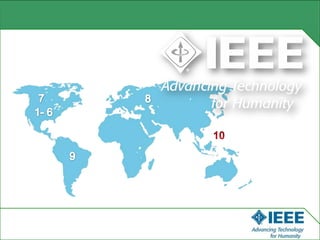
333 Sections in 10 geographic
regions worldwide;
2,195Chapters that unite local
members with similar technical
interests;
2,354 student branches at
colleges and universities;
800 student branch chapters of
IEEE technical societies;
IEEE
has 38 Societies and 7 technical Councils representing
the wide range of IEEE technical interests;
has more than 3 million documents in the IEEE Xplore
Digital Library, with more than 8 million downloads each
month;
has more than 1,400 standards and projects under
development;
publishes more than 148 transactions, journals, and
magazines;
sponsors more than 1,300 conferences in 80 countries
while:
partnering with more than 1,000 non-IEEE entities
globally;
attracting more than 400,000 conference attendees;
publishing more than 1,200 conference proceedings via
IEEE Xplore.
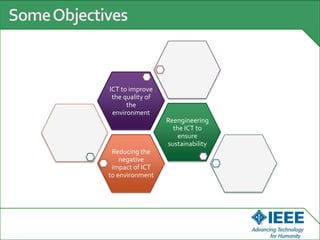
Reducing the
negative
impact of ICT
to environment
Reengineering
the ICT to
ensure
sustainability
ICT to improve
the quality of
the
environment
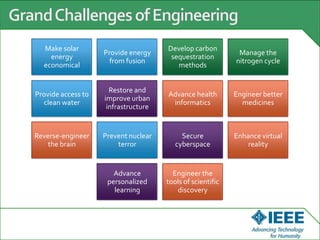
Make solar
energy
economical
Provide energy
from fusion
Develop carbon
sequestration
methods
Manage the
nitrogen cycle
Provide access to
clean water
Restore and
improve urban
infrastructure
Advance health
informatics
Engineer better
medicines
Reverse-engineer
the brain
Prevent nuclear
terror
Secure
cyberspace
Enhance virtual
reality
Advance
personalized
learning
Engineer the
tools of scientific
discovery
Cloud Computing
•Software,
hardware,
applications,
services, delivery,
etc. related to
cloud and big data
technologies
Green ICT
•The overall science
and technology,
practices, services,
and applications
behind
sustainable,
environmentally
friendly computing
& communications
Electric Vehicles
•Realising
transportation
electrification
Internet of Things
•Adaptive complex
system made out
of networks of
sensors and smart
objects to
interconnect all
things, including
everyday and
industrial objects
in such a way to
make them
intelligent,
programmable and
more capable of
interacting with
humans
Life Sciences
•The intersection of
the life sciences
with electrical
engineering,
computer
engineering,
computer sciences,
physics and
mathematics;
Smart Grid
•The next-
generation
electrical power
system that is
typified by the
increased use of
communications
and information
technology in the
generation,
delivery and
consumption of
electrical energy.
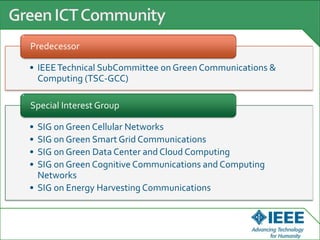
• IEEETechnical SubCommittee on Green Communications &
Computing (TSC-GCC)
Predecessor
• SIG on Green Cellular Networks
• SIG on Green Smart Grid Communications
• SIG on Green Data Center and Cloud Computing
• SIG on Green Cognitive Communications and Computing
Networks
• SIG on Energy Harvesting Communications
Special Interest Group
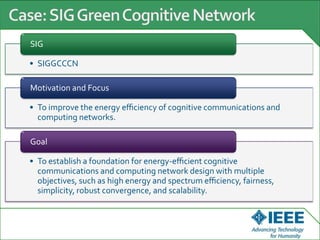
• SIGGCCCN
SIG
• To improve the energy efficiency of cognitive communications and
computing networks.
Motivation and Focus
• To establish a foundation for energy-efficient cognitive
communications and computing network design with multiple
objectives, such as high energy and spectrum efficiency, fairness,
simplicity, robust convergence, and scalability.
Goal
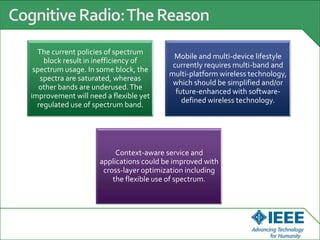
The current policies of spectrum
block result in inefficiency of
spectrum usage. In some block, the
spectra are saturated, whereas
other bands are underused.The
improvement will need a flexible yet
regulated use of spectrum band.
Mobile and multi-device lifestyle
currently requires multi-band and
multi-platform wireless technology,
which should be simplified and/or
future-enhanced with software-
defined wireless technology.
Context-aware service and
applications could be improved with
cross-layer optimization including
the flexible use of spectrum.
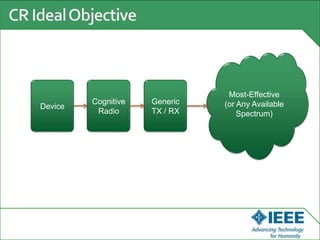
Device
Cognitive
Radio
Generic
TX / RX
Most-Effective
(or Any Available
Spectrum)
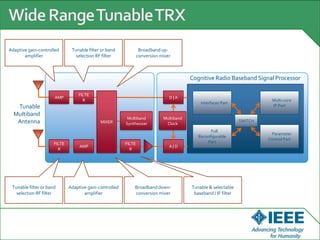
SWITCH
Multi-core
IP Part
Parameter
Control Part
FILTE
R
AMP
AMP
FILTE
R
FILTE
R
A | D
D | A
Interfaces Part
Full
Reconfigurable
Part
MIXER
Multiband
Synthesizer
Multiband
Clock
Tunable
Multiband
Antenna
Cognitive Radio Baseband Signal Processor
Adaptive gain-controlled
amplifier
Tunable filter or band
selection RF filter
Broadbandup-
conversion mixer
Tunable filter or band
selection RF filter
Adaptive gain-controlled
amplifier
Broadband down-
conversion mixer
Tunable & selectable
baseband / IF filter
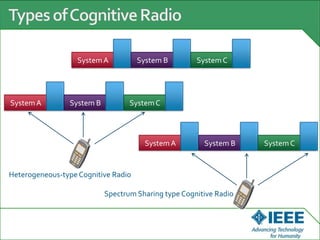
SystemA System B SystemC
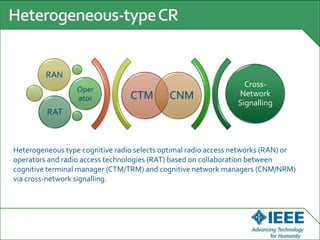
Heterogeneous-typeCognitive Radio
Spectrum Sharing type Cognitive Radio
CTM CNM
RAN
Oper
ator
RAT
Cross-
Network
Signalling
Heterogeneous type cognitive radio selects optimal radio access networks (RAN) or
operators and radio access technologies (RAT) based on collaboration between
cognitive terminal manager (CTM/TRM) and cognitive network managers (CNM/NRM)
via cross-network signalling.
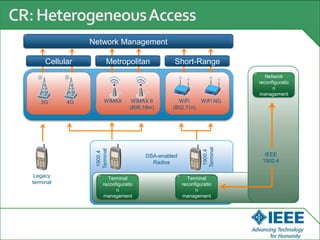
3G 4G WiMAX WiMAX II
(806.16m)
WiFi
(802.11n)
WiFi NG
DSA-enabled
Radios
Network Management
Legacy
terminal
1900.4
Terminal
1900.4
Terminal
IEEE
1900.4
Network
reconfiguratio
n
management
Terminal
reconfiguratio
n
management
Terminal
reconfiguratio
n
management
Metropolitan Short-RangeCellular
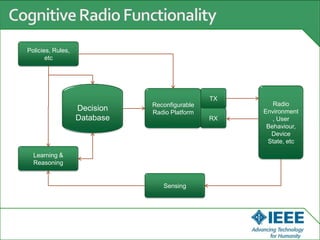
Reconfigurable
Radio Platform
TX
RX
Policies, Rules,
etc
Decision
Database
Learning &
Reasoning
Sensing
Radio
Environment
, User
Behaviour,
Device
State, etc
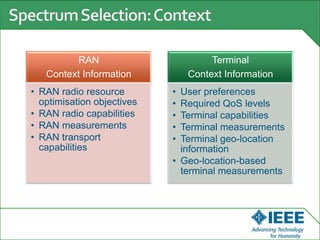
RAN
Context Information
• RAN radio resource
optimisation objectives
• RAN radio capabilities
• RAN measurements
• RAN transport
capabilities
Terminal
Context Information
• User preferences
• Required QoS levels
• Terminal capabilities
• Terminal measurements
• Terminal geo-location
information
• Geo-location-based
terminal measurements
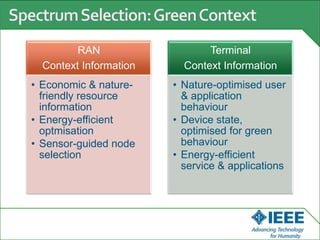
RAN
Context Information
• Economic & nature-
friendly resource
information
• Energy-efficient
optmisation
• Sensor-guided node
selection
Terminal
Context Information
• Nature-optimised user
& application
behaviour
• Device state,
optimised for green
behaviour
• Energy-efficient
service & applications
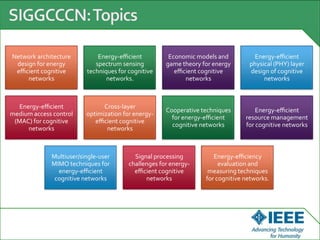
Network architecture
design for energy
efficient cognitive
networks
Energy-efficient
spectrum sensing
techniques for cognitive
networks.
Economic models and
game theory for energy
efficient cognitive
networks
Energy-efficient
physical (PHY) layer
design of cognitive
networks
Energy-efficient
medium access control
(MAC) for cognitive
networks
Cross-layer
optimization for energy-
efficient cognitive
networks
Cooperative techniques
for energy-efficient
cognitive networks
Energy-efficient
resource management
for cognitive networks
Multiuser/single-user
MIMO techniques for
energy-efficient
cognitive networks
Signal processing
challenges for energy-
efficient cognitive
networks
Energy-efficiency
evaluation and
measuring techniques
for cognitive networks.
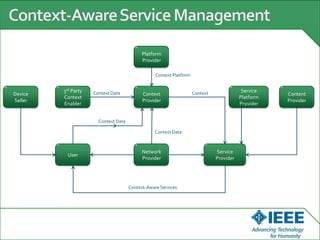
Device
Seller
3rd Party
Context
Enabler
Context
Provider
Service
Platform
Provider
Content
Provider
User
Network
Provider
Service
Provider
Platform
Provider
Context Platform
Context Data
Context Data
Context Data
Context
Context-Aware Services
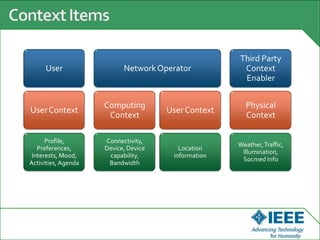
User
User Context
Profile,
Preferences,
Interests, Mood,
Activities, Agenda
NetworkOperator
Computing
Context
Connectivity,
Device, Device
capability,
Bandwidth
User Context
Location
information
Third Party
Context
Enabler
Physical
Context
Weather,Traffic,
Illumination,
Socmed Info
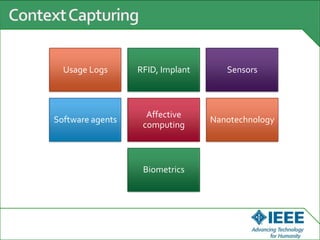
Usage Logs RFID, Implant Sensors
Software agents
Affective
computing
Nanotechnology
Biometrics
The next step for a green ICT needs a convergence of networks,
service, application, and user behaviour, optimised for a green
lifestyle.
Cognitive radio & context awareness need a deeper research &
implementation for a green-aware network & services.
Other elements should be integrated to the convergent platform:
Industrial, machine-to-machine communications
Sensor network & context information network
Cloud computing
Smart grid
@IEEEorg
@IEEEIndonesia
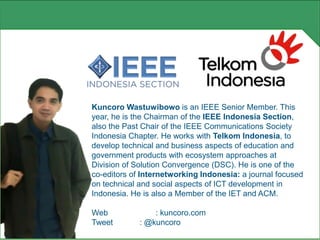
Kuncoro Wastuwibowo is an IEEE Senior Member. This
year, he is the Chairman of the IEEE Indonesia Section,
also the Past Chair of the IEEE Communications Society
Indonesia Chapter. He works with Telkom Indonesia, to
develop technical and business aspects of education and
government products with ecosystem approaches at
Division of Solution Convergence (DSC). He is one of the
co-editors of Internetworking Indonesia: a journal focused
on technical and social aspects of ICT development in
Indonesia. He is also a Member of the IET and ACM.
Web : kuncoro.com
Tweet : @kuncoro

Green-Aware Network: Keynote Speech for NEST-UI

  • 1.
    IEEE Indonesia SectionChairKeynote Speech National Electrical Engineering Seminar (NEST) Universitas Indonesia Jakarta 12 September 2013
  • 2.
    Mission statement • IEEE'score purpose is to foster technological innovation and excellence for the benefit of humanity. Vision statement • IEEE will be essential to the global technical community and to technical professionals everywhere, and be universally recognized for the contributions of technology and of technical professionals in improving global conditions. IEEE is the world's largest professional association dedicated to advancing technological innovation and excellence for the benefit of humanity. IEEE and its members inspire a global community through IEEE's highly cited publications, conferences, technology standards, and professional and educational activities.
  • 4.
    IEEE has more than425,000 members in more than 160 countries, more than 50 percent of whom are from outside the United States; more than 116,000 Student members; 333 Sections in 10 geographic regions worldwide; 2,195Chapters that unite local members with similar technical interests; 2,354 student branches at colleges and universities; 800 student branch chapters of IEEE technical societies; IEEE has 38 Societies and 7 technical Councils representing the wide range of IEEE technical interests; has more than 3 million documents in the IEEE Xplore Digital Library, with more than 8 million downloads each month; has more than 1,400 standards and projects under development; publishes more than 148 transactions, journals, and magazines; sponsors more than 1,300 conferences in 80 countries while: partnering with more than 1,000 non-IEEE entities globally; attracting more than 400,000 conference attendees; publishing more than 1,200 conference proceedings via IEEE Xplore.
  • 5.
    Reducing the negative impact ofICT to environment Reengineering the ICT to ensure sustainability ICT to improve the quality of the environment
  • 6.
    Make solar energy economical Provide energy fromfusion Develop carbon sequestration methods Manage the nitrogen cycle Provide access to clean water Restore and improve urban infrastructure Advance health informatics Engineer better medicines Reverse-engineer the brain Prevent nuclear terror Secure cyberspace Enhance virtual reality Advance personalized learning Engineer the tools of scientific discovery
  • 7.
    Cloud Computing •Software, hardware, applications, services, delivery, etc.related to cloud and big data technologies Green ICT •The overall science and technology, practices, services, and applications behind sustainable, environmentally friendly computing & communications Electric Vehicles •Realising transportation electrification Internet of Things •Adaptive complex system made out of networks of sensors and smart objects to interconnect all things, including everyday and industrial objects in such a way to make them intelligent, programmable and more capable of interacting with humans Life Sciences •The intersection of the life sciences with electrical engineering, computer engineering, computer sciences, physics and mathematics; Smart Grid •The next- generation electrical power system that is typified by the increased use of communications and information technology in the generation, delivery and consumption of electrical energy.
  • 8.
    • IEEETechnical SubCommitteeon Green Communications & Computing (TSC-GCC) Predecessor • SIG on Green Cellular Networks • SIG on Green Smart Grid Communications • SIG on Green Data Center and Cloud Computing • SIG on Green Cognitive Communications and Computing Networks • SIG on Energy Harvesting Communications Special Interest Group
  • 9.
    • SIGGCCCN SIG • Toimprove the energy efficiency of cognitive communications and computing networks. Motivation and Focus • To establish a foundation for energy-efficient cognitive communications and computing network design with multiple objectives, such as high energy and spectrum efficiency, fairness, simplicity, robust convergence, and scalability. Goal
  • 10.
    The current policiesof spectrum block result in inefficiency of spectrum usage. In some block, the spectra are saturated, whereas other bands are underused.The improvement will need a flexible yet regulated use of spectrum band. Mobile and multi-device lifestyle currently requires multi-band and multi-platform wireless technology, which should be simplified and/or future-enhanced with software- defined wireless technology. Context-aware service and applications could be improved with cross-layer optimization including the flexible use of spectrum.
  • 11.
  • 12.
    SWITCH Multi-core IP Part Parameter Control Part FILTE R AMP AMP FILTE R FILTE R A| D D | A Interfaces Part Full Reconfigurable Part MIXER Multiband Synthesizer Multiband Clock Tunable Multiband Antenna Cognitive Radio Baseband Signal Processor Adaptive gain-controlled amplifier Tunable filter or band selection RF filter Broadbandup- conversion mixer Tunable filter or band selection RF filter Adaptive gain-controlled amplifier Broadband down- conversion mixer Tunable & selectable baseband / IF filter
  • 13.
    SystemA System BSystemC SystemA System B SystemC SystemA System B SystemC Heterogeneous-typeCognitive Radio Spectrum Sharing type Cognitive Radio
  • 14.
    CTM CNM RAN Oper ator RAT Cross- Network Signalling Heterogeneous typecognitive radio selects optimal radio access networks (RAN) or operators and radio access technologies (RAT) based on collaboration between cognitive terminal manager (CTM/TRM) and cognitive network managers (CNM/NRM) via cross-network signalling.
  • 15.
    3G 4G WiMAXWiMAX II (806.16m) WiFi (802.11n) WiFi NG DSA-enabled Radios Network Management Legacy terminal 1900.4 Terminal 1900.4 Terminal IEEE 1900.4 Network reconfiguratio n management Terminal reconfiguratio n management Terminal reconfiguratio n management Metropolitan Short-RangeCellular
  • 16.
    Reconfigurable Radio Platform TX RX Policies, Rules, etc Decision Database Learning& Reasoning Sensing Radio Environment , User Behaviour, Device State, etc
  • 17.
    RAN Context Information • RANradio resource optimisation objectives • RAN radio capabilities • RAN measurements • RAN transport capabilities Terminal Context Information • User preferences • Required QoS levels • Terminal capabilities • Terminal measurements • Terminal geo-location information • Geo-location-based terminal measurements
  • 18.
    RAN Context Information • Economic& nature- friendly resource information • Energy-efficient optmisation • Sensor-guided node selection Terminal Context Information • Nature-optimised user & application behaviour • Device state, optimised for green behaviour • Energy-efficient service & applications
  • 21.
    Network architecture design forenergy efficient cognitive networks Energy-efficient spectrum sensing techniques for cognitive networks. Economic models and game theory for energy efficient cognitive networks Energy-efficient physical (PHY) layer design of cognitive networks Energy-efficient medium access control (MAC) for cognitive networks Cross-layer optimization for energy- efficient cognitive networks Cooperative techniques for energy-efficient cognitive networks Energy-efficient resource management for cognitive networks Multiuser/single-user MIMO techniques for energy-efficient cognitive networks Signal processing challenges for energy- efficient cognitive networks Energy-efficiency evaluation and measuring techniques for cognitive networks.
  • 23.
  • 24.
    User User Context Profile, Preferences, Interests, Mood, Activities,Agenda NetworkOperator Computing Context Connectivity, Device, Device capability, Bandwidth User Context Location information Third Party Context Enabler Physical Context Weather,Traffic, Illumination, Socmed Info
  • 25.
    Usage Logs RFID,Implant Sensors Software agents Affective computing Nanotechnology Biometrics
  • 26.
    The next stepfor a green ICT needs a convergence of networks, service, application, and user behaviour, optimised for a green lifestyle. Cognitive radio & context awareness need a deeper research & implementation for a green-aware network & services. Other elements should be integrated to the convergent platform: Industrial, machine-to-machine communications Sensor network & context information network Cloud computing Smart grid
  • 27.
  • 28.
    Kuncoro Wastuwibowo isan IEEE Senior Member. This year, he is the Chairman of the IEEE Indonesia Section, also the Past Chair of the IEEE Communications Society Indonesia Chapter. He works with Telkom Indonesia, to develop technical and business aspects of education and government products with ecosystem approaches at Division of Solution Convergence (DSC). He is one of the co-editors of Internetworking Indonesia: a journal focused on technical and social aspects of ICT development in Indonesia. He is also a Member of the IET and ACM. Web : kuncoro.com Tweet : @kuncoro