4G TECHNOLOGY
Aakash Mehta
Aakashmehta1993@gmail.com
SVBIT

ABSTRACT
4G wireless communication networks are
characterized by the need to support heterogeneous
terminals differing in size, display, battery,
computational power, etc. For efficient usage of
the wireless spectrum all devices should be served
by the same spectrum instead of allocating spectra
dedicated to the different terminal classes. 4G
mobile communications should not focus only on
data-rate increase and new air-interface, but
should, instead converge the advanced wireless
mobile communications and high-speed wireless
access systems into an OWA platform, which
becomes the core of this emerging next-generation
mobile technology. Based on this OWA model, 4G
mobile will deliver the best business solutions to
the wireless and mobile industries, such as
CDMA/WLAN/GPRS
and
WCDMA/OFDM/WLAN.
This paper looks beyond 3G Networks and
visualizes the network of the next generation, i.e.,
4G Networks. Essentially it discusses what 4G
network is and the need for 4G Networks. Also the
advantages and applications of 4G Network have
been discussed. The paper also discusses how the
network will be IP based and how it is different
from its previous networks.
4G is being developed to accommodate the quality
of service (QoS) and rate requirements set by
forthcoming applications like wireless broadband
access, Multimedia Messaging Service (MMS),
video chat, mobile TV, HDTV content, Digital
Video Broadcasting (DVB), global positioning
system (GPS), minimal service like voice and data,
and other streaming services for “anytimeanywhere”.
Future
wireless
service
will
be
characterized by global mobile access (terminal
and personal mobility); high quality of service (full
coverage, intelligibility, no drop, and no/lower call
blocking and latency); and easy and simple access
to multimedia voice, data, message, video,
Worldwide Web, global positioning system (GPS),
etc., services via a single user terminal.

Bhaumik Chaudhari
Bhaumik.31.10@gmail.com
SVBIT

1. INTRODUCTION
1.1 Introduction
4G or Fourth Generation is future
technology
for
mobile
and
wireless
communications. It will be the successor for the
3rd Generation (3G) network technology.
Currently 3G networks are under deployment.
Approximately 4G deployments are expected to be
seen around 2010 to 2015. There is no formal
definition for what 4G is; however, there are
certain objectives that are projected for 4G. These
objectives include, that 4G will be fully IP based
integrated system. 4G will be capable of providing
between 100 Mbps and 1Gbps speeds both indoor
and outdoor with premium quality and high
security.
The evolution from 3G to 4G will be
driven by services that offer better quality (e.g.
multimedia, video and sound) thanks to greater
bandwidth, more sophistication in the association
of a large quantity of information, and improved
personalization. Convergence with other network
(enterprise, fixed) services will come about
through the high session data rate. Machine-tomachine transmission will involve two basic
equipment types: sensors (which measure
parameters) and tags (which are generally
read/write equipment). In simplest terms, 4G will
be an integrated system of voice, data and image
communications that will support a wide range of
personal and business communications.

2. WIRELESS SYSTEM
EVOLUTION
The history and evolution of mobile
service from the 1G (first generation) to 4G (fourth
generation) are discussed in this section. As the
second generation was a total replacement of the
first generation networks and handsets, and the
third generation was a total replacement of the
second generation networks and handsets, so the
fourth generation cannot be just an incremental

Page |1
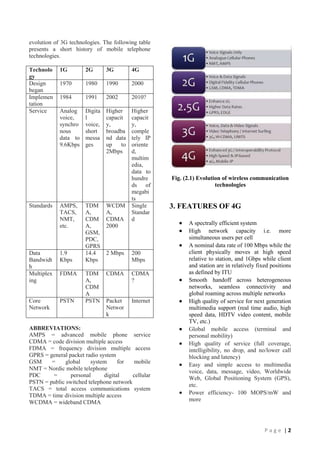
evolution of 3G technologies. The following table
presents a short history of mobile telephone
technologies.hnol
o.5G 3G 4G
Technolo 1G
2G
3G
4G
gy
Design
1970
1980 1990
2000
began
Implemen 1984
1991 2002
2010?
tation
Service
Analog Digita Higher
Higher
voice,
l
capacit capacit
synchro voice, y,
y,
nous
short broadba comple
data to messa nd data tely IP
9.6Kbps ges
up
to oriente
2Mbps
d,
multim
edia,
data to
hundre
ds of
megabi
ts
Standards AMPS, TDM WCDM Single
TACS,
A,
A,
Standar
NMT,
CDM CDMA d
etc.
A,
2000
GSM,
PDC,
GPRS
Data
1.9
14.4
2 Mbps 200
Bandwidt Kbps
Kbps
Mbps
h
Multiplex FDMA TDM CDMA CDMA
ing
A,
?
CDM
A
Core
PSTN
PSTN Packet
Internet
Network
Networ
k
Tech
ABBREVIATIONS:
AMPS = advanced mobile phone service
CDMA = code division multiple access
FDMA = frequency division multiple access
GPRS = general packet radio system
GSM
=
global
system
for
mobile
NMT = Nordic mobile telephone
PDC
=
personal
digital
cellular
PSTN = public switched telephone network
TACS = total access communications system
TDMA = time division multiple access
WCDMA = wideband CDMA

G

Fig. (2.1) Evolution of wireless communication
technologies

3. FEATURES OF 4G
A spectrally efficient system
High network capacity i.e. more
simultaneous users per cell
A nominal data rate of 100 Mbps while the
client physically moves at high speed
relative to station, and 1Gbps while client
and station are in relatively fixed positions
as defined by ITU
Smooth handoff across heterogeneous
networks, seamless connectivity and
global roaming across multiple networks
High quality of service for next generation
multimedia support (real time audio, high
speed data, HDTV video content, mobile
TV, etc.)
Global mobile access (terminal and
personal mobility)
High quality of service (full coverage,
intelligibility, no drop, and no/lower call
blocking and latency)
Easy and simple access to multimedia
voice, data, message, video, Worldwide
Web, Global Positioning System (GPS),
etc.
Power efficiency- 100 MOPS/mW and
more

Page |2
High-level modem virtual machine
interface (VMI), simplified programming
for each standard, enhanced reuse across
standards
Integration across many platforms, no
digital signal processing (DSP) and
minimal microprocessor-dependent code

4. PRINCIPAL TECHNOLOGIES
USED IN 4G
4.1 OFDM (Orthogonal
Division Multiplexing):-

Frequency

OFDM increases bandwidth by splitting a
data-bearing radio signal into smaller signal sets
and modulating each onto a different subcarrier,
transmitting them simultaneously at different
frequencies. The subcarriers are spaced
orthogonally and thus large numbers can be
packed closely together with minimal interference.
To maintain orthogonality among the tones, a
cyclic prefix is added, the length of which is
greater than the expected delay spread. With
proper coding and interleaving across frequencies,
multipath becomes an OFDM system advantage by
yielding
frequency diversity. OFDM can be implemented
efficiently by using fast Fourier transforms (FFTs)
at the transmitter and receiver.

4.2 MIMO (Multiple Input-Multiple
Output):MIMO is a spatial diversity technique that
increases coverage or data capacity by either
transmitting the same data on different antennas or
different data on different antennas. A highperformance 4G broadband wireless mobile
service requires multiple antennas be used at both
the base station and subscriber ends. Multiple
antenna technologies enable high capacities suited
for internet and multimedia services and also
dramatically increase range and reliability.
Multiple antennas at the transmitter and receiver
provide diversity in a fading environment. By
employing multiple antennas, multiple spatial
channels are created, making it unlikely that all
channels fade simultaneously. With MIMO, the
channel response becomes a matrix. Because each
narrow band carrier can be equalized
independently, the complexity of space-time
equalizers is avoided.

4.3 AMC (Adaptive Modulation and
Coding):The principle of AMC is to change the
modulation and coding format (transport format)
in accordance with instantaneous variations in
channel conditions. AMC extends the system„s
ability to adapt to good channel conditions.
Channel conditions should be estimated based on
feedback from the receiver. AMC allows different
data rates to be assigned to different users,
depending on their channel conditions. Since
channel conditions vary over time, the receiver
collects a set of channel statistics, such as
modulation and coding, signal bandwidth, signal
power, training period, channel estimation filters,
and automatic gain control, which are used by both
the transmitter and the receiver to optimize system
parameters.

4.4 Open Broadband Wireless Core:The open wireless platform requires:
Area- and power-efficient broadband
signal processing for wideband wireless
applications
The highest industry channel density
(million operations per second [MOPS]
pooling) in flexible new base transceiver
station
(BTS)
signal
processing
architectures
Waveform-specific processors that provide
new architecture for platform reuse in
terminals for multiservice capability
Terminal solutions that achieve the highest
computational efficiency for application
with high flexibility
Powerful, layered software architecture
using the virtual machine programming
concept

5. WORKING OF 4G
5.1 Internet Protocol
In the 4G wireless networks, each node
will be assigned a 4G-IP address (based on IPv6),
which will be formed by a permanent “home” IP
address and a dynamic “care-of” address that
represents its actual location. When a device
(computer) in the Internet wants to communicate
with another device (cell phone) in the wireless
network, the computer will send a packet to the
4G-IP address of the cell phone targeting on its
home address. Then a directory server on the cell
phone‟s home network will forward this packet to
the cell phone‟s care-of address through a tunnel,
Page |3
mobile IP; moreover, the directory server will also
inform the computer that the cell phone‟s care-of
address (real location), so next packets can be sent
to the cell phone directly.
The idea is that the 4G-IP address (IPv6)
can carry more information than the IP address
(IPv4) that we use right now. IPv6 includes 128
bits, which is 4 times more than 32bits IP address
in IPv4. In this rich data IP address, software can
use them to distinguish different services and to
communicate and combine with other network
areas, such as computer (PC) and cell phones‟
network.

5.2 OFDM
OFDM transmits large amounts of digital
data over a radio wave. OFDM works by splitting
the radio signal into multiple smaller sub-signals
that are then transmitted simultaneously at
different frequencies to the receiver. OFDM is a
digital modulation technology in which in one
more than thousands of orthogonal waves are
multiplexed for increasing signal strength. This is
good for high bandwidth digital data transition. In
OFDM, two wireless devices will establish a
connection tunnel before they start their
communication. Therefore, after making a
connection between a certain target, the radio
signal will split into many smaller sub-signals with
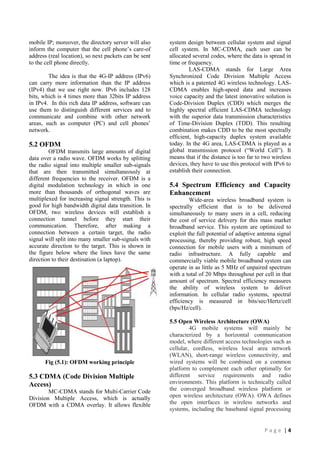
accurate direction to the target. This is shown in
the figure below where the lines have the same
direction to their destination (a laptop).

Fig (5.1): OFDM working principle

5.3 CDMA (Code Division Multiple
Access)
MC-CDMA stands for Multi-Carrier Code
Division Multiple Access, which is actually
OFDM with a CDMA overlay. It allows flexible

system design between cellular system and signal
cell system. In MC-CDMA, each user can be
allocated several codes, where the data is spread in
time or frequency.
LAS-CDMA stands for Large Area
Synchronized Code Division Multiple Access
which is a patented 4G wireless technology. LASCDMA enables high-speed data and increases
voice capacity and the latest innovative solution is
Code-Division Duplex (CDD) which merges the
highly spectral efficient LAS-CDMA technology
with the superior data transmission characteristics
of Time-Division Duplex (TDD). This resulting
combination makes CDD to be the most spectrally
efficient, high-capacity duplex system available
today. In the 4G area, LAS-CDMA is played as a
global transmission protocol (“World Cell”). It
means that if the distance is too far to two wireless
devices, they have to use this protocol with IPv6 to
establish their connection.

5.4 Spectrum Efficiency and Capacity
Enhancement
Wide-area wireless broadband system is
spectrally efficient that is to be delivered
simultaneously to many users in a cell, reducing
the cost of service delivery for this mass market
broadband service. This system are optimized to
exploit the full potential of adaptive antenna signal
processing, thereby providing robust, high speed
connection for mobile users with a minimum of
radio infrastructure. A fully capable and
commercially viable mobile broadband system can
operate in as little as 5 MHz of unpaired spectrum
with a total of 20 Mbps throughout per cell in that
amount of spectrum. Spectral efficiency measures
the ability of wireless system to deliver
information. In cellular radio systems, spectral
efficiency is measured in bits/sec/Hertz/cell
(bps/Hz/cell).
5.5 Open Wireless Architecture (OWA)
4G mobile systems will mainly be
characterized by a horizontal communication
model, where different access technologies such as
cellular, cordless, wireless local area network
(WLAN), short-range wireless connectivity, and
wired systems will be combined on a common
platform to complement each other optimally for
different service requirements and radio
environments. This platform is technically called
the converged broadband wireless platform or
open wireless architecture (OWA). OWA defines
the open interfaces in wireless networks and
systems, including the baseband signal processing

Page |4
parts, radio frequency (RF) parts, networking
parts, and operating system (OS) and application
parts, so that the system can support different
industrial standards and integrate the various
wireless networks into an open broadband
platform.

6. APPLICATIONS
To achieve the goals of true broadband
service, the systems need to make the leap to a
fourth-generation (4G) network. This is where
Global Wireless Communications (GWC) enters
the fray and excels at it. GWC will provide high
speed, high capacity, low cost-per-bit IP-based
services; fiber optic wireless connections and a
truly global wireless communications system
operating in frequency ranges that surpass all other
telecommunication companies on planet Earth.
4G will consist of a hierarchy of quality/bandwidth
modes, organized somewhat like this:
Voice, low-to-medium resolution images,
moderate data rates.
High quality audio, images with good
quality on small screens (handset, PDA,
laptop PC). This can be achieved with
WiMax, cable, satellite and DSL in
supporting roles.
Wide coverage with HDTV quality
images, hundreds of Mbps data rates.
Broadcast HDTV, digital cable, satellite
and next generations of WiMax/WiBro
support this level of quality.
Local distribution of HDTV quality
images, hundreds of Mbps data rates.
UWB, 60 GHz systems, and other
developing technologies can address this
application area.
Some of the other applications of 4G are
given as follows:
Virtual Presence: This means that the 4G
provides user services at all times, even if
the user is off-site.
Virtual navigation: 4G provides users
with virtual navigation through which a
user can access a database of a street,
building, etc.
Tele-geoprocessing application: This is a
combination of GIS (Geographical
Information System) and GPS (Global
Positioning System) in which a user can
get the location by querying.
Tele-Medicine and Education: 4G will
support remote health monitoring of

patient. For people who are interested in
lifelong education, 4G provides a good
opportunity.

7. CONCLUSION
4G is more than a cellular technology. It
combines the cellular and WLANs to create the
ultimate network. 4G networks are fully
compatible with each other and offer truly global
and local roaming. As wireless carriers explore the
most efficient ways to deploy 4G services, they
will face numerous challenges. However, with the
range of solutions that will be available at their
disposal, they will also have to opportunity to
shorten their return on investment, improve
operating efficiency, and increase revenues. The
key is to align business challenges with
infrastructure choices. 4G seems to be a very
promising generation of wireless communication
that will change the people‟s life in the wireless
world. 4G is expected to be launched by 2010 and
the world is looking forward for the most
intelligent technology that would connect the
entire globe.
The future may be bright, but it's in the
hands of the customer, not the service provider and
certainly not the network provider.

8. REFERENCES
[1] Takeshi
Hattori,
Masanobu
Fujioka
“WIRELESS BROADBAND TEXTBOOK”,
IDG, Japan, 2nd edition.
[2] Wayne
Thomas,
“ELECTRONICS
COMMUNICATION”, 3rd edition.
[3] Davis Smith, “ADVANCED 4G MOBILE
COMMUNICATION”, Tokyo, Japan,1st
edition.
[4] J. Pereira, “Fourth generation – Beyond the
hype, a new paradigm”, IEE 3G Mobile
Communication Technologies, March 28,
2001, London, United Kingdom.

Page |5

4 G Mobile Technology Research Paper

  • 1.
    4G TECHNOLOGY Aakash Mehta Aakashmehta1993@gmail.com SVBIT ABSTRACT 4Gwireless communication networks are characterized by the need to support heterogeneous terminals differing in size, display, battery, computational power, etc. For efficient usage of the wireless spectrum all devices should be served by the same spectrum instead of allocating spectra dedicated to the different terminal classes. 4G mobile communications should not focus only on data-rate increase and new air-interface, but should, instead converge the advanced wireless mobile communications and high-speed wireless access systems into an OWA platform, which becomes the core of this emerging next-generation mobile technology. Based on this OWA model, 4G mobile will deliver the best business solutions to the wireless and mobile industries, such as CDMA/WLAN/GPRS and WCDMA/OFDM/WLAN. This paper looks beyond 3G Networks and visualizes the network of the next generation, i.e., 4G Networks. Essentially it discusses what 4G network is and the need for 4G Networks. Also the advantages and applications of 4G Network have been discussed. The paper also discusses how the network will be IP based and how it is different from its previous networks. 4G is being developed to accommodate the quality of service (QoS) and rate requirements set by forthcoming applications like wireless broadband access, Multimedia Messaging Service (MMS), video chat, mobile TV, HDTV content, Digital Video Broadcasting (DVB), global positioning system (GPS), minimal service like voice and data, and other streaming services for “anytimeanywhere”. Future wireless service will be characterized by global mobile access (terminal and personal mobility); high quality of service (full coverage, intelligibility, no drop, and no/lower call blocking and latency); and easy and simple access to multimedia voice, data, message, video, Worldwide Web, global positioning system (GPS), etc., services via a single user terminal. Bhaumik Chaudhari Bhaumik.31.10@gmail.com SVBIT 1. INTRODUCTION 1.1 Introduction 4G or Fourth Generation is future technology for mobile and wireless communications. It will be the successor for the 3rd Generation (3G) network technology. Currently 3G networks are under deployment. Approximately 4G deployments are expected to be seen around 2010 to 2015. There is no formal definition for what 4G is; however, there are certain objectives that are projected for 4G. These objectives include, that 4G will be fully IP based integrated system. 4G will be capable of providing between 100 Mbps and 1Gbps speeds both indoor and outdoor with premium quality and high security. The evolution from 3G to 4G will be driven by services that offer better quality (e.g. multimedia, video and sound) thanks to greater bandwidth, more sophistication in the association of a large quantity of information, and improved personalization. Convergence with other network (enterprise, fixed) services will come about through the high session data rate. Machine-tomachine transmission will involve two basic equipment types: sensors (which measure parameters) and tags (which are generally read/write equipment). In simplest terms, 4G will be an integrated system of voice, data and image communications that will support a wide range of personal and business communications. 2. WIRELESS SYSTEM EVOLUTION The history and evolution of mobile service from the 1G (first generation) to 4G (fourth generation) are discussed in this section. As the second generation was a total replacement of the first generation networks and handsets, and the third generation was a total replacement of the second generation networks and handsets, so the fourth generation cannot be just an incremental Page |1
  • 2.
    evolution of 3Gtechnologies. The following table presents a short history of mobile telephone technologies.hnol o.5G 3G 4G Technolo 1G 2G 3G 4G gy Design 1970 1980 1990 2000 began Implemen 1984 1991 2002 2010? tation Service Analog Digita Higher Higher voice, l capacit capacit synchro voice, y, y, nous short broadba comple data to messa nd data tely IP 9.6Kbps ges up to oriente 2Mbps d, multim edia, data to hundre ds of megabi ts Standards AMPS, TDM WCDM Single TACS, A, A, Standar NMT, CDM CDMA d etc. A, 2000 GSM, PDC, GPRS Data 1.9 14.4 2 Mbps 200 Bandwidt Kbps Kbps Mbps h Multiplex FDMA TDM CDMA CDMA ing A, ? CDM A Core PSTN PSTN Packet Internet Network Networ k Tech ABBREVIATIONS: AMPS = advanced mobile phone service CDMA = code division multiple access FDMA = frequency division multiple access GPRS = general packet radio system GSM = global system for mobile NMT = Nordic mobile telephone PDC = personal digital cellular PSTN = public switched telephone network TACS = total access communications system TDMA = time division multiple access WCDMA = wideband CDMA G Fig. (2.1) Evolution of wireless communication technologies 3. FEATURES OF 4G A spectrally efficient system High network capacity i.e. more simultaneous users per cell A nominal data rate of 100 Mbps while the client physically moves at high speed relative to station, and 1Gbps while client and station are in relatively fixed positions as defined by ITU Smooth handoff across heterogeneous networks, seamless connectivity and global roaming across multiple networks High quality of service for next generation multimedia support (real time audio, high speed data, HDTV video content, mobile TV, etc.) Global mobile access (terminal and personal mobility) High quality of service (full coverage, intelligibility, no drop, and no/lower call blocking and latency) Easy and simple access to multimedia voice, data, message, video, Worldwide Web, Global Positioning System (GPS), etc. Power efficiency- 100 MOPS/mW and more Page |2
  • 3.
    High-level modem virtualmachine interface (VMI), simplified programming for each standard, enhanced reuse across standards Integration across many platforms, no digital signal processing (DSP) and minimal microprocessor-dependent code 4. PRINCIPAL TECHNOLOGIES USED IN 4G 4.1 OFDM (Orthogonal Division Multiplexing):- Frequency OFDM increases bandwidth by splitting a data-bearing radio signal into smaller signal sets and modulating each onto a different subcarrier, transmitting them simultaneously at different frequencies. The subcarriers are spaced orthogonally and thus large numbers can be packed closely together with minimal interference. To maintain orthogonality among the tones, a cyclic prefix is added, the length of which is greater than the expected delay spread. With proper coding and interleaving across frequencies, multipath becomes an OFDM system advantage by yielding frequency diversity. OFDM can be implemented efficiently by using fast Fourier transforms (FFTs) at the transmitter and receiver. 4.2 MIMO (Multiple Input-Multiple Output):MIMO is a spatial diversity technique that increases coverage or data capacity by either transmitting the same data on different antennas or different data on different antennas. A highperformance 4G broadband wireless mobile service requires multiple antennas be used at both the base station and subscriber ends. Multiple antenna technologies enable high capacities suited for internet and multimedia services and also dramatically increase range and reliability. Multiple antennas at the transmitter and receiver provide diversity in a fading environment. By employing multiple antennas, multiple spatial channels are created, making it unlikely that all channels fade simultaneously. With MIMO, the channel response becomes a matrix. Because each narrow band carrier can be equalized independently, the complexity of space-time equalizers is avoided. 4.3 AMC (Adaptive Modulation and Coding):The principle of AMC is to change the modulation and coding format (transport format) in accordance with instantaneous variations in channel conditions. AMC extends the system„s ability to adapt to good channel conditions. Channel conditions should be estimated based on feedback from the receiver. AMC allows different data rates to be assigned to different users, depending on their channel conditions. Since channel conditions vary over time, the receiver collects a set of channel statistics, such as modulation and coding, signal bandwidth, signal power, training period, channel estimation filters, and automatic gain control, which are used by both the transmitter and the receiver to optimize system parameters. 4.4 Open Broadband Wireless Core:The open wireless platform requires: Area- and power-efficient broadband signal processing for wideband wireless applications The highest industry channel density (million operations per second [MOPS] pooling) in flexible new base transceiver station (BTS) signal processing architectures Waveform-specific processors that provide new architecture for platform reuse in terminals for multiservice capability Terminal solutions that achieve the highest computational efficiency for application with high flexibility Powerful, layered software architecture using the virtual machine programming concept 5. WORKING OF 4G 5.1 Internet Protocol In the 4G wireless networks, each node will be assigned a 4G-IP address (based on IPv6), which will be formed by a permanent “home” IP address and a dynamic “care-of” address that represents its actual location. When a device (computer) in the Internet wants to communicate with another device (cell phone) in the wireless network, the computer will send a packet to the 4G-IP address of the cell phone targeting on its home address. Then a directory server on the cell phone‟s home network will forward this packet to the cell phone‟s care-of address through a tunnel, Page |3
  • 4.
    mobile IP; moreover,the directory server will also inform the computer that the cell phone‟s care-of address (real location), so next packets can be sent to the cell phone directly. The idea is that the 4G-IP address (IPv6) can carry more information than the IP address (IPv4) that we use right now. IPv6 includes 128 bits, which is 4 times more than 32bits IP address in IPv4. In this rich data IP address, software can use them to distinguish different services and to communicate and combine with other network areas, such as computer (PC) and cell phones‟ network. 5.2 OFDM OFDM transmits large amounts of digital data over a radio wave. OFDM works by splitting the radio signal into multiple smaller sub-signals that are then transmitted simultaneously at different frequencies to the receiver. OFDM is a digital modulation technology in which in one more than thousands of orthogonal waves are multiplexed for increasing signal strength. This is good for high bandwidth digital data transition. In OFDM, two wireless devices will establish a connection tunnel before they start their communication. Therefore, after making a connection between a certain target, the radio signal will split into many smaller sub-signals with accurate direction to the target. This is shown in the figure below where the lines have the same direction to their destination (a laptop). Fig (5.1): OFDM working principle 5.3 CDMA (Code Division Multiple Access) MC-CDMA stands for Multi-Carrier Code Division Multiple Access, which is actually OFDM with a CDMA overlay. It allows flexible system design between cellular system and signal cell system. In MC-CDMA, each user can be allocated several codes, where the data is spread in time or frequency. LAS-CDMA stands for Large Area Synchronized Code Division Multiple Access which is a patented 4G wireless technology. LASCDMA enables high-speed data and increases voice capacity and the latest innovative solution is Code-Division Duplex (CDD) which merges the highly spectral efficient LAS-CDMA technology with the superior data transmission characteristics of Time-Division Duplex (TDD). This resulting combination makes CDD to be the most spectrally efficient, high-capacity duplex system available today. In the 4G area, LAS-CDMA is played as a global transmission protocol (“World Cell”). It means that if the distance is too far to two wireless devices, they have to use this protocol with IPv6 to establish their connection. 5.4 Spectrum Efficiency and Capacity Enhancement Wide-area wireless broadband system is spectrally efficient that is to be delivered simultaneously to many users in a cell, reducing the cost of service delivery for this mass market broadband service. This system are optimized to exploit the full potential of adaptive antenna signal processing, thereby providing robust, high speed connection for mobile users with a minimum of radio infrastructure. A fully capable and commercially viable mobile broadband system can operate in as little as 5 MHz of unpaired spectrum with a total of 20 Mbps throughout per cell in that amount of spectrum. Spectral efficiency measures the ability of wireless system to deliver information. In cellular radio systems, spectral efficiency is measured in bits/sec/Hertz/cell (bps/Hz/cell). 5.5 Open Wireless Architecture (OWA) 4G mobile systems will mainly be characterized by a horizontal communication model, where different access technologies such as cellular, cordless, wireless local area network (WLAN), short-range wireless connectivity, and wired systems will be combined on a common platform to complement each other optimally for different service requirements and radio environments. This platform is technically called the converged broadband wireless platform or open wireless architecture (OWA). OWA defines the open interfaces in wireless networks and systems, including the baseband signal processing Page |4
  • 5.
    parts, radio frequency(RF) parts, networking parts, and operating system (OS) and application parts, so that the system can support different industrial standards and integrate the various wireless networks into an open broadband platform. 6. APPLICATIONS To achieve the goals of true broadband service, the systems need to make the leap to a fourth-generation (4G) network. This is where Global Wireless Communications (GWC) enters the fray and excels at it. GWC will provide high speed, high capacity, low cost-per-bit IP-based services; fiber optic wireless connections and a truly global wireless communications system operating in frequency ranges that surpass all other telecommunication companies on planet Earth. 4G will consist of a hierarchy of quality/bandwidth modes, organized somewhat like this: Voice, low-to-medium resolution images, moderate data rates. High quality audio, images with good quality on small screens (handset, PDA, laptop PC). This can be achieved with WiMax, cable, satellite and DSL in supporting roles. Wide coverage with HDTV quality images, hundreds of Mbps data rates. Broadcast HDTV, digital cable, satellite and next generations of WiMax/WiBro support this level of quality. Local distribution of HDTV quality images, hundreds of Mbps data rates. UWB, 60 GHz systems, and other developing technologies can address this application area. Some of the other applications of 4G are given as follows: Virtual Presence: This means that the 4G provides user services at all times, even if the user is off-site. Virtual navigation: 4G provides users with virtual navigation through which a user can access a database of a street, building, etc. Tele-geoprocessing application: This is a combination of GIS (Geographical Information System) and GPS (Global Positioning System) in which a user can get the location by querying. Tele-Medicine and Education: 4G will support remote health monitoring of patient. For people who are interested in lifelong education, 4G provides a good opportunity. 7. CONCLUSION 4G is more than a cellular technology. It combines the cellular and WLANs to create the ultimate network. 4G networks are fully compatible with each other and offer truly global and local roaming. As wireless carriers explore the most efficient ways to deploy 4G services, they will face numerous challenges. However, with the range of solutions that will be available at their disposal, they will also have to opportunity to shorten their return on investment, improve operating efficiency, and increase revenues. The key is to align business challenges with infrastructure choices. 4G seems to be a very promising generation of wireless communication that will change the people‟s life in the wireless world. 4G is expected to be launched by 2010 and the world is looking forward for the most intelligent technology that would connect the entire globe. The future may be bright, but it's in the hands of the customer, not the service provider and certainly not the network provider. 8. REFERENCES [1] Takeshi Hattori, Masanobu Fujioka “WIRELESS BROADBAND TEXTBOOK”, IDG, Japan, 2nd edition. [2] Wayne Thomas, “ELECTRONICS COMMUNICATION”, 3rd edition. [3] Davis Smith, “ADVANCED 4G MOBILE COMMUNICATION”, Tokyo, Japan,1st edition. [4] J. Pereira, “Fourth generation – Beyond the hype, a new paradigm”, IEE 3G Mobile Communication Technologies, March 28, 2001, London, United Kingdom. Page |5