On the road to  “4G” Wireless
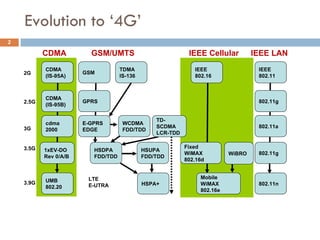
Evolution to ‘4G’ CDMA (IS-95A) GSM CDMA (IS-95B) cdma 2000 1xEV-DO Rev 0/A/B UMB 802.20 2G 2.5G 3G 3.5G 3.9G GPRS E-GPRS EDGE HSDPA FDD/TDD TDMA IS-136 WCDMA FDD/TDD TD-SCDMA LCR-TDD HSUPA FDD/TDD HSPA+ LTE E-UTRA IEEE 802.16 Fixed WiMAX 802.16d Mobile WiMAX 802.16e WiBRO IEEE 802.11 802.11g 802.11a 802.11g 802.11n CDMA GSM/UMTS IEEE Cellular IEEE LAN
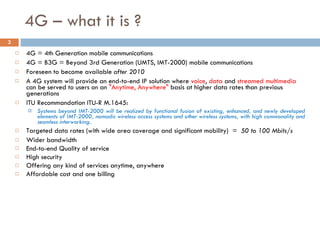
4G – what it is ? 4G = 4th Generation mobile communications 4G = B3G = Beyond 3rd Generation (UMTS, IMT-2000) mobile communications Foreseen to become available  after 2010 A 4G system will provide an end-to-end IP solution where  voice ,  data  and  streamed multimedia  can be served to users on an  "Anytime, Anywhere"  basis at higher data rates than previous generations ITU Recommandation ITU-R M.1645: Systems beyond IMT-2000 will be realized by functional fusion of existing, enhanced, and newly developed elements of IMT-2000, nomadic wireless access systems and other wireless systems, with high commonality and seamless interworking. Targeted data rates (with wide area coverage and significant mobility)  =  50 to 100 Mbits/s Wider bandwidth  End-to-end Quality of service  High security Offering any kind of services anytime, anywhere Affordable cost and one billing
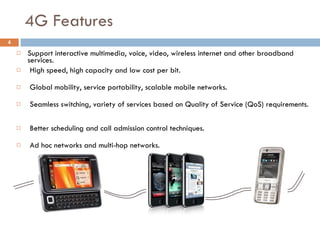
4G Features Support interactive multimedia, voice, video, wireless internet and other broadband services.  High speed, high capacity and low cost per bit.  Global mobility, service portability, scalable mobile networks.  Seamless switching, variety of services based on Quality of Service (QoS) requirements.  Better scheduling and call admission control techniques.  Ad hoc networks and multi-hop networks.
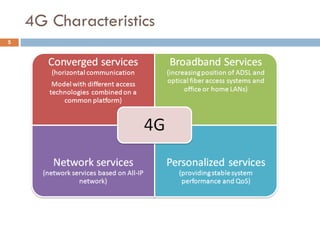
4G Characteristics
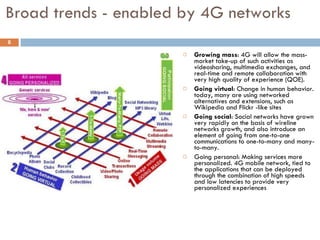
Broad trends - enabled by 4G networks  Growing mass : 4G will allow the mass-market take-up of such activities as videosharing, multimedia exchanges, and real-time and remote collaboration with very high quality of experience (QOE).  Going virtual : Change in human behavior. today, many are using networked alternatives and extensions, such as Wikipedia and Flickr -like sites Going social : Social networks have grown very rapidly on the basis of wireline networks growth, and also introduce an element of going from one-to-one communications to one-to-many and many-to-many. Going personal: Making services more personalized. 4G mobile network, tied to the applications that can be deployed through the combination of high speeds and low latencies to provide very personalized experiences
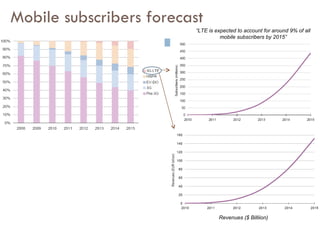
Mobile subscribers forecast “ LTE is expected to account for around 9% of all mobile subscribers by 2015” Revenues ($ Billiion)
Key business trends Global Telecom Spending Patterns Realigning Early growth in international capex, US capex lag Rise in Mobile Data Revenues Internationally ARPUs up by 25% CAGR, US [< 5% CAGR] 50% Rise in Mobile Voice Subscribers [+1.4B]  International +100%, US  +15% Emerging markets to remain unsaturated through 2012 Mobile  broadband  subscribers up 275% [+750M] New Mobile Services Taking Hold – SK/Japan/Nordics Provide impetus to mobile data services Operators Consolidating Domestically While Expanding Overseas  Total number of 4G subscribers worldwide, including both LTE & WiMAX  is expected to exceed 90 million in 2013  (ABI Research)
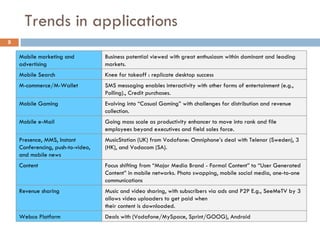
Trends in applications Mobile marketing and advertising Business potential viewed with great enthusiasm within dominant and leading markets. Mobile Search Knee for takeoff : replicate desktop success M-commerce/M-Wallet SMS messaging enables interactivity with other forms of entertainment (e.g., Polling)., Credit purchases.  Mobile Gaming Evolving into “Casual Gaming” with challenges for distribution and revenue collection. Mobile e-Mail Going mass scale as productivity enhancer to move into rank and file employees beyond executives and field sales force. Presence, MMS, Instant Conferencing, push-to-video, and mobile news MusicStation (UK) from Vodafone: Omniphone’s deal with Telenor (Sweden), 3 (HK), and Vodacom (SA). Content Focus shifting from “Major Media Brand - Formal Content” to “User Generated Content” in mobile networks. Photo swapping, mobile social media, one-to-one communications Revenue sharing Music and video sharing, with subscribers via ads and P2P E.g., SeeMeTV by 3 allows video uploaders to get paid when  their content is downloaded. Webco Platform Deals with (Vodafone/MySpace, Sprint/GOOG), Android
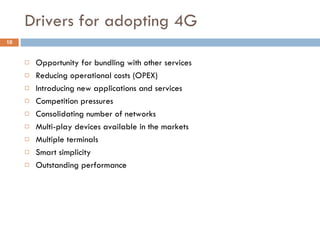
Drivers for adopting 4G  Opportunity for bundling with other services Reducing operational costs (OPEX) Introducing new applications and services Competition pressures Consolidating number of networks Multi-play devices available in the markets Multiple terminals Smart simplicity Outstanding performance
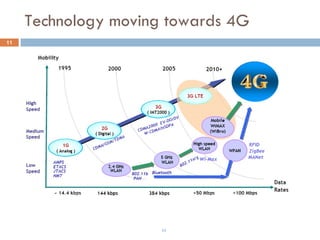
Technology moving towards 4G
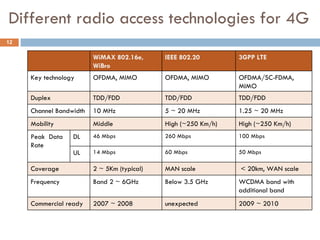
Different radio access technologies for 4G WiMAX 802.16e, WiBro IEEE 802.20 3GPP LTE Key technology OFDMA, MIMO  OFDMA, MIMO OFDMA/SC-FDMA, MIMO Duplex  TDD/FDD TDD/FDD TDD/FDD Channel Bandwidth 10 MHz 5 ~ 20 MHz 1.25 ~ 20 MHz Mobility Middle High (~250 Km/h)  High (~250 Km/h) Peak  Data Rate  DL 46 Mbps  260 Mbps 100 Mbps UL 14 Mbps 60 Mbps  50 Mbps Coverage 2 ~ 5Km (typical) MAN scale  < 20km, WAN scale Frequency Band 2 ~ 6GHz  Below 3.5 GHz  WCDMA band with additional band Commercial ready 2007 ~ 2008  unexpected 2009 ~ 2010
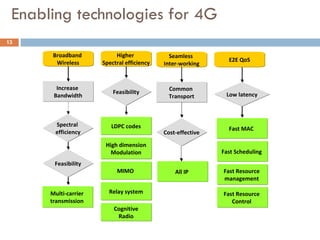
Enabling technologies for 4G  Increase  Bandwidth Multi-carrier  transmission  Broadband  Wireless Feasibility High dimension Modulation Spectral  efficiency E2E QoS Feasibility Higher  Spectral efficiency LDPC codes MIMO  Common  Transport All IP  Seamless  Inter-working Low latency Relay system Fast MAC  Fast Scheduling  Fast Resource  management  Cost-effective Fast Resource  Control  Cognitive Radio
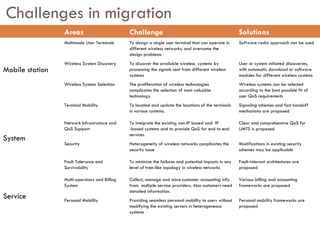
Challenges in migration  Areas Challenge Solutions  Mobile station Multimode User Terminals To design a single user terminal that can operate in different wireless networks, and overcome the design problems Software radio approach can be used Wireless System Discovery To discover the available wireless  systems by processing the signals sent from different wireless systems User or system initiated discoveries, with automatic download or software modules for different wireless systems  Wireless System Selection The proliferation of wireless technologies complicates the selection of most valuable technology Wireless systems can be selected according to the best possible fit of user QoS requirements System Terminal Mobility To located and update the locations of the terminals in various systems. Signaling schemes and fast handoff mechanisms are proposed  Network Infrastructure and QoS Support To integrate the existing non-IP based and  IP -based systems and to provide QoS for end to end services  Clear and comprehensive QoS for UMTS is proposed  Security Heterogeneity of wireless networks complicates the security issue  Modifications in existing security schemes may be applicable  Fault Tolerance and Survivability To minimize the failures and potential impacts in any level of tree-like topology in wireless networks  Fault-tolerant architectures are proposed  Service Multi-operators and Billing System Collect, manage and store customer accounting info from  multiple service providers. Also customers need detailed information. Various billing and accounting frameworks are proposed Personal Mobility Providing seamless personal mobility to users without modifying the existing servers in heterogeneous systems  Personal mobility frameworks are proposed
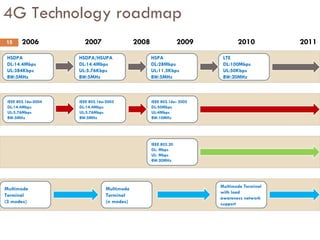
4G Technology roadmap HSDPA DL:14.4Mbps UL:384Kbps BW:5MHz HSDPA/HSUPA DL:14.4Mbps UL:5.76Kbps BW:5MHz HSPA DL:28Mbps UL:11.5Kbps BW:5MHz LTE DL:100Mbps UL:50Kbps BW:20MHz IEEE 802.16e-2004 DL:14.4Mbps UL:5.76Mbps BW:5MHz IEEE 802.16e-2005 DL:14.4Mbps UL:5.76Mbps BW:5MHz IEEE 802.16e- 2005 DL:50Mbps UL:4Mbps BW:10MHz IEEE 802.20 DL: Mbps UL: Mbps BW:20MHz Multimode Terminal (3 modes) Multimode Terminal (n modes) Multimode Terminal with load awareness network support 2006  2007 2008 2009 2010 2011
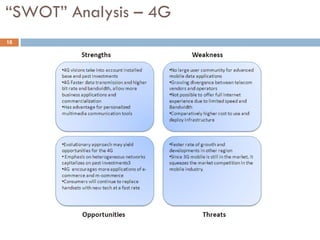
“ SWOT” Analysis – 4G
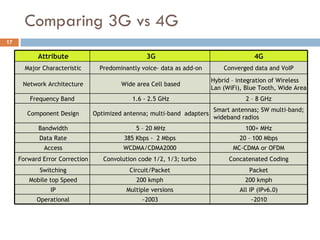
Comparing 3G vs 4G Attribute 3G 4G Major Characteristic Predominantly voice- data as add-on Converged data and VoIP Network Architecture Wide area Cell based Hybrid – integration of Wireless Lan (WiFi), Blue Tooth, Wide Area Frequency Band  1.6 - 2.5 GHz 2 – 8 GHz Component Design Optimized antenna; multi-band  adapters Smart antennas; SW multi-band; wideband radios Bandwidth 5 – 20 MHz 100+ MHz Data Rate 385 Kbps -  2 Mbps 20 – 100 Mbps Access WCDMA/CDMA2000 MC-CDMA or OFDM Forward Error Correction Convolution code 1/2, 1/3; turbo Concatenated Coding Switching Circuit/Packet Packet Mobile top Speed 200 kmph 200 kmph IP Multiple versions All IP (IPv6.0) Operational ~2003 ~2010
4G Wireless – LTE & WiMax Two competing 4G standards
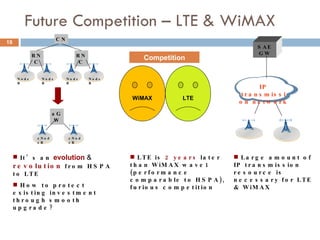
Future Competition – LTE & WiMAX It’s an  evolution  &  revolution  from HSPA to LTE How to protect existing investment through smooth upgrade? LTE is  2 years  later than WiMAX wave1 (performance comparable to HSPA), furious competition NodeB NodeB NodeB NodeB IP transmission network SAE GW Large amount of IP transmission resource is necessary for LTE & WiMAX LTE WiMAX Competition RNC RNC CN aGW eNodeB eNodeB
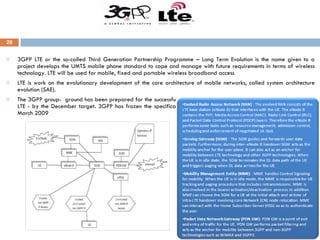
3GPP LTE or the so-called Third Generation Partnership Programme – Long Term Evolution is the name given to a project develops the UMTS mobile phone standard to cope and manage with future requirements in terms of wireless technology. LTE will be used for mobile, fixed and portable wireless broadband access LTE is work on the evolutionary development of the core architecture of mobile networks, called system architecture evolution (SAE). The 3GPP group-  ground has been prepared for the successful completion of Release 8 - containing specifications for LTE - by the December target. 3GPP has frozen the specifications for LTE, with final formal ratification expected in March 2009
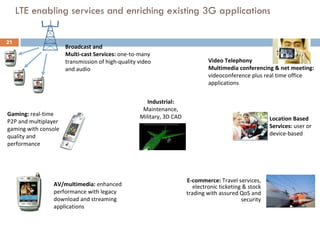
LTE enabling services and enriching existing 3G applications Gaming:  real-time P2P and multiplayer gaming with console quality and performance E-commerce:  Travel services, electronic ticketing & stock trading with assured QoS and security Video Telephony  Multimedia conferencing & net meeting:  videoconference plus real time office applications Location Based Services:  user or device-based Broadcast and Multi-cast Services:  one-to-many transmission of high-quality video and audio Industrial:  Maintenance, Military, 3D CAD AV/multimedia:  enhanced performance with legacy download and streaming applications
Requirements of LTE Peak data rate 100 Mbps DL/ 50 Mbps UL within 20 MHz bandwidth. Up to 200 active users in a cell (5 MHz) Less than 5 ms user-plane latency Mobility Optimized for 0 ~ 15 km/h. 15 ~ 120 km/h supported with high performance. Supported up to 350 km/h or even up to 500 km/h. Enhanced multimedia broadcast multicast service (E-MBMS) Spectrum flexibility: 1.25 ~ 20 MHz Enhanced support for end-to-end QoS
LTE enabling technologies OFDM (Orthogonal Frequency Division Multiplexing) Frequency domain equalization SC-FDMA (Single Carrier FDMA) MIMO (Multi-Input Multi-Output) Multicarrier channel-dependent resource scheduling Fractional frequency reuse
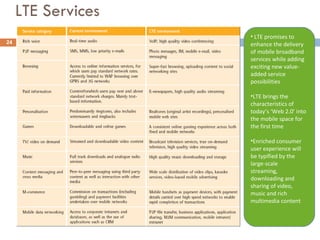
LTE Services LTE promises to enhance the delivery of mobile broadband services while adding exciting new value-added service  possibilities LTE brings the characteristics of today’s ‘Web 2.0’ into the mobile space for the first time Enriched consumer user experience will be typified by the large-scale streaming, downloading and sharing of video, music and rich multimedia content
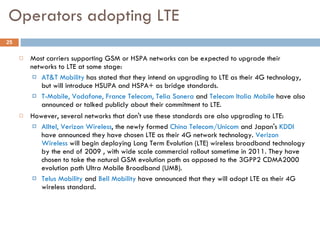
Operators adopting LTE Most carriers supporting GSM or HSPA networks can be expected to upgrade their networks to LTE at some stage:  AT&T Mobility  has stated that they intend on upgrading to LTE as their 4G technology, but will introduce HSUPA and HSPA+ as bridge standards. T-Mobile, Vodafone, France Telecom, Telia Sonera  and  Telecom Italia Mobile  have also announced or talked publicly about their commitment to LTE.  However, several networks that don't use these standards are also upgrading to LTE:  Alltel, Verizon Wireless , the newly formed  China Telecom/Unicom  and Japan's  KDDI  have announced they have chosen LTE as their 4G network technology.  Verizon Wireless  will begin deploying Long Term Evolution (LTE) wireless broadband technology by the end of 2009 , with wide scale commercial rollout sometime in 2011. They have chosen to take the natural GSM evolution path as opposed to the 3GPP2 CDMA2000 evolution path Ultra Mobile Broadband (UMB).  Telus Mobility  and  Bell Mobility  have announced that they will adopt LTE as their 4G wireless standard.
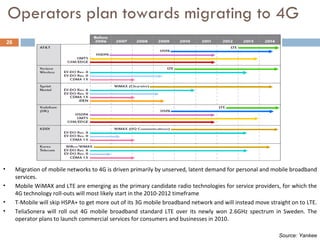
Operators plan towards migrating to 4G Migration of mobile networks to 4G is driven primarily by unserved, latent demand for personal and mobile broadband services.  Mobile WiMAX and LTE are emerging as the primary candidate radio technologies for service providers, for which the 4G technology roll-outs will most likely start in the 2010-2012 timeframe T-Mobile will skip HSPA+ to get more out of its 3G mobile broadband network and will instead move straight on to LTE.  TeliaSonera will roll out 4G mobile broadband standard LTE over its newly won 2.6GHz spectrum in Sweden. The operator plans to launch commercial services for consumers and businesses in 2010.
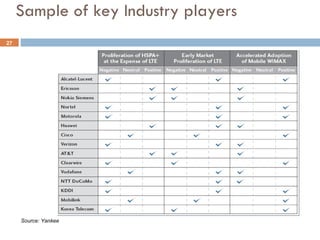
Sample of key Industry players
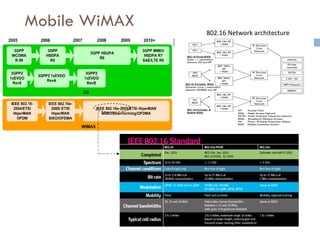
Mobile WiMAX 802.16 Network architecture
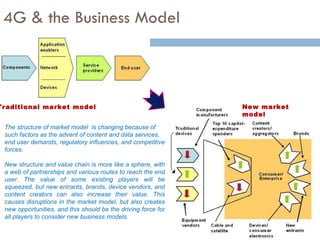
4G & the Business Model The structure of market model  is changing because of such factors as the advent of content and data services, end user demands, regulatory influences, and competitive forces. New structure and value chain is more like a sphere, with a web of partnerships and various routes to reach the end user. The value of some existing players will be squeezed, but new entrants, brands, device vendors, and content creators can also increase their value. This causes disruptions in the market model, but also creates new opportunities, and this should be the driving force for all players to consider new business models. Traditional market model New market model
Conclusion Convergence is the disruptive concept of the 4G mobile networks Migration to 4G networks will be evolutionary 4G, convergence of networks, technologies, applications and services, will offer a personalized and pervasive network to the users 4G can serve as a flexible platform for whatever services operators,  can conceivably throw at it 4G seems to be a very promising generation of wireless communication that will change the people’s life in the wireless world 4G is expected to be launched by 2010 and the world is looking forward for the most intelligent technology that would connect the entire globe.
THANK YOU

4G wireless

  • 1.
    On the roadto “4G” Wireless
  • 2.
    Evolution to ‘4G’CDMA (IS-95A) GSM CDMA (IS-95B) cdma 2000 1xEV-DO Rev 0/A/B UMB 802.20 2G 2.5G 3G 3.5G 3.9G GPRS E-GPRS EDGE HSDPA FDD/TDD TDMA IS-136 WCDMA FDD/TDD TD-SCDMA LCR-TDD HSUPA FDD/TDD HSPA+ LTE E-UTRA IEEE 802.16 Fixed WiMAX 802.16d Mobile WiMAX 802.16e WiBRO IEEE 802.11 802.11g 802.11a 802.11g 802.11n CDMA GSM/UMTS IEEE Cellular IEEE LAN
  • 3.
    4G – whatit is ? 4G = 4th Generation mobile communications 4G = B3G = Beyond 3rd Generation (UMTS, IMT-2000) mobile communications Foreseen to become available after 2010 A 4G system will provide an end-to-end IP solution where voice , data and streamed multimedia can be served to users on an &quot;Anytime, Anywhere&quot; basis at higher data rates than previous generations ITU Recommandation ITU-R M.1645: Systems beyond IMT-2000 will be realized by functional fusion of existing, enhanced, and newly developed elements of IMT-2000, nomadic wireless access systems and other wireless systems, with high commonality and seamless interworking. Targeted data rates (with wide area coverage and significant mobility) = 50 to 100 Mbits/s Wider bandwidth End-to-end Quality of service High security Offering any kind of services anytime, anywhere Affordable cost and one billing
  • 4.
    4G Features Supportinteractive multimedia, voice, video, wireless internet and other broadband services. High speed, high capacity and low cost per bit. Global mobility, service portability, scalable mobile networks. Seamless switching, variety of services based on Quality of Service (QoS) requirements. Better scheduling and call admission control techniques. Ad hoc networks and multi-hop networks.
  • 5.
  • 6.
    Broad trends -enabled by 4G networks Growing mass : 4G will allow the mass-market take-up of such activities as videosharing, multimedia exchanges, and real-time and remote collaboration with very high quality of experience (QOE). Going virtual : Change in human behavior. today, many are using networked alternatives and extensions, such as Wikipedia and Flickr -like sites Going social : Social networks have grown very rapidly on the basis of wireline networks growth, and also introduce an element of going from one-to-one communications to one-to-many and many-to-many. Going personal: Making services more personalized. 4G mobile network, tied to the applications that can be deployed through the combination of high speeds and low latencies to provide very personalized experiences
  • 7.
    Mobile subscribers forecast“ LTE is expected to account for around 9% of all mobile subscribers by 2015” Revenues ($ Billiion)
  • 8.
    Key business trendsGlobal Telecom Spending Patterns Realigning Early growth in international capex, US capex lag Rise in Mobile Data Revenues Internationally ARPUs up by 25% CAGR, US [< 5% CAGR] 50% Rise in Mobile Voice Subscribers [+1.4B] International +100%, US +15% Emerging markets to remain unsaturated through 2012 Mobile broadband subscribers up 275% [+750M] New Mobile Services Taking Hold – SK/Japan/Nordics Provide impetus to mobile data services Operators Consolidating Domestically While Expanding Overseas Total number of 4G subscribers worldwide, including both LTE & WiMAX is expected to exceed 90 million in 2013 (ABI Research)
  • 9.
    Trends in applicationsMobile marketing and advertising Business potential viewed with great enthusiasm within dominant and leading markets. Mobile Search Knee for takeoff : replicate desktop success M-commerce/M-Wallet SMS messaging enables interactivity with other forms of entertainment (e.g., Polling)., Credit purchases. Mobile Gaming Evolving into “Casual Gaming” with challenges for distribution and revenue collection. Mobile e-Mail Going mass scale as productivity enhancer to move into rank and file employees beyond executives and field sales force. Presence, MMS, Instant Conferencing, push-to-video, and mobile news MusicStation (UK) from Vodafone: Omniphone’s deal with Telenor (Sweden), 3 (HK), and Vodacom (SA). Content Focus shifting from “Major Media Brand - Formal Content” to “User Generated Content” in mobile networks. Photo swapping, mobile social media, one-to-one communications Revenue sharing Music and video sharing, with subscribers via ads and P2P E.g., SeeMeTV by 3 allows video uploaders to get paid when their content is downloaded. Webco Platform Deals with (Vodafone/MySpace, Sprint/GOOG), Android
  • 10.
    Drivers for adopting4G Opportunity for bundling with other services Reducing operational costs (OPEX) Introducing new applications and services Competition pressures Consolidating number of networks Multi-play devices available in the markets Multiple terminals Smart simplicity Outstanding performance
  • 11.
  • 12.
    Different radio accesstechnologies for 4G WiMAX 802.16e, WiBro IEEE 802.20 3GPP LTE Key technology OFDMA, MIMO OFDMA, MIMO OFDMA/SC-FDMA, MIMO Duplex TDD/FDD TDD/FDD TDD/FDD Channel Bandwidth 10 MHz 5 ~ 20 MHz 1.25 ~ 20 MHz Mobility Middle High (~250 Km/h) High (~250 Km/h) Peak Data Rate DL 46 Mbps 260 Mbps 100 Mbps UL 14 Mbps 60 Mbps 50 Mbps Coverage 2 ~ 5Km (typical) MAN scale < 20km, WAN scale Frequency Band 2 ~ 6GHz Below 3.5 GHz WCDMA band with additional band Commercial ready 2007 ~ 2008 unexpected 2009 ~ 2010
  • 13.
    Enabling technologies for4G Increase Bandwidth Multi-carrier transmission Broadband Wireless Feasibility High dimension Modulation Spectral efficiency E2E QoS Feasibility Higher Spectral efficiency LDPC codes MIMO Common Transport All IP Seamless Inter-working Low latency Relay system Fast MAC Fast Scheduling Fast Resource management Cost-effective Fast Resource Control Cognitive Radio
  • 14.
    Challenges in migration Areas Challenge Solutions Mobile station Multimode User Terminals To design a single user terminal that can operate in different wireless networks, and overcome the design problems Software radio approach can be used Wireless System Discovery To discover the available wireless systems by processing the signals sent from different wireless systems User or system initiated discoveries, with automatic download or software modules for different wireless systems Wireless System Selection The proliferation of wireless technologies complicates the selection of most valuable technology Wireless systems can be selected according to the best possible fit of user QoS requirements System Terminal Mobility To located and update the locations of the terminals in various systems. Signaling schemes and fast handoff mechanisms are proposed Network Infrastructure and QoS Support To integrate the existing non-IP based and IP -based systems and to provide QoS for end to end services Clear and comprehensive QoS for UMTS is proposed Security Heterogeneity of wireless networks complicates the security issue Modifications in existing security schemes may be applicable Fault Tolerance and Survivability To minimize the failures and potential impacts in any level of tree-like topology in wireless networks Fault-tolerant architectures are proposed Service Multi-operators and Billing System Collect, manage and store customer accounting info from multiple service providers. Also customers need detailed information. Various billing and accounting frameworks are proposed Personal Mobility Providing seamless personal mobility to users without modifying the existing servers in heterogeneous systems Personal mobility frameworks are proposed
  • 15.
    4G Technology roadmapHSDPA DL:14.4Mbps UL:384Kbps BW:5MHz HSDPA/HSUPA DL:14.4Mbps UL:5.76Kbps BW:5MHz HSPA DL:28Mbps UL:11.5Kbps BW:5MHz LTE DL:100Mbps UL:50Kbps BW:20MHz IEEE 802.16e-2004 DL:14.4Mbps UL:5.76Mbps BW:5MHz IEEE 802.16e-2005 DL:14.4Mbps UL:5.76Mbps BW:5MHz IEEE 802.16e- 2005 DL:50Mbps UL:4Mbps BW:10MHz IEEE 802.20 DL: Mbps UL: Mbps BW:20MHz Multimode Terminal (3 modes) Multimode Terminal (n modes) Multimode Terminal with load awareness network support 2006 2007 2008 2009 2010 2011
  • 16.
  • 17.
    Comparing 3G vs4G Attribute 3G 4G Major Characteristic Predominantly voice- data as add-on Converged data and VoIP Network Architecture Wide area Cell based Hybrid – integration of Wireless Lan (WiFi), Blue Tooth, Wide Area Frequency Band 1.6 - 2.5 GHz 2 – 8 GHz Component Design Optimized antenna; multi-band adapters Smart antennas; SW multi-band; wideband radios Bandwidth 5 – 20 MHz 100+ MHz Data Rate 385 Kbps - 2 Mbps 20 – 100 Mbps Access WCDMA/CDMA2000 MC-CDMA or OFDM Forward Error Correction Convolution code 1/2, 1/3; turbo Concatenated Coding Switching Circuit/Packet Packet Mobile top Speed 200 kmph 200 kmph IP Multiple versions All IP (IPv6.0) Operational ~2003 ~2010
  • 18.
    4G Wireless –LTE & WiMax Two competing 4G standards
  • 19.
    Future Competition –LTE & WiMAX It’s an evolution & revolution from HSPA to LTE How to protect existing investment through smooth upgrade? LTE is 2 years later than WiMAX wave1 (performance comparable to HSPA), furious competition NodeB NodeB NodeB NodeB IP transmission network SAE GW Large amount of IP transmission resource is necessary for LTE & WiMAX LTE WiMAX Competition RNC RNC CN aGW eNodeB eNodeB
  • 20.
    3GPP LTE orthe so-called Third Generation Partnership Programme – Long Term Evolution is the name given to a project develops the UMTS mobile phone standard to cope and manage with future requirements in terms of wireless technology. LTE will be used for mobile, fixed and portable wireless broadband access LTE is work on the evolutionary development of the core architecture of mobile networks, called system architecture evolution (SAE). The 3GPP group- ground has been prepared for the successful completion of Release 8 - containing specifications for LTE - by the December target. 3GPP has frozen the specifications for LTE, with final formal ratification expected in March 2009
  • 21.
    LTE enabling servicesand enriching existing 3G applications Gaming: real-time P2P and multiplayer gaming with console quality and performance E-commerce: Travel services, electronic ticketing & stock trading with assured QoS and security Video Telephony Multimedia conferencing & net meeting: videoconference plus real time office applications Location Based Services: user or device-based Broadcast and Multi-cast Services: one-to-many transmission of high-quality video and audio Industrial: Maintenance, Military, 3D CAD AV/multimedia: enhanced performance with legacy download and streaming applications
  • 22.
    Requirements of LTEPeak data rate 100 Mbps DL/ 50 Mbps UL within 20 MHz bandwidth. Up to 200 active users in a cell (5 MHz) Less than 5 ms user-plane latency Mobility Optimized for 0 ~ 15 km/h. 15 ~ 120 km/h supported with high performance. Supported up to 350 km/h or even up to 500 km/h. Enhanced multimedia broadcast multicast service (E-MBMS) Spectrum flexibility: 1.25 ~ 20 MHz Enhanced support for end-to-end QoS
  • 23.
    LTE enabling technologiesOFDM (Orthogonal Frequency Division Multiplexing) Frequency domain equalization SC-FDMA (Single Carrier FDMA) MIMO (Multi-Input Multi-Output) Multicarrier channel-dependent resource scheduling Fractional frequency reuse
  • 24.
    LTE Services LTEpromises to enhance the delivery of mobile broadband services while adding exciting new value-added service possibilities LTE brings the characteristics of today’s ‘Web 2.0’ into the mobile space for the first time Enriched consumer user experience will be typified by the large-scale streaming, downloading and sharing of video, music and rich multimedia content
  • 25.
    Operators adopting LTEMost carriers supporting GSM or HSPA networks can be expected to upgrade their networks to LTE at some stage: AT&T Mobility has stated that they intend on upgrading to LTE as their 4G technology, but will introduce HSUPA and HSPA+ as bridge standards. T-Mobile, Vodafone, France Telecom, Telia Sonera and Telecom Italia Mobile have also announced or talked publicly about their commitment to LTE. However, several networks that don't use these standards are also upgrading to LTE: Alltel, Verizon Wireless , the newly formed China Telecom/Unicom and Japan's KDDI have announced they have chosen LTE as their 4G network technology. Verizon Wireless will begin deploying Long Term Evolution (LTE) wireless broadband technology by the end of 2009 , with wide scale commercial rollout sometime in 2011. They have chosen to take the natural GSM evolution path as opposed to the 3GPP2 CDMA2000 evolution path Ultra Mobile Broadband (UMB). Telus Mobility and Bell Mobility have announced that they will adopt LTE as their 4G wireless standard.
  • 26.
    Operators plan towardsmigrating to 4G Migration of mobile networks to 4G is driven primarily by unserved, latent demand for personal and mobile broadband services. Mobile WiMAX and LTE are emerging as the primary candidate radio technologies for service providers, for which the 4G technology roll-outs will most likely start in the 2010-2012 timeframe T-Mobile will skip HSPA+ to get more out of its 3G mobile broadband network and will instead move straight on to LTE. TeliaSonera will roll out 4G mobile broadband standard LTE over its newly won 2.6GHz spectrum in Sweden. The operator plans to launch commercial services for consumers and businesses in 2010.
  • 27.
    Sample of keyIndustry players
  • 28.
    Mobile WiMAX 802.16Network architecture
  • 29.
    4G & theBusiness Model The structure of market model is changing because of such factors as the advent of content and data services, end user demands, regulatory influences, and competitive forces. New structure and value chain is more like a sphere, with a web of partnerships and various routes to reach the end user. The value of some existing players will be squeezed, but new entrants, brands, device vendors, and content creators can also increase their value. This causes disruptions in the market model, but also creates new opportunities, and this should be the driving force for all players to consider new business models. Traditional market model New market model
  • 30.
    Conclusion Convergence isthe disruptive concept of the 4G mobile networks Migration to 4G networks will be evolutionary 4G, convergence of networks, technologies, applications and services, will offer a personalized and pervasive network to the users 4G can serve as a flexible platform for whatever services operators, can conceivably throw at it 4G seems to be a very promising generation of wireless communication that will change the people’s life in the wireless world 4G is expected to be launched by 2010 and the world is looking forward for the most intelligent technology that would connect the entire globe.
  • 31.

Editor's Notes

  • #21 Evolved UMTS Terrestrial Radio Access Network (E-UTRAN) LTE User Equipment (UE) Policy Control and Charging Function (PCRF) Policy and Charging Enforcement Point (PCEP) Billing System SGSN: Serving GPRS Support Node MIMO: Multiple Input Multiple Output