IONIC COMPOUNDS
Naming and Formula Writing
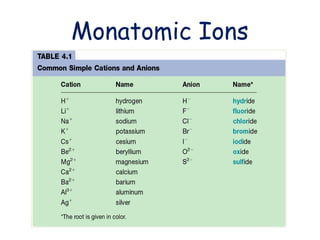
Monatomic Ions
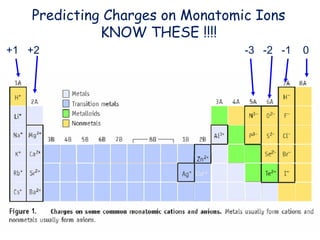
Predicting Charges on Monatomic Ions
KNOW THESE !!!!
+1 +2 -3 -2 -1 0
Cd+2
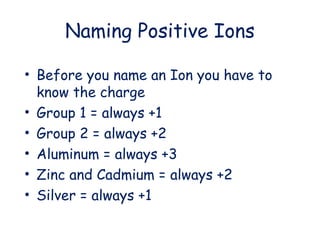
Naming Positive Ions
• Before you name an Ion you have to
know the charge
• Group 1 = always +1
• Group 2 = always +2
• Aluminum = always +3
• Zinc and Cadmium = always +2
• Silver = always +1
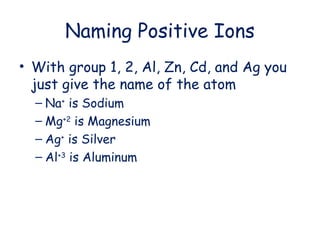
Naming Positive Ions
• With group 1, 2, Al, Zn, Cd, and Ag you
just give the name of the atom
– Na+
is Sodium
– Mg+2
is Magnesium
– Ag+
is Silver
– Al+3
is Aluminum
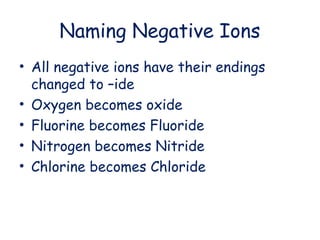
Naming Negative Ions
• All negative ions have their endings
changed to –ide
• Oxygen becomes oxide
• Fluorine becomes Fluoride
• Nitrogen becomes Nitride
• Chlorine becomes Chloride
Formulas of Ionic Compounds
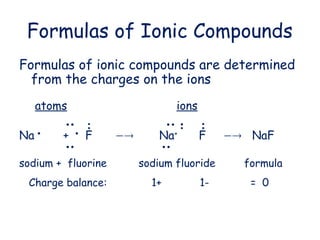
Formulas of ionic compounds are determined
from the charges on the ions
atoms ions
    -
Na 
+ 
F  Na+
F  NaF
   
sodium + fluorine sodium fluoride formula
Charge balance: 1+ 1- = 0






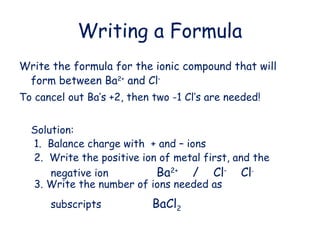
Writing a Formula
Write the formula for the ionic compound that will
form between Ba2+
and Cl
To cancel out Ba’s +2, then two -1 Cl’s are needed!
Solution:
1. Balance charge with + and – ions
2. Write the positive ion of metal first, and the
negative ion Ba2+
/ Cl
Cl
3. Write the number of ions needed as
subscripts BaCl2
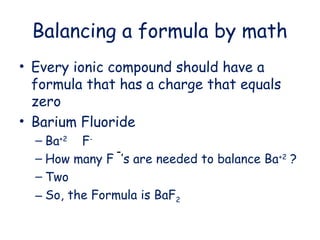
Balancing a formula by math
• Every ionic compound should have a
formula that has a charge that equals
zero
• Barium Fluoride
– Ba+2
F-
– How many F ’s are needed to balance Ba+2
?
– Two
– So, the Formula is BaF2
-
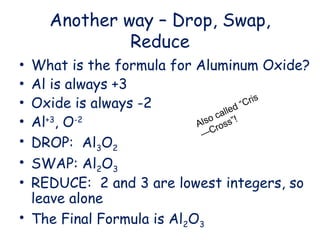
Another way – Drop, Swap,
Reduce
• What is the formula for Aluminum Oxide?
• Al is always +3
• Oxide is always -2
• Al+3
, O-2
• DROP: Al3O2
• SWAP: Al2O3
• REDUCE: 2 and 3 are lowest integers, so
leave alone
• The Final Formula is Al2O3
Also called “Cris
—Cross”!
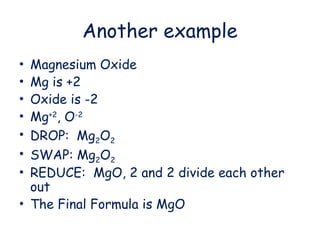
Another example
• Magnesium Oxide
• Mg is +2
• Oxide is -2
• Mg+2
, O-2
• DROP: Mg2O2
• SWAP: Mg2O2
• REDUCE: MgO, 2 and 2 divide each other
out
• The Final Formula is MgO
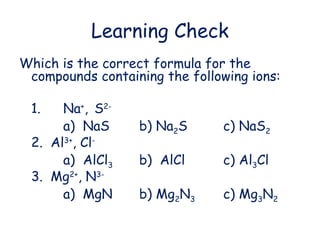
Learning Check
Which is the correct formula for the
compounds containing the following ions:
1. Na+
, S2-
a) NaS b) Na2S c) NaS2
2. Al3+
, Cl-
a) AlCl3 b) AlCl c) Al3Cl
3. Mg2+
, N3-
a) MgN b) Mg2N3 c) Mg3N2
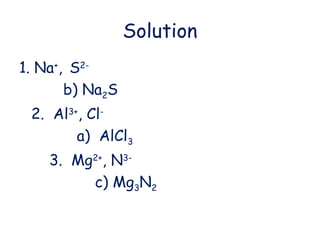
Solution
1. Na+
, S2-
b) Na2S
2. Al3+
, Cl-
a) AlCl3
3. Mg2+
, N3-
c) Mg3N2
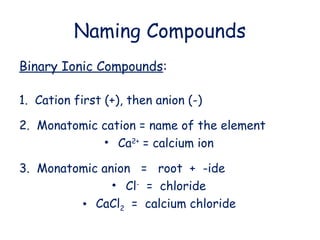
Naming Compounds
Binary Ionic Compounds:
1. Cation first (+), then anion (-)
2. Monatomic cation = name of the element
• Ca2+
= calcium ion
3. Monatomic anion = root + -ide
• Cl-
= chloride
• CaCl2 = calcium chloride
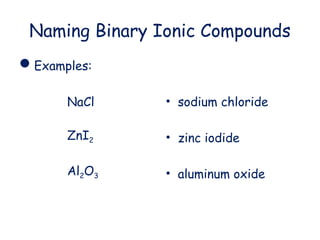
Naming Binary Ionic Compounds
Examples:
NaCl
ZnI2
Al2O3
• sodium chloride
• zinc iodide
• aluminum oxide
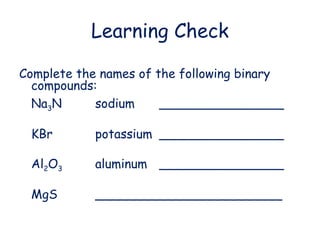
Learning Check
Complete the names of the following binary
compounds:
Na3N sodium ________________
KBr potassium ________________
Al2O3 aluminum ________________
MgS ________________________
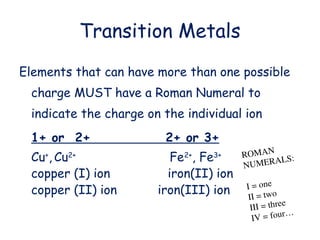
Transition Metals
Elements that can have more than one possible
charge MUST have a Roman Numeral to
indicate the charge on the individual ion
1+ or 2+ 2+ or 3+
Cu+
, Cu2+
Fe2+
, Fe3+
copper (I) ion iron(II) ion
copper (II) ion iron(III) ion
ROMAN
NUMERALS:
I = one
II = two
III = three
IV = four…
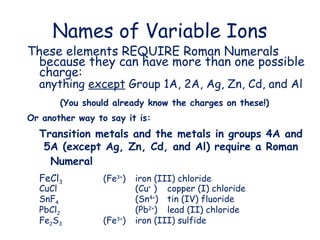
Names of Variable Ions
These elements REQUIRE Roman Numerals
because they can have more than one possible
charge:
anything except Group 1A, 2A, Ag, Zn, Cd, and Al
(You should already know the charges on these!)
Or another way to say it is:
Transition metals and the metals in groups 4A and
5A (except Ag, Zn, Cd, and Al) require a Roman
Numeral
FeCl3 (Fe3+
) iron (III) chloride
CuCl (Cu+
) copper (I) chloride
SnF4 (Sn4+
) tin (IV) fluoride
PbCl2 (Pb2+
) lead (II) chloride
Fe2S3 (Fe3+
) iron (III) sulfide
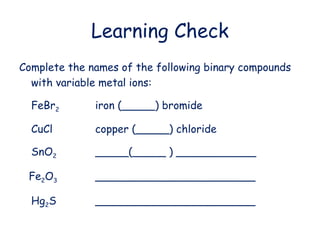
Learning Check
Complete the names of the following binary compounds
with variable metal ions:
FeBr2 iron (_____) bromide
CuCl copper (_____) chloride
SnO2 _____(_____ ) ____________
Fe2O3 ________________________
Hg2S ________________________
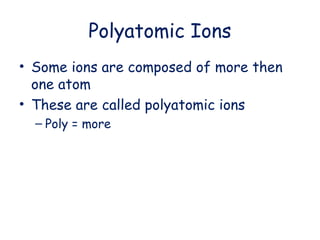
Polyatomic Ions
• Some ions are composed of more then
one atom
• These are called polyatomic ions
– Poly = more
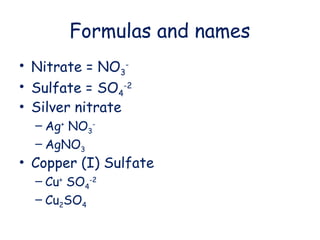
Formulas and names
• Nitrate = NO3
-
• Sulfate = SO4
-2
• Silver nitrate
– Ag+
NO3
-
– AgNO3
• Copper (I) Sulfate
– Cu+
SO4
-2
– Cu2SO4
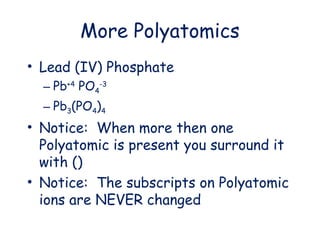
More Polyatomics
• Lead (IV) Phosphate
– Pb+4
PO4
-3
– Pb3(PO4)4
• Notice: When more then one
Polyatomic is present you surround it
with ()
• Notice: The subscripts on Polyatomic
ions are NEVER changed
Learning Check
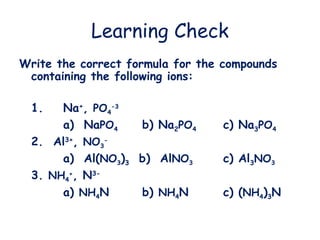
Write the correct formula for the compounds
containing the following ions:
1. Na+
, PO4
-3
a) NaPO4 b) Na2PO4 c) Na3PO4
2. Al3+
, NO3
-
a) Al(NO3)3 b) AlNO3 c) Al3NO3
3. NH4
+
, N3-
a) NH4N b) NH4N c) (NH4)3N
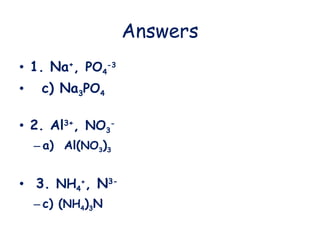
Answers
• 1. Na+
, PO4
-3
• c) Na3PO4
• 2. Al3+
, NO3
-
– a) Al(NO3)3
• 3. NH4
+
, N3-
– c) (NH4)3N
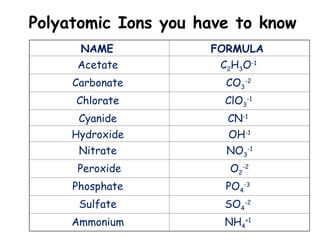
Polyatomic Ions you have to know
NAME FORMULA
Acetate C2H3O-1
Carbonate CO3
-2
Chlorate ClO3
-1
Cyanide CN-1
Hydroxide OH-1
Nitrate NO3
-1
Peroxide O2
-2
Phosphate PO4
-3
Sulfate SO4
-2
Ammonium NH4
+1
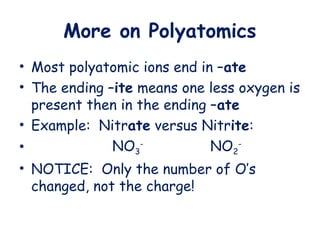
More on Polyatomics
• Most polyatomic ions end in –ate
• The ending –ite means one less oxygen is
present then in the ending –ate
• Example: Nitrate versus Nitrite:
• NO3
-
NO2
-
• NOTICE: Only the number of O’s
changed, not the charge!
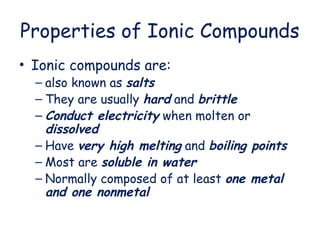
Properties of Ionic Compounds
• Ionic compounds are:
– also known as salts
– They are usually hard and brittle
– Conduct electricity when molten or
dissolved
– Have very high melting and boiling points
– Most are soluble in water
– Normally composed of at least one metal
and one nonmetal
chemistry ionic compounds and naming.ppt

  • 1.
  • 2.
  • 3.
    Predicting Charges onMonatomic Ions KNOW THESE !!!! +1 +2 -3 -2 -1 0 Cd+2
  • 4.
    Naming Positive Ions •Before you name an Ion you have to know the charge • Group 1 = always +1 • Group 2 = always +2 • Aluminum = always +3 • Zinc and Cadmium = always +2 • Silver = always +1
  • 5.
    Naming Positive Ions •With group 1, 2, Al, Zn, Cd, and Ag you just give the name of the atom – Na+ is Sodium – Mg+2 is Magnesium – Ag+ is Silver – Al+3 is Aluminum
  • 6.
    Naming Negative Ions •All negative ions have their endings changed to –ide • Oxygen becomes oxide • Fluorine becomes Fluoride • Nitrogen becomes Nitride • Chlorine becomes Chloride
  • 7.
    Formulas of IonicCompounds Formulas of ionic compounds are determined from the charges on the ions atoms ions     - Na  +  F  Na+ F  NaF     sodium + fluorine sodium fluoride formula Charge balance: 1+ 1- = 0      
  • 8.
    Writing a Formula Writethe formula for the ionic compound that will form between Ba2+ and Cl To cancel out Ba’s +2, then two -1 Cl’s are needed! Solution: 1. Balance charge with + and – ions 2. Write the positive ion of metal first, and the negative ion Ba2+ / Cl Cl 3. Write the number of ions needed as subscripts BaCl2
  • 9.
    Balancing a formulaby math • Every ionic compound should have a formula that has a charge that equals zero • Barium Fluoride – Ba+2 F- – How many F ’s are needed to balance Ba+2 ? – Two – So, the Formula is BaF2 -
  • 10.
    Another way –Drop, Swap, Reduce • What is the formula for Aluminum Oxide? • Al is always +3 • Oxide is always -2 • Al+3 , O-2 • DROP: Al3O2 • SWAP: Al2O3 • REDUCE: 2 and 3 are lowest integers, so leave alone • The Final Formula is Al2O3 Also called “Cris —Cross”!
  • 11.
    Another example • MagnesiumOxide • Mg is +2 • Oxide is -2 • Mg+2 , O-2 • DROP: Mg2O2 • SWAP: Mg2O2 • REDUCE: MgO, 2 and 2 divide each other out • The Final Formula is MgO
  • 12.
    Learning Check Which isthe correct formula for the compounds containing the following ions: 1. Na+ , S2- a) NaS b) Na2S c) NaS2 2. Al3+ , Cl- a) AlCl3 b) AlCl c) Al3Cl 3. Mg2+ , N3- a) MgN b) Mg2N3 c) Mg3N2
  • 13.
    Solution 1. Na+ , S2- b)Na2S 2. Al3+ , Cl- a) AlCl3 3. Mg2+ , N3- c) Mg3N2
  • 14.
    Naming Compounds Binary IonicCompounds: 1. Cation first (+), then anion (-) 2. Monatomic cation = name of the element • Ca2+ = calcium ion 3. Monatomic anion = root + -ide • Cl- = chloride • CaCl2 = calcium chloride
  • 15.
    Naming Binary IonicCompounds Examples: NaCl ZnI2 Al2O3 • sodium chloride • zinc iodide • aluminum oxide
  • 16.
    Learning Check Complete thenames of the following binary compounds: Na3N sodium ________________ KBr potassium ________________ Al2O3 aluminum ________________ MgS ________________________
  • 17.
    Transition Metals Elements thatcan have more than one possible charge MUST have a Roman Numeral to indicate the charge on the individual ion 1+ or 2+ 2+ or 3+ Cu+ , Cu2+ Fe2+ , Fe3+ copper (I) ion iron(II) ion copper (II) ion iron(III) ion ROMAN NUMERALS: I = one II = two III = three IV = four…
  • 18.
    Names of VariableIons These elements REQUIRE Roman Numerals because they can have more than one possible charge: anything except Group 1A, 2A, Ag, Zn, Cd, and Al (You should already know the charges on these!) Or another way to say it is: Transition metals and the metals in groups 4A and 5A (except Ag, Zn, Cd, and Al) require a Roman Numeral FeCl3 (Fe3+ ) iron (III) chloride CuCl (Cu+ ) copper (I) chloride SnF4 (Sn4+ ) tin (IV) fluoride PbCl2 (Pb2+ ) lead (II) chloride Fe2S3 (Fe3+ ) iron (III) sulfide
  • 19.
    Learning Check Complete thenames of the following binary compounds with variable metal ions: FeBr2 iron (_____) bromide CuCl copper (_____) chloride SnO2 _____(_____ ) ____________ Fe2O3 ________________________ Hg2S ________________________
  • 20.
    Polyatomic Ions • Someions are composed of more then one atom • These are called polyatomic ions – Poly = more
  • 21.
    Formulas and names •Nitrate = NO3 - • Sulfate = SO4 -2 • Silver nitrate – Ag+ NO3 - – AgNO3 • Copper (I) Sulfate – Cu+ SO4 -2 – Cu2SO4
  • 22.
    More Polyatomics • Lead(IV) Phosphate – Pb+4 PO4 -3 – Pb3(PO4)4 • Notice: When more then one Polyatomic is present you surround it with () • Notice: The subscripts on Polyatomic ions are NEVER changed
  • 23.
    Learning Check Write thecorrect formula for the compounds containing the following ions: 1. Na+ , PO4 -3 a) NaPO4 b) Na2PO4 c) Na3PO4 2. Al3+ , NO3 - a) Al(NO3)3 b) AlNO3 c) Al3NO3 3. NH4 + , N3- a) NH4N b) NH4N c) (NH4)3N
  • 24.
    Answers • 1. Na+ ,PO4 -3 • c) Na3PO4 • 2. Al3+ , NO3 - – a) Al(NO3)3 • 3. NH4 + , N3- – c) (NH4)3N
  • 25.
    Polyatomic Ions youhave to know NAME FORMULA Acetate C2H3O-1 Carbonate CO3 -2 Chlorate ClO3 -1 Cyanide CN-1 Hydroxide OH-1 Nitrate NO3 -1 Peroxide O2 -2 Phosphate PO4 -3 Sulfate SO4 -2 Ammonium NH4 +1
  • 26.
    More on Polyatomics •Most polyatomic ions end in –ate • The ending –ite means one less oxygen is present then in the ending –ate • Example: Nitrate versus Nitrite: • NO3 - NO2 - • NOTICE: Only the number of O’s changed, not the charge!
  • 27.
    Properties of IonicCompounds • Ionic compounds are: – also known as salts – They are usually hard and brittle – Conduct electricity when molten or dissolved – Have very high melting and boiling points – Most are soluble in water – Normally composed of at least one metal and one nonmetal