WHOLESALING AND
RETAILING
Wholesaler
Introduction
 Mostly buy from producers and sell mostly to
retailers, industrial consumers, institutions and
other wholesalers
 Includes all activities involved in selling goods
and services to those buying for resale or
business use
 Sale of product between businesses, as opposed
to ultimate household consumers
 Provides added by providing channel flows.
Value of these flows are often underappreciated
 Tasks are mundane, but bundled with valued
services at low cost, treated as unglamorous
unlike other channel members
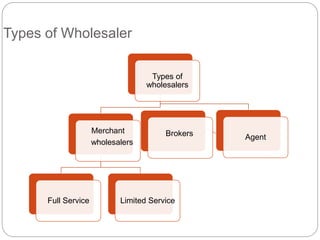
Types of Wholesaler
Types of
wholesalers
Merchant
wholesalers
Full Service Limited Service
AgentBrokers
Merchant Wholesalers
 Independently owned businesses, take title to goods
 Full-Service wholesalers: Provide a full line of
services, carrying stock, maintaining a sales force,
offering credit, making deliveries, providing
management assistance.
 Wholesale Merchants – sell to retailers
 Industrial Distributors – Sell to manufacturers
Merchant Wholesalers
 Limited Service Wholesalers: Offer few services than
full-service wholesalers.
 Cash-and-carry wholesalers: Carry a limited line of
fast-moving goods and sell to small retailers for cash.
 Truck Wholesalers: Perform a selling and delivery
function (semi perishables)
 Drop Shippers: Do not carry inventory or handle the
product. On receiving order, select a manufacturer, who
ships directly to customer.
Assumes title and risk from order to delivery. (coal,
heavy equipment, lumber)
_ Rack Jobbers: Serve grocery and drug retailers, in
non-food items. Bills only goods sold by retailers, title
retained.
Brokers and Agents
 Do not take title to goods. Facilitate buying and selling on a
commission
 Broker: Bringing buyers and sellers together and assisting in
negotiation. Paid by the party who hired them. Do not carry inventory,
do assume risk
 Agents: Represent either buyer or seller on a more permanent basis
than brokers do
 Manufacturers’ agents
 Selling agents
 Purchasing agents
 Commission merchants
Trends in Wholesaling
 Wholesale industry is facing considerable challenges
 Fierce resistance to price increases and winnowing
out of suppliers who are not adding value based on
cost and quality
 Distinction between large retailers and large
wholesalers is getting blurred
RETAILING
RETAILING
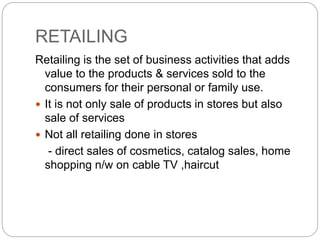
Retailing is the set of business activities that adds
value to the products & services sold to the
consumers for their personal or family use.
 It is not only sale of products in stores but also
sale of services
 Not all retailing done in stores
- direct sales of cosmetics, catalog sales, home
shopping n/w on cable TV ,haircut
RETAILING
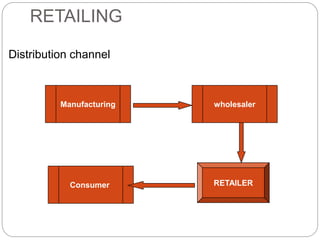
Distribution channel
Manufacturing wholesaler
Consumer RETAILER
Retailer
 Retailers are at the end of the distribution chain &
involve in direct interface with the customer
 Referred as intermediaries – pass on products from
producers & wholesalers to customers
 Provision of channel in a convenient location to
provide a successful channel of distribution
 Key objective: availability of right product, in right
qty, at right time – successful channel
Annual sales of Wal – mart, kmart. Sears are much
greater than annual sales of P&G,Pepsico
Functions of Retailing
 Retailers perform business activities that increase
the value of product & service they sell to customers
 Activities:
* Providing an assortment of products & services
* Breaking bulk
* Holding inventory
* Providing services
Providing an assortment of products
 Supermarkets carry 15000 different items made
by over 500 companies
 This assortment enables customers to buy wide
selection of brands,designs,sizes.colors & prices
in one location
 Not the case in individual manufacture’s retail
outlets
Breaking Bulk
 To reduce transportation costs, mfr’s ship whole
cases of their products to retailers
 Retailers then offer the products in smaller
quantities tailored to individual consumers usage
pattern
 Breaking the large shipments into smaller
consumer quantities – Breaking Bulk
Holding inventory
 Function of retailers – to make the availability of
products when consumers want them
 Consumers can have small inventory of products
at home as retailers will have the availability
 By maintaining inventory,retailers reduce
customer’s cost of storing products
Providing services
 Provide services that make it easier for customers
to buy & use products
 Offer products on credit
 Display products for ease of use by customers for
purchase
 Assistance provided by sales people on purchase

4 wholesaling-and-retailing

  • 1.
  • 2.
  • 3.
    Introduction  Mostly buyfrom producers and sell mostly to retailers, industrial consumers, institutions and other wholesalers  Includes all activities involved in selling goods and services to those buying for resale or business use  Sale of product between businesses, as opposed to ultimate household consumers  Provides added by providing channel flows. Value of these flows are often underappreciated  Tasks are mundane, but bundled with valued services at low cost, treated as unglamorous unlike other channel members
  • 4.
    Types of Wholesaler Typesof wholesalers Merchant wholesalers Full Service Limited Service AgentBrokers
  • 5.
    Merchant Wholesalers  Independentlyowned businesses, take title to goods  Full-Service wholesalers: Provide a full line of services, carrying stock, maintaining a sales force, offering credit, making deliveries, providing management assistance.  Wholesale Merchants – sell to retailers  Industrial Distributors – Sell to manufacturers
  • 6.
    Merchant Wholesalers  LimitedService Wholesalers: Offer few services than full-service wholesalers.  Cash-and-carry wholesalers: Carry a limited line of fast-moving goods and sell to small retailers for cash.  Truck Wholesalers: Perform a selling and delivery function (semi perishables)  Drop Shippers: Do not carry inventory or handle the product. On receiving order, select a manufacturer, who ships directly to customer. Assumes title and risk from order to delivery. (coal, heavy equipment, lumber) _ Rack Jobbers: Serve grocery and drug retailers, in non-food items. Bills only goods sold by retailers, title retained.
  • 7.
    Brokers and Agents Do not take title to goods. Facilitate buying and selling on a commission  Broker: Bringing buyers and sellers together and assisting in negotiation. Paid by the party who hired them. Do not carry inventory, do assume risk  Agents: Represent either buyer or seller on a more permanent basis than brokers do  Manufacturers’ agents  Selling agents  Purchasing agents  Commission merchants
  • 8.
    Trends in Wholesaling Wholesale industry is facing considerable challenges  Fierce resistance to price increases and winnowing out of suppliers who are not adding value based on cost and quality  Distinction between large retailers and large wholesalers is getting blurred
  • 9.
  • 10.
    RETAILING Retailing is theset of business activities that adds value to the products & services sold to the consumers for their personal or family use.  It is not only sale of products in stores but also sale of services  Not all retailing done in stores - direct sales of cosmetics, catalog sales, home shopping n/w on cable TV ,haircut
  • 11.
  • 12.
    Retailer  Retailers areat the end of the distribution chain & involve in direct interface with the customer  Referred as intermediaries – pass on products from producers & wholesalers to customers  Provision of channel in a convenient location to provide a successful channel of distribution  Key objective: availability of right product, in right qty, at right time – successful channel Annual sales of Wal – mart, kmart. Sears are much greater than annual sales of P&G,Pepsico
  • 13.
    Functions of Retailing Retailers perform business activities that increase the value of product & service they sell to customers  Activities: * Providing an assortment of products & services * Breaking bulk * Holding inventory * Providing services
  • 14.
    Providing an assortmentof products  Supermarkets carry 15000 different items made by over 500 companies  This assortment enables customers to buy wide selection of brands,designs,sizes.colors & prices in one location  Not the case in individual manufacture’s retail outlets
  • 15.
    Breaking Bulk  Toreduce transportation costs, mfr’s ship whole cases of their products to retailers  Retailers then offer the products in smaller quantities tailored to individual consumers usage pattern  Breaking the large shipments into smaller consumer quantities – Breaking Bulk
  • 16.
    Holding inventory  Functionof retailers – to make the availability of products when consumers want them  Consumers can have small inventory of products at home as retailers will have the availability  By maintaining inventory,retailers reduce customer’s cost of storing products
  • 17.
    Providing services  Provideservices that make it easier for customers to buy & use products  Offer products on credit  Display products for ease of use by customers for purchase  Assistance provided by sales people on purchase