SESSION:2022-2023
SUBJECT:-principleof marketingmanagement
SUBMITTEDTOTHEPARTICALFULFILLMENTOF FORTHEAWARDOF THEDEGREEOF
BACHELOROF BUSINESSADMINISTRATION
ASA PARTOF
SEMESTER2
SUBMITTEDBY
Priyanshutrivedi
22BBAN444
UNDERTHEGUIDANCEOF
MS.Rashmimam
Definitionsofmarketingchannels
 According to American Marketing Association ,
“A channel of distribution, or marketing channel, is the structure as intra-company
organization units and extra company agents and dealers, wholesale and retail through
which a commodity, product or service is marketed.”
 According to Philip Kotler ,
“Every producer seeks to links together the set of marketing intermediaries that best
fulfill the firm’s objectives. This set of marketing intermediaries is called the Marketing
channels. (Also called Trades channel or channel of distribution.)”
Objectivesofthemarketingchannels
 To ensure the availability of products at the point of sale.
 To build the channel members loyalty.
 To stimulate channel members to put greater selling efforts.
 To develop managerial efficiency in the channel organization.
 To identify your organization at buyer level.
 To have an effective and efficient distribution system, to make your product and
services available.
Importanceofmarketingchannels
Time and Place utility.
Convenience to Consumers.
Relive from Marketing Problems.
Information to the producer.
Stability in Price.
Promotional Activities.
Storage of finished goods.
Finance the producer.
CHANNELFUNCTIONS(cont.)
Providing marketing information:
Companies rely on market research to determine their target
markets’ needs and wants
Ex: small business producing handmade greeting cards
Promoting products:
Can be expensive
Retailers often take a large portion of promotion
responsibilities
Ex: local supermarkets/discount stores
CHANNEL FUNCTIONS (cont.)
Contact
Matching
Negotiating with the customers:
Different prices are paid by the wholesaler, retailer and
consumers based on negotiation
Physical distribution
Financing and risk taking:
Moving products through a channel costs money
When channel members work together to finance activities
and to assume financial risks, channels will be more effective
Negotiation
Promotion
Contact
Transporting and storing
Financing
Packaging
Money
Goods
Today’s system of exchange
Producers
Users
Channel levels
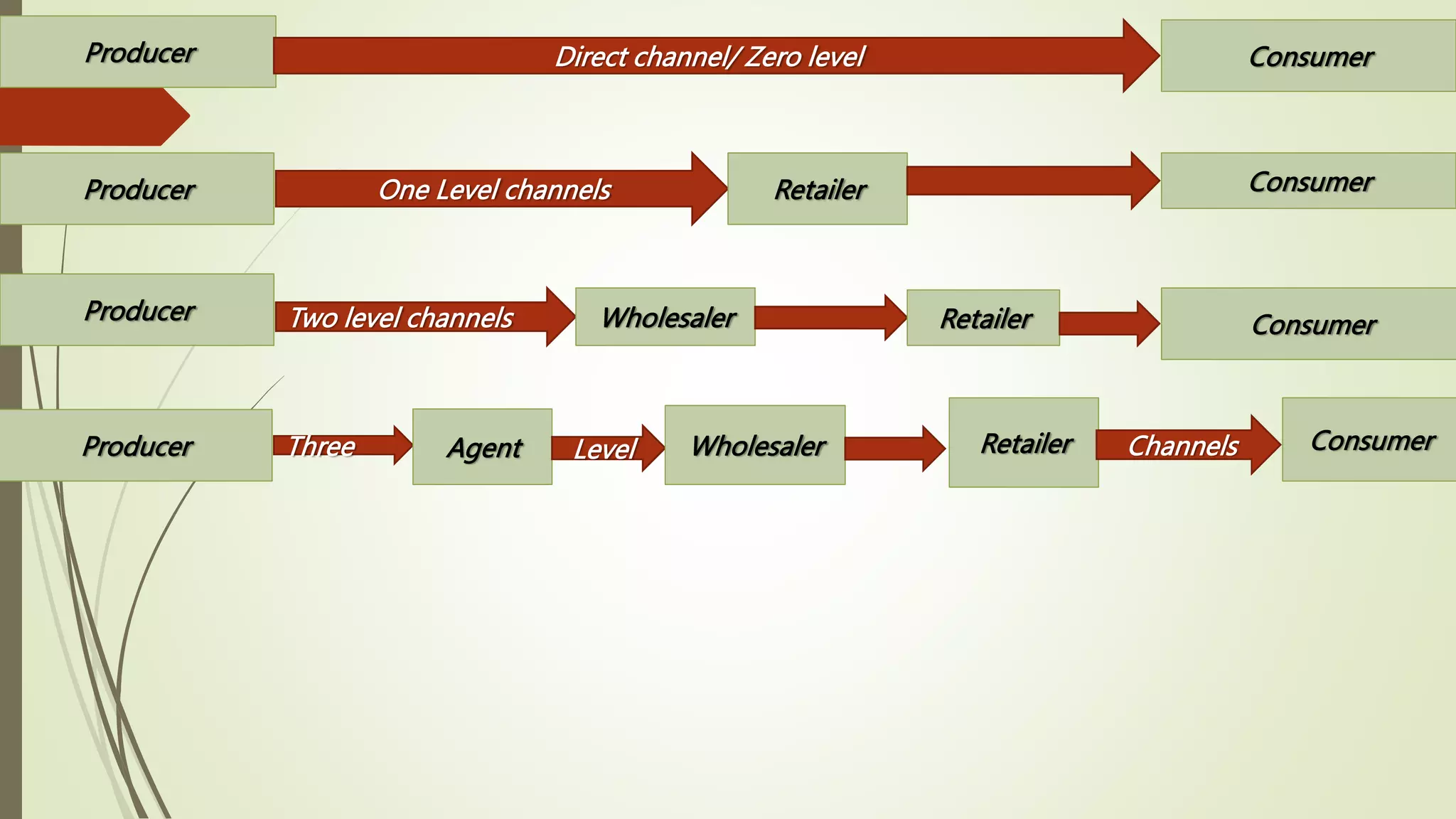
A distribution channel connects the producer and the consumer.
Several intermediaries function in between them. The number of
intermediaries the length of the channel. It is also called channel
levels or type of channels.
Producer Direct channel/ Zero level Consumer
Producer One Level channels Retailer Consumer
Producer Two level channels Wholesaler Retailer Consumer
Producer Three Agent Level Wholesaler Retailer Channels Consumer
1. Directchannel/zerolevel/directmarketing
Direct channel of distribution means making goods available to consumers
directly by the manufacturer, without involving any intermediary,
E.g. : Mail order selling, Internet selling, Selling through own sales force/own
retail outlets(e.g. Bata, McDonald etc.)
2. Indirectchannels
Indirect channels of distribution mean making goods
available to the consumers by employing one or more
intermediaries. Following are the different types of
channels under indirect channels
1. One level
2. Two level channels
3. Three level channels
Onelevel
In this type, the intermediary is the retailer firm directly
supplies the product to retailer who sells the product
directly to customers. E.g. : Maruti Udyog sells its cars
through company approved retailers
twolevel channels
Under this channel, the manufacturer sells to or more retailers who
in turn sell to the ultimate consumers. This is most commonly
adopted distribution network for most consumer goods like soaps,
oils, clothes, rice, sugar etc.
Threelevelchannels
This is the longest channel of distribution. In this path, one more
middlemen is added. So there are three intermediaries’ involved-
agents, wholesalers and retailers. Manufacture use their own
selling agents or brokers who connect them with wholesalers and
then the retailers.
Whatis Intermediaries?
Independent firms which assist in the flow of goods
and services from producers to end-users; they
include agents, wholesalers and retailers; marketing
services agencies; physical distribution companies;
and financial institutions. Also referred to as
Middlemen.
Typesofintermediaries
Retailers wholesalers
Retailers& retailing
Retailer:
Retailing refers to the business activity of selling goods or
services to the final consumer.
Retailer:
Retailer is one whose business firms sells mainly to the final
consumers.
Typesofretailer
Department Store :
This type of retailer is often the most complex offering a wide range of
products.
It appear as a collection of smaller retail stores managed by one
company.
The department store retailers offer products at various pricing levels.
This type of retailer adds high levels of customer service.
Warehouse retailers:
This type of retailer is usually situated in retail or Business Park and
where premises rents are lower.
This enables the of retailer to stock, display and retail a large
variety of good very competitive prices.
Specialty Retailers :
Specializing in specific industries or products, this type of retailer is able to
offer the customer expert knowledge and a high level of service.
They also add value by offering accessories and additional related products
at the same outlet.
E- tailer :
This type of retailer enables customers to shop on-line via the internet and
buy products which are then delivered.
Is highly convenient and is able to supply a wider geographic customer base.
Often have lower rent and overheads so offer very competitive pricing.
Convenience Retailer :
Located in residential areas this type of retailer offers a limited range of
products at premium prices due to the added value of convenience.
Discount Retailer :
This type of retailer offers a variety of discounted products.
They offer low prices on fashionable branded products.
wholesaling
It refers to all activities involved in selling goods and services to
those who intend to resell or use the same for producing goods
or services.
Typesofwholesalers:
Merchant wholesalers :
These wholesale suppliers own and produce a product or service and
resell their products to resellers, retailers, distributors and other
wholesalers.
General wholesalers :
Will usually buy large quantities of products from one or more
suppliers and will be intending to add value to them by reselling in
smaller quantities to distributors, retailers and resellers.
This type of wholesaler may resell products from a number of different
industries and in several different categories.
Specialty Wholesalers :
This type of wholesaler will resell products in a specific industry or product
category, but may have products from multiple suppliers.
Because specialty wholesalers specialize in a specific industry or product type
they tend to have good product knowledge and good pricing.
Specific Product Wholesalers :
These are wholesalers who only supply 1 type of product for example
footwear or computers.
They may supply several brands but only within one product category.
Manufacturers often use this type of wholesaler to distribute one or more of
their products.
Discount Wholesalers :
This type of wholesaler will supply significantly discounted stock.
Generally the stock is discounted because the products are
discounted lines, returned goods or refurbished goods.
Drop Ship Wholesalers :
This type of wholesaler will complete the sale of a product but will
have it dispatched from their supplier directly to their customer
without actually handling the goods.
On-line Wholesalers :
Wholesalers who sell their products on-line offer discounted
prices as they can reduce their overheads such as rent and rates of
physical premises.
This type of wholesaler is therefore able to add a lower percentage
to their purchase price and still make margin.
conclusion
As the needs, market and other factors constantly change,
companies needs to quickly adapt to it and keep their distribution
channels optimized and up to date. Distribution Analysis is
important for a company to gain competitive advantages. It
supports one’s company to :
Addresses the needs of buyers and eventually increase income,
Improve efficiency within a competitive market,
Preserve their role in channel structure.

marketing channels.pptx

  • 1.
    SESSION:2022-2023 SUBJECT:-principleof marketingmanagement SUBMITTEDTOTHEPARTICALFULFILLMENTOF FORTHEAWARDOFTHEDEGREEOF BACHELOROF BUSINESSADMINISTRATION ASA PARTOF SEMESTER2 SUBMITTEDBY Priyanshutrivedi 22BBAN444 UNDERTHEGUIDANCEOF MS.Rashmimam
  • 2.
    Definitionsofmarketingchannels  According toAmerican Marketing Association , “A channel of distribution, or marketing channel, is the structure as intra-company organization units and extra company agents and dealers, wholesale and retail through which a commodity, product or service is marketed.”  According to Philip Kotler , “Every producer seeks to links together the set of marketing intermediaries that best fulfill the firm’s objectives. This set of marketing intermediaries is called the Marketing channels. (Also called Trades channel or channel of distribution.)”
  • 3.
    Objectivesofthemarketingchannels  To ensurethe availability of products at the point of sale.  To build the channel members loyalty.  To stimulate channel members to put greater selling efforts.  To develop managerial efficiency in the channel organization.  To identify your organization at buyer level.  To have an effective and efficient distribution system, to make your product and services available.
  • 4.
    Importanceofmarketingchannels Time and Placeutility. Convenience to Consumers. Relive from Marketing Problems. Information to the producer. Stability in Price. Promotional Activities. Storage of finished goods. Finance the producer.
  • 5.
    CHANNELFUNCTIONS(cont.) Providing marketing information: Companiesrely on market research to determine their target markets’ needs and wants Ex: small business producing handmade greeting cards Promoting products: Can be expensive Retailers often take a large portion of promotion responsibilities Ex: local supermarkets/discount stores
  • 6.
    CHANNEL FUNCTIONS (cont.) Contact Matching Negotiatingwith the customers: Different prices are paid by the wholesaler, retailer and consumers based on negotiation Physical distribution Financing and risk taking: Moving products through a channel costs money When channel members work together to finance activities and to assume financial risks, channels will be more effective
  • 7.
  • 8.
    Channel levels A distributionchannel connects the producer and the consumer. Several intermediaries function in between them. The number of intermediaries the length of the channel. It is also called channel levels or type of channels.
  • 9.
    Producer Direct channel/Zero level Consumer Producer One Level channels Retailer Consumer Producer Two level channels Wholesaler Retailer Consumer Producer Three Agent Level Wholesaler Retailer Channels Consumer
  • 10.
    1. Directchannel/zerolevel/directmarketing Direct channelof distribution means making goods available to consumers directly by the manufacturer, without involving any intermediary, E.g. : Mail order selling, Internet selling, Selling through own sales force/own retail outlets(e.g. Bata, McDonald etc.)
  • 11.
    2. Indirectchannels Indirect channelsof distribution mean making goods available to the consumers by employing one or more intermediaries. Following are the different types of channels under indirect channels 1. One level 2. Two level channels 3. Three level channels
  • 12.
    Onelevel In this type,the intermediary is the retailer firm directly supplies the product to retailer who sells the product directly to customers. E.g. : Maruti Udyog sells its cars through company approved retailers
  • 13.
    twolevel channels Under thischannel, the manufacturer sells to or more retailers who in turn sell to the ultimate consumers. This is most commonly adopted distribution network for most consumer goods like soaps, oils, clothes, rice, sugar etc.
  • 14.
    Threelevelchannels This is thelongest channel of distribution. In this path, one more middlemen is added. So there are three intermediaries’ involved- agents, wholesalers and retailers. Manufacture use their own selling agents or brokers who connect them with wholesalers and then the retailers.
  • 15.
    Whatis Intermediaries? Independent firmswhich assist in the flow of goods and services from producers to end-users; they include agents, wholesalers and retailers; marketing services agencies; physical distribution companies; and financial institutions. Also referred to as Middlemen.
  • 16.
  • 17.
    Retailers& retailing Retailer: Retailing refersto the business activity of selling goods or services to the final consumer. Retailer: Retailer is one whose business firms sells mainly to the final consumers.
  • 18.
    Typesofretailer Department Store : Thistype of retailer is often the most complex offering a wide range of products. It appear as a collection of smaller retail stores managed by one company. The department store retailers offer products at various pricing levels. The department store retailers offer products at various pricing levels. This type of retailer adds high levels of customer service.
  • 19.
    Warehouse retailers: This typeof retailer is usually situated in retail or Business Park and where premises rents are lower. This enables the of retailer to stock, display and retail a large variety of good very competitive prices.
  • 20.
    Specialty Retailers : Specializingin specific industries or products, this type of retailer is able to offer the customer expert knowledge and a high level of service. They also add value by offering accessories and additional related products at the same outlet. E- tailer : This type of retailer enables customers to shop on-line via the internet and buy products which are then delivered. Is highly convenient and is able to supply a wider geographic customer base. Often have lower rent and overheads so offer very competitive pricing.
  • 21.
    Convenience Retailer : Locatedin residential areas this type of retailer offers a limited range of products at premium prices due to the added value of convenience. Discount Retailer : This type of retailer offers a variety of discounted products. They offer low prices on fashionable branded products.
  • 22.
    wholesaling It refers toall activities involved in selling goods and services to those who intend to resell or use the same for producing goods or services.
  • 23.
    Typesofwholesalers: Merchant wholesalers : Thesewholesale suppliers own and produce a product or service and resell their products to resellers, retailers, distributors and other wholesalers. General wholesalers : Will usually buy large quantities of products from one or more suppliers and will be intending to add value to them by reselling in smaller quantities to distributors, retailers and resellers. This type of wholesaler may resell products from a number of different industries and in several different categories.
  • 24.
    Specialty Wholesalers : Thistype of wholesaler will resell products in a specific industry or product category, but may have products from multiple suppliers. Because specialty wholesalers specialize in a specific industry or product type they tend to have good product knowledge and good pricing. Specific Product Wholesalers : These are wholesalers who only supply 1 type of product for example footwear or computers. They may supply several brands but only within one product category. Manufacturers often use this type of wholesaler to distribute one or more of their products.
  • 25.
    Discount Wholesalers : Thistype of wholesaler will supply significantly discounted stock. Generally the stock is discounted because the products are discounted lines, returned goods or refurbished goods. Drop Ship Wholesalers : This type of wholesaler will complete the sale of a product but will have it dispatched from their supplier directly to their customer without actually handling the goods.
  • 26.
    On-line Wholesalers : Wholesalerswho sell their products on-line offer discounted prices as they can reduce their overheads such as rent and rates of physical premises. This type of wholesaler is therefore able to add a lower percentage to their purchase price and still make margin.
  • 27.
    conclusion As the needs,market and other factors constantly change, companies needs to quickly adapt to it and keep their distribution channels optimized and up to date. Distribution Analysis is important for a company to gain competitive advantages. It supports one’s company to : Addresses the needs of buyers and eventually increase income, Improve efficiency within a competitive market, Preserve their role in channel structure.