

Diffusion of Innovation
• Diffusion of Innovations is a theory of
how, why, and at what rate new ideas and
technology spread through cultures. The
concept was first studied by the French
sociologist Gabriel Tarde (1890) and by
German and Austrian anthropologists such
as Friedrich Ratzel or Leo Frobenius .
Why does this happen?
Macromarketing issues
• Valuable resources are wasted which might have
been deployed towards more productive uses
• Products that might have helped people do things
more productively or attain higher levels in their
quality of life, fail to be used
• Successful products are those that become
culturally anchored.
Micromarketing issues
• Succesful new product development is an
important element in achieving long term
competitive superiority and profitability,especially
in low growth markets
• New product development plays an important role
in market leadership and profitability. Market
leaders normally have three times higher returns
than firms with lower market shares
• A successful new product can be the beginning of
a whole new company
The value chain
Contemporary firms are being attacked by
competitively on every dimension and
from every direction. The only way to
survive this onslaught is to create a ‘value
chain’ to serve the customer, which will
serve to differentiate the successful firm
from its competitors and will provide
competitive superiority on the critical
attributes of importance to the consumer
What is an innovation?
It is any idea or product perceived by
the potential adopter to be new. New
products are ideas, behaviour or
things that are qualitatively different
from existing forms
Diffusion of innovation
• A process through which a new product
moves from initial introduction to regular
purchase and use
• A process by which an innovation (idea) is
communicated through certain channels
over time among the members of a social
system – Everett Rogers
Diffusion variables
• Innovation
• Communication
• Time
• Social system
Types of Innovations
• Continuous – modification or improvement of an
existing product
• Dynamically continuous – may involve the
creation of either a new product or the alteration of an
existing one ,but does not generally alter established
patterns of customer buying and product use
• Discontinuous – production of an entirely new
product that causes customers to alter their behaviour
patterns significantly
Innovations include both a hardware
and a software component
The hardware are the physical and
tangible aspects of a product. The
software is the understanding
consumers’ values and lifestyles
Likelihood of innovation success
• Relative advantage – new products that are most likely to
succeed are those that appeal to strongly felt needs
• Compatibility – degree to which the product is consistent with
existing values and past experience of the adopters
• Complexity – degree to which an innovation is
perceived as difficult to understand and use
• Trialability – the ability to make trials easy for new
products without economic risk to the consumer
• Observability – reflects the degree to which results from
using a new product are visible to friends and neighbours
Types of Innovators
• Cognitive – problem solving, cerebral, new mental
experience
• Sensory – fantasy, day dreaming, hedonistic, thrill
seeking
• Monomorphic - consumers who are innovators for one
type of product
• Polymorphic – consumers who are innovators for
more than one type of product
New products in the market
Every year around 5000 new
products appear in the market.
However, most fail and only a few
remain ( around 20%). Products
which are innovative.
Characteristics that encourage rejection
• Value barrier
• Usage barrier
• Risk barrier
Speed of diffusion
• Competitive intensity
• Reputation of the supplier
• Standardised technology
• Vertical coordination
• Resource commitments
Communication of new products
• Mass media
• Homophily – degree to which pairs of individuals
who interact are similar in beliefs, education and social
status
• Heterophily – inconsistent with own beliefs and views
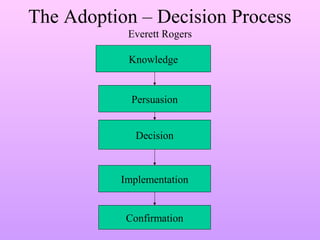
The Adoption – Decision Process
Everett Rogers
Confirmation
Knowledge
Persuasion
Decision
Implementation
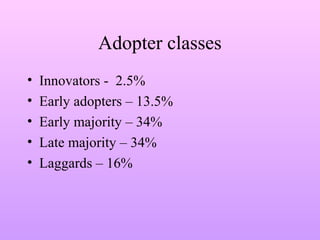
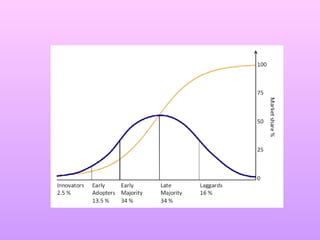
Adopter classes
• Innovators - 2.5%
• Early adopters – 13.5%
• Early majority – 34%
• Late majority – 34%
• Laggards – 16%
Innovators
• Innovators are the first individuals to adopt
an innovation. Innovators are willing to take
risks, youngest in age, have the highest
social class, have great financial lucidity,
very social and have closest contact to
scientific sources and interaction with other
innovators .
Early Adopters
• This is second fastest category of
individuals who adopt an innovation. These
individuals have the highest degree of
opinion leadership among the other adopter
categories. Early adopters are typically
younger in age, have a higher social status,
have more financial lucidity, advanced
education, and are more socially forward
than late adopters
Early Majority
• Individuals in this category adopt an
innovation after a varying degree of time.
This time of adoption is significantly longer
than the innovators and early adopters.
Early Majority tend to be slower in the
adoption process, have above average social
status, contact with early adopters, and
show some opinion leadership.
Late Majority
• Individuals in this category will adopt an
innovation after the average member of the
society. These individuals approach an innovation
with a high degree of skepticism and after the
majority of society has adopted the innovation.
Late Majority are typically skeptical about an
innovation, have below average social status, very
little financial lucidity, in contact with others in
late majority and early majority, very little opinion
leadership.
Laggards
Individuals in this category are the last to adopt an
innovation. Unlike some of the previous
categories, individuals in this category show little
to no opinion leadership. These individuals
typically have an aversion to change-agents and
tend to be advanced in age. Laggards typically
tend to be focused on “traditions”, have lowest
social status, lowest financial fluidity, oldest of all
other adopters, in contact with only family and
close friends, very little to no opinion leadership .
Innovativeness
This is the degree to which an individual
adopts an innovation relatively earlier than
others
• Based on time of adoption
• Based on number of new product adoption
Parameters for innovativeness
• Socio-economic variables
• Personality and attitude
• Communication variables
Socio – economic variables
• Education
• Literacy
• Higher social status
• Upward social mobility
• Larger-sized units
• Commercial orientation
• Favourable attitude towards credit
• Specialized operations
Personality and attitude
• Empathy
• Ability to deal in
abstraction
• Rationality
• Intelligence
• Favourable attitude
towards change
• Ability to cope with
uncertainty
• Favourable attitude
towards education
• Favourable attitude
towards science
• High aspirations
Communication variables
• Social participation
• Interconnectedness with
the social system
• Cosmopoliteness
• Change agent contact
• Mass media exposure
• Exposure to interpersonal
communication channels
• Knowledge of innovations
• Opinion leadership
• Belonging to highly
interconnected systems
Polymorphism
The degree to which innovators and early
adopters for one product are likely to be
innovators for other products. Consumers
who are innovators for one product are
monomorphic. Consumers who are
innovators for more than one product are
polymorphic.
• THANK YOU

DIFFUSION OF INNOVATION

  • 1.
  • 2.
    • Diffusion ofInnovations is a theory of how, why, and at what rate new ideas and technology spread through cultures. The concept was first studied by the French sociologist Gabriel Tarde (1890) and by German and Austrian anthropologists such as Friedrich Ratzel or Leo Frobenius .
  • 3.
    Why does thishappen? Macromarketing issues • Valuable resources are wasted which might have been deployed towards more productive uses • Products that might have helped people do things more productively or attain higher levels in their quality of life, fail to be used • Successful products are those that become culturally anchored.
  • 4.
    Micromarketing issues • Succesfulnew product development is an important element in achieving long term competitive superiority and profitability,especially in low growth markets • New product development plays an important role in market leadership and profitability. Market leaders normally have three times higher returns than firms with lower market shares • A successful new product can be the beginning of a whole new company
  • 5.
    The value chain Contemporaryfirms are being attacked by competitively on every dimension and from every direction. The only way to survive this onslaught is to create a ‘value chain’ to serve the customer, which will serve to differentiate the successful firm from its competitors and will provide competitive superiority on the critical attributes of importance to the consumer
  • 6.
    What is aninnovation? It is any idea or product perceived by the potential adopter to be new. New products are ideas, behaviour or things that are qualitatively different from existing forms
  • 7.
    Diffusion of innovation •A process through which a new product moves from initial introduction to regular purchase and use • A process by which an innovation (idea) is communicated through certain channels over time among the members of a social system – Everett Rogers
  • 8.
    Diffusion variables • Innovation •Communication • Time • Social system
  • 9.
    Types of Innovations •Continuous – modification or improvement of an existing product • Dynamically continuous – may involve the creation of either a new product or the alteration of an existing one ,but does not generally alter established patterns of customer buying and product use • Discontinuous – production of an entirely new product that causes customers to alter their behaviour patterns significantly
  • 10.
    Innovations include botha hardware and a software component The hardware are the physical and tangible aspects of a product. The software is the understanding consumers’ values and lifestyles
  • 11.
    Likelihood of innovationsuccess • Relative advantage – new products that are most likely to succeed are those that appeal to strongly felt needs • Compatibility – degree to which the product is consistent with existing values and past experience of the adopters • Complexity – degree to which an innovation is perceived as difficult to understand and use • Trialability – the ability to make trials easy for new products without economic risk to the consumer • Observability – reflects the degree to which results from using a new product are visible to friends and neighbours
  • 12.
    Types of Innovators •Cognitive – problem solving, cerebral, new mental experience • Sensory – fantasy, day dreaming, hedonistic, thrill seeking • Monomorphic - consumers who are innovators for one type of product • Polymorphic – consumers who are innovators for more than one type of product
  • 13.
    New products inthe market Every year around 5000 new products appear in the market. However, most fail and only a few remain ( around 20%). Products which are innovative.
  • 14.
    Characteristics that encouragerejection • Value barrier • Usage barrier • Risk barrier
  • 15.
    Speed of diffusion •Competitive intensity • Reputation of the supplier • Standardised technology • Vertical coordination • Resource commitments
  • 16.
    Communication of newproducts • Mass media • Homophily – degree to which pairs of individuals who interact are similar in beliefs, education and social status • Heterophily – inconsistent with own beliefs and views
  • 17.
    The Adoption –Decision Process Everett Rogers Confirmation Knowledge Persuasion Decision Implementation
  • 18.
    Adopter classes • Innovators- 2.5% • Early adopters – 13.5% • Early majority – 34% • Late majority – 34% • Laggards – 16%
  • 20.
    Innovators • Innovators arethe first individuals to adopt an innovation. Innovators are willing to take risks, youngest in age, have the highest social class, have great financial lucidity, very social and have closest contact to scientific sources and interaction with other innovators .
  • 21.
    Early Adopters • Thisis second fastest category of individuals who adopt an innovation. These individuals have the highest degree of opinion leadership among the other adopter categories. Early adopters are typically younger in age, have a higher social status, have more financial lucidity, advanced education, and are more socially forward than late adopters
  • 22.
    Early Majority • Individualsin this category adopt an innovation after a varying degree of time. This time of adoption is significantly longer than the innovators and early adopters. Early Majority tend to be slower in the adoption process, have above average social status, contact with early adopters, and show some opinion leadership.
  • 23.
    Late Majority • Individualsin this category will adopt an innovation after the average member of the society. These individuals approach an innovation with a high degree of skepticism and after the majority of society has adopted the innovation. Late Majority are typically skeptical about an innovation, have below average social status, very little financial lucidity, in contact with others in late majority and early majority, very little opinion leadership.
  • 24.
    Laggards Individuals in thiscategory are the last to adopt an innovation. Unlike some of the previous categories, individuals in this category show little to no opinion leadership. These individuals typically have an aversion to change-agents and tend to be advanced in age. Laggards typically tend to be focused on “traditions”, have lowest social status, lowest financial fluidity, oldest of all other adopters, in contact with only family and close friends, very little to no opinion leadership .
  • 25.
    Innovativeness This is thedegree to which an individual adopts an innovation relatively earlier than others • Based on time of adoption • Based on number of new product adoption
  • 26.
    Parameters for innovativeness •Socio-economic variables • Personality and attitude • Communication variables
  • 27.
    Socio – economicvariables • Education • Literacy • Higher social status • Upward social mobility • Larger-sized units • Commercial orientation • Favourable attitude towards credit • Specialized operations
  • 28.
    Personality and attitude •Empathy • Ability to deal in abstraction • Rationality • Intelligence • Favourable attitude towards change • Ability to cope with uncertainty • Favourable attitude towards education • Favourable attitude towards science • High aspirations
  • 29.
    Communication variables • Socialparticipation • Interconnectedness with the social system • Cosmopoliteness • Change agent contact • Mass media exposure • Exposure to interpersonal communication channels • Knowledge of innovations • Opinion leadership • Belonging to highly interconnected systems
  • 30.
    Polymorphism The degree towhich innovators and early adopters for one product are likely to be innovators for other products. Consumers who are innovators for one product are monomorphic. Consumers who are innovators for more than one product are polymorphic.
  • 31.