DEPARTMENT OF BUSINESS ADMINISTRATION & RESEARCH
Shri Sant Gajanan Maharaj College of Engg., Shegaon
Sales and Distribution Management
Unit-2
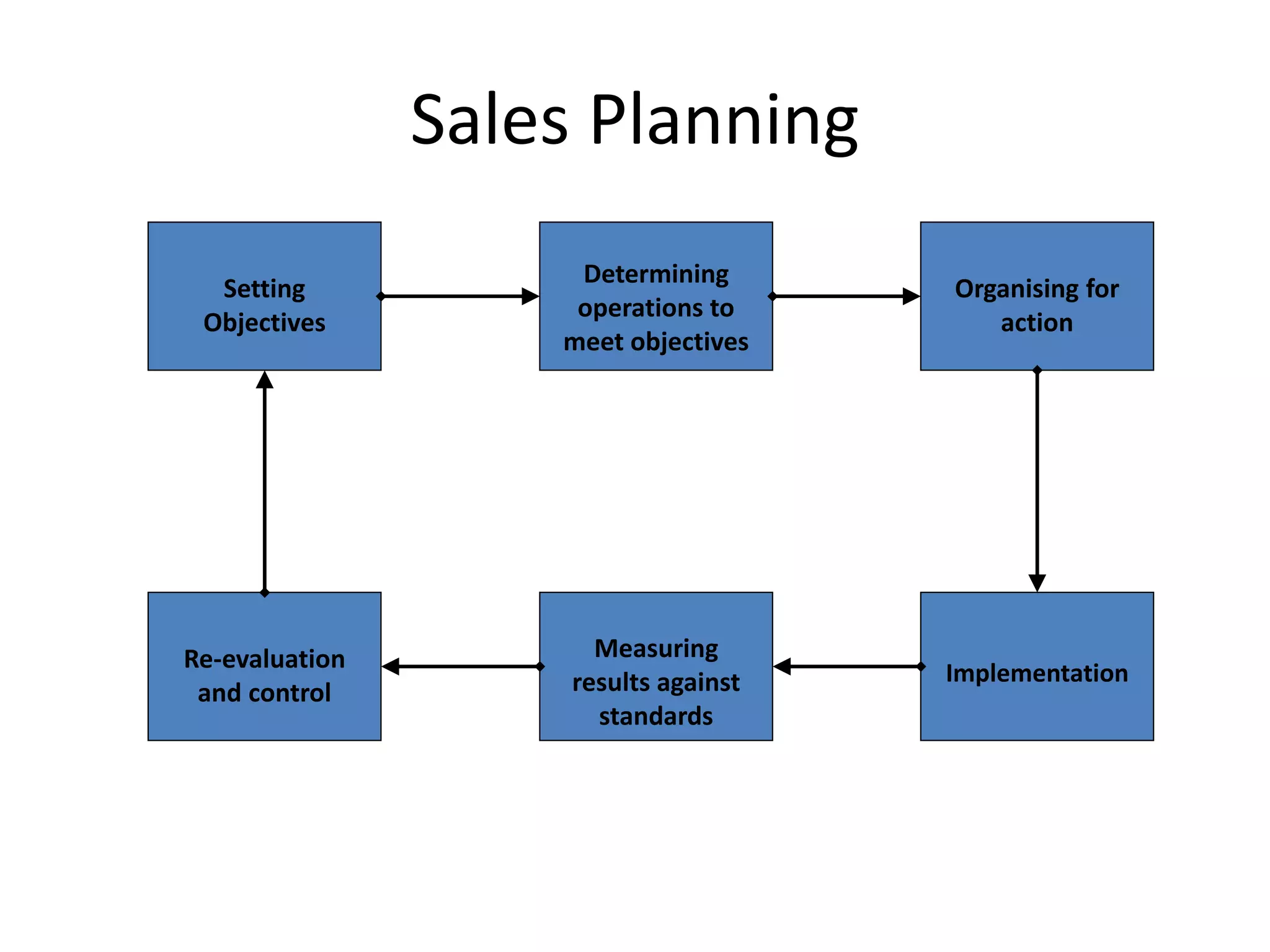
Sales Planning
Setting
Objectives
Determining
operations to
meet objectives
Organising for
action
Implementation
Measuring
results against
standards
Re-evaluation
and control
Sales Planning
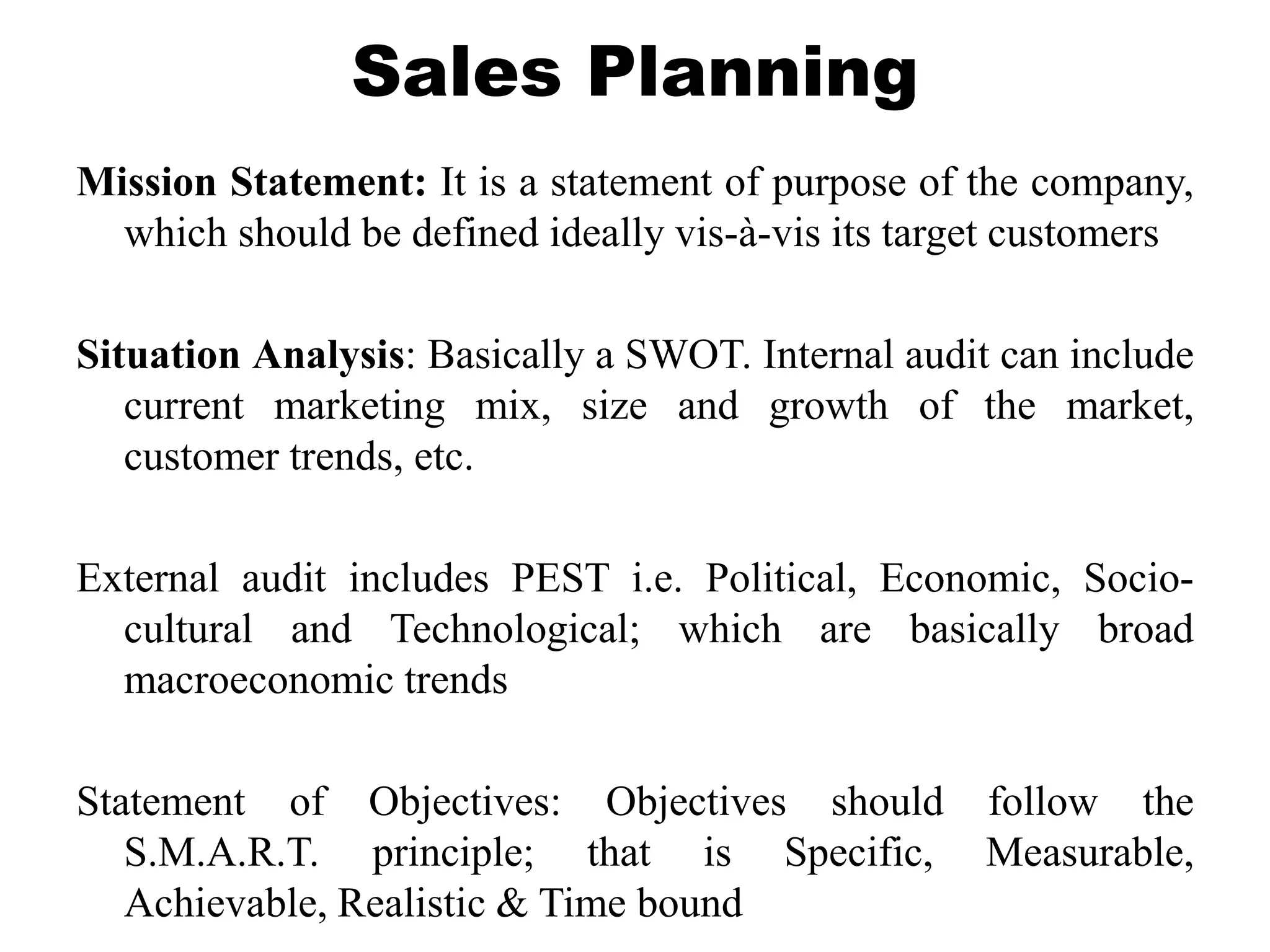
Mission Statement: It is a statement of purpose of the company,
which should be defined ideally vis-à-vis its target customers
Situation Analysis: Basically a SWOT. Internal audit can include
current marketing mix, size and growth of the market,
customer trends, etc.
External audit includes PEST i.e. Political, Economic, Socio-
cultural and Technological; which are basically broad
macroeconomic trends
Statement of Objectives: Objectives should follow the
S.M.A.R.T. principle; that is Specific, Measurable,
Achievable, Realistic & Time bound
Sales Planning
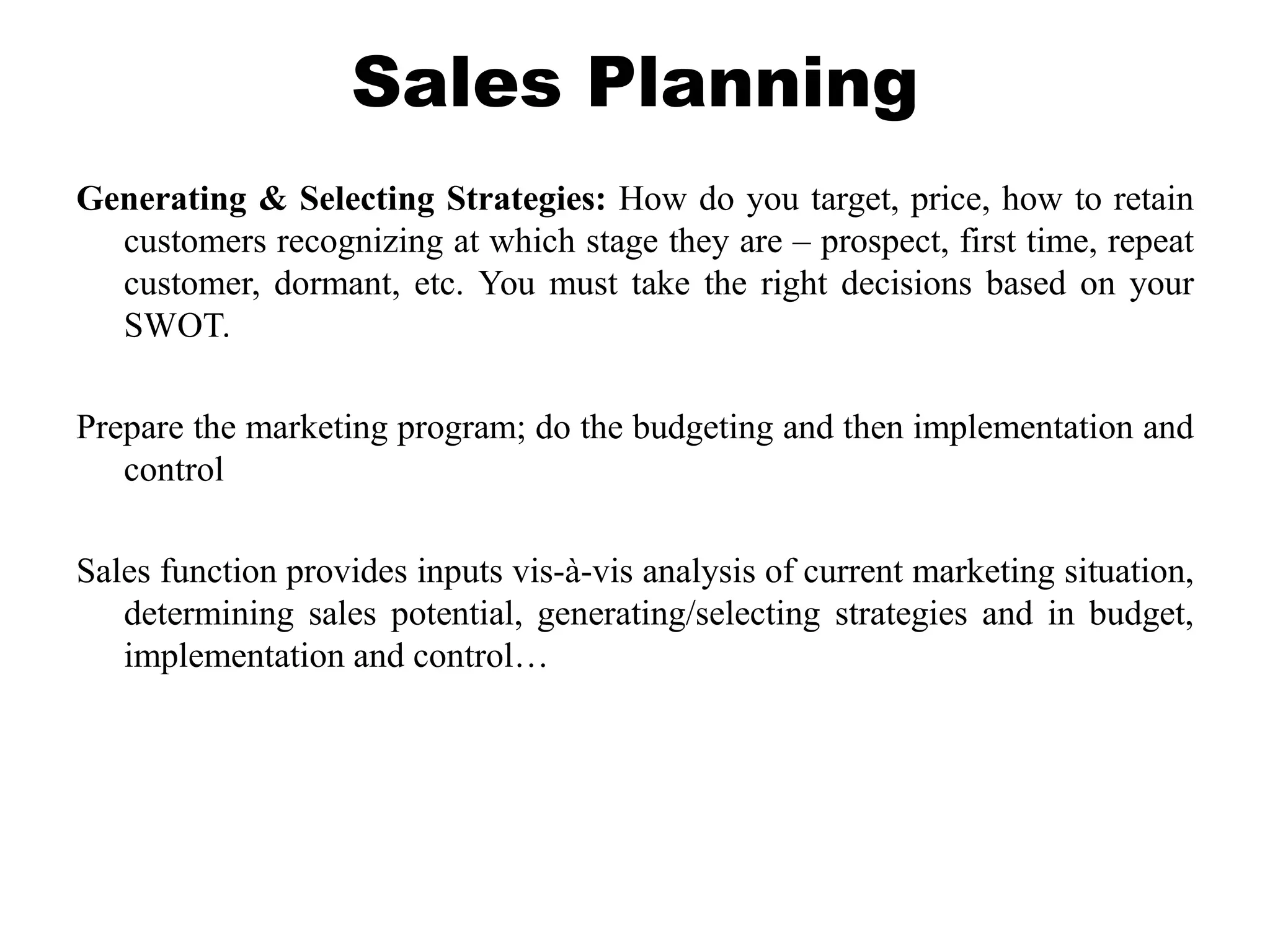
Generating & Selecting Strategies: How do you target, price, how to retain
customers recognizing at which stage they are – prospect, first time, repeat
customer, dormant, etc. You must take the right decisions based on your
SWOT.
Prepare the marketing program; do the budgeting and then implementation and
control
Sales function provides inputs vis-à-vis analysis of current marketing situation,
determining sales potential, generating/selecting strategies and in budget,
implementation and control…
Sales Budget
A sales budget consists of estimates of unit and rupee sales during
operating period as well as selling expenses; so as to estimate the
profit target.
Once the budget is set, it can be broken down by region, product
groups and/or account types
Also, sales budget talks about the optimum profitability in a given
period; since firms typically look for profit maximization in the
long term; while it seeks sales maximization in the current period.
Sales Budget
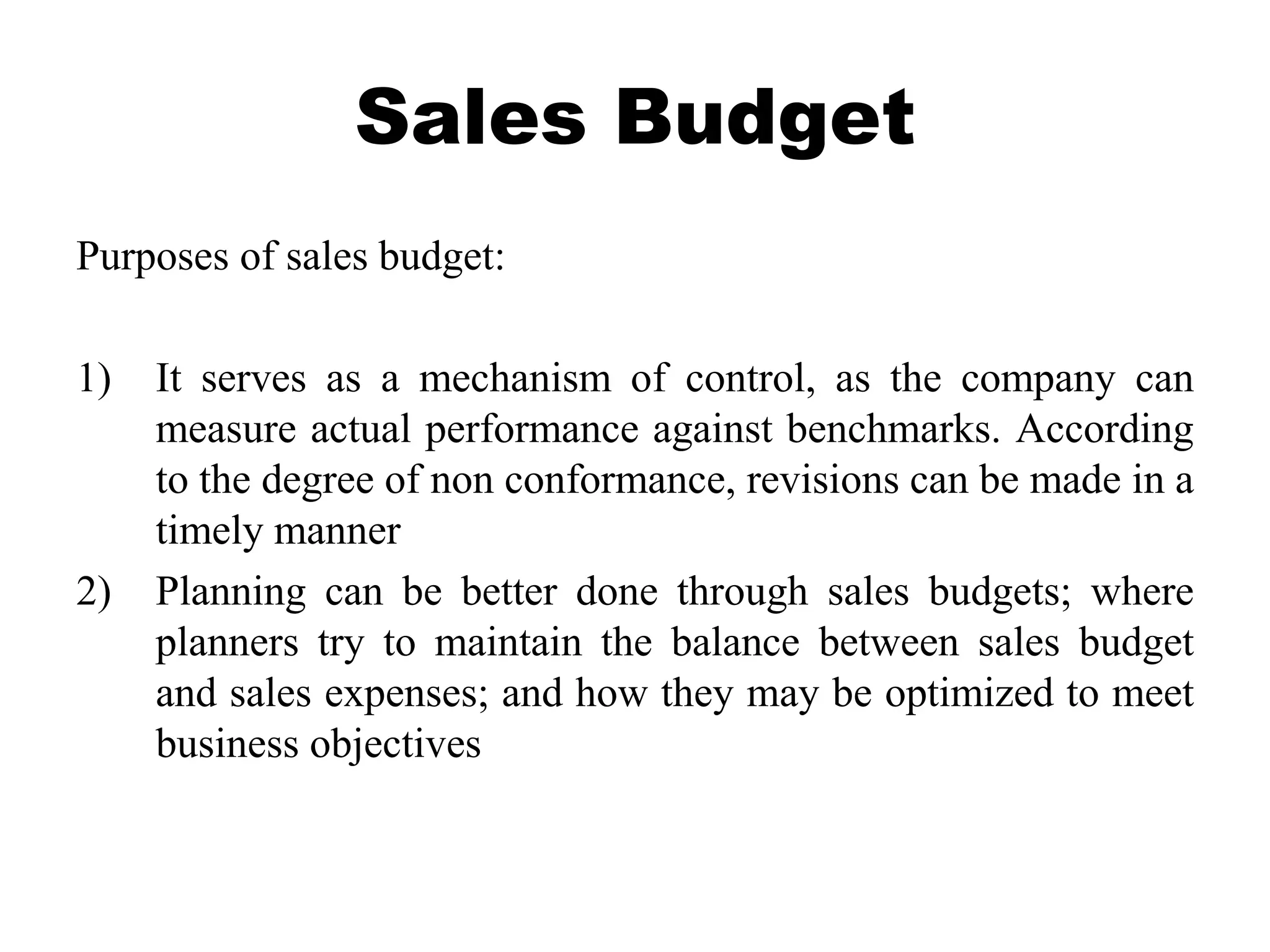
Purposes of sales budget:
1) It serves as a mechanism of control, as the company can
measure actual performance against benchmarks. According
to the degree of non conformance, revisions can be made in a
timely manner
2) Planning can be better done through sales budgets; where
planners try to maintain the balance between sales budget
and sales expenses; and how they may be optimized to meet
business objectives
Sales Budget
Sales budget: figures in ‘000 units
North South East West Total
A 80 25 32 40 177
B 90 45 12 57 204
C 30 70 60 34 194
Product
Region
Sales Budget
Sales department budget is the cost running the marketing function
in the budgetary period. It is normally split into 3
components:
1) Selling expenses budget: Costs attributable to the selling
process: Sales personnel salaries and commission, sales
training and sales expenses
2) Advertising Expenses: Expenses attributable to above the line
and below the line promotions:
a)Percentage of last year’s sales
b)Competitive parity in line with a larger player
c)Affordable method
d)Objective and task method
e)Long term ROI of advertising
3) Administrative expenses: Accounts staff, market research sales
administration, etc.
Sales Budget
Estimating selling expenses: In the long run, the goal is profit
maximization; but in the short run, one may have to incur loss
in pitching for new accounts, doing extensive follow up,
providing incentives for business development; mean that sales
optimization becomes the short term goal
The management may like to plan well in advance for the
accounting period immediately succeeding the current one.
After the sales target is made, activities are defined to achieve the
same; after which costs are estimated. For instance: the target
requires sales people to travel 1,00,000 km a year, and the
allowance per km. is Rs.8, the budgetary allocation would be
Rs.8,00,000…
Sales Budget
Also management can measure change in standard
costs over time
If standard costing is not possible, estimates like cost
per unit sale may be used. Companies may also adjust
this cost for inflation, changes in competitive
landscape, market conditions, etc.
Sales Budget
Planning styles:
1) Top down: The top management gives sales and profit
targets to various organizational units and unit heads make
plans to achieve those objectives
2) Bottom up: Unit heads and their subordinates team up in the
setting of the sales and profit objectives and also plans to
meet them.
Ideally the budgeting should be more democratically done, as the
top management is away from the realities in the field; but at
the same time, juniors may tend to understate what they can
achieve in the period.
Sales Budget
In the normal scenario, each division will make a budget and send
it to the next higher authority for approval
The division must also discuss its plans for the forthcoming period
for the sake of better evaluation. Every level must lead to more
conciseness in detail
If there is a cutback, then the division has to obviously decide
where to cut corners.
It will be similar for other departments, where they will present an
estimation of their costs.
Top management has to carefully evaluate and allocate budgetary
expenditure in the best interests of the company
Sales Budget
When there are budgetary deviations, there are two options:
1) Analyze if this is a result of poor performance
2) If there were genuine reasons, the budget itself can be
revised
Sales Budget
A budget is a plan expressed usually in
monetary terms. It is a process of allocating a
portion of an organization’s resources for its
various activities for a specified period of
time.
It helps in planning and coordination of the
organization’s activities. Sales budgets are
developed for the smooth functioning of the
sales function.
Cont.
Developing sales budgets serve two
purposes –
As a mechanism of control and
An instrument of planning.
There are several benefits an organization
derives from budgeting.
Cont.
They are –
• Improved planning
• Better communication and coordination
• Performance evaluation
• Psychological benefits
• Avoiding uncontrolled expenditure.
Cont.
Interlink Role
Marketing Plan
Sales Force BudgetSales Forecast
Types Of Budget
In practice, sales managers prepare three
types of budgets –
Sales budgets
Selling expense budget
Administrative budget
A sales budget gives a plan showing the
expected sales for a specified period in the
future.
Cont.
Selling expense budgets details the
schedule of expenses that may be incurred
by the sales department to achieve planned
sales.
Administrative budget specifies the
budgetary allocations for general
administrative expenses that would be
incurred by the sales department.
Methods For Budgeting
The different methods for budgeting include
the-
Affordability method
Percentage-of-sales method
Competitive parity method
Objective-and-task method
Return-oriented method.
Sales Forecasting
Sales forecasting is a difficult area of
management. Most managers believe they
are good at forecasting. However, forecasts
made usually turn out to be wrong!
Marketers argue about whether sales
forecasting is a science or an art. The short
answer is that it is a bit of both.
Cont.
Market Forecast refers to the estimates of
future sales of a company’s products in the
market.
Sales forecasting is very popular in
industrially advanced countries where
demand conditions are always uncertain
than the supply conditions.
Reasons for undertaking Sales Forecast
Businesses are forced to look well ahead in
order to plan their investments, launch new
products, decide when to close or withdraw
products and so on.
The sales forecasting process is a critical
one for most businesses.
Cont.
• Key decisions that are derived from a sales
forecast include:-
- Employment levels required
- Promotional mix
- Investment in production capacity
Types Of Forecasting
• There are two major types of forecasting, which
can be broadly described as macro and micro:
• Macro forecasting is concerned with forecasting
markets in total. This is about determining the
existing level of Market Demand and considering
what will happen to market demand in the future.
• Micro forecasting is concerned with detailed unit
sales forecasts. This is about determining a
product’s market share in a particular industry
and considering what will happen to that market
share in the future.
Selection Of Forecasting
 The selection of which type of forecasting
is use depends on the several factors which
can be described as:
(1) The degree of accuracy required – if the
decisions that are to be made on the basis of the
sales forecast have high risks attached to them,
then it stands to reason that the forecast should
be prepared as accurately as possible. However,
this involves more cost
Cont.
(2) The availability of data and information - in
some markets there is a wealth of available sales
information (e.g. clothing retail, food retailing,
holidays); in others it is hard to find reliable, up-to-
date information.
(3) The time horizon that the sales forecast is
intended to cover. For example, are we
forecasting next weeks’ sales, or are we trying to
forecast what will happen to the overall size of the
market in the next five years?
Cont.
(4) The position of the products in its life cycle.
For example, for products at the “introductory”
stage of the product life cycle, less sales data and
information may be available than for products at
the “maturity” stage when time series can be a
useful forecasting method.
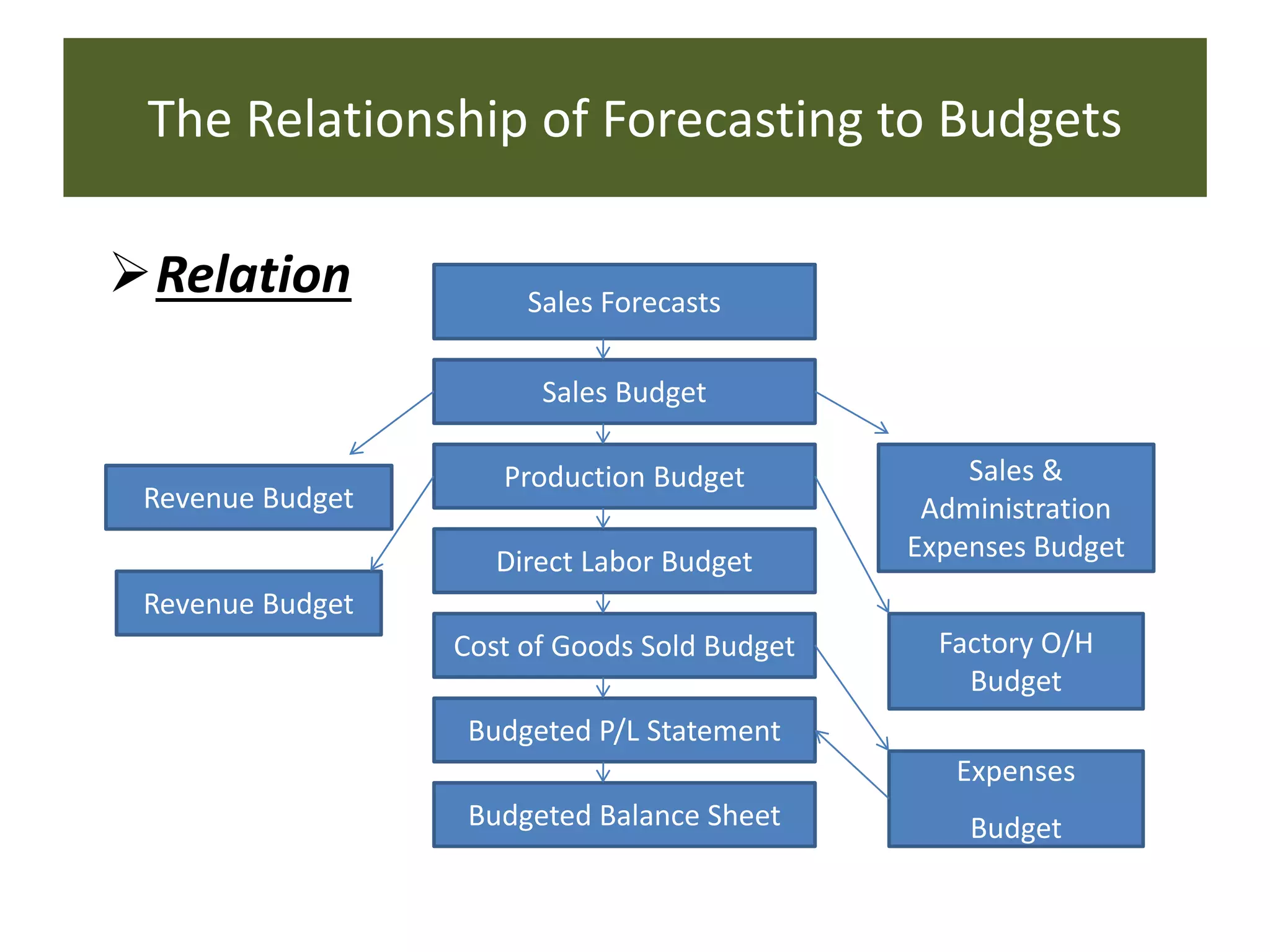
The Relationship of Forecasting to Budgets
Relation Sales Forecasts
Sales Budget
Production Budget
Direct Labor Budget
Cost of Goods Sold Budget
Budgeted P/L Statement
Budgeted Balance Sheet
Revenue Budget
Expenses
Budget
Factory O/H
Budget
Sales &
Administration
Expenses Budget
Revenue Budget
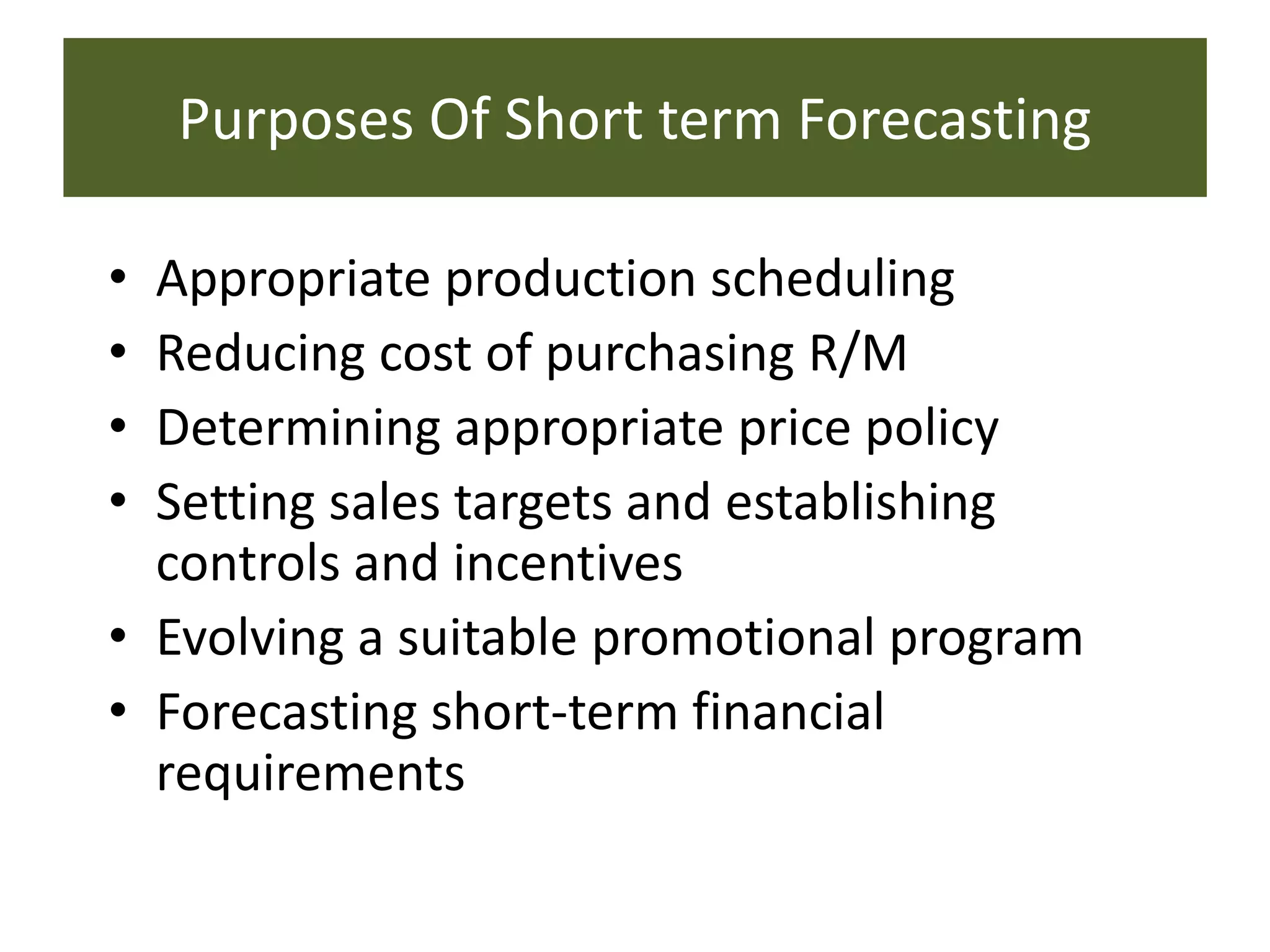
Purposes Of Short term Forecasting
• Appropriate production scheduling
• Reducing cost of purchasing R/M
• Determining appropriate price policy
• Setting sales targets and establishing
controls and incentives
• Evolving a suitable promotional program
• Forecasting short-term financial
requirements
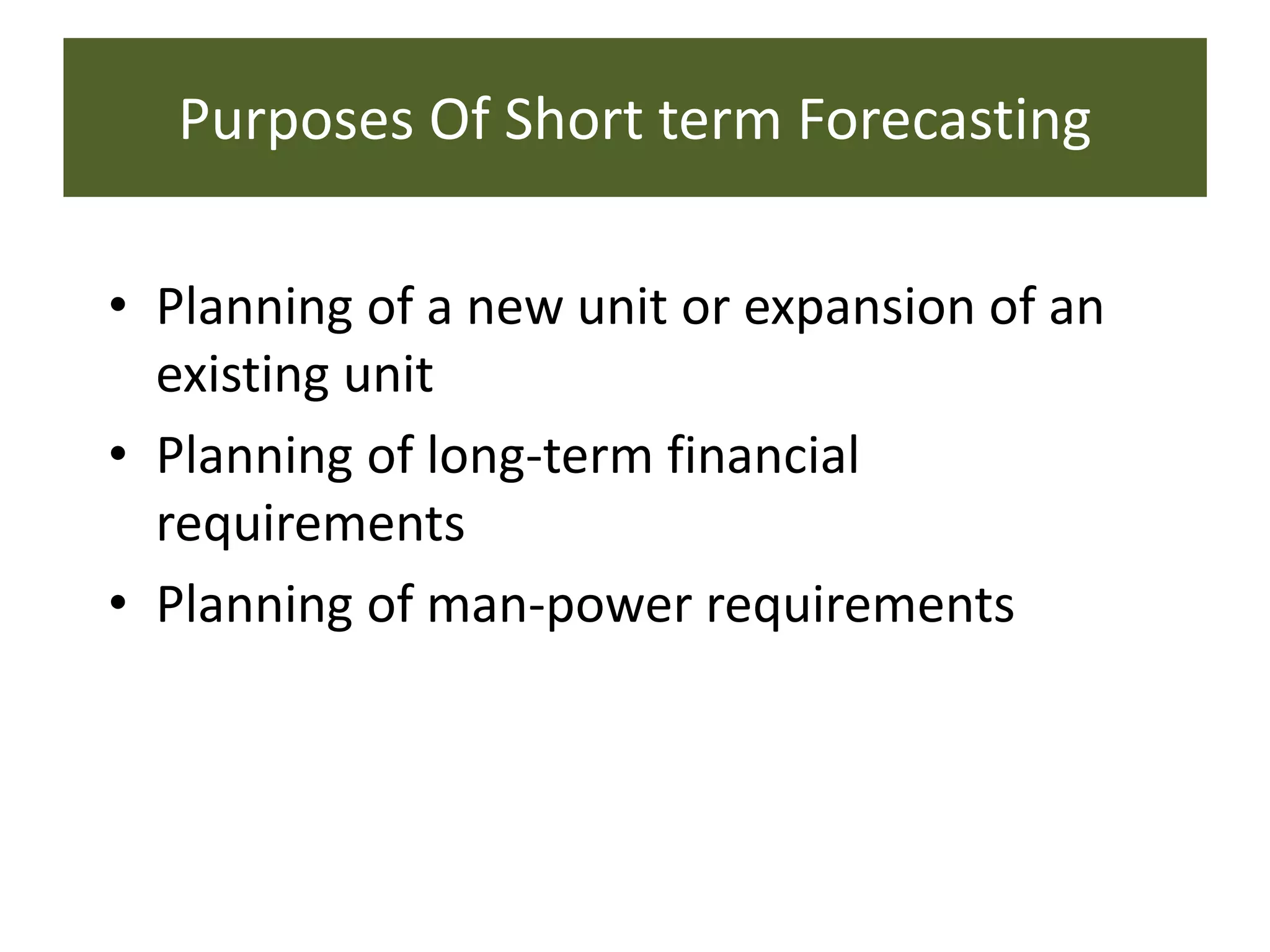
Purposes Of Short term Forecasting
• Planning of a new unit or expansion of an
existing unit
• Planning of long-term financial
requirements
• Planning of man-power requirements
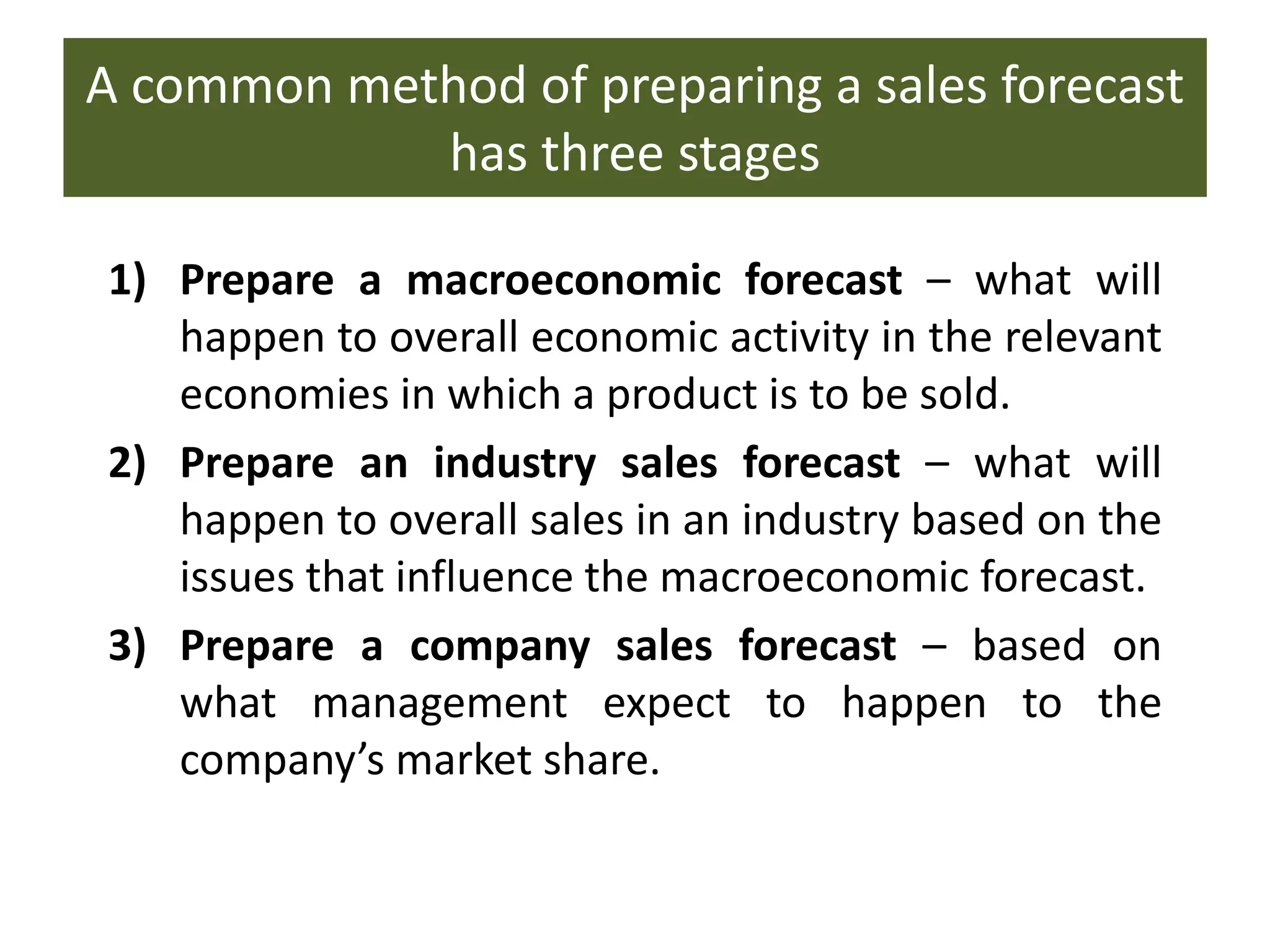
A common method of preparing a sales forecast
has three stages
1) Prepare a macroeconomic forecast – what will
happen to overall economic activity in the relevant
economies in which a product is to be sold.
2) Prepare an industry sales forecast – what will
happen to overall sales in an industry based on the
issues that influence the macroeconomic forecast.
3) Prepare a company sales forecast – based on
what management expect to happen to the
company’s market share.
Forecasting Process
Forecast Objective
Evaluate Result versus
forecast
Determined
independent and
dependent
variables
Total forecast
Procedure
Select forecast
Analysis method
Develop Forecast
Procedure
Gather & analyze
data
Present assumption
about data
Make & finalize
forecast
Cont.
Forecasting can be classified into qualitative
forecasting and quantitative forecasting.
The methods used in qualitative forecasting
are:
• user expectations,
• sales force composite,
• jury of executive opinion,
• Delphi technique and market test.
Cont.
The methods used in quantitative
forecasting are:
• time series analysis
• moving averages
• exponential smoothing regression and
correlation
• analysis, and multiple regression models
Control
Control was defined as “a process used by
managers to direct, regulate, and restrain
the actions of people so that the
established goals of an enterprise may be
achieved.”
Revenue control is clearly an important
goal of sales control, but it is not the only
one.
Sales Control
 Like any other control system, sales control
requires the establishment of standards, the
evaluation of actual performance and the
correction of deviation in performance.
 Sales control implies not only managerial action
with regard to actual sales, but it also embraces
all other marketing functions required for the
even flow of products or services form producers
to consumers.
Cont.
 All promotional and auxiliary efforts in marketing
require as much control as the actual selling
efforts demand.
 Nevertheless, control of promotional and auxiliary
efforts in marketing is more difficult and cannot be
exercised with that exactness which is possible in
case of actual selling efforts.
Cont.
 Because of their intangible performances,
ancillary activities in marketing are placed under
some broad measures of control, and they are
measured and appraised by managerial judgment,
skill or experience.
 The basic tool for controlling these efforts is to be
found in the sales expense budget .
 For controlling performances of salesmen, the sales
budget or in the absence of a sales budget, the
sales programme provides the standard for control.
Goals of Sales Control
• Optimize number of sales
• Maximize profit
• Control revenue
Systematic View
Sales Control
Behavioral Aspects Cost Aspects
Sales Effort Allocation of
Selling-Time
Performance
Expenses
Sales-function
Administration

Sdm 2.0

  • 1.
    DEPARTMENT OF BUSINESSADMINISTRATION & RESEARCH Shri Sant Gajanan Maharaj College of Engg., Shegaon Sales and Distribution Management Unit-2
  • 2.
    Sales Planning Setting Objectives Determining operations to meetobjectives Organising for action Implementation Measuring results against standards Re-evaluation and control
  • 3.
    Sales Planning Mission Statement:It is a statement of purpose of the company, which should be defined ideally vis-à-vis its target customers Situation Analysis: Basically a SWOT. Internal audit can include current marketing mix, size and growth of the market, customer trends, etc. External audit includes PEST i.e. Political, Economic, Socio- cultural and Technological; which are basically broad macroeconomic trends Statement of Objectives: Objectives should follow the S.M.A.R.T. principle; that is Specific, Measurable, Achievable, Realistic & Time bound
  • 4.
    Sales Planning Generating &Selecting Strategies: How do you target, price, how to retain customers recognizing at which stage they are – prospect, first time, repeat customer, dormant, etc. You must take the right decisions based on your SWOT. Prepare the marketing program; do the budgeting and then implementation and control Sales function provides inputs vis-à-vis analysis of current marketing situation, determining sales potential, generating/selecting strategies and in budget, implementation and control…
  • 5.
    Sales Budget A salesbudget consists of estimates of unit and rupee sales during operating period as well as selling expenses; so as to estimate the profit target. Once the budget is set, it can be broken down by region, product groups and/or account types Also, sales budget talks about the optimum profitability in a given period; since firms typically look for profit maximization in the long term; while it seeks sales maximization in the current period.
  • 6.
    Sales Budget Purposes ofsales budget: 1) It serves as a mechanism of control, as the company can measure actual performance against benchmarks. According to the degree of non conformance, revisions can be made in a timely manner 2) Planning can be better done through sales budgets; where planners try to maintain the balance between sales budget and sales expenses; and how they may be optimized to meet business objectives
  • 7.
    Sales Budget Sales budget:figures in ‘000 units North South East West Total A 80 25 32 40 177 B 90 45 12 57 204 C 30 70 60 34 194 Product Region
  • 8.
    Sales Budget Sales departmentbudget is the cost running the marketing function in the budgetary period. It is normally split into 3 components: 1) Selling expenses budget: Costs attributable to the selling process: Sales personnel salaries and commission, sales training and sales expenses 2) Advertising Expenses: Expenses attributable to above the line and below the line promotions: a)Percentage of last year’s sales b)Competitive parity in line with a larger player c)Affordable method d)Objective and task method e)Long term ROI of advertising 3) Administrative expenses: Accounts staff, market research sales administration, etc.
  • 9.
    Sales Budget Estimating sellingexpenses: In the long run, the goal is profit maximization; but in the short run, one may have to incur loss in pitching for new accounts, doing extensive follow up, providing incentives for business development; mean that sales optimization becomes the short term goal The management may like to plan well in advance for the accounting period immediately succeeding the current one. After the sales target is made, activities are defined to achieve the same; after which costs are estimated. For instance: the target requires sales people to travel 1,00,000 km a year, and the allowance per km. is Rs.8, the budgetary allocation would be Rs.8,00,000…
  • 10.
    Sales Budget Also managementcan measure change in standard costs over time If standard costing is not possible, estimates like cost per unit sale may be used. Companies may also adjust this cost for inflation, changes in competitive landscape, market conditions, etc.
  • 11.
    Sales Budget Planning styles: 1)Top down: The top management gives sales and profit targets to various organizational units and unit heads make plans to achieve those objectives 2) Bottom up: Unit heads and their subordinates team up in the setting of the sales and profit objectives and also plans to meet them. Ideally the budgeting should be more democratically done, as the top management is away from the realities in the field; but at the same time, juniors may tend to understate what they can achieve in the period.
  • 12.
    Sales Budget In thenormal scenario, each division will make a budget and send it to the next higher authority for approval The division must also discuss its plans for the forthcoming period for the sake of better evaluation. Every level must lead to more conciseness in detail If there is a cutback, then the division has to obviously decide where to cut corners. It will be similar for other departments, where they will present an estimation of their costs. Top management has to carefully evaluate and allocate budgetary expenditure in the best interests of the company
  • 13.
    Sales Budget When thereare budgetary deviations, there are two options: 1) Analyze if this is a result of poor performance 2) If there were genuine reasons, the budget itself can be revised
  • 14.
    Sales Budget A budgetis a plan expressed usually in monetary terms. It is a process of allocating a portion of an organization’s resources for its various activities for a specified period of time. It helps in planning and coordination of the organization’s activities. Sales budgets are developed for the smooth functioning of the sales function.
  • 15.
    Cont. Developing sales budgetsserve two purposes – As a mechanism of control and An instrument of planning. There are several benefits an organization derives from budgeting.
  • 16.
    Cont. They are – •Improved planning • Better communication and coordination • Performance evaluation • Psychological benefits • Avoiding uncontrolled expenditure.
  • 17.
  • 18.
    Types Of Budget Inpractice, sales managers prepare three types of budgets – Sales budgets Selling expense budget Administrative budget A sales budget gives a plan showing the expected sales for a specified period in the future.
  • 19.
    Cont. Selling expense budgetsdetails the schedule of expenses that may be incurred by the sales department to achieve planned sales. Administrative budget specifies the budgetary allocations for general administrative expenses that would be incurred by the sales department.
  • 20.
    Methods For Budgeting Thedifferent methods for budgeting include the- Affordability method Percentage-of-sales method Competitive parity method Objective-and-task method Return-oriented method.
  • 21.
    Sales Forecasting Sales forecastingis a difficult area of management. Most managers believe they are good at forecasting. However, forecasts made usually turn out to be wrong! Marketers argue about whether sales forecasting is a science or an art. The short answer is that it is a bit of both.
  • 22.
    Cont. Market Forecast refersto the estimates of future sales of a company’s products in the market. Sales forecasting is very popular in industrially advanced countries where demand conditions are always uncertain than the supply conditions.
  • 23.
    Reasons for undertakingSales Forecast Businesses are forced to look well ahead in order to plan their investments, launch new products, decide when to close or withdraw products and so on. The sales forecasting process is a critical one for most businesses.
  • 24.
    Cont. • Key decisionsthat are derived from a sales forecast include:- - Employment levels required - Promotional mix - Investment in production capacity
  • 25.
    Types Of Forecasting •There are two major types of forecasting, which can be broadly described as macro and micro: • Macro forecasting is concerned with forecasting markets in total. This is about determining the existing level of Market Demand and considering what will happen to market demand in the future. • Micro forecasting is concerned with detailed unit sales forecasts. This is about determining a product’s market share in a particular industry and considering what will happen to that market share in the future.
  • 26.
    Selection Of Forecasting The selection of which type of forecasting is use depends on the several factors which can be described as: (1) The degree of accuracy required – if the decisions that are to be made on the basis of the sales forecast have high risks attached to them, then it stands to reason that the forecast should be prepared as accurately as possible. However, this involves more cost
  • 27.
    Cont. (2) The availabilityof data and information - in some markets there is a wealth of available sales information (e.g. clothing retail, food retailing, holidays); in others it is hard to find reliable, up-to- date information. (3) The time horizon that the sales forecast is intended to cover. For example, are we forecasting next weeks’ sales, or are we trying to forecast what will happen to the overall size of the market in the next five years?
  • 28.
    Cont. (4) The positionof the products in its life cycle. For example, for products at the “introductory” stage of the product life cycle, less sales data and information may be available than for products at the “maturity” stage when time series can be a useful forecasting method.
  • 29.
    The Relationship ofForecasting to Budgets Relation Sales Forecasts Sales Budget Production Budget Direct Labor Budget Cost of Goods Sold Budget Budgeted P/L Statement Budgeted Balance Sheet Revenue Budget Expenses Budget Factory O/H Budget Sales & Administration Expenses Budget Revenue Budget
  • 30.
    Purposes Of Shortterm Forecasting • Appropriate production scheduling • Reducing cost of purchasing R/M • Determining appropriate price policy • Setting sales targets and establishing controls and incentives • Evolving a suitable promotional program • Forecasting short-term financial requirements
  • 31.
    Purposes Of Shortterm Forecasting • Planning of a new unit or expansion of an existing unit • Planning of long-term financial requirements • Planning of man-power requirements
  • 32.
    A common methodof preparing a sales forecast has three stages 1) Prepare a macroeconomic forecast – what will happen to overall economic activity in the relevant economies in which a product is to be sold. 2) Prepare an industry sales forecast – what will happen to overall sales in an industry based on the issues that influence the macroeconomic forecast. 3) Prepare a company sales forecast – based on what management expect to happen to the company’s market share.
  • 33.
    Forecasting Process Forecast Objective EvaluateResult versus forecast Determined independent and dependent variables Total forecast Procedure Select forecast Analysis method Develop Forecast Procedure Gather & analyze data Present assumption about data Make & finalize forecast
  • 34.
    Cont. Forecasting can beclassified into qualitative forecasting and quantitative forecasting. The methods used in qualitative forecasting are: • user expectations, • sales force composite, • jury of executive opinion, • Delphi technique and market test.
  • 35.
    Cont. The methods usedin quantitative forecasting are: • time series analysis • moving averages • exponential smoothing regression and correlation • analysis, and multiple regression models
  • 36.
    Control Control was definedas “a process used by managers to direct, regulate, and restrain the actions of people so that the established goals of an enterprise may be achieved.” Revenue control is clearly an important goal of sales control, but it is not the only one.
  • 37.
    Sales Control  Likeany other control system, sales control requires the establishment of standards, the evaluation of actual performance and the correction of deviation in performance.  Sales control implies not only managerial action with regard to actual sales, but it also embraces all other marketing functions required for the even flow of products or services form producers to consumers.
  • 38.
    Cont.  All promotionaland auxiliary efforts in marketing require as much control as the actual selling efforts demand.  Nevertheless, control of promotional and auxiliary efforts in marketing is more difficult and cannot be exercised with that exactness which is possible in case of actual selling efforts.
  • 39.
    Cont.  Because oftheir intangible performances, ancillary activities in marketing are placed under some broad measures of control, and they are measured and appraised by managerial judgment, skill or experience.  The basic tool for controlling these efforts is to be found in the sales expense budget .  For controlling performances of salesmen, the sales budget or in the absence of a sales budget, the sales programme provides the standard for control.
  • 40.
    Goals of SalesControl • Optimize number of sales • Maximize profit • Control revenue
  • 41.
    Systematic View Sales Control BehavioralAspects Cost Aspects Sales Effort Allocation of Selling-Time Performance Expenses Sales-function Administration