Training Methods
Basic Terms
Continuous Training
Interval Training
Circuit Training

Cross Training
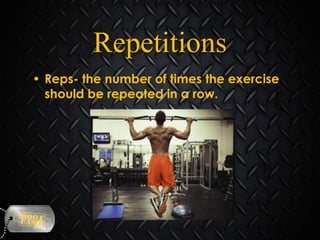
Repetitions
• Reps- the number of times the exercise
should be repeated in a row.
Sets
• Sets - the amount of times a “block” of
repetitions should be repeated.
• Rest periods of at lease 90 seconds
should present between sets.
• A set should be completed when you
realise that you can not repeat another
repetition in correct form.
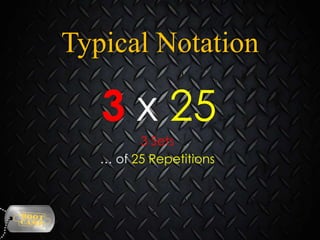
Typical Notation

3 x 25
3 Sets
… of 25 Repetitions
Repetition Maximum
• Referred to as an RM - the maximum
weight a person can lift a number of
times.
• For example, a 1RM weight is the
maximum weight someone can lift once.
• A 10RM weight is the maximum weight
someone can lift ten times.
Continuous Training
Designed to improve your aerobic (heart and lung) capacity
and muscular endurance.
Most important training method for both health and sport
related fitness.
Frequency – To improve your aerobic fitness you must perform
three continuous training sessions per week.
Intensity – Your target heart rate should be 75% of your
maximum heart rate. Your target zone should be between 70
to 85% of your maximum heart rate.
Time – Each training session must last for 20 minutes
continuously.
Ideal types of activities include: running, cycling, swimming and
aerobic floor classes.
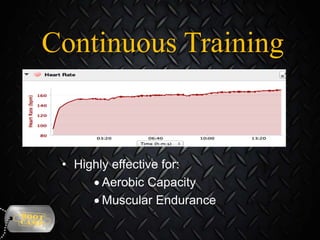
Continuous Training

• Highly effective for:
Aerobic Capacity
Muscular Endurance
Interval Training
• Alternating periods of workout and recovery .
30+ minutes
large and/or small muscle groups
low to moderate intensity
heart rate 70-80% maximum
alternate hard and easy days
Interval Training
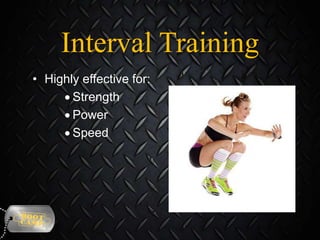
• Highly effective for:
Strength
Power
Speed
Fartlek
• Fartlek, which means "speed play" in Swedish, is a training
method that blends continuous training with interval training.
• The variable intensity and continuous nature of the exercise
places stress on both the aerobic and anaerobic systems.
• It differs from traditional interval training in that it is
unstructured; intensity and/or speed varies, as the athlete
wishes.

• Most fartlek sessions last a minimum of 45 minutes and can
vary from aerobic walking to anaerobic sprinting. Fartlek
training is generally associated with running, but can include
almost any kind of exercise.
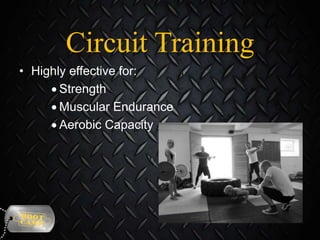
Circuit Training
• Perform 1 set of an exercise .
• Move directly to next exercise and
complete set.
• No rests until 3 laps (therefore 3 sets)
have been completed.
• Ideal for developing muscular
endurance, definition and some aerobic
fitness.
Circuit Training
• Highly effective for:
Strength
Muscular Endurance
Aerobic Capacity
Cross Fit
• The CrossFit prescription is “constantly
varied, high-intensity, functional
movement.”
• Large focus on moving large loads over
long distances, and to do so quickly.
• Involves constantly changing mix of
aerobic exercise, gymnastics (body
weight exercises), and Olympic weight
lifting.[
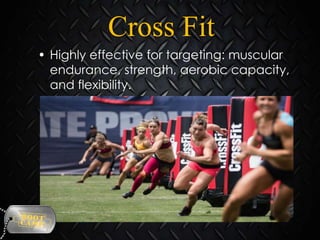
Cross Fit
• Highly effective for targeting: muscular
endurance, strength, aerobic capacity,
and flexibility.
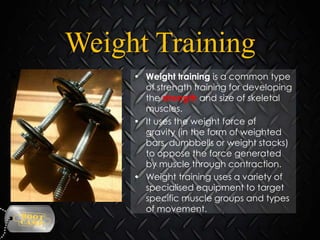
Weight Training
• Weight training is a common type
of strength training for developing
the strength and size of skeletal
muscles.
• It uses the weight force of
gravity (in the form of weighted
bars, dumbbells or weight stacks)
to oppose the force generated
by muscle through contraction.
• Weight training uses a variety of
specialised equipment to target
specific muscle groups and types
of movement.
Zumba
• Zumba is a dance fitness program
created that involves dance and
aerobic elements.
• Zumba's choreography incorporates hiphop, soca, samba, salsa, merengue, ma
mbo and martial arts.
• Squats and lunges are also included.
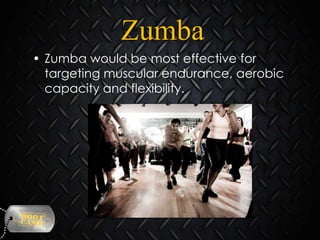
Zumba
• Zumba would be most effective for
targeting muscular endurance, aerobic
capacity and flexibility.

4. training methods

  • 1.
    Training Methods Basic Terms ContinuousTraining Interval Training Circuit Training Cross Training
  • 2.
    Repetitions • Reps- thenumber of times the exercise should be repeated in a row.
  • 3.
    Sets • Sets -the amount of times a “block” of repetitions should be repeated. • Rest periods of at lease 90 seconds should present between sets. • A set should be completed when you realise that you can not repeat another repetition in correct form.
  • 4.
    Typical Notation 3 x25 3 Sets … of 25 Repetitions
  • 5.
    Repetition Maximum • Referredto as an RM - the maximum weight a person can lift a number of times. • For example, a 1RM weight is the maximum weight someone can lift once. • A 10RM weight is the maximum weight someone can lift ten times.
  • 6.
    Continuous Training Designed toimprove your aerobic (heart and lung) capacity and muscular endurance. Most important training method for both health and sport related fitness. Frequency – To improve your aerobic fitness you must perform three continuous training sessions per week. Intensity – Your target heart rate should be 75% of your maximum heart rate. Your target zone should be between 70 to 85% of your maximum heart rate. Time – Each training session must last for 20 minutes continuously. Ideal types of activities include: running, cycling, swimming and aerobic floor classes.
  • 7.
    Continuous Training • Highlyeffective for: Aerobic Capacity Muscular Endurance
  • 8.
    Interval Training • Alternatingperiods of workout and recovery . 30+ minutes large and/or small muscle groups low to moderate intensity heart rate 70-80% maximum alternate hard and easy days
  • 9.
    Interval Training • Highlyeffective for: Strength Power Speed
  • 10.
    Fartlek • Fartlek, whichmeans "speed play" in Swedish, is a training method that blends continuous training with interval training. • The variable intensity and continuous nature of the exercise places stress on both the aerobic and anaerobic systems. • It differs from traditional interval training in that it is unstructured; intensity and/or speed varies, as the athlete wishes. • Most fartlek sessions last a minimum of 45 minutes and can vary from aerobic walking to anaerobic sprinting. Fartlek training is generally associated with running, but can include almost any kind of exercise.
  • 11.
    Circuit Training • Perform1 set of an exercise . • Move directly to next exercise and complete set. • No rests until 3 laps (therefore 3 sets) have been completed. • Ideal for developing muscular endurance, definition and some aerobic fitness.
  • 12.
    Circuit Training • Highlyeffective for: Strength Muscular Endurance Aerobic Capacity
  • 13.
    Cross Fit • TheCrossFit prescription is “constantly varied, high-intensity, functional movement.” • Large focus on moving large loads over long distances, and to do so quickly. • Involves constantly changing mix of aerobic exercise, gymnastics (body weight exercises), and Olympic weight lifting.[
  • 14.
    Cross Fit • Highlyeffective for targeting: muscular endurance, strength, aerobic capacity, and flexibility.
  • 15.
    Weight Training • Weighttraining is a common type of strength training for developing the strength and size of skeletal muscles. • It uses the weight force of gravity (in the form of weighted bars, dumbbells or weight stacks) to oppose the force generated by muscle through contraction. • Weight training uses a variety of specialised equipment to target specific muscle groups and types of movement.
  • 16.
    Zumba • Zumba isa dance fitness program created that involves dance and aerobic elements. • Zumba's choreography incorporates hiphop, soca, samba, salsa, merengue, ma mbo and martial arts. • Squats and lunges are also included.
  • 17.
    Zumba • Zumba wouldbe most effective for targeting muscular endurance, aerobic capacity and flexibility.