•CONTINUOUS training involvesLONG,
SLOW, DISTANCE exercise.
•It is performed at a CONSTANT RATE
WITHOUT REST.
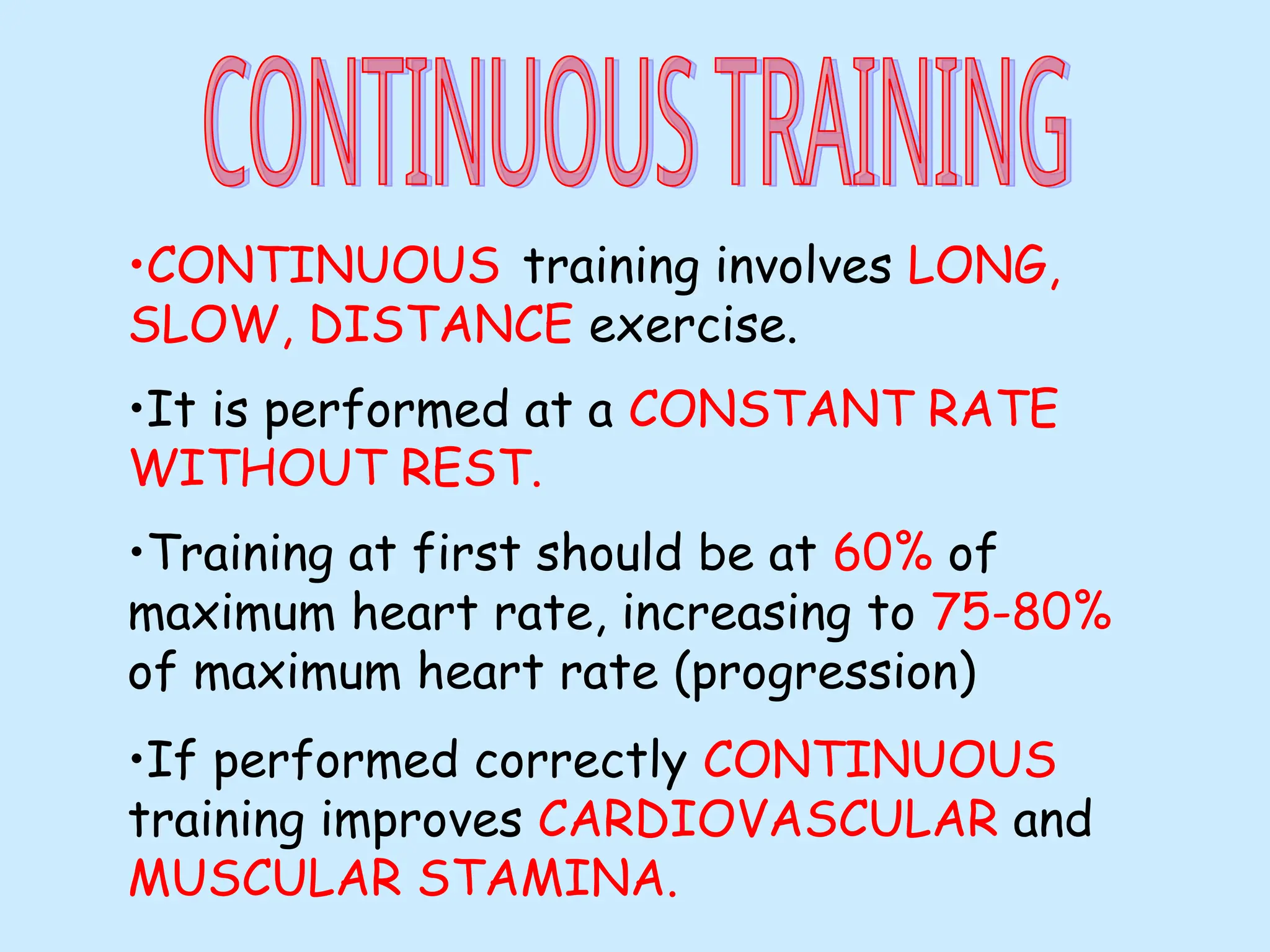
•Training at first should be at 60% of
maximum heart rate, increasing to 75-80%
of maximum heart rate (progression)
•If performed correctly CONTINUOUS
training improves CARDIOVASCULAR and
MUSCULAR STAMINA.
250 250
225 225
200200
175 175
150 150
125 125
100 100
75 75
50 50
25 25
0
0:00:00 0:10:00 0:20:00 0:30:00 0:40:00 0:50:00 1:00:00
HR [bpm] HR [bpm]
Time
Person
Exercise
Sport
Note
Date
Time
Duration
Selection
Max. HR
Heart rate Limits 1
Limits 2
Limits 3
MARK MCLAREN
01012801
Running
all way to pendine non stop soft sand at start and med NW wind
02:47:07 PM
7/7/01
1:07:19.7
0:00:00 - 1:07:15 (1:07:15.0)
183
147 / 162 144 - 166
146 - 166
144 - 166
1
147 bpm
Time: 0:23:20
HR: 143 bpm
7.
FARTLEK is aSWEDISH
word meaning SPEEDPLAY.
• In this form of training the
In this form of training the INTENSITY
INTENSITY
and
and TYPE
TYPE of exercise are varied.
of exercise are varied.
• This is done by changing the
This is done by changing the PACE,
PACE,
TERRAIN
TERRAIN and
and STYLE
STYLE of training.
of training.
• This form of running gives an athlete a lot
of training over far GREATER than their
COMPETITIVE distance.
8.
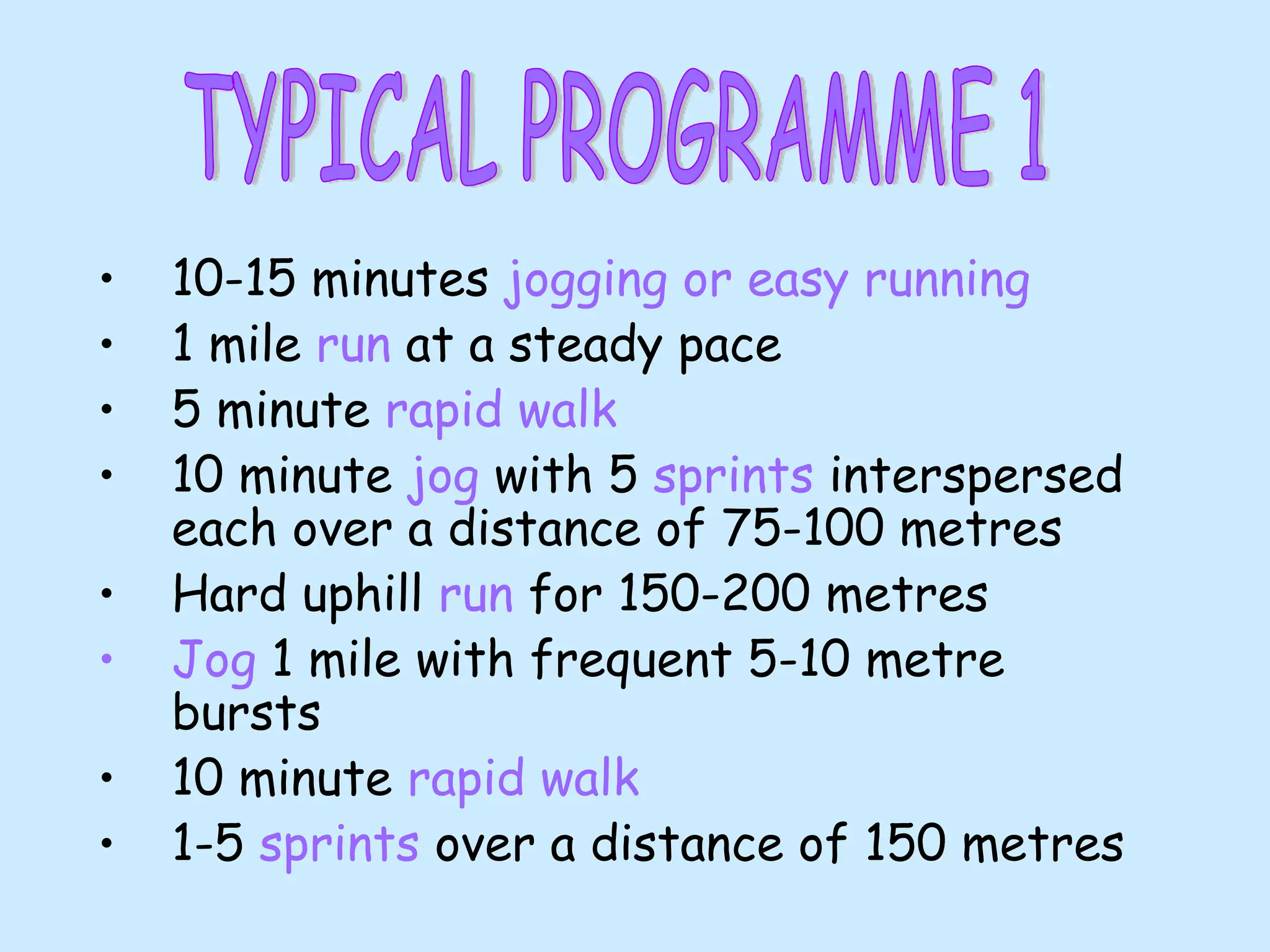
• 10-15 minutesjogging or easy running
• 1 mile run at a steady pace
• 5 minute rapid walk
• 10 minute jog with 5 sprints interspersed
each over a distance of 75-100 metres
• Hard uphill run for 150-200 metres
• Jog 1 mile with frequent 5-10 metre
bursts
• 10 minute rapid walk
• 1-5 sprints over a distance of 150 metres
9.
The distance betweenthe cones tells you how much
work / effort you need to put into that section.
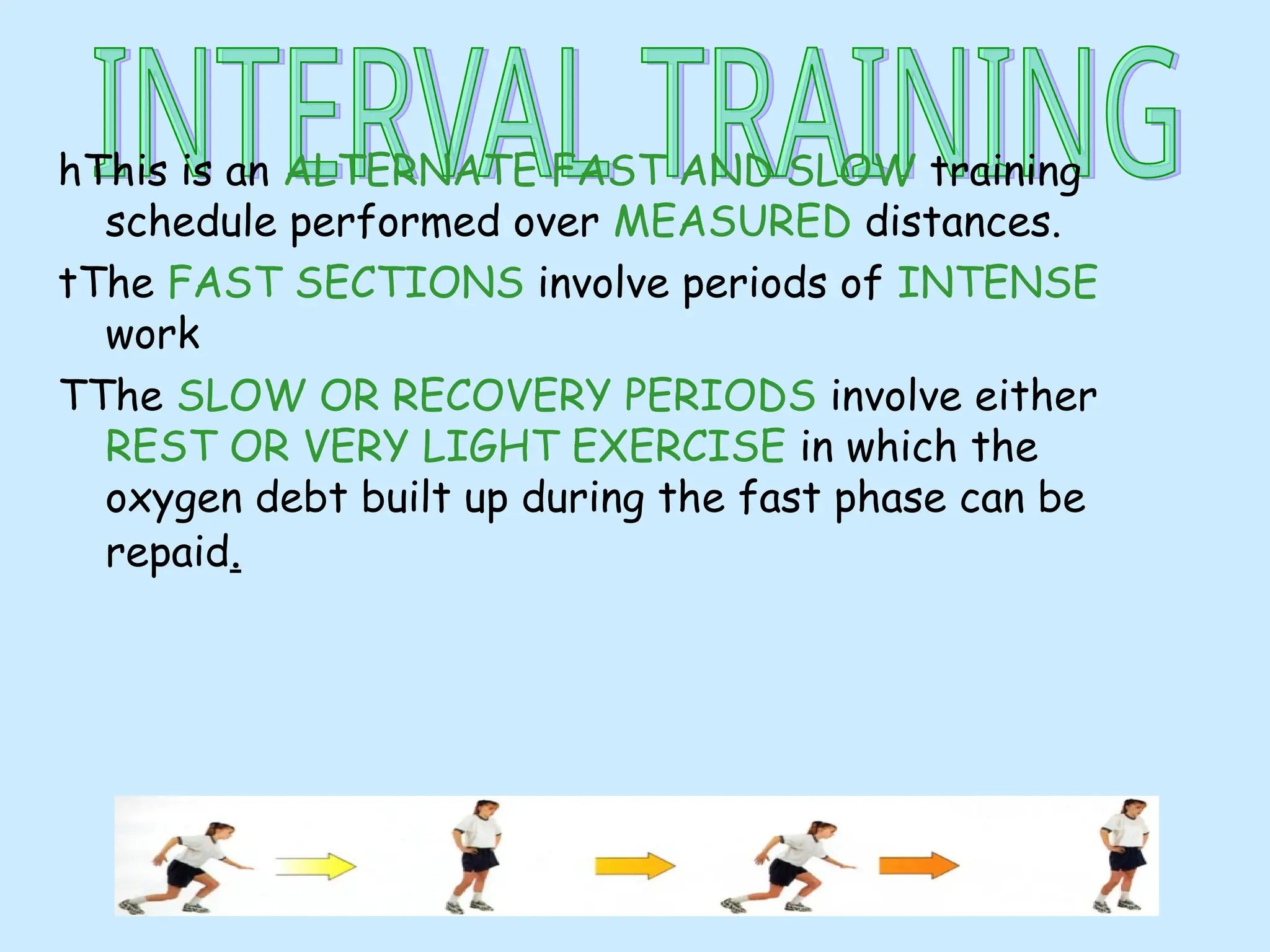
hThis is anALTERNATE FAST AND SLOW training
schedule performed over MEASURED distances.
tThe FAST SECTIONS involve periods of INTENSE
work
TThe SLOW OR RECOVERY PERIODS involve either
REST OR VERY LIGHT EXERCISE in which the
oxygen debt built up during the fast phase can be
repaid.
12.
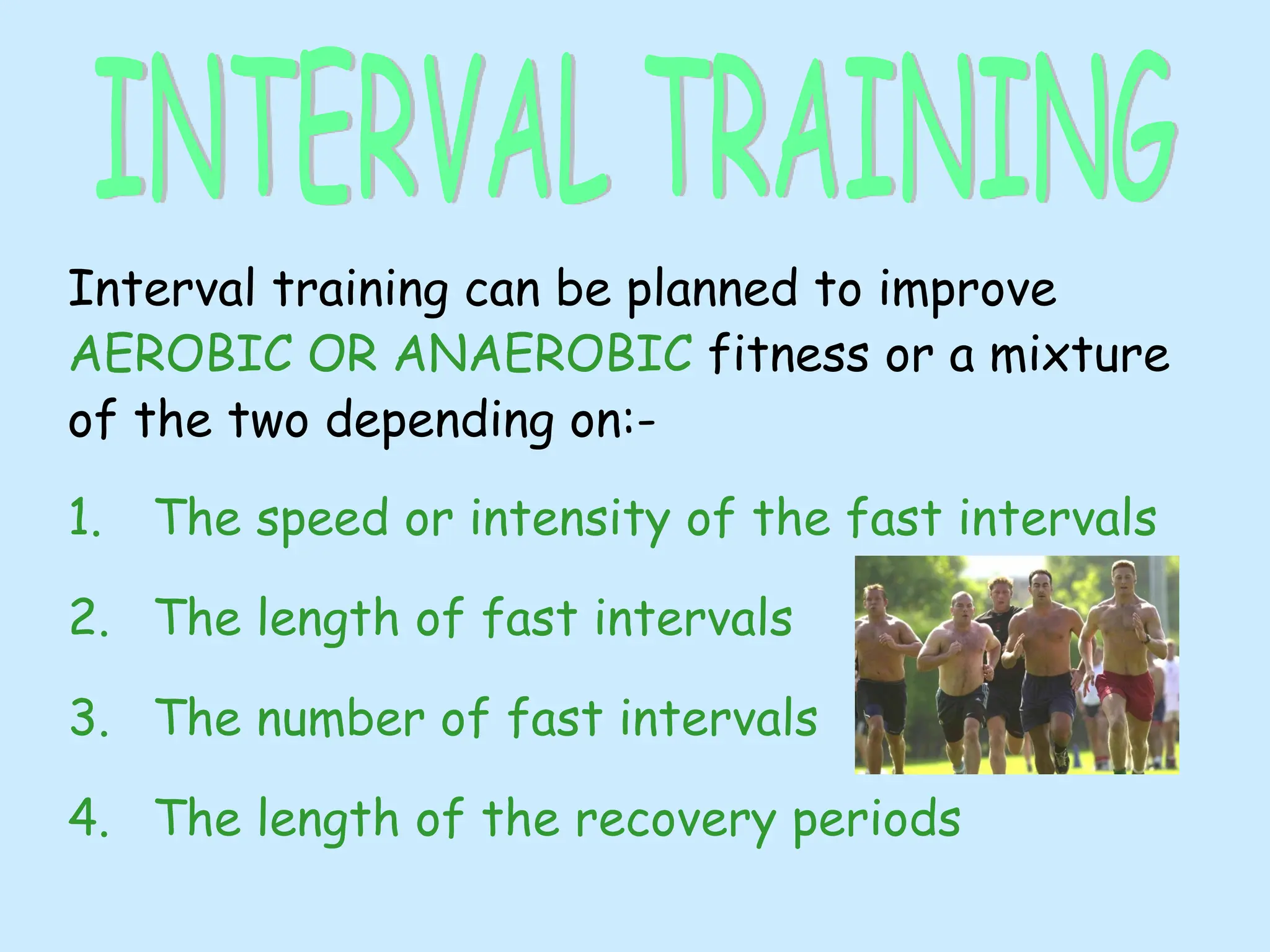
Interval training canbe planned to improve
AEROBIC OR ANAEROBIC fitness or a mixture
of the two depending on:-
1. The speed or intensity of the fast intervals
2. The length of fast intervals
3. The number of fast intervals
4. The length of the recovery periods
13.
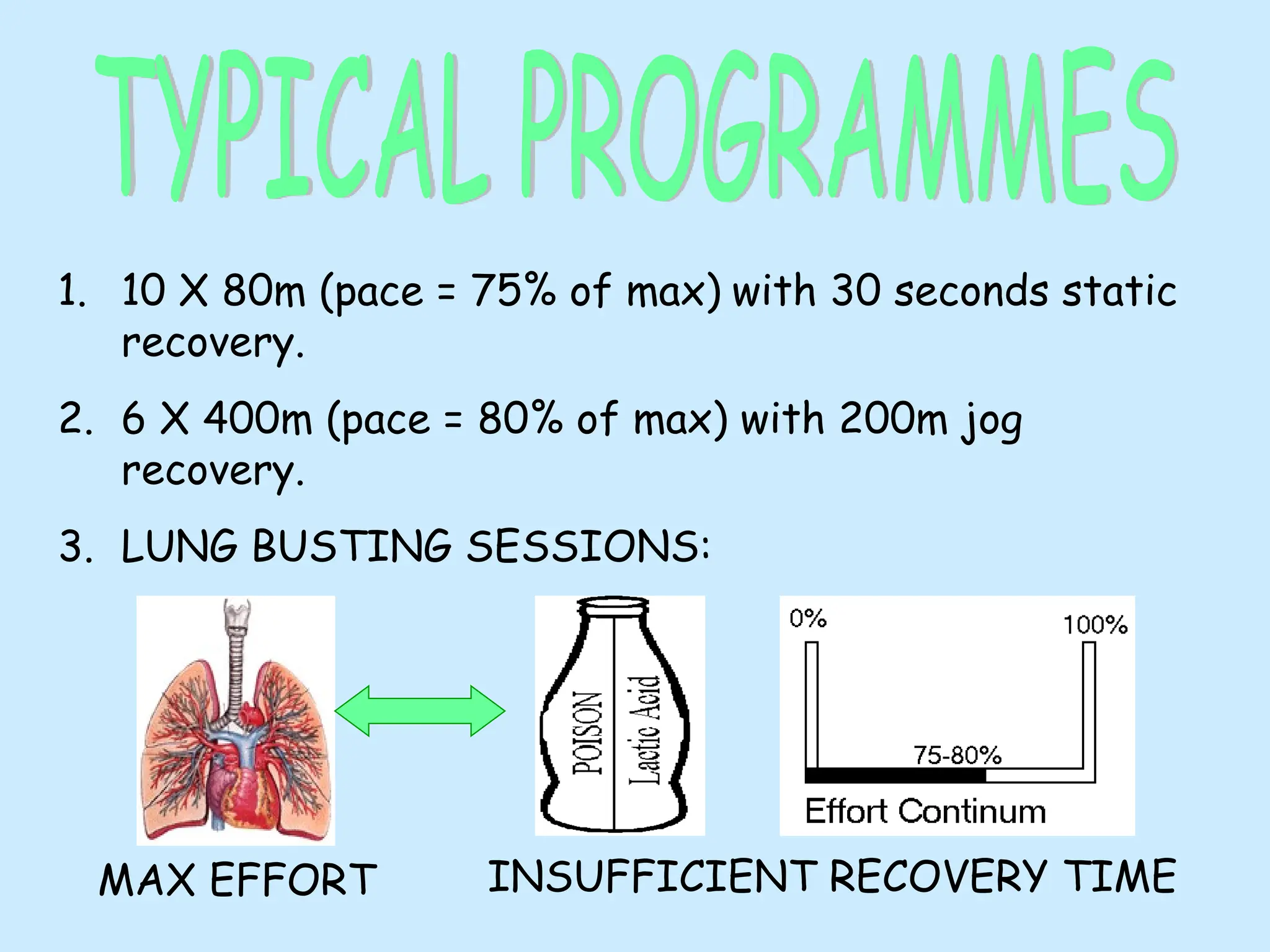
1. 10 X80m (pace = 75% of max) with 30 seconds static
recovery.
2. 6 X 400m (pace = 80% of max) with 200m jog
recovery.
3. LUNG BUSTING SESSIONS:
INSUFFICIENT RECOVERY TIME
MAX EFFORT
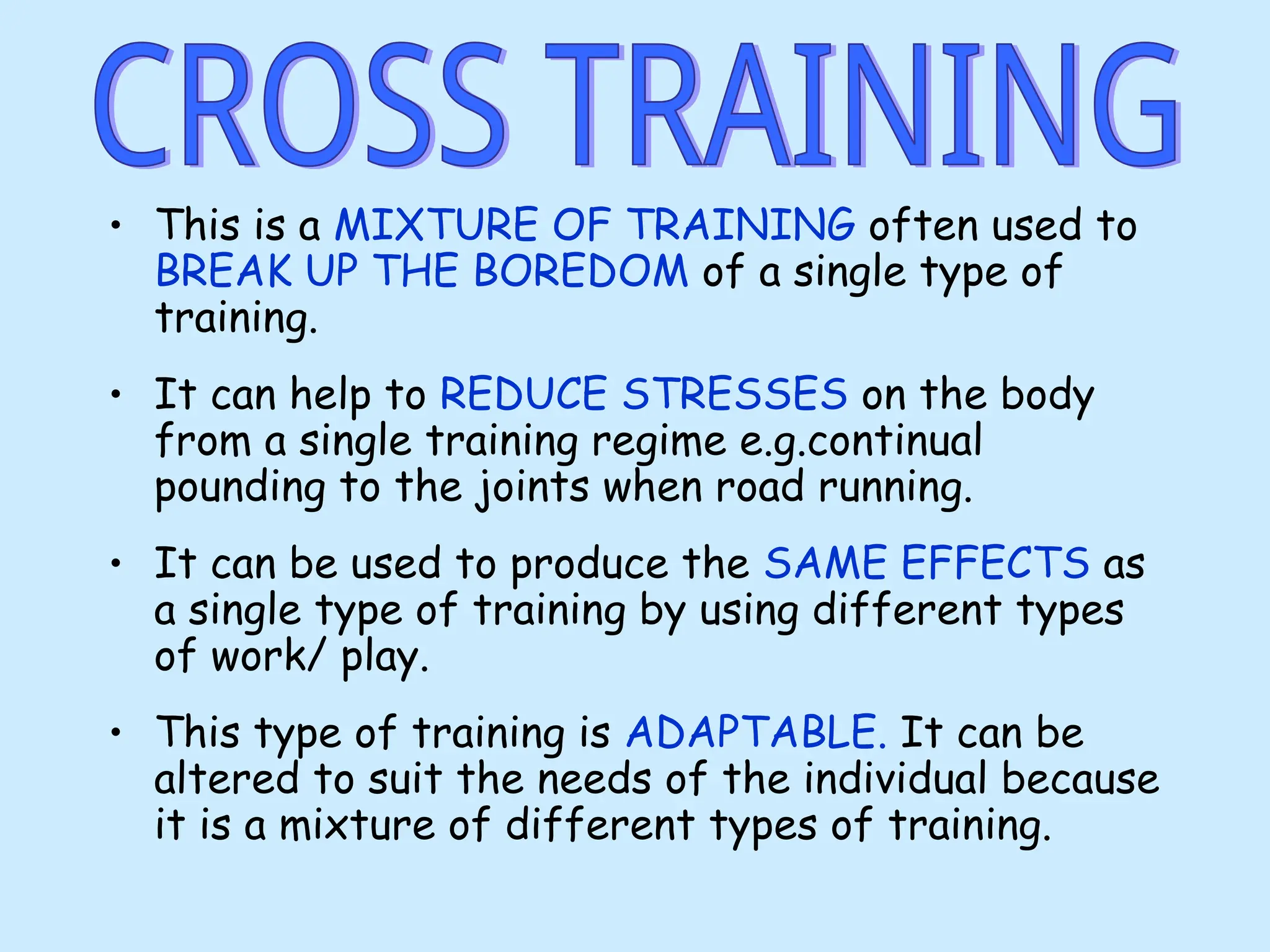
• This isa MIXTURE OF TRAINING often used to
BREAK UP THE BOREDOM of a single type of
training.
• It can help to REDUCE STRESSES on the body
from a single training regime e.g.continual
pounding to the joints when road running.
• It can be used to produce the SAME EFFECTS as
a single type of training by using different types
of work/ play.
• This type of training is ADAPTABLE. It can be
altered to suit the needs of the individual because
it is a mixture of different types of training.
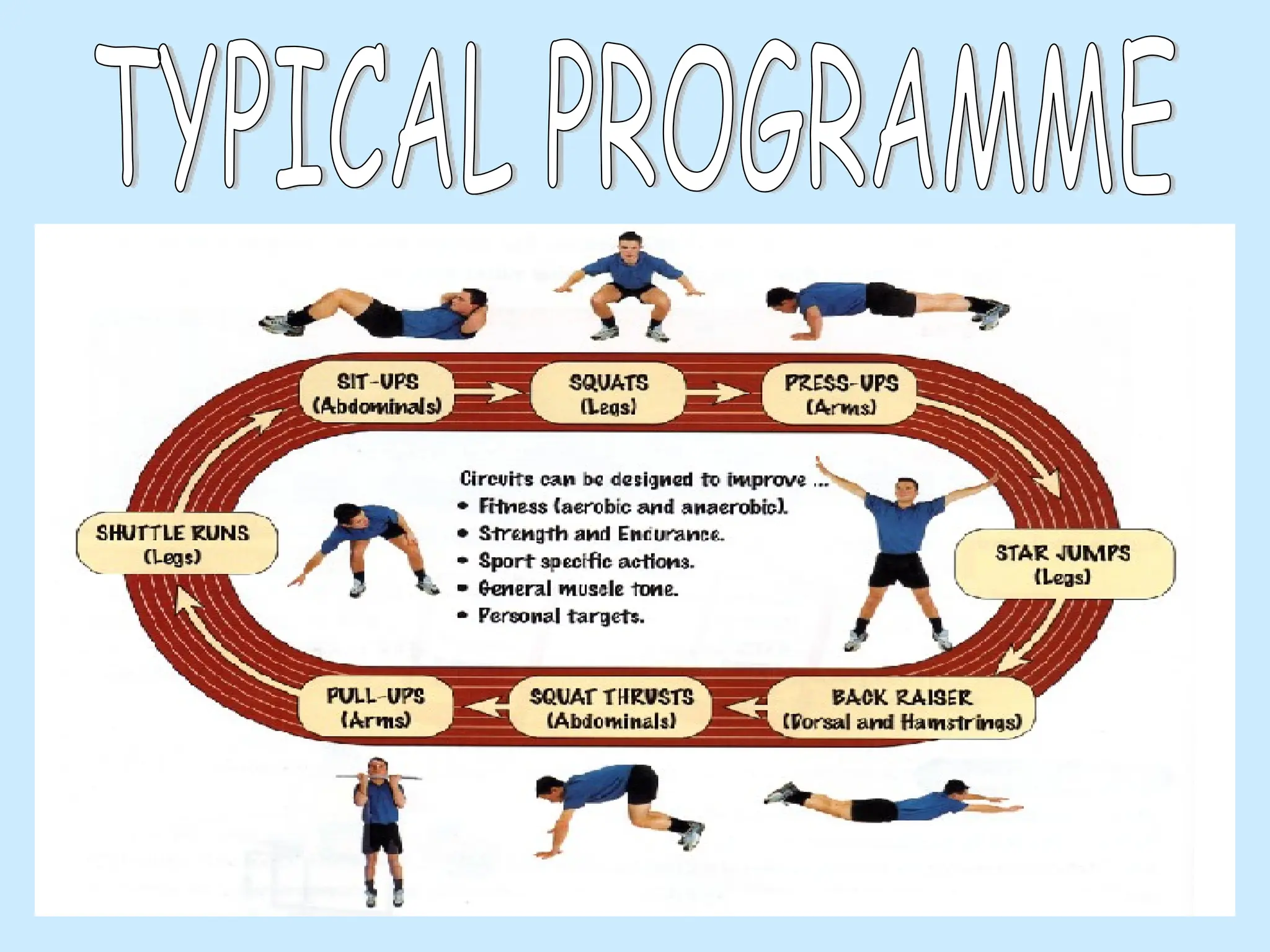
• CIRCUIT traininginvolves a series of
EXERCISES OR ACTIVITIES.
• Each one takes place at a different
STATION.
• Each station involves an exercise aimed at
a SPECIFIC MUSCLE GROUP in the body.
• The exercises are arranged so that:
1. MUSCLE GROUPS ALTERNATE BETWEEN
WORK AND RECOVERY
2. OPPOSING MUSCLE GROUPS ARE
WORKED FOR BALANCED STRENGTH
DISTRIBUTION
20.
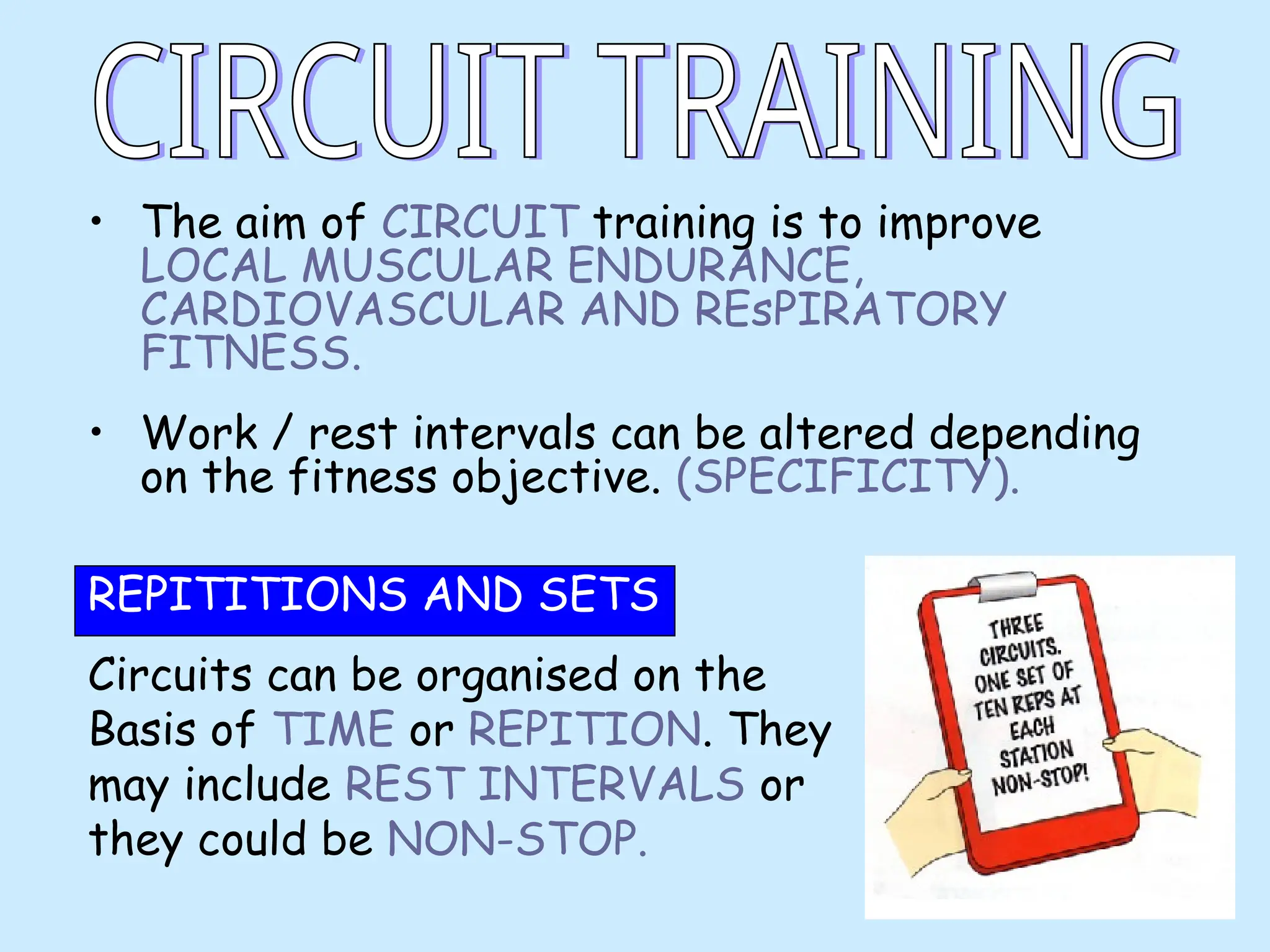
• The aimof CIRCUIT training is to improve
LOCAL MUSCULAR ENDURANCE,
CARDIOVASCULAR AND REsPIRATORY
FITNESS.
• Work / rest intervals can be altered depending
on the fitness objective. (SPECIFICITY).
REPITITIONS AND SETS
Circuits can be organised on the
Basis of TIME or REPITION. They
may include REST INTERVALS or
they could be NON-STOP.
•
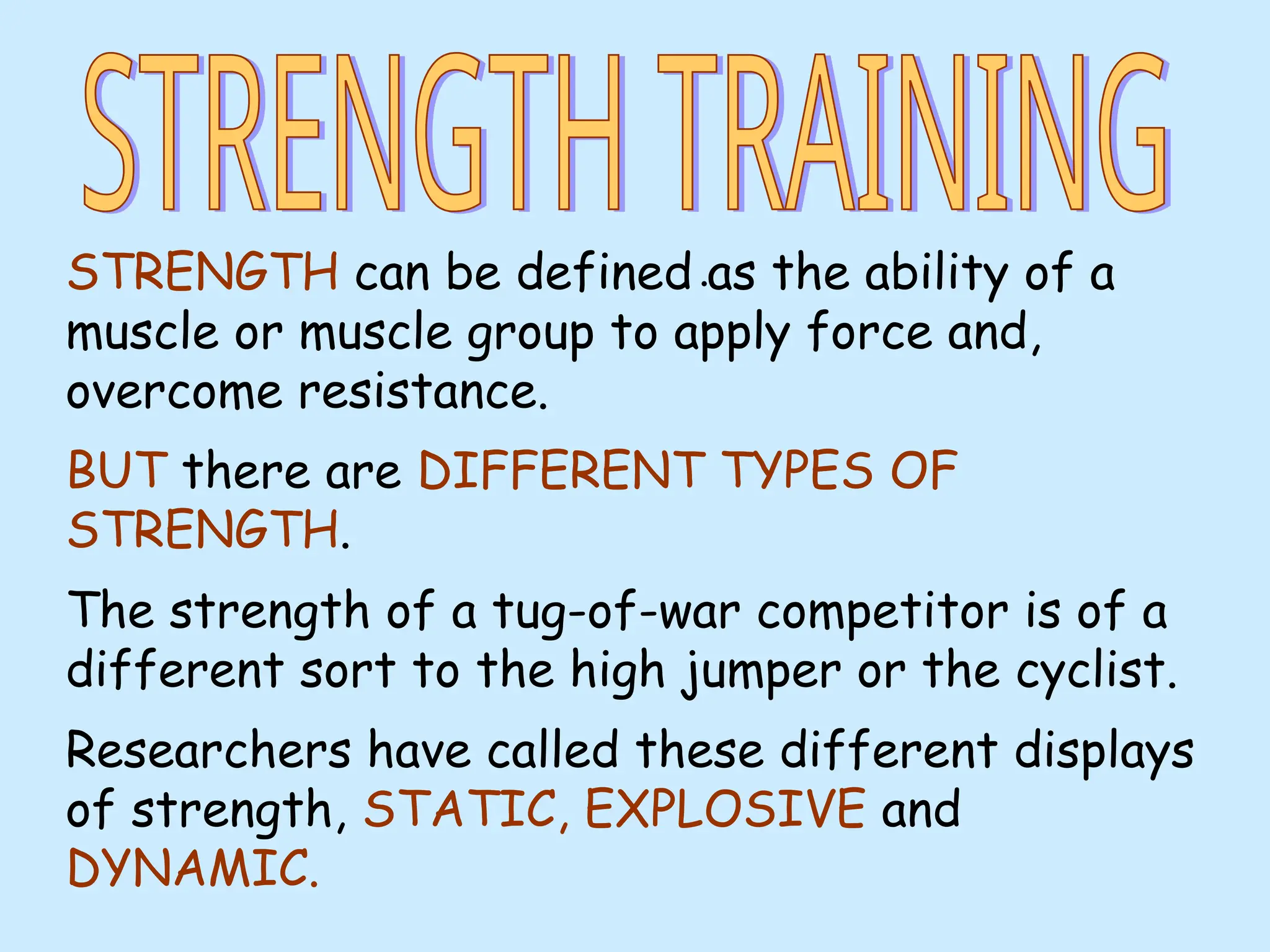
STRENGTH can bedefined as the ability of a
muscle or muscle group to apply force and,
overcome resistance.
BUT there are DIFFERENT TYPES OF
STRENGTH.
The strength of a tug-of-war competitor is of a
different sort to the high jumper or the cyclist.
Researchers have called these different displays
of strength, STATIC, EXPLOSIVE and
DYNAMIC.
24.
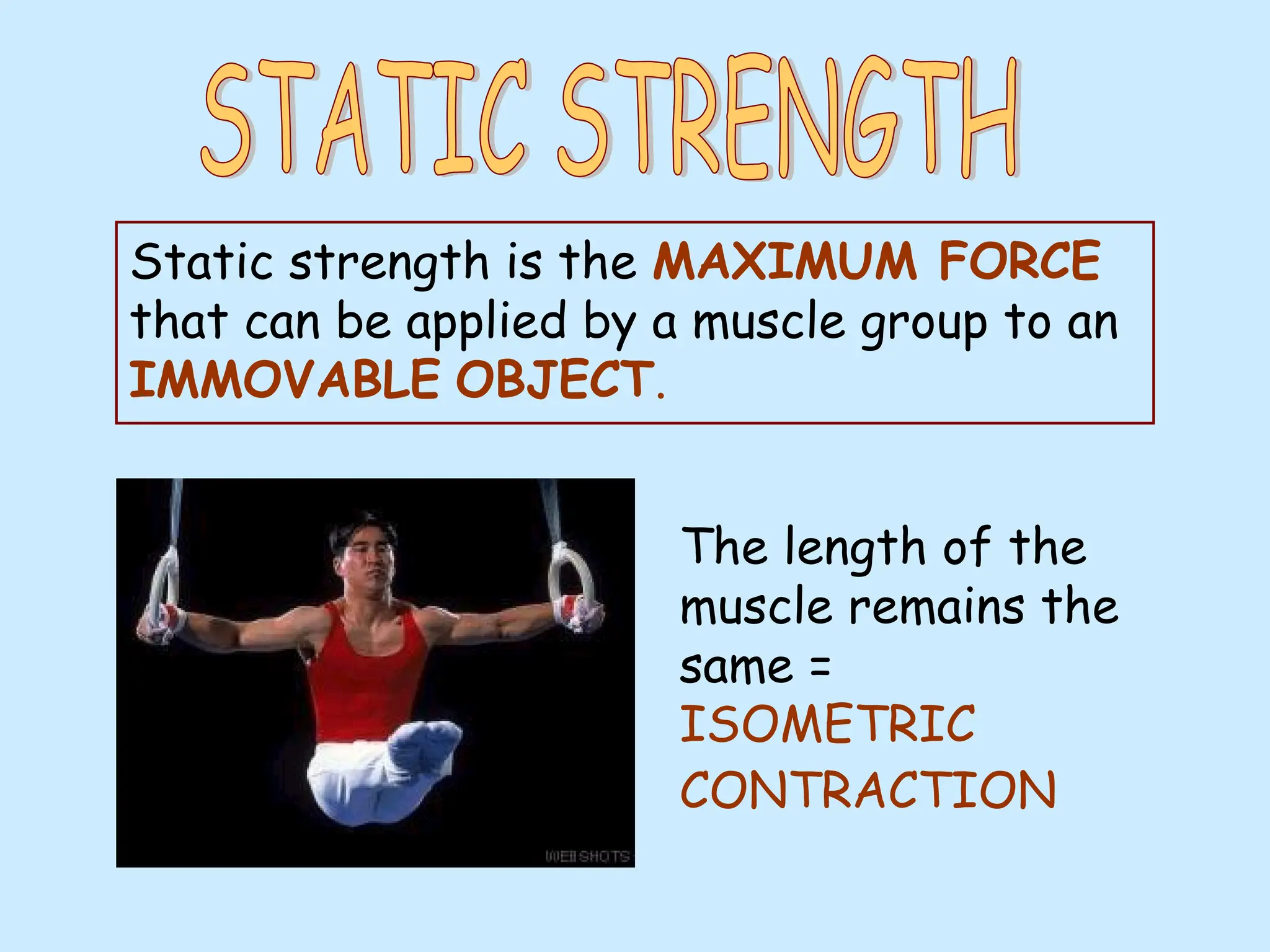
Static strength isthe MAXIMUM FORCE
that can be applied by a muscle group to an
IMMOVABLE OBJECT.
The length of the
muscle remains the
same =
ISOMETRIC
CONTRACTION
25.
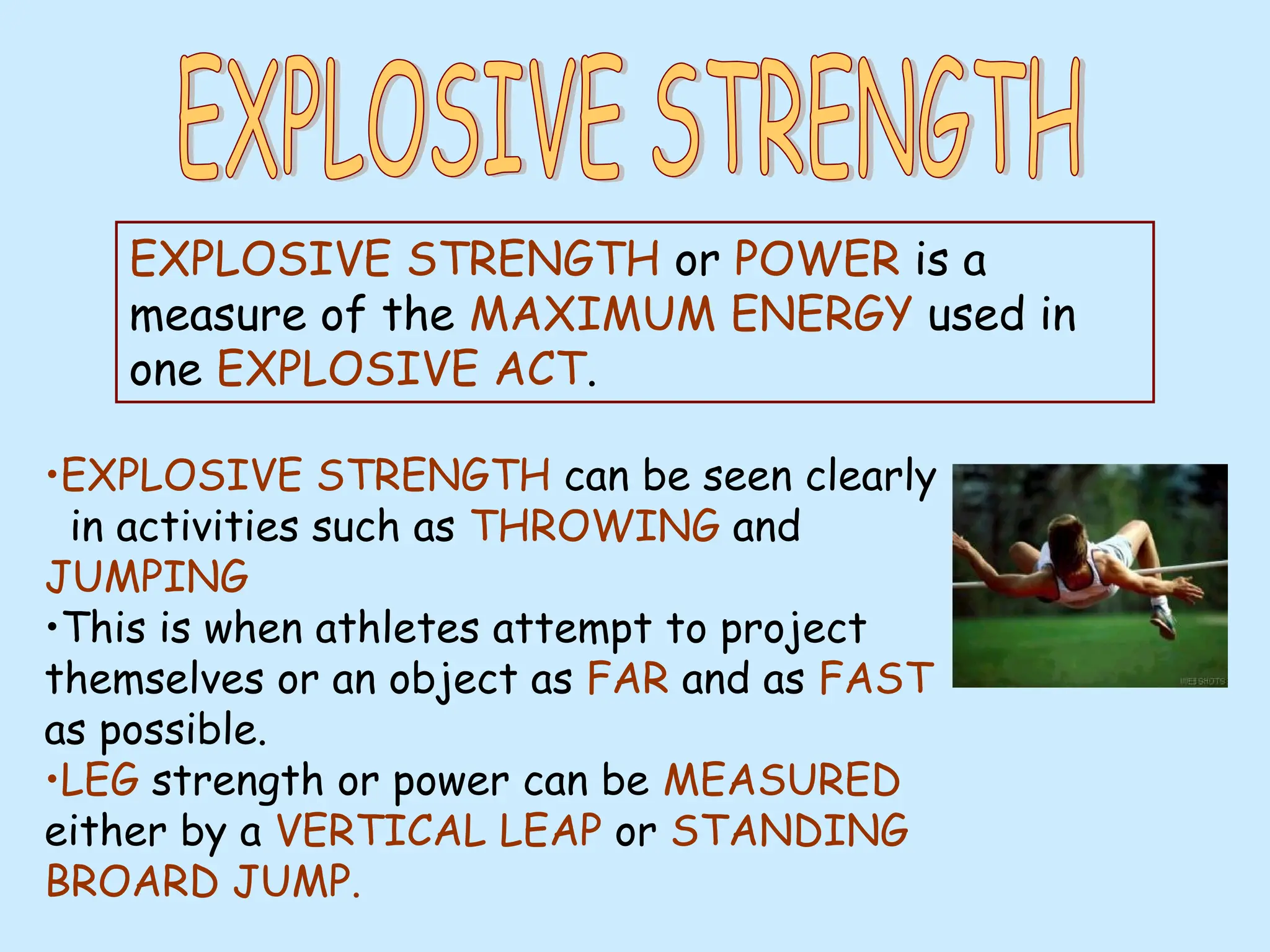
•EXPLOSIVE STRENGTH canbe seen clearly
in activities such as THROWING and
JUMPING
•This is when athletes attempt to project
themselves or an object as FAR and as FAST
as possible.
•LEG strength or power can be MEASURED
either by a VERTICAL LEAP or STANDING
BROARD JUMP.
EXPLOSIVE STRENGTH or POWER is a
measure of the MAXIMUM ENERGY used in
one EXPLOSIVE ACT.
26.
DYNAMIC STRENGTH isthe ability of the muscles
to MOVE or SUPPORT the body mass
CONTINUOUSLY over an extended period of TIME.
Most sportsmen and sportswoman require ALL
THREE types of strength, although obviously
particular types of strength are vital for
some sports:
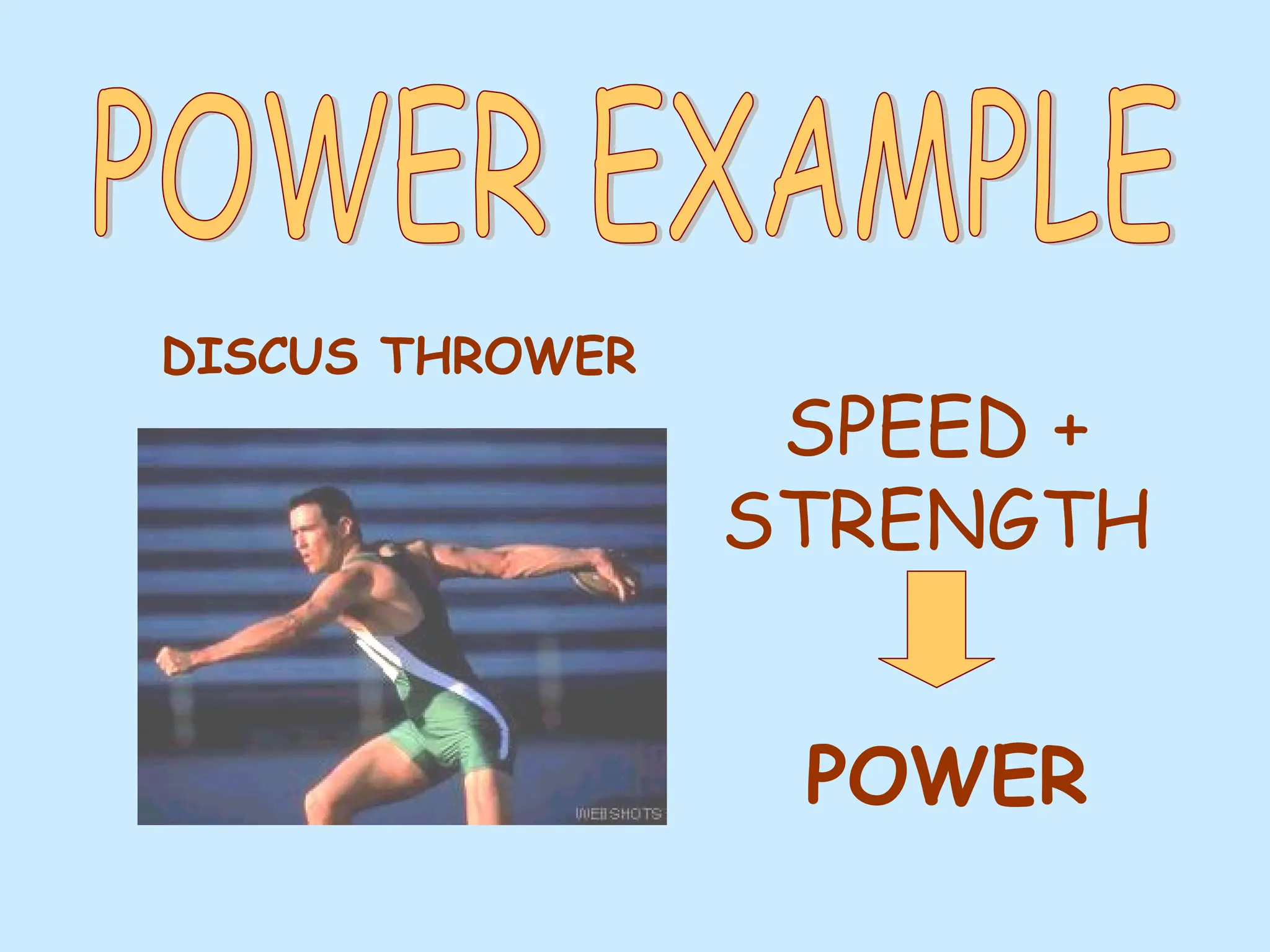
•SHOT PUTTERS NEED EXPLOSIVE
STRENGTH
•ROWERS NEED DYNAMIC STRENGTH
•TUG-O-WAR COMPETITORS NEED STATIC
AS WELL AS DYNAMIC STRENGTH.
27.
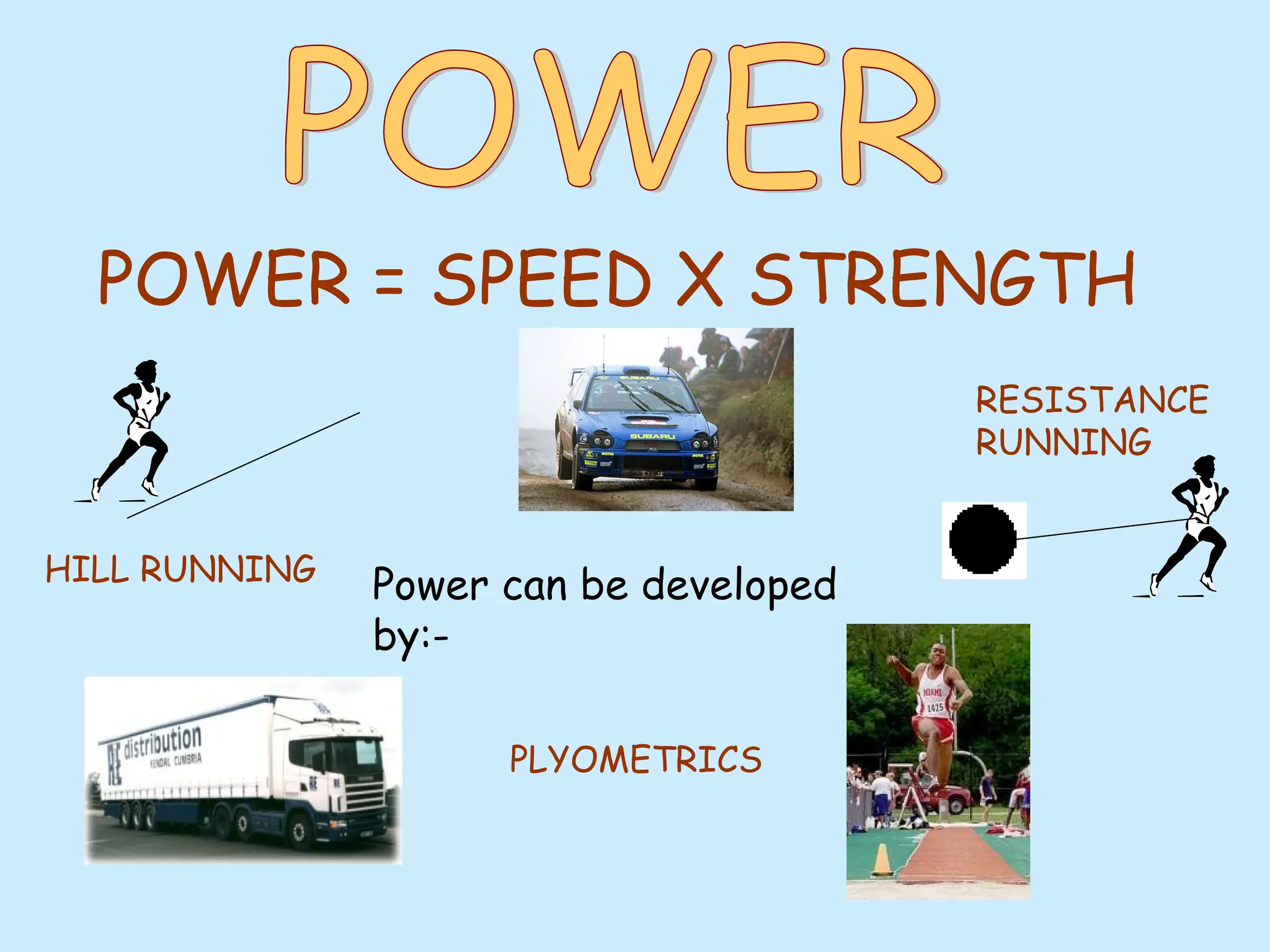
POWER = SPEEDX STRENGTH
Power can be developed
by:-
RESISTANCE
RUNNING
HILL RUNNING
PLYOMETRICS


![250 250
225 225
200 200
175 175
150 150
125 125
100 100
75 75
50 50
25 25
0
0:00:00 0:10:00 0:20:00 0:30:00 0:40:00 0:50:00 1:00:00
HR [bpm] HR [bpm]
Time
Person
Exercise
Sport
Note
Date
Time
Duration
Selection
Max. HR
Heart rate Limits 1
Limits 2
Limits 3
MARK MCLAREN
01012801
Running
all way to pendine non stop soft sand at start and med NW wind
02:47:07 PM
7/7/01
1:07:19.7
0:00:00 - 1:07:15 (1:07:15.0)
183
147 / 162 144 - 166
146 - 166
144 - 166
1
147 bpm
Time: 0:23:20
HR: 143 bpm](https://image.slidesharecdn.com/methodsoftrainingpowerpoint-251209152608-00db53e1/75/Methods-of-Training-PowerPoint-ppt-for-students-in-higher-educations-5-2048.jpg)


![250 250
225 225
200 200
175 175
150 150
125 125
100 100
75 75
50 50
25 25
0
0:00:00 0:05:00 0:10:00 0:15:00 0:20:00 0:25:00
HR [bpm] HR [bpm]
Time
Person
Exercise
Sport
Note
Date
Time
Duration
Selection
Max. HR
Heart rate Limits 1
Limits 2
Limits 3
MARK MCLAREN
00081701
Running
pontcanna straight 200 metres 10 x approx 36s 90 s rec.
12:46:37 PM
8/17/00
0:24:46.6
0:00:00 - 0:24:45 (0:24:45.0)
189
151 / 178 150 - 170
150 - 170
150 - 170
151 bpm
Time: 0:00:00
HR: 0 bpm](https://image.slidesharecdn.com/methodsoftrainingpowerpoint-251209152608-00db53e1/75/Methods-of-Training-PowerPoint-ppt-for-students-in-higher-educations-14-2048.jpg)








![[DSC Europe 25] Sara Polak - The Ancient Operating System: What Archaeology T...](https://cdn.slidesharecdn.com/ss_thumbnails/3vch2p6tttdnwhsgazoz-3-sara-polak-smart-cities-251208152532-64404202-thumbnail.jpg?width=640&height=640&fit=bounds)


![[DSC Europe 25] Marija Vlajkovic & Andrea Radonjanin - Integration of AI tool...](https://cdn.slidesharecdn.com/ss_thumbnails/qf1jrglttoc3bm8s3aop-final-integration-of-ai-tools-251208151905-394f3a6a-thumbnail.jpg?width=640&height=640&fit=bounds)
![[DSC Europe 25] Dusan Nesic - Securing Tomorrow’s Infrastructure: Why Cyber-P...](https://cdn.slidesharecdn.com/ss_thumbnails/qikbszfftyowjm2q6duw-1-251211083848-8f2ead6b-thumbnail.jpg?width=640&height=640&fit=bounds)


![[DSC Europe 25] Kaja Kandare - LLM as a judge.pptx](https://cdn.slidesharecdn.com/ss_thumbnails/arxyccaxsdsd1ba99wjw-7-251212104007-2b4e3f64-thumbnail.jpg?width=640&height=640&fit=bounds)
![[DSC Europe 25] Hans Kleinsman - The Compliance Gearbox: How Tax Tech Mediate...](https://cdn.slidesharecdn.com/ss_thumbnails/dxdytie1toel0hr90bjs-2-251212103250-174fdbe7-thumbnail.jpg?width=640&height=640&fit=bounds)
![[DSC Europe 25] Debmalya Biswas - Agentification: the art of transforming man...](https://cdn.slidesharecdn.com/ss_thumbnails/r5azlggvtqiaiiusrqdr-4-251212103249-5a12c89b-thumbnail.jpg?width=640&height=640&fit=bounds)
![[DSC Europe 25] Jovan Bogicevic - Legacy to AI-Driven Defense: Transforming D...](https://cdn.slidesharecdn.com/ss_thumbnails/rsarluadt563hntyfc8q-3-251211083849-3e7bc4c0-thumbnail.jpg?width=640&height=640&fit=bounds)
![[DSC Europe 25] Nikolay Burlutskiy - Best Practices for Building Enterprise M...](https://cdn.slidesharecdn.com/ss_thumbnails/uirvaiuvq8y1w8hzd9tx-7-251212103249-2619edb4-thumbnail.jpg?width=640&height=640&fit=bounds)
![[DSC Europe 25] Bassam Maharmeh - Artificial Intelligence: Opportunities and ...](https://cdn.slidesharecdn.com/ss_thumbnails/thhfmr2fqpawzj7hsjpg-5-251211083048-2c23204f-thumbnail.jpg?width=640&height=640&fit=bounds)
![[DSC Europe 25] Dunja Adzic Jovanovic - AI and Cybersecurity: Defending Data ...](https://cdn.slidesharecdn.com/ss_thumbnails/o1zylpbhrtwnixxq2xj8-7-251211083048-185086f6-thumbnail.jpg?width=640&height=640&fit=bounds)
![[DSC Europe 25] Milan Zdravkovic - The road less traveled in District Heating...](https://cdn.slidesharecdn.com/ss_thumbnails/nfaboniqwsz4ucyctnmy-2-milan-zdravkovic-dsc2025-the-road-less-traveled-in-district-heating-operation-251208151905-f56388a5-thumbnail.jpg?width=640&height=640&fit=bounds)
![[DSC Europe 25] Marko Krstic - Understanding the AI Threat Landscape - Risks,...](https://cdn.slidesharecdn.com/ss_thumbnails/tiyim1ins5jvbrvzpzla-2-251209104645-c69d3553-thumbnail.jpg?width=640&height=640&fit=bounds)