TRAINING METHODS
Sports Training:
Meaning : The process of preparing for a game with the help of systematic methods and
exercises.
Importance of sports training :
 It Improves physical fitness.
• Skill development
 Prevents Injuries
 Aligns posture
 Improves balance
 Develops concentration.
 Methods of Training :Some important training methods are : Interval Training Method,
Repetition Method, Continuous Method and Fartlek Training Method.
Interval training Method : In this method, instead of running a long distance of say 10 miles daily,
the athletes are made to run 400 m, 20 times a day with interval periods in between for recovery. Ex.
Jogging
Advantages of Interval training Method :
 Increased workout in less duration
 Easy measurement of performance
 Develops patience
 Beneficial for respiratory and circulatory systems
Disadvantages of Interval training Method :
 More chances of injury
 Can develop heart problems
 Repetition training:
Repetition training is when you break training distances into smaller, more
manageable parts and repeat these parts. This is, for example, when you
sprint over a set distance several times. It improves your speed-endurance.
Ex: Race,Sprint etc.
 Continuous Method :
Continuous training is a form of exercise that is performed at a 'continuous'
intensity throughout and doesn't involve any rest periods. Continuous training
typically involves aerobic activities such as running, biking, swimming and
rowing.
Ex: indoor and outdoor cycling, jogging, running, walking, rowing, stair
climbing
 Fartlek Training Method :
Fartlek, a Swedish term that
means "speed play," is a form
of interval or speed training
that can be effective in
improving your running speed
and endurance. Fartlek
running involves varying your
pace throughout your run,
alternating between fast
segments and slow jogs.
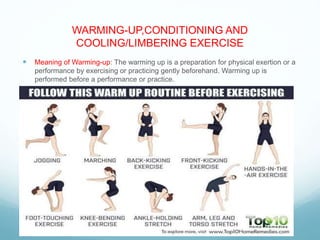
WARMING-UP,CONDITIONING AND
COOLING/LIMBERING EXERCISE
 Meaning of Warming-up: The warming up is a preparation for physical exertion or a
performance by exercising or practicing gently beforehand. Warming up is
performed before a performance or practice.
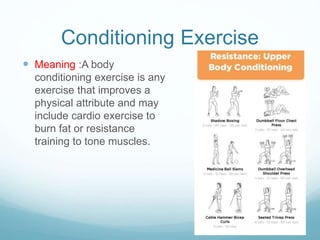
Conditioning Exercise
 Meaning :A body
conditioning exercise is any
exercise that improves a
physical attribute and may
include cardio exercise to
burn fat or resistance
training to tone muscles.
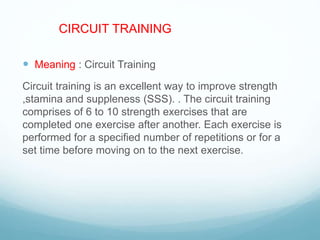
 Meaning : Circuit Training
Circuit training is an excellent way to improve strength
,stamina and suppleness (SSS). . The circuit training
comprises of 6 to 10 strength exercises that are
completed one exercise after another. Each exercise is
performed for a specified number of repetitions or for a
set time before moving on to the next exercise.
CIRCUIT TRAINING
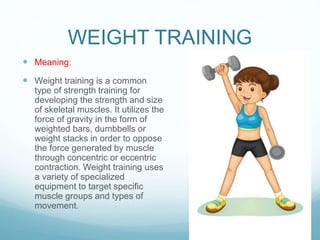
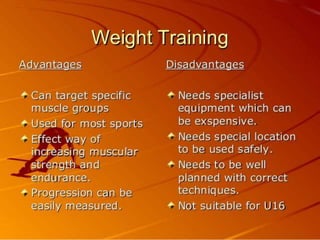
WEIGHT TRAINING
 Meaning:
 Weight training is a common
type of strength training for
developing the strength and size
of skeletal muscles. It utilizes the
force of gravity in the form of
weighted bars, dumbbells or
weight stacks in order to oppose
the force generated by muscle
through concentric or eccentric
contraction. Weight training uses
a variety of specialized
equipment to target specific
muscle groups and types of
movement.
Training methods

Training methods

  • 1.
  • 2.
    Sports Training: Meaning :The process of preparing for a game with the help of systematic methods and exercises. Importance of sports training :  It Improves physical fitness. • Skill development  Prevents Injuries  Aligns posture  Improves balance  Develops concentration.
  • 3.
     Methods ofTraining :Some important training methods are : Interval Training Method, Repetition Method, Continuous Method and Fartlek Training Method. Interval training Method : In this method, instead of running a long distance of say 10 miles daily, the athletes are made to run 400 m, 20 times a day with interval periods in between for recovery. Ex. Jogging Advantages of Interval training Method :  Increased workout in less duration  Easy measurement of performance  Develops patience  Beneficial for respiratory and circulatory systems Disadvantages of Interval training Method :  More chances of injury  Can develop heart problems
  • 4.
     Repetition training: Repetitiontraining is when you break training distances into smaller, more manageable parts and repeat these parts. This is, for example, when you sprint over a set distance several times. It improves your speed-endurance. Ex: Race,Sprint etc.  Continuous Method : Continuous training is a form of exercise that is performed at a 'continuous' intensity throughout and doesn't involve any rest periods. Continuous training typically involves aerobic activities such as running, biking, swimming and rowing. Ex: indoor and outdoor cycling, jogging, running, walking, rowing, stair climbing
  • 5.
     Fartlek TrainingMethod : Fartlek, a Swedish term that means "speed play," is a form of interval or speed training that can be effective in improving your running speed and endurance. Fartlek running involves varying your pace throughout your run, alternating between fast segments and slow jogs.
  • 6.
    WARMING-UP,CONDITIONING AND COOLING/LIMBERING EXERCISE Meaning of Warming-up: The warming up is a preparation for physical exertion or a performance by exercising or practicing gently beforehand. Warming up is performed before a performance or practice.
  • 8.
    Conditioning Exercise  Meaning:A body conditioning exercise is any exercise that improves a physical attribute and may include cardio exercise to burn fat or resistance training to tone muscles.
  • 13.
     Meaning :Circuit Training Circuit training is an excellent way to improve strength ,stamina and suppleness (SSS). . The circuit training comprises of 6 to 10 strength exercises that are completed one exercise after another. Each exercise is performed for a specified number of repetitions or for a set time before moving on to the next exercise. CIRCUIT TRAINING
  • 16.
    WEIGHT TRAINING  Meaning: Weight training is a common type of strength training for developing the strength and size of skeletal muscles. It utilizes the force of gravity in the form of weighted bars, dumbbells or weight stacks in order to oppose the force generated by muscle through concentric or eccentric contraction. Weight training uses a variety of specialized equipment to target specific muscle groups and types of movement.