1.The Principles Of Training
     2. Training Methods
  3. Anatomy Of A Training
          Session
4. Planning The Training Year:
         Periodisation
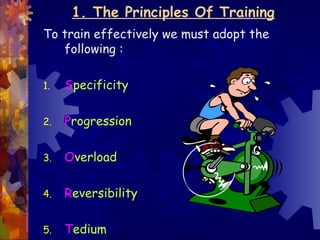
1. The Principles Of Training
To train effectively we must adopt the
   following :

1.   Specificity

2.   Progression

3.   Overload

4.   Reversibility

5.   Tedium
Specificity
 Our training must be
 specific to the
 requirements of our chosen
 sport or sporting activity.

  Eg. A sprinter would
   concentrate on speed
  rather than cardio-vascular
  endurance.

  Can you think of two other
  examples of specificity?
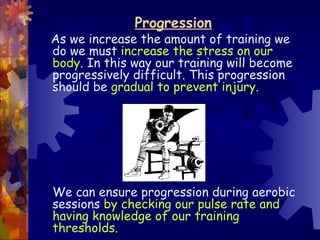
Progression
As we increase the amount of training we
do we must increase the stress on our
body. In this way our training will become
progressively difficult. This progression
should be gradual to prevent injury.


We can ensure progression during aerobic
sessions by checking our pulse rate and
having knowledge of our training
thresholds.
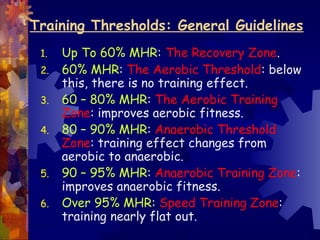
Training Thresholds: General Guidelines
 1.   Up To 60% MHR: The Recovery Zone.
 2.   60% MHR: The Aerobic Threshold: below
      this, there is no training effect.
 3.   60 – 80% MHR: The Aerobic Training
      Zone: improves aerobic fitness.
 4.   80 – 90% MHR: Anaerobic Threshold
      Zone: training effect changes from
      aerobic to anaerobic.
 5.   90 – 95% MHR: Anaerobic Training Zone:
      improves anaerobic fitness.
 6.   Over 95% MHR: Speed Training Zone:
      training nearly flat out.
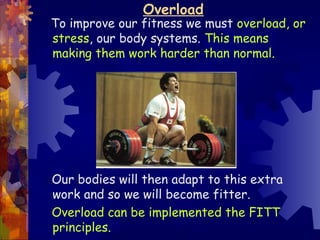
Overload
To improve our fitness we must overload, or
stress, our body systems. This means
making them work harder than normal.


Our bodies will then adapt to this extra
work and so we will become fitter.
Overload can be implemented the FITT
principles.
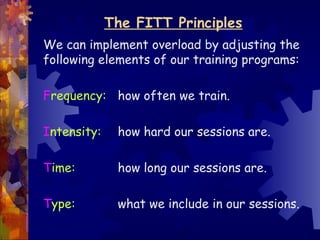
The FITT Principles
We can implement overload by adjusting the
following elements of our training programs:

Frequency: how often we train.

Intensity:    how hard our sessions are.

Time:         how long our sessions are.

Type:         what we include in our sessions.
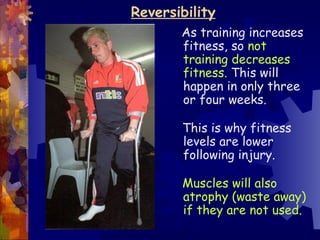
Reversibility
       As training increases
       fitness, so not
       training decreases
       fitness. This will
       happen in only three
       or four weeks.

       This is why fitness
       levels are lower
       following injury.

       Muscles will also
       atrophy (waste away)
       if they are not used.
Tedium
Tedium, or boredom, should be avoided in all
training programs by using a range of training
methods to maintain enthusiasm and interest.
By varying training methods, we can also
reduce the risk of overuse injuries.


Choose a sporting activity and think of as many
training methods that could be used as part of
a training program for that activity.
2. Training Methods
Training Methods
There are many different training methods
that are based on an understanding of how our
body adapts to training. Each training method
is designed to improve a specific area of
fitness.

You should be familiar with the following
training methods:

           1. Continuous Training
           2. Interval Training
           3. Weight Training
           4. Fartlek Training
           5. Circuit Training
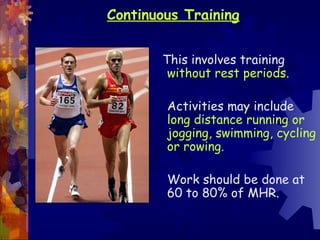
Continuous Training


       This involves training
        without rest periods.

        Activities may include
        long distance running or
        jogging, swimming, cycling
        or rowing.

        Work should be done at
        60 to 80% of MHR.
Fartlek Training
  This involves training over
  distances far greater than
  competition distances. The
  pace of running is varied
  between jogging, walking,
  striding and sprinting.
  The way that these activities
  are put together will produce
  an aerobic or anaerobic
  effect.
  This training method is
  excellent for games players as
  it recreates the changing
  intensity levels of a match.
Interval Training
      This involves alternating
      periods of work and rest.
      This training method can
      be used to develop aerobic
      or anaerobic fitness,
      depending on the demands
      of the session.

      We can vary:
      The distance of runs.
      The intensity of each run.
      The number of runs
      The length of recovery.
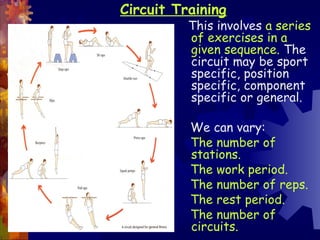
Circuit Training
          This involves a series
          of exercises in a
          given sequence. The
          circuit may be sport
          specific, position
          specific, component
          specific or general.

          We can vary:
          The number of
          stations.
          The work period.
          The number of reps.
          The rest period.
          The number of
          circuits.
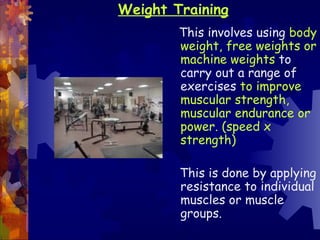
Weight Training
        This involves using body
        weight, free weights or
        machine weights to
        carry out a range of
        exercises to improve
        muscular strength,
        muscular endurance or
        power. (speed x
        strength)

        This is done by applying
        resistance to individual
        muscles or muscle
        groups.
3. Anatomy Of A Training
        Session
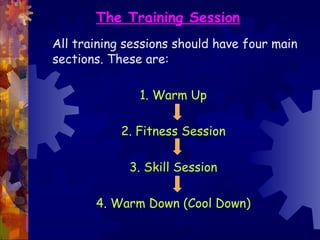
The Training Session
All training sessions should have four main
sections. These are:

               1. Warm Up

            2. Fitness Session

             3. Skill Session

       4. Warm Down (Cool Down)
1. Warm Up
The warm up should consist of:

1. A period of gentle cardio-vascular exercise
to raise body temperature and heart rate.

2. Dynamic stretching to prepare muscles and
joints for the demands of the activity.

Prior to a match or competition, the warm up
may also include skill drills to practice the
movement patterns and techniques of the
activity.

The warm up should prepare the body both
mentally and physically.
2. Fitness Session


The fitness carried out during this section will
depend on the sporting activity, the stage of
the season and the stage of the training week.


A hard fitness session may well follow the
skills session rather than precede it,
depending on the coach’s overall aims for the
training session.
3. Skill Session

This session may include individual, group, unit
or whole team skill drills.

New skills may be learned and developed in
unopposed or semi-opposed drills.

However, once skills have been learned,
coaches will try and make these drills as
competitive as possible so that they closely
relate to the actual sporting activity.
4. Warm Down (Cool Down)


This should involve a period of gentle cardio-
vascular activity and static stretching aimed
at reducing the recovery time from the
session by removing Carbon Dioxide, Lactic
Acid and other waste products from the
working muscles.

This session also allows heart rate to return to
normal gradually and so prevent blood pooling
in the working muscles which can again lead to
muscle stiffness and soreness.
Closed Season
                Out Of Season

  4. Planning The Training
    Year: Periodisation

 Pre-Season

                 Early Season

 Peak Season
Periodisation
Sportsmen and sports teams should plan their
training programs so that they ‘peak’ at the
times of major competitions or particularly
important matches. This process is called
Periodisation.

The training year should be divided into the
following phases:

              1. Closed Season.
              2. Out Of Season.
              3. Pre-Season.
              4. Early Season.
              5. Peak Season.
1. Closed Season
This phase of the training year is
characterised by:

1. A complete break from the sporting activity.

2. Recovery from or treatment for any injuries
from the previous season.

3. Recreation and relaxation through
participation in other sports or activities.
2. Out Of Season
This phase of the training year is
characterised by:

1. Heavy weight training to develop strength.

2. Low intensity continuous training to develop
an aerobic base.

3. Light skills training with non-competitive
game related activities.
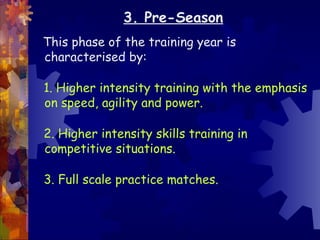
3. Pre-Season
This phase of the training year is
characterised by:

1. Higher intensity training with the emphasis
on speed, agility and power.

2. Higher intensity skills training in
competitive situations.

3. Full scale practice matches.
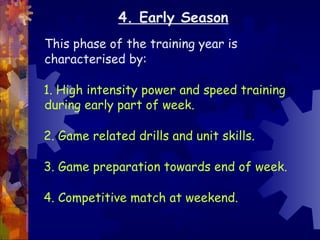
4. Early Season
This phase of the training year is
characterised by:

1. High intensity power and speed training
during early part of week.

2. Game related drills and unit skills.

3. Game preparation towards end of week.

4. Competitive match at weekend.
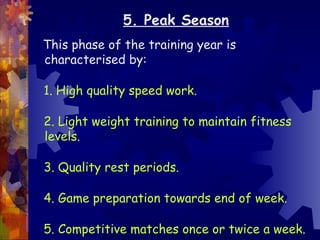
5. Peak Season
This phase of the training year is
characterised by:

1. High quality speed work.

2. Light weight training to maintain fitness
levels.

3. Quality rest periods.

4. Game preparation towards end of week.

5. Competitive matches once or twice a week.

5.1 principles of training

  • 1.
    1.The Principles OfTraining 2. Training Methods 3. Anatomy Of A Training Session 4. Planning The Training Year: Periodisation
  • 2.
    1. The PrinciplesOf Training To train effectively we must adopt the following : 1. Specificity 2. Progression 3. Overload 4. Reversibility 5. Tedium
  • 3.
    Specificity Our trainingmust be specific to the requirements of our chosen sport or sporting activity. Eg. A sprinter would concentrate on speed rather than cardio-vascular endurance. Can you think of two other examples of specificity?
  • 4.
    Progression As we increasethe amount of training we do we must increase the stress on our body. In this way our training will become progressively difficult. This progression should be gradual to prevent injury. We can ensure progression during aerobic sessions by checking our pulse rate and having knowledge of our training thresholds.
  • 5.
    Training Thresholds: GeneralGuidelines 1. Up To 60% MHR: The Recovery Zone. 2. 60% MHR: The Aerobic Threshold: below this, there is no training effect. 3. 60 – 80% MHR: The Aerobic Training Zone: improves aerobic fitness. 4. 80 – 90% MHR: Anaerobic Threshold Zone: training effect changes from aerobic to anaerobic. 5. 90 – 95% MHR: Anaerobic Training Zone: improves anaerobic fitness. 6. Over 95% MHR: Speed Training Zone: training nearly flat out.
  • 6.
    Overload To improve ourfitness we must overload, or stress, our body systems. This means making them work harder than normal. Our bodies will then adapt to this extra work and so we will become fitter. Overload can be implemented the FITT principles.
  • 7.
    The FITT Principles Wecan implement overload by adjusting the following elements of our training programs: Frequency: how often we train. Intensity: how hard our sessions are. Time: how long our sessions are. Type: what we include in our sessions.
  • 8.
    Reversibility As training increases fitness, so not training decreases fitness. This will happen in only three or four weeks. This is why fitness levels are lower following injury. Muscles will also atrophy (waste away) if they are not used.
  • 9.
    Tedium Tedium, or boredom,should be avoided in all training programs by using a range of training methods to maintain enthusiasm and interest. By varying training methods, we can also reduce the risk of overuse injuries. Choose a sporting activity and think of as many training methods that could be used as part of a training program for that activity.
  • 10.
  • 11.
    Training Methods There aremany different training methods that are based on an understanding of how our body adapts to training. Each training method is designed to improve a specific area of fitness. You should be familiar with the following training methods: 1. Continuous Training 2. Interval Training 3. Weight Training 4. Fartlek Training 5. Circuit Training
  • 12.
    Continuous Training This involves training without rest periods. Activities may include long distance running or jogging, swimming, cycling or rowing. Work should be done at 60 to 80% of MHR.
  • 13.
    Fartlek Training This involves training over distances far greater than competition distances. The pace of running is varied between jogging, walking, striding and sprinting. The way that these activities are put together will produce an aerobic or anaerobic effect. This training method is excellent for games players as it recreates the changing intensity levels of a match.
  • 14.
    Interval Training This involves alternating periods of work and rest. This training method can be used to develop aerobic or anaerobic fitness, depending on the demands of the session. We can vary: The distance of runs. The intensity of each run. The number of runs The length of recovery.
  • 15.
    Circuit Training This involves a series of exercises in a given sequence. The circuit may be sport specific, position specific, component specific or general. We can vary: The number of stations. The work period. The number of reps. The rest period. The number of circuits.
  • 16.
    Weight Training This involves using body weight, free weights or machine weights to carry out a range of exercises to improve muscular strength, muscular endurance or power. (speed x strength) This is done by applying resistance to individual muscles or muscle groups.
  • 17.
    3. Anatomy OfA Training Session
  • 18.
    The Training Session Alltraining sessions should have four main sections. These are: 1. Warm Up 2. Fitness Session 3. Skill Session 4. Warm Down (Cool Down)
  • 19.
    1. Warm Up Thewarm up should consist of: 1. A period of gentle cardio-vascular exercise to raise body temperature and heart rate. 2. Dynamic stretching to prepare muscles and joints for the demands of the activity. Prior to a match or competition, the warm up may also include skill drills to practice the movement patterns and techniques of the activity. The warm up should prepare the body both mentally and physically.
  • 20.
    2. Fitness Session Thefitness carried out during this section will depend on the sporting activity, the stage of the season and the stage of the training week. A hard fitness session may well follow the skills session rather than precede it, depending on the coach’s overall aims for the training session.
  • 21.
    3. Skill Session Thissession may include individual, group, unit or whole team skill drills. New skills may be learned and developed in unopposed or semi-opposed drills. However, once skills have been learned, coaches will try and make these drills as competitive as possible so that they closely relate to the actual sporting activity.
  • 22.
    4. Warm Down(Cool Down) This should involve a period of gentle cardio- vascular activity and static stretching aimed at reducing the recovery time from the session by removing Carbon Dioxide, Lactic Acid and other waste products from the working muscles. This session also allows heart rate to return to normal gradually and so prevent blood pooling in the working muscles which can again lead to muscle stiffness and soreness.
  • 23.
    Closed Season Out Of Season 4. Planning The Training Year: Periodisation Pre-Season Early Season Peak Season
  • 24.
    Periodisation Sportsmen and sportsteams should plan their training programs so that they ‘peak’ at the times of major competitions or particularly important matches. This process is called Periodisation. The training year should be divided into the following phases: 1. Closed Season. 2. Out Of Season. 3. Pre-Season. 4. Early Season. 5. Peak Season.
  • 25.
    1. Closed Season Thisphase of the training year is characterised by: 1. A complete break from the sporting activity. 2. Recovery from or treatment for any injuries from the previous season. 3. Recreation and relaxation through participation in other sports or activities.
  • 26.
    2. Out OfSeason This phase of the training year is characterised by: 1. Heavy weight training to develop strength. 2. Low intensity continuous training to develop an aerobic base. 3. Light skills training with non-competitive game related activities.
  • 27.
    3. Pre-Season This phaseof the training year is characterised by: 1. Higher intensity training with the emphasis on speed, agility and power. 2. Higher intensity skills training in competitive situations. 3. Full scale practice matches.
  • 28.
    4. Early Season Thisphase of the training year is characterised by: 1. High intensity power and speed training during early part of week. 2. Game related drills and unit skills. 3. Game preparation towards end of week. 4. Competitive match at weekend.
  • 29.
    5. Peak Season Thisphase of the training year is characterised by: 1. High quality speed work. 2. Light weight training to maintain fitness levels. 3. Quality rest periods. 4. Game preparation towards end of week. 5. Competitive matches once or twice a week.